
Key Takeaways
1. The Peloponnesian War: A Conflict of Fear, Not Inevitability
"The balance between war and peace was plainly delicate, but it would be a mistake to assume that the Athenians and the Spartans were by nature so mired in rivalry, so wedded to status, so skittish about the slenderest slight to honor that they were compelled to enter on the bloodbath that erupted in 431 and continued (with some interruption) for decades."
Escalating tensions. The Peloponnesian War, though often framed as an inevitable clash between rising Athenian power and fearful Sparta, was in fact the culmination of a series of avoidable diplomatic blunders and escalating provocations. The conflict was not predestined but rather the product of a "perfect storm" of coincidences, self-interest, and a pervasive sense of honor that often overshadowed pragmatic decision-making.
Key provocations. Several incidents ignited the conflict, demonstrating how minor disputes could spiral into widespread war.
- Epidamnus and Corcyra: A civil dispute in Epidamnus led to Corinthian intervention, drawing in Corcyra, which then sought an Athenian alliance.
- Potidaea: A Corinthian colony but an Athenian ally, Potidaea's rebellion against Athens, secretly backed by Sparta, further inflamed Corinthian resentment.
- Megarian Decree: Athens' unprecedented peacetime embargo against Megara, a Spartan ally, was a direct challenge that Sparta's allies could not ignore.
Spartan reluctance. Despite the provocations, Spartan King Archidamus initially opposed the war, foreseeing its protracted and destructive nature. He attempted to negotiate peace, even delaying his invasion of Attica. However, he was ultimately overruled by a war-eager assembly and allies like Corinth, who feared Athenian dominance and demanded action, highlighting the complex internal dynamics of the Peloponnesian League.
2. Athenian Democracy: Strength, Hubris, and Imperial Overreach
"Despite its democratic pretensions, Campbell lamented, Athens ultimately 'failed to grasp the most elemental principles about the free association of nations' and instead substituted the rule of force for the 'bond of principle.'"
Democratic evolution. Athens, having evolved into the most democratic state in Greece, showcased both remarkable strengths and fatal flaws during the war. Its democratic institutions, established by Solon and Cleisthenes, fostered civic participation and innovation, particularly in naval power. The assembly, though sometimes fickle, could mobilize immense resources and inspire fierce loyalty, as seen in the construction of its trireme fleet and the Long Walls.
Imperial ambition. The Delian League, initially formed for defense against Persia, gradually transformed into an Athenian Empire, fueled by tribute and enforced by naval might. This imperial expansion, while providing wealth and security, also bred hubris and a willingness to impose Athenian will on its "allies," often through brutal means. Pericles, while praising Athenian ideals in his Funeral Oration, also acknowledged the empire's tyrannical nature.
Internal contradictions. The Athenian democracy, despite its ideals of freedom and equality for citizens, exhibited a darker side in its treatment of subject cities and its internal politics. The rise of demagogues like Cleon, who advocated ruthless policies, and the assembly's susceptibility to emotional appeals, often led to brutal decisions, such as the Mytilenean debate and the Melian dialogue, where expediency trumped justice.
3. Spartan Power: Military Might Undermined by Inflexibility
"Spartans seemed to be constitutionally incapable of winning wars in any meaningful sense; as events of the subsequent decades were to show, it was their habit to win a war and then lose the peace."
Unique military culture. Sparta's unique social system, centered on lifelong military training and helot labor, produced the most formidable hoplite army in Greece. Their disciplined phalanx and unwavering courage were legendary, as demonstrated at Thermopylae. However, this focus on land power and internal stability made them inherently cautious about overseas ventures and naval warfare.
Diplomatic blunders. Despite their military prowess, Sparta's diplomatic strategy was often rigid and short-sighted. Their xenophobia and reluctance to engage with foreign cultures, coupled with a dependence on allies like Corinth, led to repeated missteps.
- They alienated potential allies by their arrogance (Pausanias).
- They failed to capitalize on opportunities (e.g., not aiding Samos, slow response to Pylos).
- Their "liberation of the Greeks" slogan was often contradicted by their actions, such as selling Ionian cities to Persia.
Internal vulnerabilities. The Spartan system, while strong, was also brittle. The declining number of Spartiates, coupled with the constant threat of helot revolt, made them deeply insecure. This insecurity often drove their foreign policy, leading them to make concessions or take actions that ultimately undermined their long-term stability, as seen in their fear of a helot uprising after Pylos and the Cinadon conspiracy.
4. The Sicilian Expedition: A Fateful Gamble Led by Flawed Generals
"Such was the end of an expedition thought up by an unprincipled young man who had never been tested on the battlefield and led by a sick old man afraid to fight because he might lose and never willing to give up hope that he might win the war by counting on a fifth column that never materialized."
Ambitious origins. The Sicilian Expedition, a massive undertaking to aid Athenian allies Egesta and Leontini against Syracuse, was driven by Alcibiades's grand ambitions for Athenian expansion, potentially encompassing Carthage and beyond. Despite Nicias's warnings about the risks and the ongoing war on the mainland, the Athenian assembly, swayed by promises of wealth and glory, voted for the costly venture.
Leadership failures. The expedition was plagued by flawed leadership from the outset.
- Alcibiades's recall: Accused of religious scandals, Alcibiades was recalled, only to defect to Sparta, depriving Athens of a daring, albeit reckless, commander.
- Nicias's caution: The remaining general, Nicias, was overly cautious, superstitious, and hesitant, often prioritizing his reputation over decisive action. His failure to request cavalry, his slow response to Peloponnesian reinforcements, and his ultimate refusal to retreat when advised by Demosthenes proved fatal.
- Lamachus's death: The third general, Lamachus, a capable but poor commander, died early in the campaign, leaving Nicias in sole command.
Catastrophic outcome. The expedition culminated in a devastating defeat for Athens. The Syracusans, aided by Spartan general Gylippus, outmaneuvered the Athenians on land and sea. The final retreat turned into a massacre, with thousands of Athenians and allies killed or enslaved. This disaster severely depleted Athens' manpower, treasury, and naval strength, marking a critical turning point in the Peloponnesian War.
5. War's Corrosive Impact: Plague, Moral Decay, and Civil Strife
"Never before had there been so many exiles and so much killing, some brought about by the war itself and some by civil strife."
The Athenian plague. The Peloponnesian War brought unprecedented suffering, most notably the devastating plague that struck Athens in 430 BC. Exacerbated by overcrowding due to Pericles' "island strategy," the epidemic killed a third of the population, including Pericles himself, and severely weakened Athens' military and morale. This unforeseen catastrophe profoundly altered the course of the war.
Moral decline. Thucydides vividly documented the moral decay that accompanied the prolonged conflict. The constant warfare eroded traditional values, leading to:
- Lawlessness: People disregarded divine and human laws, believing they would not live long enough to face consequences.
- Brutality: Acts like the Mytilenean massacre, the execution of Plataean prisoners, and the Melian dialogue demonstrated a growing ruthlessness.
- Civil strife: The Corcyraean civil war, characterized by indiscriminate killing and the breakdown of social order, became a chilling example of how war could turn citizens against each other.
Economic and demographic devastation. The war inflicted immense economic and demographic costs across Greece. Farms were ravaged, trade disrupted, and populations decimated. Athens, in particular, suffered massive losses of fighting men, both citizens and metics, and its treasury was drained. The long-term effects included widespread poverty, a generation gap, and a reliance on mercenaries, fundamentally altering Greek society.
6. The Rise and Fall of Demagogues and Strategists
"With Pericles gone, it was unclear what policies Athens would follow. Though the government was democratic, for decades one man had played a prominent role in shaping its policies. Now a multiplicity of ambitious men less talented than he would compete for power, and political life would be very different."
Pericles' legacy. Pericles' death in 429 BC left a leadership vacuum in Athens. His unique ability to guide the democracy and implement a coherent war strategy was unmatched. In his absence, a new generation of politicians, often less scrupulous and more focused on personal ambition, rose to prominence, leading to inconsistent policies and increased factionalism.
Demagogues and populists. Figures like Cleon, a tanner by trade, gained influence through populist rhetoric and aggressive policies. While Cleon achieved a notable victory at Sphacteria, his demagoguery and confrontational style, as satirized by Aristophanes, often led to rash decisions and further polarization within Athens. His death at Amphipolis, alongside Brasidas, marked the end of a significant phase of the war.
Strategic brilliance and personal ambition. The war also saw the emergence of brilliant but often self-serving strategists.
- Brasidas: A daring Spartan general, his innovative tactics and diplomatic skill in Thrace posed a serious threat to Athens, though he was often undervalued by his own state.
- Alcibiades: A charismatic but unprincipled Athenian aristocrat, his strategic insights were undeniable, but his personal scandals and repeated defections ultimately undermined his effectiveness and Athens' trust.
- Lysander: A cunning Spartan admiral, he cultivated crucial Persian support and masterminded the decisive victory at Aegospotami, but his ambition to reshape the Greek world in Sparta's image proved destabilizing.
7. The Fragility of Peace and the Cycle of Conflict
"The Peace of Nicias, though meant to endure for fifty years, lasted only seven—and during that period much blood was shed despite the presumed state of peace."
The Peace of Nicias (421 BC). This treaty, brokered by Nicias and driven by Spartan desire for their Pylos prisoners, aimed to end the Archidamian War. Its terms included mutual territorial returns and a fifty-year alliance between Athens and Sparta. However, it was inherently unstable, as key Spartan allies like Corinth, Megara, and Boeotia refused to sign, and Athens' imperial ambitions remained unchecked.
An "unpeaceable peace." The years following the Peace of Nicias were characterized by continued diplomatic maneuvering and proxy conflicts, rather than genuine peace.
- Argive Alliance: Alcibiades, resentful of Nicias, engineered a new alliance between Athens, Argos, Mantinea, and Elis, directly challenging Spartan hegemony in the Peloponnesus.
- Melian Massacre: Athens' brutal subjugation of neutral Melos, a Spartan colony, demonstrated its continued imperial ruthlessness and disregard for international norms, further eroding any pretense of peace.
- Sicilian Expedition: The launch of the massive Sicilian Expedition by Athens effectively broke the fragile peace, as Athens' attack on Syracuse, a Corinthian colony, drew Sparta back into direct conflict.
The King's Peace (387/6 BC). Even after the Peloponnesian War officially ended in 404 BC, the cycle of conflict continued with the Corinthian War. This "peace," dictated by the Persian King Artaxerxes II, ostensibly established autonomy for Greek cities but effectively ceded Ionian cities to Persia and installed Sparta as its enforcer. This humiliating arrangement highlighted the Greeks' inability to achieve lasting internal peace without external intervention.
8. The Tyranny of the Thirty: Athens' Darkest Hour
"Now Athens had come to resemble Sparta in a manner most Athenians found chilling."
Spartan imposition. Following Athens' surrender in 404 BC, Lysander, the victorious Spartan admiral, imposed a brutal oligarchic regime known as the Thirty Tyrants. This council, led by Critias, was backed by a Spartan garrison and aimed to dismantle Athenian democracy and establish a pro-Spartan government.
Reign of terror. The Thirty quickly established a reign of terror, executing political opponents and wealthy metics to confiscate their property and fund their mercenary forces. Their actions, including the murder of over 1,500 men, alienated many Athenians, even those with oligarchic sympathies like Theramenes, who eventually opposed Critias and was executed.
Democratic resistance. The brutality of the Thirty sparked widespread resistance. Athenian exiles, led by the staunch democrat Thrasybulus, found refuge and support in neighboring states like Thebes and Megara, who defied Spartan orders.
- Phyle fortress: Thrasybulus's forces gathered at Phyle, growing in strength.
- Piraeus seizure: They advanced on the Piraeus, seizing the strategic hill of Munychia.
- Critias's death: In the ensuing battle, Critias was killed, leading to the collapse of the Thirty's regime.
Restoration of democracy. Spartan King Pausanias, wary of Lysander's ambitions and the instability in Athens, intervened to broker a reconciliation. The Thirty were deposed, replaced by a more moderate Board of Ten, and eventually, the democracy was formally restored in 403 BC, accompanied by a general amnesty. This traumatic period served as a powerful lesson against civil strife for future Athenian generations.
9. Philosophical Responses to a World in Turmoil
"The bulk of the fourth century would be marked by bloody warfare on the one hand and far-reaching intellectual speculation on the other."
Presocratic foundations. Before Socrates, Greek philosophers (Presocratics) focused on the natural world, seeking scientific explanations for phenomena and challenging mythological narratives. Thinkers like Thales, Heracleitus, and Parmenides laid the groundwork for abstract thought, while Pythagoras introduced concepts of harmony and mathematics, influencing later philosophers like Plato.
The Sophists and moral relativism. The fifth century saw the rise of Sophists like Protagoras and Gorgias, who taught rhetoric and critical thinking for a fee. They questioned traditional values, explored the nature of knowledge and reality, and debated the concepts of nomos (custom/law) versus physis (nature). While often criticized for moral relativism, they filled a crucial gap in Greek education, teaching skills vital for public life in litigious democracies.
Socrates and Plato's quest for virtue. Socrates, a contemporary of the Sophists, rejected their fee-taking and moral relativism, focusing instead on defining virtue, justice, and the good life through dialectic. His execution in 399 BC, on charges of impiety and corrupting the youth, profoundly impacted his pupil Plato. Plato, disillusioned with Athenian democracy and the political turmoil of his time, sought to define the ideal state in works like the Republic and the Laws, emphasizing:
- Philosopher-kings: Rule by wise, educated elites.
- Forms: The existence of perfect, unchanging concepts beyond sensory experience.
- Mathematics: As the cornerstone of intellectual training.
Aristotle's empirical approach. Plato's student Aristotle, while influenced by his teacher, developed a more empirical approach. His Politics analyzed 158 Greek constitutions, defining man as a "political animal" whose nature is to live in a state. His Lyceum fostered diverse intellectual inquiry, contributing significantly to Western philosophy and political theory amidst ongoing Greek warfare.
10. Sparta's Self-Destructive Hegemony and the Rise of Thebes
"The Spartans had been fortunate to come out of the Peloponnesian War as well as they did, given that both sides were evenly matched and they had delayed in building a navy. Though they had captured the Athenians’ fleet in 405 and destroyed their empire, the escape of Conon left them vulnerable to a future attack at sea in the east, and a shortsighted foreign policy fixated on settling petty grudges led to a new war within less than a decade."
Post-war overreach. After their victory at Aegospotami, Sparta's newfound hegemony was marked by aggressive and meddlesome foreign policy, alienating former allies and sowing the seeds of future conflicts. Lysander's imposition of decarchies and the Thirty Tyrants, coupled with Spartan interference in other city-states, bred resentment.
Internal decay. Sparta's unique social structure, already facing declining Spartiate numbers, was further destabilized by the influx of wealth from war booty and tribute. The Cinadon conspiracy revealed deep-seated discontent among the "inferiors" and helots, highlighting the fragility of their system. The death of King Agis II and Lysander's manipulation to place Agesilaus II on the throne further exposed internal divisions.
The Corinthian War (395-386 BC). Spartan aggression, particularly Agesilaus's campaigns in Asia and his meddling in Theban politics, provoked a coalition of former allies (Corinth, Thebes) and old enemies (Athens, Argos).
- Lysander's death: Lysander's premature death at Haliartus, due to his impatience, was a significant blow to Spartan leadership.
- Conon's resurgence: The Athenian admiral Conon, with Persian backing, rebuilt Athens' fleet and defeated Sparta at Cnidus, effectively ending Spartan naval dominance.
- King's Peace: The war concluded with the humiliating King's Peace, dictated by Persia, which, while making Sparta its enforcer, underscored Greek disunity and Persian influence.
Theban ascendancy. Sparta's continued heavy-handed enforcement of the King's Peace, particularly against Thebes, led to a decisive shift in power. The Thebans, under brilliant generals like Epaminondas and Pelopidas, developed innovative military tactics, culminating in the Battle of Leuctra in 371 BC. This battle, where a smaller Theban force decisively defeated the Spartan army and killed King Cleombrotus, shattered the myth of Spartan invincibility and marked the end of their hegemony.
11. War Without Victory: The Enduring Legacy of Greek Disunity
"Only then did the Peloponnesian War really end, but there were no winners, only losers."
A cycle of destruction. The Peloponnesian War and its subsequent conflicts, including the Corinthian War and the Theban hegemony, demonstrated a tragic cycle of Greek disunity and self-destruction. Despite periods of temporary peace, the underlying rivalries, fears, and ambitions of the city-states prevented any lasting stability or genuine panhellenic cooperation.
No true victor. While Sparta emerged victorious in 404 BC, its triumph was short-lived and ultimately self-defeating. Athens, despite its devastating losses, showed remarkable resilience, rebuilding its fleet and democracy. Thebes, after its brief period of dominance, also failed to establish a lasting hegemony. The constant warfare left all major powers exhausted and weakened, unable to recover fully.
Macedonian shadow. The ultimate consequence of this prolonged internal strife was the vulnerability of the Greek city-states to external powers. The King's Peace, dictated by Persia, foreshadowed a future where Greek affairs would be controlled by non-Greek entities. The rise of Philip II of Macedon, who had observed Greek military and political strategies firsthand, marked the final end of independent Greek city-state freedom, as he unified them not through persuasion, but through conquest. The Peloponnesian War, therefore, was a war without a true victor, leaving a legacy of lessons about the perils of unchecked ambition and disunity.
Review Summary
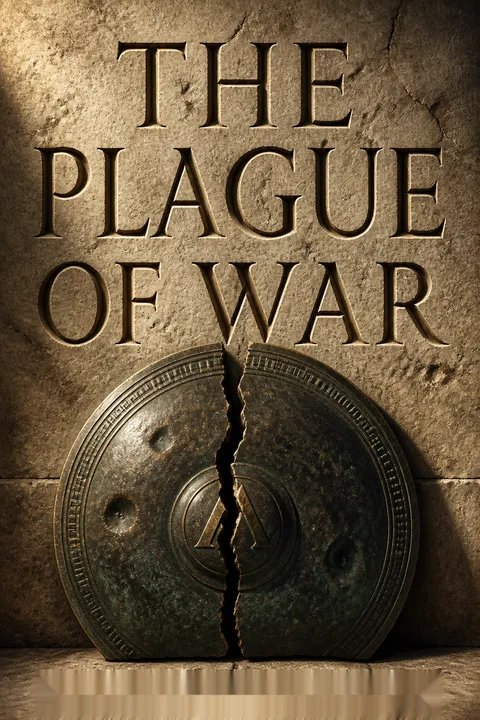
The Plague of War receives generally positive reviews (3.94/5) for its accessible, well-researched account of the Peloponnesian War. Readers praise Roberts' balanced treatment of Athens and Sparta, clear writing, and incorporation of social, cultural, and philosophical contexts alongside military history. The book extends beyond Thucydides' account to cover the war's aftermath. Common criticisms include: digressions that disrupt narrative flow, insufficient maps, casual writing tone, and excessive detail causing confusion. Several reviewers note it's more suitable for readers with some background knowledge. Most appreciate Roberts' anti-war perspective and thorough citations, though some found it dry or textbook-like.
People Also Read




Download PDF
Download EPUB
.epub digital book format is ideal for reading ebooks on phones, tablets, and e-readers.








































