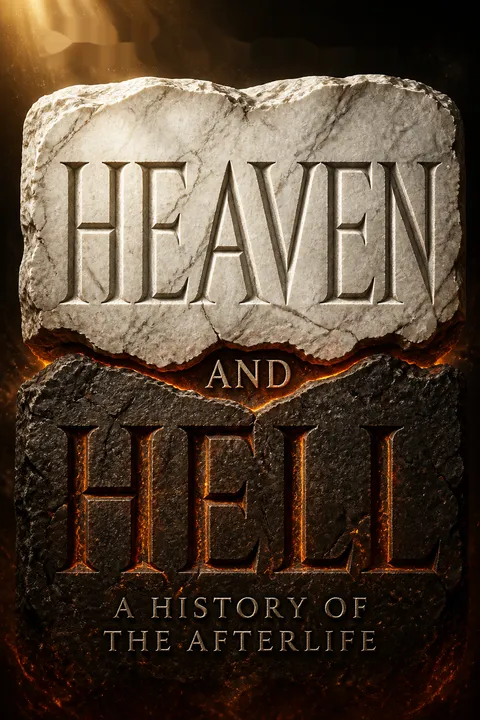

Key Takeaways
1. Afterlife beliefs are human inventions, evolving across cultures and time.
I’m saying that the ideas of heaven and hell were invented and have been altered over the years.
Human constructs. The author's core thesis is that concepts of heaven and hell are not static, divinely revealed truths but rather human ideas that have been conceived, developed, and transformed over millennia. These ideas emerged as people grappled with fundamental questions about justice, suffering, and the meaning of life and death. The book traces this evolution, showing how different cultures and religious traditions shaped these profound beliefs.
Dynamic interpretations. From ancient Mesopotamian epics to early Christian texts, the understanding of what happens after death has been remarkably diverse and often contradictory. This historical fluidity demonstrates that these are not fixed doctrines but rather evolving interpretations, reflecting the changing social, ethical, and philosophical concerns of each era. The author emphasizes that recognizing this historical development does not invalidate the ideas but contextualizes them as human attempts to comprehend the unknown.
Motivating behavior. Early Christian "guided tours" of the afterlife, like the Apocalypse of Peter, vividly illustrate how these evolving ideas served a didactic purpose. Graphic descriptions of eternal torment and blissful rewards were crafted not as objective reports but as powerful tools to influence behavior in the present, encouraging adherence to religious commitments and moral conduct. These narratives aimed to "scare people out of hell" and into a life of virtue.
2. Early Western cultures viewed death as a bleak, undifferentiated end for all.
To the house which those who enter cannot leave, On the road where travelling is one way only, To the house where those who stay are deprived of light, Where dust is their food, and clay their bread.
Universal dread. The earliest recorded Western literary traditions, such as the Mesopotamian Epic of Gilgamesh and Homer's Iliad and Odyssey, depict death as an inescapable and universally bleak fate. For Gilgamesh, the terror of death is the fear of becoming like his friend Enkidu, a "senseless, burnt-out wraith" destined to eat dust and dwell in darkness forever. This is not a place of punishment, but simply a diminished, joyless existence for everyone.
Homeric Hades. In Homer's epics, the underworld, Hades, is a shadowy realm where the psychē (life breath or soul) exists as a mere "image" or "shade" (eidōlon) of the person.
- Shades retain the form but not the substance of life.
- They experience no physical torment or pleasure.
- They are joyless, bodiless, and lack knowledge of the living world.
- Achilles famously states he'd rather be the lowest slave on Earth than rule over the breathless dead.
Exceptions were rare, reserved for those with divine connections, like Heracles or Menelaus.
Importance of burial. A fate worse than Hades was to be denied entry altogether, as seen with Elpenor in the Odyssey. Proper burial rites were crucial for the deceased to find rest, highlighting a profound ancient concern for the transition from life to death. This early understanding of the afterlife was characterized by its finality and the absence of differentiated rewards or punishments based on earthly deeds.
3. Plato and Virgil introduced postmortem justice: rewards for the virtuous, punishments for the wicked.
If what is immortal is also imperishable, it is impossible that at the approach of death soul should cease to be.
Socrates's perspective. The Greek philosopher Socrates, as portrayed by Plato, offered an alternative to the fear of death, suggesting it was either a deep, dreamless sleep or a migration of the soul to another realm. He argued that fearing death was a form of ignorance, as it might be the greatest blessing. For Socrates, the soul was the true self, destined to survive the body.
Platonic dualism. Plato championed a dualistic anthropology, where the immortal soul was distinct from the mortal body. He believed that virtuous living, focused on the soul's well-being, would lead to a happy postmortem fate, while wickedness would result in misery.
- Plato's "Myth of Er" (Republic) describes souls being judged and sent to either heavenly rewards or underworld punishments for a thousand years, before reincarnation.
- This myth, though not literally believed by Plato, conveyed the truth that virtue leads to reward and vice to suffering.
Virgil's Aeneid. Centuries later, Virgil's Aeneid, influenced by Platonic thought, vividly depicted a differentiated underworld. Aeneas's journey to Hades reveals:
- A "left-hand path" to Tartarus for the wicked, filled with groans, lashes, and chains.
- A "land of joy," Elysium, for the blessed, with radiant fields and eternal ease.
Most souls, after suffering for their sins, were destined for reincarnation, a second chance at life. This marked a significant shift from Homer's undifferentiated Hades, introducing the concept of postmortem justice.
4. The Hebrew Bible initially presented death as finality, with Sheol as the grave, not heaven or hell.
For in death there is no remembrance of you; / in Sheol who can give you praise?
Death as cessation. For most of the Hebrew Bible, death is the cessation of life, with no inherent immortality for the soul. The Hebrew nephesh (life force/breath) is not a separate, immortal entity but what animates the body. When breath leaves, the person returns to dust.
- "We are like water spilled on the ground, which cannot be gathered up" (2 Samuel 14:14).
- "Mortals lie down and do not rise again; until the heavens are no more, they will not awake or be roused from their sleep" (Job 14:11–12).
Sheol as the grave. The term "Sheol," appearing over sixty times, is often synonymous with "pit" or "grave." It is a realm of:
- Forgetfulness and silence.
- Darkness and separation from God's presence.
- No praise or remembrance of God.
It is not a place of eternal punishment or reward, but a bleak state of virtual nonexistence, to be avoided as long as possible.
National "afterlife." The primary focus on "afterlife" in the Hebrew prophets was the restoration of the nation of Israel after destruction, not individual postmortem fate. Prophetic texts like Isaiah 26:19 and Ezekiel 37 (the "valley of dry bones") use resurrection as a metaphor for national renewal, not individual bodily resurrection. However, hints of an ongoing existence for the dead appear in prohibitions against necromancy and the story of Saul consulting Samuel's spirit.
5. Jewish apocalypticism introduced bodily resurrection for justice, but often as annihilation for the wicked.
Many of those who sleep in the dust of the earth shall awake, some to everlasting life, and some to shame and contempt.
Theodicy's challenge. The problem of suffering—why the righteous suffer and the wicked prosper—led some Jewish thinkers, around two centuries before Jesus, to develop apocalypticism. This view posited cosmic enemies (like the devil) causing earthly evil, but predicted God's imminent intervention to judge the world. This judgment would include a bodily resurrection of the dead.
First individual resurrection. The book of Daniel (circa 167 BCE) is the first canonical text to explicitly mention individual resurrection.
- "Many of those who sleep in the dust of the earth shall awake, some to everlasting life, and some to shame and contempt" (Daniel 12:2).
- The righteous would shine like stars, implying an angelic, glorified existence.
- The wicked would face "shame and contempt," suggesting annihilation rather than eternal torture.
Annihilation for sinners. Other early Jewish texts, like the Psalms of Solomon, also speak of the "destruction" of sinners, where "no memory of them will ever be found." The choice was between eternal life and complete extinction, not eternal torment. This doctrine provided a powerful answer to the problem of injustice, ensuring that ultimate accountability would come, even if it meant the permanent erasure of the wicked.
6. Jesus taught an imminent, earthly Kingdom of God, with annihilation for the wicked in Gehenna.
Truly I tell you, this generation will not pass away before all these things take place.
Apocalyptic core. The historical Jesus, like many Jews of his time, was an apocalyptic prophet who believed God's Kingdom would arrive imminently, within his generation, to overthrow evil and establish a utopian world on Earth. His core message was repentance in preparation for this coming kingdom. He did not teach that souls went to heaven or hell immediately after death.
Annihilation, not torment. Jesus's teachings on the fate of the wicked consistently point to annihilation, not eternal torture.
- The "broad path" leads to "destruction" (Matthew 7:13-14).
- Bad trees are "cut down and thrown into the fire" (Matthew 3:10), consumed out of existence.
- Sinners are cast into a "furnace of fire" (Matthew 13:42), where they die, not burn forever.
Gehenna's meaning. Jesus's references to "Gehenna" (often mistranslated as "hell") referred to a desecrated valley outside Jerusalem, infamous for child sacrifices and later as a place of utter desolation and slaughter. It symbolized permanent destruction and abandonment by God, where bodies would be consumed by worms and fire, never to return. "Fear the one who can annihilate both the soul and body in Gehenna" (Matthew 10:28) implies complete extermination, not endless suffering.
7. Paul evolved afterlife views, introducing an interim state with Christ and a transformed, spiritual body at resurrection.
My desire is to die and be with Christ, for that is much better.
Paul's apocalypticism. The Apostle Paul, a fervent Jewish apocalypticist, believed in the imminent return of Christ and a bodily resurrection for believers. He taught that salvation came through faith in Jesus's death and resurrection, not merely good deeds. Baptism symbolized dying with Christ to sin and being raised to new life.
Transformed bodies. Paul addressed concerns about the nature of the resurrected body in 1 Corinthians 15, arguing that it would be a "spiritual body" (pneumatikos sōma), utterly transformed and immortal, not a mere revivification of "flesh and blood" (sarx kai haima).
- "It is sown in weakness but raised in power; it is sown a natural body, it is raised a spiritual body" (1 Corinthians 15:44).
- This glorified body would be impervious to decay, illness, or death, like Christ's own resurrected body.
Interim state. As the expected return of Jesus was delayed, Paul's views evolved to include an interim state for deceased believers. In Philippians 1:23, he expresses a desire "to die and be with Christ, for that is much better," indicating an immediate, blessed existence in Christ's presence before the final resurrection. For the wicked, Paul, like Jesus, anticipated "sudden destruction" and annihilation, not eternal torment.
8. Later Gospels de-apocalypticized Jesus's message, introducing immediate postmortem fates and eternal torment.
Truly I tell you, today you will be with me in paradise.
Shifting timelines. As Jesus's predicted imminent return failed to materialize, later Gospel writers began to reinterpret his teachings, shifting the focus from a future earthly kingdom to immediate postmortem rewards and punishments. This de-apocalypticization transformed Jesus's message from a "horizontal" dualism (this age vs. age to come) to a "vertical" dualism (earth vs. heaven).
Luke's innovations. Luke's Gospel, written decades after Jesus, introduces the idea of immediate postmortem entry into paradise.
- On the cross, Jesus tells the repentant criminal, "today you will be with me in paradise" (Luke 23:43).
- The story of Lazarus and the Rich Man (Luke 16:19-31) is the first biblical text to explicitly depict immediate, conscious torment in Hades for the wicked and blissful rest in "Abraham's bosom" for the righteous. This parable, though illustrative, laid the groundwork for literal interpretations of heaven and hell.
John's "eternal life now." The Gospel of John, the latest canonical Gospel, further de-apocalypticizes Jesus's message, emphasizing that eternal life is a present reality for believers.
- "The one who hears my word and believes in the one who sent me has eternal life and does not come into judgment, but has passed from death to life" (John 5:24).
- Jesus declares, "I am the resurrection and the life. The one who believes in me, will live, even if he dies; and everyone who lives and believes in me will never die" (John 11:25–26).
This radical shift meant salvation was not a future event but an immediate spiritual experience, though it did not become the dominant Christian view.
9. Revelation uses symbolic language for annihilation (lake of fire) and utopian eternal life (New Jerusalem).
This calls for wisdom: let anyone with understanding calculate the number of the Beast, for it is the number of a person. Its number is six hundred sixty-six.
Symbolic apocalypse. The Book of Revelation, a classic apocalypse, uses highly symbolic language to describe God's ultimate triumph over evil, not a literal chronological prediction of future events. Its author, John, uses cryptic imagery to refer to his contemporary context, particularly the Roman Empire.
- The "Whore of Babylon" and the "Beast with seven heads" symbolize Rome, the city built on seven hills, and its persecuting emperors.
- The number 666 (or 616 in some manuscripts) is a gematria for "Caesar Nero," the emperor notorious for persecuting Christians.
Annihilation, not eternal torment. The "lake of fire that burns with sulfur" is a central image for the fate of the wicked. However, like Jesus and Paul, Revelation depicts this as ultimate annihilation, not eternal conscious torment for humans.
- The Beast and false prophet are thrown in, then Satan, where they are "tormented day and night forever and ever" (Revelation 20:10), but no humans are explicitly said to suffer this fate.
- Death and Hades themselves are thrown into the lake, which is called "the second death" (Revelation 20:14), signifying the permanent destruction of all that opposes God, including all dead humans not in the book of life.
New Jerusalem. The book concludes with a vision of the "New Jerusalem" descending to Earth, a symbolic utopian city of gold and pearls, where God dwells with the saints. This is an eternal place of joy, free from death, mourning, weeping, or pain, representing the ultimate, glorious destiny for the faithful.
10. Early Christians debated spiritual versus bodily resurrection, eventually affirming "resurrection of the flesh."
For what sort of human soul would have any further desire for a body that has rotted?
Pagan ridicule. The Christian doctrine of bodily resurrection faced considerable ridicule from pagan intellectuals like Celsus, who found the idea of a resurrected, decaying body grotesque. He argued that "corpses ought to be thrown away as worse than dung" and that God would not make "flesh, which is full of things it is not even nice to mention," everlasting.
Christian defenses. Early Christian apologists, like Justin Martyr and Athenagoras, defended the bodily resurrection, arguing that God, who creates bodies, can certainly restore them. They addressed complex objections, such as the "cannibal dilemma" (whose body parts belong to whom if one person eats another), with elaborate theological reasoning. Augustine later refined these arguments, asserting that resurrected bodies would be perfect, in their prime, and free from deformities.
"Flesh" vs. "body." A key debate arose within Christianity regarding the nature of the resurrected body. Paul distinguished between the "body" (sōma), which would be raised and transformed, and "flesh" (sarx), which he saw as the sinful part of humanity that would not inherit the Kingdom.
- Some "Gnostic" Christians, like the author of the Letter to Rheginus, argued for a purely "spiritual" resurrection, where the body is discarded.
- Orthodox Christians, however, insisted on the "resurrection of the flesh," believing the actual physical body would be raised, often misinterpreting Paul's nuanced distinction. This view became dominant, emphasizing God's redemption of the entire creation, including the physical body.
11. The concepts of Purgatory and universal salvation (apocatastasis) emerged to address divine justice and mercy.
This I do not contradict, because possibly it’s true.
Need for a middle ground. The stark binary of eternal heaven or hell raised questions about divine justice for those who were neither perfectly saintly nor utterly wicked. This led to the development of the idea that some souls, destined for salvation, might first undergo postmortem suffering to atone for or be purged of their sins. This concept, though not fully formalized as "Purgatory" until the Middle Ages, has early roots.
Early purgatorial ideas.
- The Apocalypse of Peter suggests that saints' prayers could release some from torment.
- Perpetua's dream of her brother Dinocrates, suffering in a hot, thirsty place before being relieved by her prayers, illustrates temporary postmortem suffering.
- Tertullian interpreted Jesus's "pay the last penny" (Matthew 5:26) as a temporary prison in Hades for believers to pay off minor sins before resurrection.
Augustine, while hesitant, conceded the possibility of "purgatorial punishments" for some after death, distinct from eternal damnation.
Universal salvation (Apocatastasis). A more radical idea, championed by Origen of Alexandria, was the "restoration of all things" (apocatastasis). Origen believed that because God is ultimately sovereign and good, all sentient beings—including the most wicked humans, demons, and even the devil—would eventually, after "infinite and immeasurable ages" of purgative suffering, freely return to God and be saved. This view, though controversial and later condemned, found echoes in thinkers like Gregory of Nyssa and in texts like the Gospel of Nicodemus, which depicts Jesus "harrowing hell" and emptying Hades of all its inhabitants.
12. The author concludes that traditional heaven and hell are irrational, preferring nonexistence as a motivation to live fully.
Is it truly rational to think, as in the age-old Christian doctrine, that there is a divine being who created this world, loves all who are in it, and wants the very best for them, yet who has designed reality in such a way that if people make mistakes in life or do not believe the right things, they will die and be subjected to indescribable torments, not for the length of the time they committed their “offenses,” but for trillions of years—and that only as the beginning?
Questioning rationality. The author, Bart Ehrman, reflects on his personal journey from fundamentalist belief to skepticism, concluding that the traditional Christian doctrine of eternal conscious torment in hell is irrational and morally indefensible. He argues that such a concept contradicts the idea of a benevolent, loving God, portraying a "transcendent sadist" infinitely more vengeful than any human monster.
Embracing nonexistence. While acknowledging the human instinctual fear of death and the hope for a glorious afterlife, Ehrman finds the idea of nonexistence more plausible and less terrifying.
- He draws on Epicurus and Lucretius, who argued that since we did not exist for billions of years before birth without distress, we should not fear not existing after death.
- He likens death to a "deep, dreamless sleep" or a general anesthetic, a cessation of consciousness without anxiety or disturbance.
Motivation for life. This perspective, rather than leading to despair, serves as a powerful motivation to fully embrace and appreciate the present life. If this life is all there is, then the imperative is to live it to its utmost, enjoying its pleasures, pursuing meaningful endeavors, and, crucially, helping others to do the same. The author suggests that our legacy lives on not in a personal consciousness, but in the lives we have touched.
Review Summary
Heaven and Hell: A History of the Afterlife by Bart D. Ehrman explores how Christian concepts of the afterlife evolved from ancient Greek, Jewish, and early Christian sources. Readers appreciated Ehrman's scholarly yet accessible approach and his non-judgmental treatment of religious beliefs. The book traces how Jesus's apocalyptic teachings about bodily resurrection differed from later Christian beliefs about immortal souls ascending to heaven or hell—concepts borrowed from Plato. Many found the historical context enlightening, particularly regarding biblical contradictions and the influence of early Church Fathers. Some critics noted the book focuses exclusively on Western traditions and can be repetitive.
People Also Read



About the Author
Other books by Bart D. Ehrman
Download PDF
Download EPUB
.epub digital book format is ideal for reading ebooks on phones, tablets, and e-readers.








































