

Key Takeaways
Existentialism dead-ended because it mistook despair for the deepest truth
The old existentialism reached a cul de sac. Wilson argues that the philosophy of Kierkegaard, Heidegger, Sartre, and Camus stalled because all of it breathes the same air of gloom: nausea, absurdity, anguish, and the conviction that human existence is accidental and meaningless. For over twenty-five years no thinker had advanced past their standard texts. Camus admitted his impasse before dying; Heidegger went static; Sartre tried to escape into Marxism and failed.
The atmosphere was the giveaway. Wilson noticed that these philosophers treated pessimism as a hard fact rather than a personal temperament. His whole project is to build a new existentialism that keeps the serious questions about freedom and meaning but rejects the assumption that the honest answer must be bleak.
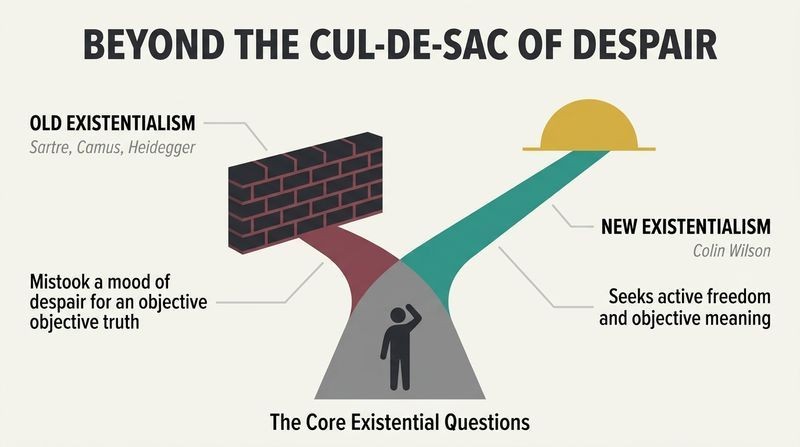
What's striking is Wilson's diagnostic move: he treats a philosophy's mood as evidence about its author rather than about reality. This anticipates later work in the psychology of ideology, where thinkers like Jonathan Haidt argue that reasoning often rationalizes a prior emotional stance. The claim is bold and contestable. A Sartrean would reply that facing absurdity squarely is courage, not neurosis, and that optimism can itself be a flinch. Wilson's counter, developed across the book, is empirical: if healthy minds routinely report meaning, then despair is not the baseline but a special case worth explaining.
Study healthy minds, not just sick ones, and meaning reappears
Maslow flipped psychology's lens. Where Freud built a science on neurosis and illness, the psychologist Abraham Maslow studied the most cheerful, well-adjusted people he could find. He discovered that such people regularly have what he called peak experiences: sudden floods of affirmation and certainty. A young mother watching her family eat breakfast, a hostess alone after a good party, both reported them.
Nobody had noticed because of a blind spot. A sick man talks endlessly about his illness; a healthy man never mentions his health. So psychology, listening only to the sick, concluded that anguish is fundamental. Maslow showed peak experiences are common, not abnormal. This matters because Sartre's contingency (man's sense of being an unnecessary accident) is exactly what a peak experience denies.
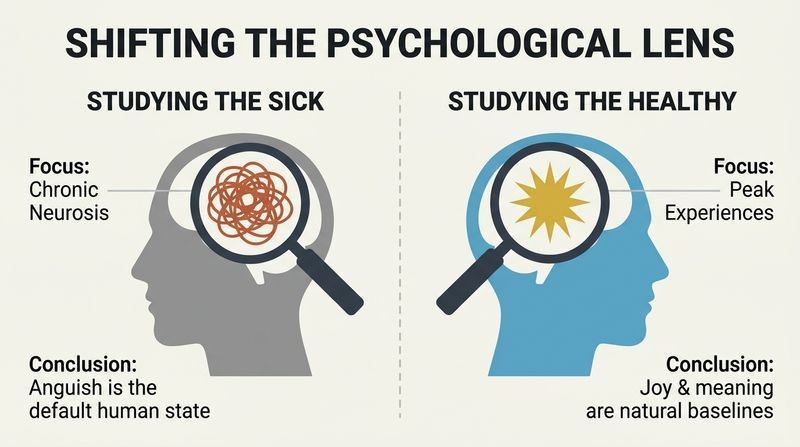
Maslow's reframing seeded humanistic and later positive psychology, revived by Martin Seligman in the 1990s. The critique of a deficit-only science remains potent: if you only sample the broken, you model humanity as broken. Yet Wilson leans hard on introspective self-reports, which modern researchers treat cautiously given memory bias and demand characteristics. Still, the structural point survives independent of methodology. Sampling matters. A science that never asks what flourishing looks like will quietly encode the assumption that flourishing does not exist, then present that assumption as a finding.
Your consciousness aims like a rifle; it never merely mirrors
Husserl caught the detective being the murderer. For two centuries philosophy assumed consciousness was a passive mirror reflecting the world, so it studied the world and ignored the mirror. Husserl's phenomenology (the study of the structure of consciousness) pointed out the mirror itself is a variable. Consciousness is intentional: you do not merely see, you fire attention at a target. Look at a thing without directing attention and you see nothing.
Ordinary examples prove it. In the Muller-Lyer illusion two identical lines look different lengths, and keep looking different even after you measure them, so the eye itself distorts. Falling in love, acquiring a taste, making yourself itch, getting drunk on two beers: all show perception is an act you perform, not an event that happens to you.
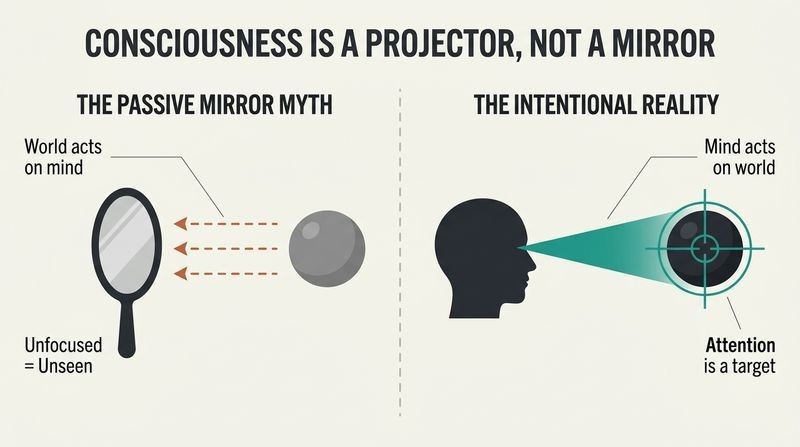
Intentionality is Husserl's genuine hinge, and Wilson translates it with unusual clarity for a lay reader. Modern cognitive science broadly vindicates him: perception is now understood as predictive, the brain generating hypotheses that sensory data merely correct, as Andy Clark and Karl Friston describe. The Muller-Lyer persists precisely because it is baked into perceptual inference. Where Wilson pushes further than mainstream science is the moral leap: if perception is active, it can be trained and expanded. That inference is suggestive rather than proven, but it reframes self-improvement as a perceptual discipline, not just a behavioral one.
You can change your perception, not only your circumstances
The passive fallacy is humanity's evolutionary bottleneck. Wilson names the belief that perception is fixed and given the passive fallacy. Animals adapt to their environment and stop there. Man became an evolutionary force by discovering he could change the world instead of accepting it. But he has not yet made the parallel discovery about his own consciousness, still assuming that reality looks the way it looks and cannot be altered.
Transactionist experiments make it concrete. In the distorted room, a trapezoidal chamber rigged to look square, a man and boy swap apparent sizes as they cross it. Yet in the Honi phenomenon, a wife watching her respected husband saw no distortion at all, because her emotional attitude corrected the illusion. Perception, Hadley Cantril concluded, is only a best bet, shaped by unconscious assumptions.
The Honi phenomenon is the jewel here. It suggests that love, respect, and expectation literally reshape what the eyes report, a finding echoed by research on top-down modulation of vision and by placebo studies where belief alters measurable physiology. Wilson's provocative extension is that Van Gogh's blazing cypresses might be truer to reality than our dull everyday seeing, because his perception was more intensely intentional. That inverts the usual assumption that ecstatic vision is distortion and grey routine is accuracy. It is philosophically slippery, since truer needs a standard, but it productively unsettles the reflex of calling the mundane real.
Everyday consciousness is a liar about your own smallness
Contingency is not a fact but a mood. The old existentialism rests on man's contingency, the feeling that he is accidental, unnecessary, insignificant in an empty universe. Wilson's rebuttal: you cannot appeal to contingency until you understand intentionality, because the self that feels contingent is the false self built on passive perception. Freud's man who forgets his umbrella looks like a victim of accident, but the forgetting was intentional, so he is not a victim at all.
Insights of value keep breaking through. Koestler in a Spanish prison, facing execution, scratched a mathematical proof on the wall and was flooded with peace, shrugging off death as trivial. Proust tasting cake dipped in tea felt he had ceased to be mediocre, accidental, mortal. These are not delusions but glimpses that the everyday sense of worthlessness is the real error.
This is Wilson's most radical epistemological claim: that pessimistic self-assessment is systematically unreliable, not neutrally accurate. It resonates with cognitive therapy, where Aaron Beck showed depressive cognition distorts toward the negative in measurable, correctable ways. The danger is symmetry. If depressive vision is a liar, why is the ecstatic vision truthful rather than equally biased upward? Wilson answers that peak states widen the field of facts while depression narrows it, so breadth becomes his tiebreaker. That is a defensible criterion, but it quietly assumes more information yields truer values, which the history of philosophy, ten pessimists per optimist, complicates.
Boredom, not pain, is the trap: pleasure stops reaching you
The indifference threshold explains modern despair. Wilson coins the indifference threshold (also his private label, the St Neot Margin) for the state in which pain and inconvenience can still stir you but pleasure cannot get through. Concentrate hard amid distractions and the excluding habit jams, leaving you numb to delight while still irritable at annoyance. This is why the man with everything can be suicidal while the prisoner clings to life.
The vinegar bottle old woman shows the mechanism. A fairy upgrades her home from bottle to cottage to palace, and she complains at every stage. Meanwhile a peasant crammed with livestock, then relieved of it, finds his hut palatial. Sartre felt freest under wartime danger. Security breeds boredom, boredom drains vitality, and comfort quietly suffocates the very freedom it was meant to protect.
Wilson isolates a paradox that behavioral economics later formalized as hedonic adaptation: humans normalize gains and keep resetting the baseline. His twist is darker and more useful than the usual treadmill metaphor. He claims the adaptation is not passive but an intentional excluding habit gone rigid, meaning it could in principle be un-jammed by deliberate discipline. This connects to research on savoring and to the clinical observation that anhedonia, the inability to feel pleasure, is a hallmark of depression rather than a natural human floor. The prescription implied is counterintuitive: sometimes you need friction, not more comfort, to feel alive.
Man is an amphibian; the fully human creature doesn't exist yet
We are stranded between two elements. Borrowing from H. G. Wells, Wilson calls modern man an amphibian, like an early sea creature struggling onto land with only fins. We crave the country of the mind, sustained thought and inner freedom, but the burden exhausts us and we slump back into everyday triviality, the sea. Sartre's cafe proprietor, whose head empties when the cafe empties, is still a pure sea creature dependent on external stimuli.
Therefore man does not yet exist. Wilson means this literally. An animal is energy without freedom; man has a further dimension of inner freedom but cannot yet stay in it, as the dark room experiments prove our dependence on outside stimulation. The truly human, what Nietzsche called superhuman, is a stage still ahead, and man is a purposive animal built to reach for it.
The evolutionary framing links Wilson to Teilhard de Chardin's noosphere and to Julian Huxley's transhumanism, all writing in the same mid-century current. The strength is refusing to treat present human nature as final; the risk is teleology, assuming evolution has a direction toward higher consciousness, which Darwinian theory explicitly denies. Wilson sidesteps biology by locating the next step in culture and discipline rather than genes, which is more defensible. The phrase man does not yet exist is a rhetorical grenade, but it captures something real: the gap between our peak capacities and our habitual functioning is vast and mostly unexplored.
The hunger to know is a primary drive, not a survival tool
Curiosity is an appetite in its own right. Maslow noticed his monkeys solved boring puzzles for no reward, sometimes throwing away the food they earned. A depressed college girl in a chewing-gum job recovered her health and her menstrual cycle simply by resuming study. The need to know, Wilson argues, is not a servant of the need for security; it is a primary evolutionary appetite, and fear becomes dominant only when vitality is in retreat.
Purpose outperforms even the will to live. Viktor Frankl, imprisoned in a Nazi camp, observed that survivors were not the physically strongest but those sustained by meaning: a mathematical system to build, a book to finish. Existential psychology treats frustrated creativity and lost purpose as real causes of neurosis, not disguised sexual or social maladjustment.
Wilson here allies with a robust research tradition. Frankl's logotherapy, Deci and Ryan's self-determination theory, and studies linking sense of purpose to longevity all converge on the idea that meaning is a genuine need, not a luxury layered atop survival. The monkey curiosity data prefigure work on intrinsic motivation and the dopaminergic reward of information itself. Where caution is warranted: Wilson generalizes from striking cases to a universal drive, and camp survival was overwhelmingly determined by chance and brutality, not attitude, a point Frankl himself was careful about. The insight holds best as a claim about what sustains people, not what saves them.
A single peak experience cured most alcoholics; induce them deliberately
Meaning can be triggered, then studied. Wilson reports experiments at three universities where alcoholics treated with mescalin or LSD recovered in about 62% of cases, and nearly all who recovered had a peak experience under the drug, while the 40% who did not recover had none. The peak, aided by music and suggestion, was doing the healing, not the chemical alone.
The drunk is everyone in miniature. The alcoholic finds daily life too boring or painful and sees the world as dead and passive, having stopped making creative effort. A peak experience shatters that passive fallacy, restoring the intuition of freedom like blood returning to a numb arm. Wilson does not endorse casual drug use; he proposes drugs occasionally as raw material for phenomenological self-analysis, which is the slower but surer path to inducing peaks without them.
Wilson was writing near the 1960s peak of psychedelic research, and his caution about generalizing from lab settings looks prescient given the decades of prohibition that followed. The renaissance since 2010, Johns Hopkins and Imperial College trials of psilocybin for addiction and depression, has substantially vindicated the mechanism he describes: durable change tracks the intensity of the mystical or peak experience, not merely the dose. His deeper claim is philosophical, that these states carry objective content about value, which neuroscience cannot settle. But his insistence on pairing the experience with disciplined analysis anticipates the modern emphasis on integration and set and setting.
Joy is not self-deception; nausea is not raw truth
Sartre reversed the arrow of perception. In his theory of emotions, Sartre treats feelings as magic, a wishful transformation of consciousness, and argues that since the world can never justify joy, all joy must be self-deception, while nausea, the disgusted sense of a meaningless sticky world, is the primal, honest perception.
Wilson's phenomenology overturns this. Boredom and meaninglessness are not primal at all; they are a complicated end-product, the result of a mind dulled by over-familiarity and negative intentionalizing. The scientist's joy at a discovery is not a screen over ignorance; it is the direct experience of his field of freedom suddenly widening. Coleridge said it plainly: we receive but what we give, and the fountains of beauty are within. The lake is not beautiful in itself; it becomes a symbol of an inner freedom the poet genuinely feels.
This is Wilson turning Sartre's own tool against him, and it is his sharpest analytic move. If all perception is intentional, as Sartre insists, then nausea is as constructed as joy, and cannot claim privileged access to reality. The argument is clean and largely valid on Sartre's premises. The subtler question is whether inner freedom is itself real or, as a strict materialist would say, another construction. Wilson concedes Sartre could escape only by declaring humans machines, which Sartre refuses. The exchange models good philosophy: locate the opponent's hidden inconsistency rather than merely asserting the opposite mood.
Defeat the inner coward who keeps you blind to your freedom
Two selves are at war inside you. Wilson revives Blake's image of the spectre: a parasite whose job is to keep man unaware of his freedom. One self is the coward, cautious, materialistic, trapped in the present, whose creed is security at all costs and who falls asleep the moment life gets comfortable. The other is the evolutionary self, geared to purpose, certain that freedom is an absolute power.
Perverseness reveals the conflict, not chaos. Sartre saw a respectable woman's urge to behave like a prostitute as a meaningless vertigo of freedom. Wilson reads it as her higher self revolting against a static, purposeless future. Poe's murderer confesses to escape being frozen as merely a murderer, restoring his freedom. Our response to crime, an instant sense of waste, proves we carry a values standard deeper than everyday consciousness.
The Blakean two-selves model is older than Wilson and reappears in Freud's ego structures, in Kahneman's fast and slow systems, and in the ancient Stoic and Buddhist observation of a reactive self versus a witnessing self. Wilson's contribution is to make the split evolutionary and moral rather than merely descriptive: the coward is not neutral machinery but the specific obstacle to becoming fully human. The reading of perverseness as thwarted purpose is more generous and arguably more accurate than Sartre's vertigo, aligning with the clinical finding that self-sabotage often expresses a suppressed demand for meaning rather than a death wish.
Analysis
Colin Wilson's project is best understood as a rescue mission rather than a demolition. He accepts existentialism's core question, what is the meaning of human existence in a universe without guaranteed religious backing, but rejects the answer he thought Sartre and Heidegger had smuggled in as a premise. His decisive intellectual maneuver is to fuse two movements that mid-century philosophy kept apart: continental existentialism and Husserlian phenomenology. From Husserl he takes intentionality, the claim that consciousness actively constitutes experience rather than passively receiving it, and turns it into an optimistic weapon. If the self that feels accidental and contingent is itself a construction of passive, blinkered perception, then contingency is not bedrock; it is a correctable error.
The book's strength is its refusal to treat the ordinary depressive baseline as the truth about human nature. Marshaling Maslow's peak experiences, Frankl's survivors, transactionist perception experiments, sensory-deprivation studies, and early psychedelic therapy, Wilson assembles a genuinely interdisciplinary case that flourishing and expanded consciousness are as real and as data-rich as pathology. Much of this has aged well. Positive psychology, predictive-processing models of perception, and the psychedelic research renaissance all rhyme with his intuitions.
The weaknesses are equally clear. Wilson relies heavily on literary and introspective testimony, his evolutionary teleology strains against Darwinian orthodoxy, and his key normative move, that wider consciousness is truer, needs a theory of value he only gestures toward. He is also a synthesizer more than an original researcher, and the prose sometimes mistakes assertion for proof. Yet the central provocation endures and remains underexplored: that the limits of everyday consciousness are self-imposed safety devices, that boredom rather than tragedy is the real modern affliction, and that the fully human creature, capable of summoning meaning at will, does not yet exist but might be engineered through disciplined attention.
Review Summary
Glossary
New Existentialism
Optimistic, phenomenology-based existentialismWilson's proposed philosophy that keeps existentialism's serious questions about freedom and meaning but rejects its pessimism. Built on Husserl's phenomenology and Maslow's peak experiences, it treats man's sense of meaninglessness as a correctable error of passive perception rather than a fundamental truth, and points toward a further stage of human evolution.
Intentionality
Consciousness actively aims, never mirrorsHusserl's principle, central to Wilson, that consciousness is not a passive mirror reflecting reality but an active process that fires attention at objects, selects, and shapes what is perceived. Perception is therefore an act of choice, demonstrated by optical illusions and by how mood, love, or boredom alter what we actually see.
Peak experience
Sudden flood of life-affirmationMaslow's term for moments of intense affirmation, meaning, and certainty reported frequently by psychologically healthy people. Not necessarily mystical, they can arise from ordinary satisfaction. Wilson treats them as evidence that the everyday sense of being accidental and insignificant is false, and as states that can be induced and analyzed.
Contingency
Feeling of being an accidentIn old existentialism, man's sense that he is unnecessary, accidental, and insignificant in an indifferent universe, taken by Sartre and Heidegger as a basic fact of existence. Wilson argues it is not a fact but a mood produced by the false self of passive perception.
Passive fallacy
Belief perception cannot be changedWilson's term for the deep assumption that perception and consciousness are passive and fixed, so reality simply looks the way it looks. He calls this humanity's evolutionary bottleneck: man learned he could change the external world but not yet that he can change how he perceives it.
Indifference threshold
State where only pain motivatesWilson's coined concept (also his private label, the St Neot Margin) for the condition in which pain and inconvenience can still stimulate a person but pleasure cannot reach them. It explains why comfort breeds boredom and why security can drain vitality, illustrated by the vinegar-bottle folktale.
The spectre
Inner parasite hiding your freedomBlake's image, adopted by Wilson, for the limited everyday self: cautious, materialistic, present-bound, its creed security at all costs. It functions like a parasite keeping man unaware of his freedom, opposed by the evolutionary self that is purposive and certain freedom is an absolute power.
Amphibian
Half-animal, half-mind transitional manBorrowed from H. G. Wells, Wilson's metaphor for modern man as a creature stranded between the physical world (the sea) and the country of the mind (land), able to reach for inner freedom but quickly exhausted and dragged back. It underpins his claim that the truly human creature does not yet exist.
About the Author





Download PDF
Download EPUB
.epub digital book format is ideal for reading ebooks on phones, tablets, and e-readers.








































