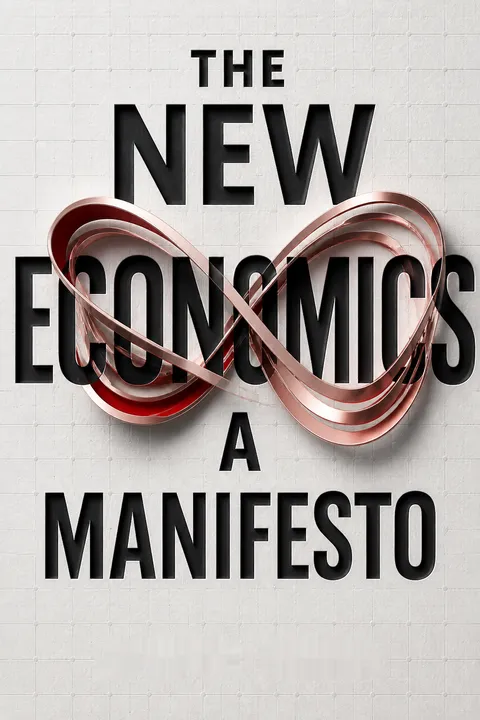

Key Takeaways
1. Neoclassical Economics Failed to Predict Crises and Resists Fundamental Change.
Not all economists did: there were some who warned that a crisis was not merely likely, but imminent.
A profound failure. The Global Financial Crisis (GFC) of 2007–2010 caught mainstream Neoclassical economists completely by surprise, despite explicit warnings from a minority of heterodox economists. Nobel laureate Robert Lucas had declared depression prevention "solved," and the OECD's Chief Economist predicted "sustained growth" just months before the crash. This catastrophic misjudgment, leading to the slowest recovery since the Great Depression, exposed a deep flaw in the dominant economic paradigm.
Resistance to reform. Despite this empirical failure, Neoclassical economics has largely refused to reform itself. Unlike in physics, where anomalies lead to paradigm shifts (e.g., Michelson-Morley experiment), economics tends to forget historical crises. The discipline's ideological role, supporting wealthy interests and a utopian vision of self-regulating markets, makes it highly resistant to fundamental change. This perpetuates a cycle where new generations of economists are indoctrinated into a flawed framework, rather than seeking new truths.
A discipline in crisis. This resistance means economics remains in a state of "perpetual, understated and unresolved crisis," failing to evolve like a true science. The "Keynesian Revolution" was co-opted and diluted by Neoclassical interpretations, preventing a genuine paradigm shift. The author argues that economics is "not a science" because it lacks the revolutionary changes seen in fields like physics, instead clinging to outdated beliefs despite overwhelming evidence.
2. Banks Create Money, Not Just Intermediaries: The Core Flaw in Mainstream Economics.
Rather than banks receiving deposits when households save and then lending them out, bank lending creates deposits.
The Neoclassical myth. Mainstream economics falsely portrays banks as mere intermediaries, shuffling existing money from savers to borrowers. Models like "Loanable Funds" and "Fractional Reserve Banking" suggest that lending is a "pure redistribution" with "no significant macroeconomic effects," ignoring the aggregate impact of debt. This view, championed by figures like Ben Bernanke and Paul Krugman, fundamentally misunderstands the nature of money creation.
The reality of money creation. Central banks like the Bank of England and the Bundesbank have explicitly debunked this myth, stating that "bank lending creates deposits," thereby creating new money. This "bank-originated money and debt" (BOMD) means that when a bank issues a loan, it simultaneously creates new debt for the borrower and new money (deposits) in their account. This process directly increases the money supply and aggregate demand, making banks far from irrelevant.
Profound macroeconomic implications. The fact that banks create money, rather than simply transferring it, has enormous consequences for macroeconomics. It means that changes in private debt are not neutral redistributions but powerful drivers of economic activity. Ignoring this fundamental mechanism, as Neoclassical economics does, leads to models that are "utterly inaccurate models of capitalism," incapable of explaining real-world phenomena like financial crises.
3. Private Debt, Not Government Debt, Drives Economic Instability and Crises.
Private debt, not government debt, is the primary cause of economic crises.
The true source of instability. Contrary to Neoclassical dogma, which often blames government deficits for economic woes, the author argues that private debt is the real culprit behind financial instability. Historical data for the USA, spanning nearly two centuries, reveals a consistent pattern: major economic crises like the Great Recession, the Great Depression, and the Panic of 1837 were preceded by surges in private debt and triggered by "credit turning negative."
Credit as aggregate demand. The "bank-originated money and debt" (BOMD) model demonstrates that credit—the annual change in private debt—is a significant component of aggregate demand and income. When credit is positive, it boosts economic activity; when it turns negative, it causes aggregate demand to collapse, leading to recessions and depressions. This dynamic is ignored by Neoclassical models, which treat debt changes as mere redistributions.
A Modern Debt Jubilee. To escape the current "debt trap," the author proposes a "Modern Debt Jubilee." This involves the government issuing a substantial sum of fiat money to every adult, requiring debtors to reduce their debt and non-debtors to buy newly issued corporate shares (which would then cancel corporate debt). This would drastically reduce the private debt-to-GDP ratio, stimulate the economy without inflation, and reverse the inequality exacerbated by policies like Quantitative Easing.
4. The Economy is a Complex, Dynamic System, Not an Equilibrium Machine.
For most complex systems, the equilibrium tells you not where the system will ultimately end up, but where the system will never be.
Beyond equilibrium. Conventional economics relies heavily on the concept of equilibrium, assuming that economic systems naturally converge to a stable state. However, the author, drawing on complex systems analysis, argues that this assumption is fundamentally false. Real-world systems, like the economy, are dynamic and often exhibit indefinite oscillations or "aperiodic cycles," as demonstrated by Lotka's predator-prey models and Lorenz's "Butterfly Effect" in weather systems.
Endogenous cycles. Unlike the Neoclassical view that economic fluctuations are caused by external "exogenous shocks," complex systems theory posits that cycles are "endogenous"—arising from the internal, nonlinear interactions within the system itself. The author's Keen-Minsky model, for instance, generates realistic patterns of rising debt, shifting income distribution, and diminishing-then-growing cycles, all emerging from simple nonlinear interactions, without any external shocks.
The "Great Moderation" fallacy. The period of reduced economic volatility prior to the GFC, dubbed the "Great Moderation" by Neoclassical economists, was misinterpreted as a sign of stability. The Keen-Minsky model, however, predicted this diminishing volatility as an "intermittent route to chaos"—a lull before a more extreme storm. This highlights how equilibrium-fixated models fail to capture the true, unstable nature of capitalism, leading to dangerous complacency.
5. Macroeconomics Needs Macrofoundations, Not Flawed Microfoundations.
The ability to reduce everything to simple fundamental laws does not imply the ability to start from those laws and reconstruct the universe.
The reductionist fallacy. Mainstream economics' relentless pursuit of "microfoundations"—deriving macroeconomic models from individual utility-maximizing consumers and profit-maximizing firms—is a misguided endeavor. As physicist Philip Anderson argued in "More is Different," while reductionism helps understand parts, it doesn't mean you can reconstruct the whole. Complex systems exhibit "emergent properties" at higher levels of aggregation that cannot be simply extrapolated from their constituent parts.
The impossibility theorem. Mathematical economists themselves, through the Sonnenschein-Mantel-Debreu theorem, proved that a downward-sloping market demand curve cannot be reliably derived from individual demand curves without making absurd assumptions. These assumptions, such as "an extra unit of purchasing power should be spent in the same way no matter to whom it is given," are patently unrealistic and invalidate the entire "supply and demand" framework.
Building from aggregates. Instead of futilely attempting to build macroeconomics from flawed microfoundations, the author proposes deriving it directly from macroeconomic definitions. By converting core aggregate definitions (e.g., employment rate, wages share, debt ratio) into dynamic statements about change over time, a robust and realistic macroeconomics can be constructed. This approach acknowledges that the economy's structure, codified in these definitions, largely determines its behavior, without needing to drill down to individual agents.
6. Economics Must Be Grounded in Energy and the Laws of Thermodynamics.
The law that entropy always increases holds, I think, the supreme position among the laws of Nature.
Ignoring nature's gifts. Modern economic models, from Adam Smith onwards, have largely ignored the fundamental role of nature and energy in production. They treat output as generated solely by labor and capital, a fallacy that violates the Laws of Thermodynamics. The Physiocrats, who saw land as the source of all wealth, were closer to the truth, as energy is the ultimate "free gift of Nature" without which no work can be done and no life can exist.
Energy as the true input. The author argues that "capital without energy is a sculpture" and "labour without energy is a corpse." Energy must be explicitly incorporated into production models, not as a third independent input, but as the force harnessed by labor and capital to perform useful work. This approach, particularly with an energy-modified Leontief production function, resolves long-standing economic conundrums and aligns with the "staggeringly tight correlation" between global energy use and global GDP.
Production creates waste, not just surplus. The Laws of Thermodynamics dictate that using energy to perform useful work inevitably generates waste. Production is fundamentally an operation that increases entropy (disorder), rather than creating a "surplus" in the traditional economic sense. This establishes an unavoidable link between economics and ecology, reframing pollution not as an "externality" but as an inherent and unavoidable consequence of economic activity that must be managed within the biosphere's finite limits.
7. Neoclassical Climate Economics Dangerously Trivializes Ecological Catastrophe.
There is currently a huge gulf between natural scientists’ understanding of climate tipping points and economists’ representations of climate catastrophes in integrated assessment models (IAMs).
A dangerous delusion. Neoclassical economists, notably William Nordhaus, have produced "appallingly bad" work on climate change, vastly underestimating its dangers. They predict trivial economic impacts, such as an 8.5% reduction in global output for a 6°C temperature increase, or a mere 0.015% decline in annual growth. This sanguine outlook stands in stark contrast to the catastrophic warnings from climate scientists, who foresee uninhabitable regions, mass extinctions, and irreversible atmospheric shifts at such temperature levels.
Misrepresenting science. Nordhaus's work, which earned him a Nobel Prize, is criticized for blatantly misrepresenting scientific consensus on "tipping elements." While scientists warn of critical tipping points within this century, Nordhaus claimed "no critical tipping elements with a time horizon less than 300 years until global temperatures have increased by at least 3°C." This misrepresentation has led to models that ignore the potential for abrupt, non-linear, and cascading climate impacts.
Absurd assumptions. The trivial damage estimates stem from two absurd assumptions:
- "Negligible effect" on most sectors: Nordhaus assumed 87% of the economy (manufacturing, services, etc.) would be "negligibly affected" by climate change because it occurs indoors, ignoring the collapse of supporting infrastructure and labor.
- Spatial analogy for temporal change: Economists used the weak correlation between current temperature and income across different regions as a proxy for global warming's future impact, ignoring the fundamental difference between regional weather variations and systemic global climate change.
These flawed assumptions have fostered a dangerous complacency, delaying meaningful action and pushing humanity towards an existential crisis.
8. The 'Neoclassical Disease': Prioritizing Fantasy Assumptions Over Reality.
Mate, you have to learn the difference between a simplifying assumption and a fantasy.
The "F-twist" and unreality. The "Neoclassical disease" is the practice of treating patently false assumptions as mere "simplifying assumptions" rather than critical flaws. Milton Friedman's infamous "assumptions don't matter" methodology (the "F-twist") argued that unrealistic assumptions are a sign of a good theory, as long as it predicts well. This allowed economists to ignore empirical contradictions, such as firms having constant or falling marginal costs, which invalidates the core "supply curve" concept.
Domain assumptions vs. simplifying assumptions. Philosopher Alan Musgrave distinguished between "simplifying assumptions" (minor omissions like air resistance in physics) and "domain assumptions" (conditions that define where a theory applies). If a domain assumption is false, the theory is false. Neoclassical economics routinely relies on false domain assumptions, like Samuelson's "benevolent central authority" that optimally reallocates income across society to justify the "Law of Demand."
Gatekeeping and groupthink. This methodological dishonesty is enforced through the academic refereeing process. Papers challenging the Neoclassical paradigm are often rejected for their "unrealistic" assumptions, while those upholding it, no matter how fantastical, are accepted. This creates a "close-knit community" prone to "group-think," as seen in climate change economics, where Nordhaus's flawed methodology became entrenched, suppressing alternative approaches like system dynamics.
9. A New Economics Requires System Dynamics and Empirical Realism.
The greatest possible detailed attention should be given to the actual sequences of actions which take place in the system.
Beyond static equilibrium. The author advocates for system dynamics, pioneered by Jay Forrester, as the mathematical foundation for a new economics. Forrester, an engineer, criticized economics for its failure to reflect "regenerative loops," interrelate flows of goods, money, and information, and use nonlinear equations to describe inherently nonlinear systems. System dynamics models explicitly treat time, feedback effects, and nonlinear interactions, generating endogenous cycles that mirror real-world complexity.
Structural realism and dynamic modeling. System dynamics emphasizes "structural realism"—building models that accurately reflect the actual sequences of actions and time delays in the economy. This approach uses integral equations to model "system states" (stocks) and their rates of change, allowing for the simulation of complex, dynamic behavior. This contrasts sharply with Neoclassical models that rely on simultaneous algebraic equations and arbitrary discrete time steps.
Reversing a methodological error. Forrester's system dynamics, initially applied to environmental economics in "Limits to Growth," was ridiculed out of contention by figures like Nordhaus, who ironically criticized its data handling while making up his own. This "disastrous consequence" sidelined a powerful tool capable of modeling the economy "in all its natural complexity." Reversing this methodological error is crucial for developing an economics that can genuinely understand and address real-world challenges.
10. Be the Change: A Contrarian Education for a Realistic Economic Future.
At present, the state of our dynamic economics is more akin to a crawl than to a walk, to say nothing of a run.
The dullness of Neoclassical utopia. The author finds Neoclassical economics "dull," with its bland vision of capitalism as a harmonious, equilibrium-driven system where everyone receives their "marginal product." This contrasts sharply with Marx's "exciting portrayal" of capitalism as a system of "constant revolutionizing of production, uninterrupted disturbance of all social conditions, everlasting uncertainty and agitation." The Neoclassical vision, while appealing to establishment interests, fails to capture the dynamic, class-based reality of capitalism.
A fearless agnosticism. A new economics must embrace a "fearless agnosticism about ideology and politics," acknowledging that capitalism is a class system and that issues of power, income, and wealth distribution are central. This means moving beyond the Neoclassical fiction of the "representative agent" and confronting the political consequences of economic policies. The new paradigm must be dynamic, complex, monetary, and grounded in biophysics and ecology.
A contrarian education. For aspiring economists, a "contrarian education" is essential. This involves mastering Post Keynesian economics (Goodwin, Godley, Minsky, Kalecki, Sraffa), Modern Monetary Theory (Kelton, Mitchell, Wray), and Biophysical Economics (Daly, Georgescu-Roegen, Hall). It also means learning system dynamics, mathematics, computing, thermodynamics, ecology, and history from experts outside traditional economics faculties. This independent learning is crucial to building a realistic economic future, as Neoclassical economics is deemed an "existential threat" to capitalism and human civilization.
Review Summary
The New Economics receives mixed reviews (3.99/5), with readers praising Keen's critique of neoclassical economics and his integration of money dynamics, complex systems modeling, and biophysical economics. Many appreciate his rigorous takedown of mainstream economic assumptions and his proposals for alternative frameworks incorporating climate change and financial instability. However, critics note the book's technical density makes it inaccessible to general readers, with some struggling to comprehend advanced mathematics and modeling. Several reviewers desire more practical policy applications. Others question Keen's reliance on Modern Monetary Theory and wish for deeper exploration of his proposed alternatives.
People Also Read







About the Author
Other books by Steve Keen

Download PDF
Download EPUB
.epub digital book format is ideal for reading ebooks on phones, tablets, and e-readers.








































