
Key Takeaways
1. Early Roots: Socialism and Craftsmanship
Valentine Reuther is the most dangerous man in Detroit because no one is more skillful in bringing about the revolution without seeming to disturb the existing forms of society.
Formative influences. Walter Reuther's early life in Wheeling, West Virginia, was deeply shaped by his father, Valentine, a German immigrant and ardent Socialist. Valentine instilled in his sons a strong sense of social justice, intellectual curiosity, and a belief in collective will and self-imposed discipline, often through lively dinner table debates on contemporary issues. This upbringing provided Walter with a moral, Manichean understanding of class power and economic progress.
Craftsmanship's allure. Walter developed a profound appreciation for skilled labor and self-mastery from a young age. Leaving high school at fifteen, he apprenticed as a toolmaker at Wheeling Corrugating, a trade he excelled at. This experience, particularly observing artisans in a glass factory, gave him a powerful vision of dignity and creativity in work, which became a lifelong inspiration for his politics.
Detroit's call. By 1927, at age nineteen, Reuther sought greater opportunities in Detroit, the booming heart of the American automobile industry. He secured a job at Ford's Highland Park plant, later transferring to the massive River Rouge complex. His exceptional mechanical aptitude and personable nature quickly earned him recognition, leading to a promotion as an "A-1 Diemaker Leader" and placing him at the apex of the working class, earning $1.40 an hour.
2. Depression's Crucible: A Radical Awakening
The argumentative spirit sweep [sic] us into revolutionary combat.
Depression's impact. The Great Depression hit Detroit with unparalleled force, causing widespread unemployment and social misery. Witnessing this devastation firsthand, particularly through tours of Hoovervilles and discussions with the unemployed, profoundly politicized Walter Reuther. His earlier ambitions for personal advancement began to transform into a deeper commitment to social justice.
Intellectual ferment. While working at Ford, Reuther enrolled in Detroit City College (now Wayne State University) alongside his brother Victor. They immersed themselves in economics and sociology, connecting with radical instructors and students. This academic environment, coupled with the stark realities of the Depression, solidified Walter's socialist convictions, moving him away from the individualistic self-improvement ethos of his youth.
Activism ignited. The Reuther brothers quickly became prominent student activists, organizing the Social Problems Club, affiliated with the League for Industrial Democracy (LID). They spearheaded successful campaigns against compulsory ROTC and racial segregation at the college, demonstrating their capacity for headline-grabbing protest and effective organizing. This period marked Walter's transition from a skilled worker to a committed radical cadre.
3. Gorky's Paradox: Industrial Vision, Authoritarian Reality
It is unpolished and crude, rough and rude, but proletarian workers' democracy in every respect.
Soviet "experiment." In 1933, Walter and Victor embarked on a two-year journey to the Soviet Union, drawn by the promise of socialist industrialization amidst capitalist crisis. Walter, a skilled toolmaker, secured a job at the newly built Gorky Auto Works, a Ford-modeled plant, and arranged for Victor to join him. Their initial impressions were overwhelmingly positive, viewing the Soviet project as a rapid transformation of a backward nation into a modern, scientific society.
Teaching and learning. At Gorky, the brothers took immense satisfaction in training former peasants in industrial skills, seeing the factory as a "huge trade school." They were impressed by the communal spirit, the presence of women in traditionally male jobs, and the "Treugolnik" (tripartite administration) system, which they initially perceived as a genuine form of "proletarian democracy" where workers could challenge management.
Critique emerges. Despite initial enthusiasm, Walter soon grew frustrated with the chaos, inefficiency, and harsh labor practices at Gorky. He criticized the piece-rate system, unsafe conditions, and administrative backwardness, advocating for Fordist principles of systematic work and coordination. While they remained publicly supportive of the Soviet Union, their experiences sowed seeds of disillusionment regarding the regime's authoritarian tendencies, which became more apparent with the onset of Stalin's purges.
4. Forging the UAW: Militancy and Strategic Genius
We really were not organizing the workers. We were just giving them a kind of constructive leadership.
Return to a nascent movement. Returning to Detroit in 1935, Reuther found a fragmented labor landscape, despite the New Deal's promise of union rights. He quickly immersed himself in the fledgling United Automobile Workers (UAW), leveraging his Socialist Party contacts and his reputation as a Ford worker with international experience. His goal was to unite disparate groups and build a powerful industrial union.
Kelsey-Hayes breakthrough. Reuther's strategic brilliance shone during the 1936 Kelsey-Hayes sit-down strike. Despite limited union membership, he and a small band of militants, including his brothers Victor and Roy, orchestrated a dramatic plant occupation. Reuther's ability to negotiate with management, mobilize community support, and persuade reluctant workers to accept a tactical settlement, even without full union recognition, proved crucial.
A model local. The Kelsey-Hayes victory, though imperfect, galvanized Detroit's West Side. Local 174, an "amalgamated" local under Reuther's leadership, rapidly grew to 30,000 members across 75 shops. Reuther's blend of political vision and practical organizing, supported by a diverse cadre of Socialists and Communists, transformed Local 174 into a dynamic institution, demonstrating the power of collective action and setting the stage for broader unionization.
5. Anti-Communism: A Path to Union Supremacy
It’s not a question of right or left in this union. It’s whether you are for or against Reuther.
Factional battles. Reuther's rise within the UAW was marked by intense factionalism, particularly against Homer Martin's "Progressive Caucus," which sought accommodation with management and purged radicals. Reuther, initially allied with Communists in the "Unity Caucus," fought to defend union militants and resist concessions to General Motors. This period honed his skills as a political infighter and orator.
The Gorky letter's shadow. Reuther's past, especially the pro-Soviet "Gorky letter," became a weapon for his opponents. While he initially defended his Soviet experience as a study tour, the escalating Cold War forced him to disavow the letter, even falsely claiming it was a forgery. This controversy, alongside accusations of draft-dodging, highlighted the personal and political costs of his radical past.
Consolidating power. The passage of the Taft-Hartley Act in 1947, requiring anti-Communist affidavits from union leaders, provided Reuther with a decisive opportunity. He relentlessly attacked his rivals for their Communist ties, framing the issue as one of "union loyalty" versus "outside interference." His campaign, culminating in a sweeping victory at the 1947 UAW convention, effectively purged his opponents and solidified his control, though at the cost of internal ideological diversity.
6. The "Reuther Plan": Labor's Vision for War Production
The plane, from certain points of view, is only an automobile with wings.
Wartime opportunity. As World War II loomed, Reuther recognized Detroit's immense, yet underutilized, industrial capacity. He saw an opportunity for labor to play a central role in national planning, challenging corporate reluctance to convert to war production. His "500 Planes a Day" plan, developed with his brother Victor and I.F. Stone, proposed converting idle auto plants and skilled labor to mass-produce aircraft.
Technocratic vision. The plan, presented to President Roosevelt in late 1940, advocated for a tripartite aviation production board with the power to conscript resources across corporate boundaries. Reuther argued that this would solve bottlenecks, ensure full employment, and give labor a voice in investment decisions. It was a bold, Veblenite vision of industrial efficiency and social planning, aiming to demonstrate labor's capacity for national leadership.
Corporate resistance and political demise. Despite initial interest from New Dealers and military officials, the "Reuther Plan" faced fierce opposition from auto executives and aircraft manufacturers, who saw it as an insidious challenge to managerial prerogatives and private enterprise. They dismissed it as technically unfeasible and ideologically dangerous. While the auto industry eventually converted to war production, it did so under corporate, not tripartite, control, effectively sidelining Reuther's vision for labor-led planning.
7. The GM Strike of 1945-46: Wages, Prices, and Public Interest
The fight of the General Motors workers is a fight to save truly-free enterprise from death at the hands of its self-appointed champions.
Postwar economic challenge. With the end of World War II, Reuther faced the threat of mass unemployment and inflation. He argued that a substantial wage increase was essential to maintain purchasing power and prevent a postwar depression. His strategy, encapsulated in the slogan "wage increases without price increases," aimed to link corporate profits to public welfare, demanding that General Motors open its books to justify its pricing policies.
A political showdown. Reuther deliberately targeted General Motors for a prolonged strike, believing that only a direct assault on a key corporate adversary could force a new postwar wage pattern and prod the government to maintain price controls. The 113-day strike, the longest of the era, was a massive display of union solidarity, drawing support from veterans and the broader public who sympathized with the UAW's fight against corporate greed.
Limited victory. Despite widespread public support and a fact-finding board's endorsement of the UAW's economic logic, GM ultimately rejected the union's core demand for price transparency. The strike ended with a wage increase, but without the explicit linkage to prices Reuther sought. This outcome, influenced by the Truman administration's wavering and the steel industry's separate settlement, marked a turning point, signaling the limits of labor's ability to reshape the national political economy.
8. The Treaty of Detroit: Stability at a Cost
General Motors has regained control over one of the crucial management functions . . . long range scheduling of production, model changes, and tool and plant investment.
A new industrial accord. In 1948, General Motors, seeking stability amidst post-war inflation and union militancy, offered the UAW a groundbreaking two-year contract. This "blue plate special" included quarterly cost-of-living adjustments (COLA) and an annual improvement factor (AIF) tied to productivity gains. This agreement, later extended to five years in 1950 and dubbed the "Treaty of Detroit," brought unprecedented economic security to autoworkers.
Benefits and constraints. The Treaty provided a private welfare state for UAW members, with pensions, health insurance, and eventually supplemental unemployment benefits (SUB). It established a predictable framework for wage determination, reducing industrial conflict and allowing for long-range corporate planning. However, it also solidified management's control over production standards and work rules, effectively privatizing and depoliticizing many issues that Reuther had once sought to address through broader social planning.
Reuther's dilemma. While Reuther hailed the contract as a "tremendous victory" and a "milestone," it represented a significant compromise of his earlier vision for industrial democracy and government-led economic planning. The focus shifted from challenging corporate power to securing benefits within the existing capitalist framework. This pragmatic accommodation, though beneficial for his members, inadvertently reinforced the very corporate structures he had once sought to transform.
9. Assassination Attempts: The Peril of Leadership
The momentum and power of our new kind of labor movement cannot be stopped and thrown back by slugs from a shotgun.
Violent attacks. In 1948, Walter Reuther was severely wounded by a shotgun blast at his home, losing partial use of his right arm. Thirteen months later, his brother Victor suffered a similar attack, losing an eye. These were not isolated incidents, but part of a pattern of violence linked to an industrial underworld, particularly the Perrone gang, whose illicit operations were threatened by Reuther's consolidation of power and the UAW's efforts to clean up corruption.
Unsolved mysteries. Despite extensive investigations by police and the UAW, no one was ever convicted for the shootings. The FBI's involvement was limited, with J. Edgar Hoover dismissing the attacks as minor. This lack of resolution, coupled with suspicions of police complicity, underscored the dangerous and often shadowy forces at play in Detroit's labor landscape.
Personal and political impact. The assassination attempts profoundly affected the Reuther family, leading to increased security and a retreat into a more guarded private life. For Walter, the trauma reinforced his unwavering commitment to the union, viewing it as a personal destiny. Politically, the attacks inadvertently strengthened his leadership within the UAW, as his opponents became suspect and his image as a courageous, principled leader was solidified.
10. Civil Rights: Championing Equality Amidst Division
The United States cannot lead the world unless we are ready to fight the master race theory in Mississippi as we fought the master race theory in Germany.
A moral imperative. Reuther was a vocal and visible champion of civil rights, believing that racial equality was essential for American democracy and global leadership. He consistently advocated for federal fair employment practices legislation and actively supported the NAACP, even when it caused friction with some southern UAW members. He saw racial discrimination as a structural problem rooted in economic scarcity and irrational emotions.
Internal union challenges. Despite his public stance, Reuther faced significant challenges within the UAW regarding racial equality. Southern locals maintained segregation, skilled trades remained overwhelmingly white, and black production workers increasingly felt the sting of discrimination in job assignments and promotions. His Fair Employment Practices Department, while symbolic, often struggled to effect real change against entrenched practices.
The TULC and "Black Power." The emergence of the Trade Union Leadership Council (TULC) in the late 1950s, and later the Dodge Revolutionary Union Movement (DRUM), presented Reuther with a dilemma. While he shared their goals for racial justice, he viewed their independent, sometimes nationalist, militancy as a threat to union unity and his own leadership. He resisted demands for a black executive board member, fearing "reverse Jim Crow," and actively suppressed DRUM, leading to accusations of hypocrisy from black activists.
11. AFL-CIO Break: A Quest for Renewed Activism
This is the trouble with the American Labor Movement. It is becoming a part of the “Establishment.”
Frustration with stagnation. By the late 1950s, Reuther grew increasingly frustrated with the AFL-CIO under George Meany's leadership. He saw the merged federation as complacent, bureaucratic, and unwilling to launch aggressive organizing drives or engage in broader social and political activism. Meany, a staunch anti-Communist and traditional craft unionist, often clashed with Reuther's social democratic vision and internationalist ambitions.
Foreign policy clashes. The deepest rift emerged over foreign policy. Meany, through Jay Lovestone, pursued an uncompromising anti-Communist agenda, often collaborating with the CIA and supporting conservative, even corrupt, unions abroad. Reuther, advocating for détente, neutralism, and support for social democratic movements, found himself at odds with Meany's "rigid, frozen" approach, leading to public disputes over issues like the ILO and CIA funding of labor groups.
The split. Reuther's attempts to reform the AFL-CIO from within proved futile. After years of escalating conflict, including Meany's blocking of UAW initiatives and personal insults, Reuther led the UAW out of the AFL-CIO in 1968. He envisioned the split as an opportunity to forge new alliances, particularly with the Teamsters in the Alliance for Labor Action (ALA), and to revitalize labor's role in social and political movements, though this new venture ultimately faltered after his death.
12. Unfulfilled Vision: The Dilemmas of Social Democracy
It is hard to change institutions fundamentally. That is why there are revolutions in the world.
The Great Society's promise. In the mid-1960s, Reuther found renewed hope in Lyndon Johnson's Great Society programs and the civil rights movement. He became a close advisor to LBJ, championing urban renewal, anti-poverty initiatives, and civil rights legislation. He saw this as a chance to finally implement his vision of a social democratic America, where government intervention and labor-liberal coalitions could address systemic inequalities.
Vietnam's shadow. However, the Vietnam War increasingly undermined Reuther's domestic agenda and strained his alliance with Johnson. While personally dovish, Reuther publicly supported the administration's war policy, fearing a split within the UAW and a backlash against labor. This compromise alienated him from the burgeoning New Left and anti-war movements, which saw his stance as a betrayal of progressive ideals.
A legacy of tension. Reuther's final years were marked by a struggle to reconcile his expansive social vision with the practical constraints of union leadership and political realities. He sought to bridge the gap between labor and new social movements, but his efforts were often hampered by internal union conservatism, the limitations of collective bargaining, and the deep divisions within American society. His death in 1970 left a legacy of ambitious, yet often unfulfilled, social democratic aspirations.
Review Summary
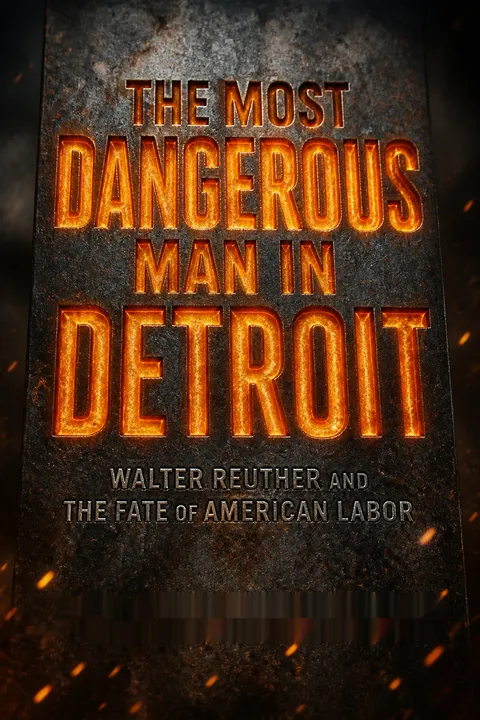
The Most Dangerous Man In Detroit by Nelson Lichtenstein receives generally positive reviews (4.04/5) for its detailed biography of labor leader Walter Reuther. Readers praise Lichtenstein's thorough research and examination of Reuther's evolution from socialist activist to anti-Communist social democrat who led the UAW from 1946-1970. Critics note the book is dense with excessive detail about internal union politics, sometimes at the expense of Reuther's personal life and broader context. Reviewers appreciate the honest assessment of Reuther's contradictions—his civil rights support versus limited Black leadership advancement, and his commitment to Democratic Party politics despite repeated betrayals.
People Also Read






Download PDF
Download EPUB
.epub digital book format is ideal for reading ebooks on phones, tablets, and e-readers.








































