

Key Takeaways
A war that killed 750,000 began without a single battle death
The bombardment of Fort Sumter opened the Civil War, yet across thirty-four hours of relentless shelling, nobody died. Confederate batteries fired 3,341 shells and balls; Sumter answered with roughly a thousand. The only fatalities came afterward, during a ceremonial gun salute when a cartridge exploded prematurely, killing Private Daniel Hough.
The grim irony frames Larson's entire saga. South Carolina's chivalry expected either no war or a brief, tidy one. James Chesnut famously pledged to drink all the blood that would be shed. Fire-eater Robert Barnwell Rhett vowed to eat the corpses. Neither could imagine armies marching across their plantations, corpses among the cotton bolls, or a conflict that would kill more Americans than any other in history.
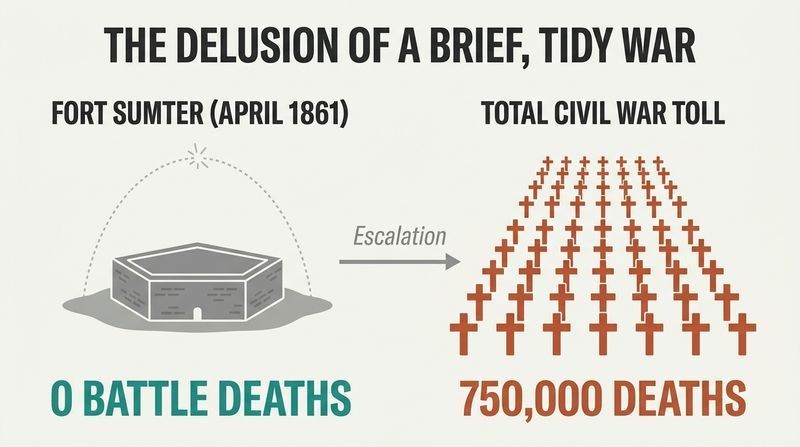
The bloodless bombardment yielding the bloodiest war illustrates what political scientists call the escalation trap: symbolic acts unleash consequences wildly disproportionate to their immediate cost. What's striking is how both sides mistook the opening gesture for the whole play. Norman Angell later argued in The Great Illusion (1910) that societies routinely underestimate war's true price. The Sumter defenders and attackers alike treated the confrontation as an affair of honor with rules, not the ignition of industrialized slaughter. This gap between intended signal and actual outcome recurs across history, from 1914 to modern conflicts, where leaders expect short, contained wars and get catastrophes.
Honor culture made Southern elites choose war over perceived humiliation
South Carolina's planter aristocracy called themselves "the chivalry." They devoured Walter Scott novels, staged jousting tournaments, gave themselves military titles, and governed disputes by the Code Duello, a formal rulebook for insults and dueling. Honor was not decoration; it was operating system. To call slavery evil was to brand slaveholders as moral criminals, an insult no gentleman could forgive.
Larson threads the dueling code's rules as epigraphs throughout, showing how personal honor scaled into national catastrophe. When abolitionists like Harriet Beecher Stowe attacked slavery in Uncle Tom's Cabin (300,000 copies in three months), no Code Duello mechanism existed to answer an insult to the entire South. That unanswerable wound festered into the conviction that separation was the only honorable response.
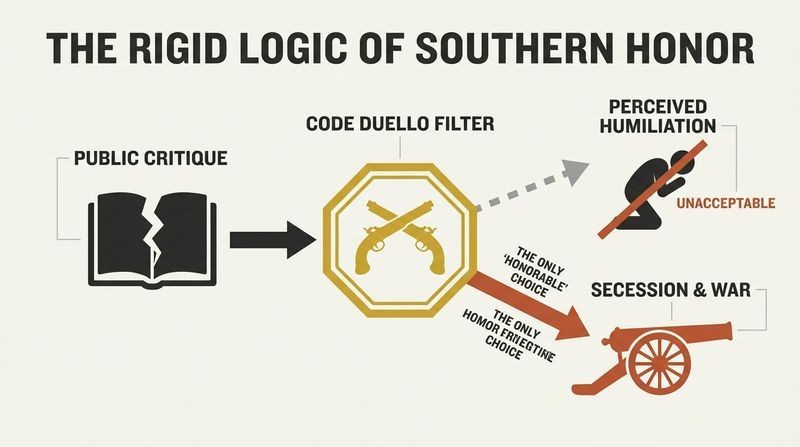
Anthropologists Richard Nisbett and Dov Cohen, in Culture of Honor (1996), demonstrated experimentally that Southern men still respond to insults with elevated cortisol and testosterone compared to Northerners, tracing this to a herding-society heritage where reputation deterred theft. Larson's chivalry fits that model precisely: a face-based culture where losing status equaled social death. What's valuable here is seeing ideology and psychology fuse. The planters needed slavery to be a positive good because otherwise their honor collapsed. This is motivated reasoning at civilizational scale, a reminder that economic interest often hides behind, and is amplified by, identity and shame.
Slavery, not states' rights, was the crisis everyone privately knew
Later historians tried to recast the war as a bloodless dispute over states' rights, but the antebellum record contradicts them. Mississippi's secession declaration stated plainly that its position was "thoroughly identified with the institution of slavery." The Peace Convention's proposed constitutional amendments all dealt with slavery, including a "Never-Never" clause barring Congress from ever interfering with it.
Historian Samuel Eliot Morison wished evasive historians who denied slavery's centrality would read those Peace Convention debates. Lincoln himself pinpointed the divide in a letter to Alexander Stephens: the South thought slavery right and wanted it extended; Republicans thought it wrong and wanted it restricted. That, Lincoln wrote, was the only substantial difference. Southern anxiety over abolition, racial equality, and feared slave insurrections drove every secession vote.
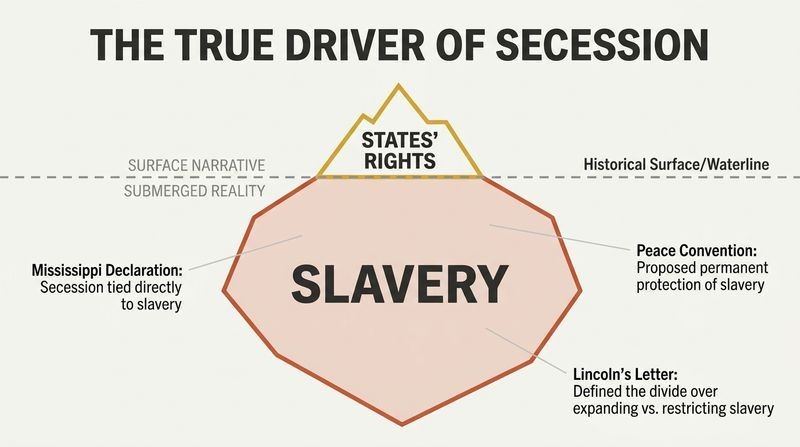
This takeaway corrects the "Lost Cause" mythology that dominated American memory for a century, softened in textbooks and monuments erected decades after the war. What's analytically important is Larson's use of primary sources over retrospective rationalization: secession ordinances, private letters, and legislative debates all foreground slavery unambiguously. The states' rights framing was largely a postwar reputational salvage operation. Modern scholarship, from Eric Foner to James McPherson, converges on this reading. The lesson extends beyond the Civil War: the stories societies tell about why they fought are often sanitized afterward, and recovering contemporaneous evidence is the antidote to comfortable revisionism.
Craving personal recognition can drive men to engineer catastrophe
Larson's key actors share a hunger for attention that shapes history. Edmund Ruffin, an aging Virginia agriculturalist ignored by his home state, found in secession the acclaim he had craved since childhood. He borrowed a Citadel cadet's uniform to attend John Brown's execution, carried a pike as a prop, and demanded to fire an early shot at Sumter.
James Henry Hammond, born a lowly "yeoman," clawed his way into the planter elite through strategic marriage and proslavery oratory, coining "Cotton is King." Both men bled ambition from every pore. Their need for affirmation, not just ideology, propelled their agitation. Ruffin later killed himself, mourning that only "the accident" of firing an early gun at Sumter had rescued his name from obscurity.
This is Larson's most novelistic insight, and it echoes what psychologists call narcissistic supply, the need for continuous external validation. What's compelling is how personal wounds scaled into public disaster. Ruffin's suicide note raging against "Yankee rule" reveals a man whose entire identity depended on being remembered as the war's igniter. Historians often privilege structural forces such as economics and institutions, but Larson restores individual psychology to its proper weight. The danger, of course, is overcorrection: Ruffin fired an early gun, not the first, and secession would have proceeded without him. Still, the amplifying role of attention-starved zealots is underappreciated in most causal accounts.
Passivity in a crisis can be as consequential as aggression
President James Buchanan wanted one thing: to reach the end of his term in peace and go home to Wheatland. He considered it "very hard" that turmoil disrupted his final months. His December 1860 address blamed the North, denied any state's right to secede, then declared the federal government powerless to stop secession, pleasing no one.
William Seward called it a document proving the president must execute the laws unless somebody opposes him. Buchanan's cabinet included Southern sympathizers who leaked plans to Charleston. His war secretary Floyd shipped 124 cannon south. By temporizing, hoping to shove the crisis onto Lincoln, Buchanan let seven states secede, forts fall, and arsenals be seized, all while the machinery of war assembled unopposed.
Buchanan is a case study in what leadership scholars call the abdication of agency, treating a decision point as if inaction were neutral. It never is. His paralysis handed the Confederacy months to fortify Charleston Harbor, turning a defensible situation into an impossible one by the time Lincoln took office. Compare this to Andrew Jackson's forceful 1832 nullification response, which Buchanan's own advisors begged him to emulate. The deeper lesson, applicable to any executive facing a slow-motion crisis, is that delay is itself a choice with compounding costs. Buchanan wanted to be judged on intentions; history judged him on outcomes.
Lincoln reframed the fight so the enemy would fire first
Lincoln's masterstroke at Sumter was making the Confederacy choose war. Rather than sneak in troops, he announced he would send provisions only, food to starving men, and notified Governor Pickens in advance. The gambit was elegant: if the ships passed unmolested, peace held and the garrison ate. If Confederate guns fired on an unarmed relief of hungry soldiers, the South became the aggressor in the world's eyes, violating the very honor code the chivalry worshipped.
Beauregard's forces took the bait, opening fire before the fleet arrived. Lincoln understood what Buchanan never grasped: the moral framing of who struck first would determine Northern unity, border-state loyalty, and foreign opinion. His inaugural pledged to "hold, occupy, and possess" federal property while promising no aggression.
This is strategic jujitsu, forcing the opponent into the role of villain. Game theorists would recognize it as manipulating the sequence of moves so the adversary bears responsibility for defection. What's remarkable is Lincoln's patience under enormous pressure to either reinforce or abandon Sumter. He found a third path that converted a military weakness into a political victory. The provisioning-only frame also constrained his own hawks. There is a slight tension worth noting: some contemporaries and historians debate whether Lincoln deliberately provoked war or genuinely sought to avoid it. Larson's account suggests both were true simultaneously, which is precisely what made it effective.
"Cotton is King" was the delusion that made war seem safe
Hammond's 1858 Senate boast that "no power on earth dares make war upon" cotton became the South's intoxicating certainty. The reasoning: the North depended on Southern cotton, Britain depended on it more, so secession would trigger economic collapse up North and force British recognition of the Confederacy. Therefore war either wouldn't happen or would be brief and victorious.
This single agricultural product became the radicals' scepter, blinding them to the risk of a prolonged, ruinous conflict. Russell of the London Times found the belief held "everywhere" in the South as "a lively all powerful faith without distracting heresies." It was catastrophically wrong. Britain found other cotton sources, the Northern economy proved resilient, and the war ground on for four years.
This is a textbook example of monocausal economic determinism producing strategic blindness. The planters mistook a real dependency for an absolute leverage, ignoring substitution effects (Egyptian and Indian cotton) and moral factors (British antislavery sentiment that made siding with slaveholders politically toxic). Behavioral economists would call it confirmation bias fused with wishful thinking, a belief so flattering and convenient that contradictory evidence bounced off. What's instructive for modern readers is how a genuine competitive advantage can become a dangerous illusion when a group treats it as unconditional. Resource-rich states from OPEC to petro-states have repeatedly overestimated the coercive power of a single commodity.
Secrecy is impossible when the whole world is watching
Both sides repeatedly learned that plans leak. Anderson warned Washington that keeping his movements secret in hostile Charleston was nearly impossible; a Mercury correspondent had already reported Major Buell's confidential mission. The Star of the West relief attempt was supposed to be covert, yet New York reporters spotted the unusual activity and the Charleston defenders were "perfectly aware of our coming."
Seward made the same argument against reinforcing Sumter: in a country with a daily press, daily mails, and an "incessantly operating telegraph" of 50,000 miles, any expedition would be known to the enemy before it began. The telegraph had transformed communication into something near-miraculous, but that same speed meant military secrets evaporated almost instantly.
Larson surfaces a genuinely modern problem: the collision of new communication technology with statecraft. The 1860s telegraph and penny press created something like a nineteenth-century information environment, compressing the time between decision and disclosure. This prefigures today's debates about operational security in an age of satellite imagery, social media, and open-source intelligence. What's ironic is that leaders kept planning as if secrecy were achievable, repeating failures. The deeper principle, familiar to intelligence scholars, is that in transparent societies, strategy must assume disclosure rather than rely on concealment. Lincoln's eventual success came precisely from a plan that worked even when fully public: send food, announce it openly.
Chivalric courtesy coexisted with plans for mass extermination
The strangest texture of the Sumter standoff was its politeness. Anderson and Beauregard, former teacher and pupil at West Point, exchanged warm, formal notes even as one prepared to destroy the other. When a Confederate gun accidentally fired on Sumter, an officer rowed over to apologize "handsomely," and the men "took to breakfast." Pickens sent Anderson free beef and vegetables while building batteries to annihilate him.
Larson likens this to serving a man his favorite meal before slipping a noose around his neck. Anderson, himself a former slaveholder sympathetic to the South, shook hands with the officers delivering the ultimatum, saying if they never met again in this world, God grant they meet in the next. Honor demanded courtesy even amid lethal intent.
This juxtaposition captures a pre-modern warrior ethic that would not survive the war it launched. The formal courtesies belong to an aristocratic dueling tradition where combatants shared a code and a class. What's poignant is watching that code collide with the industrial-scale killing to come, which recognized no such niceties. Sociologist Norbert Elias's work on the "civilizing process" is relevant: elaborate manners often mask, and sometimes enable, violence by ritualizing it. The Sumter gentlemen could imagine killing each other precisely because honor gave the act a script. When the script dissolved at places like Bull Run, the courtesies vanished and the true face of the war emerged.
Present political dread can make you finally understand the past
Larson began this book before January 6, 2021, then watched the Capitol assault unfold and felt past and present merge. Two of 1861's greatest moments of national dread centered on the same rituals that convulsed 2021: the certification of the Electoral College vote and the presidential inauguration. Lincoln feared the February 13 electoral count more than his inauguration, since his rival, sitting Vice President Breckinridge, would preside over certifying it.
General Scott stationed troops throughout Washington, positioned riflemen on rooftops, and vowed to blow obstructors from cannon. Rumors of plots to seize the capital or assassinate the president-elect swirled. Larson recovered the genuine suspense of those months by recognizing that the anxiety, anger, and astonishment of 1860-61 rhymed unsettlingly with contemporary discord.
This is the interpretive lens that makes Larson's history feel urgent rather than antiquarian. The insight that emotional resonance across eras can unlock historical understanding is methodologically double-edged. On one hand, present concerns illuminate what earlier historians overlooked, such as the fragility of peaceful power transfer. On the other, presentism risks distorting the past to fit current anxieties. Larson navigates this carefully, using the parallel to recover authentic contemporary dread rather than to score modern points. The enduring lesson is sobering: democratic norms like certifying elections and inaugurating leaders are not self-enforcing rituals but contested moments that have twice brought the republic to the edge.
Analysis
Larson applies his signature technique, the braided narrative of intimate character studies against a ticking-clock structure, to the 113 days between Lincoln's election and Sumter's fall. The book is popular narrative history, not revisionist scholarship: its arguments align with mainstream consensus (slavery caused the war) while its value lies in texture, pacing, and psychological portraiture. The War of the Rebellion official records supply the ticktock spine; diaries by Mary Chesnut and Edmund Ruffin supply the ornaments.
The central interpretive move is to treat honor culture as causal machinery rather than mere backdrop. By weaving the Code Duello through the text, Larson argues that a shame-based aristocratic ethic converted economic and moral conflict into an unstoppable trajectory toward violence. This is persuasive but should be held alongside structural accounts (McPherson, Foner) emphasizing the political economy of slavery's expansion. Honor explains the tenor and timing; slavery explains the substance.
Larson's most original contribution is his attention to the attention-seekers. Ruffin and Hammond emerge as men whose personal woundedness and craving for affirmation amplified secessionist momentum. This restores individual agency and psychology to a story often told through impersonal forces, though it risks overweighting colorful individuals over the millions of enslaved people whose bondage was the actual stake, and who remain largely peripheral in a narrative centered on white elites and Washington power players.
The January 6 framing is the book's interpretive gamble. It sharpens the reader's sense of how fragile electoral certification and inauguration truly were, and how easily grievance, false honor, and duplicity metastasize. The risk is presentism flattening genuine differences between 1861 and 2021. Larson mostly resists this, using the parallel to recover suspense rather than to editorialize, and the result is history that reads with the dread of a thriller while illuminating how a nation talks itself into catastrophe.
Review Summary
The Demon of Unrest receives mostly positive reviews for its engaging narrative and meticulous research on the lead-up to the Civil War. Readers praise Larson's storytelling and character-driven approach, bringing historical figures to life. Some criticize the book's length and occasional tangents. Many appreciate the parallels drawn to current events, while others find this comparison strained. Overall, reviewers commend Larson's ability to make history accessible and compelling, though a few express disappointment with certain aspects of the narrative.
People Also Read

FAQ
What is The Demon of Unrest: A Saga of Hubris, Heartbreak, and Heroism at the Dawn of the Civil War about?
- A Nation Divided: The book chronicles the events leading up to the Civil War, focusing on the period between Lincoln's election and the attack on Fort Sumter. It explores the political, social, and personal tensions that drove the nation toward conflict.
- Key Players: The narrative follows the actions and motivations of key figures such as Abraham Lincoln, Major Robert Anderson, and Confederate leaders, revealing their roles in the unfolding crisis.
- A Story of Escalation: It details the escalating tensions, miscommunications, and strategic decisions that ultimately led to the outbreak of war, highlighting the human element behind the historical events.
Why should I read The Demon of Unrest: A Saga of Hubris, Heartbreak, and Heroism at the Dawn of the Civil War?
- Suspenseful Narrative: Erik Larson masterfully crafts a suspenseful narrative, using historical details to create a sense of urgency and impending doom, making the reader feel as if they are experiencing the events in real-time.
- Deep Character Insights: The book provides deep insights into the motivations and complexities of key historical figures, revealing their personal struggles and the human side of the conflict.
- Relevance to Today: The themes of political division, miscommunication, and the consequences of unchecked ambition resonate with contemporary issues, making the book relevant and thought-provoking.
What is the background of The Demon of Unrest: A Saga of Hubris, Heartbreak, and Heroism at the Dawn of the Civil War?
- Historical Context: The book is set against the backdrop of the growing divide between the North and South over the issue of slavery, exploring the political and social climate of the 1850s and early 1860s.
- Political Tensions: It delves into the political machinations and strategic decisions of key figures, highlighting the role of ambition, miscommunication, and fear in the lead-up to the war.
- Cultural Differences: The narrative explores the cultural differences between the North and South, including the Southern emphasis on honor and the Northern focus on industrial progress, which contributed to the growing divide.
What are the most memorable quotes in The Demon of Unrest: A Saga of Hubris, Heartbreak, and Heroism at the Dawn of the Civil War?
- "A house divided against itself cannot stand.": This quote, from Lincoln's speech, foreshadows the inevitable conflict and highlights the irreconcilable differences between the North and South.
- "Cotton is King.": James Henry Hammond's declaration encapsulates the South's belief in the economic power of cotton and its perceived invulnerability, revealing a key element of Southern hubris.
- "I will not in the meantime open my fires upon your forces unless compelled to do so by some hostile act against this fort or the flag of my Government.": Major Anderson's statement reflects his commitment to duty and his desire to avoid conflict, while also setting the stage for the inevitable clash.
What writing style, narrative choices, and literary techniques does Erik Larson use?
- Suspenseful Pacing: Larson employs a suspenseful, almost thriller-like pacing, using short chapters and frequent shifts in perspective to build tension and keep the reader engaged.
- Detailed Historical Accuracy: The book is meticulously researched, with a focus on primary sources, including letters, diaries, and official documents, to create a vivid and authentic portrayal of the era.
- Character-Driven Narrative: Larson focuses on the personal stories and motivations of key figures, using their actions and decisions to drive the narrative and explore the human side of the conflict.
Hidden Details & Subtle Connections
What are some minor details that add significant meaning?
- The Fresnel Lens: The detail about the Fresnel lens being moved from the lighthouse to the center of the fort's parade ground symbolizes the shift from a beacon of guidance to a source of illumination for war preparations.
- The Charleston Curfew: The nightly ringing of the "negro curfew" bell, juxtaposed with the grand bells of St. Michael's Church, highlights the stark contrast between the lives of the enslaved and the white elite in Charleston.
- The Code Duello: The frequent references to the Code Duello reveal the Southern obsession with honor and the rigid rules that governed their interactions, foreshadowing the inevitable conflict.
What are some subtle foreshadowing and callbacks?
- Miss Havisham Analogy: The comparison of South Carolina to Miss Havisham from Dickens' Great Expectations subtly foreshadows the state's retreat into its own world of myth and indolence, disconnected from the modern world.
- "The plot thickens": Mary Chesnut's use of this phrase, a common saying at the time, also serves as a subtle foreshadowing of the increasingly complex and dangerous events to come.
- The "mystic chords of memory": Seward's phrase, later incorporated into Lincoln's inaugural address, subtly foreshadows the emotional and historical ties that would be tested by the war.
What are some unexpected character connections?
- Anderson and Beauregard: The relationship between Major Anderson and General Beauregard, former teacher and student, adds a layer of personal conflict to the military standoff at Fort Sumter.
- Hammond and Ruffin: The friendship between James Henry Hammond and Edmund Ruffin, two men from different social classes, reveals the shared passions and resentments that fueled the secessionist movement.
- Seward and Hammond: The fact that Seward invited Hammond to a party at his Washington mansion, despite their opposing views on slavery, highlights the complex social dynamics of the time.
Who are the most significant supporting characters?
- William Henry Trescot: As assistant secretary of state, Trescot's role as a liaison between Buchanan and South Carolina provides insight into the political maneuvering and miscommunications that contributed to the crisis.
- Captain John G. Foster: As the chief engineer at Fort Sumter, Foster's efforts to strengthen the fort and his detailed observations provide a technical perspective on the military preparations.
- Ward Lamon: As Lincoln's bodyguard, Lamon's presence highlights the very real threats to Lincoln's safety and the need for secrecy and protection during his journey to Washington.
Psychological, Emotional, & Relational Analysis
What are some unspoken motivations of the characters?
- Lincoln's Silence: Lincoln's strategic silence, while seemingly passive, is driven by a desire to avoid further inflaming tensions and to maintain a sense of control over the narrative.
- Hammond's Ambition: James Henry Hammond's relentless pursuit of political power and social status is fueled by a deep-seated need for recognition and a desire to overcome his low birth.
- Ruffin's Need for Attention: Edmund Ruffin's obsessive focus on secession is driven by a need for public acclaim and a desire to be recognized as a key figure in the Southern cause.
What psychological complexities do the characters exhibit?
- Anderson's Internal Conflict: Major Anderson's internal struggle between his loyalty to the Union and his sympathy for the South reveals the psychological toll of the conflict on individuals caught between opposing sides.
- Mary Chesnut's Ambivalence: Mary Chesnut's complex feelings about slavery, her ambition, and her desire for recognition highlight the internal contradictions and emotional turmoil experienced by many Southern women.
- Seward's Self-Importance: William Seward's belief in his own political acumen and his desire to control the narrative reveal a complex personality driven by ambition and a need for validation.
What are the major emotional turning points?
- Lincoln's Election: Lincoln's election is a major emotional turning point, triggering fear and anger in the South and a sense of hope and determination in the North.
- The Move to Sumter: Anderson's move to Fort Sumter is an emotional turning point, creating a sense of betrayal in the South and a feeling of vulnerability in the North.
- The Firing on the Star of the West: The firing on the Star of the West is an emotional turning point, highlighting the escalating tensions and the growing likelihood of war.
How do relationship dynamics evolve?
- Hammond and his Nieces: The relationship between Hammond and his nieces evolves from one of familial affection to one of sexual exploitation, revealing the dark side of power and privilege in the South.
- Anderson and his Wife: The relationship between Anderson and his wife, Eba, evolves from one of loving intimacy to one of shared anxiety and concern, highlighting the personal toll of the national crisis.
- Hammond and Ruffin: The friendship between Hammond and Ruffin evolves from one of mutual admiration to one of jealousy and resentment, revealing the corrosive effects of ambition and the need for recognition.
Interpretation & Debate
Which parts of the story remain ambiguous or open-ended?
- Lincoln's True Intentions: Lincoln's true intentions regarding slavery and the South remain somewhat ambiguous, as he carefully avoids making explicit statements that could further inflame tensions.
- The Role of Chance: The role of chance and coincidence in the unfolding events remains open to interpretation, as seemingly minor decisions and unforeseen circumstances have a major impact on the course of history.
- The Nature of Honor: The concept of honor, so central to the Southern identity, remains ambiguous, as the characters' actions often contradict their stated values and beliefs.
What are some debatable, controversial scenes or moments in The Demon of Unrest: A Saga of Hubris, Heartbreak, and Heroism at the Dawn of the Civil War?
- Anderson's Decision to Move: Anderson's decision to move to Fort Sumter is a controversial moment, with some viewing it as a strategic necessity and others as a betrayal of trust.
- The Star of the West Incident: The firing on the Star of the West is a controversial moment, with some viewing it as an act of aggression and others as a legitimate defense of Southern sovereignty.
- Lincoln's Silence: Lincoln's strategic silence is a controversial choice, with some viewing it as a sign of weakness and others as a calculated move to avoid further provocation.
The Demon of Unrest: A Saga of Hubris, Heartbreak, and Heroism at the Dawn of the Civil War Ending Explained: How It Ends & What It Means
- The Fall of Sumter: The book ends with the Confederate bombardment of Fort Sumter and its subsequent surrender, marking the beginning of the Civil War. The ending is not a resolution but rather a starting point for a much larger and more devastating conflict.
- The Failure of Diplomacy: The ending highlights the failure of diplomacy and the inability of both sides to find a peaceful resolution to their differences, underscoring the tragic consequences of miscommunication and mistrust.
- The Inevitability of War: The ending suggests that the war was perhaps inevitable, given the deep-seated divisions and the powerful forces at play, leaving the reader to ponder the human cost of such a conflict.
About the Author
Other books by Erik Larson

Download PDF
Download EPUB
.epub digital book format is ideal for reading ebooks on phones, tablets, and e-readers.








































