


Key Takeaways
Treat sex like gourmet cooking, not survival eating
The central metaphor drives everything. Alex Comfort structured his 1972 book as a cookbook: ingredients, appetizers, main courses, and sauces and pickles. The point is that anyone can throw food in a pan, just as anyone can have basic sex, but the gap between amateur and chef is enormous. Gourmet lovemaking begins where satisfying sex already exists and you want more depth, imagination, and range.
It rests on a steady basic diet. Comfort insists the wild experiments only work on a foundation of regular, unhurried, loving intercourse, just as spectacular banquets come from cooks who cook daily. He identifies two rules: never do anything you genuinely dislike, and discover your partner's needs without balking at them. Everything else is a menu, not a rulebook. You pick what suits you and skip the rest.
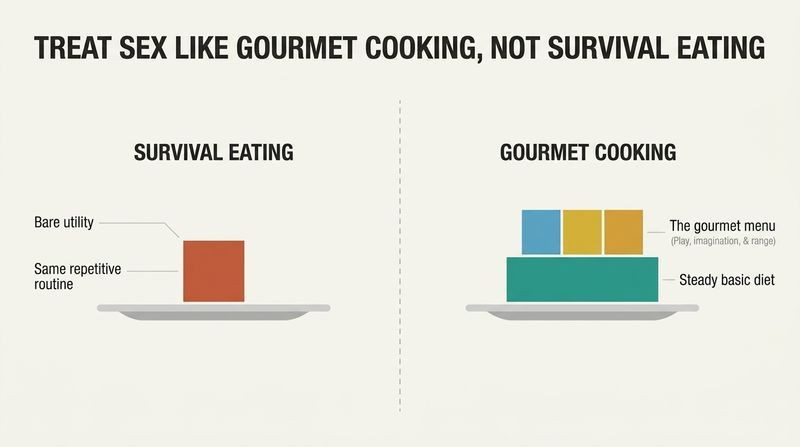
What's striking is how the culinary frame quietly smuggles in a philosophy of abundance rather than performance. By reframing sex as play and craft rather than achievement, Comfort preempts the anxiety that plagues most sex manuals. The framing has aged well: modern sex therapists like Emily Nagoski echo it, arguing that pleasure, not function, should be the metric. The one limit worth flagging is that a cookbook implies technique solves everything, when the book itself concedes tenderness cannot be taught. The recipes are necessary but never sufficient.
Reliable contraception, not frankness, caused the real sexual revolution
Separating reproduction from recreation changed behavior. Comfort argues that sexual behavior itself barely shifts across centuries. What changes is candor. The genuine transformation of his era came from the contraceptive pill, which for the first time let couples enjoy extended, unanxious sexual play without fear of pregnancy. Before that, as the old saying went, people sowed wild oats on Saturday and prayed for crop failure on Sunday.
The book itself was born from repression lifting. Comfort describes a two-hundred-year Sexual Official Secrets Act, where even in 1950s Britain pubic hair was airbrushed out of images. His predecessor was prosecuted for a low-key, unillustrated book. Joy appeared just as this froze thawed, and there was still doubt it might be banned. It went on to sell 8.5 million copies in fourteen languages.
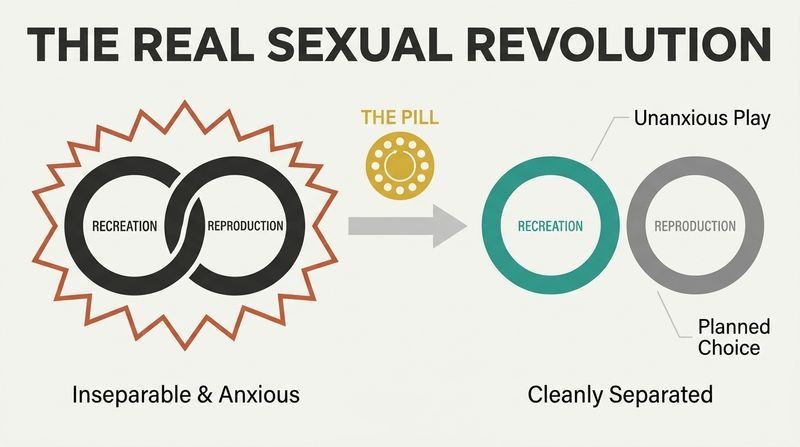
The claim that contraception, not permissiveness, drove change is a shrewd materialist argument that anticipates historians like Hera Cook, who tied Britain's sexual shift directly to fertility control. It challenges the popular myth that the sixties were mostly about attitude. Yet the update by Susan Quilliam complicates the optimism: the same freedoms produced new anxieties, from performance pressure to record STD rates. The technology that liberated desire also, arguably, commodified it. Freedom and neurosis, it turns out, arrived on the same delivery truck.
Sex is adult play, and refusing to play keeps us anxious
Playfulness is a developmental necessity, not a frivolity. Comfort argues that coital play, like childhood games or dreaming, is how humans safely process aggression, fear, and fantasy. Adults grow self-conscious about dressing up and acting scenes because something embarrassing might escape. His prescription: grow backwards into an adult context. Be the sultan, the burglar, the slave, or anything that turns you both on. Bed is the sanctioned place to act out what daylight forbids.
The rules are the rules of child's play. If a game turns nasty, spiteful, or unhappy, stop it. While it stays wild and joyful, it carries a payoff children's games lack. Comfort believed that if adults could shed shame about these immature needs, society would harbor far fewer deeply anxious people.
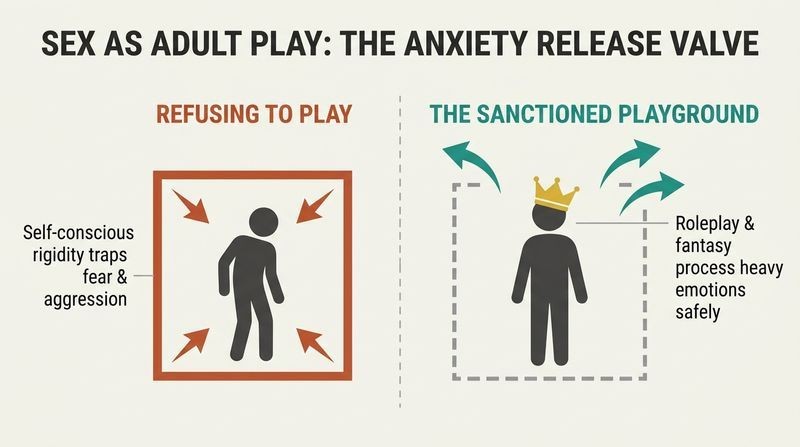
This anticipates by decades the therapeutic mainstream. Esther Perel now argues almost identically that eroticism thrives on imagination, role, and the suspension of the mundane self. Comfort's framing draws on ethology, which was replacing psychoanalysis in his day, treating play as an evolved behavior rather than a symptom. The bolder claim, that sexual play reduces general anxiety, is harder to prove and edges toward wishful universalism. Not everyone finds role-play liberating; for some it induces the very self-consciousness it aims to dissolve. Still, the reframe from moral test to playground remains genuinely disarming.
Men and women run on different sexual operating systems
Male arousal is concrete; female arousal is situational. Comfort presents parallel chapters, one written as a woman advising men, one as a man advising women. His model: male response is brisk and automatic, triggered by objects like a coin in a vending machine, centered heavily on the penis. Female response is keyed to who is doing what, unfolds through skin and breasts first, and cannot be short-circuited by a direct grab at the clitoris.
The fix is empathy and initiative, not assumption. Women are told men often just want to be held and relieved of always having to perform. Men are told that what women value most is intuition and direct initiative, the divine gift of lechery. Crucially, women differ from each other far more than men do, so never assume last partner's technique transfers.
The vending-machine model captures a real average difference in desire responsiveness, echoed in later research on spontaneous versus responsive desire. But framing it as a fixed male/female binary is the book's most dated move. Nagoski's work shows responsive desire is common in men too, and the variation within each sex often exceeds the variation between them. What rescues the chapter is its insistence on asking rather than presuming, and its quiet radicalism for 1972: it explicitly tells men to stop performing and let themselves be nurtured, dismantling the stud-bull ideal decades before it became fashionable.
For most women, the clitoris, not intercourse, delivers orgasm
Anatomy settles an old argument. Australian urologist Helen O'Connell's research revealed the clitoris is far larger than assumed: what shows on the surface is a fraction of an organ that runs deep into the pelvis, made of the same erectile tissue as the penis, with a shaft, glans, and foreskin, and roughly twice the nerve endings. It is the only human organ built purely for pleasure.
So drop the hierarchy of orgasms. Comfort and Quilliam reject the old Freudian claim that a vaginal orgasm signals mature sexuality. Most women climax easily from clitoral stimulation but only sometimes, and with effort, through penetration alone. The practical answer for most couples is to combine: choose positions like the Coital Alignment Technique or rear entry that allow hand or vibrator access to the clitoris during intercourse.
This section quietly corrects a century of harmful theory. Freud's designation of the clitoral orgasm as immature sent generations of women to therapists feeling defective. O'Connell's late-1990s dissections, arriving in medical literature astonishingly late, confirmed what women reported all along. The comparison the book makes is sharp: insisting a woman should climax from penetration alone is like insisting a man should climax from having his testicles pulled. The deeper lesson is epistemological, a reminder that authoritative science long ignored female testimony in favor of elegant male theory, and that lived experience deserved evidentiary weight sooner.
A woman's natural scent is a seduction weapon, so stop deodorizing it
Cassolette means perfume box. Comfort's term for a clean woman's natural body scent, which he calls her greatest sexual asset after her beauty. It emanates from hair, skin, armpits, and genitals, is unique to each person, and works through pheromones that attract and relax a partner, often below conscious awareness. Many people, he notes, decide bed or not-bed by letting their noses lead.
Our deodorant culture sabotages this. Comfort argues a mouthful of aluminium chloride in an armpit is one of bed's biggest disappointments, and a truly deodorized partner is another. His counsel: soap and water, not perfume and antiperspirant. Don't douche, which strips both healthy secretions and attractant pheromones. If a partner's scent genuinely turns distasteful long-term, it may signal emotional distaste or infection worth taking seriously.
The pheromone science here is more contested than the confident prose suggests; human pheromone effects remain scientifically murky, with vomeronasal organ function debated. Yet the broader point stands on firmer ground: olfaction is deeply wired to attraction and memory via the limbic system, and studies on scented T-shirts show people can detect immune-system compatibility through smell. The genuinely subversive move is cultural criticism. A multibillion-dollar hygiene industry has taught people to erase precisely the signals that bond them. Comfort's chef's analogy lands: intimate deodorants are like putting peach sauce on scampi, masking the very flavor you came for.
Penis size barely matters, and the anxiety is an optical illusion
The obsession is a dominance signal misread. Comfort treats male size worry as the counterpart to female breast anxiety: a status instinct, like a deer's antlers, with almost no bearing on function. The average erect penis is just over five inches, thickness matters more than length, and since only the first few inches of the vagina are truly sensitive, smaller can work as well or better. Flaccid size predicts nothing about erect size.
Men literally see the problem wrong. He offers a neat explanation for why the anxiety persists: a man views his own penis foreshortened from above, and other men's from the front, so his always looks smaller by comparison. No lotion, exercise, or surgery reliably enlarges anything. The advice: she should never comment except favorably, he should stop giving it a thought.
The perspective-distortion insight is genuinely useful and empirically plausible; the viewing-angle bias is real. Contemporary research backs the deflation: large studies find most women rate size as low-priority, and men consistently overestimate what partners want. Where the book could go further is acknowledging that size anxiety is increasingly manufactured by pornography's selection effects, presenting outliers as norms. The chapter's value is therapeutic reframing, treating a felt inadequacy as a cognitive error rather than a physical fact. It models a useful move: when an anxiety resists reassurance, interrogate whether the perception itself is systematically skewed.
Everyone carries a private sex map, so map your partner's
We are born sexual but not identical. Borrowing sexologist John Money's concept of a love map, Comfort and Quilliam describe how each person develops a unique mental template of the ideal lover and act, shaped by early messages, emotional events, and culture. On one level it doesn't matter whether you can swing from chandeliers. On another it matters enormously, because these maps silently drive what arouses and repels us.
Distorted maps breed disappointment. People absorb false beliefs: that men are always instantly hard, that good sex happens spontaneously without effort. Because maps operate outside awareness, we can hold unrealistic expectations and never notice. The remedy is knowledge and disclosure. Explore each other's likes, fears, and dreams openly, because you cannot assume a partner knows yours unless told, nor that you know theirs.
The sex-map concept usefully externalizes desire as a knowable object rather than a moral verdict, which lowers the stakes of disclosure. It aligns with modern attachment and schema theory: our erotic templates often encode early relational history. The book pairs this with a strong evidence-based aside, that comprehensive sex education raises the age of first intercourse and reduces partners and risks, directly countering the intuition that information encourages promiscuity. This finding, well replicated since, is one of the adaptation's most policy-relevant claims. The map metaphor's limit: templates are more malleable than cartography implies, redrawn by each significant partner.
Restraint and blindfolds amplify sensation by removing control
Bondage is about surrender, not coercion. Comfort presents ligottage, the French term for tying up a partner, as a mainstream technique for boosting orgasm, not overcoming reluctance. Citing Havelock Ellis, that restraint of muscular and emotional activity heightens sexual excitement, he explains that helplessness lets people let go completely. The tied partner gets what he calls the sensation of becoming one enormous penis, freed of all performance anxiety; the active partner controls the entire pace of arousal.
Safety converts risk into play. The book codifies rules that predate the modern safe, sane, consensual creed: agree a safe word beforehand, never block an airway, never tie anything around the neck, use quick-release knots, never leave someone helpless alone, and never combine with real anger, drugs, or excess alcohol. Blindfolds work similarly, focusing four senses by killing one.
This is remarkably progressive for 1972, normalizing kink within loving relationships years before mainstream culture caught up. The psychological mechanism it names, that surrendering control paradoxically increases pleasure, is echoed in modern research on flow states and the relief of ceding agency. Roy Baumeister's work on masochism frames it as escape from self-awareness, aligning neatly with the become-one-enormous-penis image. The safety framework is genuinely responsible and predates formalized community ethics. The one caution the book itself stresses, subtract twenty percent from any stated fantasy intensity, encodes real wisdom: imagined and enacted desire diverge, and negotiation must be continuous, not one-time.
The best sex arrives with age, not youth
Function need not fade. Comfort insists the only thing age does to sex is teach you more. About half of couples over sixty-five make love regularly, a higher share than when the book first appeared. The things that stop older people from sex are the same that stop them cycling: bad health, thinking it looks silly, or no partner, and these simply arrive later than we assume. Men's erections come less spontaneously and ejaculation slows, which he reframes as an advantage.
Menopause can unleash desire. As estrogen drops while testosterone stays high, some women discover a lust lasting months or years, a second adolescence. Culture, not biology, sets the ceiling: 90 percent of older French women think sex matters versus 30 percent of British women. The one rule: never stop for long, or restarting gets hard.
The book's optimism is now well supported by gerontology and by the reframing of aging sexuality as a use-it-or-lose-it system, where vascular and hormonal health respond to activity. The France-versus-Britain statistic makes a sharp point, that much decline is scripted by cultural expectation rather than physiology, an idea consistent with cross-cultural studies of aging attitudes. The chapter also delivers a public-health nudge the young rarely hear: a sixty-year-old new partner may pose more STD risk than a twenty-year-old, given more accumulated history. The deeper argument is that intimacy built on shed insecurity, not hormonal surges, is the mature form of desire.
Never fake orgasm, because the lie compounds into permanent silence
Faking builds a prison. Quilliam's counsel to women is blunt: don't. It is hard to do convincingly, since few can fake vaginal contractions and none can produce the telltale flush on breasts and neck. Worse, a single performance sets up a future of self-denial and deceit. The more you fake, the harder it becomes to unfake, and the harder to ask for what you actually need. The same applies to men, who sometimes fake to spare a partner's feelings.
Honesty is the only path to fixing it. In a loving relationship it should be fine to climax only occasionally and still be loved. If you want more, the route is showing, not just telling, a partner what works, since what she needs may not match what he assumes. Fear can literally block climax; neuroscience shows the brain's fear centers must switch off.
The neuroscience cited, Gert Holstege's imaging showing deactivation of fear and anxiety regions during female orgasm, gives the psychological advice a physiological spine: performance monitoring is not just unhelpful but mechanically obstructive. The anti-faking argument is essentially about information integrity in a feedback system; a lie corrupts the data both partners need to improve. This reframes honesty as practical engineering rather than moralism. Behavioral economics would call faking a short-term reward that incurs compounding long-term cost, a trap of accumulating commitment to a false signal. The prescription to show rather than tell also respects that erotic knowledge is often tacit, transmitted better by demonstration than words.
Refuse mediocre sex, and always keep somewhere new to go
Novelty is the antidote to erotic decay. The closing argument confronts biology directly: evolution programs desire only until genes combine and offspring are self-sufficient, setting no target for the long-term couple. But humans are more than genes. The first move against decline is refusing the comfortable, familiar routine that has always worked, except on tired occasions. Challenge routines as an act of love, and reject the belief that any relationship is too old or too long to be daring.
Desire must be updated as you change. Anthropologist Helen Fisher notes that novelty activates the same brain circuits as romantic passion, so trying new variations can replicate early infatuation. The deeper courage is admitting your tastes have shifted over years and saying so aloud. The whole book distills to two phrases worth repeating to a partner: I really want you to, and Yes.
Fisher's neurochemistry gives the advice teeth: novelty spikes dopamine, the same system underlying early-stage romantic obsession, which is why shared new experiences can genuinely reignite bonded couples. This aligns with self-expansion theory in relationship psychology, where couples who do novel, challenging activities together report higher satisfaction. The book's final reframe, that erotic maintenance is ongoing labor rather than a fixed state achieved once, mirrors what marriage researchers now call the difference between passion as event and passion as practice. The vulnerability it demands, confessing changed desires to a long-term partner, is the hardest and most valuable instruction in the volume.
Analysis
The Joy of Sex is best understood as a cultural artifact that became a practical one. Alex Comfort, a physician, anarchist, and gerontologist, wrote it as human natural history, treating sexuality with the same unbothered curiosity a naturalist brings to birdsong. Its genius was tonal: where prior sex writing was clinical, coy, or prosecutable, Comfort was warm, literate, and permission-giving. The cookbook structure was not mere gimmick but argument, that pleasure is a craft to be cultivated on a foundation of love, and that variety is optional seasoning rather than obligation. This distinguishes it from performance-obsessed successors.
The 2008 reinvention by Susan Quilliam reveals how much and how little dates. The anatomy updated (O'Connell's clitoral research), the epidemiology hardened (HIV, STD rates), and the technology arrived (teledildonics, internet dating). What survives untouched is the ethical core: consent, tenderness, equality, and the insistence that sex be unanxious. What ages awkwardly is the confident gender binary, the vending-machine model of male desire, which contemporary sexology (Nagoski, Basson) has softened into the more accurate spontaneous-versus-responsive framework that cuts across sexes.
The book's enduring contribution is philosophical, not technical. Its positions predate and predict the therapeutic consensus: that shame is the enemy, that female pleasure is not derivative of male pleasure, that kink belongs within loving relationships, that aging enhances rather than ends eroticism, and that honesty is the operational prerequisite for good sex. Comfort's anarchism shows in his refusal to legislate: two rules only, enjoy and attend to your partner, everything else a menu.
The limitation is scope. It assumes a stable, loving, monogamish dyad and offers less to those navigating trauma, mismatched desire, or dysfunction, wisely redirecting them to professionals. It is a book about flourishing, not repair. As such it remains a rare thing: a manual whose deepest lesson is an attitude, that sex is serious play between equals, and that the anxious modern reader's real task is to get unscared.
Review Summary
The Joy of Sex received mixed reviews, with an average rating of 3.62/5. Many praised its groundbreaking nature and helpful information for couples, while others criticized it as outdated and heteronormative. Readers appreciated the tasteful illustrations and matter-of-fact approach to sex education. Some found it too basic or vanilla, while others valued its focus on love and tenderness. The book's cultural impact was noted, with many recalling finding hidden copies as teenagers. Overall, it remains a classic guide to sexual exploration for committed couples.
People Also Read








FAQ
What is The Joy of Sex by Alex Comfort about?
- Comprehensive sexual guide: The Joy of Sex is an illustrated manual that explores human sexuality, covering anatomy, arousal, sexual techniques, and relationship dynamics.
- Emphasis on pleasure and play: The book treats sex as a form of adult play, encouraging experimentation, role-play, and open-mindedness to enhance intimacy and joy.
- Historical and cultural impact: Originally published in 1972, it broke taboos around sexual information and has been updated to reflect modern science and social changes.
- Focus on love and respect: It highlights the importance of tenderness, mutual respect, and communication in sexual relationships.
Why should I read The Joy of Sex by Alex Comfort?
- Expert, optimistic guidance: Written by a physician and human biologist, and updated by a psychologist, the book offers authoritative, scientifically grounded advice with a positive outlook on sexuality.
- Addresses modern realities: It reflects advances in physiology, psychology, and social attitudes, including gender equality, diverse practices, and technology’s role in sex.
- Encourages exploration and communication: The book supports open dialogue, experimentation, and inclusivity, making it valuable for couples at any stage.
- Enduring popularity: With over 8.5 million copies sold, its practical and non-judgmental approach has helped generations of readers.
What are the key takeaways from The Joy of Sex by Alex Comfort?
- Sex as play and connection: Sex is presented as a deeply rewarding, playful, and mutually satisfying experience, not just a biological act.
- Tenderness and feedback: Constant awareness of a partner’s feelings and open feedback are essential for mutual satisfaction.
- Variety and imagination: The book encourages using different techniques, positions, and accessories to keep sex exciting and fulfilling.
- Sexual confidence and acceptance: Building confidence, accepting one’s body, and overcoming insecurities are central to sexual happiness.
What are the most memorable quotes from The Joy of Sex by Alex Comfort and what do they mean?
- “Make love, not war.” This quote underscores the book’s advocacy for sexual freedom and happiness as a social good.
- “Sex is no longer what men do to women and women are supposed to enjoy.” It highlights the shift toward sexual equality and mutual pleasure.
- “There are only two ‘rules’ in good sex: Don’t do anything you don’t really enjoy, and find out your partner’s needs and don’t balk at them if you can help it.” This encapsulates the book’s approach to consent, communication, and mutual satisfaction.
- “The clitoris is the only human organ designed purely for pleasure.” This corrects historical neglect of female pleasure and advocates for informed, attentive lovemaking.
How does The Joy of Sex by Alex Comfort describe male and female anatomy and sexual response?
- Detailed anatomy coverage: The book explains the structure and sensitivity of sexual organs, including the vulva, clitoris, penis, breasts, and erogenous zones.
- Gender differences in arousal: Women’s sexual triggers are often more situational and emotional, while men’s are more genital and performance-centered.
- Hormonal influences: Testosterone, oxytocin, and prolactin are discussed for their roles in desire, bonding, and post-orgasmic states.
- Correcting misconceptions: The book addresses and dispels common myths and taboos about sexual anatomy and pleasure.
What are the key sexual positions and techniques described in The Joy of Sex by Alex Comfort?
- Classic and advanced positions: The book covers positions like the matrimonial (man-on-top), upper hands (woman-on-top), and rear entry, each with tips for maximizing pleasure and comfort.
- Special techniques: Methods such as the Coital Alignment Technique (CAT) and pompoir (pelvic floor muscle control) are introduced to enhance orgasmic potential.
- Emphasis on variety: Couples are encouraged to try new positions and techniques, adapting to their preferences and physical needs.
- Safety and communication: The book stresses gradual entry, control, and open discussion to avoid discomfort or injury.
How does The Joy of Sex by Alex Comfort address sexual confidence and overcoming insecurities?
- Confidence as a self-fulfilling prophecy: Relaxation, self-knowledge, and resilience to failure are key to sexual confidence, which is distinct from arrogance.
- Body acceptance: Readers are encouraged to love their bodies and focus on sensation and acceptance rather than appearance.
- Addressing performance anxiety: The book recommends loving-kindness, removing pressure, and gradual rebuilding of confidence through play and communication.
- Professional help: Persistent issues are best addressed with the support of medical or mental health professionals.
What practical advice does The Joy of Sex by Alex Comfort give on foreplay, non-penetrative activities, and sexual play?
- Foreplay as essential: Hand and mouth work, gentle touch, and gradual intensity are crucial for building arousal, especially for women.
- Exploring erogenous zones: The book suggests experimenting with nipples, ears, feet, and other sensitive areas, using feathers, ticklers, and body paints.
- Bridging to intercourse: Techniques like the "bridge" help link non-penetrative orgasm to penetrative climax, enhancing mutual satisfaction.
- Playfulness and variety: Role-play, toys, and accessories are encouraged to keep sex exciting and joyful.
How does The Joy of Sex by Alex Comfort address sexual health, safety, and contraception?
- Safe sex practices: Consistent condom use, especially with anal play, and proper hygiene are emphasized to prevent infections.
- Awareness of hazards: The book outlines a safety code for experimentation, including negotiation, safe words, and avoiding dangerous practices.
- Birth control options: Various contraceptive methods are reviewed, with advice on matching methods to individual needs and seeking expert guidance.
- Sexuality and health: The book affirms sexuality as a right for all, including those with illness or disability, and encourages adaptation and support.
What guidance does The Joy of Sex by Alex Comfort offer for overcoming premature ejaculation and other common sexual issues?
- Understanding causes: Premature ejaculation is often linked to anxiety and inexperience rather than purely physical factors.
- Training techniques: Men are advised to practice control through solo masturbation and gradual progression with a partner.
- Communication is key: Addressing relationship issues and emotional blocks is essential, with professional support recommended if needed.
- Practical solutions: The book offers exercises and techniques to build control and improve sexual satisfaction for both partners.
How does The Joy of Sex by Alex Comfort approach sexual preferences, orientation, and inclusivity?
- Wide sexual range acknowledged: The book recognizes that many people can respond sexually to either gender, with preferences often fluid and established early.
- No judgment or cure: Sexual orientation is not a choice and cannot be changed; honesty and acceptance are encouraged.
- Inclusion in sexual repertoire: Behaviors from across the spectrum can enrich relationships, and the book supports borrowing from other preferences within loving partnerships.
- Support for diversity: The updated edition addresses diverse sexual practices, gender equality, and the needs of LGBTQ+ readers.
What resources and support does The Joy of Sex by Alex Comfort provide for readers facing sexual difficulties?
- Comprehensive resource lists: The book includes contacts for organizations specializing in birth control, sexual health, LGBTQ+ support, and more.
- Guidance on seeking help: Advice is given on choosing self-help books, finding qualified therapists, and using help lines.
- Encouragement for joint problem-solving: Couples are encouraged to work together on sexual issues with openness and patience.
- Professional support: The book emphasizes the importance of comfort and rapport with professionals for persistent or complex issues.
Download PDF
Download EPUB
.epub digital book format is ideal for reading ebooks on phones, tablets, and e-readers.








































