

Key Takeaways
Men can orgasm without ejaculating — and do it repeatedly
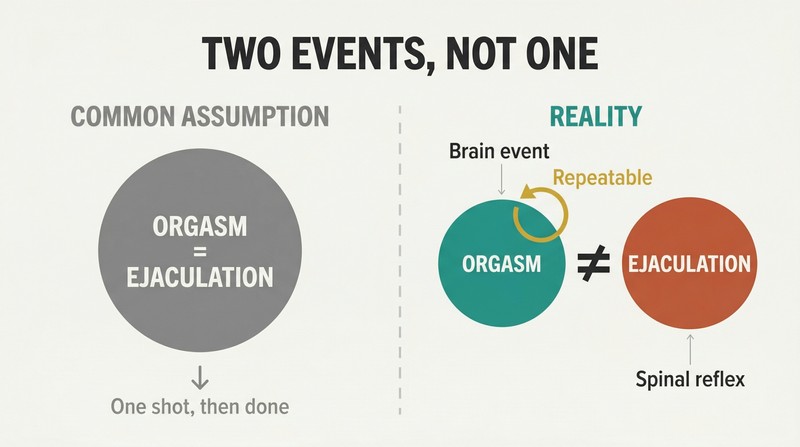
Orgasm and ejaculation are distinct. Orgasm is a peak emotional and neurological event involving whole-body contractions, elevated heart rate, and intense pleasure — primarily a brain phenomenon. Ejaculation is merely a reflex at the base of the spine that expels semen. The two happen within seconds of each other, so most men confuse them. But Kinsey's research found that over half of preadolescent boys could achieve multiple orgasms before they learned to ejaculate.
Lab evidence confirms this. Sexologists Hartman and Fithian tested 33 multi-orgasmic men and found their arousal charts were identical to those of multi-orgasmic women. These men averaged four orgasms per session — one had sixteen. The Taoist practice called Sexual Kung Fu teaches men to separate these two events, allowing orgasm without the energy crash of ejaculation.
Every ejaculation costs your body its finest energy
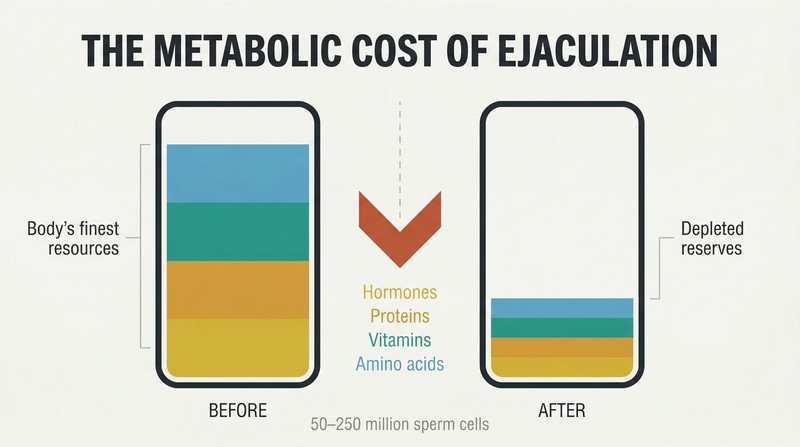
Sperm production is expensive. An average ejaculation contains 50 to 250 million sperm cells, each capable of creating half a human being. Your body pours its best resources — hormones, proteins, vitamins, amino acids — into this production. A University of Arizona nematode study reported in the New York Times found that worms allowed to mate without producing sperm lived over 50% longer than those that ejaculated freely.
Athletes and artists noticed centuries ago. The Taoists called ejaculation a betrayal of male vitality. The French called it "le petit mort" — the little death. Musicians, prizefighters, and marathon runners have long abstained before performances. According to the Tao, all organs contribute their "orgasmic energy" during ejaculation to create new life — and when procreation isn't the goal, that energy is simply wasted.
Belly breathing and PC squeezes are the two foundation skills
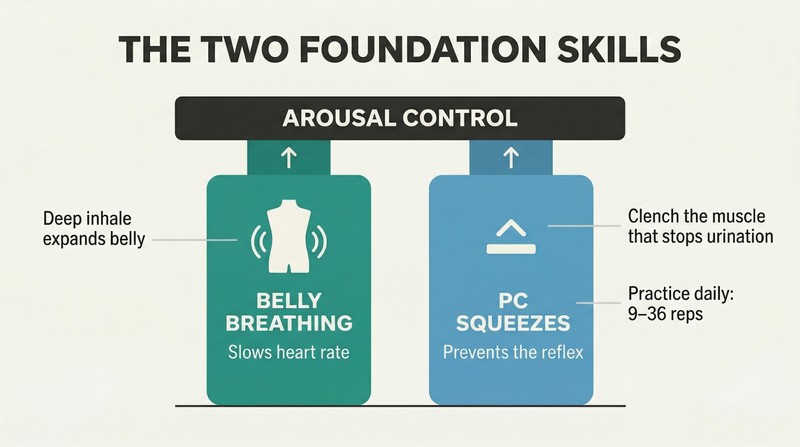
Breathing controls arousal. Slow, deep belly breathing — expanding the lower abdomen on the inhale, flattening it on the exhale — reduces heart rate and slows the sprint toward ejaculation. Most men breathe shallowly into their chest, especially during arousal. Learning to breathe into the belly like a sleeping newborn is the first step in gaining control.
The PC muscle is the master switch. The pubococcygeus muscle stretches from pubic bone to tailbone, encircling the prostate. It's the muscle you clench to stop urinating midstream, and it contracts involuntarily during orgasm. Strengthening it through daily "PC Pull-Ups" — contracting and releasing 9 to 36 times per session — gives you the ability to squeeze around the prostate and prevent the reflex from escalating into ejaculation. You can practice during red lights, boring meetings, or in bed.
Track your four stages of erection — awareness beats distraction
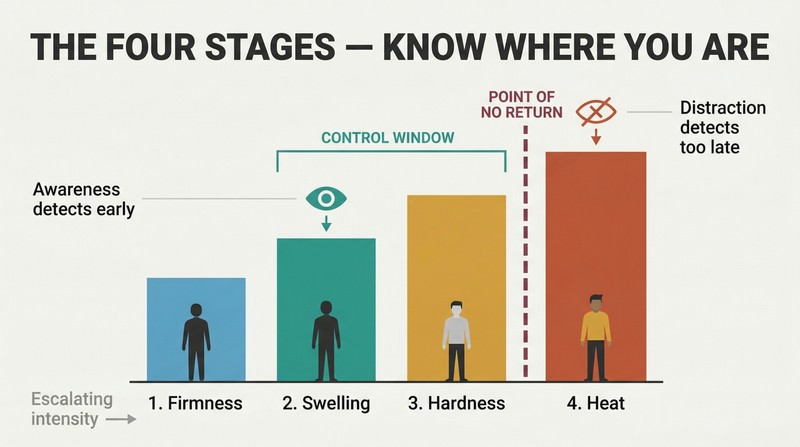
Four stages, not two. The Taoists identified four stages of erection — firmness, swelling, hardness, and heat — recently confirmed by Western physicians. The critical insight: ejaculatory control is far easier in the third stage (hard but not desperate). Once you hit the fourth stage — stiff, hot, testicles drawn up — ejaculation becomes nearly inevitable.
Distraction is the wrong strategy. Most men try to last longer by thinking about baseball statistics or work deadlines. This numbs sensation but paradoxically reduces control. True mastery comes from heightened sensitivity — learning to notice the tingling at the base of your penis, the tightening in your scrotum, the shift in your breathing. The more you feel, the earlier you can pull back from the edge.
Reframe self-pleasure as training — build to 15-20 minutes
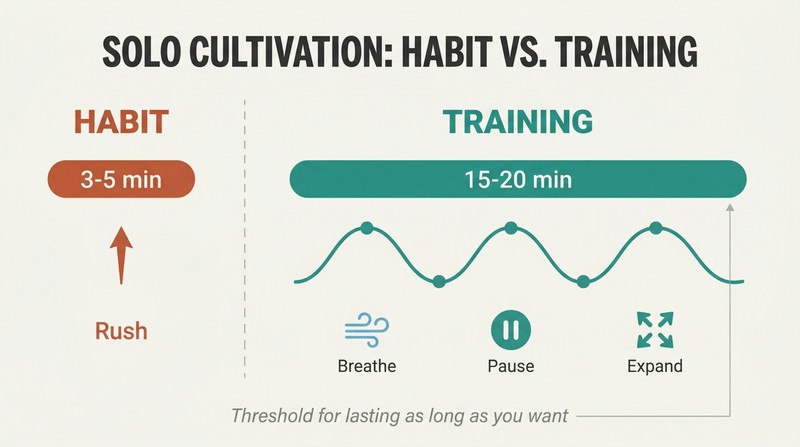
Solo practice is essential, not shameful. The Taoists called masturbation "solo cultivation" — a critical training ground for developing ejaculatory control and circulating sexual energy. Research from over a thousand cases found that men who can last 15 to 20 minutes during self-pleasuring can last as long as they want during intercourse. That threshold is the benchmark.
Slow down and expand. Most men masturbate in 3 to 5 minutes, conditioned by years of trying to finish before getting caught. Instead, use lubricant, stimulate the entire penis and scrotum (not just the head), explore the perineum, and practice stopping before the edge. When approaching orgasm, breathe deeply and squeeze your PC muscle. Try to feel the prostate contractions without tipping into ejaculation. One practitioner described it as "mentally falling backward into nonejaculatory orgasms instead of falling forward into ejaculation."
Draw sexual energy up your spine for whole-body orgasms
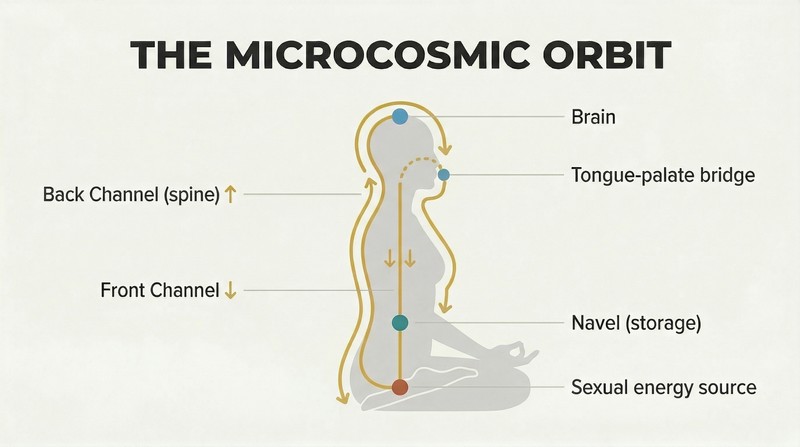
The Microcosmic Orbit is the highway. The body's main energy circuit runs up the spine (Back Channel) and down the front midline (Front Channel). By contracting the anus, perineum, and pelvic muscles while inhaling, you can pump sexual energy — what the Taoists called ching-chi — from your genitals up your spine to your brain. Touching your tongue to your palate completes the circuit, allowing energy to descend to your navel for storage.
Two key techniques make this practical. The Cool Draw moves unaroused sexual energy upward through gentle testicle breathing — useful anytime, anywhere. The Big Draw pumps highly aroused energy up through progressive muscle contractions during peak arousal. Men report warmth, tingling, and vibrating throughout their bodies — orgasms lasting minutes rather than seconds. As one practitioner described it: "My body was ringing like a bell."
Spiral your sacrum instead of jackhammering — learn to 'screw'
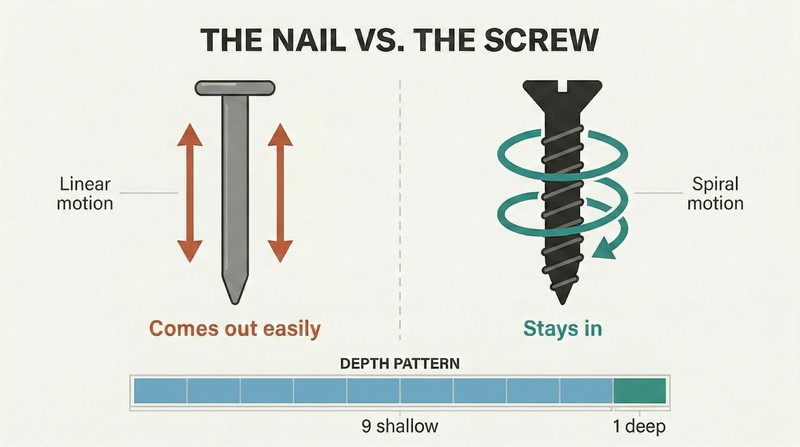
Vary depth with a pattern. The Taoists recommend nine shallow thrusts to one deep thrust. Shallow thrusts stimulate the nerve-rich outer two inches of the vagina while creating a vacuum that intensifies sensation. Deep thrusts push out remaining air. Never fully withdraw — stay about an inch inside to maintain the seal. As you gain control, shift to six or three shallow to one deep.
The up-down thrust is a game-changer. Instead of pulling back (rubbing the most sensitive head of your penis against her full vaginal length — a fast track to ejaculation), stay deep and thrust upward, pressing the base of your shaft against her clitoris. Your least sensitive spot meets her most sensitive spot. Advanced practitioners rotate the sacrum in half-circles, "screwing" into the vaginal walls from multiple directions.
Most women need clitoral stimulation during intercourse to orgasm
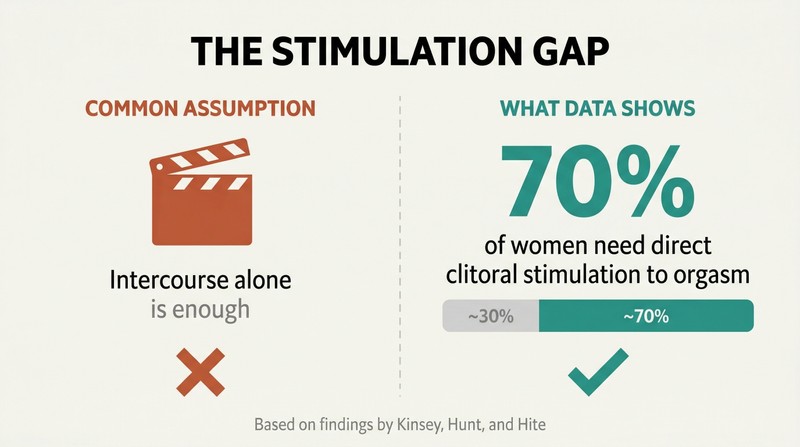
The data is clear. About 70% of women require direct clitoral stimulation to orgasm, yet the missionary position barely touches the clitoris. Kinsey, Hunt, and Hite all found that nearly half of American women rarely or never orgasm during intercourse alone. The clitoris is the only organ in either sex that exists exclusively for sexual pleasure — asking a woman to climax without stimulating it is like asking a man to finish without touching the head of his penis.
Use your hands and tongue. Coordinate finger strokes on her clitoris with your thrusting rhythm. Woman-on-top positions let her direct your penis to her most sensitive spots, including the G-spot (1.5 to 2 inches inside on the front wall). Oral sex — light, consistent, rhythmic tongue pressure — is often the fastest path to her arousal. Begin at her extremities and spiral inward; never rush to the genitals.
Exchange energy with your partner through gaze and synchronized breath
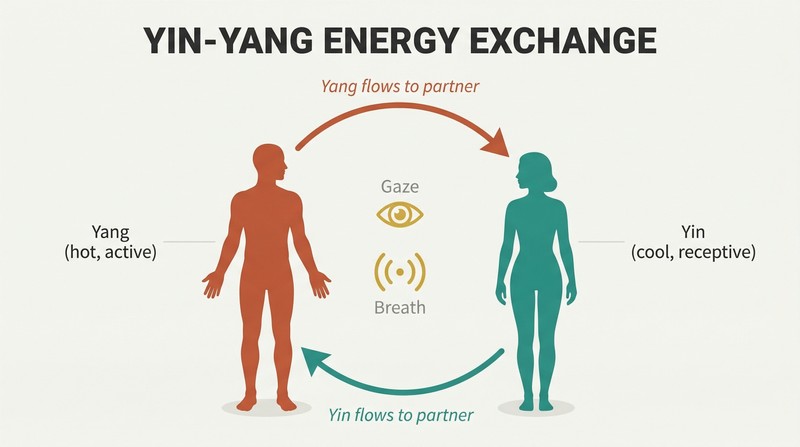
Soul-Mating transforms sex into spiritual practice. The Taoist couples exercise involves face-to-face embrace with maximum body contact, deep eye contact, and synchronized breathing — inhaling and exhaling together, or one inhaling as the other exhales. You draw your partner's cool yin energy from her vagina through your penis, up your spine to your brain. She draws your hot yang energy the opposite direction. The exchange happens through genitals, tongues, and even heart-to-chest contact.
Yin and yang seek balance. Men tend to carry more yang (active, volatile) energy; women more yin (receptive, sustained). During this exchange, each partner's excess is absorbed by the other, creating equilibrium. With practice, couples report feeling energy circulating through both bodies simultaneously — a fusion the Taoists consider the true meaning of "becoming one flesh."
Non-ejaculatory sex keeps the spark alive for decades
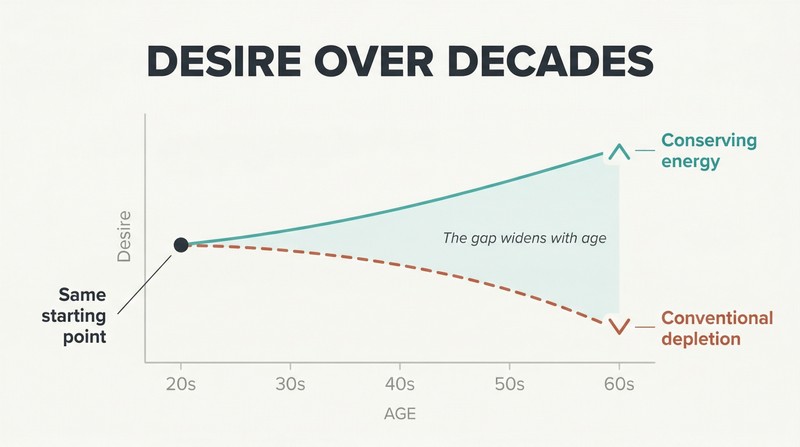
Ejaculatory sex erodes attraction. According to Taoism, the magnetic pull between partners depends on the yin-yang polarity between them. Every time a man ejaculates, he depletes his yang charge — gradually flattening the electrical difference that creates desire. This is one reason passion fades in long-term relationships. Non-ejaculatory lovemaking maintains the charge, keeping attraction intense year after year.
Aging improves your practice, not hinders it. Half the men in Dunn and Trost's study became multi-orgasmic after age 35, some between 45 and 55. Older men naturally maintain erections longer — an advantage for this practice. The ancient physician Sun Ssu-miao, who lived to 101, recommended decreasing ejaculation frequency with age: every 4 days in your 20s, every 10 days at 40, and not at all by 60. The pleasure doesn't decrease — it deepens.
Analysis
Mantak Chia's 1996 book occupies a fascinating position at the intersection of ancient Chinese medicine, modern Western sexology, and the self-help genre. Its central claim — that male orgasm and ejaculation are neurologically and physiologically distinct — has gained increasing support from researchers like Hartman, Fithian, and others studying male sexual response. The book effectively bridges two epistemological traditions: Taoist energy medicine (chi, meridians, the Microcosmic Orbit) and empirical sex research (Kinsey's data, lab-measured heart rates, pudendal and pelvic nerve pathways).
What makes the book genuinely subversive is its implicit critique of Western sexual culture's performance model. Where mainstream sexology pathologizes 'premature ejaculation' and treats impotence as dysfunction, Chia reframes both as symptoms of a single paradigm error — treating ejaculation as the goal rather than an optional (and usually counterproductive) endpoint. This is remarkably aligned with contemporary mindfulness-based sex therapy, which emphasizes interoceptive awareness over distraction techniques.
The book's empirical weaknesses are real. The nematode-to-human extrapolation is speculative. The chi framework remains unfalsifiable by Western scientific standards. Most 'evidence' comes from anonymous testimonials. Yet the practical exercises — PC muscle strengthening, controlled breathing, arousal tracking, the stop-start method — parallel evidence-based techniques in modern urology and sex therapy, suggesting the Taoists may have discovered effective interventions through millennia of observation, even if their explanatory framework differs from biomedicine.
Perhaps most relevant today is the book's relational vision: that sustained intimacy requires energetic conservation, not just emotional communication. In an era of declining sexual satisfaction in long-term relationships, this ancient framework offers a genuinely different — and potentially powerful — alternative to the exhaustion cycle most couples accept as inevitable.
Review Summary
The Multi-Orgasmic Man receives generally positive reviews, with readers praising its potential to enhance sexual experiences and overall well-being. Many find the book enlightening and life-changing, appreciating its practical techniques and positive approach to sexuality. Some readers express skepticism about the Taoist energy concepts, while others embrace them. Critics note the book's focus on pseudoscientific ideas and unnecessary complications. Overall, readers recommend it for those seeking to improve their sexual health and relationships, though some find the content controversial or humorous.
People Also Read


Glossary
Sexual Kung Fu
Taoist sexual practice systemThe overarching Taoist system of sexual practices taught in this book. 'Kung fu' literally means 'practice,' so Sexual Kung Fu means 'sexual practice.' It encompasses techniques for separating orgasm from ejaculation, circulating sexual energy through the body, and using sexuality for health, longevity, and spiritual growth. Developed as a branch of Chinese medicine over thousands of years.
Ching-chi
Sexual energy or life-forcePronounced 'JING-CHEE,' this is the Chinese term for sexual energy — one of the most powerful types of bioelectric energy in the body. What Westerners call 'getting aroused' or 'getting horny,' the Taoists understood as the generation of ching-chi. Sexual Kung Fu practices are based on cultivating this energy and circulating it through the body rather than expelling it through ejaculation.
Chi
Bioelectric energy in the bodyPronounced 'CHEE,' chi is the fundamental bioelectric energy that circulates through every cell of the body according to Chinese medicine. At least 49 cultures worldwide have a word for this concept (prana in Sanskrit, for example). Chi travels along defined circuits called meridians, which acupuncture utilizes. Sexual energy (ching-chi) can be refined into this more neutral, stable form of energy through Taoist practices.
Microcosmic Orbit
Main energy circuit in bodyThe primary energy pathway in the body, consisting of two channels: the Back Channel (running from perineum up the spine to the crown of the head and down to the upper lip) and the Front Channel (running from the tongue down the midline of the body to the perineum). Touching the tongue to the palate connects these two channels, completing the circuit. Sexual energy is drawn up the Back Channel and stored at the navel via the Front Channel.
Cool Draw
Unaroused sexual energy circulationAlso called 'testicle breathing,' this is the technique for drawing sexual energy from the testicles up through the spine to the brain when not highly aroused. The practitioner inhales while gently pulling up on the muscles around the testicles, perineum, and anus, sipping the energy upward. Used anytime and anywhere to relieve sexual frustration, increase creative energy, or prepare for the more intense Big Draw.
Big Draw
Aroused sexual energy circulationThe advanced technique for pumping highly aroused sexual energy away from the genitals and up through the spine to the brain during peak arousal or orgasm. Involves progressive muscle contractions — PC muscle, anus, buttocks, and spinal muscles — combined with mental focus to redirect energy upward. This is the core technique for experiencing whole-body orgasms and preventing ejaculation during intense arousal or lovemaking.
Finger Lock
Emergency ejaculation-blocking techniqueA technique for stopping semen from leaving the body after passing the 'point of no return.' The practitioner presses three middle fingers firmly into the Million-Dollar Point on the perineum while contracting the PC muscle, blocking the urethra during ejaculatory contractions. Used as a safety net when the Big Draw fails. The man still loses his erection but conserves most of his semen and sexual energy.
Million-Dollar Point
Key perineum pressure pointA specific spot on the perineum just in front of the anus, originally called the 'Million-Gold-Piece Point' because that's what ancient Taoist masters charged to reveal its location. Pressing this indentation can delay ejaculation by interrupting the ejaculatory reflex and focusing attention. It also serves as the pressure point for the Finger Lock technique. Can be stimulated rhythmically to mimic prostate contractions during orgasm.
Contractile-phase orgasm
Pre-ejaculatory orgasmic contractionsThe pleasurable involuntary contractions of the prostate, PC muscle, and anal sphincter that occur just before ejaculation — felt as a popping or fluttering sensation in the prostate lasting 3 to 5 seconds. This is the critical fork in the road: one path leads to ejaculation, the other to non-ejaculatory multiple orgasms. Learning to experience and enjoy these contractions without tipping into ejaculation is the gateway to becoming multi-orgasmic.
PC muscle
Pelvic floor muscle groupThe pubococcygeus muscle (pronounced PEW-bo-cox-uh-GEE-us), a group of muscles stretching from the pubic bone to the tailbone that encircles the prostate, urethra, and anus. It controls urine flow, contracts during orgasm, and serves as the primary valve for ejaculatory control. Strengthened through 'PC Pull-Ups' — repeated contracting and releasing — and originally identified in the West through Arnold Kegel's exercises for women.
Soul-Mating
Partner sexual energy exchangeThe Taoist couples practice for exchanging sexual energy between partners. Involves face-to-face embrace, sustained eye contact, synchronized breathing, and circulating energy through both partners' Microcosmic Orbits simultaneously. The man draws the woman's cool yin energy from her vagina through his penis and up his spine; the woman draws his hot yang energy the opposite direction. Aims to produce a fusion of physical, emotional, and spiritual energy between lovers.
FAQ
What's The Multi-Orgasmic Man about?
- Exploration of Male Sexuality: The book explores the idea that men can experience multiple orgasms, similar to women, by understanding the difference between orgasm and ejaculation.
- Taoist Sexual Practices: It introduces Taoist techniques for cultivating sexual energy, enhancing intimacy, and achieving greater sexual satisfaction without the depletion that often follows ejaculation.
- Health and Longevity: Mantak Chia discusses how conserving sexual energy can lead to improved health and vitality, drawing on ancient wisdom and modern research.
Why should I read The Multi-Orgasmic Man?
- Enhance Sexual Experience: The book provides practical techniques to help men experience deeper and more fulfilling sexual encounters, leading to greater intimacy with partners.
- Empowerment Through Knowledge: It educates readers about their bodies and sexual responses, empowering them to take control of their sexual experiences.
- Improved Relationships: By understanding and practicing the methods outlined, readers can improve their relationships through better communication and sexual satisfaction.
What are the key takeaways of The Multi-Orgasmic Man?
- Separation of Orgasm and Ejaculation: Men can learn to separate orgasm from ejaculation, allowing for multiple orgasms without the typical refractory period.
- Cultivation of Sexual Energy: Emphasizes the importance of cultivating sexual energy (ching-chi) and circulating it throughout the body for enhanced pleasure and health.
- Understanding Female Sexuality: Provides insights into female anatomy and arousal, encouraging men to be more attuned to their partners' needs and desires.
What techniques are introduced in The Multi-Orgasmic Man?
- Belly Breathing: This foundational technique helps men control their arousal and enhances their ability to separate orgasm from ejaculation by promoting relaxation and awareness.
- The Big Draw: A method for drawing sexual energy up the spine to enhance pleasure and prevent ejaculation, allowing for prolonged sexual experiences.
- Finger Lock: A technique to block ejaculation once the point of no return is reached, helping men maintain control during intercourse.
How does The Multi-Orgasmic Man define orgasm and ejaculation?
- Orgasm as a Whole-Body Experience: The book explains that orgasm involves the entire body, with various sensations and contractions occurring throughout.
- Ejaculation as a Reflex: Described as a reflex action that can be controlled, allowing men to experience orgasm without the loss of semen.
- Importance of Awareness: Understanding the distinction between the two is crucial for men to achieve multiple orgasms and enhance their sexual experiences.
What is the significance of the PC muscle in The Multi-Orgasmic Man?
- Key to Ejaculatory Control: The pubococcygeus (PC) muscle is essential for men to learn how to control ejaculation and enhance orgasmic experiences.
- Strengthening Techniques: The book provides exercises to strengthen the PC muscle, which can lead to stronger erections and more intense orgasms.
- Connection to Sexual Health: A strong PC muscle is linked to better sexual health and can help prevent issues such as erectile dysfunction.
What are the stages of male arousal discussed in The Multi-Orgasmic Man?
- Four Stages of Erection: The book outlines four stages: firmness, swelling, hardness, and heat, reflecting increasing levels of arousal in men.
- Awareness of Arousal Rate: Men are encouraged to become more aware of their arousal stages to better control their sexual responses and enhance pleasure.
- Connection to Orgasm: Understanding these stages helps men navigate their sexual experiences and achieve multiple orgasms.
How does The Multi-Orgasmic Man address female sexuality?
- Understanding Female Anatomy: Provides insights into female anatomy, including the clitoris and G-spot, emphasizing the importance of stimulating these areas for female pleasure.
- Encouraging Communication: Encourages men to communicate with their partners about their desires and preferences, fostering a more satisfying sexual experience for both.
- Recognition of Individual Differences: Acknowledges that every woman is different, highlighting the need for exploration and adaptability.
What are some common misconceptions about male sexuality addressed in The Multi-Orgasmic Man?
- Ejaculation as Inevitable: Challenges the notion that ejaculation is the only goal of male sexual activity, promoting the idea of multiple orgasms instead.
- Performance Anxiety: Addresses the pressure men often feel to perform, suggesting that focusing on pleasure rather than performance can lead to more satisfying experiences.
- Misunderstanding of Orgasm: Clarifies that many men equate orgasm solely with ejaculation, which limits their sexual potential and enjoyment.
What is Sexual Kung Fu as defined in The Multi-Orgasmic Man?
- Practice of Sexual Mastery: Sexual Kung Fu is the practice of mastering one’s sexual energy and abilities to enhance pleasure and intimacy.
- Integration of Mind and Body: Emphasizes the connection between physical sensations and mental focus, encouraging practitioners to be fully present during sexual experiences.
- Healing and Transformation: Suggests that Sexual Kung Fu can lead to healing on physical, emotional, and spiritual levels, promoting personal transformation.
What are the benefits of practicing the Big Draw in The Multi-Orgasmic Man?
- Enhanced Orgasms: Allows individuals to experience more intense and widespread orgasms by circulating sexual energy throughout the body.
- Control Over Ejaculation: Helps men learn to control their arousal and delay ejaculation, leading to longer and more satisfying sexual encounters.
- Increased Intimacy: Fosters a deeper emotional bond between partners by focusing on energy exchange and connection.
What are the best quotes from The Multi-Orgasmic Man and what do they mean?
- "Climax is clearly possible without ejaculation.": Emphasizes the core message that men can experience pleasure and orgasm without the need to ejaculate, opening the door to multiple orgasms.
- "The essence of foreplay is slowness.": Highlights the importance of taking time to build arousal and intimacy, leading to more fulfilling sexual experiences.
- "You can have an orgasm in your sleep.": Suggests that orgasm is a mental and physical experience that can occur independently of physical stimulation, reinforcing the idea that sexual pleasure is multifaceted.
About the Author
Download PDF
Download EPUB
.epub digital book format is ideal for reading ebooks on phones, tablets, and e-readers.








































