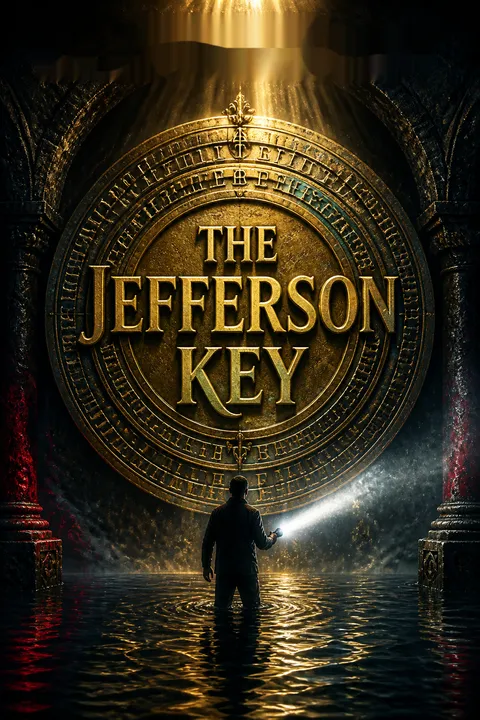

Plot Summary
Prologue: Jackson's Narrow Escape
In 1835, President Andrew Jackson faces an assassin's pistol after a funeral at the Capitol. The gun misfires, and Jackson, undaunted, charges his attacker. A second pistol also fails. The would-be assassin is subdued, but Jackson is convinced this was no random act—he suspects a conspiracy by traitors, not the ravings of a madman. This event marks the first attempt on a sitting American president's life, setting the stage for a secret war between the government and a shadowy group with roots in piracy and privateering. Jackson's resolve hardens, and he vows retribution, believing that the true enemy lurks in the shadows, plotting against the nation's unity.
A President Under Fire
In present-day New York, Cotton Malone is summoned by his former boss, Stephanie Nelle, to a hotel room overlooking a presidential event. He discovers a mysterious, automated weapon aimed at President Danny Daniels. As the president arrives, the device activates, firing at the motorcade. Malone intervenes, risking his life to disrupt the weapon's aim, saving Daniels. A second, deadlier device appears, but Malone's quick thinking averts disaster. Amid chaos, Malone becomes a suspect, forced to flee as the Secret Service and police close in. The attack's sophistication hints at a deeper conspiracy, and Malone is drawn into a deadly game where trust is scarce.
The Commonwealth's Secret Oath
Quentin Hale, head of a powerful family, oversees a centuries-old organization known as the Commonwealth, descended from American privateers and pirates. Bound by secret Articles, the Commonwealth's four families—Hale, Bolton, Cogburn, and Surcouf—have operated with a letter of marque from George Washington, granting them legal immunity to attack America's enemies. Now, under threat from the IRS and intelligence agencies, the Commonwealth faces extinction. Internal betrayal and external pressure mount, and Hale's ruthless enforcement of loyalty—including murder—reveals the group's willingness to do anything to survive, even as their pirate code collides with modern law.
The Assassin's Devices
The failed assassination attempt is traced to the Commonwealth, who, desperate to protect their fortunes and legacy, authorized the attack without Hale's knowledge. Clifford Knox, the quartermaster, orchestrates the operation, but a leak and interference from the National Intelligence Agency (NIA) foil their plans. The NIA, led by Andrea Carbonell, plays a dangerous double game, manipulating both the Commonwealth and the government. As the intelligence community fractures, old grudges and personal vendettas surface. Malone, now a fugitive, must navigate a labyrinth of shifting alliances, while the Commonwealth's internal divisions threaten to tear it apart.
Pirates in Modern America
The Commonwealth's history is revealed: their letters of marque, granted in perpetuity, allowed them to operate above the law for centuries. Presidents and governments have alternately used and tried to destroy them. The group's fortunes were built on sanctioned piracy, but as America modernized, their immunity became a legal gray area. Andrew Jackson's actions—removing congressional records of their authorization—left their legitimacy in doubt. Now, with the government closing in, the Commonwealth's leaders debate desperate measures, including blackmail and further violence. Their pirate heritage, once a source of pride, becomes a curse as the world changes around them.
The Cipher's Deadly Legacy
Central to the Commonwealth's survival is a cipher created by Thomas Jefferson and hidden by Jackson—a code that, if solved, reveals the location of the missing congressional pages legitimizing their letters of marque. For 175 years, the Commonwealth has failed to crack it. Now, with modern computing, the NIA's expert deciphers the code, setting off a race to retrieve the hidden documents. The solution points to Nova Scotia, where the pages are concealed in a pirate-era fort. The cipher's solution becomes the ultimate bargaining chip, coveted by all sides, and the quest for it turns deadly as alliances shift.
The Failed Assassination
The aftermath of the New York attack exposes fractures within the Commonwealth and the intelligence community. Malone, aided by Cassiopeia Vitt, evades capture and uncovers the depth of the conspiracy. Betrayals multiply: Knox turns informant to save himself, Carbonell manipulates events for her own gain, and the Commonwealth's captains turn on each other. The government, led by President Daniels and Chief of Staff Edwin Davis, struggles to contain the crisis without public scandal. As the cipher's solution emerges, the race to secure the missing pages intensifies, with each faction willing to kill to claim the prize.
The Hunt for Stephanie
Stephanie Nelle, investigating the NIA's ties to the Commonwealth, is kidnapped by Hale and held in the pirate compound in North Carolina. Cassiopeia, risking everything, infiltrates the estate to rescue her, while the government hesitates, wary of legal and political fallout. The compound becomes a battleground as NIA mercenaries attack, and Cassiopeia, Stephanie, and Shirley Kaiser (a key witness and former lover of Hale) fight for survival. The Commonwealth's brutal methods—torture, execution, and psychological warfare—are laid bare, and the cost of loyalty and betrayal is paid in blood.
Betrayals and Double Agents
Andrea Carbonell's duplicity is revealed: she manipulates the Commonwealth, the NIA, and even her own agents, sacrificing lives to cover her tracks. Knox, wracked by guilt and fear, tries to play all sides but is ultimately outmaneuvered. Jonathan Wyatt, a disgraced former agent, becomes a wild card, seeking redemption and revenge. The government's intelligence agencies, mired in rivalry and incompetence, are exposed as ineffective. As the search for the cipher's solution and the missing pages converges on Nova Scotia, the true nature of power, patriotism, and self-preservation is laid bare.
The Jefferson Cipher Unlocked
The Jefferson cipher, once thought unbreakable, is finally solved. The message leads to Paw Island in Mahone Bay, Nova Scotia, and the ruined Fort Dominion. There, beneath the fort, a deadly cat-and-mouse game unfolds as Wyatt, Knox, Carbonell, and Malone converge. The fort's flooded tunnels, booby-trapped and marked with pirate symbols, become a tomb for some. In the end, Wyatt finds the hidden glass case containing the missing congressional pages. Recognizing the danger of their existence, he destroys them, ensuring the Commonwealth's immunity is lost forever. The cycle of violence and secrecy is broken by a single act of conscience.
Monticello's Hidden Wheel
The cipher's solution requires Jefferson's original cipher wheel, housed at Monticello. As Malone and Cassiopeia race to retrieve it, Wyatt steals the artifact, triggering a high-stakes chase. A replica in the visitor center allows Malone to reconstruct the message, leading to the final confrontation in Nova Scotia. The wheel, a symbol of American ingenuity and secrecy, becomes the linchpin in a centuries-old struggle between law and lawlessness. The past and present collide as the legacy of the Founding Fathers is reinterpreted in the light of modern intrigue.
The Nova Scotia Revelation
In the flooded chambers beneath Fort Dominion, the final secrets are revealed. The missing pages, hidden for generations, are found and destroyed. Carbonell and Knox meet their ends, victims of their own ambition and treachery. Wyatt, having avenged his past and redeemed himself, disappears into the shadows. Malone survives, his sense of justice intact, and the government's last hope of controlling the Commonwealth vanishes. The fort, haunted by the ghosts of drowned prisoners and lost treasure, becomes the Commonwealth's grave. The age of pirates ends not with a bang, but with the quiet dissolution of their last secret.
The Pirate Compound Siege
Back in North Carolina, the Commonwealth's compound is besieged. Cassiopeia, Stephanie, and Shirley are captured, tortured, and threatened with death. Hale, desperate and unhinged, reenacts pirate punishments, forcing his enemies to witness brutality. The government, finally acting, launches a military assault. In a climactic battle aboard the yacht Adventure, Malone rescues Cassiopeia from a watery grave, and Stephanie and Shirley take revenge on Hale. The Commonwealth's power is shattered, its leaders dead or in custody, and their fortress reduced to ruins.
The Final Voyage of Adventure
Hale, clinging to his pirate identity, attempts to escape with his captives aboard Adventure. Malone's daring rescue and the arrival of military gunships end the Commonwealth's reign. The yacht is destroyed, Hale is killed, and the surviving crew is captured. The era of privateers, sustained by myth and secrecy, is finally extinguished. The government reasserts control, and the last vestiges of the pirate code are consigned to history.
The End of the Commonwealth
With the destruction of the missing pages, the Commonwealth's legal immunity is gone. The surviving captains are arrested, their fortunes seized, and their legacy erased. The intelligence community is forced to confront its failures, and the president vows reform. Personal reckonings follow: Daniels and his wife confront their grief and separation; Stephanie and Cassiopeia find closure; Malone and Cassiopeia look to the future together. The story ends with the recognition that the line between patriot and pirate is thin, and that the true treasure is the courage to do what is right, even when history is against you.
Aftermath and Reckoning
In the aftermath, the characters reckon with their choices. The president, freed from political constraints, acts decisively to end the threat. The intelligence agencies are shaken, and the lessons of secrecy, loyalty, and betrayal linger. The Commonwealth's story, once a proud chapter in America's fight for independence, becomes a cautionary tale about the dangers of unchecked power and the seduction of immunity. The survivors move on, scarred but wiser, as the nation turns the page on its pirate past.
Analysis
The Jefferson Key is a high-octane blend of historical intrigue and modern thriller, using the legacy of American privateers to explore questions of power, legitimacy, and the cost of secrecy. At its heart, the novel interrogates the myth of the "noble pirate"—those who, with government blessing, skirt the law for the greater good. Berry suggests that the line between patriot and criminal is perilously thin, and that the tools of yesterday's heroes can become today's threats. The cipher, both as a plot device and a symbol, represents the dangers of secrets kept too long: they breed corruption, paranoia, and violence. The novel's structure—alternating between action and reflection, past and present—mirrors the characters' psychological journeys, as they confront the legacies of betrayal, loss, and the need for redemption. Ultimately, The Jefferson Key is a meditation on the necessity of transparency, the perils of unchecked power, and the enduring human struggle to balance loyalty with justice. Its lesson is clear: history's shadows can only be dispelled by the courage to face the truth, no matter how uncomfortable.
Review Summary
The Jefferson Key receives mixed reviews averaging 3.92/5 stars. Readers praise Steve Berry's blend of American history with thriller elements, particularly the engaging premise involving pirates, privateers, and presidential assassinations. Many enjoyed the fast-paced action and historical accuracy. However, numerous reviewers criticized the excessive number of characters, lack of character development, and jarring narrative style that rapidly switches between scenes—sometimes paragraph to paragraph. Some found the quick cuts suspenseful while others found them confusing and annoying. Several readers noted this entry felt weaker than previous Cotton Malone novels, with less depth and too much focus on action over substance.
People Also Read





Characters
Cotton Malone
Malone, a former Justice Department agent turned rare book dealer, is drawn back into the world of espionage by loyalty to his mentor, Stephanie Nelle. Haunted by past betrayals and a failed marriage, he is methodical, resourceful, and driven by a strong moral compass. His relationship with Cassiopeia Vitt brings out his vulnerability and courage. Malone's journey is one of redemption—he risks everything to save the president, unravel the cipher, and rescue Stephanie. His psychological resilience is tested by old rivalries, especially with Jonathan Wyatt, and by the ethical ambiguities of the case. By the end, Malone emerges as a man who values loyalty, truth, and the possibility of new beginnings.
Cassiopeia Vitt
Cassiopeia, a wealthy heiress and skilled operative, is Malone's partner in both love and danger. Her intelligence, combat skills, and emotional fortitude make her indispensable. She is motivated by loyalty to friends and a desire to right wrongs, even at great personal risk. Cassiopeia's psychological complexity is revealed in her willingness to confront pain, both physical and emotional, and her struggle to balance independence with intimacy. Her rescue of Stephanie and confrontation with Hale showcase her bravery and ingenuity. Cassiopeia's arc is one of self-discovery, as she learns to trust and accept love without losing herself.
Stephanie Nelle
Stephanie, head of the Magellan Billet, is a seasoned intelligence leader whose calm authority masks deep personal wounds. Her abduction and ordeal at the hands of the Commonwealth test her endurance and resolve. Stephanie's relationship with Malone is maternal and collegial, rooted in mutual respect. She is a symbol of integrity in a world of shifting loyalties, and her survival is a testament to her inner strength. Stephanie's psychological journey is one of confronting vulnerability and accepting help, even as she remains a guiding force for those around her.
Quentin Hale
Hale, the last true captain of the Commonwealth, embodies the contradictions of the pirate legacy: honor and brutality, loyalty and ruthlessness. Obsessed with preserving his family's power, he enforces the Articles with lethal force, yet is undone by his inability to adapt to a changing world. Hale's psychological profile is marked by pride, paranoia, and a desperate need for control. His relationships—with his fellow captains, his crew, and his lover Shirley Kaiser—are transactional and ultimately self-destructive. Hale's end is both fitting and tragic, a man destroyed by the very code he sought to uphold.
Andrea Carbonell
Carbonell, head of the NIA, is a consummate schemer, playing all sides to advance her own interests. Her intelligence and ruthlessness are matched only by her lack of scruples. She sacrifices agents, betrays allies, and orchestrates violence with cold efficiency. Carbonell's psychological makeup is defined by ambition, cynicism, and a profound sense of isolation. Her downfall is the result of overreaching and underestimating those she manipulates. She is a cautionary figure, illustrating the dangers of unchecked power and the corrosive effects of betrayal.
Jonathan Wyatt
Wyatt, once a top operative, is haunted by past failures and a need for redemption. His actions are driven by a complex mix of guilt, pride, and a desire to prove himself. Wyatt's relationship with Malone is fraught with rivalry and unresolved tension. He is both antagonist and ally, ultimately choosing to destroy the Commonwealth's secret rather than profit from it. Wyatt's psychological arc is one of self-realization—he confronts his own capacity for violence and, in the end, chooses principle over self-interest.
Clifford Knox
Knox, the Commonwealth's quartermaster, is a man caught between duty and self-preservation. His role as enforcer and administrator makes him both powerful and expendable. Knox's psychological struggle is with fear—of exposure, of betrayal, of irrelevance. He tries to play all sides, but is ultimately undone by his own duplicity. Knox's fate is a warning about the perils of divided loyalty and the cost of survival at any price.
Edwin Davis
Davis, the president's right hand, is a steady, pragmatic presence amid chaos. His affair with the First Lady adds emotional depth and vulnerability to his character. Davis is a fixer, adept at managing crises and protecting those he cares about. His psychological profile is marked by restraint, loyalty, and a willingness to sacrifice personal happiness for duty. Davis's arc is one of quiet heroism, as he navigates the treacherous waters of politics and personal loss.
Danny Daniels
Daniels is a charismatic, plainspoken president facing both external threats and internal demons. His grief over his daughter's death and the collapse of his marriage humanize him, while his resolve in the face of assassination and betrayal reveal his strength. Daniels's psychological journey is one of acceptance—of loss, of change, and of the limits of power. He is a leader who learns to let go, both politically and personally, and to trust those around him.
Shirley Kaiser
Kaiser, a socialite and confidante to the First Lady, becomes a key player through her relationship with Hale. Her courage in the face of torture and her decisive action in killing Hale mark her transformation from bystander to agent of justice. Kaiser's psychological arc is one of awakening—she confronts betrayal, loss, and the need to act, ultimately finding strength she did not know she possessed.
Plot Devices
The Jefferson Cipher
The Jefferson cipher, a real historical encryption method, serves as the central MacGuffin. Its solution is the key to the Commonwealth's survival, driving the plot and uniting the historical and modern threads. The cipher's complexity and the race to solve it create suspense and structure the narrative, while its eventual decryption reveals both the literal and symbolic end of the pirate era.
Dual Timelines and Historical Parallels
The novel weaves together the 19th-century origins of the Commonwealth with the present-day crisis, using flashbacks, letters, and historical exposition. The parallels between Jackson's era and the modern world—conspiracies, betrayals, the tension between law and lawlessness—underscore the persistence of certain human drives. The use of real historical events grounds the fiction and adds depth to the characters' motivations.
Shifting Alliances and Betrayal
The story is propelled by a constant realignment of loyalties. Characters betray each other for survival, power, or principle. Double agents, informants, and hidden agendas create a sense of paranoia and uncertainty. This device heightens tension and forces characters to confront their own values, often at great personal cost.
High-Stakes Action and Set Pieces
The narrative is punctuated by dramatic action sequences: assassination attempts, chases, sieges, and underwater escapes. These set pieces are not only thrilling but also serve to reveal character under pressure. The use of technology—automated weapons, encrypted communications, surveillance—contrasts with the old-world methods of the pirates, highlighting the clash of eras.
Symbolism and Motifs
Recurring symbols—the cipher wheel, the Articles, the gibbet—reinforce the themes of secrecy, justice, and the blurred line between hero and villain. The motif of the "letter of marque" encapsulates the central question: who gets to decide what is lawful, and at what cost? The destruction of the missing pages is both a literal and metaphorical end to the age of sanctioned piracy.
Cotton Malone Series















About the Author
Other books by Steve Berry

Download PDF
Download EPUB
.epub digital book format is ideal for reading ebooks on phones, tablets, and e-readers.








































