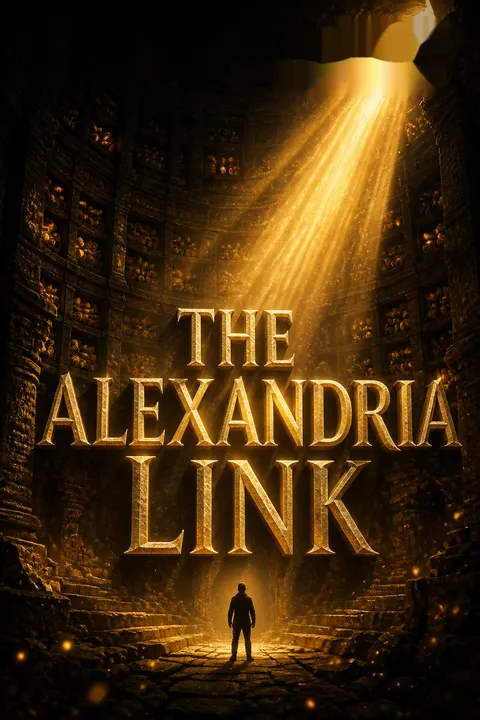

Plot Summary
Prologue: Keeper of Knowledge
In 1948 Palestine, a Guardian—one of a secret order preserving ancient knowledge—seeks to pass on a hidden invitation to a respected academic. Instead, he is killed by the academic's embittered son, George Haddad, who is fighting in the chaos of the nakba. The Guardian's cryptic words about knowledge being more powerful than bullets haunt Haddad for decades, setting the stage for a generational quest. This prologue establishes the enduring conflict over the Holy Land, the tragic cycles of violence, and the existence of a secret that could upend the world's understanding of history and faith.
Family in Peril
In present-day Copenhagen, ex-agent Cotton Malone's quiet life is shattered when his ex-wife Pam arrives, frantic: their son Gary has been kidnapped. The kidnappers demand Cotton retrieve the "Alexandria Link," a secret only he knows. As their bookshop is firebombed and they narrowly escape, Cotton and Pam are thrust into a desperate race. Their fractured relationship and unresolved betrayals add emotional weight, while the threat to Gary forces them to confront their past and unite against a faceless, ruthless enemy.
The Circle Conspires
In Vienna, the secretive Order of the Golden Fleece—an international cabal of industrialists—meets to discuss their latest scheme. Led by the enigmatic Blue Chair, they authorize their operative, Dominick Sabre, to pursue the Alexandria Link at any cost. Their goal: destabilize the Middle East for profit and power. The Order's cold calculations, willingness to kill, and manipulation of governments reveal a shadowy world where ancient secrets are currency and human lives expendable.
The Alexandria Link Revealed
Cotton seeks help from his Danish friend Thorvaldsen and his former boss, Stephanie Nelle, now at the heart of U.S. intelligence. The Alexandria Link is revealed to be George Haddad, a Palestinian biblical scholar who claims to have found the lost Library of Alexandria. Haddad's research suggests the Old Testament's origins—and thus the Jewish claim to the Holy Land—may be based on a mistranslation, with the true "Promised Land" in Arabia. The U.S., Israel, and Saudi Arabia all want Haddad silenced or controlled, as the truth could ignite or resolve centuries of conflict.
Race Against Time
With Gary's life on the line, Cotton and Pam follow a trail of clues, pursued by assassins and manipulated by unseen hands. Allies are few and trust is scarce. The Order's agent Sabre orchestrates events, always a step ahead, while Israeli operatives close in to eliminate Haddad. The tension between Cotton and Pam simmers, their shared trauma and guilt complicating their mission. Each revelation brings them closer to the heart of a conspiracy that spans continents and centuries.
The Order's Deadly Game
The Order's reach is vast, their methods ruthless. Sabre engineers Gary's kidnapping, manipulates Cotton, and eliminates loose ends with cold efficiency. In Washington, political intrigue deepens as the U.S. vice president and attorney general are revealed to be complicit, each with their own ambitions. Stephanie and her allies struggle to discern friend from foe, as the White House, Mossad, and the Order all pursue their own agendas. The stakes escalate: not just Gary's life, but the fate of nations.
The Hero's Quest Begins
Cotton and Pam, joined by the enigmatic "treasure hunter" McCollum (Sabre in disguise), follow a cryptic hero's quest left by the Guardians. Clues lead them from England's Bainbridge Hall—where a monument and a lost novel hide secrets—to Lisbon's Jerónimos Monastery, where sunlight and architecture reveal the next step. Each puzzle is a test of intellect and character, echoing the Guardians' belief that only the worthy may find the truth. The journey is both physical and psychological, forcing Cotton and Pam to confront their own failings and strengths.
Secrets of Bainbridge Hall
At Bainbridge Hall, Cotton and Pam decipher clues left by Thomas Bainbridge, an 18th-century invitee to the library who broke his vow of secrecy. A marble arbor, inscribed with enigmatic letters and a reversed Poussin painting, points the way. The quest's riddles blend art, language, and faith, challenging the protagonists to see beyond surface meanings. The Order's assassins close in, and a deadly shootout leaves Cotton and Pam fugitives, their only hope lying in the next clue.
The Israeli Threat
In London, Cotton and Pam find Haddad, but Israeli agents arrive to kill him and erase the threat to Israel's biblical claim. In a staged confrontation, Haddad is apparently killed, but the truth is more complex. The Israelis' actions are driven by existential fear, while the Americans' motives are muddied by politics and personal ambition. The lines between ally and enemy blur, and Cotton is forced to question the cost of truth and the price of survival.
Betrayals in Washington
In Washington, Stephanie uncovers a web of betrayal. The vice president, attorney general, and Order are all complicit in a plot to kill the president and reshape U.S. foreign policy. The Alexandria Link is the linchpin: whoever controls it can destabilize Israel, empower the Saudis, and profit from chaos. Daley, the deputy national security adviser, is murdered to cover tracks. Stephanie, aided by Cassiopeia Vitt and Israeli agent Dixon, must outmaneuver killers and expose the truth before it's too late.
The Guardians' Riddle
The quest leads Cotton, Pam, and McCollum to Lisbon, where the interplay of architecture, sunlight, and ancient texts reveals the next step: GPS coordinates in the Sinai. The Guardians' riddles are designed to ensure only the worthy—those who seek knowledge, not power—can find the library. The journey becomes a crucible, burning away selfish motives and forcing the protagonists to choose between personal gain and the greater good.
Lisbon's Golden Light
In the Jerónimos Monastery, Cotton and Pam solve the riddle of the "silver turned to gold," as sunlight at a precise moment transforms a silver sacrarium. The Guardians' clues blend science, faith, and art, demanding humility and insight. The Israeli assassins make a final, deadly attempt to stop them, but Cotton and Pam survive, shaken but resolute. The next clue points to the Sinai, where the ultimate secret awaits.
Sinai: The Final Path
Parachuting into the Sinai, Cotton, Pam, and McCollum follow the last clues to a hidden monastery. There, the Guardians' maze of tunnels and coded doors tests their memory and resolve. McCollum reveals himself as Sabre, intent on seizing the library for the Order. A deadly showdown ensues, with Pam forced to kill to save Cotton. The cost of knowledge is blood, and the line between hero and villain blurs.
The Library's True Legacy
Deep beneath the Sinai, the legendary library survives, preserved by the Guardians. Its scrolls and codices hold the true history of the Bible, evidence that the Old Testament's "Promised Land" was Arabia, not Palestine, and that early Christian leaders deliberately altered translations to serve political ends. The knowledge could upend millennia of conflict, but also unleash chaos. The Guardians, nearly extinct, entrust the secret to Cotton and Thorvaldsen, who vow to protect it.
Truth, Power, and Survival
In Vienna, the Order's plans unravel as the U.S. president, warned by Thorvaldsen, outmaneuvers the vice president and Hermann. The traitors are exposed and neutralized, but the world is spared the destabilizing truth. In Washington, Stephanie survives assassination attempts and political betrayal, her faith in herself and her allies restored. The cost of victory is high, but the greater good is preserved.
The Price of Knowledge
Cotton and Pam, forever changed, reconcile their past and agree to tell Gary the truth about his parentage. The library's secret is kept, its knowledge preserved but not weaponized. Thorvaldsen ensures the Guardians' survival, funding their mission in secret. The Order is crippled, the vice president disgraced, and the world returns to its uneasy balance. The story ends with a hard-won peace, the lesson that some truths are too powerful to be unleashed, and that the memory of humanity—like the library—endures through those who choose wisdom over violence.
Analysis
A modern thriller about the peril and promise of truthThe Alexandria Link is more than a globe-trotting adventure; it is a meditation on the power of knowledge, the fragility of history, and the moral ambiguity of those who seek to control both. Steve Berry uses the conventions of the genre—riddles, conspiracies, betrayals—to probe deeper questions: What happens when foundational truths are revealed as constructs? Who benefits from the stories we tell about ourselves, our nations, our gods? The novel's central revelation—that the biblical "Promised Land" may not be where billions believe—serves as a metaphor for all the ways in which history is written by the victors, and truth is shaped by those in power. The characters' personal journeys mirror the larger narrative: Cotton and Pam must confront their own lies and find forgiveness; Stephanie must trust her instincts in a world of shifting allegiances; the Guardians must decide whether to share or safeguard their knowledge. The story ultimately argues that some truths are too dangerous to unleash, and that wisdom lies in humility, restraint, and the recognition that the memory of humanity—like the lost library—endures not in monuments or dogma, but in the choices we make to protect, rather than exploit, what we know.
Review Summary
The Alexandria Link receives mixed reviews averaging 3.94 stars. Readers praise its thrilling treasure hunt plot involving the lost Library of Alexandria and fast-paced action across multiple countries. Many appreciate the historical intrigue and conspiracy elements. However, several reviewers criticize perceived anti-Semitic content and repeated attacks on religion, particularly regarding mistranslated Old Testament passages suggesting Israel's incorrect location. Common complaints include too many characters, formulaic plotting reminiscent of Dan Brown, short choppy chapters, and underdeveloped storylines. Fans of the Cotton Malone series generally enjoyed it more than casual readers.
People Also Read

Characters
Cotton Malone
Cotton is a former U.S. intelligence operative seeking peace in Copenhagen, but his past drags him back into danger when his son is kidnapped. His eidetic memory, legal mind, and moral code drive the narrative. Cotton's relationship with Pam is fraught with betrayal and regret, yet their shared ordeal rekindles trust. He is torn between duty and family, guilt and love, and must navigate a world where every ally may be a traitor. His journey is one of self-forgiveness, as he learns that true strength lies in vulnerability and sacrifice.
Pam Malone
Pam is Cotton's ex-wife, a brilliant but emotionally scarred lawyer. Her anger and defensiveness mask deep pain over past betrayals—both hers and Cotton's. The kidnapping of Gary forces her to confront her own failings and rediscover her courage. Pam's arc is one of transformation: from victim to protector, from guilt to redemption. Her final act—killing to save Cotton—cements her as a complex, fully realized character, capable of both love and violence in the name of family.
Gary Malone
Gary is the teenage son whose abduction sets the plot in motion. Unaware of his true parentage, he is caught in a web of adult secrets and violence. His resilience and intelligence echo both Cotton and Pam, and his presence forces them to confront their own truths. Gary represents the future—the possibility of breaking cycles of betrayal and choosing honesty and compassion.
George Haddad
Haddad is a Palestinian academic haunted by a lifetime of regret, especially the murder of the Guardian in his youth. His quest for truth leads him to the lost library and the role of Librarian. Haddad's psychoanalysis reveals a man seeking atonement, willing to sacrifice himself for a greater good. His manipulation of events is both selfless and tragic, and his death is a final act of redemption, ensuring the library's survival.
Dominick Sabre / James McCollum
Sabre is the Order's ruthless operative, a master manipulator who adopts the persona of "McCollum" to infiltrate Cotton's quest. His psychological profile is marked by opportunism, emotional detachment, and a hunger for power. Sabre's actions drive much of the plot's violence, and his willingness to kill—even those close to him—underscores the story's theme of the corrupting influence of unchecked ambition.
Stephanie Nelle
Stephanie is Cotton's former boss and the head of the Magellan Billet. She is resourceful, principled, and unafraid to challenge authority. Her arc is one of disillusionment and resilience, as she uncovers betrayal at the highest levels and must rely on her own judgment. Stephanie's relationships—with Cassiopeia, Thorvaldsen, and even her adversaries—highlight the importance of trust and integrity in a world of shifting loyalties.
Henrik Thorvaldsen
Thorvaldsen is a wealthy Danish industrialist and Cotton's friend. His own tragedies—especially the loss of his son—inform his empathy and resolve. Thorvaldsen's role as protector, strategist, and eventual patron of the Guardians is central to the story's resolution. His psychological insight and moral clarity provide a counterpoint to the Order's cynicism.
Alfred Hermann (Blue Chair)
Hermann leads the Order of the Golden Fleece, orchestrating global conspiracies with chilling detachment. His psychoanalysis reveals a man driven by legacy, power, and a belief in the primacy of knowledge as a tool for control. Hermann's willingness to sacrifice anyone—including his own daughter—exposes the emptiness at the heart of his quest for dominance.
The Vice President
The U.S. vice president is a master of duplicity, willing to betray his country for personal gain. His alliance with the Order and the Saudis, and his plot to assassinate the president, make him a symbol of the dangers of unchecked ambition. His psychological profile is marked by entitlement, rationalization, and a lack of empathy.
Heather Dixon
Dixon is a Mossad operative whose loyalties shift with circumstance. She is both ally and adversary to Stephanie, embodying the realpolitik of intelligence work. Her actions are driven by a fierce commitment to her country, but also by personal connections and a recognition of shared humanity. Dixon's arc reflects the story's theme that enemies and friends are often indistinguishable.
Plot Devices
The Hero's Quest and Riddles
The narrative is structured around a series of riddles and physical challenges—the "hero's quest"—designed by the Guardians to ensure only the worthy can find the library. These puzzles blend art, language, architecture, and astronomy, requiring intellect, humility, and moral clarity. The quest serves as both a literal and metaphorical journey, forcing characters to confront their own motives and limitations.
Multiple Perspectives and Interlocking Plots
The story unfolds through shifting viewpoints: Cotton and Pam's race across Europe and the Middle East; Stephanie's battles in Washington; the Order's machinations in Vienna. This structure allows for foreshadowing, dramatic irony, and a deep exploration of character psychology. The convergence of these threads in the Sinai provides a satisfying narrative payoff.
Betrayal and Shifting Alliances
The plot is driven by betrayals at every level: personal (Cotton and Pam), professional (Stephanie and her superiors), and political (the vice president and the Order). Characters must constantly reassess loyalties, and the reader is kept off-balance by reversals and revelations. This device underscores the story's central question: who can be trusted with the truth?
Historical and Religious Revisionism
The central plot device is the revelation that the Old Testament's geography—and thus the foundation of modern Israel—may be based on a mistranslation. The library's existence threatens to upend millennia of belief and conflict. The story uses this device to explore the malleability of history, the dangers of dogma, and the responsibility that comes with knowledge.
Foreshadowing and Symbolism
Symbols such as the rose window, the serpent, and the marble arbor recur throughout the narrative, foreshadowing key revelations and reinforcing the story's themes of enlightenment, temptation, and the cyclical nature of history. The use of light and shadow, both literal and metaphorical, highlights the tension between truth and secrecy.
Cotton Malone Series
About the Author
Other books by Steve Berry

Download PDF
Download EPUB
.epub digital book format is ideal for reading ebooks on phones, tablets, and e-readers.








































