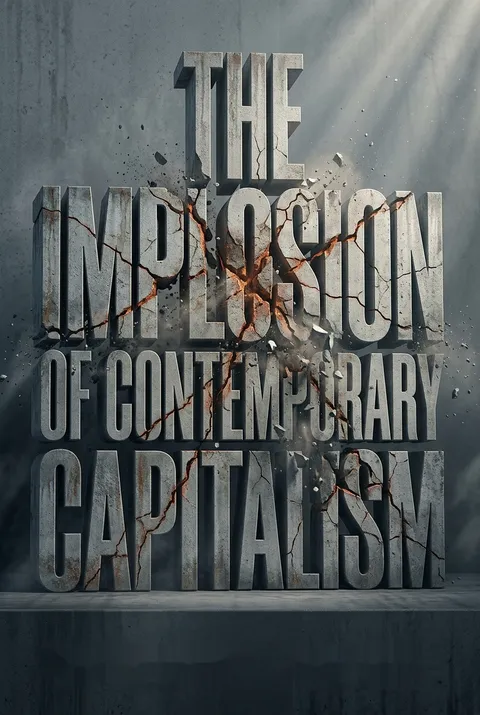

Key Takeaways
1. Generalized Monopolies Drive Capitalism's Implosion
Having attained the current phase of its evolution, capitalism—the capitalism of generalized, financialized, and globalized monopolies; I will specify the significance of those adjectives further on—has nothing left to offer the human race but the lamentable perspective of self-destruction.
Systemic control. Contemporary capitalism has evolved into a system of "generalized monopolies," where a few dominant entities control entire production chains, reducing smaller and even large non-oligopolistic firms to mere subcontractors. This centralization of capital, primarily within the Triad (United States, Western/Central Europe, Japan), emerged during the 1980s and 1990s. This structure is not merely a collection of powerful companies but an integrated system that dictates global economic terms.
New imperialism. This generalized monopoly capitalism is fundamentally a new stage of imperialism, where "globalization" serves as the mechanism for these monopolies to exert control over the productive systems of the global periphery. This control allows them to extract a "monopoly rent" or "imperialist rent" from the surplus-value generated by labor, leading to an unprecedented concentration of wealth and income in the hands of a few oligarchies. This rent-seeking behavior becomes the primary driver of capital accumulation.
Unavoidable implosion. The system's inherent drive towards ever-extended capital accumulation, coupled with its inability to control internal contradictions, makes its implosion unavoidable. This "autumn of capitalism" does not automatically usher in a "springtime of peoples," as the forces capable of building a humane global order are not yet fully organized. The current historical moment is characterized by a dangerous gap between capitalism's decline and the potential for a socialist alternative.
2. Financialization: Capitalism's Self-Destructive Mechanism
This imbalance in continued growth is, in turn, the source of the financialization of the economic system.
Surplus absorption. The continuous concentration of wealth by generalized monopolies creates an ever-growing surplus that cannot be productively reinvested in expanding real production. This excess capital is then channeled into "financial investment," primarily speculative activities, becoming the only viable option for continued accumulation under monopoly control. This process is termed financialization.
Mechanisms of financialization. Specific systems enable this financialization:
- Subjugation of firms to "shareholder value"
- Shift from public pension systems to private, capitalized pension funds
- Adoption of flexible exchange rates
- Transfer of interest rate determination from central banks to the market
These mechanisms empower a few giant banks in the Triad, whose strategies dominate global "markets."
Debt-fueled growth. Financialization fuels an explosive growth in financial speculation, disproportionate to GDP or real production investment. This necessitates and thrives on increasing debt in all forms, especially sovereign debt. Governments' austerity policies, ostensibly aimed at reducing debt, paradoxically increase it, serving the monopolies' strategy to absorb their surplus profits. This self-perpetuating cycle of financialization and debt is a core reason for the system's implosion.
3. "Postindustrial" Narratives Mask Monopoly Control and Global Exploitation
The verbal formulae referring to that “something new”—postindustrial society, cybernetic revolution, the growth in production of “immaterial” or “non-material” goods, the knowledge-based economy, the service society—all these remain vague.
Vague characterizations. Terms like "postindustrial society" or "knowledge economy" are imprecise and fail to explain the underlying transformations in capitalism. While central countries show declining industrial labor and GDP contributions, emerging peripheral countries exhibit accelerated industrial growth, suggesting a global re-division of labor rather than a postindustrial shift.
Redefining labor and surplus. The growth of "nonmaterial" (service) outputs is undeniable but requires critical re-examination. Many services are directly linked to material production or control over it, especially as production is outsourced to peripheries. The concept of "surplus," distinct from Marx's surplus-value, accounts for the growing portion of GDP (now half, up from 10% in the 19th century) that includes government administration, social services, and parasitic selling costs, all serving to absorb capital's growing surplus.
Imperialist rent's role. The unequal division of labor between centers and peripheries, where material production is outsourced, inflates nonmaterial activities in the centers (e.g., control over technology, finance, communications). This global imbalance generates "imperialist rent," a quantifiable benefit from differential labor pricing and non-quantifiable advantages from exclusive access to resources and technology. This rent further swells the surplus in the centers, masking the true nature of global exploitation.
4. Capitalism Polarizes Societies: Oligarchy vs. Generalized Proletariat
The formation of generalized-monopoly capitalism resulted in structural transformation both of the dominant and the dominated classes.
New ruling class. Generalized-monopoly capitalism has profoundly reshaped class structures. In the dominant centers, a small "financial oligarchy" now holds centralized control over capital, distinct from the traditional bourgeoisie of stable families. This new elite, often "parvenus" from financial speculation, operates with a "Mafia-like" disregard for traditional values, prioritizing "winners" and money above all else.
Middle-class transformation. The middle classes, increasingly wage-earning, are polarized: a privileged, highly paid segment serves as direct agents of the oligarchy, while the rest face impoverishment. This stratification means many "extra-skilled" workers consume more surplus-value than they contribute, blurring traditional class lines and creating a "generalized proletariat" that is segmented but universally exploited.
Generalized proletariat. While the concept of the proletariat seems to disappear, the proletarian condition becomes generalized, as millions of small producers are wiped out and become waged employees or "independent contractors." This creates a diverse, segmented working class, exploited in various forms and degrees. The challenge for the left is to unite this "99 percent" (or 80 percent) against capital, recognizing internal contradictions while rebuilding coherent leadership.
5. Emergence vs. Lumpen-Development: The South's Divergent Paths
Opposing the favorable evolution of an authentic emergence is the fact that there is typically a unilateral submission to the requirements of the implementation of global capitalism and general monopolies, which produce nothing other than what I call lumpen-development.
Defining emergence. True "emergence" is more than just GDP growth; it signifies sustained industrial production, strengthening global competitiveness of the entire productive system, and reasserting national economic sovereignty (food, natural resources, technology). It requires an inward-looking focus on domestic markets and coherent state policies, rather than mere outward-looking export growth.
Lumpen-development's trap. In contrast, "lumpen-development" results from unilateral submission to global capitalism and generalized monopolies. This model leads to accelerated social disintegration, massive pauperization, and the dizzying growth of "informal" survival occupations. Countries like India and Brazil exhibit hybrid systems, combining elements of emergence with widespread lumpen-development, benefiting a minority while impoverishing the majority.
Failed emergence examples. Countries like Turkey, Iran, and Egypt, despite past attempts at modernization and anti-imperialist postures, are deemed "non-emergent." Their projects have been frustrated by imperialist intervention or internal contradictions, leading to comprador states and classes of "corruptionists" who prioritize personal wealth through ties with political power and foreign masters, rather than national development. This perpetuates lumpen-development and submission to imperialist dictates.
6. China's Unique Non-Capitalist Emergence Offers a Different Model
This “Chinese specificity”—whose consequences are of major importance—absolutely prevents us from characterizing contemporary China (even today) as “capitalist,” because the capitalist road is based on the transformation of land into a commodity.
Agrarian foundation. China's unique path, rooted in Mao's revolution, is fundamentally non-capitalist due to its approach to land. Agricultural land remains the property of the nation (village communes), with use rights granted to rural families, preventing its commodification. This contrasts sharply with capitalist models and has enabled controlled rural-to-urban migration and remarkable food sovereignty, feeding 22% of the world's population with only 6% of its arable land.
State capitalism with socialist potential. China's "state capitalism" aims to build a sovereign, integrated industrial system, manage rural production, and control its integration into the world system. While exhibiting capitalist features like surplus extraction and worker exploitation, it is plan-driven, not purely market-driven. The nationalization of basic industries and the credit system, coupled with controlled private initiative, allows for technological absorption and infrastructure development on an unparalleled scale.
Controlled globalization. China's integration into globalization has been partial and controlled. It remains outside financial globalization, with a national banking system and sovereign currency management. This allows China to retain the majority of its produced surplus-value, unlike other "emergent markets" that are open to penetration and extraction by Triad monopolies. This sovereign project, not foreign capital, is the primary driver of China's success.
7. The European Union's Inherent Flaws Lead to Implosion
The Eurozone was designed to aggravate still further that movement. Its fundamental nature is defined by the statute of the European Central Bank, which is forbidden to lend to national governments (and even to a supranational European state were one to exist, which is not the case), but lends exclusively to banks—at a ridiculously low rate—which, in turn, draw from their investments in national bonds a rental income that has reinforced the domination of the generalized monopolies.
Fundamental handicaps. Europe suffers from inherent weaknesses preventing it from becoming a unified power comparable to the United States. These include:
- Limited natural resources and energy dependence.
- Deeply diverse national political cultures, precluding a unified "European people."
- Uneven capitalist development, with a core (Western Europe) dominating a peripheral East and South.
Atlanticist and imperialist. Europe is deeply "Atlanticist," with NATO's central role de facto integrated into its political structure, aligning it with U.S. foreign policy. As part of the Triad's collective imperialism, Western Europe shares in imperialist rent, while Eastern European states, lacking their own generalized monopolies, remain subordinate peripheries. This collective imperialism dictates a unified policy towards the South, prioritizing aggression against states challenging its globalization.
Eurozone's self-destruction. The European Union and Eurozone were designed to serve generalized-monopoly capitalism, making them inherently unviable. The ECB's structure, lending only to banks, reinforces monopoly domination and financialization. Austerity policies, imposed on peripheral countries like Greece, are self-defeating, increasing debt and leading to social disaster. This system is destined to split apart, potentially returning Europe to a fragmented, 1930s-like landscape, ripe for nationalist demagogy and the extreme right.
8. Capitalism's "Senile" Decline Demands a Socialist Alternative
For all these reasons, I maintain that contemporary oligopolistic capitalism must henceforward be considered senile, despite any seeming short-term successes it might enjoy.
Long decline. Capitalism entered its "long decline" at the end of the 19th century with the rise of monopolies, where its destructive dimensions began to outweigh its constructive ones. This period, marked by two long structural crises (1870s and 1970s), signals that capitalism has become "obsolete" and demands a transition to socialism. The 20th century's wars and revolutions were expressions of this decline and the "awakening of the South."
Generalized monopolies: the final stage. The current phase of "generalized monopolies," where capital's control is extremely centralized and detached from a rooted bourgeoisie, represents the "highest phase" of capitalism. This abstraction of capital, where speculation replaces productive labor and property is reduced to a derisory status, signifies that the system has run its course.
Expropriate the expropriators. The only viable response to this senile capitalism is the "expropriation of the expropriators" – the nationalization of monopolies. This is the unavoidable first step towards socializing their management by workers and citizens, paving the way for a new macroeconomy that supports small and medium enterprises. Without this, the system will only lead to a decline of democracy and civilization, culminating in "generalized apartheid."
9. Marxism's Tricontinental Vocation: The South Leads the Way
“Marxism” or, more exactly, historical Marxisms, were confronted by a new challenge, which did not exist in the most lucid political consciousness of the nineteenth century, but arose because of the transfer of the initiative to transform the world to the peoples, nations, and states of the periphery.
Shifting center of struggle. The most significant social and political struggles of the 20th century primarily challenged capitalism's permanent imperialist dimension, rather than capitalism itself. This shift of the revolutionary center of gravity from the capitalist core to the periphery (Asia, Africa, Latin America) gives Marxism a decisive "tricontinental vocation." The challenge is to analyze this reality and formulate effective strategies for change.
Mao's framework. Mao's analysis, distinguishing and connecting "peoples, nations, and states," offers a profound framework for understanding these struggles. "Peoples" (popular classes) drive revolution, "nations" seek liberation from imperialist domination, and "states" (even popular ones) possess autonomy, navigating between popular demands and global capitalist pressures. The success of the transition depends on reinforcing the complementarity of these three dimensions.
South as the "storm zone." The "South" remains the "storm zone" of permanent uprisings against imperialism, as peoples, nations, and states refuse to accept the system. The second wave of these initiatives, building on the first (1917-1980), is now challenging the Triad's control over technology, resources, finance, communication, and weapons. These anti-imperialist struggles are inherently anti-capitalist, as "catching up" within the system is an illusion for the periphery.
10. Three Critical Challenges for a Socialist Future: Democracy, Agrarian Justice, Ecology
The political radicalization of the social struggles is the condition for overcoming their fragmentation and their exclusively defensive strategy—“safeguarding social benefits.”
Democracy beyond elections. The "democratic" discourse of imperialist powers is often a deceptive tool to impose liberal market economies, not genuine democracy. True democratization must be intrinsically linked with social progress, empowering people beyond formal multiparty elections. It is an endless, multidimensional process that integrates gender equality, individual liberties, and collective social rights, aiming to socialize economic management and move beyond capitalism's sacred private property.
Agrarian question: land for all. The "new agrarian question" highlights the stark inequality between highly productive capitalist agriculture (a few tens of millions of farmers) and the three billion peasants in the South. Treating food production as a commodity under WTO rules threatens to eliminate billions of "non-competitive" peasants, leading to a potential "genocide of half of humankind." A socialist alternative demands guaranteeing access to land for all peasants, protecting them from unequal competition, and supporting non-capitalist modernization to ensure food security and gradual, equitable development.
Ecology: solar socialism. Capitalism's inherent logic of accumulation destroys both human beings and nature. While "green capitalism" and "weak sustainability" merely commodify environmental costs and open new fields for destructive expansion, a genuine response requires a "socialist perspective of use value." This means "solar socialism" or "no socialism," recognizing that capitalism cannot truly address ecological destruction. A socialist counterculture, open to an inventive imaginary, is needed to reconstruct societies on principles beyond capitalist logic.
11. Audacity is Required: Socialize, De-Financialize, De-Globalize
This moment offers us the historic opportunity to go much further; it demands as the only effective response a bold and audacious radicalization in the formulation of alternatives capable of moving workers and peoples to take the offensive to defeat their adversaries strategy of war.
No compromise. Generalized-monopoly capitalism has declared war on workers and peoples, making "liberalism non-negotiable." Defensive strategies are futile. The radical left must be audacious, moving beyond "market regulation," nostalgic returns to past models, humanist consensus, or illusions of identity. The goal is not to "end the crisis of capitalism" but to "end capitalism in crisis."
Socialize monopolies. The first audacious step is to socialize the ownership of monopolies through nationalization, followed by democratic socialization of their management. This means replacing shareholder value with a system prioritizing stable employment and decent wages, managed by directorates involving workers, subcontractors, consumers, local authorities, and the state. This abolishes accumulation by dispossession and fosters a truly transparent, socially driven economy.
De-financialize and de-globalize. De-financialization requires nationalizing major banks, restructuring the banking system to serve specific economic functions (e.g., agriculture banks), banning speculative funds, and replacing pension funds with universal distributive systems. This creates "a world without Wall Street." De-globalization, or "de-linking," means strategically disengaging from the Triad's five privileges (technology, resources, finance, communication, WMDs) to reconstruct a globalization based on negotiation and reduce international inequalities. This requires national and regional initiatives, even if it means "disobeying" existing international rules.
Review Summary
Reviewers largely praise The Implosion of Contemporary Capitalism as a compelling, accessible critique of global monopoly capitalism, imperialism, and financialization. Many appreciate Amin's bold proposals for socializing monopolies, de-financialization, and de-linking from exploitative global systems. His analysis of China and North-South divisions receives particular commendation. Common criticisms include sloppy writing, a lack of empirical evidence, and an assumption that readers already hold Marxist viewpoints. Despite these shortcomings, most reviewers consider it a valuable, thought-provoking work.
People Also Read







Download PDF
Download EPUB
.epub digital book format is ideal for reading ebooks on phones, tablets, and e-readers.








































