
Key Takeaways
1. The Human Magnet Syndrome: An Irresistible Pull to Opposite Personalities
All of us are compelled to fall in love with a specific personality type that is dichotomously opposite from our own.
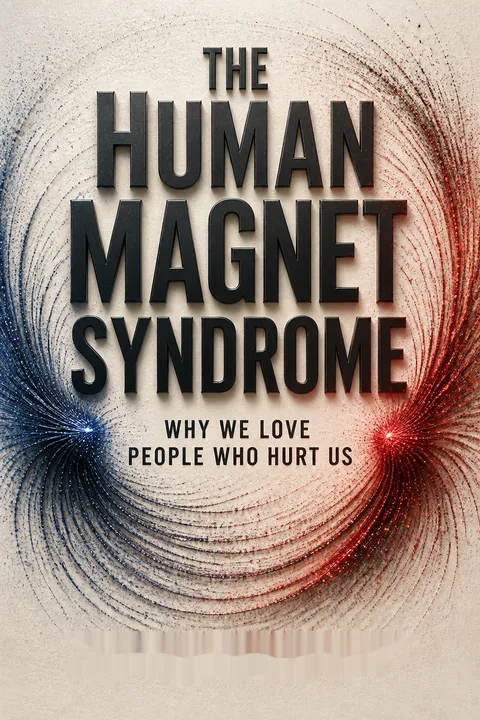
Invisible forces. We are all "human magnets," drawn to romantic partners not just by conscious preferences, but by powerful, invisible forces. This magnetic pull, the Human Magnet Syndrome, compels individuals with opposite "magnetic polarities" to connect, whether for healthy or dysfunctional relationships. It's an instinctive attraction that often defies rational thought and conscious intentions.
Opposite charges attract. Just like metal magnets, human magnets possess either a positive or negative charge, attracting those with the opposite polarity. Codependents carry a "negative" charge (others-oriented), while emotional manipulators carry a "positive" charge (self-oriented). This complementary magnetic dynamic creates an intense, often trance-like, attraction that binds them together in enduring relationships.
Repulsion of likes. Conversely, individuals with similar magnetic roles tend to repel each other, making romantic connection nearly impossible. This explains why two codependents or two emotional manipulators rarely find romantic chemistry, even if they seem perfect "on paper." The Human Magnet Syndrome dictates that true romantic "spark" arises from the powerful interaction of opposite, yet compatible, magnetic fields.
2. The Continuum of Self Theory: Quantifying Our Relationship Orientation
The continuum of self theory was designed to quantitatively and qualitatively represent a person’s self-orientation.
Measuring self-orientation. The Continuum of Self Theory provides a framework to understand and quantify a person's "self-orientation"—how they express their emotional and psychological needs in a relationship. This spectrum ranges from a complete focus on others' needs to an exclusive focus on one's own, with a balanced midpoint.
Continuum of Self Values (CSVs). The theory uses 11 numerical values, from -5 to +5, to represent this spectrum.
- -5 CSV: Represents severe codependency, a complete absorption with others' needs, neglecting one's own.
- +5 CSV: Represents severe emotional manipulation (narcissistic, borderline, antisocial personality disorders, or addiction-induced narcissism), a complete focus on one's own needs.
- 0 CSV: Represents a hypothetical perfect balance between self-care and other-care.
Zero-sum relationships. Relationship stability is achieved when the CSVs of two partners sum to zero (e.g., -3 and +3). This "zero-sum relationship" indicates a stable, enduring bond, but not necessarily a healthy one. Healthier relationships are characterized by partners with lower, milder CSVs (e.g., -1 and +1), where both are capable of reciprocity and mutual care, even if one leans slightly more towards giving or taking.
3. Codependency: The Selfless Pursuit of Others' Needs
A disorder of selflessness, passivity and personal powerlessness.
Defining codependency. Codependency is a problematic relationship orientation characterized by an excessive focus on others' needs while neglecting one's own. Codependents are habitually attracted to, and easily manipulated by, self-centered, controlling, or addicted individuals, often placing their own personal and emotional needs as a lower priority.
Origins and evolution. The term "codependency" evolved from the Alcoholics Anonymous movement, initially describing partners of alcoholics ("co-alcoholics"). By the 1980s, its meaning broadened to include anyone habitually in relationships with narcissistic or addicted individuals, recognizing it as a universal problem of self-destructive people-pleasing and sacrificial behaviors. Melody Beattie's "Codependent No More" was instrumental in this shift.
Key characteristics: Codependents exhibit specific patterns that perpetuate their dysfunctional relationships.
- Low self-esteem: Difficulty making decisions, harsh self-judgment, valuing others' approval.
- Compliance: Compromising values to avoid rejection, extreme loyalty to harmful situations.
- Control: Believing others are incapable, offering unsolicited advice, using gifts/favors to manipulate.
- Avoidance: Suppressing feelings, avoiding intimacy, using indirect communication to prevent conflict.
They often rationalize their selflessness as noble, leading to a "codependent martyr syndrome."
4. Emotional Manipulation Disorders: The Spectrum of Self-Centeredness
An individual who has been diagnosed with one of three personality disorders – narcissistic, borderline, or antisocial personality disorder, and/or is chemically or behaviorally addicted.
Defining emotional manipulators. Emotional manipulators are individuals whose self-orientation is almost entirely focused on their own needs and desires, often at the expense of others. This category encompasses specific psychological disorders, all sharing narcissistic traits.
The four subtypes:
- Narcissistic Personality Disorder (NPD): Characterized by grandiosity, a need for admiration, and a profound lack of empathy. They have an inflated sense of self-importance and are acutely sensitive to criticism, often reacting with "narcissistic rage."
- Borderline Personality Disorder (BPD): Marked by instability in mood, self-image, and relationships. They experience intense emotions, fear abandonment, and can swing between idealization and devaluation of others, often engaging in self-destructive behaviors.
- Antisocial Personality Disorder (ASPD): Involves a pervasive disregard for and violation of others' rights, lacking guilt or remorse. They are often dishonest, manipulative, impulsive, and can be aggressive, living by a "pleasure principle."
- Addiction-Induced Narcissism: Individuals whose addiction to a substance or behavior drives them to act selfishly and manipulatively, mirroring personality disorder traits, even if they don't have an underlying personality disorder.
Resistance to therapy. Emotional manipulators are significantly more psychologically impaired than codependents and are highly resistant to therapy. Their grandiosity, denial, and fragile self-esteem prevent them from acknowledging their problems or their role in relationship difficulties, making genuine healing exceptionally challenging.
5. The Dysfunctional "Dance": A Perfectly Matched Cycle of Pain
Codependents and emotional manipulators participate in a dance-like phenomenon that ultimately creates a lasting dysfunctional relationship or “dancing partnership.”
A choreographed misery. The "dance" metaphor vividly illustrates the dynamic between codependents and emotional manipulators. Each partner is intimately attuned to the other's "dance style," creating a seemingly flawless, yet deeply dysfunctional, partnership. The emotional manipulator consistently leads and controls, while the codependent instinctively follows and acquiesces.
Complementary dysfunction. This dance thrives on complementary dysfunctional personalities. The codependent's giving, sacrificing nature perfectly accommodates the emotional manipulator's need for control, attention, and self-focus. What begins as exciting and euphoric inevitably transforms into a cycle of drama, conflict, and feelings of neglect and being trapped, yet neither partner dares to end it.
Stuck on the dance floor. Despite shared misery, neither dancer feels compelled to "sit out." Codependents confuse caretaking with love, silently swallowing unhappiness, while emotional manipulators feel comfortable with a partner who allows them to maintain the spotlight. This perpetual cycle is fueled by deep-seated insecurities and a fear of being alone, making the relationship paradoxically stable, even amidst chaos.
6. Childhood Trauma: The Generational Roots of Our Relationship Patterns
The experiential landscape of our childhood directly impacts our future adult relationships.
The inevitability of the past. Our formative years (first five to six years) profoundly shape our adult personalities and relationship choices. Children raised by psychologically healthy parents develop a stable foundation, while those raised by abusive, neglectful, or absent parents are likely to carry psychological damage into adulthood, setting the stage for dysfunctional relationships.
Two paths from emotional manipulators. Children of emotional manipulator parents typically follow one of two paths:
- Future Codependent ("Pleasing Child"): Adapts by becoming agreeable and accommodating, fulfilling the parent's narcissistic fantasies to secure conditional love and avoid harm. They learn to suppress their own needs and feelings.
- Future Emotional Manipulator ("Disappointing/Scapegoat Child"): Unable or unwilling to please the narcissistic parent, they face harsher treatment (deprivation, neglect, abuse). They internalize labels of being "bad" or "unworthy," leading to deep-seated shame and the development of narcissistic traits as a defense.
Defense mechanisms. Both paths involve psychological defenses to cope with trauma. The "disappointing" child, in particular, relies heavily on repression and disassociation to block unbearable memories and feelings of worthlessness, leading to a more severe psychological impairment in adulthood. This transgenerational pattern ensures that dysfunctional family dynamics are passed down.
7. The Paradox of Healing: Why Codependents Seek Help, Manipulators Resist
Because codependents experienced less childhood trauma and did not have to repress it, their mental health is superior to that of an emotional manipulator.
Codependents' amenability to therapy. Codependents possess greater self-awareness, introspection, and a capacity to accept their problems without debilitating shame. They are more likely to seek professional help because they feel less threatened by it and are capable of forming trusting relationships with therapists. Their tendency to please authority figures can also make them highly motivated clients.
Emotional manipulators' resistance. Conversely, emotional manipulators are significantly more psychologically damaged and resistant to therapy. Their grandiosity, denial, and fragile self-esteem prevent them from recognizing their role in problems. Confrontation often triggers "narcissistic injury," leading to anger, defensiveness, blame, or outright refusal to participate. Their repressed childhood trauma remains locked behind impenetrable psychological barriers.
The therapist's challenge. Working with emotional manipulators is exceptionally challenging, even for experienced clinicians. They may attempt to manipulate the therapist, discredit the process, or abruptly terminate therapy when challenged. The prognosis for emotional manipulation disorders is generally poor due to their deeply ingrained nature and the client's lack of insight and motivation for change.
8. Breaking the Cycle: The Path to True and Healthy Love
It’s never too late to be who you might have been.
The power of choice. Despite the deep-seated patterns of dysfunctional relationships, personal transformation and healing are profoundly possible. The author emphasizes that individuals have the power to break free from the unconscious forces that compel them to repeat childhood traumas through their adult romantic choices. This requires conscious commitment, perseverance, and often, professional psychotherapy.
Healing the inner child. The journey involves confronting and healing the "frightened child" within, who is frozen in time by past harm. By addressing self-doubt, self-loathing, and fear, individuals can cultivate self-love and build a stronger, more confident self. This internal work is crucial for changing one's "magnetic polarity" and attracting healthier relationships.
A new relationship picker. As individuals heal, their "relationship picker" improves, naturally repelling narcissists and drawing in partners who offer genuine love, respect, and care. This transformation leads to mutually satisfying relationships where both partners are whole, interdependent individuals, capable of giving and receiving love in equal measure. The ultimate goal is to choose to live and love fully, embracing the courage to seek true connection.
Review Summary
The Human Magnet Syndrome explores why codependents and narcissists/emotional manipulators attract each other in dysfunctional relationships. Reviews are polarized: supporters praise its clarity in explaining relationship patterns and codependency as addiction, finding it life-changing and validating. Critics cite excessive repetition, self-promotional writing, questionable credentials (Masters in Education, not psychiatry), and controversial grouping of BPD with narcissistic disorders. Many note the book lacks concrete recovery solutions beyond "get therapy." Some find the dancing metaphor helpful; others find it overextended. The writing style, including lengthy personal anecdotes, frustrates many readers despite the book's helpful conceptual framework.
People Also Read






Download PDF
Download EPUB
.epub digital book format is ideal for reading ebooks on phones, tablets, and e-readers.








































