

Key Takeaways
Comedy can be taught; nobody is born already funny
The biggest myth is that funny is genetic. Kaplan dismantles the idea that comedy is unteachable magic reserved for the lucky few. The Marx Brothers were a terrible act when their mother first pushed them onstage. They became legends by grinding through eight vaudeville shows a day, stealing tips from other performers, and honing the material. They taught themselves.
Talent versus artistry. You are born with genius, but artistry is learned. You cannot teach someone to be more gifted, but you absolutely can teach anyone to write, act, and perform to the peak of their ability. Analyzing a joke does not kill it either. Working comics dissect their sets like Talmudic scholars, probing every setup and punch line until it becomes reliable.
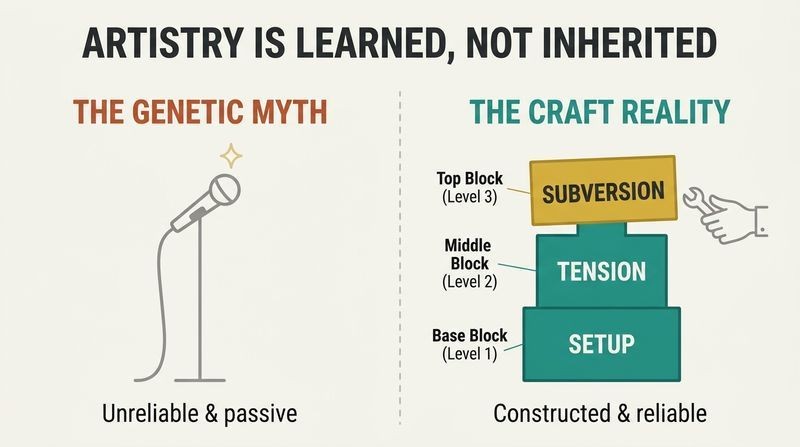
What's striking is how this mirrors the deliberate-practice research of Anders Ericsson, who found expertise across fields is built, not gifted. Kaplan's craft-over-talent stance also echoes the growth-mindset work of Carol Dweck. A useful caveat: teachability does not guarantee greatness. Deliberate practice explains variance within trainable skills, but raw comedic timing and instinct still separate the merely competent from the transcendent. Kaplan concedes this by distinguishing genius from artistry. The empowering takeaway stands: most people who assume they lack the gift have simply never been shown the mechanics.
Comedy is the art of telling the truth about being human
This is Kaplan's central thesis. Drawing on Sid Caesar and Lenny Bruce, he argues comedy is not pratfalls or K-sounds but truth, specifically the truth about people. Drama shows us idealized versions of ourselves: strong, sensitive, flawless. Watch a soap opera hero confronting a beautiful woman in a revealing blouse. He stares only into her eyes. A real man would peek, because he is human. That peek is where comedy lives.
Drama versus comedy. Drama helps us dream about what we could be, like rooting for Rocky to conquer the mountain. Comedy helps us live with who we are: eating peanut butter from the jar in a dirty robe during our dark night of the soul. It loves humanity without forgiving its flaws.
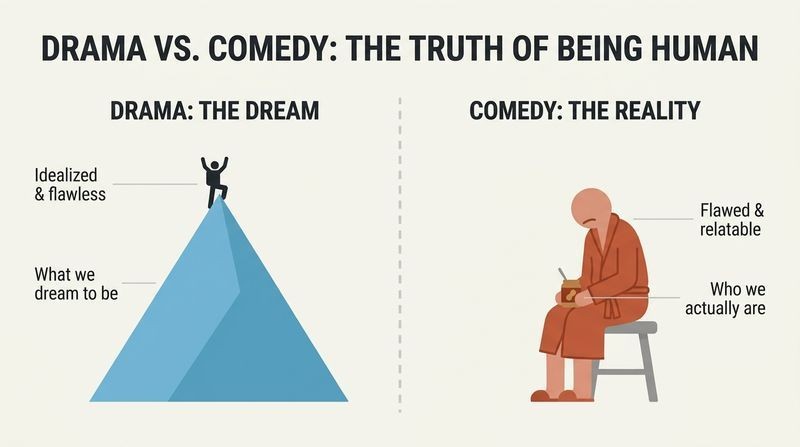
Kaplan places comedy inside a lineage stretching to Aristotle, who dismissed it in a sentence while dedicating the Poetics to tragedy. His truth-telling definition resonates with sociologist Erving Goffman's idea that we all perform an idealized self, and comedy exposes the backstage mess. It also connects to incongruity theory, comedy arising from the gap between our pretensions and our reality. The framing is generous and humane, positioning the comedian not as a mocker but as a fellow sufferer who stands up and admits: me too. That reframe alone changes how a writer approaches a joke.
Every comic scene runs on one equation: hopeful struggle without the tools
The Comic Equation is the book's engine. Comedy is an ordinary person struggling against insurmountable odds, lacking the skills needed to win, yet never giving up hope. Jerry Lewis said the premise of all comedy is a man in trouble. Remove any element and the comedy collapses.
Hope is the load-bearing element. Kaplan points to Woody Allen's early films (Annie Hall, Sleeper) full of neurotic messes who keep getting knocked down and back up. Then came September, an Allen film about miserable people who knew they were doomed and wallowed in it. No hope, no comedy. It became a drama. Every choice a comic character makes, no matter how deluded, is an attempt to nudge their happiness meter one notch toward bliss.
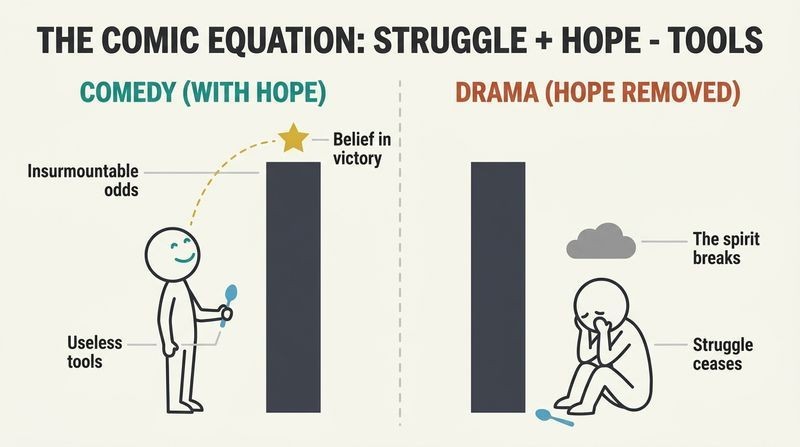
The equation is elegantly falsifiable, which is rare in creative advice. Its emphasis on persistence-despite-futility echoes Camus's Sisyphus, who we must imagine happy, and existentialist absurdism generally. Comedy, in this reading, is applied philosophy about mortality: we know we die, yet floss with cinnamon floss anyway. One tension worth noting: some celebrated comedy (bleak British sitcoms, gallows humor) seems to thrive precisely on hopelessness. Kaplan would likely counter that even there, characters keep trying. The equation's real power is diagnostic, giving writers a checklist when a scene reads flat.
Give your character permission to win, and stop trying to be funny
Winning frees the character to do anything. In Kaplan's Three Lawyers exercise, actors are told they are late for the biggest case of their careers at a courthouse four blocks away. Instead of racing out, trained actors linger and invent business because they think the job is to act. The real job is to solve the problem: leave the room. Add secret agendas (each wants to be second out the door) and watch bodies get thrown through doorways. Comedy emerges from the desperate pursuit of winning, not from trying to be clever.
Winning permits idiocy. In Annie Hall, Alvy pulls Marshall McLuhan out from behind a poster to win an argument. In Liar Liar, Fletcher beats himself up in a bathroom to delay a trial. They are not being funny. They are winning by any means.
This maps onto improv's foundational rule from Viola Spolin and Keith Johnstone: play the objective, not the joke. It also parallels acting's Stanislavski system, where an actor pursues a concrete want. Kaplan's twist is that comedy grants unusually wide latitude, permission to be crass, cowardly, or absurd, as long as the goal is real. The counterintuitive payoff, that aiming at winning produces more laughs than aiming at funny, aligns with psychological research on flow and paradoxical intention: chasing the byproduct directly often sabotages it. The lesson generalizes well beyond comedy, into sales, courtship, and negotiation.
The fewer skills your character has, the funnier they become
Meet the Non-Hero. A hero has every skill needed to win: Charles Bronson can shoot, strategize, and shrug off bullets. Put Woody Allen in a room with twelve armed men and you laugh before a single joke is written, because he has no skills yet refuses to surrender. Kaplan calls this figure the Non-Hero, an ordinary person lacking the tools to win but trying anyway.
Knowing is a skill, so characters must not know. In the Experts game, a woman slaps an interviewee every time he says a word with a K sound. His funniest moment comes not from the slap but from him groping to solve the puzzle. When Tom Hanks in Big can't fit into his old jeans, the comedy lives in the gap between expectation and reality. Add skills to create drama or romance; strip them to create comedy.
The dial metaphor, add skills for drama, subtract them for comedy, is the book's most practical tool. It explains the arc of every romantic comedy: the bumbling lead acquires sensitivity, and the laughs give way to tenderness. Kaplan's insistence that characters must not know echoes dramatic irony from Sophocles, where the audience sees what the character cannot. It also connects to Heisenberg's uncertainty, which Kaplan cites: nobody actually knows the next five minutes, so a knowing character is the real lie. Writers resist this because they confuse their own intelligence with their character's, over-arming everyone with wit.
Bury a hidden relationship beneath the surface one
Metaphorical Relationship is the tool of perception. Beneath every surface relationship lies a truer, essential one. In The Odd Couple, Felix and Oscar are roommates, but they behave like a bickering married couple. In Seinfeld, Jerry and George sit in a police car acting like kids, asking to play with the siren. The comedy comes from grafting recognizable behavior onto an incongruous pairing.
You recollect, you don't invent. The power of this tool is that you never have to make anything up. You already know how kids fight in the back of a car or how lovers coo. In The Producers, Bialystock seduces Bloom into his scheme by treating him first like a son, then a nervous lover, then Mephistopheles tempting Faust. Keep the surface reality intact; just let the metaphor drive the behavior.
Anais Nin's line, we see things as we are, anchors this tool. It resembles the conceptual-metaphor theory of linguists Lakoff and Johnson, who argue humans think in metaphor by default. Kaplan operationalizes that insight for writers: choose the buried metaphor and the scene half-writes itself, because the audience already carries the script for married couples or squabbling children. The efficiency claim is the real gift. Rather than straining for novelty, the writer mines shared memory. The one discipline required, keeping the literal relationship real so Felix never actually kisses Oscar, prevents the device from collapsing into surreal nonsense.
Let characters act on the deluded belief their move will work
Positive Action means selfish, hopeful action. Every action a Non-Hero takes is done in the genuine belief it will improve their situation, however stupid that belief is. When Kramer flirts by bragging that he eats apple cores and asks if she has ever eaten pineapple bark, then flashes a confident grin, he truly thinks it will close the deal. A director once reframed a flat scene for Kaplan: don't make it an argument, protect the possibility of a happy ending.
Negative action creates drama. A bus driver suffering silently about his cheating wife is drama. A bus driver flooring it at ninety to catch her is comedy. Positive Action also redeems nasty characters. Basil Fawlty and Melvin Udall in As Good As It Gets are cruel not out of malice but because meanness helps them win, which keeps them oddly likable.
The insight that villainy plus self-interest equals charm, while villainy plus malice equals repellence, is sharp character psychology. It aligns with how audiences forgive antiheroes who are pursuing a goal rather than pursuing harm. There is a performance corollary Kaplan stresses: the actor must let the character look crazy, resisting the human urge to appear justified and reasonable. This connects to self-presentation research showing people instinctively manage impressions to seem rational. Comedy demands the opposite, exposing the unflattering truth. The screen-door metaphor, defenses so flimsy that emotion leaks through, is a memorable note for actors trained to protect their dignity.
Comedy is watching someone watch someone do something silly
Straight Line/Wavy Line replaces the straight man and comic. John Cleese realized comedy is not watching someone be silly, but watching someone watch it. Kaplan renames the pair: the Straight Line is blind to the problem or creating it; the Wavy Line struggles with the problem but cannot solve it. In Who's On First, Abbott is not the wise one, he is blind to the confusion he causes, while Costello sees it and flails. Our sympathy goes to Costello, the Wavy Line, because he represents us.
It is focus, not character. No one is permanently straight or wavy. In a Seinfeld scene, Jerry juggles Kramer, his agent, and a suddenly genius George, making Jerry the Wavy Line one moment and the Straight Line the next. The Wavy Line needs almost no clever dialogue. A confused What? is often enough.
This reframes the century-old straight-man/comic model into something more precise and more useful. The claim that the Wavy Line is the audience surrogate connects to reception theory: viewers need an on-screen proxy to route their emotional response through. Kaplan's point that comedy uniquely demands a synchronized physiological reaction, hundreds of strangers laughing together dozens of times, is genuinely underappreciated. Drama tolerates diffuse attention; a thousand people can watch different characters in Streetcar and all feel moved. Comedy cannot. That is why a stray scene-stealing actor kills a laugh. The teamwork argument reframes comedy as an ensemble discipline of shared focus, not individual funniness.
The emotion you actually feel in the scene is the right one
Active Emotion trusts the human, not the plan. The emotion that arises naturally from being in the situation is the correct emotion for the character. You do not have to manufacture a reaction. In Kaplan's hand-slapping game, a non-performer cycles through a dozen genuine emotions (frustration, triumph, fear, glee) in one minute, more than Olivier could fake. You already possess everything you need to play comedy, because you are human.
Faking distances the audience. In the Seinfeld pilot, Jerry slides dramatically off the couch when told the Mets score, an exaggerated pretend reaction. Kaplan sees the fakery and it detracts. Even the world's worst compliment still makes you feel good; even a false criticism stings. Writers should beware parentheticals like (laughs hysterically), because dutiful actors will obey them whether or not the moment earns it.
Active Emotion is essentially the Meisner technique, live truthfully under imaginary circumstances, applied to comedy. Its most provocative implication is why untrained stand-ups often outperform trained actors on camera: they react honestly rather than performing an idea of a reaction. This aligns with research on emotional authenticity and micro-expressions, where audiences detect manufactured affect and disengage. The warning about parentheticals is a small but potent craft note, revealing how written stage directions can sabotage the very truth the scene needs. The counterpoint: some heightened comic styles (farce, cartoons) do require calibrated exaggeration. Kaplan's rule works best for grounded, character-driven comedy.
Tell one big lie, then never lie again
Comic Premise is the lie that tells the truth. A great premise imagines an impossible situation, then asks honestly: what would happen next? A boy wishes to be big and wakes up a thirty-year-old man. A weatherman relives the same day forever. Superpowers land on a nerdy teenager who still cannot get a job or a girl. Once the premise is set, you cannot tell another lie; everything must flow organically from character.
Two lies sink a movie. Kaplan cites Chicken Little, which tells one story about a boy redeeming himself in his father's eyes, then bolts on a second, unrelated alien invasion. Two premises, one failure. A strong premise explodes in your imagination, generating scenes and characters faster than you can write them, the ultimate antidote to the blank page.
The one-lie rule is essentially the principle of internal consistency that governs all speculative fiction, from Tolkien to hard science fiction. Kaplan ties it to a theme-as-question idea worth adopting broadly: Groundhog Day asks how to be a decent person, so it summons a town, not a president or a mother. This is disciplined worldbuilding. The generative claim, that a good premise writes itself, matches how screenwriters describe high-concept ideas that feel inevitable. The caveat is that premise-driven high concept suits features more than sitcoms, which Kaplan notes rely instead on a charming dysfunctional family the audience returns to weekly.
Every comic character descends from the same ancient archetypes
Comedy has a 3,000-year toolkit. From Greek New Comedy through the improvised Italian Commedia dell'Arte of the 1500s, the same stock characters recur: the tricky clever servant (Harlequin), the sad silent clown (Pierrot), the lecherous miserly old man (Pantalone), the braggart cowardly soldier (Il Capitano), the pompous windbag academic (Il Dottore). Because audiences everywhere recognized the masks, no setup was needed. Kramer bursting through the door works the same way.
Character creates plot. Put two young lovers on a bench and they lean together. Swap one for the lecherous old man and he chases her around the bench. Swap in three idiots (the Zannis) and they knock heads and fall down. The sitcom is modern Commedia: fixed characters, fresh situations weekly. Status negotiation, master versus servant, drives the action.
Kaplan compresses theater history into a working tool. The claim that recognizable archetypes eliminate setup connects to cognitive schema theory: audiences process familiar types faster, freeing attention for the joke. Molière, who Kaplan credits with saving comedy from wit by writing how people actually talk, offers a durable lesson against over-clever dialogue. The Commedia principle that comedy is a closed universe, where every character connects and no one wanders in for two lines, is smart economy that Hollywood still ignores with bloated casts. Keith Johnstone's status work, cited here, remains one of the most useful lenses in all of performance.
Analysis
Kaplan's achievement is to make an ephemeral art form tractable without draining its joy. Where most comedy books offer disconnected tip-lists (43 techniques, the letter K, the rule of threes), he builds a coherent system from a single philosophical premise: comedy tells the truth about being human, specifically about our flawed, hopeful, mortal fumbling. Everything else, the Comic Equation and its eight tools, descends logically from that root. That architecture is the book's real value; it converts intuition into diagnostics a writer can run when a scene dies.
The strongest through-line is the primacy of character over joke. Winning, Non-Hero, Positive Action, Metaphorical Relationship, and Straight Line/Wavy Line all say the same thing from different angles: stop manufacturing funny, and instead build a truthful, under-equipped human pursuing a real want. The repeated contrast between drama and comedy (drama shows perfection, comedy shows imperfection; add skills for pathos, subtract them for laughs) gives writers a single adjustable dial. This is more elegant than most craft frameworks and genuinely portable to fiction, advertising, and public speaking.
The book's limits are worth naming. Its examples skew heavily male, white, and pre-2010 (Woody Allen, the Farrellys, Seinfeld), and its taste occasionally hardens into dogma, dismissing exaggeration and slapstick that clearly works in other traditions. The tools suit grounded, character-driven American comedy better than absurdist, satirical, or physical forms, though Kaplan hedges by calling them tools, not rules, to be reached for only when something breaks.
What elevates the work is its humane thesis. By reframing the comedian as someone who stands before strangers and confesses to being human, Kaplan gives comedy a moral seriousness usually reserved for tragedy. The essential gesture of comedy, he argues, is the shrug: you'll live. That vision, comedy as the art of hope in a mortal universe, is both a practical writing philosophy and a small consolation.
Review Summary
The Hidden Tools of Comedy is highly praised for its practical insights into comedy writing, particularly for film and TV. Readers appreciate Kaplan's clear explanations of comedy principles, character development, and storytelling techniques. Many find it valuable for understanding and improving their own writing. The book's focus on truth-telling in comedy and its philosophical approach resonate with readers. While some note it's less applicable to stand-up or sketch comedy, most consider it an essential resource for aspiring comedy writers and those interested in analyzing humor.
People Also Read


FAQ
What is The Hidden Tools of Comedy by Steve Kaplan about?
- Comprehensive comedy framework: The book breaks down the art and mechanics of comedy, offering practical tools for writers, actors, and directors to create and understand humor.
- Focus on character and truth: Kaplan defines comedy as “the art of telling the truth about being human,” emphasizing flawed, persistent characters and their struggles.
- Practical and theoretical blend: It covers comedy’s philosophy, debunks myths, introduces actionable tools, and provides industry insights for applying these concepts.
- Applicable across mediums: The guidance is relevant for stand-up, sitcoms, film, and theater, making it a versatile resource for anyone interested in comedy.
Why should I read The Hidden Tools of Comedy by Steve Kaplan?
- Demystifies comedy creation: Kaplan challenges the myth that comedy is innate, showing it’s a craft that can be learned and improved.
- Practical tools for creators: The book provides eight hidden tools that help diagnose and fix comedic material, making it invaluable for writers, actors, and directors.
- Industry credibility: Endorsed by professionals and based on Kaplan’s experience consulting on hundreds of scripts, the advice is both credible and actionable.
- Deepens understanding: It connects modern comedy to its historical roots and offers a rigorous, character-driven approach rather than relying on jokes or gags.
What are the key takeaways from The Hidden Tools of Comedy by Steve Kaplan?
- Comedy is teachable: Anyone can learn to create comedy by understanding its underlying mechanics and applying practical tools.
- Character drives comedy: Flawed, persistent “Non-Heroes” who keep trying despite odds are at the heart of comedic storytelling.
- Truthful emotion matters: Authentic emotional reactions, not exaggerated performances, are essential for connecting with audiences and generating humor.
- Tools for every creator: The book’s eight hidden tools provide a framework for writing, performing, and directing comedy across genres and formats.
What are the main myths about comedy that Steve Kaplan dispels in The Hidden Tools of Comedy?
- Comedy is not innate: Kaplan refutes the idea that you must be born funny, emphasizing that comedy can be taught and practiced.
- Not just timing or exaggeration: He explains that comedy is more than mechanical tricks or feeling superior; it’s about truthfully portraying human imperfection.
- Analysis enhances comedy: Contrary to the belief that dissecting comedy kills it, Kaplan shows that understanding and refining comedy is essential.
- Comedy is integral, not an interruption: He argues that comedy arises naturally from character and story, not as a break from narrative.
How does Steve Kaplan define comedy in The Hidden Tools of Comedy?
- Truth about humanity: Comedy is “the art of telling the truth about being human,” focusing on flaws, mistakes, and the struggle to improve life.
- Contrast with drama: While drama idealizes noble struggles, comedy embraces imperfection, insecurity, and the absurdity of everyday life.
- Comedy as hope: Kaplan describes comedy as “the art of hope,” where characters persist despite insurmountable odds.
- Emotional connection: Comedy connects with audiences through shared vulnerabilities and authentic human experiences.
What is the “Comic Equation” in The Hidden Tools of Comedy and why is it important?
- Core definition: The equation is “Comedy is about an ordinary guy or gal struggling against insurmountable odds without many of the required skills and tools with which to win yet never giving up hope.”
- Guides storytelling: It helps creators focus on flawed, hopeful characters facing challenges they’re ill-equipped for, maintaining comedic tension.
- Balance of elements: Removing any part of the equation shifts the tone toward drama, making it a crucial framework for comedy.
- Foundation for tools: The equation underpins the book’s practical advice and toolset for creating effective comedy.
What are the “Hidden Tools of Comedy” introduced by Steve Kaplan?
- Eight essential tools: Winning, Non-Hero, Metaphorical Relationship, Positive Action, Active Emotion, Straight Line/Wavy Line, Archetype, and Comic Premise.
- Each tool’s purpose: They help creators understand why comedy works or fails and how to fix it, focusing on character, action, and relationships.
- Broad applicability: The tools are relevant for writing, acting, and directing, and can be used to analyze or improve any comedic material.
- Framework for creation: Together, they provide a step-by-step method for crafting authentic, funny characters and scenes.
How does the “Winning” tool work in The Hidden Tools of Comedy by Steve Kaplan?
- Permission to pursue goals: Characters are allowed to do whatever they believe necessary to achieve their goals, even if it makes them look foolish.
- Focus on action, not laughs: Comedy arises when characters try to “win” rather than trying to be funny, leading to organic humor.
- Breaks social rules: Characters often ignore what they “should” do, creating comedic situations by breaking norms in pursuit of their objectives.
- Illustrated through exercises: Kaplan’s examples, like the “Three Lawyers” problem, show how this tool generates conflict and comedy.
What is the “Non-Hero” concept in The Hidden Tools of Comedy by Steve Kaplan?
- Flawed, persistent protagonist: The Non-Hero is an ordinary person lacking many skills needed to succeed but who never gives up hope.
- Source of humor: Their confusion, mistakes, and lack of awareness create comedic tension and relatable situations.
- Contrast with traditional heroes: Unlike skilled heroes, Non-Heroes’ struggles and failures drive the comedy.
- “Don’t know” principle: Non-Heroes often don’t understand what’s really happening, prolonging comedic tension.
How does Steve Kaplan explain “Metaphorical Relationships” in The Hidden Tools of Comedy?
- Relationships as metaphors: Characters perceive and interact with each other through metaphors, revealing deeper, often humorous truths.
- Creates organic comedy: These relationships lead to illogical but believable behavior, generating comedy from character dynamics.
- Adds character depth: Metaphorical Relationships avoid stereotypes by grounding behavior in recognizable human dynamics.
- Classic examples: Works like The Odd Couple and The Producers use these relationships to create humor through contrasting roles.
What is the “Straight Line/Wavy Line” concept in The Hidden Tools of Comedy by Steve Kaplan?
- Focus device in scenes: The Straight Line is the character blind to or creating a problem, while the Wavy Line struggles with it, shifting focus as needed.
- Audience identification: The Wavy Line character represents the audience’s emotional response, making them relatable and funny.
- Dynamic interplay: Characters can switch roles within a scene, creating layered comedic tension and focus.
- Classic routines: Examples like Abbott & Costello’s “Who’s On First?” illustrate this dynamic in action.
What is a “Comic Premise” according to The Hidden Tools of Comedy by Steve Kaplan?
- A lie that tells truth: A Comic Premise is an impossible or improbable “lie” that imagines a world that could never happen but explores what would happen next.
- Story engine: A strong premise generates scenes, characters, and conflicts organically, making the story “write itself.”
- Rules for development: After the initial lie, the story must unfold honestly from character needs and theme, without further contrivances.
- Famous examples: Groundhog Day’s repeating day or The Incredibles’ outlawed superheroes are classic comic premises that drive rich comedic stories.
Download PDF
Download EPUB
.epub digital book format is ideal for reading ebooks on phones, tablets, and e-readers.








































