
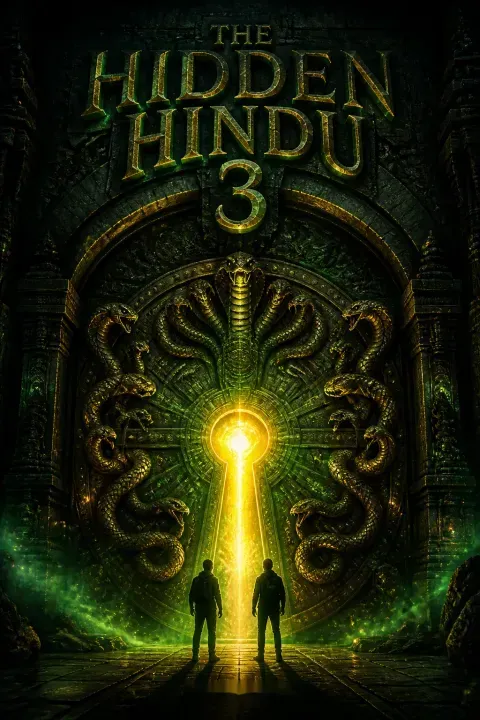


Plot Summary
I Am Devdhwaja
At Gyanganj, Om1 regained consciousness after the battle of Kuldhara and spoke words that stunned the immortals: he was Devdhwaja,1 born in Satya Yuga to Vishnuyasha and Lakshmi beside the river Tamirabarani.
The revelation came because when Ashwatthama5 beheaded Nagendra,2 a single drop of blood fell on Om1's tongue. Since Nagendra2's blood was drawn from Om1's own body, it triggered a flood of memories. Om1 then healed Vrishkapi11 by transferring Nagendra2's poison wound to his own shoulder, an ancient practice older than the immortals themselves.
While Om1 meditated to recover fully, Ved Vyasa9 overheard disembodied voices revealing that Shukracharya,6 the ancient guru of asuras, was the true architect behind everything. Nagendra2 was his protégé.
The memory-as-blood motif literalizes a psychological truth: we cannot remember what we have severed from ourselves. Om's amnesia was the cost of his separation from Nagendra, and only through reincorporation—however violent—could wholeness return. The scene also establishes the trilogy's central thesis: that Hindu mythology is suppressed history, and that the immortals are not gods but beings who have endured across yugas through specific, teachable techniques.
Nagendra Reborn Immortal
Deep in the submarine's forbidden chamber, Nagendra2's decapitated corpse began to stir. Shukracharya6 had used the Mrit Sanjeevani knowledge and Dr Batra's stolen sample of Om1's blood to complete the resurrection. The frail, creased body transformed: spine straightened, wrinkles vanished, and Nagendra2 rose as a strikingly handsome immortal with the black birthmark prominent on his heel.
He immediately sought out LSD7 in Parimal8's presence, pulled her into a passionate kiss, and declared himself her soulmate. He revealed LSD7 carried Parimal8's child but that Parimal8 was merely the vessel for a genetic trait Nagendra2 needed. He ordered them to Goa, then handed Parimal8 coordinates for the submerged Dwarka — the next word location.
Nagendra's resurrection inverts the traditional hero's journey: the villain achieves immortality not through sacrifice but through theft and manipulation. The kiss forced upon LSD in front of Parimal is not romance but territorial display, a performance of ownership that reveals how Nagendra treats all relationships as transactions. His newly beautiful appearance masks an ancient ugliness, demonstrating that evil in Kali Yuga no longer wears a monstrous face but a charming one.
Two Souls, One Body
Om1 narrated his Satya Yuga childhood to Ved Vyasa9 and Ashwatthama.5 His mother Lakshmi always claimed a mysterious stranger delivered her baby. As Devdhwaja1 grew, a nameless evil presence manifested within: he once snapped his pet rabbit's neck without volition, murdered livestock, and finally beheaded a visiting sage in broad daylight before the entire village.
The only being who loved him unconditionally was Nibhisha,12 a baby navgunjara he rescued from its dead mother's womb. She possessed nine animal forms and could transform at will, but even she suffered when the darkness took over.
A sage declared Devdhwaja1 had been born at the juncture of the night's darkest hour and Brahma Muhurta, causing his dual nature. The villagers decided he must be divided.
The childhood flashbacks reframe Om not as a hero but as a survivor of profound internal violence. His description of feeling like 'a mere mask' while the evil acted through his body evokes dissociative identity disorder rendered in mythological terms. Nibhisha's unconditional loyalty despite abuse mirrors the psychology of trauma bonds, while the sage's diagnosis—that Devdhwaja is a Kali Yuga man born in the wrong era—positions evil not as external demon but as a premature future self.
The Separation Ritual
The villagers and sages performed Prithak Vyaktitwa Yagya, the same filtration ritual Parashurama4 would later use on Ashwatthama.5 When the ceremony ended, Devdhwaja1 saw his own reflection standing before him — identical on the surface, entirely different within.
The evil entity was imprisoned in a dry well covered with a lid, fed vegetables thrown through a hole. Years passed. Then a messenger arrived: a man whose bald head glowed with mystical colors, carrying a sacred word embedded as an energy chakra within his skull.
He needed an escort to the Himalayas to deliver this word to Dhanvantari.16 Devdhwaja1 agreed and departed on the full moon with Nibhisha12 and his warriors. That same night, the imprisoned twin2 escaped through a tunnel he had dug to the Tamirabarani river.
The Prithak Vyaktitwa represents an ancient understanding of psychological integration: what we exorcise does not disappear but becomes an autonomous entity seeking reunion. The well, with its single hole for food and light, functions as a dark womb where resentment gestates into vengeance. The messenger's glowing skull—a word literally embedded in bone—transforms language from abstraction into physical reality, a recurring theme where words in this mythology carry material, world-altering power.
Murder at Roopkund
The evil twin2 tracked Devdhwaja1's convoy across India, killing soldiers in their sleep. At Roopkund, he cornered the last survivors: Devdhwaja,1 Nibhisha,12 and the messenger. He forced Devdhwaja1 to command Nibhisha12 to turn herself into stone, promising she would remain frozen until called by name.
Then, in hand-to-hand combat, he stabbed Devdhwaja1 with a hidden arrow tip, slit his tongue so he could never call Nibhisha12's name, and killed the messenger — whose final words revealed his name was Nagendra.2
The twin2 then murdered Devdhwaja1 with repeated sword thrusts, venting years of accumulated hatred. As he celebrated, his strength began fading: killing Devdhwaja1 meant killing himself since they shared one destiny. Shukracharya6 materialized and offered survival in exchange for service.
The Roopkund massacre literalizes fratricide as suicide. The evil twin's victory is hollow because he has destroyed the vessel that sustains him—a mythological rendering of the psychological insight that destroying one's 'good' self leaves nothing worth preserving. The tongue-slitting is particularly cruel: it transforms a promise into an impossibility, weaponizing love against the one who gave it. Nibhisha's transformation into stone prefigures the entire book's meditation on waiting, loyalty, and the cost of devotion.
Love, Poison, and Curse
The evil twin, now calling himself Nagendra,2 dragged Devdhwaja1's frostbitten corpse to Dhanvantari16's Himalayan camp. He presented himself as the messenger bearing the word 'Anadi,' and Dhanvantari16 accepted him. Devdrath,7 one of ten sages, fell deeply in love with Nagendra,2 and they became lovers in secret.
When Dhanvantari16 successfully resurrected Devdhwaja1 — naming him Mrityunjay1 and using his own blood for transfusion — Nagendra2 grew desperate. He hypnotized Devdrath7 into poisoning the other sages, then slaughtered Sushrut and imprisoned Dhanvantari.16
Dhanvantari,16 seeing Devdrath7 smile while soaked in Sushrut's blood, cursed him: never attain salvation, reincarnate through all forms, always find Nagendra2 as your dead end. Devdrath7 died fed to a crocodile and was reborn as a bird, beginning 84 lakh incarnations.
Devdrath's tragedy is that love, the most sacred emotion in bhakti traditions, becomes the instrument of his damnation. Dhanvantari's curse is psychologically precise: the punishment fits the crime not through equivalence but through eternal repetition. Devdrath will spend eternity seeking the very being who destroyed him—a supernaturalized portrait of trauma bonding and the compulsion to repeat. The smile forced by hypnosis while serving poison captures the horror of being a conscious prisoner in one's own body.
Sacred Sites, Stolen Words
Nagendra2 and Parimal8 dove into submerged Dwarka, fought two giant guardian turtles, and fixed a nine-pointed pyramid artefact into a concealed slot. When Nagendra2 died from oxygen loss, his immortal body resurrected and demanded the word: 'Tihu-Lau-Niyanta' appeared, triggering a tsunami that Parashurama4 barely stopped with the Sailastra.
At Bheemkund, Nagendra2 stripped naked, slashed himself, and fell dead into the sacred waters. The kund chose self-destruction over corruption, its water evaporating as volcanic fire erupted beneath.
Nagendra2 inhaled the word 'Yasya Prapnoti' from the rising vapor. At Ellora, Shukracharya6's asuras trapped Parashurama4 inside his own temple as it reversed its carving and consumed him, while LSD7 extracted 'Ashta-sangrah' from seven sacred statues.
Each word extraction follows a pattern of symbolic defilement: the sacred must be violated before it yields its secret. Dwarka drowns again, Bheemkund boils itself rather than serve evil, Ellora reverses its creation. These acts invert the original sacred narratives—Krishna's city, Bheem's water miracle, Parashurama's penance—turning devotion into destruction. The pattern suggests that evil in this cosmology operates not by creating but by uncreating, reversing the divine acts that shaped the world.
Om Breaks Free
At Gyanganj, Om1 could no longer wait for permission to free Nibhisha.12 When Ashwatthama5 blocked his path, the two immortals fought — first with swords, then bows and arrows. Ashwatthama5 summoned the Naagpasha to bind Om1 in venomous snakes, but the astra inexplicably reversed direction and coiled around Ashwatthama5 instead. Om1 revealed it would release him in nine days.
Outside, Kripacharya10's Yeti Ballhaar17 attacked, but Om1 raised his body temperature to scalding levels, broke free, and psychically summoned Vrishkapi11 to fight the giant. Om1 then trekked to the destroyed Roopkund, where Nibhisha12 had been stone for yugas. A mace materialized in his hand — the divine Kaumodaki — and he began smashing the mountain that had grown around her.
Om's rebellion against Gyanganj's hierarchy marks his transition from passive amnesiac to active agent. His ability to reverse the Naagpasha and summon Vrishkapi telepathically demonstrates that his powers are not skills to be taught but memories to be recovered. The mace appearing when needed—like the sword later—suggests that divine weapons are not external tools but extensions of awakened identity. Om's loyalty to Nibhisha overrules his loyalty to the immortals, establishing that ancient bonds outweigh institutional authority.
The Baby Cut from Womb
In the submarine, Nagendra2 revealed his true design: LSD7's pregnancy was never about love or lineage. Parimal8's cursed bloodline carried a genetic trait — a keyhole-shaped pupil embedded in the left palm of every child born to the family. Nagendra2 strapped LSD7 to a stretcher, slit her abdomen open, and pulled out an egg containing the premature infant.
LSD7 died screaming as Parimal8 watched. Parimal8 shot Nagendra2 in the head, but the immortal simply resurrected. Parimal8's oath-breaking triggered his ancestral curse: his lower body transformed into a snake, his eyeballs fell out, and a layer of skin sealed his sockets. Nagendra2 then cut the pupil from the baby's palm and left Parimal8 to die beside LSD7's corpse.
This scene represents the trilogy's moral nadir: a C-section performed as murder, a birth weaponized as theft. The keyhole pupil literalizes the book's obsession with keys, doors, and thresholds, transforming a child's body into hardware. Parimal's curse—blind and half-serpent—returns him to his ancestor Lopaksh's original state, making the curse not punishment but reversion to default. The infant crying beside its dead mother while Nagendra celebrates is the book's starkest image of evil's indifference to suffering.
Parimal's Final Warning
Parimal,8 blind and half-transformed, lay dying beside LSD7's body. He heard his infant still wailing and realized Ved Vyasa9 — who could hear every word spoken on earth — might hear him too. With his final breaths, he screamed the destination again and again: Padmanabhaswamy Temple in Thiruvananthapuram.
His voice reached Ved Vyasa9 at Gyanganj, who immediately mobilized the Pushpak Vimana. Kripacharya10 and Vrishkapi11 found the submarine, fought through its asura crew, discovered the corpses of LSD7 and Parimal,8 and rescued the crying infant along with the Mrit Sanjeevani books. They destroyed the vessel. Parashurama4 later named the child Prithvi3 and gave him to Om1 to raise.
Parimal's death is simultaneously his redemption. After a lifetime of servitude to evil, his final act is defiance: using Ved Vyasa's cosmic surveillance against his masters. The scene redefines strength—a blind, dying, half-snake creature screaming into the void accomplishes what the immortal warriors could not. His tragedy is compounded by the revelation that Devdrath's soul will enter his infant son's body, meaning the father dies unaware that his wife's consciousness now inhabits their child.
Nibhisha's Liberation
After nine days of hammering, Om1 heard a heartbeat resonating within the mountain at Roopkund. He struck harder until a massive eye blinked through the crack. Nibhisha12 erupted from the stone, far larger than when she was imprisoned — she had continued growing across the yugas. Ashwatthama5 arrived and, witnessing the reunion, abandoned his mission to capture Om.1
Nibhisha12 transformed into a snake for the journey to Gyanganj. Om1 then joined Vrishkapi11 at Ellora, where Vrishkapi11 — newly mastering his size-shifting powers — took the mace and shattered the mountain imprisoning Parashurama.4 The immortal emerged, and the mace, now bonded to Vrishkapi,11 was revealed as Kaumodaki Gada, Vishnu's divine weapon.
The heartbeat within the mountain is the book's most hopeful image: life persisting through geological time on nothing but a promise. Nibhisha's growth while imprisoned suggests that loyalty, even when frozen, is not static but accumulative. Vrishkapi's emerging powers—shrinking to insect size, growing to giant proportions—mirror Hanuman's siddhis, establishing a lineage of divine service through physical transformation that culminates in his wielding of Vishnu's own mace.
The Veerabhadra Temple Falls
Nagendra2 and Parimal8 entered the Veerabhadra Temple at Lepakshi after the priests departed. Nagendra2 placed a copper sheet embossed with all previously extracted words beneath the famous hanging pillar. The pillar scanned the sheet with reflected light as if verifying each word's authenticity.
Once confirmed, the next word — 'Sah Bhavishyati' — embossed itself onto the copper. Immediately, all seventy pillars began melting like candles. The pair walked out unchallenged.
Nagendra2 now needed only the final word, which Shukracharya6 revealed was never hidden in any location: it was Om1's first name, Mrityunjay,1 the name Dhanvantari16 gave him upon resurrection. The final confrontation would require Om1's physical presence at Padmanabhaswamy Temple.
The hanging pillar's verification function suggests the words are not merely collected but judged—they form a sentence that must be syntactically and spiritually coherent. The pillar melting rather than breaking represents a reversal of creation: what was carved from stone returns to formlessness. The revelation that the final word is a name transforms the hunt from archaeological quest to personal confrontation, making Om's participation not optional but ontologically necessary.
The Kallara Opens
At Padmanabhaswamy Temple, the immortals arrived too late. Nagendra2 fixed the keyhole pupil into the carved snake's eye socket on Vault B and chanted the completed verse: 'Avinashi Anadi Ananta, Sakal Jagat Tihu-Lau-Niyanta, Yasya Prapnoti Ashta-sangrah, Sah Bhavishyati Mrityunjay.1 'The door swung open.
Through smoke emerged the cursed negative selves of Parashurama4 and Ashwatthama5 — the evil separated by Prithak Vyaktitwa ages ago. Then came Hiranyaksha, Hiranyakashipu, Ravana, Kumbhakarna, Meghnaad, and endless armies of asuras. Shukracharya6 declared victory: every asura killed by the Dashavatars was imprisoned behind this door, and now they were free to pre-emptively end Kali Yuga.
The verse itself is a theological statement: 'Indestructible, eternal, infinite, the conqueror of death who attains these words from the creator of the three worlds shall be invincible.' It is not a password but a claim of sovereignty. The door's opening unleashes not random monsters but the specific enemies each Vishnu avatar was incarnated to defeat—a perversion of divine chronology that suggests evil's ultimate goal is not new conquest but the reversal of old defeats.
The Immortals' Darkest Hour
The battle turned catastrophic. Cursed Ashwatthama5 embraced his righteous counterpart in an inauspicious reunion, absorbing him as the asuras blew victory bugles. Ballhaar17 the Yeti was beheaded by cursed Parashurama4's axe. Nibhisha12 fought Nagendra2 through transformation after transformation: he sliced off her elephant trunk, ripped her tiger's jaw, split her snake body, and carved her dog's face in two.
Each death cost her one of her nine forms. She continued as a woman, borrowing weapons from the immortals, until she consumed a Brahmastra aimed at Om1 and died as a human. Only the white horse remained — her last visible body. The Gyanganj animal army was being slaughtered. Hope had nearly vanished.
This sequence inverts the expected battle rhythm: instead of the heroes gaining ground, they lose their most beloved figures in quick succession. Ashwatthama's absorption literalizes what every human fears—being consumed by one's own darkness. Nibhisha's progressive dismemberment is a sacrificial striptease, each lost form a payment for Om's survival. The detail that she smiles while dying from the Brahmastra transforms her from loyal pet to willing martyr, completing her arc from abused companion to self-chosen savior.
Kalki Rises on Devdutta
King Bali14 and Vibhishana15 arrived with their armies, having chosen to fight when their ancestors appeared among the enemy. Vibhishana15 put Kumbhakarna to sleep, revealed the invisible Meghnaad, and helped expel them through the door. Om,1 riding the white horse Nibhisha12 — now understood as Devdutta — wielded the blazing sword Nandaka and became unstoppable.
He beheaded the cursed Parashurama4 and slew Hiranyaksha. Ravana fell to the combined assault. When the door finally closed, Ved Vyasa9 revealed the solution: Nagendra2 must be cut into nine pieces. Om1's sword fell. Parashurama4 then revealed the prophecy: Om1 is Kalki, the tenth avatar of Vishnu, born to complete the Dashavatars and end Kali Yuga.
The battle's resolution depends not on the immortals' power but on their willingness to accept help from those they once considered enemies. King Bali and Vibhishana—asuras who chose righteousness—represent the possibility of moral choice transcending birth nature. Om's transformation into Kalki is not a possession by external divinity but a recognition of what he has always been: the sword, horse, and mace were not gifts but forgotten possessions. The nine pieces of Nagendra mirror the nine words, suggesting evil can be contained but never truly destroyed, only distributed and guarded.
Epilogue
Back in Mrs Batra13's home in 2041, Prithvi3 completed his narration and asked for water. She obliged, then pressed him: how could he know Nagendra2's side of events so intimately? Prithvi3's answer froze her blood. His soul was Devdrath7 — the cursed sage, the lover who poisoned seven sages, the consciousness that endured 84 lakh incarnations.
When LSD7 died on the submarine, Devdrath7's soul entered the only available newborn: her own son. Prithvi3 had been telling the story of his own damnation.
He then slit Mrs Batra13's throat and collected her blood in a bottle, explaining that Dr Batra had Om1's blood flowing through his veins from a transfusion, and Mrs Batra13 carried that same blood. A familiar voice echoed through the room — Shukracharya6 — guiding Prithvi3 toward their next objective: reassembling Nagendra2's scattered body parts.
The epilogue's double revelation reframes the entire trilogy. Prithvi is not merely a narrator but the story's most tragic figure: a soul so thoroughly colonized by its abuser that it murders to resurrect him. His act of killing Mrs Batra mirrors the original sin that earned Devdrath's curse—serving poison to the innocent—suggesting that Dhanvantari's damnation was not merely punitive but prophetic. Shukracharya's final voice, echoing the book's last line 'It's not over yet!', transforms the trilogy's apparent resolution into merely another move in an eternal game. The collected blood implies that the cycle of death, resurrection, and word-hunting will begin again, affirming the book's deepest conviction: that the war between good and evil is not a story with an ending but a structure of recurrence.
Analysis
The Hidden Hindu 3 operates as a theological thriller that weaponizes Hindu cosmology's most destabilizing feature: the doctrine of the yugas. If time is cyclical, then evil is not something to be defeated once but something that must be defeated repeatedly, forever. The book's central innovation is to literalize this through the Prithak Vyaktitwa Yagya — the ritual that separates good from evil — and then ask what happens to the evil that was excised. The answer is devastating: it does not disappear but waits, accumulates, and seeks reunion. Every immortal who undergoes purification creates a shadow self that becomes an enemy. This is a sophisticated psychological insight dressed in mythological clothing: trauma work does not eliminate the traumatized self but creates a split that must be perpetually managed. The character of Devdrath7 embodies the book's deepest tragedy. Cursed to love his destroyer across 84 lakh incarnations, he represents the psyche that cannot escape its abuser because the abuser has become the organizing principle of its existence. When Devdrath7's soul enters the infant Prithvi3 and continues serving Nagendra2's resurrection, the book makes an uncomfortable claim: some bonds survive death, and not all of them are redemptive. The climax's solution — cutting Nagendra2 into nine pieces and distributing them among immortals — is both resolution and acknowledgment of failure. Evil cannot be killed, only contained, guarded, and passed down. The epilogue's murder of Mrs Batra13 confirms this: the cycle has already begun again. The trilogy's ultimate argument is that Hinduism's 'mythology' is suppressed history and that its central figures are not allegories but participants in an ongoing war whose next battle is always imminent.
Review Summary
The Hidden Hindu 3 concludes Akshat Gupta's trilogy, blending Hindu mythology with modern storytelling. Readers praise the action-packed plot, character development, and unexpected twists. The book explores themes of immortality, power, and destiny, weaving together ancient legends and contemporary science. While some criticize repetitive information and underdeveloped characters, many find the series captivating and eagerly anticipate future installments. The ending leaves readers both satisfied and curious about potential sequels, with mixed opinions on the final revelations and character fates.
People Also Read

Characters
Om
Amnesiac immortal turned Kalki AvatarThe protagonist who awakens in Gyanganj with no memory and gradually discovers he is Devdhwaja, a being born in Satya Yuga with a dual nature. After separation from his evil half, he was murdered at Roopkund and resurrected by Dhanvantari16 as Mrityunjay. He possesses immense but dormant powers that surface when challenged, including the ability to summon divine weapons. His defining drive is loyalty—to Nibhisha12, to his promises, to protecting the world. Through the narrative, he evolves from passive confusion to active self-realization, ultimately accepting his identity as Kalki, the tenth avatar of Vishnu. His psychology is marked by the trauma of having witnessed his own body commit atrocities he could not control.
Nagendra
Ancient evil consuming immortalOm1's separated evil half, imprisoned in a well for years in Satya Yuga before escaping. He took the name of the messenger he murdered and built an identity on stolen names and bodies. Driven by an insatiable hunger—for flesh, for power, for recognition—he serves Shukracharya6 as a means to his own ends. After becoming an immortal, his cruelty escalates without consequence. His relationship with Devdrath7 is the book's most twisted: he loves possessively but destroys casually, keeping Devdrath7's soul trapped across reincarnations as pets, servants, and lovers. Psychologically, he represents the personified shadow self, convinced that his suffering in the well justifies infinite retribution.
Prithvi
Narrator bearing ancient curseThe twenty-one-year-old who tells the story to Mrs Batra13. He was the infant cut from LSD7's womb, rescued by Ved Vyasa9, named by Parashurama4, and raised by Om1. His calm, encyclopedic narration masks a devastating secret: his soul is Devdrath7, the sage cursed by Dhanvantari16 to endless reincarnation. He possesses perfect memory of every life he has lived, every death he has suffered, and every betrayal by Nagendra2. This accumulated trauma makes him simultaneously the most knowledgeable and most damaged character. His stated goal of finding Om1 conceals his true mission of reassembling Nagendra2, revealing that his psyche remains colonized by the abuser he cannot escape.
Parashurama
Immortal commander and Vishnu avatarThe sixth avatar of Vishnu and leader of the seven immortals. He carved the Kailash temple at Ellora over 351 years as penance. Stern, duty-bound, and slow to trust, he initially views Om1 as a potential threat and orders him confined to Gyanganj. His strategic mind is Shukracharya6's primary obstacle, though the enemy's psychological warfare repeatedly outmaneuvers him. He undergoes his own Prithak Vyaktitwa, separating from his rage-filled cursed self. His revelation of Om1's true identity as Kalki transforms him from commander to servant, fulfilling the prophecy that all seven immortals exist to serve the final avatar.
Ashwatthama
Cursed immortal warriorSon of Dronacharya, cursed by Krishna after the Kurukshetra war to wander eternally with leprosy. He became Om1's trainer and closest friend among the immortals, often mediating between Om1's impulses and the hierarchy's commands. His own trauma—his father's death through deception, his curse—makes him empathetic to Om1's fractured past. His absorption by his evil counterpart represents the book's darkest psychological turn: the fear that one's purified self can be re-consumed by the darkness that was excised. His fate remains unresolved, with Parashurama4 departing to find him.
Shukracharya
Ancient asura guru mastermindGrandson of Brahma and guru of the asuras, driven by vengeance against Vishnu for beheading his mother Kavyamata. He acquired the Sanjeevani Stotram to resurrect dead asuras but could never create true immortals until Nagendra2. He operates through protégés, proxies, and psychological manipulation, never revealing his full plan because Ved Vyasa9 can hear all spoken words. His method is patience across yugas: playing the long game of weakening the immortals through division. Though rarely seen, his presence permeates the narrative as the ultimate architect of every catastrophe. His motivation transcends simple evil, rooted in a genuine grievance that has festered into cosmic destruction.
Devdrath/LSD
Cursed soul across incarnationsOnce a celibate sage at Dhanvantari16's camp, Devdrath fell in love with Nagendra2 and was hypnotized into poisoning seven fellow sages. Dhanvantari16 cursed him to never attain salvation, to reincarnate through all forms, and to always find Nagendra2 as his dead end. Across yugas, his soul occupied countless bodies: a bird, a beaver, a black lion, a fruit fly, an elephant killed as 'Ashwatthama5,' a deer named Baadal, and finally LSD (Latika). In each incarnation, Nagendra2 owned him as a pet or lover and orchestrated his death. As LSD, he married Parimal8 and bore a child, feeling genuine love for the first time since his curse began.
Parimal Nair
Cursed servant turned rebelA history professor whose lineage was bound to Nagendra2's service since Satya Yuga, when his ancestor Sarputi traded her descendants' freedom for her son Lopaksh's humanity. Parimal married LSD7 sincerely, unaware of her connection to Nagendra2, and fathered a child carrying the keyhole pupil trait. His arc moves from obedient servant to heartbroken husband to desperate father, culminating in his fatal rebellion when he shoots Nagendra2. His death—blind, half-snake, screaming his child's location to Ved Vyasa9—represents the cost of breaking an oath and the possibility of redemption through sacrifice.
Ved Vyasa
All-hearing immortal sageCompiler of the Vedas and author of the Mahabharata, Ved Vyasa possesses the ability to hear every word ever spoken on earth. This makes him both invaluable to the immortals and a liability when Shukracharya6 feeds him misinformation. He is the father of Vidur (whom Om1 once impersonated) and serves as the immortals' intelligence network. His horror at realizing Shukracharya6 used him as a puppet—letting him hear only what would divide the immortals—represents a crisis of faith in his own powers. He ultimately secures the Mrit Sanjeevani books and the infant Prithvi3, his wisdom proving essential to the final victory.
Kripacharya
Distrustful immortal preceptorThe royal preceptor who trained the Kuru princes, suspicious of Om1 from the beginning. He advocated imprisoning or killing Om1, believing the amnesiac immortal posed an unknown threat. His judgment proves partially correct when Om1 overrules his orders and later escapes Gyanganj. He commands Ballhaar17 to kill Om1 if he leaves alone, a decision that leads to Ballhaar17's death. In the final battle, he fights beside Vibhishana15 and King Bali14, his rigid adherence to duty balanced by genuine grief when Ashwatthama5 is absorbed. He takes two pieces of Nagendra2's body into his custody.
Vrishkapi
Ape-like guardian gaining powersA being from Hanuman's lineage who serves as warden of extinct species at Gyanganj. After Om1 heals his near-fatal wounds, dormant siddhis activate: he can grow enormous, shrink to insect size, fly at immense speeds, and wield immense strength. His innocent, earnest personality provides comic relief amid the darkness, but his combat prowess becomes crucial. He wields the Kaumodaki Gada—Vishnu's divine mace—after Om1 gifts it to him. His promise to protect Ballhaar17, which he cannot keep, adds tragic weight to his development from comic relief to formidable warrior.
Nibhisha
Nine-formed eternal companionA navgunjara rescued by Devdhwaja1 as a baby, possessing nine animal forms: human arm, tiger leg, elephant leg, horse leg, lion waist, snake tail, dog head, bull hump, and two visible hearts. She can transform fully into any of her component creatures and reproduce asexually. Her defining quality is absolute loyalty—she waited as stone for yugas because Devdhwaja1 promised to call her name. In the final battle, she dies form by form protecting Om1, her last body revealed as Devdutta, the white horse prophesied to carry Kalki1. Her arc transforms her from pet to avatar vehicle, her loyalty transmuted into cosmic purpose.
Mrs Batra
Grieving widow hearing taleDr Tej Batra's widow, who lost her husband to Nagendra2's machinations. She serves as the audience for Prithvi3's narration, asking questions that prompt deeper explanations of Hindu cosmology and the events of the story. Her grief is the frame's emotional anchor: she wants to understand why her husband died. Her medical knowledge (she carries Om1's blood from her husband's research and subsequent transfusion) makes her both listener and unwitting participant, her body containing the very substance needed to potentially resurrect Nagendra2 again.
King Bali
Righteous asura king of SutalaThe demon king granted immortality and the kingdom of Sutala by Vamana avatar. Initially determined to remain neutral, he changes his stance when his ancestors Hiranyaksha and Hiranyakashipu emerge from the Kallara door, recognizing the stakes transcend clan loyalty.
Vibhishana
Ravana's righteous brotherThe asura king of Lanka who sided with Rama against his brother Ravana. He serves Lord Jagannath in Puri disguised as a priest. His decision to join the battle—accepting arrows from Ravana while helping the immortals—repeats his ancient choice: righteousness over blood.
Dhanvantari
Divine physician and sageThe demigod who brought amrit from the ocean during Samudra Manthan. He resurrected Devdhwaja1's corpse using his own blood and compiled the nine words into the Mrit Sanjeevani books before being murdered by Nagendra2. His curse on Devdrath7 drives one of the trilogy's central tragedies.
Ballhaar
Yeti guardian of GyanganjA massive white-furred Yeti who guards the entrance to Gyanganj on Kripacharya10's orders. He attacks Om1 during his escape but is defeated by Vrishkapi11, to whom he later owes a life debt. He leads the Gyanganj animal army into the final battle and is beheaded by the cursed Parashurama4.
Plot Devices
Mrit Sanjeevani Books
Resurrection and word extractionThe books compiled by Dhanvantari16 after resurrecting Devdhwaja1 contain the complete process for achieving immortality and extracting the nine sacred words scattered across India. Nagendra2 initially seeks them for immortality, but Shukracharya6's true purpose is the word locations they contain. The books function as both medical text and spiritual key: they teach the Sanjeevani Stotram for resurrecting the dead, the process of Mrit Sanjeevani for transferring consciousness and blood, and the locations where each word fragment was hidden. After the words are extracted, the books lose their strategic value, which is why Shukracharya6 leaves them in the submarine. They are ultimately recovered by Kripacharya10 and returned to Gyanganj.
The Nine Sacred Words
Verse key to Kallara doorDhanvantari16 divided a powerful verse into nine pieces and hid eight of them across sacred sites in India: Mansarovar, Roopkund, Tejo Mahalaya (Agra), Kuldhara, Dwarka, Goa (Bheemkund), Ellora, and Veerabhadra Temple. The ninth word was never hidden in a location but embedded in Om1's identity: his first name after resurrection, Mrityunjay1. When assembled and spoken in correct sequence alongside the keyhole pupil, the verse opens the Kallara door at Padmanabhaswamy Temple. Each word extraction causes the destruction of its host site—lakes overtaken, temples reversed, cities submerged—as the word's removal unravels the sacred protection that maintained the site.
The Keyhole Pupil
Biological key for the doorA genetic trait carried in Parimal8's cursed bloodline since Satya Yuga, when his ancestor Aghasura was killed by Lord Krishna. A keyhole-shaped pupil appears in the left palm of every child born to the lineage. This trait is the biological counterpart to the nine-word verse: the words form the spiritual key, but the pupil provides the physical mechanism that activates the carved snakes on the Kallara door. The pupil was originally embedded in Aghasur's eye socket and popped out when Krishna killed him, only to re-emerge in his descendants. Nagendra2 orchestrated Parimal8 and LSD7's union specifically to produce a child carrying this trait.
Prithak Vyaktitwa Yagya
Filtration of good from evilAn ancient Vedic ritual that separates a being's positive and negative aspects into two distinct physical entities. It was first performed on Devdhwaja1 in Satya Yuga, creating Om1 and Nagendra2 as separate beings. The same ritual was later used on Ashwatthama5 to cure his leprosy and rage, and on Parashurama4 to remove his fury. However, the separated evil does not disappear—it manifests as an identical being with equal powers, imprisoned in a parallel dimension behind the Kallara door. The ritual's hidden consequence is that the separated entities remain linked: killing one kills the other, and in the final battle, the cursed counterparts seek to reabsorb their purified originals.
The Kallara Door
Prison of defeated asurasVault B at Padmanabhaswamy Temple in Thiruvananthapuram, sealed by chants and guarded by carved serpents. Behind it are imprisoned all asuras and their allies who were defeated by Vishnu's Dashavatars across the four yugas—including Ravana, Kumbhakarna, Meghnaad, Hiranyaksha, and Hiranyakashipu. The door also contains the cursed negative selves separated through Prithak Vyaktitwa. It requires both the complete nine-word verse and the keyhole pupil to open. The door can only be opened by an immortal, and its opening threatens to end Kali Yuga prematurely by flooding the world with concentrated evil. It closes only when the keyhole pupil melts and the verse's power is dispersed.
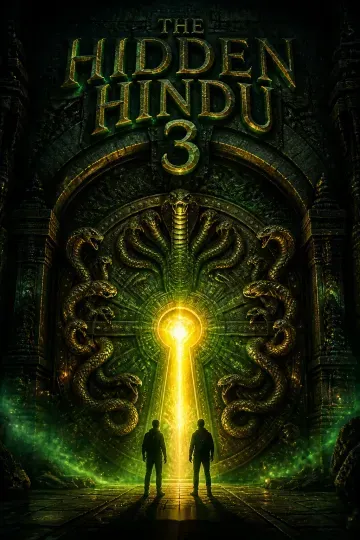
The Hidden Hindu Series
About the Author

Download PDF
Download EPUB
.epub digital book format is ideal for reading ebooks on phones, tablets, and e-readers.








































