
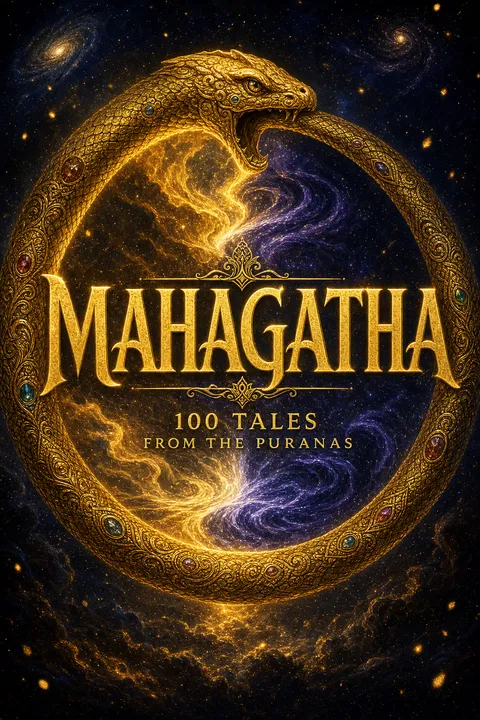


Plot Summary
The Cosmic Egg Cracks Open
When the Parabrahman wills existence into motion, the sound Om vibrates matter into being. Narayana2 floats on primordial waters, a golden egg forms, and from it emerges Vishnu the Preserver.2 A navel-lotus births Brahma the Creator,1 who splits the egg into heaven and earth and produces the four Vedas. Almost immediately, two creatures born from Vishnu's2 earwax, Madhu and Kaitabha, snatch the scriptures and threaten Brahma.1
Vishnu2 wakes as the horse-headed Hayagriva and tricks the brothers into unwittingly granting their own deaths. Brahma1 populates the cosmos with mountains, yugas and sages, but his troubles multiply when a fiery being, Rudra,3 emerges from his anger and can birth only immortals, endangering the cycle of mortal life.
The opening establishes the Puranic universe as a self-correcting machine rather than a static paradise. Creation is immediately imperiled, teaching that generation and destruction are twinned from the first breath. The Madhu-Kaitabha episode introduces the book's governing logic: brute force fails where cunning and the exploitation of one's own words succeed. Brahma's helplessness beside a sleeping Vishnu dramatizes interdependence within the trinity. The refusal of immortality as a viable option for earthly life encodes a philosophy of impermanence, mortality is the price of participation in the cosmic wheel. The tone is cosmological yet oddly domestic, gods bickering and improvising, signaling a mythology comfortable in its gray zones.
A Father's Curse, A Daughter's Terror
Brahma's1 children keep frustrating him: his mind-born sages refuse to procreate, and Narada,4 sprung from his neck, rejects worldly duty for devotion to Vishnu.2 Enraged, Brahma1 curses Narada4 to wander eternally; Narada4 retaliates, foretelling that his father will desire what must never be desired.
Shiva3 then reveals the Ardhanarishwara, the half-male, half-female form, teaching Brahma1 that creation requires Shakti, the sacred feminine. Empowered, Brahma1 fashions the first human pair, Manu and Shatarupa.
But Narada's4 curse ripens: Brahma1 lusts after his own daughter, sprouting heads to keep watching as she flees through a hundred animal forms, birthing all creatures. Shiva3 severs Brahma's1 fifth head in fury, then wanders cursed with the skull until Kashi cleanses him.
This sequence exposes the Puranas' willingness to let the divine sin. Brahma, the Creator, becomes the first transgressor of the incest taboo he himself must guarantee, and no divinity is exempt from consequence. The mutual father-son curse collapses hierarchy, curses operate as impersonal natural law, binding even gods. The Ardhanarishwara offers a strikingly non-dualist theology of gender: creation is impossible without integration of opposites. Shatarupa's shapeshifting flight literalizes woman as generative nature pursued and threatened, and her later fear (who will protect women if fathers wound them) plants a question the book returns to across yugas. Shiva's penalty for a justified killing insists that action and reaction are context-independent.
The Gatekeepers Choose Hatred
When Brahma's1 child-sages reach Vaikuntha, its gatekeepers Jaya and Vijaya18 turn them away, and the offended sages curse the pair to be born mortal. Vishnu2 cannot revoke the curse but offers a choice: seven lifetimes on earth as his devotees, or three as his enemies.
Unable to bear long separation from their lord, the brothers18 choose the shorter path of enmity, begging Vishnu2 to slay them himself each time so they may return sooner. He foresees their destinies stretched across the ages: as Hiranyaksha and Hiranyakashipu9 in this era, as Ravana10 and Kumbhakarna in the next, and as Shishupala and Dantavakra in the third, reborn again and again only to die by his hand.
This is the book's structural keystone, a spine threading the entire chronology. The paradox is theologically radical: to love God through hatred, to draw near through opposition. The devotion of the villain reframes the epic antagonists not as evil incarnate but as souls on an accelerated homeward arc, their monstrousness a costume worn for love. It dissolves the good-versus-evil binary the author's note promises, replacing it with a logic of karmic acceleration. The choice of three violent lives over seven gentle ones also dramatizes impatience as a form of intensity, suffering embraced as the fastest route to reunion. The reader now carries a secret key to every demon-slaying that follows.
The War That Never Ends
Gods and demons, half-brothers sharing Daksha's21 blood, wage perpetual war. To save the dwindling asuras, their guru Shukracharya7 wins from Shiva3 the Mritasanjivani, the mantra that revives the dead, making his clan nearly unkillable.
Meanwhile boons and curses ricochet across the realms: Chandra loses and regains his light, Sati's father Daksha21 nurses hatred for Shiva,3 and the sage Dadhichi,22 made invincible by Shiva's3 boons, later offers his own indestructible bones so the gods can forge a weapon against the drought-demon Vritra. Again and again the same pattern repeats: a devotee earns a boon, abuses or sacrifices it, and the universe rebalances through terrible cost, whether a beheading, a sacrifice, or a fresh curse.
Here the book's engine becomes visible: boons are neither good nor evil but neutral opportunities that reveal the character of whoever wields them. The Mritasanjivani functions as a strategic superweapon, and its very existence, more than its use, is psychological warfare. Dadhichi's self-donation introduces the ethic of sacrifice as the highest dharma, giving back what was only ever borrowed. The relentless deva-asura conflict is reframed not as a moral contest but as a dynamic tension necessary to keep the cosmos in motion, stasis being a subtler death than war. The gray zone deepens: gurus arm demons, gods commit murder, and every gift carries a hidden bill.
Sati Walks Into The Fire
Adishakti reincarnates as Sati, daughter of Daksha,21 and marries Shiva3 against her father's wishes. When Daksha21 stages a grand sacrifice and pointedly excludes Shiva,3 denying him any offering, Sati attends uninvited.
Humiliated as her father21 mocks her husband3 as an uncouth outsider, she declares that her body, tainted by being Daksha's21 daughter, is unworthy, and immolates herself in the sacrificial fire. Grief-maddened Shiva3 creates the terrifying Veerbhadra, who beheads Daksha21 and wrecks the ceremony.
Carrying Sati's charred corpse, Shiva3 performs the cosmos-shaking Rudra Tandava until Vishnu's2 discus dismembers her body into fifty-one fragments that fall to earth as sacred Shakti Peeths. Shiva,3 unburdened but broken, withdraws into solitary grief.
Sati's death is protest as much as despair, a woman weaponizing her own body against patriarchal contempt. Her insistence that her flesh is the problem inverts blame onto the identity imposed by her father, making self-destruction a paradoxical act of agency and reunion with her true nature. Shiva's Tandava renders private mourning as cosmic catastrophe: the destroyer's grief literally threatens dissolution, collapsing the boundary between personal loss and universal collapse. The scattering of her body into pilgrimage sites transmutes trauma into sacred geography, suffering territorialized as devotion. Daksha's ram-headed revival later underscores the book's refrain that pride toward the divine reduces the proud to beasts.
Love Melts The Mountain Hermit
The demon Taraka, granted a boon that only Shiva's3 son can kill him, terrorizes heaven, counting on the grieving Shiva3 never to father a child. Adishakti reincarnates as Parvati5 and undertakes ferocious austerities to win the withdrawn god. When Kamadeva, the love god, fires an arrow to wake Shiva's3 desire, Shiva3 incinerates him with his third eye.
Yet Parvati's5 devotion eventually thaws him, and they marry. Their union produces Kartikeya, nurtured by six star-mothers, born six-headed. Merely days old, the child leads the gods into battle, matches Taraka's sorcery form for form, and drives his lance through the demon's heart, fulfilling the prophecy and ending Taraka's reign of terror.
This arc stages the reconciliation of yoga and bhoga, ascetic withdrawal and erotic engagement, as a cosmic necessity. Shiva's incineration of desire and eventual surrender to Parvati dramatize the impossibility of pure renunciation within a universe that requires generation. The demon's boon is a masterstroke of self-interested logic, weaponizing the enemy's own grief, and its defeat requires Shiva to rejoin the world of attachment. Kartikeya, the infant warrior, embodies potency compressed into innocence, martial power divorced from ego. Parvati's austerities recast the goddess not as passive consort but as the active force who reintegrates the fractured masculine principle back into creation's flow.
The Son Who Guarded The Door
Longing for a child of her own while Kartikeya campaigns, Parvati5 molds a boy from the turmeric paste of her body and breathes life into him, naming him Ganesha.19 She posts him to guard her chamber while she bathes. When Shiva3 returns and the boy blocks his own father, neither recognizing the other, a standoff escalates until Shiva's3 trident severs Ganesha's19 head.
Parvati's5 grief detonates into world-ending fury, sixty-four Yoginis rising to unmake creation. To pacify her, Shiva3 sends his hosts to fetch the head of the first northward-facing creature; they return with an elephant's head, granting it to a fulfilled boon of Gajasura. Restored, Ganesha19 is crowned the cardinal deity, remover of obstacles, first among gods.
The tale threads a knot of devotion and violence: a boy's absolute loyalty to his mother collides fatally with paternal authority, and the resolution requires grafting animal onto divine. Kashyapa's earlier curse, that Shiva would one day behead his own son, reframes the tragedy as karmic inevitability rather than accident, dissolving individual guilt into cosmic design. Parvati's near-annihilation of the universe insists that the maternal, when wounded, holds destructive power equal to any destroyer. Ganesha's elevation from slain guardian to auspicious threshold-god models transformation through catastrophe: the one who obstructed becomes the one who clears the way, hierarchy overturned by worth rather than birth.
The Ocean Yields Both Poison And Nectar
When a sage's curse drains heaven's fortune and demons seize Swarga, Vishnu2 proposes that gods and demons cooperate to churn the Ocean of Milk, using Mount Mandara as a churning rod and the serpent Vasuki as rope. Vishnu2 becomes the tortoise Kurma to steady the mountain. The churning births treasures: the wish-cow, the goddess Lakshmi,24 and finally amrita, the nectar of immortality.
But it also spews halahal, a world-dissolving poison, which Shiva3 drinks, staining his throat blue. When the demons grab the nectar, Vishnu2 takes the seductive female form Mohini, beguiles them, and feeds it only to the gods. One demon, Swarbhanu, sneaks a sip and becomes the eclipse-causing Rahu and Ketu.
The churning is the book's central image of cooperative dualism: creation's greatest boon requires the union of opposites pulling in contrary directions. That the same ocean yields both salvation and annihilation crystallizes the author's thesis that light and darkness are inseparable emissions of a single process. Shiva's swallowing of the poison models divine sacrifice as containment rather than conquest, holding evil in the throat rather than destroying it. Mohini's deception raises uncomfortable questions about divine fairness, the gods win immortality through trickery, not merit. The episode refuses clean morality: the demons labor equally yet are denied the reward, seeding grievances that will fuel future conflict.
The Pillar Splits, The Lion Emerges
Vishnu2 descends as the fish Matsya to save Manu from a world-flood, then as the boar Varaha to lift the drowned earth and slay Hiranyaksha, the first of the Jaya-Vijaya brothers.18 His brother Hiranyakashipu9 wins a boon making him unkillable by man or beast, indoors or out, by day or night.
But his own son Prahlad8 worships Vishnu2 with unbreakable devotion, surviving every murder attempt his father devises, including his aunt Holika's fire. When the enraged demon strikes a pillar demanding Vishnu2 appear, the column bursts open to reveal Narasimha,2 the man-lion, who eviscerates Hiranyakashipu9 at twilight, on a threshold, upon his lap, defeating every clause of the boon and completing the brothers'18 first lifetime.
Prahlad embodies devotion as ontological armor, faith so total it renders the devotee physically inviolable. The Narasimha form is a triumph of theological ingenuity over legalistic boon-crafting: the demon's meticulous loopholes are defeated by God inhabiting the interstices, neither this nor that. This dramatizes the divine as fundamentally liminal, escaping every category humans erect. The father-son conflict inverts natural loyalty, blood versus belief, and the book sides with chosen devotion over inherited tribe. Hiranyakashipu's terror of a nephew-less, godless universe reveals tyranny as fundamentally driven by fear of irrelevance. The completed first death of Jaya-Vijaya quietly advances the hidden clock beneath the surface violence.
Three Steps Measure The Universe
The noble demon Bali,17 grandson of Prahlad,8 conquers the three worlds through virtue and boundless charity. To restore Indra,6 Vishnu2 is born as the dwarf Vamana and approaches Bali's17 grand sacrifice, begging only as much land as three of his steps can cover. Warned by Shukracharya7 that the dwarf is Vishnu2 in disguise, Bali17 grants the wish anyway, unwilling to break his word.
Vamana2 swells into the cosmic Trivikrama, covering earth with one stride and heaven with the second, then asks where to place the third. Bali17 offers his own head, and Vishnu2 pushes him gently down to rule the netherworld, honoring his devotion. Later, water that washed Vishnu's2 foot becomes the river Ganga.
Bali is the book's supreme portrait of the virtuous asura, generosity so absolute it becomes his undoing and his glory. The tale interrogates the ethics of divine trickery: Vishnu exploits a good king's integrity, yet the exchange elevates rather than destroys Bali, transfiguring apparent defeat into coronation. Charity here is dharma pushed to its limit, giving even against self-interest, and the god honors it precisely by taking everything. The cosmic expansion of the dwarf visualizes the infinite hiding in the humble, divinity underestimated until it unfolds. Ganga's birth from the foot-washing links conquest to grace, the same act that humbles a king also releases salvation into the mortal world.
The King Who Would Not Lie
King Kaushika15 covets the sage Vashishtha's wish-granting cow, wages a losing war of weapons against spiritual power, and renounces his throne to become the sage Vishwamitra,15 obsessed with surpassing his rival. Generations later he tests the truth-bound King Harishchandra,16 who has vowed that his word is dearer than life.
Vishwamitra15 strips him of kingdom, wealth, wife and self, forcing him to sell his queen and finally to labor as a corpse-burner at a cremation ground. When his own dead son is brought for cremation, Harishchandra16 refuses to waive the fee even for his wife, honoring his master's claim. Only when he passes every torment does Vishwamitra,15 revealed as tester, restore everything and Yama vindicates him.
This arc pivots the book from cosmic war to interior moral endurance. Vishwamitra's ferocious ascent from Kshatriya to Brahmin dramatizes ambition sublimated into spiritual power, yet his rivalry exposes even sages as ego-driven. Harishchandra is the extremity of integrity: truth pursued past cruelty, until fidelity to a vow eclipses love, grief and dignity. The narrative deliberately makes his virtue disturbing, forcing readers to weigh whether unbending principle can curdle into inhumanity. The corpse-ground setting, where all castes burn to the same ash, quietly levels the hierarchies the story otherwise obeys. Vindication arrives only through suffering fully borne, sanctity earned not by ease but by refusal to break.
The Axe That Emptied Kingdoms
Born of a swapped fertility rice-portion, Parashurama carries a Kshatriya's ferocity in a Brahmin's body. When his father Jamadagni orders his mother beheaded for a momentary lapse, only Parashurama obeys without hesitation, then wins boons to restore her. Later the thousand-armed king Kartavirya Arjuna, an incarnation of Vishnu's2 own discus born to be humbled, steals Jamadagni's divine cow and is slain by Parashurama.
When the king's sons murder Jamadagni in revenge, Parashurama vows vengeance and purges the earth of oppressive Kshatriyas twenty-one times over, filling five lakes with blood at Shyamanta Panchaka, the very ground where a far greater war will one day be fought.
Parashurama personifies dharma as terrible corrective, violence sanctioned when kingship becomes tyranny. His unhesitating matricide, rewarded rather than condemned, is among the book's hardest tests of obedience over conscience, framing absolute reverence for the father as its own extreme dharma. The axe that craves blood yet strikes only the depraved literalizes justified violence, and its inseparability from its wielder marks Parashurama as a weapon-being, purpose fused to identity. The foreshadowing of Kurukshetra at the blood-lakes stitches this genocide into the epic's karmic fabric, one carnage prefiguring another. The tale's discomfort is deliberate: the Puranic universe permits, even demands, holy slaughter, and refuses to pretend it is gentle.
An Illusion Walks Into Lanka
The Jaya-Vijaya brothers18 return as Ravana10 and Kumbhakarna, seizing golden Lanka. Vishnu2 descends as Rama11 of Ayodhya, with Lakshmi24 as Sita12 and Sheshnaga as Lakshmana. Exiled fourteen years by a jealous stepmother, Rama11 loses Sita12 to Ravana's10 abduction, though secretly the fire-god has already hidden the true Sita12 and given Ravana10 only an illusory Maya Sita.
Rama11 wages war, slays Ravana10 and Kumbhakarna, completing the brothers'18 second death, and Maya Sita passes through fire so the real Sita12 can return. Yet Rama,11 bound relentlessly to public duty over private love, later banishes his pregnant queen12 on rumor and even beheads a Shudra for practicing forbidden austerities, ruling that a king serves order, not himself.
The Rama avatar embodies dharma as burden rather than reward, kingship demanding the sacrifice of personal happiness on the altar of social order. The Maya Sita device is theologically audacious, protecting the goddess's purity while implicating Rama in trusting witnesses over his wife, the very failing that curses the marriage. Sita's ordeal by fire and the queen Shatarupa's ancient fear converge: a woman defined by her body, forced to prove worth in flame. The Shambuka killing is left deliberately raw, exposing dharma's collusion with caste hierarchy and forcing readers to confront a beloved god enforcing an ugly order. Rama upholds; the cost is love, and the reader's comfort.
Midnight Crossing Of The Yamuna
In Dwapar Yuga, Vishnu2 prepares his descent as Krishna.13 Warned that his sister Devaki's eighth child will kill him, King Kansa14 of Mathura imprisons Devaki and her husband Vasudeva and smashes their newborns one by one against stone, six sons dead. The seventh is mystically transferred to become Balarama.
When the eighth, Krishna,13 is born at midnight, the prison doors swing open, the guards sleep, and Vasudeva carries the infant across the flooding Yamuna, whose waters part and whom the serpent Vasuki shields with his hoods. He exchanges Krishna13 for a cowherd couple's daughter, who transforms into the goddess Yogamaya in Kansa's14 grip and warns him his slayer already lives.
Krishna's birth reprises Vishnu's watery emergence at creation, the god ferried across primordial waters, now carried by a mortal father. The inversion is deliberate: the Preserver who keeps the world afloat is himself kept afloat by human devotion and cooperating nature. Kansa's serial infanticide, driven by prophecy, mirrors every tyrant's futile war against fate, and his private grief over his own cursed birth complicates the monster into a wounded man. Devaki's collected umbilical cords and refusal to nurse doomed sons render maternal trauma with harrowing intimacy. The exchange of children stages divinity slipping through tyranny's fingers, illusion and prophecy conspiring so that violence cannot touch what it most fears.
The Cowherd Who Lifted A Hill
Raised in Gokul and Vrindavan by Yashoda and Nanda, Krishna13 survives Kansa's14 assassins, kills demons sent as nurse, whirlwind and cart, and uproots two cursed trees while tied to a grinding mortar. He subdues the poison-serpent Kalia by dancing on its hoods and driving it from the Yamuna.
When he persuades the cowherds to worship Mount Govardhan instead of Indra,6 the furious rain-god6 floods Vrindavan, and Krishna13 lifts the entire hill on one fingertip for seven days, sheltering all. Summoned to Mathura for a rigged wrestling match, he heals the hunchback Kubja (once Manthara), defeats the royal wrestlers, and drags Kansa14 from his throne by the hair, killing him and fulfilling the prophecy.
The Vrindavan cycle recasts divinity as play, leela, the god as mischievous child whose every prank conceals liberation. Kalia's taming and Govardhan's lifting reframe Krishna's later teaching in action: fear held aloft becomes conquerable, and inherited ritual should yield to reasoned engagement with the material world. His challenge to Indra-worship is quietly revolutionary, privileging the tangible hill that feeds cattle over the distant god, empiricism dressed as devotion. Kubja's healing, echoing Rama's redemption of Ahalya, insists beauty lies in the soul, not the body, answering the book's recurring wound about women judged by flesh. Kansa's death closes the Mathura terror while opening Krishna's public reign.
The God Who Humbles His Devotees
Fleeing repeated sieges by Jarasandh, Krishna13 relocates his Yadava clan to the sea-fortress Dwaravati. He weds Rukmani and others, recovers the sun-jewel Shyamantaka from the bear Jambavan (who once served him as Rama11 ), reunites the reborn love-god Pradyumna with Rati, and frees sixteen thousand women from the demon Narakasura by multiplying himself to marry them all.
When the deluded king Paundraka declares himself the true Vishnu,2 Krishna13 destroys him. Finally, when the master archer Arjuna23 boasts he can protect a Brahmin's newborns where Krishna13 cannot, and fails, Krishna13 leads him to the depths of the Ocean of Milk to face Vishnu2 himself, revealing Arjuna23 as Nara to his Narayana,13 humbling the ego of even the greatest hero.
Dwaravati's Krishna is statesman, lover and teacher, and the throughline is the dismantling of pride. Each episode punctures a form of arrogance: Satrajit's suspicion, Paundraka's delusion, Arjuna's martial vanity. The rescue of Narakasura's concubines answers Shatarupa's primordial question directly, Krishna accepts the women the world would discard, deifying rather than defiling them, and his self-multiplication insists that divine love scales infinitely. The Nara-Narayana revelation reframes human heroism as instrumentality: Arjuna does nothing; he channels the Parabrahman's will. This is the book's mature theology, agency dissolved into cosmic design, the doer humbled into a conduit. Even the mightiest devotee must learn he is a reflection, not a source.
A Clan Devours Itself
Thirty-six years after the Mahabharata war, the curses converge. Gandhari, having watched her hundred sons die, curses Krishna13 that his own Yadava clan will annihilate itself. When pranksters provoke the volatile sage Durvasa, he decrees that an iron club born from Krishna's13 son will destroy the clan; ground to dust and cast into the sea, the metal returns as iron reeds on the shore.
Drunk at a coastal gathering, the Yadavas fall to quarreling, seize the reeds, and slaughter one another. Balarama sheds his body as the serpent Sheshnaga. Krishna13 sits beneath a banyan, foot outstretched, and a hunter named Jara, mistaking his sole for a deer, pierces it, fulfilling a vow from when Krishna,13 as Rama,11 slew Vali.
The end of the Yadus is karma's most intimate demonstration: the god who preserved the world cannot save his own people, because dharma binds even the divine. Gandhari's curse transfers a grieving mother's helplessness onto Krishna, forcing the Preserver to watch what Devaki once suffered, symmetry as cosmic justice. The self-destruction of the clan through drink and pride, from a weapon they tried to destroy, illustrates that fate cannot be evaded, only fulfilled. Jara's arrow closes a loop opened lifetimes earlier, the Rama-Vali debt repaid, revealing the entire epic as one continuous chain of cause and effect. Krishna's serene acceptance of death models the ultimate teaching: even God submits to the wheel he turns.
The Serpents Burn, The Cycle Closes
After Krishna13 departs the earth, the Pandavas renounce their kingdom and crown Parikshit, first ruler of Kali Yuga. When the serpent Takshak fulfills an old vow and kills Parikshit with a bite, his son Janmejaya20 launches the Sarpa Satra, a sacrifice to burn every snake alive, dragging serpents from all realms into the flames, and nearly Indra6 with them.
A young Brahmin, Astika, nephew of the serpent-king Vasuki, sings praises and begs the rite be halted. Brahma1 appears and reveals that the snakes die fulfilling a curse laid ages ago by their mother Kadru, just as Parikshit died fulfilling his fate. Understanding the interlocked design, Janmejaya20 stops the sacrifice and turns toward self-examination.
The closing tale is the book's thesis made narrative: every event is a knot in one continuous cord, a serpent swallowing its own tail. Janmejaya's revenge, seemingly the start of a new grievance, turns out to complete an ancient one, collapsing the illusion of isolated action. Brahma's intervention reframes suffering as the discharge of predetermined debts, consoling and unsettling at once. The pivot from vengeance to self-inquiry offers Kali Yuga's distinct grace: in a diminished age, even small inner effort yields vast merit. The frame closes the Mahagatha as an epic of connection, karma and karma-phal binding gods, demons and mortals into a single, endlessly turning design.
Analysis
Mahagatha reframes a hundred scattered Puranic legends as a single, interlocking saga governed by cause and effect. Its most radical move is dissolving the good-versus-evil binary: demons practice virtue, gods commit murder and deceit, gurus arm the wicked, and the same churned ocean yields both nectar and poison. Nayak's arrangement, from creation to Kali Yuga, insists these tales are not isolated but bound in a web of karma where boons breed chaos, curses beget good, and every action closes one cycle while opening another. The recurring devices, avatars, maya, the three enemy-births, cyclical time, all serve one thesis stated in the author's note: nothing is haphazard; everything occurs for a reason within a monumental design. Psychologically, the book is preoccupied with pride and fear as the engines of downfall, Indra's6 dread of irrelevance, Ravana's10 tenfold ego, Nahusha's corruption by power, and with devotion as the counterforce that renders the faithful inviolable. A persistent feminist wound runs beneath: from Shatarupa's primordial terror of a world that wounds women, through Sati's and Sita's12 trials by fire, to Krishna's13 redemption of Narakasura's discarded concubines, the text repeatedly asks who will honor women the world defiles. Its treatment of dharma is unsentimental, Rama's11 banishment of Sita12 and killing of Shambuka expose righteousness colluding with cruelty and caste, refusing easy comfort. The deepest teaching, voiced through Krishna13 and Vishnu,2 is that no one truly acts; all beings are conduits of the Parabrahman, agency dissolved into cosmic will. Yet within this determinism glimmers grace: even gods submit to their fates, and Kali Yuga offers the consolation that minimal inner effort now reaps enormous merit. The closing snake sacrifice, where vengeance reveals itself as the fulfillment of an ancient curse, crystallizes the whole: a serpent swallowing its own tail, existence as endless, connected, self-correcting motion.
Review Summary
Mahagatha: 100 Tales from the Puranas is a captivating collection of Hindu mythological stories, praised for its chronological arrangement and engaging narrative style. Readers appreciate the blend of well-known and lesser-known tales, the beautiful illustrations, and the author's ability to connect various stories. The book offers insights into Hindu philosophy and culture, making it accessible to both mythology enthusiasts and newcomers. While some readers found the writing repetitive or lacking depth in certain chapters, most highly recommend it as an enlightening and entertaining read.
People Also Read


Characters
Brahma
The Creator, four-headedThe lotus-born Creator who initiates and sustains the cosmic cycle, forever laboring against forces that threaten his handiwork. Psychologically he is the anxious progenitor: proud of his role yet chronically insecure, prone to flares of rage and lust that undo him, as when he curses Narada4 and later desires his own daughter. He dispenses boons compulsively, insisting effort must be rewarded regardless of the seeker's nature, a principle that repeatedly arms demons. Presiding over the attribute of action, he embodies generativity shadowed by attachment. Across the tales he functions as mediator and explainer, appearing to counsel, crown, pacify and reveal the hidden logic of events, the universe's harried administrator who understands its rules even when he cannot control its chaos.
Vishnu
The Preserver of worldsThe blue-skinned Preserver who maintains cosmic balance and descends repeatedly as avatars to restore order. He is the strategist of the trinity, favoring cunning, illusion and games of the mind over brute force, from tricking Madhu and Kaitabha to beguiling demons as the enchantress Mohini. Serene, sometimes slumbering in cosmic sleep, he embodies detachment married to duty: he acts not from desire but from obligation to greater good, often paying terrible personal costs, including curses that condemn him to mortal births and suffering. His recurring teaching is that no one truly acts alone, that all beings, even gods, are expressions of the Parabrahman. He is at once the most powerful and the most self-effacing figure, doing everything while claiming to do nothing.
Shiva
The Destroyer, ascetic godThe wild ascetic of Kailash, smeared with ash and crowned with the moon, presiding over destruction and renewal. Untamed and indifferent to worldly ritual, he is both the most terrifying and the most tender of gods: he swallows world-ending poison to save creation, revives the boy Markandeya against death itself, and grants boons so freely he must sometimes flee his own devotees. His grief for Sati and his eventual love for Parvati5 reveal a being torn between absolute renunciation and the pull of attachment. He operates by paradox, wearing both the seed of life and the dust of death, and his interventions, from beheading Brahma1 to calming Kali5, enforce the impersonal justice of natural law even upon himself.
Narada
Wandering troublemaker sageThe celestial minstrel who drifts eternally through the realms, sowing questions, doubts and mischief that ironically advance the cosmic design. Devoted to Vishnu2 yet incorrigibly meddlesome, he dissuades princes from duty, provokes wars, and manipulates demons, always insisting he merely reveals higher truths. Cursed to homelessness, he embodies the restless intellect. His own comeuppances, including a humbling monkey-face lesson in illusion, expose the vanity beneath his piety and teach that no one stands beyond maya.
Parvati
Goddess reborn for ShivaThe mountain-king's daughter and reincarnation of Adishakti, the sacred feminine whose devotion reintegrates the withdrawn Shiva3 into creation. Fierce and proud of her every form, she undertakes extreme austerities to win her destined lord3 and later manifests her ferocious aspects as Durga and Kali to slay demons no god can defeat. As mother she is boundlessly protective, molding Ganesha19 from her own body and threatening to unmake the universe when he is harmed. She embodies the principle that masculine and feminine are two halves of one whole, tender nurturer and world-destroying power fused in a single being who insists creation cannot function without her.
Indra
Insecure king of godsThe Devaraja, ruler of heaven, defined by chronic insecurity about his throne. He repeatedly sabotages rising mortals and demons through theft, trickery and even attempted foeticide, fearing displacement above all. Rain-bringer and wielder of the Vajra, he is powerful yet cowardly, quick to flee and quicker to panic. His arc is one of recurring humiliation and guilt, a god whose greatest enemy is his own dread of becoming unnecessary.
Shukracharya
Guru of the demonsThe preceptor of the asuras, who wins the resurrection mantra Mritasanjivani through a thousand years of penance, making his clan nearly unkillable. Loyal to his students by sacred duty, he shelters and revives them against the gods, embodying dharma toward one's own even when it opposes the cosmic order. Shrewd and often outmaneuvered by Vishnu's2 illusions, he is the counterweight that keeps the deva-asura war perpetually alive.
Prahlad
Demon-born devotee of VishnuSon of the tyrant Hiranyakashipu9, a boy whose devotion to Vishnu2 survives every murderous attempt by his own father. Serene, fearless and immovable in faith, he embodies the book's insistence that lineage does not determine loyalty and that belief can render a devotee physically inviolable. His humility persists even into rulership, a lotus blooming from demonic seed.
Hiranyakashipu
Tyrant with an airtight boonThe golden-clothed demon king and second incarnation of a Vaikuntha gatekeeper18, who wins a meticulously worded boon of near-invulnerability and conquers the three worlds. Consumed by fear of irrelevance and hatred of Vishnu2, he persecutes even his own devout son8. His downfall through the boon's own loopholes epitomizes the futility of legalistic self-protection against the divine.
Ravana
Ten-headed lord of LankaThe learned, immensely powerful demon king of golden Lanka, reincarnation of a Vaikuntha gatekeeper18 in his second enemy-birth. His ten heads signify not wisdom but tenfold pride; a devotee of Shiva3 who seizes what is not his, he embodies brilliance corrupted by ego. Destined to fall to one who renounces all wealth11, his hubris drives him to the abduction that seals his fate.
Rama
Duty-bound prince avatarVishnu's2 Treta Yuga avatar, crown prince of Ayodhya, the paragon of dharma who upholds order at devastating personal cost. Accepting exile without protest and warring to reclaim his abducted wife12, he is defined by an unbending fidelity to duty that repeatedly overrides his private heart, trusting public judgment over his own certainty. His tragedy is that righteousness demands he wound those he loves, banishing his queen12 on rumor and enforcing harsh law. He embodies the burden of the ideal king who belongs more to his people than to himself, and whose greatness is inseparable from its cruelty.
Sita
Goddess-queen, tested by fireReincarnation of Lakshmi24 and wife of Rama11, born in an extraordinary manner to King Janaka. Devoted yet quietly clear-eyed, she perceives the injustice of a world that defines women by their bodies and forces them to prove worth in flame. Protected by illusion during her ordeal, she articulates the book's deepest wound about female dignity, pious, principled, and unflinching before those who doubt her.
Krishna
Playful, sovereign avatarVishnu's2 Dwapar Yuga avatar, born in a prison and raised as a cowherd, who grows from butter-thieving child to statesman, lover and cosmic teacher. He unites playfulness and profundity: subduing serpents and lifting mountains as leela, yet teaching that all agency belongs to the Parabrahman and he himself merely enacts its will. Compassionate toward the outcast and the shamed, he accepts those the world discards and humbles the proud. Omniscient and therefore denied the comfort of hope, he engages fully with love and duty while remaining detached from their fruits. He embodies the mature Puranic god, immanent and transcendent, who submits even to the curses that unmake his own clan, modeling acceptance of the wheel he turns.
Kansa
Prophecy-haunted tyrant uncleThe despot of Mathura who imprisons his sister Devaki and murders her newborns to escape a prophecy that her eighth child will kill him. Colossal and pitiless, he is also a wounded man cursed by his own parents, his cruelty rooted in a loveless origin. His futile war against fate, killing child after child, dramatizes tyranny's doomed struggle against destiny.
Vishwamitra
King turned rival sageA Kshatriya monarch who, humbled by a sage's spiritual power, renounces his throne to become a Brahmin through fierce penance, driven by an ego-fueled rivalry. Powerful, proud and unrelenting, he tests mortals like Harishchandra16 to cruel extremes yet ultimately vindicates true virtue. His arc shows both the heights ambition can climb and the vanity that still clings to the enlightened.
Harishchandra
King who never liedA Suryavanshi ruler whose fame rests entirely on honoring his word, dearer to him than kingdom, family or life. Subjected to escalating torments that strip him of everything, he clings to truth past the point of humane endurance, selling his wife and refusing to cremate his own son without payment. He embodies integrity pushed to its most disturbing and heroic extreme.
Bali
Generous virtuous demon kingGrandson of Prahlad8 and a demon renowned for boundless charity and righteousness, who conquers the three worlds yet refuses no request. Confronted by Vishnu2 in disguise, he honors his pledge even knowing it means his fall, offering his own head. He embodies the noble asura, proof that virtue transcends birth and that generosity carried to its limit becomes both undoing and glory.
Jaya and Vijaya
Cursed gatekeeper pairThe twin doorkeepers of Vishnu's2 Vaikuntha, cursed by child-sages to mortal births. Choosing three lifetimes as their lord's2 enemies over seven as devotees, they embody devotion paradoxically expressed through hatred, their villainy a costume worn to hasten reunion. As a linked pair they form the hidden structural thread beneath the epic's recurring demon-slayings.
Ganesha
Elephant-headed remover of obstaclesThe son molded by Parvati5 from her own body, slain by an unrecognizing Shiva3 and revived with an elephant's head. Fiercely loyal to his mother5, wise and steadfast, he is elevated to cardinal deity, first invoked and clearer of paths. His story fuses devotion, violence and transformation, the obstructor who becomes the remover of others' obstacles.
Janmejaya
Vengeful king who relentsA Kuru descendant who launches a sacrifice to burn all serpents in vengeance for his father Parikshit's death by snakebite, then halts it upon understanding the interlocked web of karma. His turn from revenge to self-inquiry closes the epic's frame.
Daksha
Proud patriarch, Shiva's foeA son of Brahma1 and progenitor whose hatred for Shiva3 leads him to insult and exclude his own son-in-law, precipitating Sati's death. Proud of civilization and ritual, he embodies orthodoxy's contempt for the untamed divine, and pays for it dearly.
Dadhichi
Self-sacrificing invincible sageA sage made indestructible by Shiva's3 boons who, understanding his long life was preserved for one purpose, donates his own bones to forge the weapon that slays the drought-demon Vritra. He embodies sacrifice as the return of borrowed energy to the cosmos.
Arjuna
Humbled master archerThe peerless Pandava bowman and Krishna's13 companion, revealed to be Nara to Krishna's13 Narayana. Proud of his skill, he learns through failure that his every accomplishment channels the Parabrahman's will, not his own, ego dissolved into cosmic instrumentality.
Lakshmi
Goddess of fortune, Vishnu's consortThe goddess of wealth and auspiciousness who rises from the churned Ocean of Milk to become Vishnu's2 consort. She embodies prosperity and grace, occasionally binding even the Preserver's2 hand through her loyalties, and incarnates on earth alongside his avatars.
Plot Devices
Boons and Curses
Engine of cause and effectThe central mechanism driving nearly every tale. Austerities earn boons; offenses provoke curses; both become irreversible natural law once uttered, binding gods, demons and mortals alike. Boons are morally neutral opportunities that reveal the wielder's character, often empowering demons who then abuse them into their own destruction. Curses cannot be revoked, only modified in scope or duration, and frequently create the very good they seem to prevent. This device generates the book's relentless karmic momentum: Narada4 curses Brahma1, Shukracharya7 earns resurrection, Gandhari curses Krishna's13 clan. It embodies the author's thesis that nothing in the universe is random, that every action seeds a consequence, and that even the divine must submit to the machinery they set in motion.
Vishnu's Avatars
Divine descent to restore orderThe recurring pattern by which Vishnu2 incarnates on earth whenever chaos overwhelms dharma, spanning the yugas from fish and boar to man-lion, dwarf, Parashurama, Rama11 and Krishna13. Each avatar answers a specific crisis with a specific stratagem, often defeating meticulously worded boons through liminality and cunning rather than force. The device organizes the book's chronological spine and demonstrates the divine as fundamentally adaptive, taking whatever form the moment demands. Crucially, the avatars suffer, bound by curses to endure mortal pain, love and loss, revealing preservation as sacrifice. Through them the book explores how the infinite hides in the humble and how order is repeatedly wrenched back from collapse across cosmic time.
Maya (Divine Illusion)
Blurs reality and truthThe pervasive force of cosmic illusion that deludes beings into mistaking the transient for the real. It appears literally, as Narada's4 forgotten lifetime by a river, the Maya Sita substituted for the true goddess12, Chhaya standing in for Sangya, and the enchantress Mohini2, and philosophically, as the attachment that binds souls to suffering. Maya is Vishnu's2 instrument for teaching detachment and for accomplishing what direct force cannot. It underscores the book's non-dualist metaphysics: only the Parabrahman is real, and all beings are reflections enacting a higher will. The device repeatedly humbles those, even sages and gods, who believe themselves beyond delusion, insisting that recognizing illusion is the first step toward liberation.
The Three Enemy Births
Hidden thread linking villainsThe cursed gatekeepers Jaya and Vijaya's18 choice to be born three times as Vishnu's2 enemies rather than seven times as devotees provides the book's secret architecture. It links otherwise separate demon-slayings across the yugas into one continuous devotional arc, reframing the epic's antagonists as souls hastening home through hatred. Established early as prophecy, it pays off as Hiranyaksha and Hiranyakashipu9 fall in one age, Ravana10 and Kumbhakarna in the next, with the final pair foretold. The device transforms the reader's understanding of every villain, dissolving the good-versus-evil binary into a logic of accelerated union. It exemplifies the interconnected, cyclical design the author insists governs the whole cosmos.
Cyclical Yuga Time
Frames the cosmic timelineThe four-age cycle, from pure Satya through Treta and Dwapar to degraded Kali, structures the book's chronology and its moral geography. Dharma, imagined as a bull, loses a leg each age as virtue erodes, so that events, curses and prophecies span epochs, ripening lifetimes after their sowing. The device lets the narrative treat time as a wheel rather than a line: souls reincarnate, debts carry forward, and a Rama11-Vali killing is repaid in Krishna's13 death. It closes with Kali Yuga's paradoxical grace, that small inner effort now yields vast merit, and with the promise of dissolution and renewal. Cyclical time embodies the epic's vision of a universe of interlocked circles, endlessly ending and beginning.
FAQ
1. What is Mahagatha - 100 Tales from the Puranas by Satyarth Nayak about?
- Epic retelling of Puranic tales: The book presents 100 interconnected stories from the Hindu Puranas, featuring gods, demons, sages, and kings, and explores cosmology, theology, genealogy, and philosophy.
- Chronological narrative structure: Unlike most collections, the tales are arranged in a chronological sequence, from the creation of the universe to the dawn of Kali Yuga, helping readers see cause and effect across ages.
- Complex moral universe: The stories reveal a nuanced world where good and evil are not absolute, and even divine beings act with both virtue and vice, reflecting the intricate workings of karma and cosmic law.
- Modern relevance: The book delves into the motivations of its characters, making ancient wisdom accessible and relevant to contemporary readers.
2. Why should I read Mahagatha - 100 Tales from the Puranas by Satyarth Nayak?
- Comprehensive mythological insight: The book offers a panoramic view of Hindu mythology, connecting isolated stories into a grand cosmic cycle and providing a fresh perspective on the Puranas.
- Engaging and accessible storytelling: Written in lively prose with charming illustrations, it makes complex myths enjoyable and easy to understand.
- Cultural and spiritual depth: The tales explore fundamental questions about existence, morality, and the universe, making it valuable for anyone interested in Indian culture, spirituality, or mythology.
- Inclusion of lesser-known stories: The book features both popular and rare tales, broadening the reader’s understanding of Hindu mythological tradition.
3. How does Satyarth Nayak structure the 100 tales in Mahagatha?
- Four Yugas framework: The stories are organized according to the four Yugas—Satya, Treta, Dwapar, and Kali—providing a temporal and thematic flow.
- Linked and interconnected tales: Each story is connected to others through characters, events, and cosmic principles, emphasizing the cycles of karma and cause and effect.
- Chronological and thematic progression: The narrative moves from creation myths to the end of the Yadava clan, showing the evolution of dharma and cosmic order.
- Continuous epic narrative: The book avoids isolated stories, instead weaving them into a seamless, interconnected epic.
4. What are the key themes and takeaways from Mahagatha - 100 Tales from the Puranas?
- Interconnectedness and karma: The Puranas emphasize that everything happens for a reason, and all beings are part of a monumental design where actions have far-reaching consequences.
- Complexity of good and evil: The tales show that good and evil are not absolute; divine beings can act badly and demons can act virtuously, highlighting the nuanced nature of dharma.
- Role of divine manifestations: The stories illustrate the cosmic trinity—Brahma, Vishnu, and Shiva—and their avatars in maintaining balance through creation, preservation, and destruction.
- Moral and philosophical depth: The book explores universal morals and truths, showing that the universe operates on reason and interconnected karma.
5. How does Mahagatha by Satyarth Nayak portray the creation of the universe according to the Puranas?
- Parabrahman and Om: Creation begins with the Parabrahman, the supreme reality, whose will produces the primordial sound Om, from which the three gunas and five elements emerge.
- Golden egg and cosmic entities: The Parabrahman implants a seed in the cosmic waters, generating the golden egg (Brahmanda), from which Vishnu and Brahma emerge, initiating creation.
- Cycle of creation: Brahma creates the universe and the Vedas but faces challenges like rebellious sons and cosmic conflicts, highlighting the cyclical nature of creation, preservation, and dissolution.
- Cosmic law and order: The process reflects the intricate design and order underlying the universe, as described in the Puranas.
6. What is the significance of the avatars of Vishnu in Mahagatha - 100 Tales from the Puranas?
- Preserver’s interventions: Vishnu’s avatars appear to restore cosmic order when evil threatens the universe, such as Matsya saving Manu, Varaha rescuing Earth, and Narasimha protecting Prahlad.
- Chronological sequence of avatars: The book follows the Puranic order of avatars, not just the popular list, showing their multi-dimensional roles and interactions.
- Moral and philosophical lessons: Each avatar’s story conveys lessons about dharma, devotion, and the triumph of good over evil, often involving complex boons, curses, and cosmic laws.
- Restoration of balance: The avatars are central to maintaining the balance of the universe across different ages.
7. How are Brahma, Vishnu, and Shiva—the divine trinity—depicted in Mahagatha by Satyarth Nayak?
- Distinct cosmic functions: Brahma is the creator, Vishnu the preserver, and Shiva the destroyer, each embodying one of the three gunas and performing their cosmic duties.
- Interplay and conflicts: The book narrates their interactions, such as Brahma’s arrogance leading to Shiva beheading him, and Shiva’s fierce forms pacifying avatars like Narasimha.
- Unity in diversity: Despite their differences and occasional conflicts, the trinity is shown as equal and complementary aspects of the Parabrahman, emphasizing unity behind diversity.
- Central to cosmic order: Their actions and relationships are pivotal in maintaining the universe’s balance.
8. What is the role and significance of the feminine divine or Shakti in Mahagatha - 100 Tales from the Puranas?
- Creative and sustaining power: Shakti, the feminine energy, is essential for creation and procreation, as seen in the Ardhanarishwara form where Shiva and Shakti are united.
- Goddess incarnations: The book features powerful goddesses like Parvati, Durga, and Kali, who play crucial roles in cosmic battles and nurturing the universe.
- Balance of creation and destruction: The feminine divine embodies both nurturing and destructive aspects, balancing creation and dissolution.
- Central to cosmic justice: Shakti’s interventions are often key to restoring moral and cosmic order.
9. How does Mahagatha by Satyarth Nayak address the concepts of curses and boons in Hindu mythology?
- Dual nature of boons and curses: Boons can empower beings but also create chaos, while curses can lead to eventual good, reflecting the complex moral fabric of the universe.
- Consequences and accountability: Stories like Narada’s curse on Brahma and the boons granted to demons illustrate how these divine decrees shape cosmic events.
- Karma and cosmic law: The book shows that actions, whether curses or boons, are part of karma and natural law, with consequences that even gods must face.
- Moral complexity: The interplay of curses and boons highlights the unpredictable and intricate nature of fate and justice.
10. What are some notable lesser-known stories included in Mahagatha - 100 Tales from the Puranas by Satyarth Nayak?
- Vishnu beheaded and Saraswati cursing Lakshmi: The book includes rare tales such as Vishnu being beheaded and Saraswati cursing Lakshmi, offering fresh perspectives on familiar deities.
- Narada’s monkey face: A story where Narada is given a monkey’s face by Vishnu to teach him humility and the nature of maya.
- Harishchandra’s trials: The king’s unwavering commitment to truth is tested by Varuna, highlighting the supreme value of integrity.
- Vishwamitra and Vashishtha’s rivalry: The conflict between two sages illustrates spiritual rivalry and transformation.
11. How does Mahagatha by Satyarth Nayak explore the relationship between gods and humans?
- Interconnected destinies: Gods intervene in human affairs, but humans also influence divine outcomes, as seen in Krishna’s interactions with mortals and deities.
- Divine tests and lessons: Many stories involve gods testing humans’ virtues, such as Harishchandra’s trials or Vishwamitra’s challenges to Vashishtha.
- Mutual dependence: The narratives show that gods and humans are part of a cosmic cycle, each playing roles that sustain the universe.
- Reflection of human dilemmas: The stories highlight the timelessness of human impulses and the relevance of ancient wisdom to modern life.
12. What are the best quotes from Mahagatha - 100 Tales from the Puranas by Satyarth Nayak and what do they mean?
- “Nothing is haphazard about our universe. That everything occurs for a reason. For greater good.” — Emphasizes the book’s core message about cosmic order and karma.
- “The Puranas inhabit a gloriously grey zone. That there is no simplified dichotomy of good and evil but a highly complex cosmos.” — Highlights the nuanced moral universe where divine and demonic qualities coexist.
- “One may give up one’s life but never go back on one’s pledge.” — Harishchandra’s unwavering commitment to truth underscores the supreme value of integrity.
- “Love means everything but attachment is vile. Love is selfless but attachment is selfish.” — Vishnu’s teaching to Narada distinguishes between pure love and binding attachment.
- **“You must hold it aloft like how I am holding Govardhan... When you can finally hold up your fear with only the tip of your little finger, you would
Download PDF
Download EPUB
.epub digital book format is ideal for reading ebooks on phones, tablets, and e-readers.








































