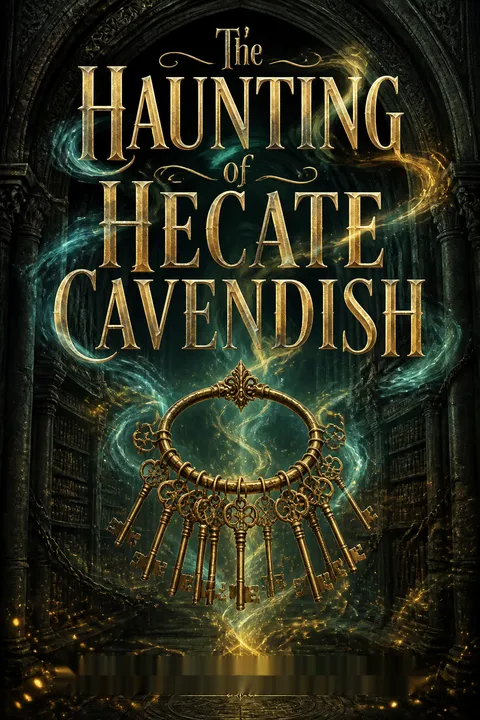

Plot Summary
Dawn Over Ancient Tombs
In the quiet city of Hereford, 1881, the centuries-old peace of a sealed tomb is shattered, setting in motion a chain of supernatural events. Hecate Cavendish, a fiercely intelligent and unconventional young woman, prepares for her first day as assistant librarian at the cathedral. Her family is a blend of warmth and tension: her father, an archeologist, encourages her curiosity, while her mother frets over her prospects. The city and its cathedral, with their layered histories and secrets, are introduced as living entities. As Hecate cycles through the city, the narrative hints at the thin boundary between the living and the dead, and the sense that something ancient and dangerous is about to awaken beneath the surface of ordinary life.
Hecate's First Day
Hecate's first day at the cathedral library is filled with anticipation and awe. She meets the reserved Reverend Thomas, her superior, and is introduced to the chained library—a trove of ancient, mysterious books, some locked away in a cabinet that piques her curiosity. The Mappa Mundi, a medieval map filled with myth and legend, becomes a focal point for her fascination. Hecate's hunger for knowledge and adventure is contrasted with her mother's desire for her to marry well. The cathedral's atmosphere is thick with history, and Hecate senses the presence of secrets waiting to be uncovered. Her first encounters with the staff and the building's peculiarities set the stage for the supernatural events to come.
Library Mysteries Unveiled
As Hecate settles into her role, she navigates the library's routines and the personalities of those around her. She befriends John Forsyth, a charismatic vicar, and Clementine, her vivacious best friend. The locked cabinet in the library becomes an obsession, symbolizing the forbidden knowledge she craves. Hecate's family life is marked by her brother Charlie's fragile health and her parents' differing hopes for her future. The narrative weaves together the mundane and the magical, as Hecate's curiosity leads her to sense that the library is more than a repository of books—it is a living, haunted place, and she is uniquely attuned to its mysteries.
Ghosts Among the Living
Hecate's ability to see and communicate with ghosts is revealed when she encounters Brother Michael, a centuries-old monk who haunts the library. She learns that the cathedral is home to a family of lost souls, each with their own story and unfinished business. Hecate's gift is both a blessing and a burden, setting her apart from the living but granting her allies among the dead. Her father, who has long suspected her abilities, becomes her confidant. The ghosts become guides and protectors, helping Hecate navigate the increasingly strange and dangerous events unfolding in the cathedral.
The Map's Secret Power
While cleaning the Mappa Mundi, Hecate experiences a supernatural vision: the creatures and figures on the map come to life, roaring and calling out to her. This magical connection deepens her sense of purpose and her bond with the cathedral's mysteries. The map becomes a conduit for ancient energies, and Hecate realizes that her touch can awaken its power. The appearance of a spectral griffin, which escapes the map and becomes her companion, signals that the boundaries between worlds are weakening. Hecate's role as a mediator between the living, the dead, and the magical is solidified.
Unrest in the Crypt
The cathedral crypt is found desecrated—tombs smashed, coffins emptied, and a chilling sense of evil lingering in the air. The community is shaken, and Inspector Winter, a pragmatic detective, is called to investigate. Hecate senses a dark presence, unlike the benign ghosts she knows. The narrative tightens as the possibility of grave robbers is dismissed in favor of a more terrifying explanation: something has broken out, not in. The crypt's unrest is mirrored by a series of violent events in the city, and Hecate becomes convinced that ancient, malevolent forces have been unleashed.
The Summoning Begins
Research in the library and a clandestine trip to the British Museum reveal the existence of the Essedenes, a lost tribe known for necromancy and cannibalistic rituals. Hecate and her father discover that a forbidden book in the locked cabinet contains the spells used to summon the dead. The narrative links the desecration of the crypt to a centuries-old curse, and Hecate realizes that someone within the cathedral is using the Essedenes' magic for their own ends. The stakes escalate as the line between myth and reality blurs, and Hecate's quest for knowledge becomes a fight for survival.
Spirits and Shadows Stir
The Resurgent Spirits—malevolent entities summoned from the crypt—begin to possess living hosts, turning ordinary people into violent, supernatural threats. Hecate and her allies race to identify and stop the Embodied Spirits before more lives are lost. The narrative becomes a cat-and-mouse game, with Hecate pursued by both human and supernatural enemies. Her relationships with John, her father, and the ghosts are tested as the danger intensifies. The cathedral, once a sanctuary, becomes a battleground between light and darkness.
Murder in the City
A series of brutal murders rocks Hereford, each linked to the Embodied Spirits. Hecate's investigations bring her into conflict with Inspector Winter, who struggles to accept the supernatural explanation. The city's elite, including the powerful Lord Brocket, are drawn into the web of suspicion. Hecate's own family is threatened, and her sense of isolation grows. The narrative explores themes of power, corruption, and the cost of knowledge, as Hecate is forced to confront the possibility that someone she knows is responsible for the summoning.
The Locked Cabinet's Curse
Determined to stop the spirits, Hecate risks everything to gain access to the locked cabinet and the forbidden book within. With the help of a mysterious keymaker, she forges her own set of keys and faces the cabinet's magical defenses. The book's guardian attacks her, and only the intervention of her magical brooch—gifted by her father and imbued with the power of the goddess Hekate—saves her and her griffin companion. The cost of forbidden knowledge is high, and Hecate realizes that the true enemy is not just the spirits, but the ambition and hubris of those who seek to control them.
The Embodied Spirits
Hecate uncovers the truth: Lord Brocket and his allies are using the Embodied Spirits to further their own ambitions, seeking power through supernatural means. The spirits possess the bodies of the living, including people close to Hecate, and the threat becomes personal. The narrative explores the horror of possession, the loss of self, and the struggle to maintain one's humanity in the face of evil. Hecate's courage and resourcefulness are tested as she confronts the spirits in both physical and magical battles.
The Price of Knowledge
The fight against the spirits comes at a terrible cost. John, Hecate's beloved and the cathedral's exorcist, sacrifices himself to save her brother Charlie from possession. His death devastates Hecate, forcing her to confront the limits of her power and the consequences of her quest for knowledge. The narrative delves into grief, guilt, and the burden of responsibility. Hecate's resolve is hardened by loss, and she vows to finish what she started, even if it means standing alone against the darkness.
The Brockhampton Connection
A visit to Brockhampton Manor uncovers the link between Lord Brocket's family and the original summoners of the Essedenes. The estate's haunted gatehouse, marked with occult symbols, becomes the focal point of the spirits' power. Hecate realizes that the curse is cyclical, tied to the ambitions of the Brocket family and their willingness to use dark magic for personal gain. The narrative weaves together history, myth, and personal vendetta, as Hecate prepares for a final confrontation with the forces that threaten her city and her soul.
The Exorcist's Sacrifice
John's exorcism of Charlie is a harrowing ordeal, culminating in his own possession and death. The scene is a crucible of love, faith, and supernatural terror, as Hecate and her allies fight to save her brother and themselves. The ghosts of the cathedral rally to her side, but the cost is immense. John's sacrifice is both a personal tragedy and a turning point in the battle against the spirits. Hecate's grief is raw, but her determination is unbroken.
Fire in the Library
A fire, set by the vengeful spirits, threatens to destroy the library and the Mappa Mundi. Hecate, trapped and nearly overcome by smoke, is saved by the magical intervention of the map's creatures and her own ingenuity. The fire is both a literal and symbolic trial by ordeal, forcing Hecate to confront her fears and her limitations. The aftermath is one of devastation, but also of renewal, as Hecate and her father begin the work of restoration. The library, like Hecate herself, emerges scarred but stronger.
Hecate's Reckoning
In the wake of tragedy, Hecate faces judgment from the cathedral's authorities. With the support of her father and Inspector Winter, she is allowed to remain as assistant librarian, tasked with repairing the damage she has caused. The narrative explores themes of accountability, redemption, and the importance of community. Hecate's relationships with the living and the dead are deepened, and she finds new purpose in her work. The battle is not over, but she is no longer alone.
The Goddess's Chosen
Hecate's connection to the goddess Hekate is revealed to be more than symbolic—she is the goddess's chosen, destined to stand at the threshold between worlds and protect the living from the dead. With the help of her magical brooch, her ghostly allies, and her own courage, Hecate embraces her role as a mediator and protector. The narrative celebrates the power of female agency, the value of knowledge, and the strength found in embracing one's true self.
The Battle for the Map
In a climactic confrontation, Hecate faces the last of the Resurgent Spirits in the library, fighting to save the Mappa Mundi and the city itself. With the aid of the goddess, her spectral friends, and the magical creatures of the map, she banishes the spirits and breaks the cycle of possession. The victory is hard-won, and the scars—both physical and emotional—remain. But Hecate stands triumphant, her place in the world secured, her purpose clear. The story ends with a sense of hope and renewal, as Hecate pedals into the future, her hair wild in the wind, ready for whatever challenges may come.
Analysis
Paula Brackston's The Haunting of Hecate Cavendish is a richly layered gothic fantasy that explores the interplay between knowledge, power, and the supernatural. At its heart is Hecate, a heroine whose journey from outsider to chosen protector mirrors the story's central tension: the allure and danger of forbidden wisdom. The novel uses the haunted cathedral and its library as a microcosm for Victorian anxieties about gender, class, and the limits of reason. Through Hecate's gift, the narrative interrogates the boundaries between life and death, past and present, and the personal and the cosmic. The story's use of magical realism—embodied in the living map, the spectral allies, and the cyclical curse—serves as both metaphor and mechanism for exploring trauma, grief, and resilience. The cost of knowledge is a recurring theme: every revelation comes with a price, and the pursuit of power—whether through magic or ambition—threatens to consume the seeker. Yet the novel ultimately affirms the value of courage, empathy, and community. Hecate's triumph is not in vanquishing evil alone, but in forging connections—across time, between worlds, and within herself. The book's lessons are both timely and timeless: that true strength lies in embracing one's gifts, that the past is never truly gone, and that hope endures even in the shadow of loss.
Review Summary
The Haunting of Hecate Cavendish follows a young woman in 1881 England who becomes an assistant librarian at Hereford Cathedral and discovers she can see ghosts. Reviewers praised the atmospheric setting, compelling protagonist, and her supportive relationship with her archaeologist father. Common criticisms included slow pacing, an unsatisfying ending that leaves questions unresolved, and underwhelming resolution despite intense buildup. Many noted this is the first in a series. The audiobook narration by Marisa Calin received high praise. Overall ratings averaged 3-4 stars, with readers appreciating the gothic mystery elements despite structural issues.
People Also Read
Characters
Hecate Cavendish
Hecate is a fiercely intelligent, red-haired young woman whose hunger for knowledge and adventure sets her apart from her Victorian peers. Raised by an archeologist father who encourages her curiosity, and a mother who wishes her to marry well, Hecate is torn between societal expectations and her own calling. Her unique gift—the ability to see and communicate with ghosts—makes her both an outsider and a bridge between worlds. Hecate's psychological journey is one of self-acceptance, courage, and sacrifice. She is driven by a sense of responsibility to the living and the dead, and her relationships—with her family, her spectral allies, and her beloved John—are marked by loyalty, empathy, and a willingness to risk everything for those she loves. Over the course of the story, Hecate evolves from a curious outsider to a powerful, self-assured protector, embracing her destiny as the goddess's chosen.
Edward Cavendish
Edward is Hecate's archeologist father, a man of intellect, humor, and deep affection for his family. He is Hecate's confidant and mentor, encouraging her unconventional pursuits and sharing her fascination with the arcane. Edward's own experiences with the supernatural—though less direct than Hecate's—make him open-minded and supportive of her gift. He is a stabilizing force, offering practical wisdom and emotional grounding. His relationship with Hecate is marked by mutual respect and a shared sense of adventure. As the story progresses, Edward's protective instincts are tested, but he ultimately trusts Hecate's judgment and stands by her, even when it means facing danger together.
Beatrice Cavendish
Beatrice embodies the anxieties and expectations of Victorian womanhood. She is deeply concerned with propriety, social standing, and her children's futures—especially Hecate's marriage prospects and Charlie's fragile health. Her relationship with Hecate is fraught with misunderstanding, but beneath her stern exterior lies fierce maternal love. Beatrice's psychological complexity is revealed in moments of vulnerability, particularly when her family is threatened. Over time, she comes to appreciate Hecate's strengths, even if she cannot fully understand them, and her own sacrifices and fears are given dignity and depth.
Charlie Cavendish
Charlie is Hecate's younger brother, whose chronic illness makes him the focus of family worry and affection. His innocence and vulnerability heighten the stakes of the supernatural threat, especially when he becomes the target of a Resurgent Spirit. Charlie's relationship with Hecate is tender and playful, and his presence serves as a reminder of what is at risk. His recovery and protection become central to Hecate's motivation, and his near-loss is a crucible for the family's love and resilience.
John Forsyth
John is a charismatic vicar and the cathedral's exorcist, whose passion for music and faith draws Hecate to him. He is open-minded, compassionate, and courageous, willing to believe in Hecate's gift and to risk his life for others. John's psychological arc is one of love, sacrifice, and acceptance of his own limitations. His relationship with Hecate is marked by mutual respect, intellectual kinship, and growing romantic attachment. His ultimate sacrifice—giving his life to save Charlie—cements his role as a tragic hero and leaves a lasting impact on Hecate's journey.
Clementine Twyford-Harris
Clementine is Hecate's best friend, a social butterfly whose warmth, optimism, and determination to see the best in everything provide a counterpoint to Hecate's seriousness. She is a source of emotional support and comic relief, helping Hecate navigate the complexities of love, friendship, and societal expectations. Clementine's own romantic subplot and her unwavering loyalty deepen the story's emotional resonance, and her presence reminds Hecate of the joys and challenges of ordinary life.
Reverend Thomas
Reverend Thomas is the master of the library, a man of routine, authority, and deep attachment to the collection. He is skeptical of Hecate's abilities and slow to trust her, embodying the resistance of tradition to change. His psychological rigidity is both a source of conflict and, ultimately, a test of Hecate's perseverance. As the story unfolds, his role as gatekeeper of forbidden knowledge becomes central to the mystery, and his own motivations are called into question.
Inspector Winter
Inspector Winter is the city's detective, a man of logic, order, and skepticism. Initially resistant to Hecate's supernatural explanations, he is gradually convinced by the evidence and becomes a crucial ally. His psychological journey is one of expanding belief and trust, as he learns to balance reason with openness to the unknown. Winter's partnership with Hecate is marked by mutual respect and a shared commitment to justice, and his presence grounds the story's magical elements in the realities of crime and consequence.
Lord Brocket
Lord Brocket is the story's human antagonist, a powerful aristocrat whose family history is entwined with the Essedenes' curse. His ambition and willingness to use dark magic for personal gain make him a formidable foe. Psychologically, Brocket is a study in entitlement, moral decay, and the dangers of unchecked power. His manipulation of the Embodied Spirits and his role in the cycle of summoning position him as both a product and perpetuator of generational evil.
Brother Michael
Brother Michael is the ghost of a fourteenth-century monk, the library's original guardian. He becomes Hecate's mentor and guide in the world of the dead, offering historical knowledge, spiritual insight, and emotional support. His psychological depth lies in his acceptance of his own liminality—choosing to remain as a lost soul to protect the library he loves. Brother Michael's relationship with Hecate is one of mutual learning and affection, and his presence bridges the gap between past and present, life and death.
Plot Devices
The Chained Library and Locked Cabinet
The library's chained books and the locked cabinet serve as both literal and metaphorical obstacles. They represent the tension between the pursuit of knowledge and the dangers of forbidden wisdom. The act of unlocking the cabinet is a pivotal plot device, triggering supernatural consequences and forcing Hecate to confront the costs of curiosity. The library's structure also enables the narrative's claustrophobic, haunted atmosphere, and its secrets drive the story's central mystery.
The Mappa Mundi
The Mappa Mundi is more than a historical artifact—it is a living, magical object that responds to Hecate's touch and becomes a battleground for supernatural forces. Its creatures and figures come alive, offering guidance, warnings, and, ultimately, direct intervention. The map's shifting imagery foreshadows events, reveals hidden connections, and serves as a visual metaphor for the story's themes of liminality, history, and the interconnectedness of worlds.
Ghostly Allies and Embodied Spirits
The presence of ghosts—both benign and malevolent—blurs the line between life and death. Hecate's ability to see and communicate with the dead is a key plot device, granting her access to hidden knowledge and allies, but also exposing her to danger. The Embodied Spirits, by contrast, are a terrifying inversion: the dead possessing the living, erasing identity and agency. This duality heightens the story's tension and explores the psychological costs of being a mediator between worlds.
Forbidden Knowledge and Magical Artifacts
The narrative is structured around the pursuit and protection of forbidden knowledge—spells, rituals, and histories that can summon or banish the dead. Magical artifacts, such as Hecate's brooch and the keymaker's creations, are both tools and symbols of power. The story uses foreshadowing (the tomb's disturbance, the map's awakening) and cyclical structure (the recurring curse, generational ambition) to build suspense and reinforce the theme that knowledge, once unlocked, cannot be easily contained.
Sacrifice and Redemption
The story's emotional arc is driven by sacrifice—John's death, Hecate's willingness to risk herself, and the ghosts' unfinished business. These sacrifices are not only plot points but also vehicles for character development, forcing Hecate and others to confront their fears, guilt, and desires. Redemption is offered through acts of courage, forgiveness, and the restoration of order, but always at a cost. The narrative structure uses these moments to deepen the psychological realism and emotional stakes.
Download PDF
Download EPUB
.epub digital book format is ideal for reading ebooks on phones, tablets, and e-readers.








































