

Key Takeaways
The obsession with "storytelling" is a symptom of narration dying
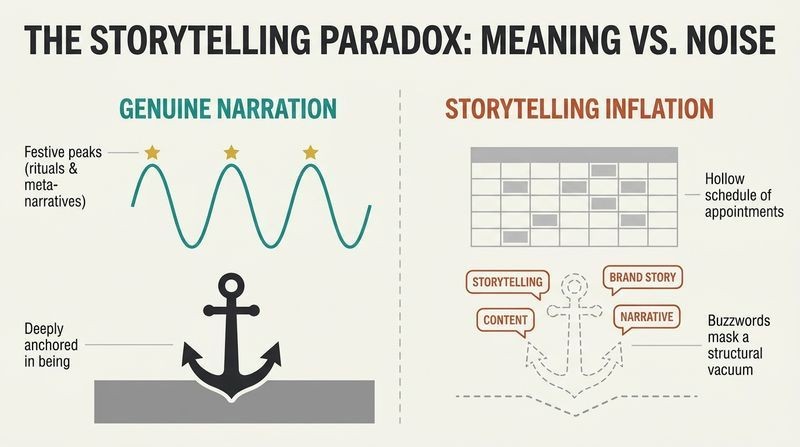
Inflation betrays a vacuum. Han opens with a paradox: marketers, politicians, and academics have never talked more about "narratives" and "storytelling," yet this chatter is proof that genuine narration has lost its power. A paradigm only becomes a fashionable research object once people are already alienated from it. When stories truly anchored us, nobody needed a word for the act.
We live in a post-narrative age. Once, living was narrating. Religion was a meta-narrative that reached into every corner of life, so that even the calendar felt meaningful (Easter, Christmas, festive high points). Now the calendar is a hollow schedule of appointments. When narratives are seen as merely "constructed," contingent, and swappable, they lose their inner truth and can no longer bind us together or anchor us in being.
Han's opening move mirrors a pattern noticed across disciplines: we name what we are losing. Just as "mindfulness" became a billion-dollar industry amid record distraction, "authenticity" trends precisely as it evaporates. The claim is elegant but worth pressing: is the vocabulary of narrative a sign of loss, or of a maturing self-awareness (the "narrative turn" in psychology and medicine has genuinely helped patients)? Han would counter that studying narration from outside the spell is itself the disease. Cognitive scientists like Jerome Bruner argued narrative is a fundamental mode of thought, which complicates Han's diagnosis that it can simply drain away.
We drown in information yet starve for orientation
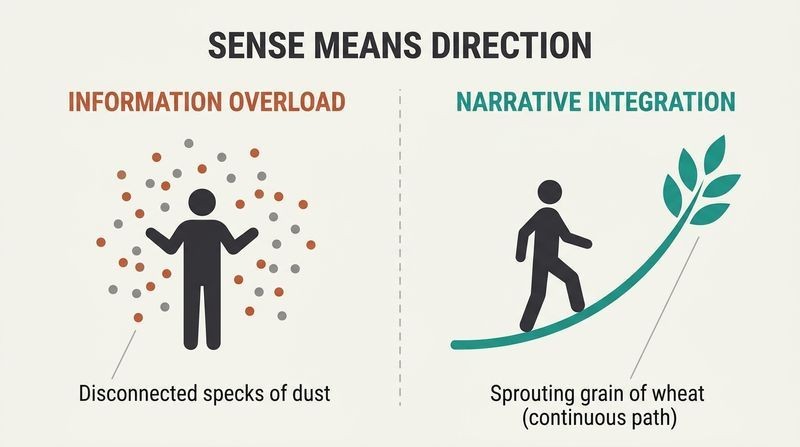
Information and narration are opposing forces. Drawing on sociologist Niklas Luhmann, Han argues information belongs to a "cosmology of contingency," not of being. Information is additive, exhausts itself the instant it is registered, and chops time into a stream of disconnected present moments. Narration does the reverse: it turns the accidental into the necessary, carrying meaning and creating a temporal continuum, a story with a before and after.
Sense means direction. The original meaning of the word sense is direction, and that is exactly what a data-saturated world cannot supply. We are perfectly informed and utterly disoriented, lost in a thick forest of facts with no path through it. Han compares bits of information to specks of dust with no germinal force, versus a story like a grain of wheat that keeps its power to sprout for centuries.
The distinction lands hard in an era of infinite feeds. It resonates with Herbert Simon's warning that a wealth of information creates a poverty of attention, and with historian Yuval Harari's point that humans cooperate through shared fictions, not raw data. One nuance: information and narrative are not always enemies. Good science journalism, or a well-built dataset, can seed narrative rather than starve it. Han's binary is rhetorically sharp but risks flattening the gradient between them. Still, the core insight, that facts accumulate while meaning must be composed, explains why doomscrolling leaves people both stuffed and hollow.
Storytelling is really storyselling, and it manufactures consumers, not community
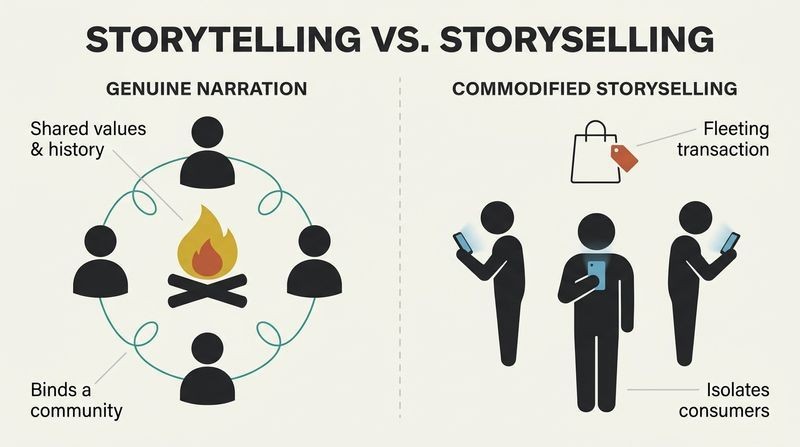
The book's title concept. Storytelling in its trendy corporate form is not the return of narration but its capture by capitalism. It charges products with emotion, promises unique experiences, and turns useless things into valuable goods. "Stories sell" really means "emotions sell," and emotions live in the limbic system, bypassing conscious critical reflection. Capitalism thus grabs life at a pre-reflexive level.
Genuine narratives bind; storyselling scatters. A real story creates community by giving it identity and shared values, like villagers gathered around a fire. Storyselling produces only a fleeting commodified community of lonely consumers separated by screens. When even morality becomes a selling point ("fair trade" as a product feature), moral consumption inflates our own self-worth rather than improving any shared world. The word for both story and history in German, Geschichte, gets reduced to a commodity.
Han sharpens a critique that runs from Adorno's culture industry to Naomi Klein's No Logo: brands wrap themselves in meaning because the product alone no longer moves us. Marketing textbooks openly teach the limbic shortcut Han describes. Where his account could go further is agency. Consumers are not purely passive; subcultures constantly repurpose brand narratives against their makers. And some corporate narratives (Patagonia's environmental activism, say) do seed real communities and behavior change. The stronger version of Han's point is not that all storytelling is manipulation, but that when narrative's only measure becomes conversion and clicks, its world-founding power atrophies.
Withholding explanation is what gives a story its staying power
Benjamin's ancient master. Han retells Herodotus via Walter Benjamin. An Egyptian king, captured and forced to watch his daughter humiliated and his son led to execution, stays stone-faced. Yet when he spots an old servant among the prisoners, he breaks down weeping. Herodotus offers no explanation for why the servant, not the children, cracked him. That refusal is the point. Withheld information heightens tension, so the story still provokes astonishment thousands of years later.
Aura lives in distance. Han ties this to the aura, the mysterious veil around things created by the interplay of nearness and distance. Information destroys aura by making everything instantly available and gapless. A true story arrives "from afar" and resists being fully explained. Explanation and narration are mutually exclusive: the moment everything is clarified, the story dies.
This is a working principle for anyone who writes or teaches. Cognitive research on the "Zeigarnik effect" shows unresolved tension keeps material alive in memory, echoing Han's grain-in-the-pyramid metaphor. Screenwriters call it subtext; the best drama shows rather than tells. There is tension, though, with modern demands for transparency and accessibility. Journalism and medicine rightly prize explanation. Han is not arguing against clarity in every domain, but noting that art and meaning need shadow. The over-explained, spoiler-flattened, algorithmically summarized content of the feed is exactly what cannot retain germinative power.
Selfies and "Stories" record a life without ever narrating one
Memory forgets; data hoards. Digital platforms crave a total record of a life, because more data means better surveillance, control, and exploitation. But human memory is the opposite of a database. It is selective and narrative, connecting a few chosen events while leaving most out. A remembered life is necessarily incomplete, and that incompleteness is what makes it a story. Instagram "Stories" that vanish in 24 hours, Snapchat's disappearing snaps, and selfies are "momentary actualities," bits of visual information that add up to nothing.
Live or post. Han updates Sartre's old choice "live or tell" into "live or post." The Quantified Self movement's motto, "Self-Knowledge through Numbers," is an illusion, because the self is a quality, not a quantity, and numbers narrate nothing. Even the Black Mirror episode where an implant replays every memory shows that gapless total recall abolishes remembrance, which needs forgetting.
Han anticipates a live debate about digital memory. Neuroscience backs him: memory is reconstructive, not a recording, and each recall rewrites the trace. Perfect data storage is not perfect memory; it is the death of memory's meaning-making edit. His link between data extraction and a "digital unconscious" prefigures Shoshana Zuboff's surveillance capitalism, where behavioral surplus is mined below awareness. One counterpoint: some people genuinely use journaling apps and photos as prompts for reflective narrative, not just accumulation. The tool is not wholly deterministic. But Han's warning stands: a platform engineered to maximize data actively discourages the slow, selective work of composing a self.
Narration lifts life above bare facticity, the meaningless one-thing-after-another
Sartre's nausea. In Sartre's novel, Roquentin is sickened by the naked, purposeless existence of things, a pebble in his hand, the mere buzzing of a life that is just Monday, Tuesday, Wednesday, days tacked on without rhyme or reason. Then he realizes narration is the cure: to recount even a banal event turns it into an adventure. You must choose, live or tell.
Bare life is survival, not living. Without narrative, existence collapses into what Han calls bare life, a mere functioning obsessed with staying "healthy" and "optimized." A narrative, by contrast, has intrinsic value and cannot be optimized. Days of the week once carried story (Wednesday was Woden's day, Thursday Thor's); festivals gave time shape. Stripped of that, we compulsively post and like to hide life's terrifying emptiness. Selfies, Han insists, spring not from narcissism but from an inner void with no meaning to stabilize the ego.
The reframe of selfie culture as emptiness rather than vanity is genuinely counterintuitive and more compassionate than the usual scolding. It aligns with existential psychology: Viktor Frankl argued that the modern "existential vacuum" drives compensatory behaviors. Han's target, the optimization imperative, echoes critiques of quantified productivity culture, where a life becomes a dashboard of metrics with no plot. The vulnerability in his argument is nostalgia: pre-modern narrative time was also rigid, hierarchical, and often oppressive. Meaning-through-tradition can imprison as much as it anchors. The challenge is composing narratives that orient without foreclosing, a harder task than Han's elegiac tone admits.
A world that can be fully explained is a world that can no longer be narrated
The boy who couldn't tell stories. Han retells Paul Maar's tale of Konrad, a boy who can only enumerate facts. Ask him about yesterday and he lists a schedule; mention a mouse and he recites rodent taxonomy. His world is disenchanted, reduced to causality, which is only one thin kind of relation. His parents send him to a Ms Leishure (a play on leisure), whose impossible enchanted house, with staircases that never end and language turned to riddles, finally cures him. He returns bursting to narrate what happened.
Disenchantment as de-auratization. For Han, a magical world is one where things exchange intimacies and return our gaze, becoming a "thou" rather than a mute "it," as when Novalis addresses a rock. Today's disenchantment goes beyond Max Weber's scientific rationalization: it is the informatization of the world. Transparency is the new formula of disenchantment, dissolving everything into data and killing the secrets every story needs.
The Konrad fable dramatizes a real cognitive style. It resembles the difference between the "paradigmatic" and "narrative" modes Jerome Bruner described, or between explaining and understanding in the hermeneutic tradition. Han's claim that causality is only one relation echoes Indigenous and animist epistemologies, and even recent "more-than-human" scholarship in anthropology, which treats the world as full of agents rather than objects. The provocative edge is the attack on transparency, usually a civic virtue. Han distinguishes political accountability from existential over-exposure, but readers should be careful: a plea for enchantment and secrets can be misused to shield real opacity of power.
The screen traded shocks for likes and sealed us off from reality's gaze
From Baudelaire to the touchscreen. Benjamin read Baudelaire's poem about a poet losing his halo in traffic as an allegory: modernity delivers reality as shock, and shock disintegrates the aura. Freud saw consciousness mainly as a shield parrying stimuli. Han extends this: a screen (Schirm) is literally a protective barrier. The smartphone screens us off so completely that reality can no longer shock us. Shocks give way to likes.
The vanished gaze. Following Lacan, Han argues a real picture looks back at us, captures and enchants us. The touchscreen is flat; nothing gazes back. It becomes a digital mirror that keeps us in a permanent, narcissistic mirror stage, expelling the otherness of the other and eroding the shared symbolic world that binds a community. Netflix does not deliver art that endangers us; it fattens "consumer cattle" through binge watching. The emblematic artist is Jeff Koons, whose only aim is a disarming "Wow" and to be liked.
The shift from shock to like captures something precise about attention economics. Where avant-garde art once aimed to rupture perception (think of the audience fleeing early cinema), platforms now optimize for frictionless approval, engineered by A/B-tested dopamine loops. The Koons example is pointed: smooth, affirming, resistance-free. Han's Lacanian claim about the lost gaze is more speculative and hard to test, but it names a felt experience, the difference between a face and a feed. A fair pushback: shock itself became a commodity long ago (outrage drives engagement too). Perhaps the true regime is not pure likability but whatever is frictionlessly consumable, whether it soothes or enrages.
Telling your story, and being truly listened to, is a form of healing
The blocked story. Benjamin describes the primal scene of healing: a mother sitting beside a sick child, telling stories. The narrating voice and even the stroking hand release inner blockages. Freud understood psychological pain as a story a person can no longer continue; the cure is helping the patient narrate themselves free. Isak Dinesen's line, quoted by Hannah Arendt, captures it: any sorrow can be borne if you put it into a story.
Listening as active healing. Han holds up Michael Ende's character Momo, who heals people simply by listening with total attention, her only wealth being time. Deep listening is not passive; it opens a resonating space in which the other feels heard and can discover thoughts they never knew they had. Touch heals the same way, as when a child instinctively caresses a hurt sibling. Yet our touchless, hyper-connected society keeps us trapped in the ego, because being connected is not being united.
This chapter connects Han to a large evidence base he does not cite. Narrative therapy (Michael White and David Epston) and James Pennebaker's expressive-writing studies show that turning trauma into structured story measurably improves health outcomes. The distinction between hearing and being listened to is central to Carl Rogers's client-centered therapy. Han's point about touch also lands amid research on "skin hunger" and the documented harms of isolation. His provocative aside, that conspiracy theories are therapeutic because they place a crisis safely in the past, is worth dwelling on: it explains their appeal without endorsing them, reframing them as failed healing rather than mere stupidity.
No shared story, no "we": neoliberal self-narratives dissolve community
Community without communication. Han cites Peter Nadas's village with an ancient pear tree, where people gather on summer nights not to exchange opinions but to share in one great story, a silent unity. That is the inverse of today, where we communicate incessantly yet form no community: communication without community.
The self as its own brand. The neoliberal performance narrative turns each person into an entrepreneur of the self, competing, self-optimizing, and playing to the gallery. This produces no solidarity, no "we," only isolated egos. Crucially, Han insists not all binding narratives are the exclusionary, nationalist kind. He points to Kant's Perpetual Peace, with its cosmopolitan hospitality where no one is a refugee, and Novalis's poetic "world family" as inclusive, community-founding stories. Political action itself, following Arendt, requires a narrative coherent enough to be told; without it, action degrades into contingent reactions and crisis management.
Han threads a careful needle here that distinguishes him from reactionary critics of individualism. He acknowledges that the hunger for closure fuels populist and conspiracy narratives, yet insists the answer is inclusive universalism, not tribalism. This resonates with Robert Putnam's Bowling Alone thesis on collapsing social capital and Emile Durkheim's older worry about anomie. The gap in the argument is mechanism: how does a society deliberately generate a binding yet non-exclusionary narrative under market conditions that reward self-branding? Kant and Novalis are inspiring but abstract. Contemporary examples, from climate movements to open-source communities, suggest shared narratives can still form, usually around a common project rather than a common identity.
Big data reveals correlations but can never tell you why
The end of theory is the end of spirit. Wired editor Chris Anderson claimed that with enough data, models and theories become obsolete: the numbers speak for themselves. Han rejects this. Correlation is the most primitive form of knowledge; it shows that things connect but never why. Theory, by contrast, is a narrative that designs an order of things, builds conceptual context, and yields comprehension, the highest form of knowing.
Intelligence computes; spirit recounts. Artificial intelligence counts and calculates but cannot narrate, and therefore cannot truly think, because it is incapable of passion. Han shows that all great theory has been narrative and risk: Freud's psychoanalysis, Plato's myths of the soul, Descartes's founding certainty, Kant's moral God, Nietzsche's joyful revaluation of values. Humans are animal narrans, the storytelling animal, and every world-changing action begins with a narrative. When philosophy tries to become an exact science, it denies its narrative nature and falls silent.
The distinction between counting and recounting is a memorable compression of a deep debate. Han sides with the hermeneutic tradition (Dilthey, Gadamer) that the human sciences seek understanding, not just prediction. His claim gains force in the large-language-model era: these systems are staggering correlation engines that produce fluent text without comprehension or stakes, an eerie confirmation of "intelligence without spirit." The vulnerable spot is his flat assertion that correlation explains nothing; in practice, robust predictive models have driven genuine discovery, and theory often follows data rather than preceding it. The sharper truth is that data without a narrative frame cannot answer why, and why is what humans live by.
Analysis
Byung-Chul Han's The Crisis of Narration is a compact philosophical essay, not a self-help manual, and its method is characteristically his: a mosaic of close readings (Benjamin above all, plus Sartre, Proust, Heidegger, Lacan, Arendt, Nietzsche) assembled into a single accelerating indictment of digital late modernity. The difficulty in summarizing it is that Han argues by resonance and repetition rather than linear proof; the same opposition, narration versus information, being versus contingency, aura versus transparency, gets restated in register after register. The reward of distillation is that one clean thesis emerges: a society that has replaced narrative with information has traded meaning, orientation, and community for availability, data, and consumption, and the frantic cult of storytelling is the hollow echo of what was lost. Han's great strength is diagnostic vividness. The reframes stick: selfies as symptoms of emptiness rather than vanity, the screen as a shield that turns shocks into likes, the Quantified Self as an oxymoron because a self is a quality. His weakness is the mirror image of that strength. The binaries are too clean, the tone elegiac to the point of nostalgia, and the pre-narrative past he mourns (religious meta-narratives, mythic villages) was also authoritarian and exclusionary in ways he mostly brackets. He concedes that the hunger for closure feeds conspiracy and populism, yet his prescription, inclusive universalist narratives after Kant and Novalis, remains gestural.
Still, Han is a diagnostician, not an engineer, and the diagnosis is bracing. In the age of generative AI, his line that intelligence computes while only spirit recounts reads less like lament than prophecy. The book's enduring provocation is deceptively simple and genuinely actionable: reclaim the slow, selective, secretive, community-building work of telling and listening, because a life that only solves problems and posts moments has quietly stopped living.
Review Summary
The Crisis of Narration receives mixed reviews, with an average rating of 3.88/5. Many readers appreciate Han's critique of modern society's information overload and loss of meaningful narratives. Some find his ideas thought-provoking and relevant, while others view them as repetitive or exaggerated. Critics note Han's reliance on Western philosophers and a lack of practical solutions. The book's brevity and accessible writing style are praised, though some find it lacks depth compared to his earlier works.
People Also Read
Glossary
Storyselling
Commodified, manipulative corporate storytellingHan's term for storytelling reduced to a marketing and communication technology. It charges products and politics with emotion to drive consumption, bypassing critical reflection through the limbic system. Unlike genuine narration, storyselling is ephemeral, contingent, and consumable; it produces isolated consumers rather than a binding community, and cannot design new forms of life beyond consumption.
Narration (Erzählen)
Meaning-making that anchors us in beingFor Han, genuine storytelling that turns the accidental into the necessary, creates a temporal continuum, and founds meaning, identity, and community. Narration is a "concluding form" with closure, requires deep attentive listening, feeds off experience passed between generations, and has intrinsic value. It is the opposite of information and cannot be optimized.
Aura
Mysterious veil of distance around thingsAdapted from Walter Benjamin, the aura is the radiance that lifts things above mere facticity, produced by the interplay of nearness and distance. Auratic things seem to return our gaze, becoming a "thou" rather than a mute object. Information de-auratizes and disenchants the world by making everything gaplessly available and transparent.
Phono sapiens
Smartphone-bound, historyless human typeHan's label for the digital human who surrenders to momentary actualities rather than living a narrated life stretched between birth and death. Phono sapiens records rather than remembers, posts rather than tells, and exists without fate or history, mistaking the smartphone's playground for freedom while being surveilled and exploited through data.
Animal narrans
Humans as the storytelling animalHan's phrase for the human being as an essentially narrating creature. Living is narrating: through narrative, humans bring about genuinely new forms of life and world-changing action, distinguishing them from other animals. Every action that changes the world presupposes a narrative that opens a future.
Bare life
Meaningless survival stripped of narrativeExistence reduced to sheer facticity and functioning when narrative collapses, leaving only a meaningless one-thing-after-another. Bare life is preoccupied with staying healthy and optimized, mere survival rather than living, because there is no narrative horizon to lift it above the naked, purposeless presence of things.
Poverty of experience
Loss of transmissible, narratable experienceBenjamin's term Han revives for modernity's inability to pass down communicable experience through storytelling. As tradition and continuity disintegrate, wisdom (narrated truth woven into life) decays and is replaced by problem-solving techniques. What remains is bare life without the condensed, shareable experience that stabilizes and makes a life narratable.
Mémoire involontaire
Involuntary, auratic remembranceProust's involuntary memory, where a present sensation fuses with a distant past moment into a single "crystal of time," overcoming the contingency of time and producing happiness. For Han these memory images carry an aura and narrative inwardness, unlike photographs or data, which record without internalizing and therefore mean nothing.
FAQ
What's "La crisis de la narración" about?
- Narrative Crisis: The book explores the contemporary crisis of narration, where traditional storytelling is losing its power and meaning in a world dominated by information.
- Post-Narrative Era: Byung-Chul Han argues that we live in a post-narrative time where narratives no longer anchor us in being or provide meaning and orientation.
- Information vs. Narration: The book contrasts the depth and meaning provided by narratives with the fleeting and contingent nature of information.
- Cultural and Social Implications: It examines how this crisis affects culture, society, and individual identity, leading to a loss of community and empathy.
Why should I read "La crisis de la narración"?
- Understanding Modern Society: The book provides insights into the cultural and social shifts in modern society, particularly the decline of traditional narratives.
- Critical Perspective: Byung-Chul Han offers a critical perspective on how the rise of information technology impacts human experience and community.
- Philosophical Exploration: It delves into philosophical discussions about meaning, identity, and the human condition in the digital age.
- Relevance to Current Issues: The themes are highly relevant to current debates about media, technology, and the erosion of traditional cultural practices.
What are the key takeaways of "La crisis de la narración"?
- Narrative Vacuum: Despite the abundance of storytelling, there is a lack of meaningful narratives that provide orientation and identity.
- Information Overload: The flood of information fragments time and experience, leading to a loss of narrative continuity and depth.
- Community Erosion: The decline of shared narratives weakens social cohesion and community, replacing it with isolated consumer experiences.
- Healing Power of Narration: Narration has the potential to heal and create community, but this power is being undermined by commodification and digitalization.
How does Byung-Chul Han define the "narrative crisis"?
- Loss of Meaning: Han defines the narrative crisis as a loss of meaning and orientation in life due to the decline of traditional storytelling.
- Contingency and Fragmentation: He highlights how modern society's focus on information leads to a fragmented experience of time and reality.
- Erosion of Community: The crisis results in the erosion of community and empathy, as narratives that once united people are replaced by isolated consumer experiences.
- Post-Narrative Time: Han argues that we live in a post-narrative time where narratives are seen as constructed and contingent, lacking their original power.
What is the difference between narration and information according to Byung-Chul Han?
- Narration Provides Meaning: Narration creates a temporal continuum and provides meaning, identity, and orientation to life.
- Information is Fleeting: Information is additive, cumulative, and lacks the solidity of being, leading to a fragmented experience of reality.
- Narrative Depth vs. Surface: Narratives have depth and are capable of carrying sense, while information is surface-level and lacks narrative tension.
- Impact on Society: The prevalence of information over narration contributes to the de-narrativization of society, leading to a loss of community and empathy.
How does "La crisis de la narración" address the role of technology in the narrative crisis?
- Digital Disruption: The book discusses how digital platforms and technology contribute to the fragmentation of narratives and the erosion of traditional storytelling.
- Information Overload: Technology accelerates the flood of information, making it difficult for narratives to provide continuity and meaning.
- Loss of Empathy: The digital age's focus on information and communication reduces the capacity for empathy and genuine community.
- Narrative vs. Data: Han contrasts the narrative depth with the superficiality of data-driven interactions, highlighting the impact on human experience.
What are the implications of the narrative crisis for individual identity?
- Fragmented Self: The narrative crisis leads to a fragmented sense of self, as individuals lack coherent narratives to anchor their identity.
- Consumer Identity: In the absence of meaningful narratives, identity is increasingly shaped by consumer experiences and digital interactions.
- Loss of Continuity: The decline of traditional storytelling results in a loss of temporal continuity, affecting how individuals perceive their life stories.
- Search for Meaning: Individuals struggle to find meaning and orientation in a world dominated by information and contingent narratives.
How does Byung-Chul Han view the relationship between narration and healing?
- Narration as Healing: Han suggests that narration has healing powers, creating deep relaxation and trust, and helping individuals overcome crises.
- Therapeutic Narratives: Narratives can integrate traumatic experiences into meaningful contexts, providing consolation and hope.
- Blockage and Flow: Illness is seen as a blockage that can be released through the rhythm of narration, allowing for healing and balance.
- Listening and Empathy: The act of listening and narrating fosters empathy and community, countering the isolating effects of modern communication.
What role do conspiracy theories play in the narrative crisis?
- Simple Explanations: Conspiracy theories offer simple explanations for complex situations, providing a sense of meaning and orientation in times of crisis.
- Therapeutic Function: They serve a therapeutic function by embedding crises in narratives that make them more manageable and less threatening.
- Pathological Phenomenon: Han views the rise of conspiracy theories as a pathological response to the narrative vacuum and the need to cope with contingency.
- Community and Division: While they can create a sense of community among believers, conspiracy theories often lead to division and exclusion.
How does "La crisis de la narración" explore the concept of "bare life"?
- Sheer Facticity: Bare life refers to existence stripped of meaning and narrative, reduced to mere survival and facticity.
- Existential Crisis: The book discusses how the narrative crisis leads to an existential crisis, where life lacks coherence and purpose.
- Narrative Elevation: Narration elevates life above its sheer facticity, providing structure and meaning to otherwise disconnected events.
- Modernity's Impact: Han examines how modernity's focus on information and efficiency contributes to the experience of bare life.
What are the best quotes from "La crisis de la narración" and what do they mean?
- "The inflation of narrative betrays a crisis of narration." This quote highlights the paradox of abundant storytelling in a time when meaningful narratives are lacking.
- "Narration is a concluding form." It emphasizes the role of narration in creating a closed order that provides meaning and identity.
- "Information lacks the solidity of being." This quote contrasts the fleeting nature of information with the depth and continuity provided by narratives.
- "Living is narrating." It underscores the fundamental role of narration in shaping human experience and identity.
How does Byung-Chul Han propose we address the narrative crisis?
- Reclaiming Narration: Han suggests reclaiming the power of narration to provide meaning, orientation, and community in a fragmented world.
- Fostering Empathy: Emphasizing the importance of empathy and genuine community through shared narratives and attentive listening.
- Challenging Consumerism: Critiquing the commodification of narratives and advocating for narratives that transcend consumer experiences.
- Reviving Tradition: Encouraging a return to traditional storytelling practices that anchor individuals and communities in meaningful narratives.
About the Author
Download PDF
Download EPUB
.epub digital book format is ideal for reading ebooks on phones, tablets, and e-readers.








































