

Key Takeaways
Unlimited freedom is now the most efficient form of coercion
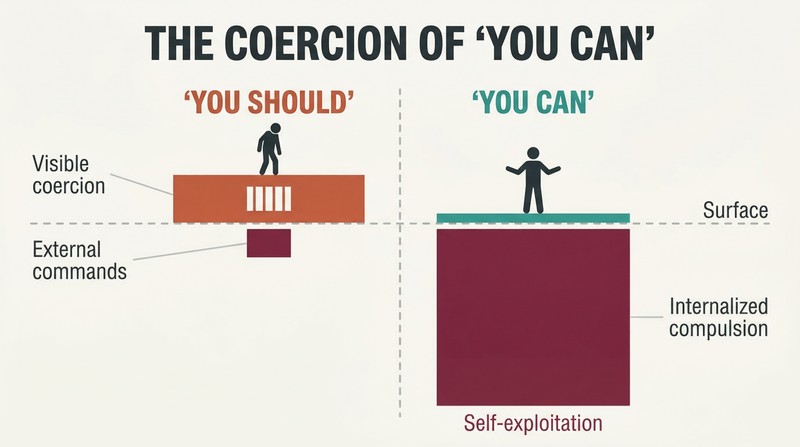
Han's central paradox is disarmingly stark. Under disciplinary societies, power said "You should" and "You must not" — commands with hard limits. Neoliberalism replaced these with "You can," which has no ceiling. The result: depression and burnout are not failures of willpower but pathological signs that limitless possibility is flipping into limitless compulsion. We think we've graduated from being subjugated subjects to being free "projects," endlessly reinventing ourselves.
But the project is a deeper prison. Han calls today's individual an "achievement-subject" — someone who willingly exploits themselves without any master forcing them. This makes the neoliberal subject an "absolute slave," one who has internalized control so completely that compulsive self-optimization feels indistinguishable from liberation.
You are both the slave and the master exploiting yourself
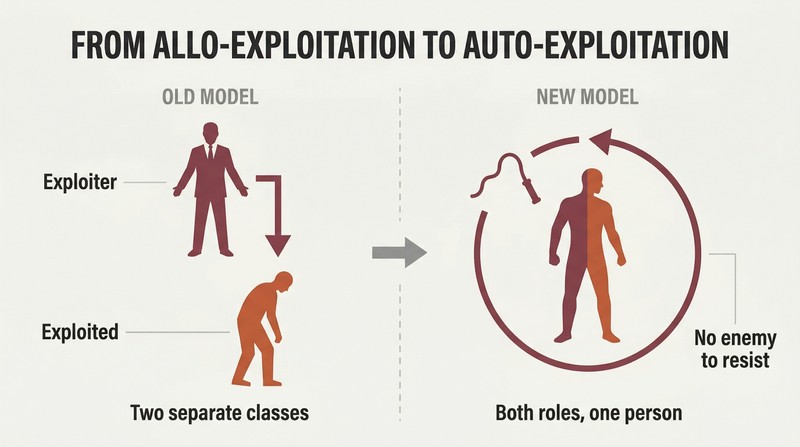
Neoliberalism's structural genius is transforming workers into entrepreneurs of themselves. Under older capitalism, exploitation came from outside — a boss, a factory owner. Marx called this allo-exploitation: one group forces another to labor. Neoliberalism replaced it with auto-exploitation, where you impose work discipline on yourself. Everyone now owns their means of production (a laptop, a personal brand). The class struggle has migrated inward.
This neutralizes collective resistance. The old Marxist formula — an exploited class rises against its exploiters — requires a visible antagonist. When everyone is simultaneously oppressor and oppressed, no political "We" can form. Even the concept of a proletariat dissolves: if everyone is a self-made project, failure feels personal, never structural.
The most powerful control says yes, not no
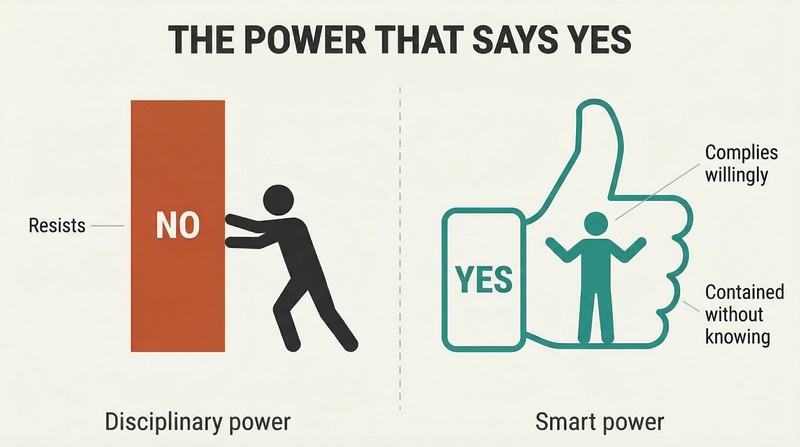
Smart power doesn't prohibit — it pleases. Disciplinary power operated through negation: rules, prohibitions, punishments. It was inefficient because it met resistance. Neoliberal "smart power" works through seduction — activating, motivating, and optimizing rather than repressing. It says "yes" far more than "no." The Like button is its emblem; we subjugate ourselves to the order of domination while clicking Like.
Invisibility is its strength. The most effective power isn't felt as power at all. Smart power doesn't force confession — it constantly invites us to share, confide, and participate. It guides the will rather than breaking it. Instead of erecting obstacles, it meets the subject halfway, making dependency feel like empowerment. Free choice dissolves into free selection among pre-approved options.
Psychopolitics targets your mind where biopolitics targeted your body
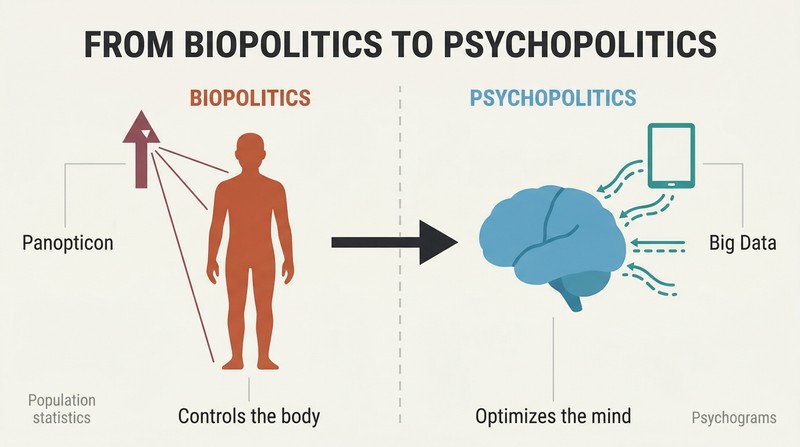
This is the book's title concept. Foucault's biopolitics described how disciplinary society controlled bodies — birth rates, physical labor, health. That model fit industrial capitalism, where the body was the production unit. But neoliberalism runs on immaterial production: information, programs, ideas. The body is no longer the central productive force. What matters now is optimizing psychic and mental processes — neuro-enhancement, not physical discipline.
Big Data is psychopolitics' primary instrument. Where population statistics gave biopolitics demographic data, Big Data provides psychograms — maps of desires, preferences, and unconscious patterns. It can peer into the soul in ways Bentham's panopticon never could. Foucault himself never made this conceptual turn; Han argues this blind spot prevented him from theorizing neoliberal power accurately.
We built a surveillance panopticon and moved in voluntarily
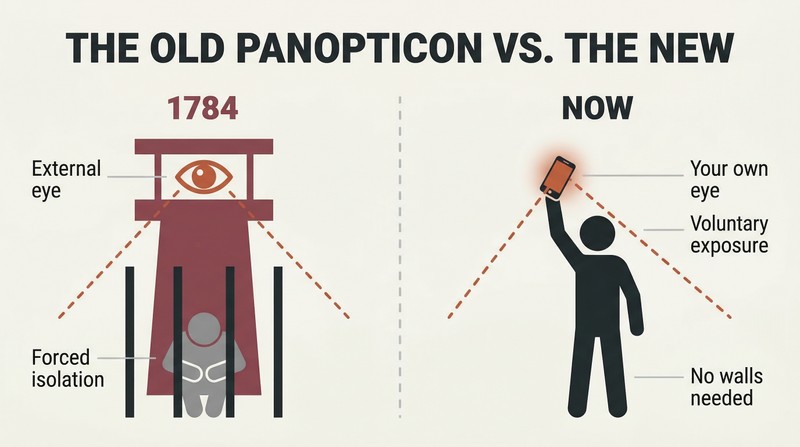
Bentham's panopticon isolated inmates and prevented them from interacting. The digital panopticon inverts every element: its occupants actively communicate, willingly expose themselves, and collaborate in their own surveillance. No edict forces us to post our locations or reveal our preferences — we do it from what Han calls "an inner need." The digital panopticon is also "aperspectival" — no blind spots exist, unlike Bentham's optical system.
Apple's legendary 1984 Super Bowl ad presented the Macintosh as liberation from Orwellian surveillance. But Han argues it inaugurated a far more efficient control system. Orwell's Big Brother imposed scarcity, fear, and censorship. Today's version offers abundance, freedom, and connectivity. The feeling of freedom is precisely what makes this panopticon inescapable: everyone is now his or her own panopticon.
Self-optimization is domination wearing a wellness mask
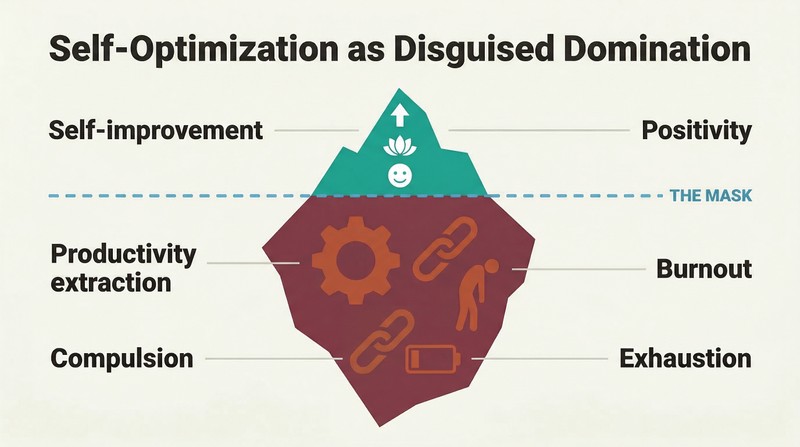
The neoliberal self-help industry turns everything — attention, personality, mental health — into resources for exploitation. Motivational retreats and mental training programs promise boundless self-improvement, but their actual function is eliminating any friction that reduces productivity. Han draws a direct line from Protestant self-examination (hunting for sins) to today's self-optimization (hunting for negative thoughts). Even fundamentalist preachers now sound like motivational coaches.
Positivity becomes its own violence. Tony Robbins preaches "Constant, Never-Ending Improvement" and reframes dissatisfaction as productive pain. But the imperative to always achieve more destroys what it claims to heal. Without negativity — suffering, tension, depth — life degrades into "something dead." The human soul, Han insists, is not a positivity machine. Depression and burnout are symptoms of a system demanding infinite optimization from finite beings.
Neoliberal failure triggers shame, not solidarity — by design
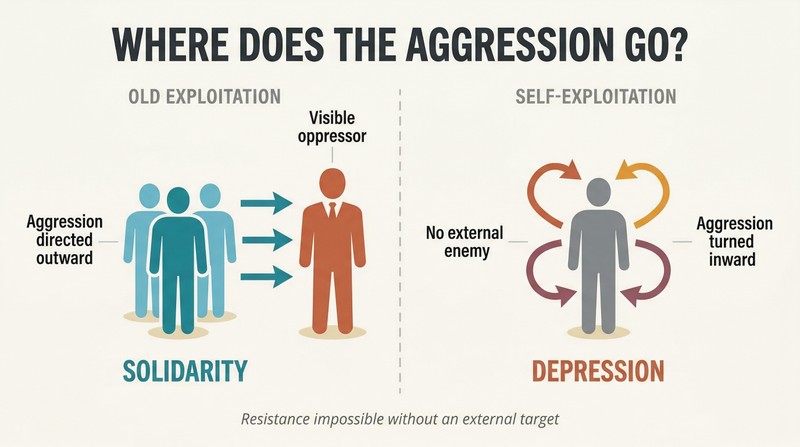
This is the regime's defensive architecture. Under older exploitation, the exploited could identify their oppressor and band together. A factory worker knew who owned the factory. But when you're your own boss, your own brand, your own enterprise, failure feels like personal moral deficiency. You don't question the system — you question yourself. Shame replaces solidarity.
Collective action becomes structurally impossible. There is no clearly defined ruling class to oppose. The old distinction between proletariat and bourgeoisie collapses when production is immaterial and everyone nominally owns their means of production. People turn aggression inward rather than outward. This is what Han calls the system's "particular intelligence": resistance cannot emerge because there is no external enemy to resist.
Capitalism now harvests emotions because rationality hit a ceiling
Han distinguishes three concepts most researchers conflate:
1. Feelings are constative and durable — a "feel for language," mourning
2. Emotions are performative and fleeting — they drive specific actions
3. Affects are eruptive and momentary — like a shitstorm on social media
Capitalism specifically harvests emotions because their performativity generates action and consumption. Feelings resist exploitation because they lack directionality.
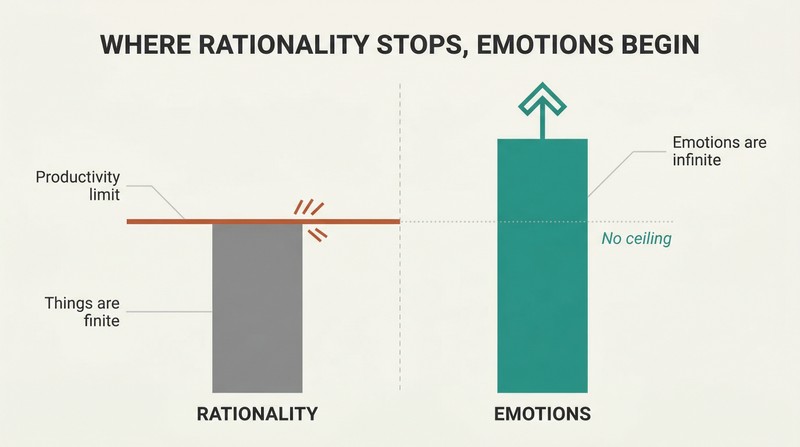
Emotional management has replaced rational management. Daimler-Chrysler publicly stated employees' "social and emotional skills" would determine evaluations. Managers now act as motivation coaches. Rationality, the medium of disciplinary society, eventually hits a productivity limit — it feels rigid and constraining. Emotions provide the energy to push past it, opening an infinitely consumable field beyond mere use value.
Big Data delivers correlations, never comprehension — that's not knowledge
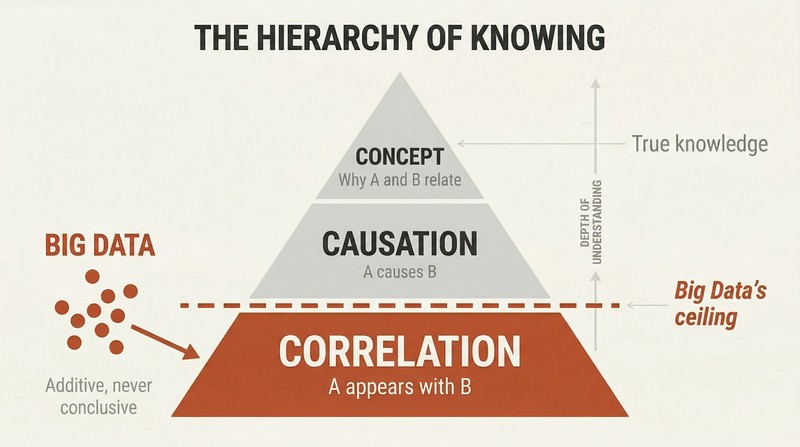
Han deploys Hegel's hierarchy of knowing to demolish Big Data's pretensions. Correlation (A appears with B) sits at the lowest rung. Causation (A causes B) is higher. But real knowledge requires what Hegel called the Concept — the overarching context explaining WHY A and B relate. Big Data never reaches this level. It is purely additive; it never arrives at a conclusion.
Dataism — the ideology that everything measurable should be measured — markets itself as a second Enlightenment, freeing knowledge from subjectivity. But Han argues it is producing its own mythology: data totalitarianism. Numbers replace narrative; counting replaces recounting. The Quantified Self promises "Self Knowledge through Numbers," but no sensor answers "Who am I?" And Big Data is wholly blind to the singular event — the improbable rupture that actually shapes history.
Resist psychopolitics through idiotism: silence and disconnection
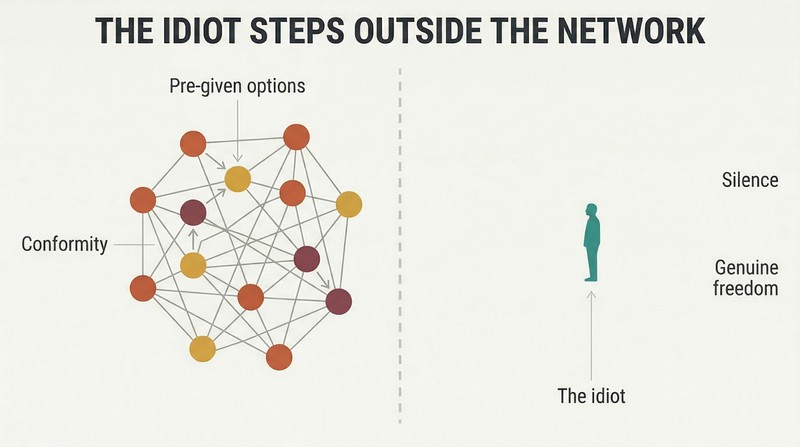
The idiot is philosophy's oldest hero. Socrates was an idiot — he knew only that he didn't know. Descartes was an idiot — he doubted everything. Every philosopher who forged a genuinely new way of thinking had to step outside the prevailing system first. Today, thorough digital networking has amplified conformism so severely that the outsider figure has nearly vanished from society.
Idiotism is Han's proposed resistance. The idiot is unallied, un-networked, uninformed — inhabiting an "immemorial outside" that escapes communication entirely. Etymologically, heresy means "choice": the idiot-heretic exercises genuine free choice by deviating from orthodoxy. Intelligence, Han argues, only selects between options a system provides. The idiot accesses what lies beyond. In an age where power forces expression, the right to say nothing becomes the last authentic freedom.
Analysis
Han's Psychopolitics arrives at a peculiar inflection point in critical theory: the moment when Foucault's toolkit — biopolitics, disciplinary power, panopticism — can no longer adequately map the terrain of neoliberal domination. Han's central move is elegant: power has migrated from the body to the psyche, from prohibition to permission, from the 'Should' to the 'Can.' This reframing makes phenomena like burnout culture, self-help industries, and social media compulsion legible not as individual pathologies but as systemic features of a power that works precisely by being invisible.
The book's most original contribution is its fusion of Frankfurt School critical theory with a diagnosis of digital capitalism. Han reads Big Data through Hegel's hierarchy of knowledge, revealing that correlation without the Concept is not knowledge but its opposite — absolute ignorance masquerading as omniscience. This philosophical argument gives serious intellectual weight to popular anxieties about algorithmic governance that most commentators can only gesture at vaguely.
Yet the work carries characteristic vulnerabilities. Han's totalizing pessimism — where every act of self-improvement serves Capital, every emotion is harvested, every freedom is secretly coercion — risks becoming unfalsifiable. If resistance is structurally impossible, then the closing appeal to 'idiotism 'feels more like a philosophical performance than a viable political strategy. The Deleuzian idiot who retreats into silence requires the cultural capital to opt out, a privilege that reinforces the structures Han critiques.
What makes Psychopolitics indispensable despite these tensions is its diagnostic precision. Written in 2014, before the Cambridge Analytica scandal, before the mental health crisis was mainstream discourse, before 'attention economy' became a household term, Han identified with surgical clarity how digital platforms exploit the psyche for profit. The book reads less like prophecy and more like an autopsy performed slightly ahead of the death. Its enduring value lies not in its solutions but in its refusal to let us mistake our chains for jewelry.
Review Summary
Psychopolitics explores how neoliberalism and digital technology have created a new form of control through voluntary self-disclosure and data collection. Han argues that we've moved from biopolitics to psychopolitics, where power operates by exploiting our desire for freedom and self-optimization. The book critiques Big Data, social media, and the commodification of emotions, suggesting that true resistance may lie in "idiotism" or withdrawal. While some readers find Han's analysis insightful, others criticize his pessimism and lack of concrete solutions.
People Also Read





Glossary
Psychopolitics
Neoliberal governance targeting the psycheHan's central concept for the neoliberal form of power that operates by exploiting psychic processes—desires, emotions, and unconscious patterns—rather than disciplining the body. Unlike Foucault's biopolitics, which regulated populations through physical control, psychopolitics steers behavior through positive stimuli, emotional manipulation, and Big Data, all while maintaining the illusion of freedom.
Auto-exploitation
Self-imposed exploitation without external masterThe neoliberal mode of exploitation in which individuals impose work discipline, performance demands, and optimization imperatives on themselves. The subject is simultaneously master and slave. Because there is no visible external exploiter, auto-exploitation prevents collective resistance and redirects aggression inward, producing depression rather than revolution. Han contrasts it with allo-exploitation.
Allo-exploitation
Exploitation imposed by external othersThe traditional mode of exploitation in which one group (e.g., factory owners) forces another group (e.g., workers) to labor under coercive conditions. Under allo-exploitation, the exploited can identify their oppressor and potentially unite against them. Han argues neoliberalism's shift to auto-exploitation rendered this solidarity—and with it, Marxist revolution—structurally impossible.
Achievement-subject
Self-optimizing neoliberal individualHan's term for the neoliberal individual who views themselves as a free 'project' engaged in constant self-optimization but who is actually engaged in voluntary self-exploitation. The achievement-subject replaces the disciplinary 'obedience-subject.' Lacking any external master, it cannot identify the source of its exhaustion, leading to burnout and depression rather than political resistance.
Smart Power
Power through seduction not coercionHan's term for the neoliberal technology of power that operates by saying 'yes' rather than 'no'—seducing, motivating, and optimizing rather than repressing. Smart power guides the will instead of breaking it, exploits freedom instead of constraining it, and remains invisible because subjects mistake their subjugation for empowerment. The Like button is its emblematic symbol.
Digital panopticon
Voluntary self-surveillance networkHan's update of Bentham's panopticon for the digital age. Unlike the original, where inmates were watched against their will, the digital panopticon relies on occupants who actively communicate, share personal data, and expose themselves voluntarily. It is 'aperspectival'—eliminating all blind spots—and far more efficient because it outsources surveillance to its own inhabitants.
Ban-opticon
Device excluding low-value personsA concept Han draws from Bauman and Lyon describing the complement to the panopticon. While the panopticon watches those inside the system, the ban-opticon identifies and excludes persons deemed without economic value. Big Data company Acxiom, for instance, categorizes roughly 300 million Americans into seventy groups, designating those with low market value as 'waste.'
Dataism
Ideology of data as objective truthThe quasi-religious belief that everything measurable should be measured and that data provides a transparent, reliable lens free from emotion and ideology. Han frames dataism as a 'second Enlightenment' that—like the first—is switching over into its own mythology and totalitarianism. He calls it nihilism: data is purely additive, replacing narrative meaning with endless accumulation of numbers.
Profanation
Returning sacred objects to common useA concept from Agamben that Han applies to resistance against capitalism. Profanation means taking things removed from ordinary use—whether by religion or by Capital—and returning them to free, purposeless human activity. Han's emblematic example: Greek children who found a bundle of banknotes in ruins and simply played with them, tearing the fetishized money apart.
Idiotism
Philosophical outsidership resisting conformismHan's term for the practice of stepping outside prevailing systems of communication and conformity. Drawing on Deleuze and a lineage from Socrates to Descartes, Han frames the idiot as someone unallied, un-networked, and uninformed who accesses a dimension beyond the system. In an age of compulsory communication, idiotism—silence, solitude, heretical deviation—represents the last authentic practice of freedom.
FAQ
What's "Psychopolitics: Neoliberalism and New Technologies of Power" about?
- Exploration of Neoliberalism: The book examines how neoliberalism uses new technologies to exert power over individuals and societies.
- Concept of Psychopolitics: It introduces the idea of psychopolitics, where psychological manipulation is used to control and influence people.
- Freedom and Coercion: The author discusses how freedom is paradoxically used as a tool for coercion and self-exploitation in modern society.
- Impact of Technology: It delves into how digital technologies, like Big Data, are employed to monitor and steer human behavior.
Why should I read "Psychopolitics: Neoliberalism and New Technologies of Power"?
- Understanding Modern Power Dynamics: The book provides insights into how power operates in contemporary society through psychological and technological means.
- Critical Perspective on Neoliberalism: It offers a critical analysis of neoliberal ideologies and their impact on personal freedom and societal structures.
- Relevance to Current Issues: The themes discussed are highly relevant to ongoing debates about privacy, surveillance, and digital capitalism.
- Thought-Provoking Ideas: Byung-Chul Han presents thought-provoking ideas that challenge conventional views on freedom and autonomy.
What are the key takeaways of "Psychopolitics: Neoliberalism and New Technologies of Power"?
- Freedom as a Tool of Control: The book argues that what is perceived as freedom often leads to self-exploitation and internalized constraints.
- Role of Technology: It highlights how digital technologies are used to gather data and influence behavior, leading to a new form of control.
- Neoliberal Subjectivity: The neoliberal subject is seen as an entrepreneur of the self, constantly optimizing and exploiting themselves.
- Crisis of Freedom: The author suggests that the current crisis of freedom is characterized by a shift from external to internal forms of coercion.
How does Byung-Chul Han define "psychopolitics"?
- Psychological Manipulation: Psychopolitics refers to the use of psychological techniques to influence and control individuals.
- Beyond Biopolitics: It extends Foucault's concept of biopolitics by focusing on the psyche rather than just the body.
- Exploitation of Emotions: The book discusses how emotions and personal desires are exploited for economic and political gain.
- Digital Influence: Psychopolitics involves using digital technologies to predict and steer human behavior on a subconscious level.
What is the "Crisis of Freedom" according to Byung-Chul Han?
- Freedom as Coercion: The crisis arises when freedom itself becomes a form of coercion, leading to self-exploitation.
- Unlimited Compulsion: Unlike the disciplinarian "Should," the freedom of "Can" leads to unlimited compulsion and self-optimization.
- Psychic Maladies: Conditions like depression and burnout are seen as symptoms of this crisis, reflecting the paradox of freedom.
- Redefining Freedom: The book suggests the need to redefine freedom to escape the dialectic that turns it into coercion.
How does "Psychopolitics" relate to neoliberalism?
- Neoliberal Exploitation: Neoliberalism is portrayed as a system that efficiently exploits freedom and personal autonomy.
- Self-Entrepreneurship: Individuals are seen as entrepreneurs of themselves, leading to self-exploitation without external coercion.
- Classless Exploitation: The book argues that neoliberalism transforms traditional class exploitation into a universal self-exploitation.
- Emotional Capitalism: Neoliberalism uses emotions and personal relationships as resources for economic productivity.
What role does technology play in "Psychopolitics"?
- Surveillance and Control: Technology is used for surveillance and control, turning individuals into data points for manipulation.
- Big Data Influence: Big Data is a key tool in psychopolitics, allowing for the prediction and steering of human behavior.
- Digital Panopticon: The book describes a digital panopticon where individuals willingly expose themselves, enhancing control.
- Transparency as a Dispositive: Transparency is used to turn everything into information, facilitating control and exploitation.
What is the "Dictatorship of Transparency" in "Psychopolitics"?
- Transparency as Control: Transparency is portrayed as a neoliberal tool that turns everything inside out for control and exploitation.
- Elimination of Secrets: The demand for transparency eliminates secrets and interiority, accelerating communication and control.
- Conformity and Surveillance: It leads to total conformity and self-surveillance, as individuals willingly expose themselves.
- Crisis of Informational Self-Determination: The book highlights a crisis where individuals lose control over their personal information.
How does Byung-Chul Han view "Emotional Capitalism"?
- Exploitation of Emotions: Emotional capitalism exploits emotions as resources for productivity and economic gain.
- Shift from Rationality: It marks a shift from rationality to emotionality in the productive process, enhancing motivation and engagement.
- Consumption of Emotions: The book argues that we consume emotions rather than things, leading to limitless consumption.
- Role in Neoliberalism: Emotional capitalism is integral to neoliberalism, using emotions to drive economic activity and control.
What is "Gamification" in the context of "Psychopolitics"?
- Integration of Play: Gamification involves integrating play and game elements into work and daily life to enhance motivation and productivity.
- Emotional Engagement: It emotionally engages individuals, making them more invested and productive.
- Commercialization of Play: The book argues that gamification leads to the commercialization of play, undermining its potential for freedom.
- Destruction of Human Communication: Gamification is seen as destroying genuine human communication by subordinating it to game logic.
What are the best quotes from "Psychopolitics" and what do they mean?
- "Freedom will prove to have been merely an interlude." This quote suggests that what we perceive as freedom is temporary and often leads to new forms of coercion.
- "The neoliberal subject has no capacity for relationships with others that might be free of purpose." It highlights how neoliberalism transforms personal relationships into transactional ones.
- "Today, we are entering the age of digital psychopolitics." This quote emphasizes the shift towards using digital technologies for psychological control.
- "Healing, it turns out, means killing." It critiques the neoliberal focus on self-optimization, which can lead to self-destruction.
How does "Psychopolitics" address the concept of "Idiotism"?
- Role of the Idiot: Idiotism is seen as a form of resistance against the coercive conformism of neoliberal society.
- Heretical Consciousness: The idiot represents a heretic who deviates from consensus, preserving individuality and freedom.
- Silence and Solitude: Idiotism values silence and solitude as spaces for genuine thought and expression.
- Beyond Intelligence: The book suggests that true freedom and creativity lie beyond conventional intelligence and system-imposed choices.
About the Author
Other books by Byung-Chul Han

Download PDF
Download EPUB
.epub digital book format is ideal for reading ebooks on phones, tablets, and e-readers.








































