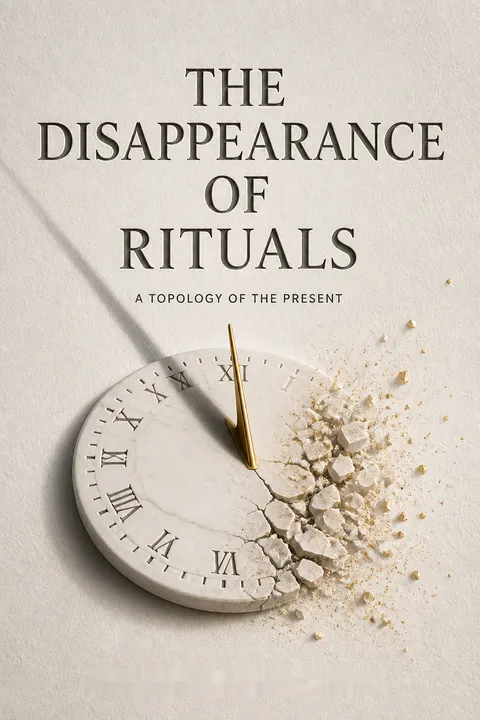

Key Takeaways
1. The Erosion of Rituals: A Loss of Symbolic Meaning and Community
Rituals are symbolic acts. They represent, and pass on, the values and orders on which a community is based.
Symbolic anchors. Rituals once served as vital symbolic anchors, transforming the world into a habitable, reliable place and time into a structured home. They fostered community not through explicit communication, but through shared symbolic perception, allowing individuals to recognize permanence and stability in a contingent world. This symbolic force, exemplified by the Greek symbolon (a sign of recognition and wholeness), brought people together and solidified collective identity.
Symbol-poor world. Today, we inhabit a "symbol-poor" world where data and information lack symbolic power, preventing recognition and diminishing the experience of duration. The loss of these meaning-founding images and metaphors leads to a proliferation of contingency and a sense of being "de-housed" in time. Without rituals, life lacks stabilizing resting points, becoming an erratic stream of point-like presences that rush off without hold.
Community without communication. The modern era is characterized by "communication without community," a stark contrast to rituals that forged community without explicit communication. This shift reflects a deeper societal atomization, where the collective experience of meaning and belonging is replaced by individualistic, fleeting interactions. The widespread rejection of rituals as "empty conformity" signals a revolt against form itself, further isolating individuals and eroding the very fabric of shared existence.
2. The Compulsion of Production: Destabilizing Life and Erasing Duration
The contemporary compulsion to produce robs things of their endurance [Haltbarkeit]: it intentionally erodes duration in order to increase production, to force more consumption.
Eroding durability. The relentless compulsion of production actively undermines the endurance of things, intentionally eroding their durability to fuel consumption. This constant drive for the new prevents lingering and transforms objects from stable "things" (in Hannah Arendt's sense) into disposable commodities. A smartphone, for instance, with its ever-changing content and planned obsolescence, exemplifies this non-thing status, fostering restlessness rather than stability.
Destabilizing life. This compulsion extends beyond objects, destabilizing life itself by attacking what is enduring within it. While life expectancy may increase, the quality of life's duration diminishes, as everything becomes subject to a cycle of use-up and replacement. This mindset treats the world as something to be consumed rather than used or cherished, leading to a relentless cycle of disappearance that leaves life unprotected and transient.
Infinite consumption. The compulsion of production also colonizes emotions and values, turning them into new fields for infinite consumption. Emotions, being more fleeting than things, do not stabilize life but rather strengthen narcissistic self-relationships. Values like justice or sustainability are commodified, consumed as marks of distinction that appreciate the ego's self-worth, further detaching individuals from community and deepening collective narcissism.
3. Authenticity's Narcissism: Undermining Public Life and Genuine Connection
Contrary to Taylor’s assumptions, however, authenticity is in fact the enemy of community. The narcissism of authenticity undermines community.
Cult of the self. The modern cult of authenticity, while often framed as a moral imperative for self-realization, paradoxically atomizes society by shifting identity formation entirely to the individual. This neoliberal form of production encourages voluntary self-exploitation under the guise of freedom, turning the entire person into a highly efficient site of self-production. The constant occupation with one's own psychology and the drive to "play to the gallery" on social media exemplify this narcissistic self-absorption.
Erosion of public space. Authenticity erodes public space, transforming it from a theatrical stage for roles and ritual gestures into a market for self-exhibition. The demand for intimacy and exposure, where the private is constantly revealed, lends society a pornographic character. This contrasts sharply with 18th-century public life, where theatrical presentation, manners, and ritualized interactions created a scenic distance essential for social relations and the "playacting" capacity of humans.
Brutalization of society. The narcissistic cult of authenticity, by discarding "semblance of beauty" and ritual gestures as inauthentic, contributes to the brutalization of society. It prioritizes raw, spontaneous emotion over formed behavior, leading to a culture of affect where politeness and manners decay. This formless morality, devoid of external forms, fosters an animosity to form itself, making society increasingly impolite despite its moralizing tendencies.
4. The Disappearance of Closure: An Endless, Unfinished Existence
For something to die, life must find its own closure. If life is deprived of any possibility of closure, it will end in non-time.
Loss of completion. Modern society, driven by the neoliberal imperative of optimization and performance, has lost the capacity for closure, rendering life a purely additive and provisional process. Nothing is final or conclusive; everything remains incomplete, from lifelong learning to personal achievements. This inability to complete is deeply linked to narcissism, where the subject finds intensity in ongoing performance rather than in finished work, which would exist independently of the self.
De-siting the world. This excessive opening and removal of boundaries is evident in globalization and digitalization, which "de-site" the world, turning it into a boundless market or an "off-site" internet. Traditional "sites" – places of dwelling and rootedness – are abolished, replaced by incessant circulation of capital, commodities, and information. This contrasts with ritually closed places, like Péter Nádas's village centered around an ancient pear tree, which offer stability, deep unity, and a sense of belonging through collective consciousness and ritual silence.
Erosion of autonomous time. The abolition of rituals also removes "autonomous time," the discontinuous, structured phases of life like childhood, youth, and old age. Without rites of passage, individuals "slip through" life, aging without growing old, or remaining infantile consumers. Thresholds, which once articulated space and time with rhythm and meaning, are erased, replaced by accelerated, seamless communication and production. This loss of the "magic of the threshold" leaves only a "hell of the same," devoid of otherness and transformative experiences.
5. Profanation of Life: When Rest Becomes Work's Shadow
If rest becomes a form of recovery from work, as is the case today, it loses its specific ontological value.
Sacred rest. In ancient traditions, rest, particularly the Sabbath, was not mere idleness but an essential, sacred part of creation, bringing completion and demanding silence. This contemplative rest, characterized by deep listening and receptivity, united people and intensified life. It represented an independent, higher form of existence, fundamentally distinct from profane work, and was crucial for the vitality of religious life and community.
Work's totalization. Today's compulsion of production has totalized work, subordinating all areas of life, including rest, to its dictates. Rest is degraded into "leisure" or "recreational time," serving only as recovery for further work, thereby losing its ontological value and becoming a derivative of production. This total profanation of life eliminates sacred silence, replacing it with communicative noise and a constant pressure to perform, even during supposed downtime, leading to phenomena like "leisure sickness."
Capitalism's anti-religion. Capitalism, often mistakenly called a religion, is fundamentally antithetical to true religion.
- It lacks the binding force (religare) to create community, as money individualizes.
- It despises contemplative rest, as capital must always work and move.
- It erases the distinction between sacred and profane by totalizing the profane, making everything comparable and equal.
- It lacks narrativity, reducing time to mere labor time, devoid of meaning, unlike religious narratives that provide orientation and tension.
6. From Play to Production: The Decline of Sovereignty and Ritual Combat
The compulsion of production destroys sovereignty as a form of life. Sovereignty gives way to a new kind of subordination which, however, masquerades as freedom.
Sovereignty's demise. The compulsion of production has destroyed sovereignty, which is defined as freedom from necessity, purpose, and utility, and is intrinsically linked to "strong play." In a society dominated by work, only "weak play" (recreation) is tolerated, serving the logic of production. The neoliberal subject, while appearing free, is an "absolute slave" who voluntarily exploits itself, lacking the sovereign spirit that risks life for glory or honor.
Ritual combat vs. modern war. Archaic warfare, exemplified by dueling or the "Great Sacrifice" ritual, was a form of "strong play" governed by strict rules, symmetry, and reciprocity. It was a ritual combat where honor, not destruction, was at stake, and the opponent was recognized as an equal (iustus hostis). Modern wars, by contrast, are "battles of production," driven by technological means and economic logic, where soldiers are "labouring slaves" afraid of death, and the enemy is degraded into a criminal to be eliminated.
Drone warfare's asymmetry. Drone warfare represents the pinnacle of this shift, embodying total asymmetry and the mechanical production of death. The invisible attacker, operating through data and algorithms, transforms the opponent into a mere "data set" or "criminal," eliminating any face-to-face confrontation, drama, or fate. Killing becomes a data-driven operation, a "work" performed in shifts, where "scorecards" confirm kills, reflecting a society where everything, even death, is subjected to the form of production and performance.
7. The Dataist Turn: Replacing Myth and Thought with Calculation
The human being now has to comply with data. No longer the producer of knowledge, the human being cedes its sovereignty to data.
From myth to data. The transfer of knowledge has shifted from the playful, agonistic riddle-solving of archaic cultures and early Greek philosophy to the mechanical calculation of dataism. Ancient philosophers, like Heraclitus, engaged in "ritual games of riddle-solving" that vivified myth and embodied cosmic strife. Even Plato's dialogues, despite his move towards truth, retained theatrical and agonistic elements, reflecting a playful approach to knowledge.
Enlightenment's end. The Enlightenment, with Kant's "Copernican revolution," established the human subject as the autonomous producer of knowledge, centered around its own a priori forms. However, dataism silently supersedes this, demanding that humans comply with data rather than produce knowledge. This marks the end of Enlightenment humanism, as humans are reduced to calculable variables, and knowledge is mechanically generated by algorithms that operate beyond human understanding.
Erosion of thinking. Dataism's imperative of transparency, a "compulsion of production," transforms everything into visible data, leading to a "knowledge for domination" that manipulates the human psyche. This algorithmic, additive process eliminates the narrative space of thinking, which cannot be accelerated like calculation. Thinking, once characterized by play and Eros, becomes alienated from its essence, degenerating into mere "steps of a calculation," naked and pornographic, devoid of the "wings" that give it creative power.
8. Seduction's Demise: The Rise of Pornographic Transparency
Porn, finally, marks the end of seduction. Here, the other is effaced altogether. Pornographic pleasure is narcissistic.
Seduction as ritual. Seduction, as described by Kierkegaard, is a game, a ritual duel characterized by playful power and scenic distance, where the sexual act is subordinate. It thrives on "extimacy" – the exteriority and fantasy of the other – and the negativity of the secret. This contrasts with the intimacy of love, which marks the end of play and the beginning of psychology, and with porn, which effaces the other entirely.
Pornographic transparency. Pornography signifies the triumph of transparency and unambiguousness, where secrets, riddles, and ambiguities are uncomfortable. It represents the loss of any capacity for illusion, semblance, or drama. Even reading can acquire a pornographic form, seeking a progressive unveiling of "truth as a sexual organ," unlike poems that play with fuzzy edges and resist the production of singular meaning. Political correctness, with its rigorous linguistic hygiene, further condemns ambiguity, stifling erotic language and seduction.
Overproduction of sex. The compulsion of production extends to sexuality, turning it into a performance where everything is presented, made visible, and exposed. In porn, even ejaculation is "produced," making the sexual act mechanical and the body a "sexual machine." This "overproduction" of sex, rather than moral repression, ultimately kills off sexuality and eroticism, leading to a "post-sexual age" where the excessive visibility of "carography" (meat) leaves sex devoid of allure, a pathology of "too much" rather than "too little."
9. The Crisis of Resonance: Narcissism and the Atomization of Society
Without resonance we are thrown back on to ourselves, isolated. Increasing narcissism works against the experience of resonance.
Loss of resonance. Rituals once fostered a community of "resonance," creating accord and a common rhythm through vertical (to gods/cosmos), horizontal (social), and diagonal (to things) relationships. This resonance, distinct from self-echoes, inherently involved the dimension of the other. Its disappearance leaves individuals isolated, thrown back onto themselves, and contributes to depression. Digital communication, filled with "echo chambers" and superficial "likes," only strengthens self-echoes rather than providing genuine resonance.
Disembodied connections. Rituals are embodied, bodily performances that solidify community values and create a "communal body" with shared bodily knowledge and memory. Digitalization, by its disembodying influence, weakens these common ties, fostering disembodied communication. Collective feelings, which consolidate community (e.g., objective mourning in a ritual), are replaced by fleeting affects and emotions of isolated individuals, predominantly expressed through affect-based digital media like Twitter, where immediate affect supplants time-intensive reason in politics.
Exploitation of freedom. The neoliberal regime, while invoking empathy, paradoxically isolates individuals by encouraging self-production. This "communication without community" is accelerated and additive, lacking the narrative depth of rituals. Neoliberal psycho-politics exploits freedom itself, using emotional management to influence and direct people more effectively than rational management. This constant self-production for attention leads to a crisis of community, transforming it into an "atrophied," commodified, and consumerized entity devoid of symbolic binding power.
Review Summary
The Disappearance of Rituals by Byung-Chul Han receives mixed reviews (4.01/5). Supporters appreciate Han's critique of neoliberalism's erosion of communal rituals, replacing them with narcissistic individualism and production-obsession. They praise his clear, aphoristic style and insights on how ritual loss creates alienation and fuels nationalism. Critics find him repetitive, overly nostalgic, lacking empirical grounding, and blaming "neoliberalism" for everything. Some question his romanticization of past rituals and primitive warfare, noting his analysis ignores historical context and overlooks modern rituals' continued existence through different institutions like technology companies.
People Also Read

FAQ
1. What is "The Disappearance of Rituals" by Byung-Chul Han about?
- Explores the loss of rituals: The book examines how modern society has lost traditional rituals, which once provided structure, meaning, and community.
- Analyzes contemporary pathologies: Han argues that the disappearance of rituals leads to issues like narcissism, atomization, and the erosion of community.
- Contrasts ritual and production: The text contrasts the stabilizing, communal nature of rituals with the destabilizing, individualizing forces of neoliberal production and performance.
- Proposes a new perspective: Rather than advocating a return to old rituals, Han uses their disappearance as a lens to critique the present and suggest alternative forms of life.
2. Why should I read "The Disappearance of Rituals" by Byung-Chul Han?
- Insight into modern malaise: The book offers a philosophical diagnosis of contemporary issues such as loneliness, burnout, and the loss of meaning.
- Unique cultural critique: Han provides a fresh critique of neoliberalism, digital culture, and the cult of authenticity, making it relevant for readers interested in society and culture.
- Accessible yet profound: The essay is concise and accessible, yet it draws on a wide range of philosophical, sociological, and literary sources.
- Encourages reflection: Readers are prompted to reflect on their own lives, habits, and the potential for new forms of community and meaning.
3. What are the key takeaways from "The Disappearance of Rituals" by Byung-Chul Han?
- Rituals create community: Rituals are symbolic acts that stabilize life, foster community, and make time and space habitable.
- Neoliberalism erodes rituals: The compulsion for production, performance, and authenticity under neoliberalism leads to the atomization and narcissism of individuals.
- Loss of duration and resonance: Modern life is characterized by fleeting experiences, serial perception, and a lack of deep, resonant connections.
- Need for new forms of life: Han suggests that alternative, possibly ritual-like practices could help counteract collective narcissism and restore meaning.
4. How does Byung-Chul Han define rituals in "The Disappearance of Rituals"?
- Symbolic techniques of belonging: Rituals are symbolic acts that help individuals feel at home in the world, transforming mere existence into a meaningful dwelling.
- Stabilize time and life: Rituals structure time, provide durability, and allow for lingering and repetition, which are essential for deep attention and community.
- Embodied and communal: Rituals are bodily performances that create collective feelings and embodied identities, transcending individual psychology.
- Contrast with routine: Unlike routines, rituals generate intensity and meaning through repetition and symbolic recognition.
5. What is the "compulsion of production" and how does it affect society according to Byung-Chul Han?
- Endless drive to produce: The compulsion of production refers to the relentless push for productivity, efficiency, and consumption in neoliberal societies.
- Destabilizes life and objects: This drive erodes the endurance of things and rituals, making life transient, unstable, and inhospitable to lingering or contemplation.
- Promotes narcissism and isolation: The focus shifts from community and shared values to individual self-production and self-presentation, leading to atomization.
- Undermines deep attention: Serial perception and constant novelty replace deep, ritual-based attention, contributing to issues like attention deficit disorder.
6. How does "The Disappearance of Rituals" by Byung-Chul Han critique the cult of authenticity?
- Authenticity as self-obsession: Han argues that the modern emphasis on authenticity leads to narcissistic introspection and the devaluation of social forms.
- Erodes public space: The cult of authenticity dissolves public, theatrical spaces into private, intimate ones, undermining sociability and politeness.
- Morality as commodity: Values and moral stances become commodities for individual distinction rather than genuine communal bonds.
- Loss of play and beauty: The pursuit of authenticity dismisses ritual gestures and the semblance of beauty, resulting in a more brutal and affect-driven society.
7. What role do rituals play in creating community and meaning, according to Byung-Chul Han?
- Foundation of community: Rituals bring people together, creating alliances and a sense of wholeness that transcends individual interests.
- Generate resonance: They enable vertical (cosmic), horizontal (social), and diagonal (with things) resonances, fostering a sense of belonging and accord.
- Produce collective feelings: Rituals facilitate collective, impersonal emotions (e.g., mourning), strengthening communal bonds.
- Counteract narcissism: By requiring self-transcendence and de-psychologization, rituals help individuals move beyond self-absorption.
8. How does Byung-Chul Han contrast rituals with digital communication and neoliberal society?
- Digital as disembodied: Digital communication is extensive, disembodied, and accelerates connections without fostering true community.
- Communication without community: Social media and digital platforms encourage self-production and exhibition rather than genuine communal ties.
- Acceleration and seriality: The digital world promotes serial perception, constant updating, and the loss of duration, making deep attention and ritual impossible.
- Empathy as exploitation: Neoliberalism uses empathy as a tool for emotional management and production, rather than fostering real resonance.
9. What are some key concepts introduced in "The Disappearance of Rituals" by Byung-Chul Han?
- Symbolic perception vs. serial perception: Symbolic perception enables recognition and duration, while serial perception is shallow and fleeting.
- Rituals of closure: Rituals provide closure and structure to life’s transitions, which are being eroded by the imperative of openness and flexibility.
- Festivals and sacred rest: Festivals and religious rituals offer exalted time and contemplative rest, in contrast to the profane, endless time of production.
- Empire of signs: Han discusses societies (like Japan) where ritual, form, and signifiers are prioritized over meaning, offering an alternative to Western narcissism.
10. How does Byung-Chul Han relate the disappearance of rituals to broader cultural and historical shifts?
- From play to production: The book traces a shift from societies centered on play, ritual, and myth to those dominated by work, production, and data.
- End of history and ritualization: Han discusses how the end of history (as theorized by Kojève) could lead to a ritualized, aestheticized society, but warns against empty formalism.
- From myth to dataism: The transition from mythic, narrative knowledge to data-driven, additive processes marks a loss of meaning, play, and human sovereignty.
- From seduction to porn: The move from ritualized, playful seduction to pornographic transparency exemplifies the loss of ambiguity, play, and symbolic richness.
11. What practical advice or reflections does Byung-Chul Han offer for reclaiming meaning and community?
- Reviving ritual-like practices: Han suggests that new forms of ritual or repetition could help restore deep attention and a sense of belonging.
- Emphasizing form and play: He advocates for a renewed appreciation of forms, play, and the semblance of beauty as antidotes to narcissism and brutality.
- Contemplative rest and silence: The book highlights the importance of contemplative rest, silence, and lingering as ways to resist the compulsion of production.
- Openness to the foreign: Han encourages a form of cultural closure that is inclusive and receptive to otherness, rather than exclusionary or fundamentalist.
12. What are the best quotes from "The Disappearance of Rituals" by Byung-Chul Han and what do they mean?
- "Rituals are in life what things are in space." – Rituals stabilize and structure our experience of time, just as objects stabilize our experience of space.
- "The compulsion of production expresses itself in the compulsion of communication." – The drive to produce has infiltrated all aspects of life, including how we communicate, leading to quantity over quality.
- "The narcissistic subject of performance breaks apart because of a fatal accumulation of ego-libido. It exploits itself voluntarily and passionately until it breaks down." – Han critiques the self-destructive nature of self-optimization and performance culture.
- "The empire of signs is opposed to today’s empire of souls who expose themselves and constantly produce themselves." – He contrasts a society focused on ritual, form, and play with one obsessed with self-exposure and authenticity.
- "The pathology of today’s society is the excess of positivity. It is a ‘too much’, not a ‘too little’, that is making us sick." – Han identifies overproduction, overexposure, and the relentless pursuit of the new as sources of contemporary malaise.
About the Author
Other books by Byung-Chul Han
Download PDF
Download EPUB
.epub digital book format is ideal for reading ebooks on phones, tablets, and e-readers.








































