


Key Takeaways
Your past didn't make you this way — your goals did
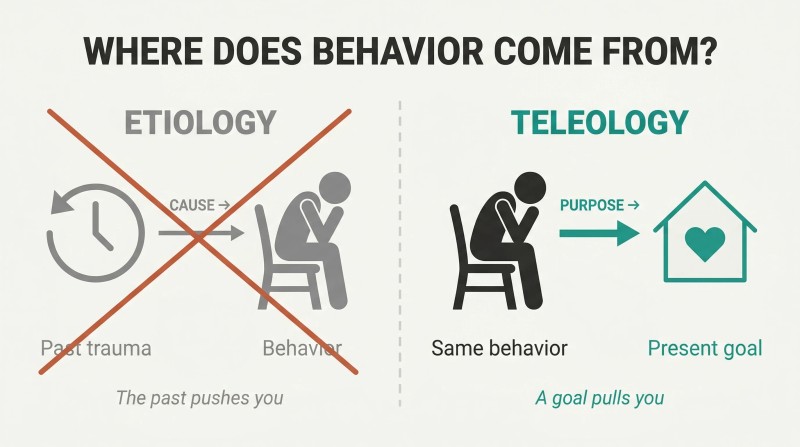
Adler calls this teleology — the study of the purpose behind behavior, rather than its cause. Freudian etiology says childhood trauma made you who you are. Adler flips it: you chose this way of being because it serves a present goal. Consider a man who can't leave his house. Etiology blames past bullying. Teleology says he created anxiety to achieve the goal of staying home — where his parents dote on him and handle him with care. The symptoms are real, but they serve a function.
Even anger follows this logic. A mother screaming at her daughter instantly switches to a polite voice when the phone rings, then resumes yelling after hanging up. If anger were uncontrollable, the call couldn't interrupt it. Anger is a tool pulled out to make others submit.
You're not stuck — you're choosing the safety of not changing
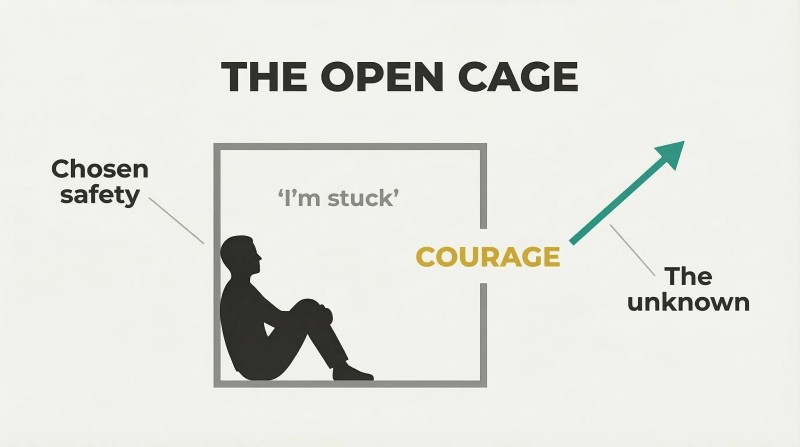
Adler uses the word "lifestyle" to describe personality — your tendencies of thought and action, including how you see the world and yourself. Unlike "personality," which sounds permanent, lifestyle is something chosen (unconsciously, around age ten) and can be re-chosen. Yet people cling to familiar unhappiness because it feels safer than the unknown. It's like driving a rattling old car — you know its quirks and can maneuver around them.
The aspiring novelist illustrates this. He dreams of writing but never finishes anything, blaming his busy job. Really, he wants to preserve the possibility that "I could do it if I tried." Submitting work risks rejection and shattered illusions. So he chooses the comfort of the untested dream over the courage to face reality.
Every problem is a relationship problem — there is no other kind
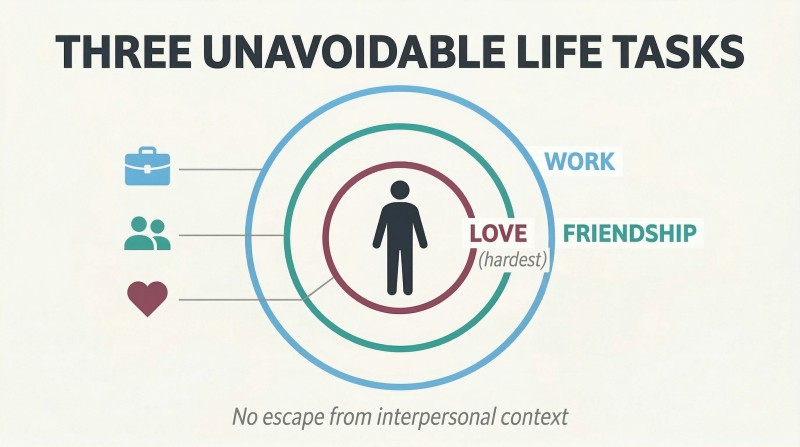
This is Adler's most sweeping claim: all problems — even those that feel deeply personal — are rooted in interpersonal relationships. Loneliness itself requires other people; you can't feel excluded without a community to be excluded from. Even feelings of inferiority are comparative: the philosopher, standing just 61 inches tall, only worried about his height because taller people existed.
Adler arranges these unavoidable challenges into three "life tasks" every person must confront:
1. Tasks of work (professional cooperation)
2. Tasks of friendship (non-compulsory personal relationships)
3. Tasks of love (romantic and family bonds, the hardest of all)
Avoiding these tasks — not the tasks themselves — is what creates suffering. People who become shut-ins or refuse to work aren't rejecting labor; they're fleeing the interpersonal friction that comes with it.
Ask 'Whose task is this?' then stop meddling in theirs
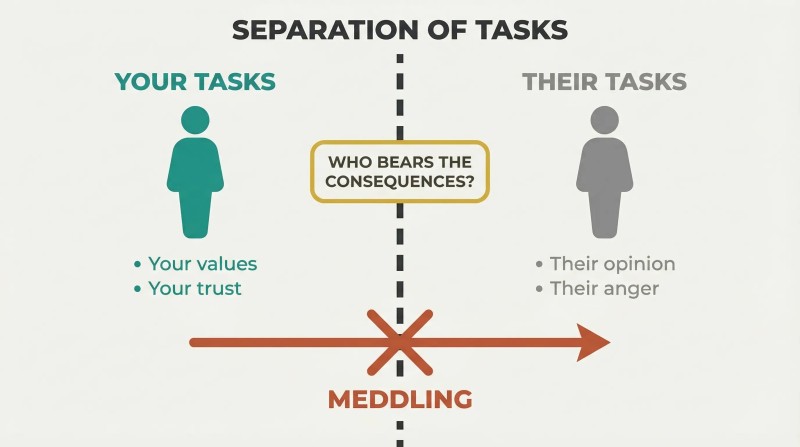
Separation of tasks is Adlerian psychology's most practical tool. Determine who ultimately bears the consequences of a decision — that person owns the task. A child's studying is the child's task, because the child faces the results. When parents command "Study harder!" they intrude on the child's task, breeding rebellion rather than motivation. This isn't cold indifference; it's knowing what the child is doing and being ready to assist when asked.
The principle applies everywhere. Your boss's irrational anger is his task. Whether someone likes you is their task. Whether you live by your own principles is yours. Even in love, believing in your partner is your task, but how they respond to that trust is theirs. Drawing this line is the gateway to lighter, freer relationships.
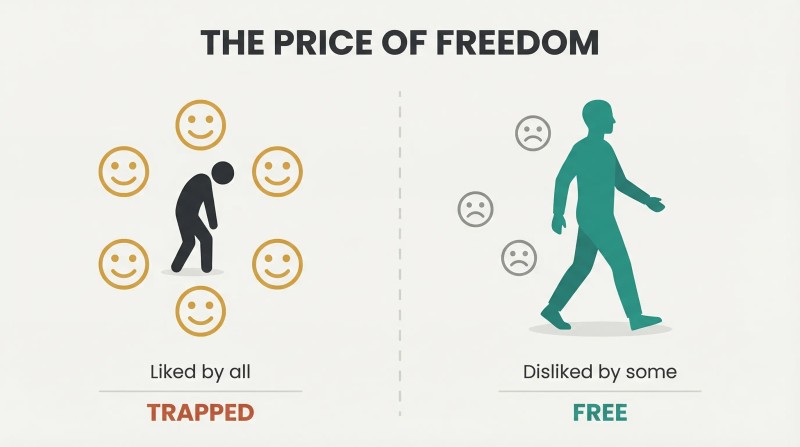
Freedom costs being disliked — pay up or stay trapped
Kant called the desire to be liked an "inclination" — an instinctive pull, like a stone rolling downhill. But following that pull wherever it leads isn't freedom; it's slavery to impulse. Real freedom means pushing your tumbling self uphill. The cost? Some people won't like you. That's the price of admission.
Consider the impossible alternative. If ten people surround you and you try to please all ten, you'll swear contradictory loyalties, make impossible promises, and eventually be exposed. The philosopher offers a thought experiment: given a choice between a life where everyone likes him and one where some people dislike him, he'd choose the latter without hesitation. Being disliked isn't the goal — but refusing to fear it is the prerequisite for living by your own principles.
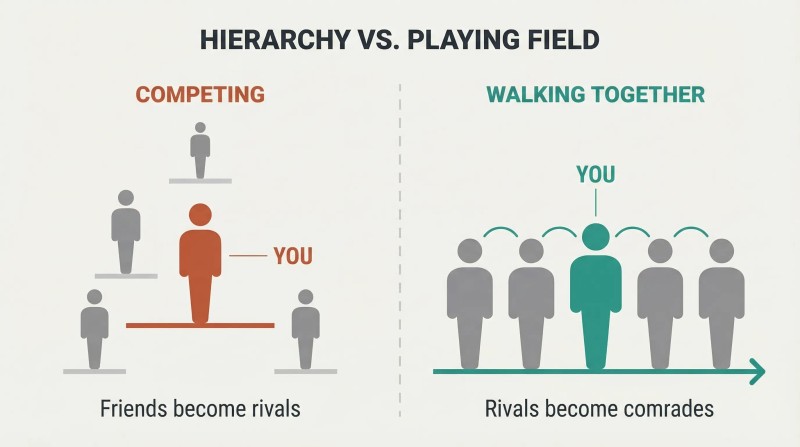
Stop competing — it turns comrades into enemies
Adler's "pursuit of superiority" doesn't mean beating others — it means moving forward on a flat playing field at your own pace. But once you treat life as a vertical hierarchy, every acquaintance becomes a rival. Every friend's success becomes your defeat. You can't celebrate someone else's happiness because it feels like evidence of your own failure.
The philosopher's young friend obsessed over his appearance in the mirror until his grandmother told him: "You're the only one who's worried how you look." Most people aren't scrutinizing you — they're busy worrying about themselves. When you drop the competitive lens, former rivals become potential comrades. Only then can you genuinely celebrate others' victories and receive support in return.
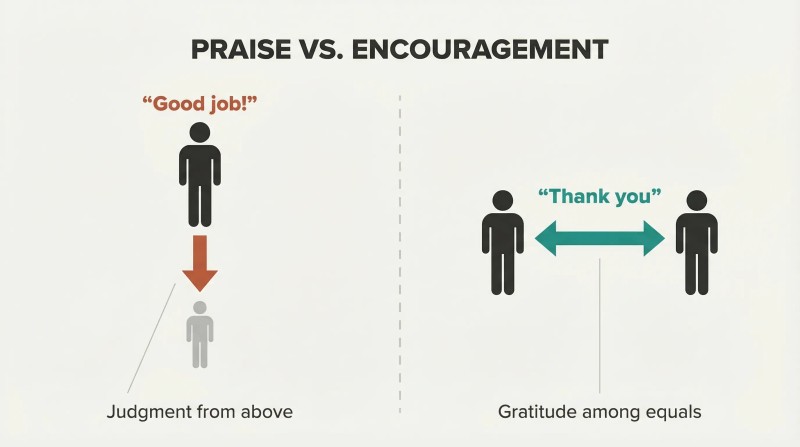
Replace 'good job' with 'thank you' to flatten the hierarchy
Praise is a verdict from above. When a mother tells her child "Good job!" she's unconsciously placing herself in a position of superiority — judging someone she deems beneath her. She would never say those same words to her husband for doing the dishes. Adler rejected both praise and punishment as tools of manipulation, arguing they create vertical relationships that breed dependency.
The alternative is encouragement — expressing gratitude on equal footing. "Thank you" and "That was a big help" acknowledge contribution without passing judgment. The difference matters: praise chains the recipient to someone else's yardstick, while gratitude lets them feel genuinely useful on their own terms. This distinction underpins what Adler calls "horizontal relationships," where people interact as equals regardless of age, role, or status.
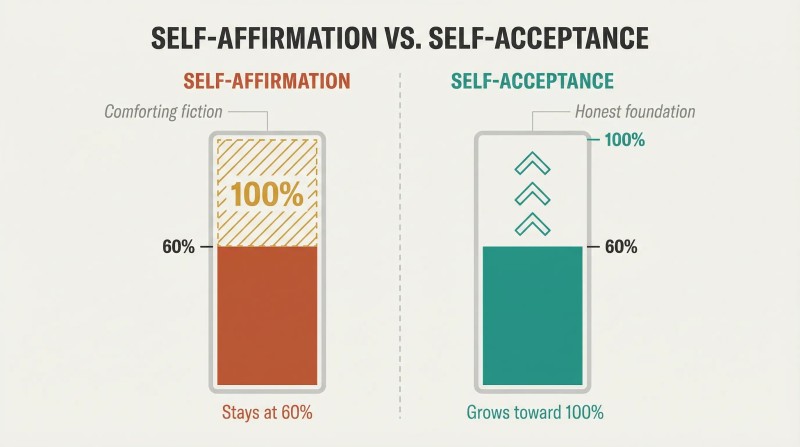
Accept your 60%, then work toward 100%
Self-affirmation is a lie; self-acceptance is a foundation. If you score 60% and tell yourself "The real me is 100%," that's self-affirmation — a comforting fiction that can breed a superiority complex. Self-acceptance means seeing the 60% clearly and asking, "How do I get closer to 100%?" You don't pretend limitations don't exist; you acknowledge what can't be changed and pour energy into what can.
The philosopher calls this "affirmative resignation" — seeing reality with fortitude and acceptance. The concept echoes the Serenity Prayer: accept what you cannot change, have courage to change what you can, develop wisdom to know the difference. Paired with unconditional confidence in others and active contribution, self-acceptance forms a circular structure where each element reinforces the others.
Happiness is the subjective sense you're useful to someone
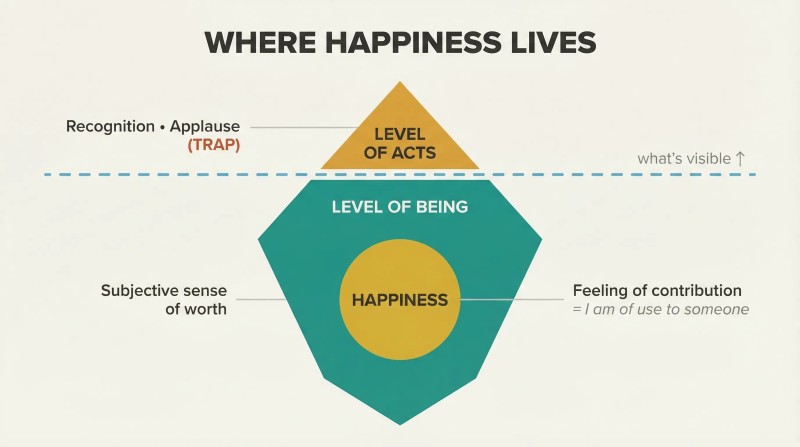
Adler's definition of happiness is precise: it's the feeling of contribution — the inner sense that "I am of use to someone." Not objective proof of usefulness, not applause from others, but the subjective awareness of making a difference. This is why chasing recognition is a trap. Recognition provides a feeling of contribution, but at the cost of living by others' yardsticks. The moment you tie your worth to approval, you surrender your freedom.
Even someone bedridden contributes. A mother in critical condition may do nothing on the "level of acts," but her family is grateful she's alive — she matters on the "level of being." Worth doesn't require visible output. Wealthy people who turn to charity after amassing fortunes aren't driven by guilt; they're seeking the confirmation that "it's okay to be here."
Dance the present — life is dots, not a line
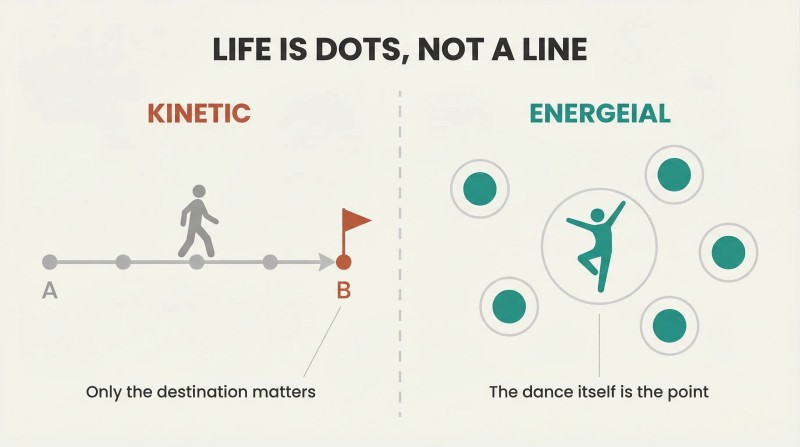
Imagine standing on a theater stage under a bright spotlight. You can't see the audience — not the front row, not the balcony. That blindness is a feature. When you live earnestly in the present, the past and future naturally disappear from view. It's only when the lights dim that you imagine you can see everything — the regrets behind you and the anxieties ahead.
Adler distinguishes "energeial" living from "kinetic" living. Kinetic life treats existence as a journey from point A to point B — get the degree, land the job, reach the summit. Everything before arrival is merely "en route." Energeial life treats each moment as both the process and the outcome, like dancing where the dance itself is the point. No destination is required. If you are dancing earnestly right now, your life is already complete.
Analysis
The Courage to Be Disliked is one of the most commercially successful philosophy books of the 21st century, and its Socratic dialogue format explains why. By packaging Adlerian psychology — the least famous pillar of the Freud-Jung-Adler triad — inside a dramatic confrontation between a skeptic and a sage, Kishimi and Koga accomplish something that academic psychology rarely does: they make abstract ideas feel like personal combat. The young man's resistance mirrors the reader's own, and each 'But that's impossible!' objection gets systematically dismantled before the next one arrives.
What makes the book philosophically rich isn't just its content but its genealogy. Adler's teleology is essentially Aristotelian final causation repackaged for the therapy room. His 'community feeling' echoes Hegel's intersubjectivity. The separation of tasks smuggles in Stoic dichotomy of control — Epictetus's distinction between what is 'up to us' and what is not — without ever naming it. Kishimi, as a Greek philosophy scholar, almost certainly sees these threads and uses Adler as a bridge between ancient wisdom and modern therapeutic practice.
The book's most provocative move — denying trauma — is also its most vulnerable. Taken literally, Adler's position risks minimizing genuine suffering. But the charitable reading, which the authors carefully construct, is more nuanced: past events have influence but not determination. The meaning you assign to experience is the variable you control. This lands closer to Viktor Frankl's logotherapy than to crude victim-blaming, though the dialogue format doesn't always make the distinction cleanly.
The Japanese cultural context matters enormously. In a society that prizes conformity and group harmony, telling readers that 'freedom is being disliked' is genuinely subversive. The book's massive domestic success suggests it struck a nerve precisely because it offered philosophical permission to prioritize individual authenticity over social approval — a message the culture simultaneously craves and resists. For Western readers the insights may feel more familiar, but the Socratic packaging gives them fresh emotional weight that purely prescriptive self-help cannot match.
Review Summary
The Courage to Be Disliked receives mixed reviews, with some praising its life-changing insights and others criticizing its controversial ideas. Supporters find the book's Adlerian psychology concepts enlightening, appreciating its focus on self-responsibility and interpersonal relationships. Critics argue that it oversimplifies complex issues and potentially promotes harmful ideas about trauma and mental health. The dialogue format is divisive, with some finding it engaging and others frustrating. Overall, readers agree the book presents thought-provoking ideas, even if they don't accept all its premises.
People Also Read








Glossary
Teleology
Study of purpose behind behaviorIn Adlerian psychology, the view that people's current behavior is driven by present goals and purposes rather than by past causes. Contrasted with Freudian etiology. A shut-in doesn't stay home because of past trauma; he creates anxiety to achieve the goal of staying home and receiving parental attention.
Lifestyle
Chosen worldview and behavioral tendenciesAdler's term for what is commonly called personality—one's tendencies of thought and action, including how one sees the world and oneself. Unlike 'personality,' which implies something fixed, lifestyle is considered something chosen (typically unconsciously, around age ten) and can be re-chosen at any time through an act of courage.
Life tasks
Work, friendship, and love challengesAdler's three categories of interpersonal challenges every person must confront: tasks of work (professional cooperation), tasks of friendship (non-compulsory personal relationships), and tasks of love (romantic and family bonds). They represent increasing levels of interpersonal closeness and difficulty, and avoiding them—rather than the tasks themselves—creates suffering.
Life-lie
Manufactured excuses to avoid tasksAdler's term for the state of inventing pretexts to avoid confronting one's life tasks. Includes fabricating flaws in others to justify avoiding relationships, blaming circumstances for inaction, and shifting responsibility onto other people or the environment. It is framed not as a moral failing but as an issue of insufficient courage.
Separation of tasks
Distinguishing whose responsibility is whoseAn Adlerian framework for resolving interpersonal conflict by identifying who ultimately bears the consequences of a given decision. That person 'owns' the task. The rule: don't intrude on others' tasks and don't allow others to intrude on yours. Applied by asking 'Who ultimately receives the result of this choice?'
Community feeling
Sense of belonging among comradesAdler's key concept (also called 'social interest') referring to the awareness that others are comrades and that one has a place of refuge in one's community. Achieved through the interconnected practice of self-acceptance, confidence in others, and contribution to others. Adler controversially extended 'community' to encompass all of humanity and even the universe.
Encouragement
Horizontal assistance without judgmentIn Adlerian psychology, the alternative to both praise and punishment in interpersonal communication. Rather than judging from a position of superiority ('Good job!'), encouragement involves expressing gratitude and respect on equal footing ('Thank you' or 'That was a big help'), helping the other person recover the courage to face their own tasks.
Affirmative resignation
Clear-eyed acceptance of unchangeable factsThe practice of seeing reality with fortitude—acknowledging what cannot be changed while focusing energy on what can. In the context of self-acceptance, it means honestly acknowledging one's current limitations (scoring 60%) without pretending they don't exist, and then working toward improvement. Related to the Serenity Prayer's three-part framework.
Horizontal relationship
Equal interpersonal connection without hierarchyAdler's proposed model for all human relationships, in which people interact as equals regardless of age, role, or status. Contrasted with vertical relationships (hierarchical ones), which breed inferiority complexes, superiority complexes, and the desire for recognition through praise or rebuke. Adlerian psychology holds that if even one relationship is vertical, all tend to become vertical.
Energeial life
Process-as-outcome present-focused livingBorrowed from Aristotle's concept of energeia, this describes a way of living where each present moment is both 'now forming' and 'has been formed'—the process itself is the outcome, like dancing where the dance is the point. Contrasted with 'kinetic life,' which treats existence as movement from a starting point to an endpoint, making everything in between merely 'en route.'
Pursuit of superiority
Universal desire to improve oneselfAdler's term for the innate human drive to move from a less desirable state toward a more desirable one—not about being superior to others, but about personal progress on a level playing field. Its healthy counterpart is the feeling of inferiority, which serves as a motivational launchpad. Becomes problematic only when misdirected into competition with others.
FAQ
What's "The Courage to Be Disliked" about?
- Overview of the book: "The Courage to Be Disliked" is a philosophical dialogue between a philosopher and a young man, exploring the ideas of Alfred Adler, a lesser-known psychologist compared to Freud and Jung.
- Main themes: The book delves into Adler's theories on how individuals can achieve happiness and change their lives by focusing on the present and discarding the need for recognition from others.
- Structure: The narrative unfolds over five nights of conversation, where the philosopher challenges the youth's preconceived notions about life, happiness, and interpersonal relationships.
- Philosophical approach: It emphasizes the importance of living in the moment, self-acceptance, and the courage to be disliked as pathways to true freedom and happiness.
Why should I read "The Courage to Be Disliked"?
- Unique perspective: The book offers a fresh take on psychology and self-help by introducing Adlerian psychology, which is less known but highly impactful.
- Practical advice: It provides actionable insights on how to live a happier, more fulfilled life by changing one's mindset and approach to interpersonal relationships.
- Philosophical depth: The dialogue format encourages readers to engage deeply with the material, prompting self-reflection and personal growth.
- Empowerment: It empowers readers to take control of their lives by focusing on what they can change and letting go of the need for external validation.
What are the key takeaways of "The Courage to Be Disliked"?
- Denying trauma: The book argues that trauma does not dictate one's present or future, and individuals have the power to change their lives regardless of past experiences.
- Interpersonal relationships: All problems are seen as interpersonal relationship problems, and resolving these is key to achieving happiness.
- Separation of tasks: It introduces the concept of separating one's tasks from others', emphasizing personal responsibility and boundaries.
- Community feeling: True happiness comes from feeling useful to others and having a sense of belonging, which is achieved through self-acceptance and contribution to others.
How does "The Courage to Be Disliked" define happiness?
- Feeling of contribution: Happiness is defined as the feeling of being useful to others, which provides a sense of worth and belonging.
- Self-acceptance: Accepting oneself as is, without the need for external validation, is crucial for happiness.
- Living in the present: The book emphasizes living earnestly in the here and now, rather than being preoccupied with the past or future.
- Freedom from recognition: True happiness involves the courage to be disliked and not living according to others' expectations.
What is the "separation of tasks" in "The Courage to Be Disliked"?
- Concept explanation: The separation of tasks involves distinguishing between what is one's responsibility and what belongs to others, avoiding unnecessary intervention.
- Application in life: By focusing on one's own tasks and not intruding on others', individuals can reduce interpersonal conflicts and live more freely.
- Boundaries: It helps establish clear boundaries in relationships, promoting healthier interactions and personal autonomy.
- Empowerment: This concept empowers individuals to take control of their lives by focusing on what they can change and letting go of what they cannot.
How does "The Courage to Be Disliked" address the desire for recognition?
- Denial of necessity: The book argues that seeking recognition from others is unnecessary and can lead to living a life dictated by others' expectations.
- Self-worth: True self-worth comes from within, through self-acceptance and the feeling of contribution, rather than external validation.
- Freedom: Letting go of the desire for recognition is essential for achieving personal freedom and living authentically.
- Interpersonal relationships: By not seeking recognition, individuals can build more genuine and equal relationships with others.
What is "community feeling" in "The Courage to Be Disliked"?
- Definition: Community feeling is the sense of belonging and being useful to others, which is central to achieving happiness.
- Interpersonal connections: It involves seeing others as comrades and contributing to the community, fostering a sense of unity and purpose.
- Beyond visible contributions: The book emphasizes that contributions do not need to be visible; the subjective feeling of being useful is what matters.
- Guiding principle: Community feeling serves as a guiding star for living a meaningful and fulfilling life.
How does "The Courage to Be Disliked" redefine freedom?
- Freedom as being disliked: The book posits that true freedom involves the courage to be disliked by others, as it means living according to one's own principles.
- Letting go of expectations: Freedom is achieved by not living to satisfy others' expectations and focusing on one's own tasks.
- Interpersonal autonomy: It encourages individuals to establish boundaries and take responsibility for their own lives, free from external pressures.
- Living authentically: By embracing the possibility of being disliked, individuals can live more authentically and pursue their true desires.
What role does "self-acceptance" play in "The Courage to Be Disliked"?
- Acceptance over affirmation: The book emphasizes self-acceptance rather than self-affirmation, focusing on accepting oneself as is.
- Realistic self-view: It encourages individuals to recognize their limitations and focus on what they can change, rather than dwelling on what they cannot.
- Foundation for happiness: Self-acceptance is a crucial step towards achieving happiness and building healthy relationships with others.
- Courage to change: By accepting oneself, individuals gain the courage to make necessary changes and pursue personal growth.
How does "The Courage to Be Disliked" view life and its meaning?
- Life as moments: The book suggests viewing life as a series of moments, rather than a linear path with a set destination.
- Living in the present: It encourages living earnestly in the here and now, without being burdened by the past or future.
- Assigning meaning: Life has no inherent meaning; individuals must assign their own meaning through their actions and contributions.
- Energeial life: The focus is on the process of living, rather than achieving specific goals, akin to dancing through life.
What are the best quotes from "The Courage to Be Disliked" and what do they mean?
- "The courage to be happy also includes the courage to be disliked." This quote emphasizes that true happiness involves living authentically, even if it means being disliked by others.
- "Life in general has no meaning. Whatever meaning life has must be assigned to it by the individual." It highlights the idea that individuals are responsible for creating their own meaning in life.
- "Freedom is being disliked by other people." This quote suggests that personal freedom comes from not being bound by others' expectations or opinions.
- "Happiness is the feeling of contribution." It defines happiness as the sense of being useful to others, which provides a sense of worth and belonging.
How can I apply the teachings of "The Courage to Be Disliked" in my life?
- Focus on the present: Practice living in the moment and letting go of past regrets and future anxieties.
- Separate tasks: Identify what is your responsibility and what belongs to others, and avoid unnecessary intervention.
- Build community feeling: Cultivate a sense of belonging by contributing to others and seeing them as comrades.
- Embrace self-acceptance: Accept yourself as you are, and focus on what you can change to improve your life.
About the Author
Other books by Ichiro Kishimi




Download PDF
Download EPUB
.epub digital book format is ideal for reading ebooks on phones, tablets, and e-readers.








































