

Key Takeaways
Pain is unavoidable, but psychological suffering is entirely optional
The second arrow is the one you fire. Nguyen opens with the Buddhist parable of two arrows. The first arrow is the painful event itself, which you often cannot control. The second arrow is your reaction, the story you tell yourself about the pain. That second arrow is optional, and it causes the deeper wound. Nguyen spent years chasing relief: therapy, 4am wake-ups, diets, spiritual retreats, personality typing, shadow work. Nothing stuck. He still woke up anxious, angry, and heavy every day.
The breakthrough came not from adding more tools but from locating the single source of emotional suffering. He distinguishes emotional and psychological suffering from physical pain. A diagnosis hurts. Grief hurts. But the spiraling anguish layered on top is manufactured internally, which means it can be dismantled internally.
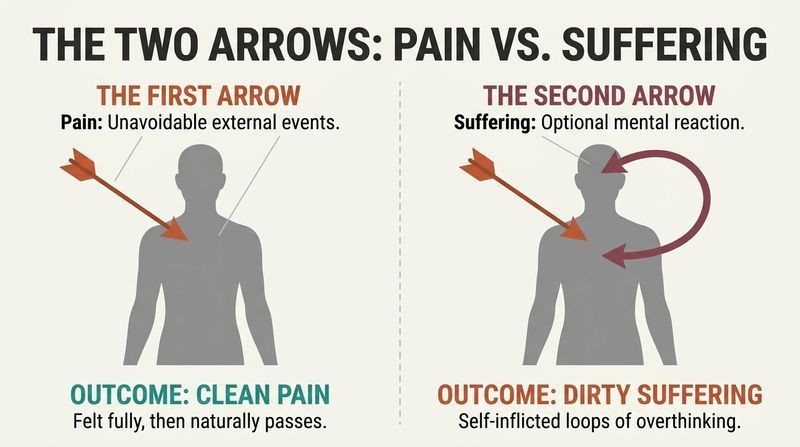
The two-arrows framing maps cleanly onto cognitive behavioral therapy and Stoicism. Epictetus wrote that people are disturbed not by events but by their judgments about events. What's distinctive here is Nguyen's claim that his years of self-improvement actively made things worse, a critique of the wellness industry's tendency to sell more inputs. There is real risk in the phrase suffering is optional, though. Told to trauma survivors or the clinically depressed, it can curdle into self-blame. The steelman: Nguyen restricts his claim to psychological suffering layered atop unavoidable pain, a narrower and more defensible target than banishing hardship itself.
You live inside your thinking about reality, never reality itself
One event, a hundred realities. Ask 100 people what money means and you get roughly 100 answers: freedom, security, greed, evil, opportunity. The dollar is identical; the meaning is manufactured. Two people can work the same job, one calling it a dream and the other a living hell. The only variable is the thinking each brings to it.
Nguyen borrows from Sydney Banks: thought is not reality, yet reality is constructed through thought. An event happens with no inherent meaning. Every interpretation you add is yours. This is what he calls an inside-out understanding: feelings do not arrive from external circumstances but from your own thinking about them. His test question: Who would you be without the thought that you hate your job? Drop the thought, and the heaviness evaporates instantly, revealing the feeling was never in the job.
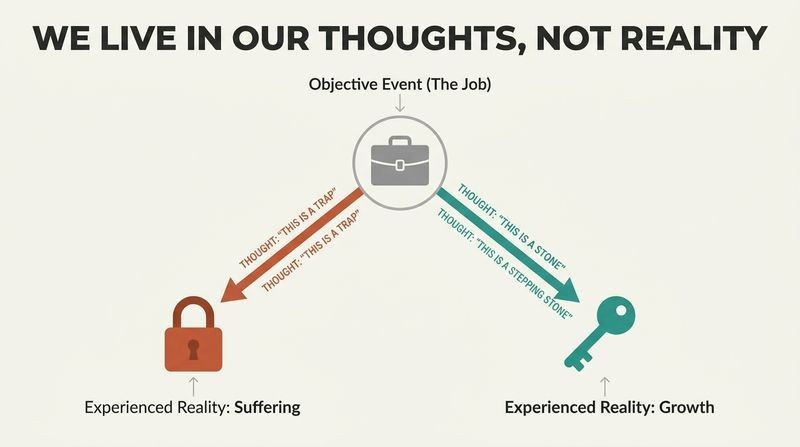
This is constructivism, the view that humans build rather than passively record reality, and it aligns with predictive-processing neuroscience, which frames the brain as a prediction machine that hallucinates a controlled version of the world. Nguyen's coffee-shop and job examples are vivid and testable. The philosophical tension is that inside-out taken to an extreme risks minimizing genuine external injustice: poverty, discrimination, and abuse are not merely thinking problems. His both-things-are-true move helps: the event is real, the feeling is real, but the meaning connecting them is authored. That preserves agency without denying that some first arrows genuinely need changing, not just reframing.
Thoughts arrive on their own; thinking is what wounds you
A noun versus a verb. Nguyen's central distinction: thoughts are effortless raw material that pop into your mind unbidden, like an answer surfacing the instant someone asks a question. Thinking is the effortful, willpower-draining act of grabbing a thought and chewing on it, judging it, spiraling around it. Thoughts create. Thinking destroys.
His demonstration: name your dream income. An answer appears in seconds, neutral and even exciting. Now multiply it by five and dwell on it. Suddenly come the objections: impossible, greedy, nobody in my family earns that. The number did not hurt you. Your thinking about it did. Nguyen maps the contrast: thoughts feel light, expansive, and alive; thinking feels heavy, restrictive, and stressful. Your emotions become a dashboard. Heavy feelings signal you have slipped from receiving thoughts into grinding on them.
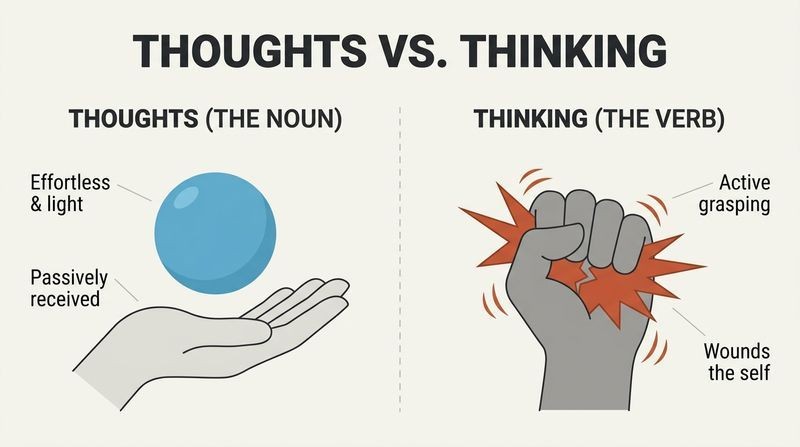
The thought-versus-thinking split resembles the psychological concept of rumination, the repetitive churning that Yale researcher Susan Nolen-Hoeksema linked to depression and anxiety. It also echoes Acceptance and Commitment Therapy's cognitive defusion, watching thoughts pass rather than fusing with them. Nguyen's contribution is a crisp vocabulary ordinary people can deploy mid-spiral. The debatable edge is his insistence that thinking is purely destructive. Deliberate analysis builds bridges, debugs code, and drafts arguments. Nguyen would likely counter that genuine problem-solving flows from relaxed insight rather than anxious grinding, a distinction supported by creativity research showing incubation and mind-wandering often beat forced effort.
Joy is your factory default, not a reward you earn
Peace is the baseline, not the achievement. Nguyen challenges the think-positive doctrine. He argues you do not need good thoughts to feel good, because well-being is your natural resting state. His evidence is a memory exercise: recall your happiest, most love-filled moment, then ask what you were actually thinking. Most people realize they were thinking nothing at all. Any grateful thought came after the feeling, so it could not have produced it.
Look at a healthy baby, he says: its default is not anxiety but bliss. Thinking is what pulls you off that baseline. He offers a thought-o-meter metaphor: the more thinking spins, the higher the needle climbs into the red zone of stress and burnout. Negative emotion is directly proportional to mental churn; positive emotion is inversely proportional. Less thinking, more space for joy to surface on its own.
The claim that peace is subtractive, revealed by removing interference rather than added through effort, echoes contemplative traditions from Zen to Taoism and Eckhart Tolle's present-moment work. It also rhymes with flow research: Csikszentmihalyi found people happiest when so absorbed that self-conscious thought vanishes. The baby-as-natural-state argument is rhetorically clean but empirically shaky, since infants also cry, fear, and rage, and temperament varies genetically. Positive psychology would add that gratitude practices and savoring, which are deliberate cognitive acts, reliably lift mood, complicating the all thinking is bad stance. Still, the core insight that chronic mental noise crowds out contentment is well supported.
To clear a muddy mind, stop stirring and simply wait
Awareness alone settles the water. How do you stop thinking? You cannot force it, Nguyen says, because forcing is more thinking. Instead, merely notice that you are caught in thought and that thinking is the source of your distress. That awareness alone loosens its grip. His governing image: a bowl of murky water. Try to filter or boil it and you keep it agitated. Leave it undisturbed and the sediment settles on its own, revealing water that was always clear underneath.
He pairs this with the young monk who kept rowing farther out on a lake to escape distractions, growing furious at every ripple, until an empty drifting boat rammed his own. With no one to blame, his anger dissolved. The lesson: people and events are empty boats. They hold no power to disturb you without your reaction.
The don't-fight-it prescription lines up with paradoxical-intention research and with mindfulness studies showing that labeling emotions, what neuroscientist Matthew Lieberman calls affect labeling, reduces amygdala activation. Trying to suppress a thought famously backfires, as Daniel Wegner's white-bear experiments demonstrated: told not to think of a polar bear, subjects think of little else. Nguyen's settle, don't strain approach sidesteps that trap elegantly. The empty-boat parable, drawn from Zhuangzi, is one of philosophy's most durable images for depersonalizing offense. The practical caution: for intrusive thoughts tied to trauma or OCD, passive settling is often insufficient and clinical intervention matters.
Peak performance is the absence of thinking, not more of it
The zone is an empty mind. Nguyen argues your best work happens when thinking disappears. Recall being so absorbed in a task that time and self-consciousness dissolved. What were you thinking? Nothing, or thoughts flowing through without friction. That state of flow is non-thinking. Elite athletes call it the zone. Japanese martial arts call it mushin, a mind emptied of anger, fear, and ego, freeing the practitioner to react instantly from trained instinct rather than deliberation.
An Olympic sprinter overanalyzing every stride would falter. Hesitation, doubt, and insecurity only appear once thinking intrudes. This dismantles the fear that dropping mental effort makes you passive or unproductive. The opposite is true. Removing the ego's constant commentary unlocks your full capacity, letting skill and creativity operate unobstructed. You perform at your peak precisely when you stop trying to think your way through.
This is well-grounded science. Flow, mapped by Mihaly Csikszentmihalyi, involves transient hypofrontality, a quieting of the prefrontal cortex's self-monitoring, documented by neuroscientist Arne Dietrich. Musicians, surgeons, and coders report the same egoless absorption. The concept of choking under pressure, studied by Sian Beilock, confirms the inverse: conscious over-monitoring of automated skills wrecks them, exactly Nguyen's claim. The nuance he underplays is that flow requires a foundation of deliberate, effortful practice first. Mushin works because the karateka drilled thousands of hours consciously. Non-thinking is the payoff of prior thinking, not a substitute for skill acquisition. The zone rewards the prepared mind.
Chase goals born of inspiration, never goals born of desperation
Same goal, opposite fuel. When Nguyen realized thinking caused his suffering, he panicked: would dropping it kill his ambition? His answer is that goals are neither good nor bad; what matters is their source.
1. Desperation goals feel heavy, urgent, and scarce. They are usually means goals, wanted only to escape something or reach something else. Achieve one and the emptiness returns within days, so you set a bigger one.
2. Inspiration goals feel light, expansive, and pulled by a calling. They are ends in themselves, created from abundance rather than lack. This is why painters paint even unpaid.
His clarifying question strips out fear and status: If you had infinite money, had already traveled the world, feared nothing, and got no recognition, what would you create? Whatever surfaces effortlessly comes from inspiration, not desperation.
The distinction closely tracks self-determination theory, where psychologists Deci and Ryan separate intrinsic motivation, doing something for its inherent satisfaction, from extrinsic motivation driven by external rewards or pressure. Decades of research confirm intrinsic goals produce more persistence and well-being. Nguyen's hedonic-treadmill observation, that achievement's glow fades fast, is also empirically solid. The infinite-money question is a sharper version of the classic ikigai and values-clarification prompts. One tension: many worthy pursuits, from raising children to building companies, mix both fuels, and pure inspiration can be a luxury unavailable to someone working two jobs to survive. Necessity has produced plenty of meaningful, excellent work too.
Decide the what, then surrender the how to something larger
Your job is the vision, not the blueprint. Nguyen says most of us already know what to do; we just fear doing it, or we sabotage ourselves demanding to know exactly how before we move. His reframe: you are responsible only for holding what you want. The how belongs to what he calls Infinite Intelligence, accessed through non-thinking. There are infinite paths to any destination, so a finite mind trying to map the whole route in advance is futile and exhausting.
The path reveals itself only as you walk, which is why faith matters. He points to Edison napping with steel balls in his hands to catch solutions in the drop into sleep, and Einstein playing violin until answers arrived unbidden. Both created empty space rather than grinding harder, trusting insight to arise once effortful thinking stopped.
The what-not-how principle has a legitimate cognitive basis: the incubation effect, where stepping away from a problem lets unconscious processing solve it, is a replicated finding in creativity research. Edison's and Einstein's hypnagogic tricks exploited the drowsy borderland where the brain loosens rigid associations, a technique Salvador Dali also used and that recent MIT studies on targeted dream incubation have partially validated. Where readers should stay grounded: surrendering the how can slide into magical thinking if it means skipping planning entirely. The most durable interpretation is psychological, that obsessive control breeds paralysis, rather than metaphysical, that the universe will arrange logistics if you simply believe hard enough.
Real love needs no reasons, because reasons make it conditional
The list is the trap. Nguyen asked his girlfriend why she loved him; she said she simply did, no reasons. Asked the same, he rattled off fifty traits: her smile, her laugh, her kindness. For years her answer bothered him. Then it clicked. Every reason he listed was a condition. If he loved her for her laugh, did he stop loving her on days she did not laugh? Reasons secretly install an off switch.
Her reasonless love was unconditional precisely because it rested on nothing external. It was an overflow of love she already felt inside, not a transaction responding to his behavior. Nguyen extends this to creation: making something purely because you want to, for no further purpose, is unconditional creation, the same overflow expressed as work rather than affection.
The insight that justified love is conditional love inverts common romantic intuition, where we flatter partners by cataloging their virtues. Psychologically it resonates with attachment research: secure love feels unearned and stable, whereas love contingent on performance breeds anxiety, the pattern Carl Rogers called conditional positive regard and blamed for much neurosis. Erich Fromm made a parallel argument in The Art of Loving, framing mature love as a capacity one generates rather than an object one finds. The counterpoint worth holding: reasons and unconditionality are not strictly opposed. Admiring specific qualities can deepen a bond as long as the commitment beneath them is not hostage to any single trait.
Your intuition already knows; fear disguised as logic silences it
The gut speaks; thinking overrides. Nguyen frames intuition as a real-time inner GPS that always knows the next move, even if it never shows the whole route. Regret, he notes, is usually the residue of ignoring a gut feeling in favor of someone else's opinion. Intuition arrives as a thought, effortless and carrying a sense of knowing, not as effortful thinking with heavy emotion attached.
Why do so few follow it? Fear. Intuition operates in the unknown, the field of infinite possibility, and humans are wired to dread uncertainty. He warns that society rarely confirms your intuition until an idea is already mainstream, so seeking external validation guarantees discouraging noise. The move is to acknowledge the fear as mere thinking, watch it dissolve, and let the courage underneath surface naturally, then act.
Intuition research is genuinely divided, which makes this takeaway worth scrutinizing. Gary Klein's work on expert firefighters and nurses shows rapid gut judgments can be remarkably accurate, but only in domains with reliable feedback where expertise was built. Daniel Kahneman's work shows the same fast intuition produces systematic bias in noisy, low-feedback domains, and both men co-authored a paper defining exactly when to trust it. Nguyen's blanket trust your gut is therefore safest for value-laden personal choices, where no expert can know your preferences, and riskier for probabilistic judgments. His deeper point holds: fear frequently masquerades as prudent analysis, and naming it as fear restores the capacity to act.
Guard your environment because it quietly pulls you back into thinking
Design the room, not just the mind. Although Nguyen insists reality is built inside-out, he concedes that as physical beings we are still shaped by our surroundings. So he prescribes engineering an environment that makes non-thinking easier and thinking-triggers rarer. To be more productive, subtract distractions rather than add effort.
His practical toolkit:
1. Audit what pushes you into fight-or-flight across physical health, physical space, digital environment, and digital consumption, then rank and remove the worst offenders.
2. Build an activation ritual, a morning routine of meditation, walking, or yoga that starts the day in flow, since momentum from a calm morning carries forward.
3. At work, rate every task from 1 to 10 by energy, cut the drainers, and aim to spend 80% of your time on 9s and 10s.
Start small; overhauling everything at once creates the very stress you are trying to remove.
This is the book's most concrete, behavior-change chapter, and it sensibly hedges the pure inside-out philosophy. It converges with James Clear's environment-design principle in Atomic Habits and with willpower research from Roy Baumeister and Wendy Wood showing that self-control depletes and that habit plus context beats brute effort. The morning-ritual claim aligns with studies on decision fatigue and on how the day's opening emotional tone shapes downstream mood. The 80% energizing-work target echoes the Pareto principle and Marcus Buckingham's strengths research. The subtle tension worth noting: if environment matters this much, the inside-out thesis is not the whole story, and Nguyen's willingness to blend both is a strength, not a contradiction.
Analysis
Don't Believe Everything You Think is a compact, aggressively simple entry in the inside-out or three-principles genre descended from Sydney Banks, whom Nguyen credits explicitly. Its power lies in radical compression: where most self-help stacks tactics, Nguyen collapses all psychological suffering into one variable, thinking, and offers one intervention, awareness. That parsimony is both the book's genius and its liability. A single lever is memorable and empowering, but it flattens genuinely different problems (grief, trauma, injustice, ordinary anxiety) into one undifferentiated diagnosis.
The book's strongest material is experiential rather than argued. Nguyen's thought experiments, the dream-income spiral, the happiest-memory recall, the who-would-you-be-without-the-thought prompt, let readers verify claims in their own experience rather than accept them on authority. This is smart pedagogy and echoes the phenomenological turn in modern therapy: insight beats information. His thought-versus-thinking distinction is a genuinely useful vocabulary that mirrors clinical concepts (rumination, cognitive defusion) without the jargon.
The intellectual weaknesses are the metaphysical scaffolding and the overreach. The Three Principles framework (Universal Mind, Consciousness, Thought) is presented as discovered truth rather than one interpretive lens, and the book slides between defensible psychology (your reactions are authored) and undefended metaphysics (thoughts are divine downloads from the universe, faith will arrange logistics). Readers get the most value treating the spiritual claims as optional packaging around a sturdy psychological core.
What the book gets right and what CBT, Stoicism, ACT, and flow research corroborate is that chronic mental churn manufactures most day-to-day misery, that suppression backfires while gentle awareness dissolves, and that our best states are quiet ones. What it underweights is that some suffering demands changing the first arrow, that deliberate thinking builds civilization, and that non-thinking mastery rests on prior effortful practice. Read as a corrective to overthinking rather than a complete philosophy of mind, it is a genuinely useful, humane little book.
Review Summary
Don't Believe Everything You Think received mixed reviews. Some readers found it insightful and helpful for managing overthinking, praising its simplicity and powerful message. However, many criticized the writing as repetitive, simplistic, and lacking scientific backing. Critics felt the book relied too heavily on spiritual concepts and failed to provide practical techniques. Some appreciated the book's core ideas but found the execution lacking. Overall, opinions were divided, with some finding value in its teachings while others deemed it unhelpful or potentially harmful.
People Also Read



Glossary
Thoughts vs. Thinking
Passive material versus active ruminationNguyen's core distinction. Thoughts are noun-like, effortless, and arrive unbidden, serving as neutral raw material for creation. Thinking is verb-like, effortful, and willpower-draining, the act of engaging, judging, and spiraling around thoughts. Thoughts feel light and expansive; thinking feels heavy and restrictive. Nguyen claims thinking, not thoughts, is the root of all psychological suffering.
The Three Principles
Mind, Consciousness, Thought create experienceA framework Nguyen attributes to Sydney Banks. Universal Mind is the intelligence and life force behind all things. Universal Consciousness is the awareness that makes experience perceivable. Universal Thought is the raw material from which we form our reality. All three must operate together for any human experience to occur, and understanding them explains how experience is created inside-out.
Non-thinking
Quiet-minded state of flowNguyen's term for the state reached by minimizing active thinking while letting thoughts flow through. Synonymous with flow. Characterized by peace, love, joy, loss of time and self, and connection to what Nguyen calls Infinite Intelligence. He presents it as both the cure for suffering and the condition for peak performance and creativity.
Inspiration vs. desperation goals
Goals from abundance versus lackTwo sources of ambition. Desperation goals feel heavy, urgent, and scarce, are pursued to escape or reach something else (means goals), and leave emptiness even when achieved. Inspiration goals feel light and expansive, arise as a calling, are ends in themselves created from abundance, and bring fulfillment in the pursuit itself. The goal itself is neutral; only its source matters.
Infinite Intelligence
Universal source of insightNguyen's term (also called Universal Mind, God, Source, or the Universe) for the intelligence connecting all things and the origin of thoughts and insight. Accessed through non-thinking. He advises holding the what of what you want while surrendering the how to this intelligence, trusting that answers and paths reveal themselves in real time.
Mushin
Japanese empty mind in actionA Japanese martial-arts concept Nguyen uses to illustrate non-thinking. Mushin describes a mind free of random thought, anger, fear, and ego, allowing a practitioner to act and react instantly from trained instinct rather than deliberation. Nguyen equates it with flow and the athlete's zone, evidence that peak performance is the absence of thinking.
The empty boat
Others cannot disturb you aloneA Zen parable Nguyen retells. A monk seeking silence rows to a lake's center; a drifting boat rams him and he rages, until he sees the boat is empty with no one to blame. The lesson: people and events are empty boats with no power to upset you without your own reaction, which is the true source of the disturbance.
Activation ritual
Morning routine for non-thinkingNguyen's prescribed morning practice (meditation, walking, yoga, journaling) designed to enter a calm, non-thinking, flow state early. Because momentum from a peaceful start carries through the day, the ritual makes it harder to relapse into stress and thinking. He notes great spiritual leaders share such routines and frames it as building positive momentum, like an object in motion.
FAQ
What's "Don't Believe Everything You Think" about?
- Exploration of Suffering: The book delves into the root causes of psychological and emotional suffering, suggesting that much of it stems from our own thinking.
- Non-Thinking Concept: It introduces the concept of "non-thinking" as a state where one can experience peace, joy, and love by minimizing unnecessary thoughts.
- Three Principles: The book explains how the human experience is created through the principles of Universal Mind, Consciousness, and Thought.
- Practical Guidance: It offers practical advice and frameworks for reducing thinking and creating a life filled with peace and fulfillment.
Why should I read "Don't Believe Everything You Think"?
- Transformative Insights: The book promises to change your perspective on life by helping you understand the root cause of suffering.
- Practical Applications: It provides actionable steps and frameworks to implement the principles of non-thinking in daily life.
- Personal Growth: Readers can expect to experience personal growth, increased peace, and fulfillment by applying the book's teachings.
- Universal Relevance: The concepts are applicable to anyone, regardless of background, seeking a deeper understanding of their thoughts and emotions.
What are the key takeaways of "Don't Believe Everything You Think"?
- Thinking Causes Suffering: The book posits that our own thinking is the root cause of psychological suffering.
- Non-Thinking State: Achieving a state of non-thinking can lead to peace, joy, and love, as it connects us to Universal Mind.
- Intuition and Inner Wisdom: Trusting one's intuition and inner wisdom is crucial for navigating life without overthinking.
- Unconditional Love and Creation: The book emphasizes creating from a place of unconditional love, free from conditions and expectations.
How does Joseph Nguyen define "non-thinking"?
- State of Being: Non-thinking is described as a state where one is free from the burdens of overthinking and is connected to their natural state of peace and joy.
- Flow and Intuition: It is akin to being in a state of flow, where intuition guides actions without the interference of analytical thinking.
- Space for Miracles: Non-thinking creates space for new thoughts and insights, allowing for miraculous occurrences and creativity.
- Effortless Presence: It involves being present in the moment, experiencing life without the constraints of past or future concerns.
What are the Three Principles in "Don't Believe Everything You Think"?
- Universal Mind: This is the intelligence behind all living things, the life force that connects everything in the universe.
- Consciousness: It is the awareness that allows us to experience life and perceive our thoughts and surroundings.
- Thought: Thought is the raw material from which we create our perception of reality, shaping our experiences and emotions.
- Interconnectedness: These principles work together to create the human experience, emphasizing the interconnectedness of all things.
How can I stop thinking according to Joseph Nguyen?
- Awareness of Thinking: Recognize that thinking is the root cause of suffering and become aware of when you are caught up in it.
- Create Space: Allow thoughts to settle naturally without engaging with them, similar to letting murky water clear on its own.
- Trust Inner Wisdom: Rely on your intuition and inner wisdom to guide you, rather than overanalyzing situations.
- Practice Non-Thinking: Engage in activities that promote a state of non-thinking, such as meditation, to cultivate peace and clarity.
How does "Don't Believe Everything You Think" suggest we handle goals and ambitions?
- Inspiration vs. Desperation: The book distinguishes between goals created out of inspiration, which feel light and energizing, and those from desperation, which feel heavy and burdensome.
- Divine Inspiration: Encourages setting goals that come from a place of divine inspiration, where creation is an end in itself, not a means to an end.
- Let Go of Thinking: By reducing thinking, one can tap into a natural flow of inspiration and creativity, leading to fulfilling goals.
- Trust the Process: Emphasizes trusting the process and allowing goals to manifest naturally without forcing outcomes.
What role does intuition play in "Don't Believe Everything You Think"?
- Guidance System: Intuition is seen as an inner guidance system that knows what to do without the need for overthinking.
- Direct Connection: It represents a direct connection to Infinite Intelligence, providing insights and solutions in the present moment.
- Beyond Logic: Intuition often defies logical reasoning but leads to outcomes aligned with one's true desires and purpose.
- Courage to Follow: The book encourages having the courage to follow one's intuition, even when it goes against conventional thinking.
What are the best quotes from "Don't Believe Everything You Think" and what do they mean?
- "Thinking is the root cause of all suffering." This quote encapsulates the book's central thesis that our own thinking is the primary source of psychological pain.
- "We are ever only one thought away from peace, love, and joy." It suggests that by letting go of unnecessary thinking, we can immediately access our natural state of happiness.
- "The truth is always simple." This emphasizes that the fundamental truths of life are straightforward and uncomplicated, contrary to the complexity often created by overthinking.
- "Follow your intuition and inner wisdom." Encourages readers to trust their gut feelings and innate knowledge as a reliable guide through life.
How does Joseph Nguyen suggest creating a non-thinking environment?
- Eliminate Triggers: Identify and remove elements in your environment that trigger overthinking or stress.
- Morning Rituals: Establish a morning routine that promotes peace and sets the tone for a day of non-thinking.
- Relaxation Practices: Incorporate activities like meditation, yoga, or nature walks to maintain a state of calm and clarity.
- Supportive Surroundings: Design your physical and digital environments to support a state of non-thinking and inspiration.
What is the significance of unconditional love in "Don't Believe Everything You Think"?
- Beyond Conditions: Unconditional love is described as love without limitations or conditions, a pure expression of the soul.
- Source of Creation: It is the foundation for unconditional creation, where one creates not for gain but from a place of abundance and joy.
- Natural State: The book posits that unconditional love is our natural state, accessible when we let go of thinking and ego.
- Transformative Power: Embracing unconditional love can transform relationships and personal fulfillment, leading to a more harmonious life.
What happens when you begin living in non-thinking according to Joseph Nguyen?
- Increased Peace: You experience a profound sense of peace and contentment, free from the usual worries and stress.
- Miraculous Occurrences: Life begins to feel magical, with serendipitous events and opportunities arising naturally.
- Familiarity with Joy: Initially, the unfamiliarity of constant joy may cause doubt, but faith in the process helps maintain this state.
- Continuous Growth: Living in non-thinking allows for continuous personal growth and deeper connections with others and the universe.
Download PDF
Download EPUB
.epub digital book format is ideal for reading ebooks on phones, tablets, and e-readers.








































