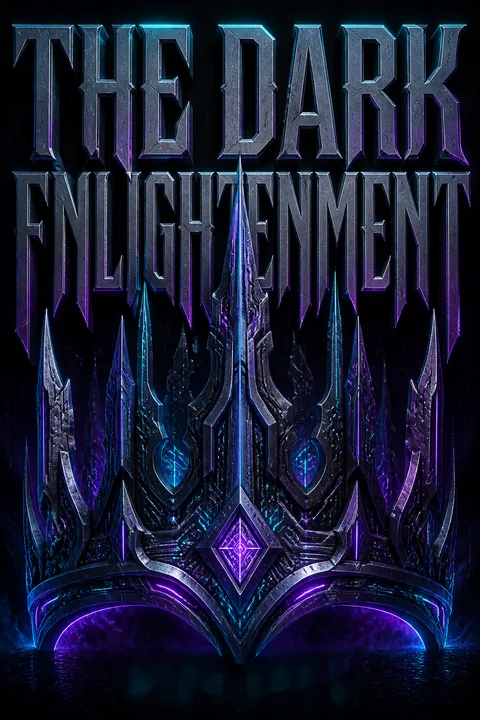

Key Takeaways
1. The Progressive Enlightenment's Self-Confirming Trajectory
Between ‘enlightenment’ and ‘progressive enlightenment’ there is only an elusive difference, because illumination takes time – and feeds on itself, because enlightenment is self-confirming, its revelations ‘self-evident’, and because a retrograde, or reactionary, ‘dark enlightenment’ amounts almost to intrinsic contradiction.
Modernity's True Name. The historical Enlightenment, concentrated in 18th-century Europe, is considered the origin and essence of modernity. This "enlightenment" inherently implies progress, making any "dark" or "reactionary" enlightenment seem contradictory. The very acknowledgment of enlightenment is a miniature form of Whig history, suggesting an irreversible advance.
Conservatism's Paradox. Once certain enlightened truths are deemed "self-evident," there's no turning back, condemning conservatism to a paradoxical existence. Figures like F.A. Hayek, who preferred "Old Whig" or "classical liberal," acknowledged that progress wasn't what it used to be, essentially becoming "reactionary progressives" in a world where the democratic vector is unmistakable.
Flight from Democracy. Amidst growing disillusionment with democratic politics, some thinkers, including Peter Thiel, have concluded that "freedom and democracy are not compatible." This leads to a "voiceless flight" or "exit" from democratic systems, as libertarians increasingly believe their voice is inherently drowned out in a system designed for mass self-expression and state expansion.
2. Democracy's Inevitable Degeneration Towards Collapse
For the hardcore neo-reactionaries, democracy is not merely doomed, it is doom itself.
Systemic Corruption. Democracy, seen as a "vector" rather than a system, is synonymous with "progressive democracy" and the relentless expansion of the state. It fosters a cycle of vote-buying and bribery, where politicians are incentivized to plunder society rapidly, as anything left behind will be seized by opponents. This short-sightedness systematically promotes capital consumption.
Negation of Civilization. Civilization is defined by diminishing time-preference (future concern over present). Democracy, however, accentuates time-preference to a "convulsive feeding-frenzy," leading to "sterile, orgiastic consumerism, financial incontinence, and a ‘reality television’ political circus." This makes democracy a precise negation of civilization, leading towards "murderous barbarism or zombie apocalypse."
Parasitic Nature. The appropriate analysis for democracy is "general parasitology." It insulates parasitism from its consequences by replacing high-frequency market signals with sluggish, centralized "general will" loops. This transforms local dysfunctions into chronic socio-political pathologies, where policies designed to soften bad consequences inevitably worsen them, leading to societal collapse.
3. Neo-cameralism: The State as a Profit-Driven Corporation
To a neocameralist, a state is a business which owns a country.
Curing Democracy. Recognizing that sovereignty cannot be eliminated, Moldbug proposes "neo-cameralism" to cure the state of democracy. This approach formalizes the state as a business, with logical ownership divided into negotiable shares, each yielding a fraction of the state's profit and one vote for a board that hires managers.
Efficient Governance. The state's customers are its residents, and a profitably managed neo-cameralist state would serve them efficiently. Misgovernment equals mismanagement. This model requires:
- Squashing the myth that the state belongs to the citizenry.
- Formally transferring ownership to actual rulers (the "Cathedral").
- Converting democratic corruption (lobbying, privileges) into fungible shares.
- Appointing a CEO to maximize long-term shareholder value.
Historical Precedents. While never fully implemented, neo-cameralism draws parallels to 18th-century enlightened absolutism (e.g., Frederick the Great) and modern non-democratic states like Hong Kong, Singapore, and Dubai. These examples demonstrate high-quality service, minimal crime, and economic freedom without meaningful democracy, where "political freedom is unimportant by definition when government is stable and effective."
4. The "Cathedral" as a Dominant, Secularized Religious Cult
Universalism, in my opinion, is best described as a mystery cult of power.
Modernity's True Faith. Moldbug identifies the dominant modern ideology as "Universalism," a "nontheistic Christian sect" synonymous with progressivism, multiculturalism, liberalism, and political correctness. This tradition, tracing its roots to Anglo-Calvinist/Puritan dissenters, has evolved into a global hegemony, shaping all legitimate mainstream thought.
Mystery Cult of Power. Universalism is a "cult of power" because its replicative lifecycle is critically dependent on the State, which it captures and directs to create conditions favoring its continued replication. It's also a "mystery cult" because it replaces traditional metaphysical superstitions with philosophical mysteries like "humanity, progress, equality, democracy, justice, environment, community, peace," which are often incoherent.
Global Hegemony. The Cathedral's ascent to global supremacy means it no longer needs "Founding Fathers" who recall its parochial ancestry. Instead, it seeks perpetual re-invigoration through their denigration, as seen in the "New Atheism" movement. This synthetic secularism separates the progressive faith from its religious foundations while obscuring its ethnically specific, dogmatic core.
5. Universalism's Morbid Logic and Denial of Reality
None of these concepts, as defined in orthodox Universalist doctrine, is even slightly coherent.
Morbidity of Progress. Universalism exhibits "Misesian morbidity" (compromising personal goals) and "Darwinian morbidity" (compromising gene propagation). It's a parasitic tradition where progress for the "tick" (Universalism) is not progress for the "dog" (its hosts). This logic leads to "Lysenkoist" outcomes where facts are disregarded if they don't align with the theory.
Tolerance as Control. The dialectic of Universalism transforms "tolerance" into a social police function. When only intolerance is intolerable, political authority legitimates anything convenient to itself. This "positive right to be tolerated" expands into substantial entitlements, government protections against slights, and proportional representation, fueling infinite grievance and soft-totalitarianism.
Subsidizing Dysfunction. Universalism's creed, identifying inequality with injustice, dictates that lower status implies a more compelling claim on society. This creates an automatic cultural mechanism that advocates for dysfunction, as "whatever is subsidized is promoted." Attempts at "progressive" improvement are fated to reverse into failure, a truth no democracy can accept, ensuring its eventual collapse.
6. The Racial Dialectic: A Tool for Perpetual State Expansion
The real enemy, glacial, inchoate, and non-argumentative, is ‘white flight’.
Reciprocal Terror. American society is characterized by reciprocal fear and perceived victimization between whites and blacks, evident in urban development, school choice, and policing. This "objective balance of terror" is erased by victimological supremacism and denial, but the political asymmetry favors liberalism, which "wins" any discussion on race.
Liberalism's Paradoxical Creed. The fundamental doctrine of the liberal creed asserts that "Race doesn't exist, except as a social construct employed by one race to exploit and oppress another." This Gnostic delirium demands simultaneous belief in racial non-existence and its profound social impact, making racial recognition both mandatory and forbidden.
White Flight as Exit. "White flight" is a sub-political, non-argumentative "exit" from social democracy's dreams, a spontaneous impulse of the dark enlightenment. It represents a "cold, dark despair" about racial harmony, leading to ethnic disaggregation and segregated communities, which is seen as an "unmentionable" but visible social problem.
7. Cross-Coded History and the "Cracker Factory" Trap
Escape is racist.
America's Original Sin. American history is framed by the "original sin" of slavery and the subsequent Civil Rights Movement, which established a "providential narrative of escape from bondage." This narrative, particularly King's dream, became integral to the American Creed, but also created a political trap for conservatism.
The Dialectical Trap. The left thrives on dialectics, while the right perishes. Progressivism has no enemies to its left, only idealists. Conservatism, however, is caught between the "juggernaut of post-constitutional statism" and unassimilable right-wing tendencies. This ensures that political dialectics always ratchet towards state expansion and substantial egalitarianism.
The Cracker Factory. Any attempt to limit government power is "decoded" as obstruction of racial justice, creating a "translation protocol" where "reactionary regression smells of strange fruit." This "Cracker Factory" blocks all exits, ensuring that "white flight" and other forms of spatial dissociation are condemned as "racist," trapping dissent within a system that equates liberty with original sin.
8. The "Blank Slate" Dogma and Suppressed Biological Truths
The central dogma of the Cathedral has been formalized as the Standard Social Scientific Model (SSSM) or ‘blank slate theory’.
Culture Over Nature. The Cathedral's central dogma, the Standard Social Scientific Model (SSSM) or "blank slate theory," asserts that all legitimate questions about humanity are restricted to culture. It denies natural characteristics and variations between humans, viewing any inquiry into them as cultural pathologies or failures of "nurture."
Antagonism to Hereditarianism. This dogma creates a stark political dichotomy: "the right likes genes and the left likes culture." Hereditarian determinism confronts social constructivism, each offering a radically pared-back model of causality. This ideological sifting ensures that scientific appraisal easily veers into raw antagonism if it challenges the SSSM.
Monsters in the Shadows. When truths are suppressed by orthodoxy, they don't disappear but are displaced into "sheltering shadows," sometimes transforming into "monsters." The Cathedral's unstringing, in various ways, signals a time when these suppressed truths, particularly concerning human biological diversity, will re-emerge, challenging the established dogma.
9. The Bionic Horizon: Where Nature and Culture Converge
Instead, nature and culture compose a dynamic circuit, at the edge of nature, where fate is decided.
Techno-Scientific Advance. Modernity is defined by sustained economic growth driven by techno-industrial contributions. Science and technology are an integral system, developing through experimental techniques and sophisticated instrumentation. This "culture of practical naturalism" is where knowledge acquisition and tool usage form a single, dynamic circuit.
Beyond the SSSM. The SSSM, with its radical separation of nature and culture, is structurally blind to this techno-scientific manipulation of the world. It fails to recognize that culture is a complex natural force that neither merely expresses pre-existing nature nor solely constructs social representations.
Deciding Fate. At the "bionic horizon," nature and culture are inextricably linked, forming a dynamic circuit where humanity's fate is decided. This implies a future where techno-science actively manipulates and reshapes human nature, moving beyond the ideological constraints of the Cathedral's "blank slate" dogma.
Review Summary
The Dark Enlightenment receives mixed reviews, with some praising its incisive critique of liberal democracy and others criticizing its racist undertones. Readers find Land's writing style engaging but often convoluted. The book is seen as a key text in neoreactionary thought, exploring ideas of anti-democracy, race realism, and techno-capitalism. While some appreciate Land's provocative analysis, others find his proposals impractical and potentially dangerous. The work is recognized as influential in certain online political circles, despite its controversial nature.
People Also Read
About the Author
Download PDF
Download EPUB
.epub digital book format is ideal for reading ebooks on phones, tablets, and e-readers.








































