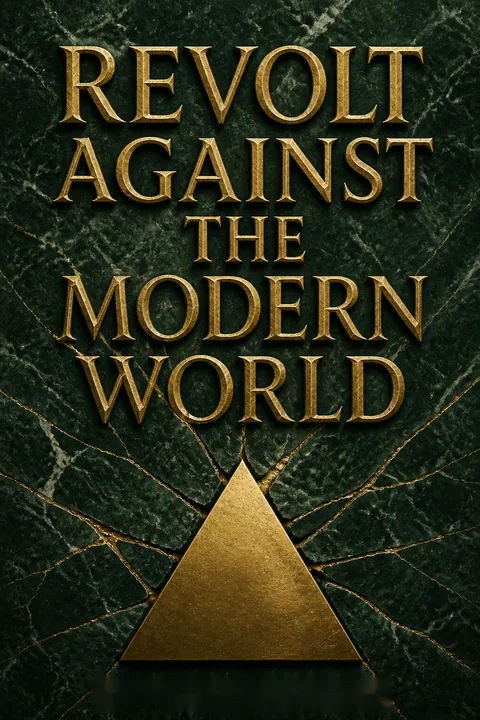

Key Takeaways
1. The Modern World: A Degenerate Fall from Primordial Tradition
The main thesis is the idea of the decadent nature of the modern world.
Involution, not evolution. Contrary to modern beliefs in progress and evolution, traditional man understood history as a process of gradual decline or "involution." This descent, often termed the "Dark Age" or Kali Yuga, signifies a progressive abandonment of higher states for those increasingly conditioned by human, mortal, and contingent elements. The modern world, therefore, is not an advancement but a "lifeless body falling down a slope," its true normalcy and health long forgotten.
Loss of spiritual root. The causes of this spiritual and material degeneration have been active for centuries, stripping humanity of the capacity for genuine revolt or a return to health. What is rejected in modernity is often unconsciously retained, as people lack the true principles to understand what they are reacting against. This profound lack of awareness prevents modern individuals from grasping the global and dreadful perspective of their own civilization's decay.
A call to awakening. The book serves as a "testimony" for those "different" individuals who do not belong to this time, offering a fixed point of reference. It aims to provide the absolute reference point—the key to understanding modern deviations—and to construct a pole for those who can "ride the wave" of decline, remaining firm in principles, indifferent to the "fevers, convulsions, superstitions, and prostitutions" of contemporary generations.
2. Traditional Society: Rooted in a Dualism of Being and Becoming
According to this doctrine there is a physical order of things and a metaphysical one; there is a mortal nature and an immortal one; there is the superior realm of 'being' and the inferior realm of 'becoming.'
Two Natures. Traditional civilization was fundamentally structured around the knowledge of two distinct "natures": the visible, tangible world of "becoming" (impermanence, dependence, transformation) and the invisible, intangible realm of "being" (stability, transcendence, true life). This was not mere theory but a lived experience, where the "invisible" was often more real than physical data.
Beyond physical reality. For traditional man, "reality" extended far beyond the physical bodies in space and time that define modern understanding. The incessant flux of "becoming" was seen as a cosmic manifestation of an existential predicament, a "blind yearning" or "irrational identification with impermanent aggregates." This contrasts sharply with modern materialism, which limits experience to the physical world.
Asceticism as liberation. The path to the realm of "being" was through asceticism, understood as self-mastery, discipline, autonomy, and a unified life. This involved liberation from earthly bondage and the pursuit of the "nonhuman dimension," which constituted the essence and goal of any truly traditional civilization. All authority, law, and institutions were deemed fraudulent unless aligned with this superior principle.
3. Divine Kingship and Patriciate: Embodiments of Transcendent Authority
In the world of Tradition the most important foundation of the authority and of the right (ius) of kings and chiefs, and the reason why they were obeyed, feared, and venerated, was essentially their transcendent and nonhuman quality.
Kings as pontifices. Traditional kings were not merely political leaders but "pontifices" – bridge-builders connecting natural and supernatural dimensions. Their authority stemmed from a metaphysical, nonhuman quality, often seen as "immanent transcendence" or a "divine nature disguised in human form." This contrasts with modern notions of authority based on strength, wisdom, or popular consent.
Solar symbolism and divine attributes. Kingship was frequently associated with solar symbols, embodying "glory," "victory," "stability," "peace," and "justice." These were not abstract ideas but metaphysical realities, such as the Persian hvareno (supernatural fire) or the Roman felix (extra-normal virtus). The king's presence radiated beneficial spiritual influences, ensuring prosperity and order.
Patriciate: A sacred legacy. The patriciate, like royalty, derived its authority from a sacred tradition, not just biological heredity. Patricians possessed and practiced rites connected to divine power, transmitting a "transcendent legacy" through blood. Their ancestors were "divine ancestors," unlike the plebeians, who lacked this spiritual chrism and were considered "children of the Earth," their religion often chthonic and collective.
4. Rites and Spiritual Virility Were the Core of Traditional Life
The rite was rather a 'divine technique,' a determining action upon invisible forces and inner states similar in spirit to what today is obtained through physical forces and states of matter.
Rites as divine technology. In traditional societies, rites were not mere ceremonies or expressions of religious devotion, but precise, necessitating "divine techniques." Performed by qualified individuals (kings, priests, patricians) according to strict norms, they were believed to produce objective results by acting upon invisible forces and inner states. Neglecting or improperly performing a rite was considered sacrilege, unleashing dreadful powers.
Spiritual virility and impersonal action. This approach fostered a "spiritual virility," an active, commanding attitude towards the divine, rather than passive worship. The Roman patrician's "lance and rite" symbolized this synthesis of power and sacred action. The brahmana, for instance, dominated Brahman (the vital principle) and the gods through formulas of power, embodying a non-theistic, "magical" (in the higher sense) relationship with the divine.
Beyond human emotions. Traditional rites were devoid of the emotional pathos characteristic of modern religiosity. They were efficacious weapons, not effusions of feeling, designed to establish causes in the invisible dimension that would produce necessary effects in the visible world. This law of action was also a law of freedom, as beings who neither hoped nor feared, but acted, were spiritually unbound.
5. The Caste System: Reflecting Innate Spiritual Hierarchy and Purpose
The division of individuals into castes or into equivalent groups according to their nature and to the different rank of activities they exercise with regard to pure spirituality is found with the same traits in all higher forms of traditional civilizations, and it constitutes the essence of the primordial legislation and of the social order according to 'justice.'
Organic hierarchy. The caste system, exemplified by Indo-Aryan society, was an organic social order mirroring the hierarchy of functions within a living organism, from the undifferentiated vitality of workers (sudras) to the spiritual authority of priests (brahmanas). It was based on innate nature and vocation (svadharma), not social injustice or oppression.
Nature determines birth. Traditional man believed birth was not accidental but corresponded to the "nature of the principle embodied in an empirical self." Thus, a person was born into a specific caste because they possessed a given spirit, making caste differences a reflection of pre-existing, deeper inequalities. This provided a "natural place" for individuals to develop their potential harmoniously.
Beyond modern equality. The system fostered a sense of dignity and purpose in every function, as each activity, no matter how humble, could be performed as an "art" and an "offering" (niskama-karma). This contrasts sharply with modern claims of equality and the right to be anything one chooses, which Evola sees as rooted in the "shifting sands of that nothingness without a name and tradition that is the empirical human subject."
6. Heroic Action and "Holy War": Paths to Immortality
In death thy glory in heaven, in victory thy glory on earth. Arise therefore, with thy soul ready to fight.
War as a sacred ritual. In traditional societies, war could assume a sacred character, becoming a "holy war" and a "path to God." This concept, found in Islamic jihad and the Bhagavadgītā, distinguished between the "greater holy war" (inner, spiritual struggle against one's lower nature) and the "lesser holy war" (external, material combat).
Inner transformation through combat. The external war was a means to wage the inner one, forcing the warrior to overcome self-preservation instincts, fear, and other passions. The "right intention" (niya) towards transcendence was paramount, transforming battle into a sacrificial and purifying ritual. Death in battle, when imbued with this spirit, became a mors triumphalis, a path to immortality (e.g., Valhalla, House of the Sun).
Transcendent power in destruction. The Bhagavadgītā emphasizes the irreality of ephemeral life and the mortal body, aligning the warrior with the divine power of destruction that "negates the negation." This consciousness allows the warrior to evoke and become transfigured by transcendent power, breaking human bonds and achieving liberation. This contrasts with modern warfare, which is often devoid of spiritual meaning and reduced to brute, cynical power.
7. The Decline of the West: A Regression of Castes and Spiritual Feminization
A progressive shift of power and type of civilization has occurred from one caste to the next since prehistoric times (from sacred leaders, to a warrior aristocracy, to the merchants, and finally, to the serfs); these castes in traditional civilizations corresponded to the qualitative differentiation of the main human possibilities.
The law of caste regression. Western history is characterized by a systematic regression of castes, a progressive shift of power from the highest (sacred leaders) to the lowest (serfs). This process began with the decline of divine regality, leading to warrior kings, then to merchant oligarchies, and finally to the rule of the proletariat. Each step represents a materialization and secularization of authority.
Feminization of spirituality. Parallel to this caste regression is the "feminization of spirituality." As virile, solar principles declined, lunar and Demetrian (Mother) spiritualities gained prominence, often leading to priestly dominance and a passive, devotional relationship with the divine. This shift is evident in the historical rise of the Church's authority over the Empire, embodying a "maternal principle" over the male.
Loss of integral unity. The medieval Ghibelline ideal, representing the last echo of a higher tradition, attempted to restore the unity of regal and hieratic power. However, its eventual decline, exacerbated by the Church's hegemonic claims and the rise of national states, led to a definitive scission. This left Europe without a unifying spiritual axis, paving the way for secularization and the triumph of lower, particularistic forces.
8. Modernity's Illusions: Humanism, Individualism, and the Cult of Becoming
The earliest version of humanism was individualism. Individualism should be regarded as the constitution of an illusory center outside the real center; as the prevaricating pretense of a 'self' that is merely a mortal ego endowed with a body; and as by-product of purely natural faculties that, with the aid of arts and profane sciences, create and support various appearances with no consistency outside that false and vain center.
Humanism's false center. Modern humanism, emerging from the "darkness of the Middle Ages," established man as the measure of all things, creating an "illusory center" in the mortal ego. This individualism, a "prevaricating pretense," led to a radical unrealism where truth and laws are contingent and ephemeral, lacking consistency outside this false self.
Rationalism and scientism as decline. The loss of initiatic tradition and the reduction of the sacred to faith and sentiment paved the way for rationalism and scientism. These intellectual movements, far from being progress, are seen as products of degeneration, replacing metaphysical knowledge with abstract concepts, empirical data, and a "dead knowledge of dead objects." This systematic profanation of knowledge serves material needs and the lust for power.
The "treason of the clerics." Intellectuals, once guardians of higher values, betrayed their role by legitimizing and even celebrating the plebeian realism and deconsecrated existence of the masses. They provided doctrinal justifications for base passions and material pursuits, ridiculing transcendent principles and accelerating the spiritual havoc. This inversion of polarity turns superior faculties into instruments of subpersonal forces.
9. The Rise of Collectivism and the "Religion of Work": Marking the End of the Cycle
The slave's self-congratulating stupidity creates sacred incenses with the exhalations of human sweat, hence expressions such as 'Work ennobles man'; 'The religion of work'; and 'Work as a social and ethical duty.'
Triumph of the Fourth Estate. The regression of castes culminates in the rise of the Fourth Estate, where power passes to the "beasts of burden" and standardized individuals. This leads to a universal, communist civilization where the individual is disintegrated into the collective, losing autonomous personality and interests unrelated to the collectivity's needs.
Work as a new religion. Work, once despised by traditional societies that valued "action," is elevated to a sacred duty and a religion. This "slave's self-congratulating stupidity" creates a morality where "work ennobles man" and becomes the sole path to social and ethical fulfillment. This reflects an animal-like subordination of higher principles to purely physical life.
Mechanization and dehumanization. The communist ideal systematically employs mechanization, disintellectualization, and rationalization to eliminate "individualistic rough edges" and "bourgeois illusions." This creates a human type reduced to a "bundle of reflexes," whose existence is defined by production and consumption, driven by an insatiable, machine-generated need, leading to a "demonic" triumph of the formless collective.
Review Summary
Reviews of Revolt Against the Modern World are sharply divided. Admirers praise it as a profound, magisterial metaphysical critique of modernity, celebrating its spiritual depth, critique of materialism, and longing for transcendent hierarchical order. Critics dismiss it as pseudoscientific, incoherent, and dangerously reactionary, noting its poor scholarship, repetitive structure, and ideological extremism. Many acknowledge Evola is compelling when critiquing capitalism and modern alienation, but deeply wrong on race, history, and mythology. The book is widely recognized as foundational to traditionalist and far-right thought, with polarizing relevance today.
People Also Read



About the Author

Download PDF
Download EPUB
.epub digital book format is ideal for reading ebooks on phones, tablets, and e-readers.








































