


Plot Summary
Prologue
Holden Caulfield1 narrates from a treatment facility somewhere near Hollywood, where his older brother D.B.6 — once a brilliant short-story writer, now a screenwriter Holden considers a sellout — visits most weekends in his new Jaguar. Holden is seventeen. He won't give us his whole autobiography, just the madman stuff that happened around last Christmas, the events that landed him here.
He's vague about his condition, mentioning checkups and needing to take it easy. The story he's about to tell spans roughly forty-eight hours, from a Saturday afternoon at a Pennsylvania boarding school to a rainy Monday in Central Park, and by the end, most of the people he describes — even the ones he claims to despise — he'll admit he misses.
The Last Saturday at Pencey
On the Saturday of the big Saxon Hall football game, Holden1 stands alone on Thomsen Hill while the rest of Pencey Prep cheers below. He's been expelled for flunking four of five subjects — only English survived — and isn't supposed to return after Christmas.
That morning he lost the fencing team's equipment on the subway, earning their total ostracism. He visits his elderly history teacher, Mr. Spencer,10 who is sick in bed surrounded by Vicks Nose Drops and pill bottles.
Spencer reads aloud Holden's worthless Egypt essay and its apologetic postscript, tries to lecture him about the future. Holden endures it all, thinking the whole time about where the ducks in Central Park go when the lagoon freezes over. He leaves Spencer's house feeling worse than when he arrived.
Allie's Mitt for Stradlater
Holden's1 roommate Stradlater3 returns from the football game looking handsome and asking favors — he wants Holden to write his English composition. Then he drops a name that stops Holden cold: his date tonight is Jane Gallagher.4
Holden spent an entire summer with Jane, playing checkers and golf, nearly kissing her on a rainy porch when she cried over her alcoholic stepfather. She never moved her kings from the back row. Holden keeps saying he'll go downstairs to say hello but never does.
Instead, after Stradlater leaves, he writes the composition about his younger brother Allie's5 left-handed fielder's mitt — covered in poems in green ink so Allie would have something to read in the outfield. Allie died of leukemia at eleven. Holden broke every window in the garage that night.
Blood on the Dorm Floor
Stradlater3 returns late and rejects the composition — it was supposed to be about a room, not a baseball glove. Holden1 tears it up. When Stradlater won't say what happened with Jane,4 Holden throws a punch. His right hand, never fully healed from the garage windows, connects weakly.
Stradlater pins him and bloodied his nose. Afterward, Holden lies in his neighbor Ackley's9 room feeling lonesome enough to wish he were dead. He packs his bags, sells his typewriter for twenty dollars, puts on the red hunting hat he bought that morning for a buck, and shouts a sarcastic goodnight down the corridor.
He walks through the snow to the train station. Pencey is behind him before midnight, and Wednesday — when he was supposed to leave — is three days away.
Nobody to Call at Penn Station
At Penn Station, Holden1 steps into a phone booth and cycles through every person he might call — his brother D.B.6 in Hollywood, his kid sister Phoebe2 asleep at home, Jane Gallagher,4 Sally Hayes8 — and finds a reason to reject each one.
He takes a cab to the Edmont Hotel, asking the driver about the Central Park ducks. The driver thinks he's insane. The Edmont is grim: a room overlooking other rooms where, through uncurtained windows, Holden watches a man trying on women's clothes and a couple squirting drinks at each other's faces.
He's fascinated and disgusted simultaneously. He tries calling a woman a Princeton acquaintance recommended but she won't meet at this hour. He goes down to the hotel nightclub alone, unable to order anything stronger than Cokes.
Sunny and Maurice
The elevator operator Maurice11 offers to send a girl up — five dollars. Holden1 agrees, then puts on a clean shirt and brushes his teeth, nervous and still a virgin. Sunny12 arrives in a green dress, about his age, jiggling her foot on the desk chair.
Holden gets too depressed to go through with anything, claims a recent operation, and pays her five dollars. She insists the price was ten. Hours later, at dawn, Maurice and Sunny return. She takes five more from Holden's wallet while he cries.
Maurice snaps him painfully, then punches him in the stomach. Alone on the floor, Holden fantasizes an elaborate movie-style revenge with an automatic pistol, then takes a bath. He lies in bed talking out loud to his dead brother Allie,5 wishing he could disappear.
Nuns and the Sidewalk Song
Sunday morning, Holden1 checks out of the Edmont and has breakfast at Grand Central beside two nuns with inexpensive suitcases on their way to teach at a convent uptown. He gives them ten dollars for their collection and they discuss Romeo and Juliet — one teaches English, and Holden tells her he felt sorrier for Mercutio than for the lovers.
It is the most genuine conversation he's had since leaving Pencey. Walking uptown afterward to buy a record for Phoebe,2 he spots a small boy walking along a curb singing about a body coming through the rye, ignoring the traffic and his inattentive parents. The song lifts something in Holden. He finds the record — a Dixieland number called 'Little Shirley Beans' — and for a moment feels almost happy.
Sally Won't Run Away
Holden1 meets Sally Hayes8 at the Biltmore looking terrific in a black beret — and for one irrational minute wants to marry her. They see the Lunts play, and during intermission Sally spots an Andover acquaintance and launches into exactly the kind of phony name-swapping conversation that scrapes Holden raw.
Afterward, at the Radio City skating rink, wobbling on rented skates, he pours out his loathing for prep schools, phonies, and the whole conveyor belt toward Cadillacs and office jobs.
He begs her to drive to Massachusetts tomorrow, live in cabins by a brook, chop their own wood. Sally calls it fantastic — they're practically children. He tells her she gives him a royal pain. She cries. He leaves alone, unsure why he proposed something he didn't really mean — except that he did.
Broken Record at the Frozen Lagoon
Holden1 calls Carl Luce,13 a former student adviser from Whooton now at Columbia, and meets him at the Wicker Bar. Luce talks about his older Chinese girlfriend and Eastern philosophy, suggests Holden see a psychoanalyst, and leaves after one drink.
Holden stays and drinks until he can barely see straight. He drunk-dials Sally Hayes,8 babbling incoherently about Christmas trees until her grandmother hangs up. Stumbling through Central Park to find the lagoon, he drops Phoebe's2 record and it shatters into pieces he pockets anyway.
The lagoon is partly frozen and completely duckless. On a bench, shivering with ice in his hair, he imagines his own funeral — his mother still not over Allie,5 Phoebe too young to attend. He decides to sneak home and see his sister while he still can.
Phoebe Weatherfield Caulfield
Holden1 cons the new elevator man with a story about his bad leg and creeps into the apartment. Phoebe2 is asleep in D.B.'s6 room — she prefers the bigger bed — and he sits at the desk reading her notebooks. She has signed them with an invented middle name, Weatherfield, replacing the Josephine she dislikes.
Her notes to friends, homework about Alaskan salmon, and practiced signatures fill him with tenderness. When he wakes her she throws her arms around him, thrilled, tells him about her school play — she's Benedict Arnold in a Christmas pageant.
Then her excitement sharpens. She asks why he's home early. Within minutes she has diagnosed the truth: expelled again. She puts a pillow over her head and repeats, with the certainty of a verdict, that their father will kill him.
Catcher at the Cliff's Edge
Phoebe2 tells Holden1 he doesn't like anything that's happening. He struggles to name one thing and can only produce his dead brother Allie5 and this present moment — sitting here in the dark talking with her. When she pushes him to name something he'd like to be, he reaches for the song he heard that morning, misremembering the Robert Burns lyric: a body catching, not meeting.
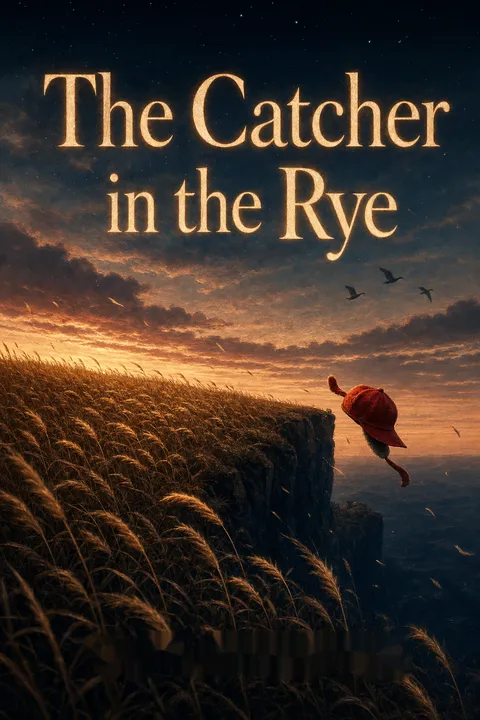
He pictures thousands of children playing in a vast field of rye near a cliff's edge, with nobody watching them except him. His sole job would be to stand there and catch anyone who starts to go over — the catcher in the rye. He knows it's crazy. Phoebe, who corrects his misquotation without blinking, simply repeats that their father will kill him.
Eight Dollars and Eighty-Five Cents
Holden1 calls Mr. Antolini,7 his former English teacher, and arranges to stay there. Back in D.B.'s6 room, he and Phoebe2 dance to radio music with the volume barely on. She stays rigid in position between songs, dead serious about the silence — it kills him.
Their mother comes home. Phoebe covers for the cigarette smoke, claiming she lit one herself. Holden hides in the closet, heart slamming, until his mother leaves. In the dark, Phoebe finds her Christmas savings — eight dollars and eighty-five cents — and presses the bills into his hand.
Holden starts crying and cannot stop, shaking so hard Phoebe wraps her arm around his neck. He gives her the red hunting hat, makes her promise to sleep, and slips out through the back stairs. For the first time, he barely cares if his parents catch him.
The Hand on Antolini's Couch
Mr. Antolini7 — the teacher who once carried a student named James Castle to the infirmary after the boy jumped from a window at Elkton Hills — opens his Sutton Place door with a highball.
Over drinks and stale cake, he warns Holden1 about a terrible, particular kind of fall: the kind designed for men who gave up looking for something before they ever really started. He copies out a quote from the psychoanalyst Wilhelm Stekel about the mark of maturity being the willingness to live humbly for a cause rather than die nobly for one.
Holden falls asleep on the couch. He wakes to find Antolini sitting on the floor in the dark, stroking his head. Holden panics, dresses in seconds, and flees. He sleeps at Grand Central, tormented by uncertainty about whether the touch was predatory or merely kind.
Allie, Don't Let Me Disappear
Monday morning, Holden1 is coming apart. Walking up Fifth Avenue, every time he steps off a curb he feels certain he will keep falling and never reach the other side. He begins speaking to Allie5 out loud, begging his dead brother not to let him vanish, thanking him at each safe crossing.
He decides to hitchhike West, pretend to be a deaf-mute, pump gas at some lonely filling station, marry a deaf-mute woman, and teach their hidden children to read. But first he needs to say goodbye to Phoebe.2
At her school — his old school — he writes a note asking her to meet him at the museum. On the stairs he finds obscene graffiti scratched into the wall and rubs it off with his hand, certain that no matter how long anyone lived, they could never erase them all.
The Carousel in the Rain
Phoebe2 arrives at the museum wearing Holden's red hunting hat and dragging an old suitcase packed with her clothes — she intends to go West with him. Holden1 nearly passes out. He refuses, harshly. She cries and hurls the hat back at his face.
He tells her he's changed his mind, he's not going anywhere. She doesn't believe him at first, trailing him on the opposite side of the street through the zoo. But when they reach the carousel — still playing the same songs from their childhood — she lets him buy her a ticket.
She rides the beat-up horses, reaching for the gold ring. Rain comes down in sheets. Every other parent takes shelter. Holden stays on the bench, soaked, his hunting hat back on his head, so overwhelmed with happiness he's nearly crying.
Epilogue
Holden1 cuts the story short. He went home afterward, got sick, ended up at this facility with a psychoanalyst who keeps asking whether he'll apply himself next September. Holden calls the question stupid — nobody knows what they're going to do until they do it. D.B.6 visits with an English actress and asks what Holden thinks about everything he's just recounted.
Holden has no answer. What he does know surprises him: he misses people. Not just Phoebe2 or Jane,4 but Stradlater,3 Ackley,9 even Maurice.11 His parting advice carries the weight of everything he's learned and nothing he can yet articulate — never tell anybody anything, because once you do, you start missing everybody.
Analysis
The Catcher in the Rye is less about adolescent rebellion than unresolved grief costumed as social criticism. Holden's1 obsession with phoniness — his most quoted concern — is secondary to the real condition: Allie's5 death from leukemia, an event he never processed because he was hospitalized after shattering his hand on garage windows that same night. Every encounter filters through this loss. The ducks question asks where living things go when their world can no longer sustain them. The museum fantasy longs for time to freeze. The catcher vision tries to prevent a fall that already happened.
Salinger constructs an unreliable narrator whose unreliability is itself the diagnosis. Holden1 lies constantly — to Mrs. Morrow,14 to Sunny,12 to himself — but his fictions orbit the same truth: he wants to shield the vulnerable from damage he knows is inevitable. His inability to call Jane Gallagher4 all weekend is not timidity but preservation — to reach out risks discovering she has changed, and change is what Holden cannot accept.
The novel's most radical formal quality is its embrace of digression as meaning. Holden1 flunks Oral Expression because he values speakers who wander, and the book itself wanders relentlessly — into Allie's5 sailboat, Jane's4 hand in the dark, a kettledrum player at Radio City. These detours resist the adult narrative of applying yourself and moving forward. The carousel at the end — circling, playing the same songs it played when Holden was small — embodies his ideal: motion that goes nowhere, permanence disguised as movement.
What gives the novel its endurance is its refusal to cure its protagonist. Holden1 ends in a facility, not healed but exhausted into stillness. His closing discovery — that telling stories makes you miss people — turns the narrative inside out. Remembering was supposed to explain the breakdown; instead, it becomes the breakdown's continuation. To narrate is to grieve, to grieve is to love, and Holden finds he loves almost everyone he described, including those who hurt him.
Review Summary
The Catcher in the Rye is a polarizing novel that resonates with many readers, particularly adolescents, for its depiction of teenage angst and alienation. The protagonist, Holden Caulfield, is seen as either a relatable, misunderstood character or an insufferable, whiny brat. Critics praise Salinger's writing style and insights into the teenage psyche, while detractors find the book boring and offensive. The novel's themes of innocence, phoniness, and growing up continue to spark debate, with some considering it a timeless classic and others viewing it as overrated.
People Also Read






Characters
Holden Caulfield
Expelled narrator in crisisSixteen, six-foot-two with premature gray hair, Holden narrates from a treatment facility with a voice that swings between savage wit and naked vulnerability. He flunks schools not from stupidity but from a deep refusal to participate in systems he finds false. Beneath his obsession with phoniness runs unbearable tenderness—for his dead brother, for children, for any authentic human moment. His compulsive lying reveals a boy who finds truth too painful to inhabit directly. His fixation on the Central Park ducks, his attachment to the red hunting hat, and his catcher-in-the-rye fantasy all orbit the same unresolved wound: Allie's5 death and the terrifying certainty that innocence cannot be preserved. He is simultaneously the most perceptive and most self-deceiving character in his own story.
Phoebe Caulfield
Holden's ten-year-old anchorAt ten, Phoebe is emotionally honest, fiercely intelligent, and capable of both fury and forgiveness in the same breath. She writes detective stories about a character named Hazle Weatherfield, invents new middle names for herself weekly, and knows every line of the film 'The 39 Steps.' She sees through Holden1 instantly—his deflections crumble under her cross-examination. Unlike every adult in the novel, she confronts him not with lectures but with direct emotional force. She functions as his moral compass and the only person whose disappointment genuinely frightens him. Her intelligence is matched by almost aggressive affection—she grabs, hugs, punches, and listens with equal intensity. Where Holden1 oscillates, Phoebe commits. She is the fixed point around which his chaos orbits.
Stradlater
Handsome, careless roommateWard Stradlater is Pencey's golden boy—athletic, conventionally handsome, sexually confident—yet privately slovenly, shaving with a rusty razor and borrowing clothes without care. He represents the effortless social competence Holden1 lacks and resents. His date with Jane Gallagher4 triggers Holden's most violent act because Stradlater treats intimacy as casual while Holden treats it as sacred. He is decent enough to greet everyone but shallow enough to never deliver anyone's message.
Jane Gallagher
The girl who kept her kingsJane never appears in the present action, existing entirely through Holden's1 memories: checkers games where she lined her kings along the back row and refused to move them, a rainy afternoon when she cried over her stepfather and Holden kissed her everywhere except her mouth, the quiet perfection of holding hands at the movies. She represents emotional authenticity Holden cannot reach. He keeps almost calling her all weekend but never does—protecting the memory from the risk of reality.
Allie Caulfield
Dead brother, ever presentHolden's1 younger brother, dead of leukemia at eleven. Red-haired, gentle, brilliantly intelligent, he wrote poems in green ink on his baseball mitt so he'd have something to read in the outfield. His death is the wound beneath every other wound in the novel—Holden broke the garage windows with his bare fist that night and still speaks to Allie when he's falling apart. He is the fixed star of Holden's grief.
D.B. Caulfield
Screenwriting older brotherHolden's1 older brother, once a brilliant short-story writer whose collection Holden reveres, now a screenwriter in Hollywood. Holden considers this a form of prostitution. D.B. served in World War II without firing a shot, drives a Jaguar, and visits the treatment facility regularly. He represents the talented person who chose commerce over art—Holden's cautionary example of what compromise can do to authentic ability.
Mr. Antolini
Holden's most trusted teacherFormerly Holden's1 English teacher at Elkton Hills, now at NYU, married to a much older, wealthy woman. He is witty, intellectual, a heavy drinker, and genuinely invested in Holden's survival. He was the teacher who carried a student's body to the infirmary after the boy's suicide—an act of moral courage that cemented Holden's trust. He represents the novel's most articulate adult wisdom and its most painful ambiguity.
Sally Hayes
Pretty, conventional dateAttractive and socially polished, Sally represents everything Holden1 is drawn to and repelled by simultaneously. She uses words like 'grand' and 'marvelous,' knows the right people, and treats cultural events as social currency. Holden keeps dating her despite finding her phony because she looks terrific in a beret. Their ice-skating argument crystallizes his inability to connect with someone invested in the very world he wants to flee.
Ackley
Pimply, unwelcome neighborHolden's1 next-door neighbor at Pencey—a senior with terrible hygiene, mossy teeth, and a habit of barging in uninvited through the shared shower curtains. Lonely and socially hostile, he serves as an unwitting mirror of Holden's own isolation.
Mr. Spencer
Ailing elderly history teacherHolden's1 history teacher at Pencey, around seventy, sick with the grippe. He reads Holden's failing essay aloud and lectures him about the future, embodying the well-intentioned adult counsel Holden finds simultaneously touching and unbearable.
Maurice
Edmont Hotel elevator pimpThe Edmont's elevator operator who doubles as a pimp. Large, menacing, and casually cruel, he sends Sunny12 to Holden's1 room and later returns to extort five additional dollars, punching Holden in the stomach when he resists.
Sunny
Nervous teenage prostituteThe young prostitute Maurice11 sends to Holden's1 room—about his age, wearing a green dress, jiggling her foot nervously. Her youth and vulnerability make Holden feel sad rather than aroused, and he sends her away barely touched.
Carl Luce
Intellectual former adviserHolden's1 former Student Adviser at the Whooton School, three years older, now at Columbia. He once gave infamous sex talks to younger boys but refuses to engage with Holden's questions as an adult, suggesting psychoanalysis before leaving after a single martini.
Mrs. Morrow
Kind, deceived mother on trainThe mother of a Pencey classmate whom Holden1 meets on the late train to New York. He lies elaborately about her son being popular and modest when the boy is actually a bully. Her warmth and credulity bring out Holden's most inventive fictions.
Plot Devices
The Red Hunting Hat
Identity shield and love tokenHolden1 buys this red hunting hat with earflaps for a dollar on the same morning he loses the fencing foils. He wears it backward, always when alone or vulnerable—writing the composition about Allie5, crying after the fight, walking through freezing streets. He calls it a 'people shooting hat' when mocked. The hat marks his desire to be different and his need for armor. Its journey traces the novel's emotional arc: he gives it to Phoebe2 when leaving her room, she throws it at him in anger at the museum, and she places it back on his head at the carousel. It is the story's most visible emblem of tenderness between siblings—protection that only works when freely surrendered.
Allie's Baseball Mitt
Grief preserved in green inkA left-handed fielder's glove covered in poems written in green ink by Holden's1 dead brother Allie5, who wanted something to read during dull stretches in the outfield. Holden writes Stradlater's3 English composition about the mitt, and the essay's rejection triggers the fight that sends him fleeing Pencey. He carries it in his suitcase throughout the weekend. The mitt operates as a reliquary—proof that someone pure once existed—and becomes the standard against which every living person falls short. It is also the only piece of writing Holden produces with genuine emotion, making it both a memorial and quiet evidence of his own suppressed talent.
The Central Park Ducks
Displaced question about deathHolden1 repeatedly wonders where the ducks go when the Central Park lagoon freezes, asking two different cab drivers and receiving no satisfying answer. One driver insists the fish have it worse—they survive frozen in the ice with their pores open. The question functions as a displaced meditation on death and displacement: where do living things go when their environment can no longer hold them? When Holden finally visits the lagoon at night, it is partly frozen and completely empty. The absence confirms nothing and resolves nothing, which is precisely the point. The ducks are Holden's way of asking about Allie5 without ever saying his brother's name.
The Catcher in the Rye Fantasy
Holden's impossible vocationWhen Phoebe2 asks Holden1 what he'd like to be, he describes a vision drawn from a misheard Burns lyric: thousands of children playing near a cliff in a field of rye, and him catching anyone who starts to fall over. Phoebe corrects his misquotation—the poem says 'meet,' not 'catch'—but the error is the meaning. The fantasy reveals his deepest wish: to be the guardian of innocence in a world that inevitably destroys it. The role is also impossible, which Holden acknowledges. The catcher cannot exist because the fall is not literal and cannot be prevented—making it his most beautiful and most self-defeating thought, a vocation that can only be imagined.
The Obscene Graffiti
Proof innocence can't be shieldedHolden1 discovers vulgar graffiti scratched into the walls of Phoebe's2 school and again inside the Egyptian tomb at the museum. He rubs the first one off but the second, carved with a knife, won't come clean. The device crystallizes his central despair: there is no place on earth so protected that someone won't deface it. Not a children's school, not an ancient tomb. He envisions the words appearing even on his own tombstone. The graffiti is the direct counterargument to the catcher-in-the-rye fantasy—concrete evidence that the corruption he wants to shield children from is already everywhere, permanent, and beyond any single person's power to erase.
FAQ
Synopsis & Basic Details
What is The Catcher in the Rye about?
- Teenage Disillusionment Explored: The novel follows Holden Caulfield, a teenager recently expelled from his prep school, as he navigates New York City, grappling with feelings of alienation, loss, and the perceived phoniness of the adult world.
- Search for Authenticity: Holden's journey is a search for genuine connection and meaning, as he struggles to reconcile his idealized view of childhood innocence with the complexities and hypocrisies he encounters.
- Internal Conflict and Growth: The story is driven by Holden's internal conflicts, his emotional turmoil, and his attempts to make sense of his place in the world, ultimately leading to a breakdown and a path toward recovery.
Why should I read The Catcher in the Rye?
- Relatable Teenage Experience: The novel offers a raw and honest portrayal of teenage angst, making it relatable to readers who have experienced similar feelings of confusion, alienation, and disillusionment.
- Exploration of Universal Themes: It delves into timeless themes of identity, loss, innocence, and the struggle to find one's place in the world, making it relevant to readers of all ages.
- Unique Narrative Voice: J.D. Salinger's distinctive writing style and Holden's first-person narration create an intimate and engaging reading experience, drawing readers into his complex and often contradictory thoughts and emotions.
What is the background of The Catcher in the Rye?
- Post-War America: The novel is set in the late 1940s, reflecting the anxieties and disillusionment of post-World War II America, where traditional values were being questioned and a sense of unease pervaded society.
- Cultural Critique: Salinger critiques the conformity and materialism of American culture through Holden's cynical observations, highlighting the perceived phoniness and hypocrisy of the adult world.
- Psychological Exploration: The novel delves into the psychological complexities of adolescence, exploring themes of mental health, trauma, and the challenges of navigating emotional turmoil, reflecting a growing interest in psychology during the mid-20th century.
What are the most memorable quotes in The Catcher in the Rye?
- "That's the thing about girls. Every time they do something pretty, even if they're not much to look at, or even if they're sort of stupid, you fall half in love with them, and then you never know where the hell you are.": This quote captures Holden's romantic idealism and his tendency to be easily swayed by fleeting moments of beauty or charm, highlighting his emotional vulnerability.
- "I keep picturing all these little kids playing some game in this big field of rye and all. Thousands of little kids, and nobody's around—nobody big, I mean—except me. And I'm standing on the edge of some crazy cliff. What I have to do, I have to catch everybody if they start to go over the cliff—I mean if they're running and they don't look where they're going I have to come out from somewhere and catch them. That's all I'd do all day. I'd just be the catcher in the rye and all.": This iconic quote reveals Holden's desire to protect innocence and his fear of the corrupting influence of the adult world, encapsulating his idealized vision of childhood.
- "Don't ever tell anybody anything. If you do, you start missing everybody.": This poignant quote reflects Holden's deep sense of loss and his fear of vulnerability, highlighting his struggle to connect with others and his tendency to isolate himself emotionally.
What writing style, narrative choices, and literary techniques does J.D. Salinger use?
- First-Person, Stream of Consciousness: Salinger employs a first-person narrative, allowing readers direct access to Holden's thoughts and feelings, creating an intimate and subjective reading experience. The stream-of-consciousness style mirrors the fluidity and often chaotic nature of Holden's mind.
- Colloquial Language and Tone: The novel is characterized by its use of colloquial language, slang, and profanity, which contributes to Holden's authentic teenage voice and his rebellious attitude towards societal norms.
- Symbolism and Motifs: Salinger uses recurring symbols and motifs, such as the red hunting hat, the ducks in Central Park, and the carousel, to enhance the novel's themes and provide deeper layers of meaning, enriching the reader's understanding of Holden's internal struggles.
Hidden Details & Subtle Connections
What are some minor details that add significant meaning?
- The Ducks in Central Park: Holden's repeated inquiries about where the ducks go in winter symbolize his own fear of change and loss, reflecting his anxiety about the disappearance of innocence and the unknown future.
- Allie's Baseball Mitt: The baseball mitt with poems written on it represents Holden's idealized memory of his deceased brother and his struggle to cope with grief, serving as a tangible reminder of the innocence he longs to preserve.
- The Museum of Natural History: The museum's unchanging exhibits symbolize Holden's desire for stability and permanence, contrasting with the ever-changing and often disappointing nature of the world around him.
What are some subtle foreshadowing and callbacks?
- Holden's Gray Hair: The recurring mention of Holden's gray hair foreshadows his premature aging and the emotional toll his experiences have taken on him, highlighting his internal struggles and anxieties.
- The "Fall": The repeated references to falling, both literally and metaphorically, foreshadow Holden's emotional breakdown and his fear of losing control, culminating in his eventual "fall" and need for help.
- The "Phonies": Holden's constant use of the word "phony" to describe others foreshadows his own self-awareness and his struggle with his own hypocrisy, as he often engages in the very behaviors he criticizes.
What are some unexpected character connections?
- Ackley and Stradlater: Despite their apparent differences, both Ackley and Stradlater represent aspects of the "phony" world that Holden despises, highlighting his inability to find genuine connection with his peers.
- Mrs. Morrow and Holden: Holden's fabricated stories to Mrs. Morrow, the mother of a classmate, reveal his desire to connect with others, even if it means creating a false persona, showcasing his complex need for acceptance and understanding.
- The Nuns and Holden: Holden's encounter with the nuns reveals his capacity for empathy and his appreciation for genuine kindness, contrasting with his cynicism towards many other adults, highlighting his search for authentic connections.
Who are the most significant supporting characters?
- Phoebe Caulfield: As Holden's younger sister, Phoebe serves as a symbol of innocence and authenticity, providing him with a source of comfort and challenging him to confront his fears and insecurities, making her a pivotal figure in his journey.
- Mr. Antolini: As a former teacher, Mr. Antolini represents a potential mentor figure for Holden, offering him guidance and advice, but his actions ultimately lead to a sense of betrayal and confusion, highlighting the complexities of adult relationships.
- Allie Caulfield: Though deceased, Allie's memory serves as a constant presence in Holden's life, representing the innocence and goodness he longs to preserve, influencing his actions and thoughts throughout the novel.
Psychological, Emotional, & Relational Analysis
What are some unspoken motivations of the characters?
- Holden's Fear of Adulthood: Beneath his cynicism and rebellion, Holden is driven by a deep-seated fear of growing up and facing the responsibilities and compromises of the adult world, leading him to cling to an idealized vision of childhood.
- Stradlater's Insecurity: Despite his outward confidence and popularity, Stradlater's actions reveal a deep-seated insecurity and a need for validation, driving his superficial relationships and his obsession with his appearance.
- Ackley's Loneliness: Ackley's annoying and often abrasive behavior masks a profound sense of loneliness and a desperate need for acceptance, highlighting his struggle to connect with others and his inability to form genuine relationships.
What psychological complexities do the characters exhibit?
- Holden's Depression and Anxiety: Holden's journey is marked by periods of intense depression, anxiety, and emotional instability, reflecting his struggle to cope with grief, loss, and the pressures of adolescence, highlighting the complexities of his mental state.
- Phoebe's Emotional Intelligence: Despite her young age, Phoebe demonstrates a remarkable level of emotional intelligence and empathy, often challenging Holden's cynicism and offering him a more nuanced perspective on life, showcasing her maturity and insight.
- Mr. Antolini's Ambiguity: Mr. Antolini's character is marked by ambiguity, as his well-intentioned advice is juxtaposed with his unsettling behavior, leaving readers to question his motives and highlighting the complexities of human nature.
What are the major emotional turning points?
- The Fight with Stradlater: The fight with Stradlater over Jane Gallagher marks a turning point in Holden's emotional state, revealing his deep-seated insecurities and his inability to cope with jealousy and loss, leading to his decision to leave Pencey.
- The Carousel Scene: The carousel scene with Phoebe represents a rare moment of genuine happiness and peace for Holden, highlighting his capacity for joy and his desire to protect innocence, offering a glimpse of hope amidst his turmoil.
- The Encounter with Mr. Antolini: The encounter with Mr. Antolini, and the subsequent misunderstanding, triggers a deep sense of betrayal and confusion in Holden, leading to a further deterioration of his mental state and his eventual breakdown.
How do relationship dynamics evolve?
- Holden and Phoebe's Bond: The relationship between Holden and Phoebe evolves from a source of comfort and connection to a catalyst for Holden's self-reflection, as Phoebe challenges his cynicism and forces him to confront his fears and insecurities.
- Holden's Isolation: Holden's relationships with others often devolve into conflict and disappointment, highlighting his inability to form genuine connections and his tendency to push people away, reinforcing his sense of isolation and alienation.
- Holden's Idealization: Holden's tendency to idealize certain people, such as Allie and Jane, reveals his longing for a simpler, more innocent past, while his disillusionment with others reflects his struggle to reconcile his ideals with the realities of human nature.
Interpretation & Debate
Which parts of the story remain ambiguous or open-ended?
- Holden's Future: The novel's ending leaves Holden's future uncertain, as he expresses a desire to apply himself but remains unsure of his path, leaving readers to speculate about his eventual recovery and his ability to navigate the adult world.
- Mr. Antolini's Motives: The ambiguity surrounding Mr. Antolini's actions and intentions leaves readers to question his character and the nature of adult relationships, highlighting the complexities of trust and betrayal.
- The Meaning of "Catcher in the Rye": The interpretation of Holden's desire to be the "catcher in the rye" remains open to debate, as it can be seen as both a noble aspiration to protect innocence and a naive attempt to escape the realities of life.
What are some debatable, controversial scenes or moments in The Catcher in the Rye?
- Holden's Sexual Encounters: Holden's interactions with women, including his attempt to hire a prostitute, are often debated for their portrayal of teenage sexuality and his conflicted feelings about intimacy, raising questions about his maturity and his understanding of relationships.
- Mr. Antolini's Actions: The scene where Mr. Antolini pets Holden's head while he is sleeping is highly controversial, sparking debate about his motives and the nature of adult-child relationships, challenging readers to consider the complexities of trust and boundaries.
- Holden's Mental State: The novel's portrayal of Holden's mental state and his eventual breakdown has been subject to various interpretations, with some readers viewing him as a troubled teenager in need of help, while others see him as a self-pitying and unreliable narrator.
The Catcher in the Rye Ending Explained: How It Ends & What It Means
- Holden's Reflection: The novel concludes with Holden in a mental institution, reflecting on his experiences, suggesting a period of recovery and introspection, but also leaving his future uncertain.
- Ambiguous Hope: The ending offers a sense of hope for Holden's eventual healing, as he expresses a desire to apply himself in the future, but it also acknowledges the complexity of his struggles and the challenges he will continue to face.
- The Cycle of Life: The final lines of the novel, where Holden admits to missing everyone he talked about, suggest a recognition of the importance of human connection and the cyclical nature of life, hinting at a potential for growth and acceptance.

Download PDF
Download EPUB
.epub digital book format is ideal for reading ebooks on phones, tablets, and e-readers.








































