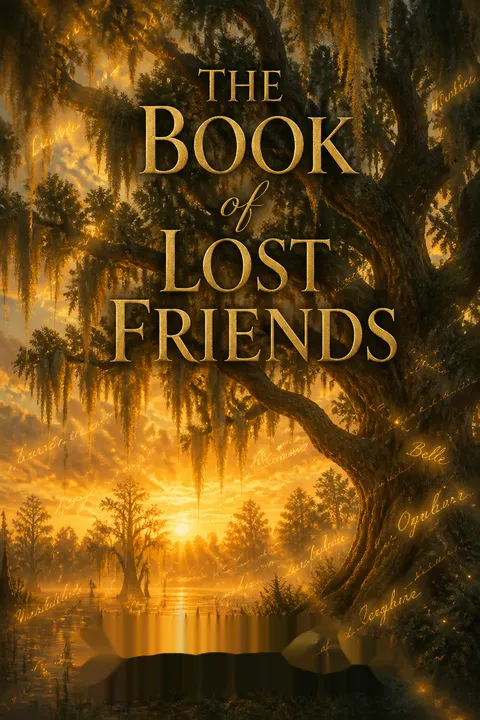

Plot Summary
Lost and Stolen Names
In 1875 Louisiana, Hannie Gossett, once enslaved, is haunted by the memory of her family being torn apart—siblings and cousins sold away, her mother's promise to reunite them echoing in her dreams. The trauma of separation shapes Hannie's adulthood, as she clings to three blue beads, a symbol of her lost kin. Meanwhile, in 1987, Benedetta "Benny" Silva, a new teacher in Augustine, Louisiana, struggles to connect with her students, many of whom are descendants of those who lived and worked on the same land. Both women, separated by a century, are linked by the pain of lost names and the hope of finding family.
Letters Across Generations
After emancipation, formerly enslaved people placed "Lost Friends" ads in newspapers, seeking any word of family members sold away. Hannie learns of these ads and the hope they offer. In the present, Benny discovers the same ads while researching local history, realizing their power to connect generations. Both women are driven by the need to know: Are my people out there, somewhere? The act of writing and reading these letters becomes a lifeline, a way to resist the final death—being forgotten.
Secrets Beneath the Grand House
Hannie, disguised as a boy, sneaks into the Gossett plantation's Grand House, uncovering secrets about the family's inheritance and the fate of her people. She witnesses the rivalry between Lavinia, the white daughter, and Juneau Jane, the mixed-race daughter, both vying for their father's legacy. In the present, Benny rents a house on former plantation land and discovers a vast, neglected library in the abandoned mansion. She senses that the stories of the past are buried beneath layers of silence and shame, waiting to be unearthed.
Divided by Blood, Bound by Hope
Hannie is drawn into the schemes of Lavinia and Juneau Jane, who are forced to work together despite their mutual resentment. Their journey to find their missing father and secure their futures is fraught with danger, betrayal, and the ever-present threat of violence. Hannie, though not family by blood, becomes their protector and conscience. In the present, Benny's attempts to bridge racial and class divides in her classroom mirror the struggles of the past, as she encourages her students to share their own stories and histories.
The Road to Reunion
The trio—Hannie, Lavinia, and Juneau Jane—embark on a dangerous trip across Louisiana and Texas, searching for answers about the Gossett inheritance and the fate of their loved ones. Along the way, they encounter violence, deception, and the lingering scars of slavery. Hannie's determination to find her family is tested by the harsh realities of the postwar South. In the present, Benny faces her own obstacles: poverty, apathy, and resistance from the community as she tries to inspire her students.
Lessons in the Present
Benny's classroom is chaotic, her students hungry in body and spirit. She learns that many are more concerned with survival than literature. Through small acts of kindness—snack cakes, listening, and respect—she begins to earn their trust. She discovers that the stories of the past, especially those of lost families, resonate with her students' own experiences of absence and longing. The act of teaching becomes an act of hope, a way to keep names and stories alive.
The Book of Lost Friends
Hannie and Juneau Jane begin to collect the names and stories of those searching for lost family, creating their own "Book of Lost Friends." This book becomes a symbol of resistance against erasure, a testament to the enduring bonds of kinship. In the present, Benny and her students uncover the same book, hidden in the plantation library, and realize its significance. The book bridges the gap between past and present, black and white, loss and hope.
Searching for Family
Hannie's quest takes her across rivers, through swamps, and into the heart of Texas, where she encounters both cruelty and unexpected kindness. She is aided by unlikely allies—Gus, a white boy with his own scars, and Elam Salter, a Black lawman. Each character is searching for something: family, justice, belonging. In the present, Benny's students begin their own searches, tracing their family histories and discovering connections they never imagined.
The Weight of History
The legacy of slavery, violence, and betrayal weighs heavily on both timelines. Hannie confronts the reality that the people who owned her family are also, in some ways, her kin. The plantation's tangled bloodlines complicate questions of loyalty and justice. In the present, Benny faces resistance from the town's white elite, who want to keep the past buried. She learns that history is not just dates and facts, but living wounds and unresolved debts.
Uncovering the Past
Benny and her students, with the help of elders like Granny T and Sarge, piece together the hidden history of Augustine. They discover that the land they live on is layered with unmarked graves, forgotten names, and stories of resilience. The unsealing of a time capsule and the discovery of the Book of Lost Friends bring the past into the present, forcing the community to confront its history and reckon with its consequences.
The Power of Story
Both Hannie and Benny come to understand that telling the truth about the past is an act of healing. The stories of lost friends and found family become a source of strength, not shame. In the present, Benny's students stage a living history pageant, giving voice to those who were silenced. The act of speaking names aloud becomes a form of resurrection, ensuring that the dead are not forgotten.
Risk and Redemption
Hannie risks everything to save Lavinia and Juneau Jane, facing down the men who destroyed her family. She finds redemption not only for herself, but for those she loves. In the present, Benny risks her job and reputation to defend her students' right to know their history. Both women learn that the most important endeavors require risk, and that redemption is possible when we refuse to let go of hope.
The Final Gathering
Hannie's journey ends with a miraculous reunion—she finds her lost cousin Mary Angel and, through the Book of Lost Friends, helps others find their kin. The tangled threads of the Gossett family are finally unraveled, and justice, though imperfect, is served. In the present, Benny's students gather for the unveiling of the time capsule, their stories now part of the community's official history. The act of gathering—of coming together across lines of race, class, and time—is itself a victory.
The Legacy Unsealed
The unsealing of the library's time capsule reveals the Book of Lost Friends and the stories of those who built the community. The legacy of Hannie, Juneau Jane, and their descendants is finally acknowledged. Benny and Nathan, the last Gossett heir, commit to preserving the library and the stories it holds. The past is no longer hidden, but embraced as a source of wisdom and warning.
Speaking the Names
At a public festival, Benny's students recite the Lost Friends ads, speaking the names of those who were lost and found. The act of naming becomes a form of resistance against oblivion. Benny reflects on her own lost child, understanding that to speak a name is to keep a person alive in memory. The community, once divided, begins to heal through the power of shared story.
The Ties That Remain
Both timelines end with the affirmation that family is not just blood, but those who choose to love and remember each other. Hannie, once alone, is embraced by her people. Benny, once an outsider, finds belonging among her students and colleagues. The ties that remain are those forged by courage, compassion, and the willingness to seek the lost.
The Courage to Seek
The story closes with a call to action: to seek out the lost, to tell the stories that matter, to risk vulnerability for the sake of connection. Hannie's and Benny's journeys remind us that the search for family—literal or metaphorical—is never in vain. The courage to seek is itself a form of victory.
Finding Home
In the end, both women find home—not just a place, but a community of memory and meaning. The Book of Lost Friends, once a record of longing, becomes a testament to the power of hope. The names within it are no longer lost, but found, spoken, and cherished. The story ends with the promise that as long as we remember, no one is truly gone.
Analysis
The Book of Lost Friends is a sweeping, emotionally charged novel that explores the enduring impact of slavery, the search for family, and the power of storytelling to heal and transform. By weaving together the journeys of Hannie in 1875 and Benny in 1987, Lisa Wingate demonstrates how the wounds of the past persist in the present, shaping identities, relationships, and communities. The novel's central lesson is that history is not merely a record of what has been, but a living force that demands engagement, honesty, and courage. Through the motif of the "Lost Friends" ads and the creation of the Book of Lost Friends, the story insists that every name matters, every story deserves to be told, and that the act of remembrance is itself an act of resistance against erasure. The novel challenges readers to confront uncomfortable truths, to seek out the lost, and to risk vulnerability for the sake of connection. Ultimately, it offers hope: that through the telling and hearing of stories, we can find home, forge new ties, and ensure that no one is truly lost as long as their name is spoken.
Review Summary
The Book of Lost Friends by Lisa Wingate receives largely positive reviews (4.15/5 stars). Readers praise the dual timeline narrative connecting 1875 Louisiana with 1987, exploring freed slaves searching for separated families through newspaper ads. Many appreciate the historical authenticity and emotional depth, though several note a slow beginning that improves significantly. The inclusion of actual "Lost Friends" advertisements deeply moves readers. Some criticism focuses on pacing issues, disconnected narratives, and concerns about a white author portraying Black perspectives. Overall, fans of historical fiction find it compelling and educational.
People Also Read




Characters
Hannie Gossett
Hannie is the heart of the historical narrative—a young Black woman whose family was shattered by slavery. Her journey is one of loss, resilience, and relentless hope. Marked by trauma but driven by the memory of her mother's promise, Hannie becomes both protector and chronicler, collecting the names of the lost and helping others search for family. Her psychological depth lies in her struggle with identity, belonging, and the tension between bitterness and mercy. Over time, Hannie transforms from a girl defined by what was taken from her into a woman who claims her own story and helps others do the same.
Benedetta "Benny" Silva
Benny is a young, idealistic teacher in 1987 Louisiana, struggling to connect with her students and the insular community. Haunted by her own family wounds and a secret past, she finds purpose in uncovering the stories of the land and its people. Benny's psychoanalysis reveals a deep need for belonging and redemption, both for herself and her students. Through her efforts to revive the local library and stage a living history project, she becomes a catalyst for healing, learning to risk vulnerability and embrace the messy, beautiful work of remembrance.
Juneau Jane LaPlanche
The mixed-race daughter of William Gossett, Juneau Jane is caught between worlds—never fully accepted by her white family or the Black community. Educated, proud, and fiercely intelligent, she is both rival and ally to Hannie and Lavinia. Her journey is one of self-assertion, as she fights for her rightful inheritance and her place in the world. Juneau Jane's psychological complexity lies in her struggle with identity, loyalty, and the burden of being both privileged and marginalized.
Lavinia Gossett
The white daughter of William Gossett, Lavinia is spoiled, manipulative, and initially cruel, especially to Hannie and Juneau Jane. Her psychological wounds run deep—she is a product of her environment, shaped by her mother's bitterness and her father's absence. Over the course of the journey, Lavinia's mind unravels, and she becomes a figure of pity rather than scorn. Her fate is a stark reminder of the costs of hatred and the fragility of privilege.
Elam Salter
A Black deputy U.S. marshal, Elam is both a figure of authority and a survivor of slavery. He aids Hannie and her companions, risking his life to protect them from the violence of the Marston Men. Elam's presence is a beacon of possibility—a man who has claimed his freedom and forged a new identity. His relationship with Hannie is marked by mutual respect, unspoken longing, and the shared scars of the past.
Gus McKlatchy
A poor white boy with a rough past, Gus becomes Hannie's companion on the journey west. Despite their differences, they form a bond rooted in shared loss and the search for belonging. Gus's humor and resourcefulness provide relief amid hardship, and his loyalty to Hannie is unwavering. He represents the possibility of friendship across lines of race and class, even in a divided world.
Granny T (Margaret Turner)
In the present, Granny T is a living link to the past—a woman whose family history stretches back to slavery and the founding of the local library. Wise, tough, and nurturing, she guides Benny and the students, sharing stories that bridge generations. Her psychological strength lies in her ability to hold pain and hope together, modeling resilience and pride for the next generation.
LaJuna Carter
A student in Benny's class, LaJuna is tough, guarded, and fiercely independent. Her family struggles mirror those of Hannie's era—poverty, instability, and the longing for connection. Through her involvement in the history project, LaJuna discovers her own roots and the power of naming and remembering. Her development is a testament to the enduring impact of history on the present.
Nathan Gossett
The last Gossett heir, Nathan is burdened by the legacy of his family's past. Raised away from Louisiana, he returns to find himself responsible for the Grand House and its secrets. His relationship with Benny is marked by mutual attraction, shared wounds, and the challenge of reconciling history with the present. Nathan's journey is one of acceptance—of his family, his community, and his own role in shaping the future.
Sarge (Donna Alston)
Sarge is LaJuna's aunt, a tough, no-nonsense woman who has seen the world and returned to care for her family. She provides practical support and emotional grounding for Benny and the students. Sarge's psychological insight and refusal to sugarcoat reality make her a vital bridge between past and present, tradition and change.
Plot Devices
Dual Timeline Structure
The novel alternates between Hannie's 1875 journey and Benny's 1987 experiences, allowing the reader to see how the legacy of slavery, loss, and resilience echoes across generations. This structure creates suspense, deepens emotional impact, and highlights the ways in which history is never truly past.
The "Lost Friends" Ads
The inclusion of actual "Lost Friends" newspaper ads grounds the story in historical reality and provides a powerful motif of longing and hope. These ads serve as both plot device and symbol, connecting characters across time and driving the search for family.
The Book of Lost Friends
The creation, preservation, and eventual discovery of the Book of Lost Friends ties the two timelines together. It is both a literal record of names and a metaphor for the act of remembrance. The book's journey—from Hannie's hands to the library's time capsule—mirrors the characters' journeys toward healing.
Hidden Inheritance and Family Secrets
The search for the Gossett inheritance, the tangled bloodlines, and the secrets buried in the Grand House drive much of the plot. These mysteries create tension and force characters to confront uncomfortable truths about themselves and their community.
Living History and Storytelling
In the present, Benny's students stage a living history pageant, embodying the stories of the past. This device allows for the dramatization of history, the reclamation of silenced voices, and the forging of new connections. Storytelling becomes both a means of survival and a tool for change.
Foreshadowing and Symbolism
The three blue beads, the family Bible, the time capsule, and the recurring image of the ladybug all serve as symbols of hope, memory, and the fragility of life. Foreshadowing is used to build suspense and to suggest that the past will inevitably surface, demanding to be reckoned with.

Download PDF
Download EPUB
.epub digital book format is ideal for reading ebooks on phones, tablets, and e-readers.








































