

Key Takeaways
Master one true duel and you master ten thousand
Scale is fractal in strategy. Musashi, who claims to have won over sixty duels between ages thirteen and twenty-nine, insists that the spirit of defeating one man is identical to the spirit of defeating ten million. If you learn to read timing, distance, and spirit against a single opponent, you possess the same craft a general uses to move armies. He compares this to a sculptor building a giant Buddha from a one-foot model.
One thing contains ten thousand things. This is his recurring refrain. The swordsman who trains alone with a blade can still learn to defeat armies, because principles do not change with scale, only their visible size. What is big is easy to see; what is small is hard to see. Learn the small, and the large becomes readable.
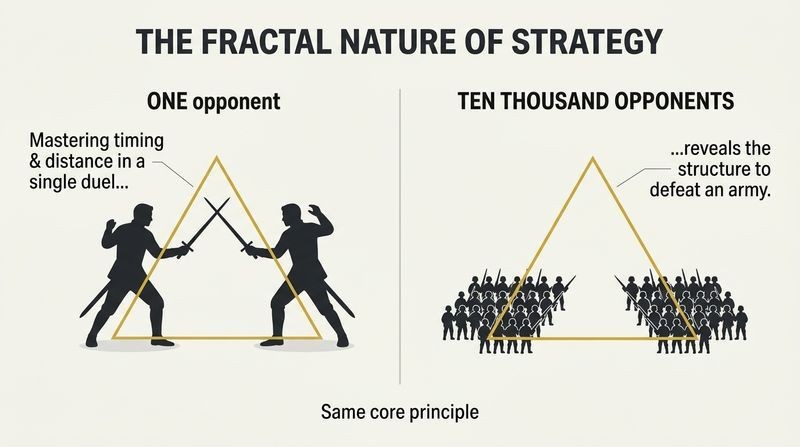
What's striking is how modern this feels. Systems theorists call it self-similarity, and fractal geometry formalized the same intuition centuries later: patterns repeating across scales. Business strategists borrow Musashi precisely here, arguing that how a person handles a single negotiation mirrors how a firm handles a market. The claim has limits, though. Command at scale introduces coordination, logistics, and communication problems that no solo duel teaches, which is why Clausewitz stressed friction. Musashi's genius is psychological rather than logistical: he saw that reading an opponent's intention is the invariant core, whether the opponent is one blade or one army.
Make your fighting stance and your everyday stance identical
No special combat mode. Musashi insists your spirit in battle should be no different from your spirit walking down the street. Meet danger determined yet calm, settled yet unbiased, neither over-spirited nor under-spirited. An elevated spirit is weak; a depressed spirit is weak. Do not let your body sway your mind, nor your mind sway your body.
Collapse the training-life divide. He applies this to posture, footwork, and gaze. Walk in a fight exactly as you walk normally: no jumping-foot, no floating-foot, no theatrical stances. Keep the head erect, eyes slightly narrowed, the same broad gaze you use daily. The goal is that combat requires no switch to flip, because you have already trained your ordinary existence to be combat-ready. Training is not separate from living.
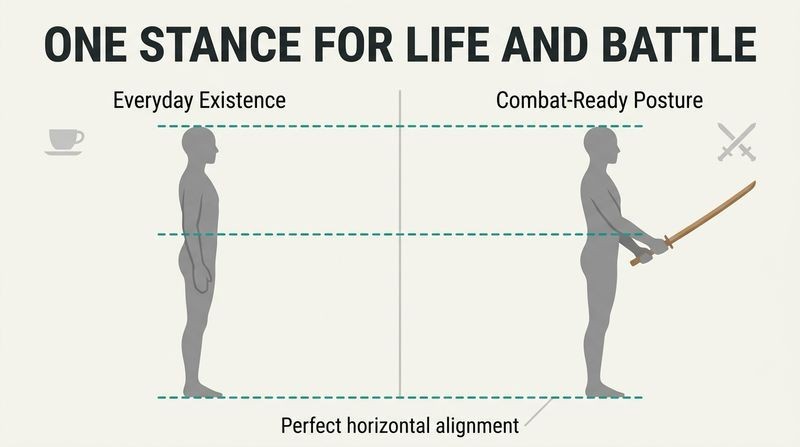
This anticipates what psychologists call state-dependent performance and what athletes now chase as flow: the erasure of the gap between practice and performance. Musashi's rejection of a special combat mode aligns with modern findings that adrenaline-fueled state changes degrade fine motor control under pressure. The samurai who has made calm his baseline does not spike. There is a Stoic parallel too: Seneca urged rehearsing hardship until crisis feels ordinary. The deeper move is ethical, not tactical. By refusing a divide between fighting and living, Musashi makes strategy a total discipline of character rather than a set of tricks pulled out in emergencies.
Never fall in love with a favorite weapon or technique
Preference is a weakness. Musashi warns that becoming over-familiar with one weapon is as much a fault as not knowing it well enough. Commanders and troopers alike should have no likes and dislikes. He catalogs weapons coldly by fitness for context: the bow excels at a battle's opening but fails beyond forty yards; the gun dominates before ranks clash but is useless once swords cross; the halberd is defensive while the spear takes initiative; the companion sword shines in confined spaces.
Fit the tool to the situation. Weapons should be sturdy rather than decorative. Do not copy others; use what you can actually handle. The whole Ichi school is built on carrying two swords precisely so you are never trapped by a single option. Flexibility, not attachment, wins.
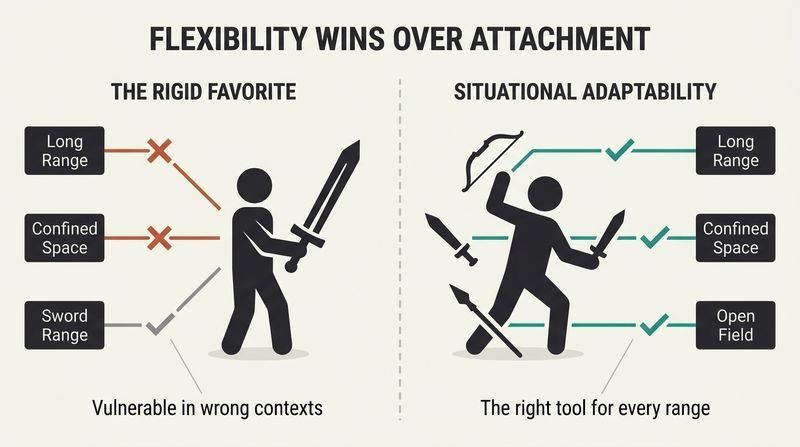
This is a manifesto against what cognitive scientists call the law of the instrument, Maslow's hammer: give someone a favorite tool and every problem starts looking like a nail. Musashi's insistence on emotional neutrality toward equipment mirrors modern decision theory's warning against sunk-cost and identity-based commitments. Traders who marry a position, engineers who force a beloved framework onto every project, generals who refight the last war all suffer his diagnosed disease. The subtle point is that a favorite weapon narrows perception itself: you stop seeing the situation clearly because you are already reaching for the familiar. Detachment is not coldness here; it is clarity.
Seize the initiative through three ways to forestall an enemy
Take the lead, always. Musashi identifies exactly three methods of forestalling, which he considers among the most important things in all of strategy:
1. Ken No Sen: attacking first, charging in to set the terms.
2. Tai No Sen: forestalling him as he attacks, feigning weakness then striking when he relaxes.
3. Tai Tai No Sen: forestalling together, joining his movement as you both advance and defeating him inside it.
Winning means leading. Even when you let the enemy strike first, you lead him around rather than react passively. He captures this with the image of holding down a pillow: stop the enemy's action at its first syllable, checking his cut at cu, his jump at ju. Suppress useful moves, permit useless ones. You have effectively already won the moment you control initiative.
Musashi's three sen map neatly onto modern concepts of the OODA loop developed by fighter pilot John Boyd: whoever observes, orients, decides, and acts faster gets inside the opponent's decision cycle and paralyzes them. Holding down the pillow is precisely disrupting an enemy's orientation before action crystallizes. Boxing, chess, and startup competition all reward this preemption. One nuance worth flagging: pure aggression can be predictable, and Musashi knows it, which is why he includes the receptive Tai No Sen. The mastery is not always striking first but always controlling tempo. Reactivity is the true enemy, not defense per se.
Beat theatrical technique by aiming only at cutting the enemy
The nut has become less than the flower. Musashi's central complaint against rival schools is that they sell flourish over function. Teachers and students obsess over beautiful attitudes, elaborate footwork, extra-long swords, and secret inner teachings, all to attract paying pupils. They color and decorate their technique like merchants growing flowers to sell. This, he says, is why the true Way is dying.
Intend the kill, not the move. In his school, whenever you parry, spring, strike, or touch the enemy's blade, you must be cutting him in the same motion. If you think only of hitting or blocking, you will never actually cut. Purpose subordinates form. There is no interior and surface, no secret gate: only keeping your spirit true to the practical aim of winning.
This is a devastating critique of credentialism and performance for its own sake, and it echoes across domains. Academia's citation games, corporate theater of busyness, martial arts belt-collecting: all substitute visible signaling for real capability. Nassim Taleb's distinction between having skin in the game and merely looking competent is the same blade. Musashi earned his authority in sixty lethal duels, not in a dojo. The philosophical core is teleological: every action must serve its true end, or it becomes decoration. There is a risk, though. Ruthless functionalism can miss how ritual and form transmit knowledge across generations, which is arguably why his own school needed a book.
Fight on terrain that traps the enemy and frees you
Examine your environment first. Musashi is relentlessly practical about place. Position the sun behind you, or at least on your right. Keep your rear unobstructed and space open on your left. At night, put fires behind you. Take slightly higher ground and look down on the enemy.
Herd him into bad ground. Once fighting, chase the enemy toward awkward places: thresholds, pillars, poor footing, obstacles. Keep him with his back to trouble and never let him see or reorient to his own situation. He calls the decisive commitment across such terrain crossing at a ford, meaning launching only when wind, route, and the soundness of your vessel all align, then attacking the enemy's weak point from advantage. Terrain is not backdrop; it is a weapon you wield before the first cut.
Environmental leverage is the oldest principle in strategy and the most neglected in daily life. Sun Tzu built his treatise on it; behavioral scientists rediscovered it as choice architecture, the idea that context shapes outcomes more than willpower. Musashi's ford metaphor is quietly sophisticated: it distinguishes reckless boldness from calibrated boldness that waits for converging conditions. Entrepreneurs call this timing the market. The insight generalizes brutally: most contests are decided by positioning before engagement, not by effort during it. What looks like superior skill in the clash is often superior setup beforehand. Win the ground, and the fight becomes a formality.
When rhythm breaks, chase collapse and cut utterly
Everything collapses when rhythm deranges. Houses, bodies, and armies all fall apart the moment their timing goes wrong. Musashi's instruction is merciless: the instant you sense the enemy's rhythm breaking, pursue without pause and cut him down so thoroughly he cannot recover. Hesitate, and he regains composure and grows more careful.
Read and manipulate timing. He layers many timing techniques: passing on your calm to relax a frantic enemy (like a yawn spreading), causing loss of balance through danger or surprise, confusing his spirit so he wonders here or there, fast or slow. When two forces deadlock in equal spirit, a four hands stalemate, abandon that approach entirely and renew with an unexpected technique. And never repeat a failed move a third time: if he expects mountains, become the sea.
The obsession with rhythm prefigures modern performance science on momentum and tempo. Sports analytics confirm that runs and collapses are real psychological cascades, not just superstition; once a team's timing breaks, error compounds error. Musashi's refusal to let a beaten enemy recover is echoed in military doctrine on pursuit, where more casualties historically occur during retreat than in the battle proper. The contagion techniques, passing on calm or boredom, anticipate research on emotional contagion and mirror neurons. The one caution: relentless pursuit assumes you correctly read collapse. Mistaking a feint for a genuine break is how aggressive fighters get counterattacked. Reading precedes chasing.
Think yourself into the enemy's mind to defeat him
Become the enemy. Musashi urges you to occupy your opponent's position. People imagine a cornered robber as a fortified threat, but if you become him, you feel the whole world closing in with no escape. The trapped man is a pheasant; the one entering to seize him is a hawk. Reframing reveals the enemy is usually weaker and more frightened than he appears.
Command him as your own troops. In his phrase the commander knows the troops, Musashi says to treat the enemy as if he were your own soldiers, which lets you move him at will and chase him around. He warns against the opposite error too: if you tell yourself here is a true master who knows strategy, you have already lost. Overestimating opponents breeds the caution that defeats you.
This is theory of mind weaponized. Musashi arrives at what game theorists formalize as recursive reasoning, modeling what the other side models, and what negotiators call tactical empathy, understanding an adversary's fears precisely in order to move them. The pheasant-and-hawk reframe is a cognitive reappraisal technique modern therapists would recognize: the same situation flips from threatening to advantageous by shifting vantage point. His warning against overestimation is equally shrewd, echoing the well-documented tendency of underdogs to psych themselves out. The subtle ethics here differ from empathy as compassion; this is empathy as penetration, understanding another's interior solely to exploit it. Cold, effective, and psychologically acute.
Absorb strategy into your body until it needs no thought
Do not just read or imitate. Musashi repeatedly insists the Way cannot be gained from words. You must absorb principles into your body through relentless practice, morning and evening, until they arise naturally. He rejects fixing your eyes on the enemy's sword or hands, comparing it to how skilled footballers do not stare at the ball and master musicians do not fix on the score; mastery means seeing naturally. Fixedness in the hand is a dead hand; pliability is a living hand.
Walk the thousand-mile road step by step. His famous formulation of progress: today is victory over yourself of yesterday, tomorrow your victory over lesser men. Genuine speed is not haste; the true master never appears rushed or busy, because rhythm, not velocity, wins. Deliberate, embodied, lifelong practice is the only path.
Musashi describes what psychologists now call automaticity and what Dreyfus brothers modeled as the stages from novice to expert, where the master no longer follows rules consciously but perceives situations holistically. His football and music analogies precede by centuries the research on expert gaze patterns showing that elites fixate less and see more peripherally. His attack on speed is profound and counterintuitive in a culture worshipping fast: he intuits that true expertise looks unhurried because it eliminates wasted motion, a finding confirmed in studies of elite performers who are measurably more efficient, not more frantic. Victory over yesterday's self is arguably the healthiest competitive frame ever articulated.
Reach the Void by mastering everything, not by knowing nothing
The Void is clarity, not ignorance. Musashi ends with his most philosophical book, the Void, and immediately corrects a misunderstanding: people assume that whatever they cannot comprehend must be the void, but that is mere bewilderment, not the true void. The genuine Void is reached only by studying fully, accumulating practice day by day, polishing both heart and mind, and sharpening both perception and sight until no cloud of confusion remains.
By knowing what exists, know what does not. Only after total mastery does action become natural and spontaneous, striking the enemy without deliberate intention, moving in harmony with the rhythm of nature itself. In the Void, he says, there is virtue and no evil; wisdom, principle, and the Way have existence, while the striving spirit dissolves into nothingness. Mastery precedes emptiness.
This is the crucial corrective to lazy readings of Zen-flavored strategy. Musashi's Void is not the beginner's blank mind but the expert's, what jazz musicians reach only after ten thousand hours, when improvisation flows because the scaffolding has been internalized and discarded. It parallels the Zen ox-herding pictures, where enlightenment arrives after, not instead of, disciplined effort. The distinction he draws between bewilderment and true emptiness is philosophically vital and often lost in pop appropriations of Eastern thought. Effortlessness is earned. The danger he implicitly warns against is romanticizing spontaneity without the decades of grinding practice that alone make spontaneity trustworthy rather than reckless.
Analysis
The Book of Five Rings is a treatise on strategy dictated in 1645 by Miyamoto Musashi, Japan's most storied swordsman, from a cave where he had retreated near the end of his life. Structured as five books named for the classical elements (Ground, Water, Fire, Wind, Void), it is simultaneously a manual for individual swordsmanship, a doctrine of army command, and a philosophy of life. Its difficulty for a summarizer lies in its deliberate opacity: Musashi repeatedly insists the Way cannot be transmitted in words, larding the text with oral-tradition placeholders and refusing to explain his most important techniques, trusting embodied practice to complete what language cannot. What survives translation is a coherent worldview.
Several principles unify the sprawl. First, scale-invariance: the same craft governs a duel and a war, so mastery of one thing yields ten thousand. Second, the collapse of the training-life boundary: combat readiness is not a mode you enter but a character you become. Third, ruthless functionalism: every movement must serve the aim of cutting the enemy, and any decoration, preference, or theatrical technique that does not is a fatal weakness. Fourth, the primacy of initiative and timing over speed and strength. Fifth, the psychological penetration of the opponent, becoming him to command him.
What makes the work endure beyond martial arts is its transferability. Business strategists, athletes, and negotiators mine it because its subject is really the structure of any adversarial contest and, more deeply, the cultivation of an undivided self. Its shadow side deserves honesty: this is a philosophy forged to kill, indifferent to the enemy's humanity, and its coldness can be mistaken for wisdom detached from ethics. Yet its insistence that emptiness is earned through total mastery, not claimed as a shortcut, rescues it from the mysticism that lesser imitators peddle. Victory over yesterday's self remains its finest gift.
Review Summary
The Book of Five Rings is widely praised as a classic on strategy, with insights applicable beyond martial arts. Readers appreciate its practical wisdom, Zen philosophy, and timeless principles. Many find value in Musashi's emphasis on mastery, adaptability, and self-control. Some struggle with the archaic language and specific sword-fighting references. While not universally accessible, the book is considered essential reading for those interested in Japanese culture, martial arts, and strategic thinking. Its enduring popularity stems from its blend of practical advice and philosophical depth.
People Also Read






FAQ
What's "The Book of Five Rings" about?
- Author and Background: Written by Miyamoto Musashi, a legendary Japanese samurai, the book is a treatise on strategy, tactics, and philosophy. Musashi was known for his undefeated record in his 60 duels.
- Content Overview: The book is divided into five sections, each named after an element: Ground, Water, Fire, Wind, and Void. Each section explores different aspects of strategy and martial arts.
- Purpose: Musashi wrote this book to explain his unique style of swordsmanship and strategy, known as the Hyōhō Niten Ichi-ryū, which emphasizes adaptability and understanding the opponent.
Why should I read "The Book of Five Rings"?
- Timeless Wisdom: The book offers insights into strategy and philosophy that are applicable beyond martial arts, including business and personal development.
- Unique Perspective: Musashi's experiences as a samurai provide a unique perspective on discipline, focus, and the art of combat.
- Practical Advice: The book is filled with practical advice on how to approach challenges, understand opponents, and achieve victory in various aspects of life.
What are the key takeaways of "The Book of Five Rings"?
- Adaptability: Musashi emphasizes the importance of being adaptable and flexible in strategy, rather than relying on fixed techniques.
- Understanding Opponents: Knowing your opponent's strengths and weaknesses is crucial for success, whether in combat or other competitive fields.
- Continuous Learning: The book advocates for lifelong learning and constant practice to refine one's skills and understanding of strategy.
What is the significance of the five books in "The Book of Five Rings"?
- Ground Book: Focuses on the basics of strategy and the importance of a solid foundation in any endeavor.
- Water Book: Emphasizes adaptability and fluidity, likening strategy to the nature of water, which takes the shape of its container.
- Fire Book: Discusses the intensity and directness required in combat, highlighting the need for decisive action.
- Wind Book: Examines the strategies of other schools, encouraging readers to learn from others while developing their own unique approach.
- Void Book: Explores the concept of the void, representing the ultimate understanding and mastery of strategy beyond physical techniques.
How does Musashi define "The Way of Strategy"?
- Craft of the Warrior: Strategy is seen as the craft of the warrior, essential for both commanders and troopers.
- Twofold Way: Musashi describes the warrior's path as the twofold way of pen and sword, emphasizing the need for both intellectual and physical mastery.
- Victory and Fame: The ultimate goal of strategy is to achieve victory and gain power and fame for oneself or one's lord.
What is the "Nito Ichi Ryu" style mentioned in "The Book of Five Rings"?
- Two Swords: "Nito Ichi Ryu" translates to "Two Heavens, One School," and involves the use of both a long sword and a companion sword.
- Flexibility: This style allows for greater flexibility and adaptability in combat, enabling the warrior to handle various situations effectively.
- Training Method: Musashi advises training with two swords from the start to develop proficiency and confidence in using both weapons.
What are the "Five Attitudes" in Musashi's strategy?
- Upper, Middle, Lower: These attitudes refer to the positioning of the sword, each with a specific purpose in combat.
- Right and Left Side: These attitudes are more fluid and are used to adapt to the opponent's movements and the environment.
- Purpose: The primary purpose of these attitudes is to cut the enemy, with each attitude offering different tactical advantages.
How does Musashi compare strategy to carpentry?
- Master Plan: Just as a carpenter uses a master plan to build a house, a strategist must have a plan of campaign.
- Tools and Skills: Both carpenters and strategists must be proficient with their tools and skills, constantly honing their craft.
- Deployment: A foreman carpenter deploys his men according to their abilities, similar to how a commander must understand and utilize his troops effectively.
What is the "Attitude No-Attitude" teaching in "The Book of Five Rings"?
- No Fixed Attitudes: Musashi teaches that there should be no fixed attitudes in combat, as flexibility and adaptability are key.
- Existing and Nonexisting: The principle of "Existing Attitude - Nonexisting Attitude" emphasizes the need to adjust one's stance according to the situation.
- Intention to Cut: Regardless of the stance, the primary intention should always be to cut the enemy effectively.
What does Musashi mean by "Timing in Strategy"?
- Importance of Timing: Timing is crucial in all aspects of life, including strategy, as it determines the success of actions.
- Applicable and Inapplicable: Understanding the applicable and inapplicable timing helps in making strategic decisions.
- Training: Continuous training is necessary to develop an intuitive sense of timing, allowing for quick and effective responses.
What are some of the best quotes from "The Book of Five Rings" and what do they mean?
- "Do not think dishonestly.": This quote emphasizes the importance of honesty and integrity in strategy and life.
- "The Way is in training.": Musashi highlights the necessity of constant practice and dedication to mastering any skill.
- "Perceive those things which cannot be seen.": This encourages developing intuition and insight to understand deeper truths beyond the obvious.
How does "The Book of Five Rings" compare to other philosophical works like "The Art of War"?
- Focus on Individual Combat: While "The Art of War" by Sun Tzu focuses on large-scale military strategy, Musashi's work is more centered on individual combat and personal mastery.
- Philosophical Depth: Both books offer philosophical insights, but Musashi's work delves into the personal journey of a warrior, emphasizing self-discipline and personal growth.
- Practical Application: Both texts provide practical advice, but Musashi's teachings are more directly applicable to personal development and individual challenges.
About the Author
Other books by Miyamoto Musashi
Download PDF
Download EPUB
.epub digital book format is ideal for reading ebooks on phones, tablets, and e-readers.








































