
Key Takeaways
1. Black Swans are Unpredictable, High-Impact Events with Retrospective Explanations
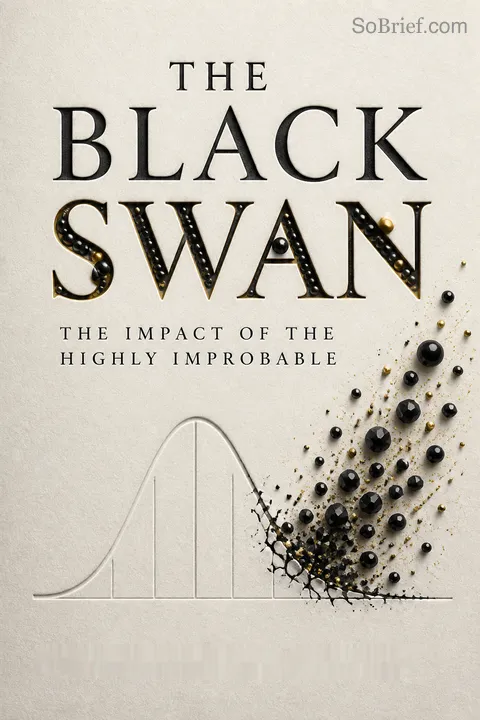
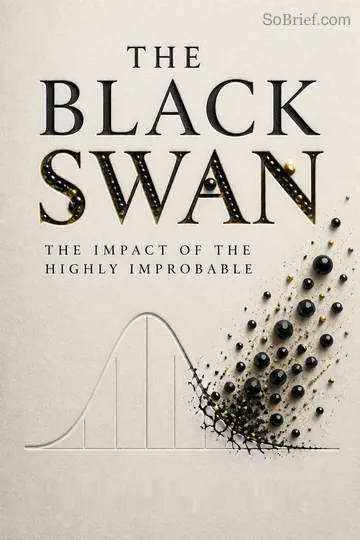
A BLACK SWAN is a highly improbable event with three principal characteristics: It is unpredictable; it carries a massive impact; and, after the fact, we concoct an explanation that makes it appear less random, and more predictable, than it was.
Defining the improbable. Black Swans are rare, unforeseen events that have profound consequences, yet are rationalized as predictable only after they occur. Examples like the astonishing success of Google or the devastating impact of 9/11 illustrate how these events reshape our world, defying prior expectations. Our human nature struggles to acknowledge their true randomness.
The illusion of understanding. After a Black Swan, our minds instinctively create coherent narratives, making the event seem less random and more explainable than it truly was. This retrospective distortion leads to a false sense of understanding, preventing us from learning about the inherent unpredictability of such occurrences. We become victims of our own need for logical coherence.
Impact on perception. This tendency to rationalize makes us focus on what we do know, ignoring the vast realm of what we don't. Consequently, we fail to genuinely estimate opportunities or risks, remaining vulnerable to simplification and categorization. This blindness to the "impossible" leaves us unprepared for the most significant shocks that shape history and our personal lives.
2. The World is Divided into Mediocristan and Extremistan
In Extremistan, inequalities are such that one single observation can disproportionately impact the aggregate, or the total.
Two types of randomness. The world operates under two distinct forms of randomness: Mediocristan and Extremistan. In Mediocristan, like human height or weight, individual observations do not significantly alter the overall average. Even the heaviest person would be a negligible fraction of a thousand people's total weight.
The tyranny of the singular. Extremistan, however, is characterized by extreme inequalities where a single event or individual can disproportionately influence the aggregate. Consider wealth: Bill Gates's net worth can dwarf the collective capital of a thousand average individuals. This scalable nature means that a few occurrences can have massive impacts, making the average less meaningful.
Social vs. physical. Most social and economic phenomena, such as book sales, company sizes, or financial market returns, belong to Extremistan. Unlike physical attributes, these informational quantities have no inherent upper bounds, allowing for "winner-take-all" effects and the emergence of Black Swans. Understanding this distinction is crucial for assessing risk and knowledge.
3. We Are Blinded by Narrative and Confirmation Biases
The narrative fallacy addresses our limited ability to look at sequences of facts without weaving an explanation into them, or, equivalently, forcing a logical link, an arrow of relationship, upon them.
The craving for stories. Our minds are wired to create narratives, simplifying complex sequences of facts into coherent stories, even if it means inventing causal links. This "narrative fallacy" distorts our perception of the world, making events appear more logical and predictable than they truly are. It's an ingrained biological need to reduce dimensionality, making information easier to store and retrieve.
Seeking confirmation. This narrative tendency is exacerbated by the "confirmation bias," where we actively seek out information that supports our existing beliefs and interpretations, while ignoring contradictory evidence. We readily find corroboration for our theories, whether it's about a person's innocence or a market trend, because we are predisposed to look for it. This makes us resistant to changing our minds, even in the face of new, more accurate information.
The cost of simplification. While narratives help us make sense of the world, they can be lethal when they lead to over-interpretation and a false sense of understanding, especially concerning rare events. This "dimension reduction" causes us to overlook the true randomness and complexity, making us vulnerable to Black Swans. It takes conscious effort to resist theorizing and to see facts without imposing premature explanations.
4. Silent Evidence Distorts Our Perception of Success and Risk
The drowned worshippers, being dead, would have a lot of trouble advertising their experiences from the bottom of the sea.
The unseen cemetery. History, and our understanding of success, is heavily skewed by "silent evidence." We tend to focus only on what survived or succeeded, ignoring the vast "cemetery" of failures. This "survivorship bias" leads to a distorted view of reality, making success seem more attributable to skill and less to luck than it actually is.
Skewed perceptions of talent. In fields with "winner-take-all" dynamics, like literature or acting, we celebrate a few "superstars" and attribute their success to unique talent. However, we fail to account for the countless equally talented individuals who never got a lucky break or whose works perished. This makes us overestimate the uniqueness of the successful and commit an injustice to the unseen failures.
The illusion of stability. Silent evidence also creates a "Teflon-style protection" for survivors, leading them to retrospectively underestimate the risks they faced. Just as a city that has recovered from disasters might believe itself "invincible," individuals or institutions that have survived Black Swans often attribute their resilience to internal properties rather than sheer luck. This bias encourages uninformed risk-taking, as the true dangers are hidden by the absence of those who didn't survive.
5. The Ludic Fallacy Leads Us to Misunderstand Real-World Uncertainty
The casino is the only human venture I know where the probabilities are known, Gaussian (i.e., bell-curve), and almost computable.
Games vs. reality. The "ludic fallacy" is the dangerous mistake of applying the sterilized, well-defined randomness of games (like dice or coin flips) to the messy, unpredictable uncertainty of real life. In games, rules are known, probabilities are computable, and outcomes are typically from Mediocristan. This is a laboratory contraption, not reality.
The uncertainty of the nerd. Many "experts," particularly in economics and finance, base their models on these game-like assumptions, believing they can precisely calculate risks. They ignore that in real life, the rules are often unknown, the sources of uncertainty are undefined, and the "step sizes" of random events can vary wildly. This "nerd knowledge" leads to a false sense of security and catastrophic miscalculations.
Ignoring true uncertainty. The casino example highlights this flaw: while casinos meticulously manage gambling risks, their largest losses often come from unforeseen "Black Swan" events outside their models, like a tiger attack or an employee's bizarre actions. These real-world risks are fundamentally different from the computable odds of a roulette wheel. Relying on game-based models for complex systems is an intellectual fraud that makes us vulnerable to the truly impactful unknown.
6. Prediction is Fundamentally Limited, Especially for Significant Events
Popper's central argument is that in order to predict historical events you need to predict technological innovation, itself fundamentally unpredictable.
The paradox of knowledge. We cannot predict future discoveries or innovations because if we knew them, they would already exist. This inherent limitation, highlighted by Karl Popper, means that any attempt to forecast historical events or technological advancements is fundamentally flawed. The future is not a mere extension of the past.
The three-body problem. Henri Poincaré demonstrated that even in seemingly simple physical systems, like three celestial bodies interacting, small initial errors compound rapidly, making long-term prediction impossible. Our world is far more complex, with countless interacting elements, making precise forecasting an illusion. The "butterfly effect" illustrates how tiny, unmeasurable changes can lead to massive, unpredictable outcomes.
Experts' poor track record. Empirical studies consistently show that "experts" in fields like economics, finance, and political science have a dismal prediction record, often performing no better than random chance or a simple naive forecast. They tend to be overconfident, rationalize their failures, and herd together in their predictions, avoiding outlandish but potentially accurate forecasts. This "scandal of prediction" reveals a deep-seated human and institutional flaw.
7. The Bell Curve is a Dangerous Intellectual Fraud in Extremistan
The main point of the Gaussian, as I've said, is that most observations hover around the mediocre, the average; the odds of a deviation decline faster and faster (exponentially) as you move away from the average.
Misleading normalcy. The Gaussian bell curve, or "normal distribution," is a "Great Intellectual Fraud" when applied to phenomena in Extremistan. It assumes that most observations cluster around the average, and that extreme deviations are exceedingly rare and inconsequential. This property, where probabilities drop exponentially as you move from the mean, allows us to safely ignore outliers in Mediocristan.
Ignoring the tails. However, in Extremistan, where wealth, market returns, or book sales reside, extreme events are not negligible; they disproportionately impact the total. The bell curve's comforting assumption of rapidly declining odds for extremes leads to massive underestimation of risk and opportunity. It's like using a tool designed for measuring pebbles to measure mountains.
The illusion of certainty. The bell curve's simplicity and the ease with which its parameters (like standard deviation) can be calculated make it appealing, but this convenience comes at a severe cost. It provides a false sense of certainty, masking the true "wild" randomness of many real-world variables. Relying on it for critical decisions, especially in finance, has led to catastrophic consequences, as seen with the failures of "Nobel-crowned" theories.
8. Embrace Asymmetry: Maximize Exposure to Positive Black Swans, Minimize Negative Ones
Put yourself in situations where favorable consequences are much larger than unfavorable ones.
The barbell strategy. Since precise prediction of Black Swans is impossible, the optimal strategy is to manage exposure to their consequences. This involves an "asymmetric" approach: being hyper-conservative with the majority of your resources (e.g., 85-90% in extremely safe investments like Treasury bills) and hyper-aggressive with a small, diversified portion (e.g., 10-15% in highly speculative, high-upside ventures). This creates a "convex" combination, limiting downside while offering unlimited upside.
Positive vs. negative contingencies. Distinguish between undertakings where unpredictability can be beneficial (positive Black Swans) and those where it causes harm (negative Black Swans). Industries like scientific research, venture capital, and some publishing segments thrive on positive Black Swans, where small losses are frequent but rare successes are massive. Conversely, banking or catastrophe insurance face predominantly negative Black Swans, where unexpected events lead to large losses.
Exploiting uncertainty. The goal is not to predict, but to position oneself to benefit from unpredictability. This means collecting "free non-lottery tickets" – opportunities with limited downside and open-ended upside. It requires a willingness to accept small, frequent failures as a necessary part of the process, knowing that a single large success can compensate for many small losses.
9. Focus on Preparedness, Not Prediction
Knowing that you cannot predict does not mean that you cannot benefit from unpredictability.
Beyond forecasting. Given the inherent limits to prediction, especially for consequential events, the focus should shift from trying to forecast to building robustness and adaptability. Instead of asking "what will happen?", ask "how can I prepare for a wide range of possible outcomes?". This mindset acknowledges our epistemic arrogance and future blindness.
Trial and error. Embrace a strategy of "stochastic tinkering" – continuous trial and error, learning from small failures, and seizing opportunities as they arise. This bottom-up, empirical approach is more effective than top-down planning based on flawed predictions. It requires a capacity for delayed gratification and resilience in the face of continuous small setbacks.
Cultivating serendipity. Maximize your exposure to positive accidents by being open-minded and actively seeking out unexpected opportunities. This means avoiding narrow-minded focus, engaging in diverse interactions, and being ready to pivot when unforeseen circumstances present themselves. The goal is to be prepared for the unknown, rather than trying to know the unknowable.
10. Mandelbrotian Fractals Offer a More Realistic View of Wild Randomness
Fractality is the repetition of geometric patterns at different scales, revealing smaller and smaller versions of themselves.
The geometry of nature. Unlike the pure, smooth shapes of Euclidean geometry, nature's geometry is often jagged and "fractal." Fractals exhibit "self-affinity," meaning that patterns repeat at different scales – a small part resembles the whole. This concept, pioneered by Benoît Mandelbrot, provides a more accurate way to describe the irregular, yet patterned, randomness found in many natural and social phenomena.
Scalable randomness. Mandelbrotian randomness, or "power laws," accounts for the persistence of inequality across scales. For instance, the distribution of wealth among the superrich might resemble that among the merely rich, just at a different magnitude. This "scale-invariance" means that extreme events are not exponentially rare, as the bell curve suggests, but rather follow a different, slower-declining probability distribution.
Turning Black Swans gray. While fractals don't allow for precise prediction of individual extreme events, they make the possibility of such large events conceivable. By understanding that phenomena like market crashes or megablockbuster successes are not "outliers" but inherent to a fractal distribution, we can turn some Black Swans into "Gray Swans." This awareness mitigates the surprise effect and allows for better risk management, even if exact timing remains elusive.
Review Summary
Reviews for The Black Swan are mixed. Many praise Taleb's insights on uncertainty and improbable events, finding the book thought-provoking and relevant. However, critics argue the writing is repetitive, arrogant, and unnecessarily complex. Some appreciate Taleb's irreverent style, while others find it off-putting. The book's core ideas about unpredictability and our inability to foresee major events are generally well-received, but the presentation and execution are contentious. Overall, readers seem to value the concepts but are divided on Taleb's delivery and personality.
People Also Read




FAQ
1. What is The Black Swan: The Impact of the Highly Improbable by Nassim Nicholas Taleb about?
- Central concept: The book explores the concept of "Black Swan" events—rare, unpredictable occurrences with massive impact that are rationalized after the fact.
- Challenge to prediction: Taleb argues that most significant events in history, finance, and personal life are shaped by these Black Swans, which traditional models fail to anticipate.
- Human limitations: The book highlights our cognitive biases and the limits of our knowledge, showing how we are often blind to the possibility and impact of such events.
- Critique of conventional wisdom: Taleb critiques the overreliance on statistical models, especially those based on the Gaussian bell curve, for underestimating the role of extreme events.
2. Why should I read The Black Swan by Nassim Nicholas Taleb?
- Understanding uncertainty: The book provides deep insights into the nature of randomness, uncertainty, and the limits of prediction, which are crucial in a world dominated by rare, high-impact events.
- Skepticism of experts: Taleb exposes the failures of experts and models, especially in finance and economics, encouraging readers to question overconfident predictions.
- Practical strategies: Readers gain actionable advice, such as the "barbell strategy," to protect themselves from negative Black Swans while seeking positive ones.
- Intellectual humility: The book encourages embracing epistemic humility, recognizing the limits of our knowledge, and preparing for the unexpected.
3. What are the key takeaways from The Black Swan by Nassim Nicholas Taleb?
- Black Swan events dominate: Rare, unpredictable events have a disproportionate impact on history, markets, and personal lives.
- Limits of prediction: Traditional forecasting methods, especially those using bell curves, are inadequate for dealing with real-world randomness.
- Cognitive biases: Humans are prone to narrative fallacies, confirmation bias, and overconfidence, which blind us to the role of randomness.
- Practical risk management: Taleb advocates for strategies that are robust to uncertainty, such as the barbell strategy, and for maximizing exposure to positive Black Swans.
4. What is the definition of a "Black Swan" event according to Nassim Nicholas Taleb?
- Three characteristics: A Black Swan is an event that is highly improbable, has a massive impact, and is rationalized in hindsight as if it were predictable.
- Examples: The rise of Google, the 9/11 attacks, and major financial crashes are cited as Black Swans.
- Unpredictability: These events lie outside regular expectations and cannot be forecasted using standard models.
- After-the-fact explanations: Humans tend to create stories to make these events seem less random and more predictable than they actually were.
5. How does Nassim Nicholas Taleb explain why humans fail to predict or acknowledge Black Swan events?
- Focus on known information: Humans are biologically inclined to focus on specifics and what they know, neglecting unknown possibilities.
- Narrative fallacy: We create coherent stories after the fact, making unpredictable events seem inevitable in hindsight.
- Simplification and platonicity: People mistake simplified models for reality, which blinds them to the complexity and randomness of the world.
- Confirmation bias: We seek evidence that supports our beliefs and ignore evidence to the contrary, reinforcing false confidence.
6. What is the difference between "Mediocristan" and "Extremistan" in The Black Swan by Nassim Nicholas Taleb?
- Mediocristan: This domain involves mild randomness, where individual events have limited impact and outcomes are predictable (e.g., human height).
- Extremistan: Here, wild randomness prevails, with rare events dominating outcomes (e.g., wealth, book sales, financial markets).
- Statistical implications: Mediocristan follows bell curve distributions, while Extremistan has "fat tails" and power laws, making averages unstable.
- Relevance: Most impactful real-world phenomena belong to Extremistan, where Black Swans are most likely to occur.
7. What is the "ludic fallacy" and why does Nassim Nicholas Taleb warn against it in The Black Swan?
- Definition: The ludic fallacy is the error of applying simplified, game-like models of randomness (like dice or roulette) to the complex uncertainty of real life.
- Known vs. unknown probabilities: Games have fixed rules and known odds, while real life involves unknown variables and unpredictable Black Swans.
- Consequences: This fallacy leads to overconfidence in models and underestimation of rare, impactful events, especially in finance and policy.
- Taleb’s critique: He urges skepticism toward neat probabilistic models, emphasizing the messiness and opacity of real-world randomness.
8. How does Nassim Nicholas Taleb describe the "problem of induction" in relation to Black Swans?
- The turkey problem: A turkey fed daily expects this to continue, but is slaughtered unexpectedly, illustrating the danger of assuming the future will resemble the past.
- False sense of security: Confidence grows with each confirming observation, even as risk increases, leading to vulnerability to surprise events.
- Historical examples: Long periods of stability, such as before wars or financial crashes, often precede Black Swans, showing the limits of inductive reasoning.
- Learning backward: Relying on past data can be misleading when rare, high-impact events are possible.
9. What are the "narrative fallacy" and "confirmation bias" in The Black Swan by Nassim Nicholas Taleb?
- Narrative fallacy: Humans have a psychological need to create coherent stories, linking facts causally and simplifying complex events.
- Post hoc rationalization: People often invent reasons for outcomes after the fact, making rare events seem more predictable than they are.
- Confirmation bias: We naturally seek evidence that supports our beliefs and ignore disconfirming information, leading to overconfidence.
- Impact on risk assessment: These biases distort our understanding of randomness and make us underestimate the likelihood of Black Swans.
10. What is the "problem of silent evidence" and how does it affect our understanding of history and success in The Black Swan?
- Invisible failures: We only see survivors and successes, while failures remain unseen, skewing our perception of causality and probability.
- Diagoras problem: Remembering only those who survived or succeeded leads to false beliefs about the effectiveness of actions or traits.
- Misleading success stories: Overrepresentation of winners (like Casanova or millionaires) makes us underestimate the role of luck and randomness.
- Implications: This bias leads to flawed conclusions about talent, skill, and the true drivers of success.
11. What practical advice and strategies does Nassim Nicholas Taleb offer in The Black Swan for dealing with uncertainty and benefiting from Black Swans?
- Barbell strategy: Combine extreme conservatism (safe assets) with aggressive risk-taking (high-reward bets) to protect against negative Black Swans and benefit from positive ones.
- Maximize exposure to positive Black Swans: Engage in scalable professions or activities where rare, high-impact successes are possible.
- Emphasize anti-knowledge: Focus on what you do not know and remain open to surprises, rather than relying solely on known information.
- Avoid naive prediction: Accept the unpredictability of extreme events and build robustness or antifragility into your strategies.
12. What are the best quotes from The Black Swan by Nassim Nicholas Taleb and what do they mean?
- "I had to invent my predecessors, so people take me seriously." — Mandelbrot’s strategy for gaining credibility, highlighting how recognition often depends on connecting ideas to established thought.
- "It makes them gray. Why gray? Because only the Gaussian give you certainties." — Fractal randomness can make some Black Swans conceivable (gray), but not fully predictable, unlike Gaussian models that falsely promise certainty.
- "In a world in which these two get the Nobel, anything can happen. Anyone can become president." — Taleb’s critique of the Nobel Committee for awarding flawed financial theories, illustrating the disconnect between academic recognition and practical reality.
- "The turkey problem": A metaphor for the dangers of induction, showing how past stability can lead to catastrophic surprises.
- "History jumps, it does not crawl": Emphasizes that major changes often come suddenly and unpredictably, not gradually as models suggest.
Incerto Series

About the Author
Other books by Nassim Nicholas Taleb


Download PDF
Download EPUB
.epub digital book format is ideal for reading ebooks on phones, tablets, and e-readers.








































