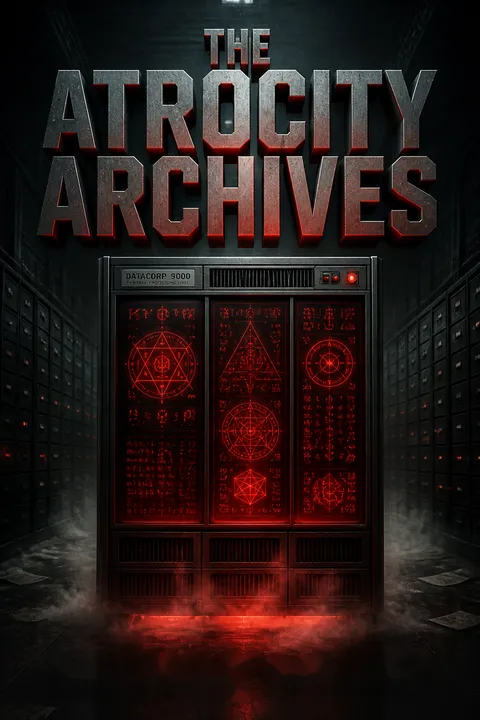

Plot Summary
Bureaucracy and Black Magic
Bob Howard, a computer geek and reluctant field agent for the Laundry—a secret British agency that polices occult threats—navigates a world where magic is real, but it's all about mathematics, paperwork, and bureaucracy. Bob's daily grind is a blend of IT support, soul-crushing meetings, and the ever-present threat of eldritch horrors. The Laundry's culture is a mix of civil service tedium and Cold War paranoia, where the greatest danger is not just the monsters outside, but the Kafkaesque machinery of the organization itself. Bob's longing for excitement is tempered by the reality that "active service" means freezing in the rain, breaking into offices, and cleaning up after magical disasters, all while dodging office politics and HR memos.
The Turing-Lovecraft Theorem
The Laundry's existence is rooted in the Turing-Lovecraft Theorem: Alan Turing's secret, never-published discovery that certain mathematical computations can breach the walls between universes, summoning entities from beyond. Magic is not wands and spells, but the dangerous manipulation of information and geometry. Bob learns that reality is thin, and the wrong equation can open doors best left closed. The agency's mission is to suppress dangerous knowledge, erase forbidden theorems, and keep the world blissfully ignorant of the cosmic horrors lurking in the mathematical shadows.
Nightmares in the Shrubbery
Bob's first taste of "active service" is a black-bag job: breaking into a tech company to erase a mathematician's dangerous research. The operation is a far cry from spy movie glamour—Bob is cold, wet, and wracked with guilt over destroying someone's life's work. The mission's success is measured in erased files and plausible deniability, not heroics. The Laundry's methods are revealed as ethically murky, and Bob's conscience is pricked by the realization that the agency's "cleaning" often means ruining innocent lives to prevent apocalyptic outcomes.
Summoning Gone Wrong
Sent to a compulsory occult training course, Bob witnesses a summoning demonstration go catastrophically wrong when a clueless trainee grounds the containment field. A non-sapient but deadly entity possesses the trainee, forcing Bob to act with brutal decisiveness—killing the possessed man with a fire extinguisher to save the rest. The incident leaves Bob traumatized, suspended pending inquiry, and haunted by the knowledge that in the Laundry, a moment's error can mean death or worse. The agency's cold, bureaucratic response to tragedy underscores the emotional toll of the work.
The Price of Knowledge
Bob's suspension is a period of introspection, guilt, and heavy drinking with his eccentric housemates, Pinky and Brains. The trauma of killing a colleague and the emotional fallout are only partially alleviated by black humor and geeky distractions. The Laundry's culture of gallows humor and emotional repression is both a coping mechanism and a symptom of deeper dysfunction. Bob's relationship with his ex, Mhari, is a source of further emotional turbulence, highlighting the personal costs of a life spent on the front lines of cosmic horror.
Possession and Consequence
The official inquiry into the training accident is a surreal, emotionally draining ordeal. Bob is forced to relive the event, justify his actions, and confront the reality that saving lives sometimes means taking them. The agency's internal politics and the ever-present threat of bureaucratic retribution add layers of stress. Ultimately, Bob is cleared and commended, but the experience leaves him changed—more aware of the thin line between heroism and horror, and the impossibility of remaining unscathed in the Laundry's service.
The Defector's Dilemma
Bob's first overseas assignment is to extract a British academic, Mo O'Brien, from the clutches of American occult agencies. The mission is complicated by the tangled web of alliances and rivalries between the UK, US, and other occult intelligence services. Mo's research into belief calculus has made her a strategic asset, and both sides are wary of letting her knowledge fall into the wrong hands. The operation is a dance of coded messages, clandestine meetings, and the ever-present risk of betrayal or abduction.
Crossroads of Espionage
The Santa Cruz mission spirals into chaos when Mo is kidnapped by a group with ties to Middle Eastern and Nazi occultists. Bob's attempts to rescue her are hampered by American surveillance, hostile operatives, and the realization that the Laundry's procedures are often inadequate in the field. The boundaries between friend and foe blur, and Bob is forced to improvise, relying on his wits and a handful of magical gadgets. The mission's outcome is ambiguous—Mo is extracted, but the true nature of the threat remains unclear.
The Atrocity Archive Unveiled
Back in the UK, Bob and Mo delve into the Atrocity Archive—a secret collection of Nazi occult research. They discover that the Ahnenerbe-SS attempted to weaponize mass murder as a means of opening gates to other universes, using computers and human sacrifice to power their rituals. The legacy of these experiments lingers, with rogue agents and cultists seeking to revive the old horrors. The Archive is a place of unspeakable artifacts and chilling revelations, forcing Bob and Mo to confront the depths of human and cosmic evil.
The Nazi Necromancer Legacy
The investigation reveals that the Nazi occultists' final act was a mass suicide, but their rituals left behind a residue—possessive entities and unfinished gates. The Mukhabarat and other modern actors are trying to exploit this legacy, seeking to harness the power of the old rituals for their own ends. Mo's unique expertise makes her a target, and Bob realizes that the past is never truly dead. The threat is not just historical, but ongoing—a festering wound in the fabric of reality.
The Gate to Nowhere
The pursuit of the Nazi legacy leads Bob and an SAS team through a gate to a parallel Earth—a dead, frozen world where the sun has gone out, drained by an ancient entity summoned by the Ahnenerbe. The landscape is a monument to hubris and horror, with a fortress of dead Nazis and the looming presence of an "ice giant" infovore. The team's mission is to rescue Mo and prevent the entity from using a nuclear explosion to open a gate to our world. The stakes are nothing less than the survival of reality.
The Ice Giant's Shadow
Inside the fortress, the team discovers the aftermath of the Nazi ritual—a world consumed by entropy, haunted by possessive entities, and on the brink of collapse. Bob and Mo are caught in a deadly game, pursued by possessed soldiers and racing against the clock to disarm a nuclear device. The only hope is to use a magical "basilisk gun" to sabotage the bomb, preventing the entity from gaining the energy it needs to invade our universe. The operation is a harrowing blend of science, magic, and sheer nerve.
The Trap is Sprung
The mission's climax is a desperate struggle against time, possession, and the environment. Bob's ingenuity and willingness to risk everything are the only things that save the team and close the gate. The cost is high—casualties, trauma, and the knowledge that the threat is only temporarily contained. The Laundry's victory is pyrrhic, and the emotional toll on Bob and Mo is profound. The experience leaves them both scarred, but also bonded by shared ordeal.
The Concrete Jungle
In a parallel novella, Bob investigates a bizarre incident in Milton Keynes involving a cow incinerated by a magical "basilisk" effect. The case leads to the discovery that the UK's CCTV network has been secretly weaponized as a magical defense system—SCORPION STARE—capable of turning cameras into lethal weapons. The project is a bureaucratic nightmare, riddled with security holes and vulnerable to sabotage. Bob's investigation uncovers a conspiracy, a blackmail plot, and the dangers of entrusting ultimate power to flawed systems.
Surveillance and Sacrifice
The SCORPION STARE project is revealed as a double-edged sword—intended to protect against cosmic threats, but easily subverted for murder and blackmail. Bob's pursuit of the saboteur is a race against time, complicated by office politics, interdepartmental rivalries, and the ever-present risk of magical disaster. The story is a meditation on the dangers of surveillance, the limits of control, and the ethical quagmires of wielding power without oversight.
The Medusa Network
The true horror of SCORPION STARE is its reliance on the "medusa effect"—the ability to kill by observation. The network's omnipresence turns the act of being seen into a potential death sentence, blurring the line between protection and oppression. Bob's struggle to contain the threat is both a technical and moral battle, as he confronts the reality that the tools designed to save humanity can just as easily destroy it.
The End of Innocence
The conspiracy at the heart of the Laundry is exposed—ambitious bureaucrats, corrupted by power, have unleashed forces they cannot control. Bob and his allies must navigate a labyrinth of betrayal, cover-ups, and magical traps to prevent catastrophe. The resolution is bittersweet: the immediate threat is contained, but the cost is high, and the Laundry's internal rot is laid bare. Bob's illusions about the agency—and his own innocence—are shattered.
The Fear Factory
In the aftermath, Bob reflects on the nature of fear, bureaucracy, and the human capacity for both heroism and horror. The Laundry is revealed as a "fear factory"—an institution that manufactures both protection and terror, staffed by people who are as much victims as they are defenders. The story ends on a note of weary resilience: the fight against cosmic horror is endless, the cost is personal, and the only certainty is that the work will go on.
Analysis
Modern anxieties, the banality of horror, and the cost of survivalThe Atrocity Archives is a masterful fusion of cosmic horror, spy thriller, and workplace satire, using the mundane machinery of bureaucracy as both shield and source of terror. Stross's central insight is that the true horror of the modern world is not just the monsters lurking in the shadows, but the systems we build to contain them—systems that are as likely to destroy us as to save us. The novel interrogates the price of knowledge, the dangers of unchecked power, and the psychological toll of living on the edge of apocalypse. Its satire of office life and government dysfunction is both hilarious and chilling, revealing that the line between heroism and complicity is razor-thin. The story's lessons are clear: vigilance is necessary, but never sufficient; power corrupts, and the tools we create to protect ourselves can become our greatest threats. In the end, survival is a matter of resilience, adaptability, and the willingness to confront both external and internal demons—knowing that the work is never done, and the cost is always personal.
Review Summary
The Atrocity Archives by Charles Stross receives mixed reviews (3.89/5). Readers praise its inventive blend of Lovecraftian horror, spy fiction, and bureaucratic satire featuring Bob Howard, a computer programmer-turned-supernatural agent. Many enjoy the dry British humor and unique premise combining mathematics with magic. However, critics frequently cite excessive technobabble, info-dumps, and computer jargon as barriers to enjoyment. Some find the protagonist unlikable and the pacing uneven. The book particularly appeals to technically-minded readers familiar with Lovecraft and computer science, though others struggle with its specialized references and dense explanations.
People Also Read
Characters
Bob Howard
Bob is the everyman protagonist—a computer nerd drafted into the Laundry for hacking into forbidden knowledge. His role is both technical and operational, blending IT support with fieldwork against supernatural threats. Bob's relationships are fraught: he's emotionally scarred by trauma, guilt, and the constant stress of balancing bureaucracy with existential danger. Psychologically, Bob is marked by cynicism, black humor, and a deep-seated need to do the right thing, even when the system is stacked against him. His development is a journey from naïveté to hard-won resilience, learning that heroism often means making impossible choices and living with the consequences.
Mo O'Brien
Mo is a philosopher and mathematician whose research into belief calculus makes her a target for multiple agencies. Her relationship with Bob is complex—initially a defector in need of extraction, she becomes a partner, confidante, and eventual love interest. Mo is fiercely intelligent, independent, and skeptical, but the traumas she endures—abduction, near-sacrifice, and exposure to cosmic horror—leave her both hardened and vulnerable. Psychologically, Mo is driven by curiosity and a desire for agency, but haunted by the knowledge that her work can be weaponized. Her arc is one of adaptation, learning to navigate the Laundry's world without losing her sense of self.
Angleton
Angleton is Bob's supervisor and the head of the Counter-Possession Unit. He is a figure of both authority and ambiguity—deeply knowledgeable, ruthlessly pragmatic, and possibly more than human. Angleton's relationship with Bob is paternal but distant, guiding him through the labyrinth of the Laundry while withholding crucial information. Psychologically, Angleton is inscrutable, operating on a level of understanding that borders on the inhuman. His development is static but profound—he is the embodiment of the Laundry's institutional memory and moral calculus, willing to make terrible sacrifices for the greater good.
Andy
Andy is Bob's line manager and the closest thing to a supportive colleague in the Laundry. He balances empathy with the demands of the job, often acting as a buffer between Bob and the agency's harsher elements. Andy's role is to keep Bob alive and functional, offering practical advice and emotional support. Psychologically, Andy is weary but committed, shaped by years of service and the knowledge that the work is both necessary and soul-destroying. His development is subtle—a steady presence who helps Bob navigate the agency's dangers.
Pinky and Brains
Pinky and Brains are Bob's fellow Laundry employees and flatmates, embodying the agency's culture of geeky camaraderie and black humor. Pinky is the wild experimenter, prone to dangerous magical projects; Brains is the methodical, socially awkward genius. Their relationship with Bob is fraternal, providing both support and exasperation. Psychologically, they are coping with the stress of their work through obsessive hobbies and in-jokes. Their development is static but essential—they are the human face of the Laundry's otherwise dehumanizing environment.
Mhari
Mhari is Bob's on-again, off-again partner, representing the life he might have had outside the Laundry. Their relationship is fraught with unresolved tension, mutual need, and emotional damage. Mhari's role is to highlight the personal costs of Bob's work—the loneliness, the inability to maintain normal relationships, and the ever-present threat of loss. Psychologically, she is both a comfort and a source of pain, embodying the collateral damage of the Laundry's mission.
Boris
Boris is Angleton's gofer and a figure of quiet menace within the Laundry. His role is to enforce the agency's rules, handle dirty work, and serve as a reminder of the organization's darker history. Psychologically, Boris is inscrutable, possibly traumatized by past actions, and utterly loyal to the Laundry's mission. His development is minimal—he is a fixture, a symbol of the agency's willingness to do whatever is necessary.
Harriet and Bridget
Harriet and Bridget are the embodiment of bureaucratic ambition and the dangers of unchecked power within the Laundry. Their relationship with Bob is adversarial, marked by petty power plays, procedural sabotage, and eventual betrayal. Psychologically, they are driven by insecurity, ambition, and a willingness to sacrifice others for personal gain. Their development is a cautionary tale—ambition without ethics leads to disaster.
Sergeant Alan Barnes
Alan leads the SAS team on the mission through the Nazi gate. He is competent, courageous, and fatalistic, embodying the professionalism of the military in the face of the unknown. His relationship with Bob is one of mutual respect, tempered by the realities of command and sacrifice. Psychologically, Alan is marked by a sense of duty and acceptance of risk. His development is tragic—wounded by exposure to cosmic forces, he becomes a casualty of the Laundry's endless war.
Detective Inspector Josephine Sullivan
Josephine is the local police officer drawn into the Laundry's world during the Concrete Jungle case. Initially skeptical and resistant, she is forced to confront the reality of magic and horror. Her relationship with Bob is contentious but ultimately collaborative, as she proves her worth and is drafted into the agency. Psychologically, Josephine is resilient, adaptable, and determined to maintain her integrity in the face of the unimaginable. Her development is a journey from outsider to insider, mirroring Bob's own initiation.
Plot Devices
Bureaucratic Horror and Mundane Magic
The novel's central device is the fusion of Lovecraftian cosmic horror with the drudgery of civil service bureaucracy. Magic is not mystical, but computational—dangerous theorems, forbidden algorithms, and the manipulation of information as the key to power. The Laundry's procedures, paperwork, and office politics are as much a source of danger as the monsters outside, creating a world where existential dread is both cosmic and bureaucratic. The narrative structure alternates between action, introspection, and satirical office drama, using black humor to underscore the absurdity and horror of the setting.
Foreshadowing and Layered Threats
The story is rich in foreshadowing—casual references to past disasters, ominous memos, and the ever-present threat of "CASE NIGHTMARE GREEN" (the prophesied apocalypse). The plot unfolds through a series of escalating crises, each revealing deeper layers of threat: from individual possession to Nazi necromancy to the weaponization of surveillance technology. The use of parallel novellas ("The Concrete Jungle") allows for thematic resonance and exploration of different facets of the Laundry's world.
Possession, Sacrifice, and the Limits of Control
The recurring motif of possession—by entities, by bureaucracy, by ambition—serves as both literal and metaphorical threat. Sacrifice is a constant theme: the need to destroy knowledge, lives, or even worlds to prevent greater catastrophe. The narrative repeatedly questions the limits of control—over magic, over technology, over people—and the consequences of overreaching. The Laundry's attempts to contain threats often create new dangers, highlighting the futility of seeking absolute security.
Surveillance, Observation, and the Medusa Effect
The "Concrete Jungle" novella introduces the idea of surveillance as both protection and threat. The SCORPION STARE project weaponizes observation, turning cameras into lethal instruments. The medusa effect—killing by being seen—serves as a metaphor for the dangers of omnipresent surveillance and the loss of privacy. The plot uses this device to explore themes of power, vulnerability, and the unintended consequences of technological solutions to existential threats.
Satire, Parody, and Genre Subversion
The novel parodies and subverts both the spy thriller and horror genres, blending their tropes into a unique hybrid. The Laundry is both MI5 and Arkham Asylum, staffed by geeks, bureaucrats, and the occasional sociopath. The narrative structure borrows from Cold War thrillers, with dossiers, inquiries, and interdepartmental intrigue, but overlays them with Lovecraftian dread and absurdist humor. The result is a story that is both a loving homage and a sharp critique of its influences.
Laundry Files Series
About the Author
Other books by Charles Stross

Download PDF
Download EPUB
.epub digital book format is ideal for reading ebooks on phones, tablets, and e-readers.








































