
Key Takeaways
1. A Paradoxical Masterpiece: A Medical Treatise as Grand Entertainment
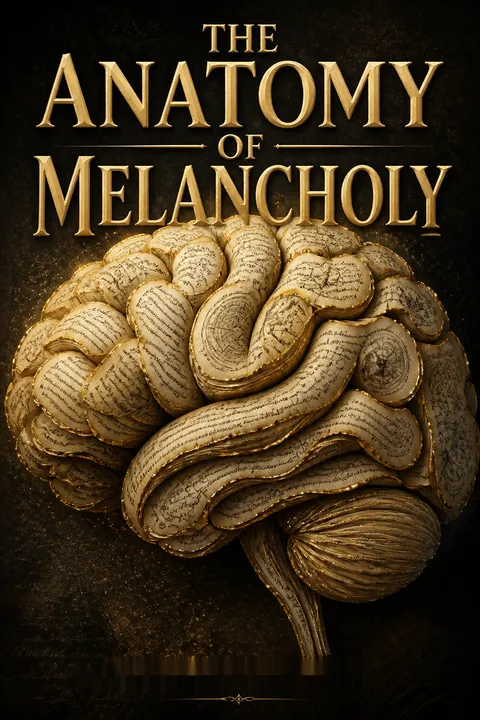
It is difficult to realize how any book with such an unprepossessing title as The Anatomy of Melancholy should have become the companion of so many readers and writers.
An unexpected delight. Despite its seemingly dry and academic title, "The Anatomy of Melancholy" transcended its initial purpose as a medical treatise to become a celebrated work of literature. Burton's genius transformed a clinical subject into a vast, engaging entertainment, captivating readers and writers for centuries. Its enduring appeal lies in this surprising blend of serious inquiry and delightful prose.
More than medicine. While ostensibly a medical text, the book is a rich mine of miscellaneous learning, fertilizing countless essayists and writers on human nature. It delves into diverse subjects, offering a grand literary experience that far surpasses a mere diagnostic manual. This unexpected depth and breadth are what secured its place as a cherished companion.
A unique legacy. Lamb affectionately referred to Burton as 'Old Burton,' a testament to the author's warm, quixotic personality shining through his work. The book's ability to be both a scholarly resource and a deeply human reflection on the human condition is its defining, paradoxical characteristic, making it a timeless classic.
2. The Author's Reclusive Genius: Robert Burton Embodied in His Work
if ever author were embodied in a book or if ever book were the presentment of an author, that author was Robert Burton and that book the Anatomy of Melancholy.
A life among books. Robert Burton, born in 1577, spent his life cloistered in Oxford, primarily within his study. He described his existence as "a silent, sedentary, solitary, private life, mihi & musis in the University," dedicating himself almost entirely to his studies. This reclusive nature allowed him to immerse himself deeply in the vast world of literature.
The book as a mirror. His masterpiece, "The Anatomy of Melancholy," is an unparalleled reflection of its author. It is not merely a collection of facts but a living embodiment of Burton's personality, intellect, and peculiar humor. Readers feel as though they are conversing directly with him, gaining insight into his genial yet diffident character.
Beyond pedantry. Despite his profound erudition and pedantic method, Burton avoided becoming a mere "schoolman." His adventures among books were translated into a work that, while learned, remained warmly human and engaging. His life, though outwardly uneventful, was rich in intellectual exploration, all poured into the pages of his singular creation.
3. A Mosaic of Learning: Burton's Unique, Quotation-Rich Style
He is an artist in literary mosaic, using the shreds and patches he has torn from the work of others to make a picture emphatically his own.
A master of citation. Burton's writing style is distinctive for its lavish use of quotations and citations, a method he mastered with unparalleled skill. He meticulously gathered "shreds and patches" from countless authors across all times, weaving them into a coherent and original tapestry of thought. This approach, though seemingly a crude assembly, reveals the author's unique voice on every page.
Distillation of knowledge. His treatise is the "legitimate offspring of a bookish mind," serving as an "epitome or quintessence of the books of all times." Far from being a mere compilation, Burton's work is a profound distillation, where the "rifler" (Burton himself) is revealed behind every borrowed phrase, making the collective wisdom his own.
Engaging and fluent. Despite the "characteristic and entertaining encumbrances" of extensive quoting, Burton's prose is surprisingly direct and brisk. It flows like "good talk," redeemed from monotony by "an apt twist or a whimsical turn," and enriched by curious tales. This unique mosaic style ensures that the reader, though potentially wearied by its size, is never bored.
4. Vast Scope and Pioneering Insights: Exploring Every Human Endeavour
Although his theme is melancholy, he contrives by a method of intermission and digression to glance at almost every human interest or endeavour.
A commentary on humanity. "The Anatomy of Melancholy" is remarkable for its immense size and scope, traversing all times and places, from ancient thought to contemporary issues. While ostensibly focused on melancholy, Burton's method of "intermission and digression" allows him to touch upon virtually every aspect of human life and endeavor, making the work a comprehensive commentary on the human race.
Bridging eras. The book stands as a bridge between medieval and modern thought, representing both the "swan song of authoritarian scholasticism" and an "anticipation of the method of deduction from observed facts." Its structured form, with "partitions," "sections," and "subsections," belies its sprawling intellectual journey.
Anticipating modern studies. Burton's work contains pioneering studies that predate their formal recognition by centuries.
- Climatology: "A Digression of Air" is noted as the first essay on the subject.
- Religious Psychology: The section on "Religious Melancholy" is the first study of its kind.
- Sex Psychology: His insights anticipate Havelock Ellis.
- Social Critique: His repudiation of romantic love predates Bernard Shaw, and his chapters on "Jealousy" contain elements of modern problem novels.
- Utopian Vision: His preface includes a "Utopia which suggests Wells," revealing his foresight in political economy, advocating for better infrastructure, land reclamation, garden villages, and old-age pensions.
5. The Universal Malady of Folly: All Humanity Dotes and is Mad
For indeed who is not a fool, melancholy, mad?
A world of fools. Burton, adopting the persona of Democritus Junior, posits that melancholy and folly are universal human conditions. He challenges readers to survey the world, from the highest thrones to the lowest ashes, and conclude that "all the world is mad, that it is melancholy, dotes." This pervasive "crazed head" or "fools’ paradise" necessitates a profound reformation.
No one is exempt. From princes and magistrates to scholars and common folk, all are touched by this malady, "more or less in habit or disposition." He cites Solomon, David, and Paul to demonstrate that even the wise are not immune, and that "in the multitude of wisdom is much grief, and he that increaseth wisdom increaseth sorrow."
A shared affliction. Burton argues that folly, melancholy, and madness are but different degrees of the same disease, a "delirium" common to all. He provocatively asks, "Who is not brain-sick?" implying that a fundamental irrationality underlies much of human behavior, making us all "ad unum omnes, all mad."
6. A Scathing Critique of Societal Vices: From War to Corruption
In a word, the world itself is a maze, a labyrinth of errors, a desert, a wilderness, a den of thieves, cheaters, etc., full of filthy puddles, horrid rocks, precipitiums, an ocean of adversity, an heavy yoke, wherein infirmities and calamities overtake and follow one another, as the sea-waves...
A world in disarray. Burton paints a grim picture of society, rife with "vast confusion" and "enormous villainies." He observes a perpetual state of conflict and moral decay, where individuals and nations alike are driven by base impulses. This pervasive corruption leads to widespread suffering and discontent.
Specific societal ills:
- War: Described as a "devilish, so brutish a thing," causing mass slaughter for "vain titles" or "sport for princes." He laments the "feral madness" of civil wars and the "hellish course of life" glorified as heroic.
- Corruption: Lawyers are "gowned vultures," judges are bribed, and laws are "altered, misconstrued, interpreted pro and con."
- Greed: "Our summum bonum is commodity, and the goddess we adore Dea Moneta, Queen Money." This avarice drives men to "pill and poll, oppress ad libitum, flay, grind, tyrannize."
- Hypocrisy: Men "turn themselves into all shapes like a chameleon," professing friendship while plotting mischief, and acting "twenty parts and persons at once for his advantage."
- Bad Governance: "Impotentia gubernandi, ataxia, confusion, ill government," stemming from "unskilful, slothful, griping, covetous, unjust, rash, or tyrannizing magistrates."
A cycle of misery. This relentless pursuit of self-interest and indulgence in vice creates a "contentious, discontent, tumultuous, melancholy, miserable life." Burton concludes that "man is a devil to man," perpetuating a cycle of mutual torment and unhappiness.
7. The Misery of Scholars: Learning's Unrewarded Toil
Poverty is the Muses’ patrimony, and as that poetical divinity teacheth us, when Jupiter’s daughters were each of them married to the gods, the Muses alone were left solitary, Helicon forsaken of all suitors, and I believe it was because they had no portion.
A thankless profession. Burton laments the plight of scholars, who, despite their arduous studies and intellectual pursuits, often face poverty, contempt, and neglect. He notes that "of all other men, scholars are most subject to it [melancholy]," attributing this to their sedentary, solitary lives and the unrewarding nature of their calling.
Unjust recompense. After years of "irksome hours, laborious tasks, wearisome days," scholars are frequently "rejected, contemned, and... driven to their shifts, exposed to want, poverty, and beggary." While other trades offer clear paths to livelihood, learning is deemed "not gainful arts... but poor and hungry."
A societal failing. The fault lies not with the scholars, but with "griping patrons" and an ignorant public who "contemn learning." They prioritize wealth and superficial accomplishments over genuine erudition, leading to a "vast confusion of hereditary diseases" and a "great decay of Christian professors." Burton argues that if patrons were bountiful, "there will be painful scholars in all sciences."
8. The Author's Personal Struggle and Purpose: Writing to Cure Melancholy
I write of melancholy, by being busy to avoid melancholy.
A personal antidote. Burton openly confesses that his monumental work was born from his own struggle with melancholy. He undertook the task "to ease my mind by writing," viewing it as a necessary "evacuation" for the "imposthume in my head." This personal connection imbues the treatise with authenticity and a profound sense of empathy.
A shared affliction. His intent extends beyond self-cure; he aims to "help others out of a fellow-feeling." Recognizing the universality of melancholy, he dedicates his "time and knowledge... for the common good of all," much like a leper building a hospital for fellow sufferers.
A divine calling. Despite being a divine, Burton felt "fatally driven upon this rock of melancholy," seeing it as a "subject most necessary and commodious." He believed that anatomizing this humor was a service to humanity, offering means to "prevent and cure so universal a malady, an epidemical disease, that so often, so much, crucifies the body and mind."
9. An Ideal Commonwealth: Burton's Visionary Utopia
I will yet, to satisfy and please myself, make an Utopia of mine own, a New Atlantis, a poetical commonwealth of mine own, in which I will freely domineer, build cities, make laws, statutes, as I list myself.
A dream of order. Frustrated by the world's pervasive folly and corruption, Burton retreats into a literary exercise: the creation of his own ideal commonwealth. This "poetical commonwealth" is a mental escape, allowing him to "freely domineer, build cities, make laws, statutes, as I list myself," unconstrained by earthly imperfections.
Principles of the Utopia:
- Meritocracy: Offices and dignities are given "without all intercessions, bribes, letters," based solely on "worth and good service."
- Planned Cities: Cities are "regular, round, square, or long square, with fair, broad, and straight streets, houses uniform."
- Public Welfare: Hospitals for all in need, common granaries, and public works (highways, bridges, aqueducts) maintained from a common stock.
- Economic Regulation: Trades are rated, necessary goods have low customs, and monopolies are forbidden.
- Social Order: No beggars or idle persons; able-bodied individuals are "enforced to work." Marriage is regulated by age, and dowries are minimal.
- Justice: Few laws, but strictly kept; causes are swiftly dispatched, and judges are chosen for learning and manners.
- Education: Public schools for all, teaching by "use, example, conversation," not tedious precepts.
A necessary fantasy. While acknowledging such a vision as a "mere chimera," Burton's Utopia serves as a powerful counterpoint to the chaotic reality he critiques. It highlights his deep desire for a rational, just, and well-ordered society, even if achievable only in the realm of imagination.
10. The Peril of Passions: Unchecked Emotions as Primary Causes of Melancholy
Every perturbation is a misery, but grief a cruel torment.
The mind's tempest. Burton identifies passions and perturbations of the mind as the "greatest of all" causes of melancholy, calling them "fulmen perturbationum," the thunder and lightning that violently alter the microcosm of man. These turbulent emotions, if immoderate, "consume the spirits" and pervert the body's temperature.
A universal struggle. Though philosophy and divinity may mitigate these passions in a few, "most part they domineer, and are so violent, that as a torrent... bears down all before." Humans, "led like beasts by sense," often give "reins to their concupiscence and several lusts," leading to a "labyrinth of cares, woes, miseries."
Key destructive passions:
- Sorrow: "A cruel torture of the soul, a most inexplicable grief, poisoned worm, consuming body and soul and gnawing the very heart." It "dries up the bones," hinders concoction, and makes men "weary of their lives."
- Fear: A "foul fiend" that "tortures many days before with continual affrights and suspicion." It causes sudden madness, palpitation, and makes men "childishly drooping without reason, without judgment."
- Anger: "Ira furor brevis est," a "cruel tempest of the mind," making eyes sparkle, teeth gnash, and leading to "violent, outrageous" actions, often degenerating into madness.
- Envy and Malice: "The rotting of the bones," a "hidden wound" that "crucifies their souls, withers their bodies," and is an "incurable disease" that "never ceaseth."
11. The Potent Force of Imagination: Shaping Reality and Disease
This strong conceit or imagination is astrum hominis [a man’s guiding star], and the rudder of this our ship, which reason should steer, but, overborne by phantasy, cannot manage, and so suffers itself and this whole vessel of ours to be overruled, and often overturned.
The mind's architect. Burton emphasizes the extraordinary power of imagination, or phantasy, as a primary force in both health and disease. It is the "medium deferens of passions," capable of producing "miraculous alterations" in the body and mind, often leading to melancholy.
Deceptive power. In melancholy individuals, imagination "rageth," mistaking and amplifying objects through "continual and strong meditation." This can lead to:
- Delusions: Believing one is a king, a beast, made of glass or butter, or has frogs in one's belly.
- Hallucinations: Seeing and hearing "strange forms of bugbears, devils, witches, goblins," or even one's own image in the air.
- Physical Manifestations: Causing sudden sickness, paralysis, or even death through intense apprehension, as seen in cases of plague by mere conceit.
A double-edged sword. While a corrupt imagination can cause profound suffering, a "strong conceit or apprehension" can also "take away diseases." Spells, charms, and even the confidence placed in a physician can effect cures, demonstrating that "opinion alone... makes or mars physicians." This highlights the mind's profound influence over the body, often overriding reason.
12. A Caution for Melancholy Readers: The Book Itself Can Harm
Yet one caution let me give by the way to my present or future reader, who is actually melancholy, that he read not the symptoms or prognostics in this following tract, lest by applying that which he reads to himself, aggravating, appropriating things generally spoken to his own person (as melancholy men for the most part do), he trouble or hurt himself, and get in conclusion more harm than good.
A necessary warning. Recognizing the sensitive nature of his subject, Burton issues a direct and earnest caution to readers already afflicted by melancholy. He advises them to avoid the sections detailing symptoms and prognostics, understanding that self-diagnosis and over-identification can worsen their condition.
The danger of appropriation. Melancholy individuals are prone to "aggravating, appropriating things generally spoken to his own person." This tendency to internalize and magnify described ailments can lead to increased anxiety, fear, and a deepening of their existing melancholy, turning a potential remedy into a source of further distress.
A physician's responsibility. This warning underscores Burton's genuine concern for his readers' well-being, even as he delves into the darkest aspects of the human mind. It serves as a poignant reminder of the delicate balance between knowledge and its application, especially for those already vulnerable to the mind's intricate workings.
Review Summary
Readers widely regard The Anatomy of Melancholy as a monumental, encyclopedic work that defies easy categorization. Most praise its extraordinary erudition, digressive brilliance, and surprising emotional intimacy, describing it as endlessly rewarding when read in pieces rather than straight through. Burton's vast accumulation of classical quotations, humorous asides, and profound meditations on human suffering resonate across centuries. Some find the dense Latin passages and archaic language challenging, while others consider this richness essential to the experience. Nearly all agree it rewards patient, unhurried reading.
People Also Read


Download PDF
Download EPUB
.epub digital book format is ideal for reading ebooks on phones, tablets, and e-readers.








































