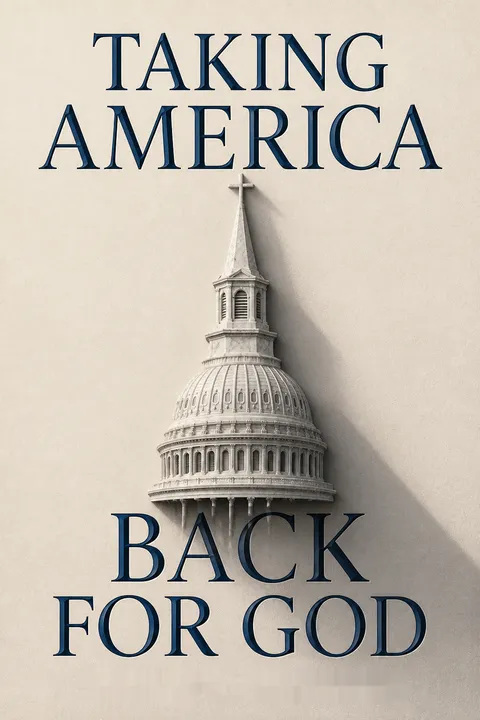

Key Takeaways
1. Christian Nationalism: A Distinct Ideology Shaping American Life
Christian nationalism is a cultural framework—a collection of myths, traditions, symbols, narratives, and value systems—that idealizes and advocates a fusion of Christianity with American civic life.
More than religion. Christian nationalism (CN) is a complex ideology that extends beyond mere theological beliefs or personal piety. It envisions a fusion of American civic life with a specific type of Christian identity and culture, often implicitly blurring religious identity (preferably Protestant Christian) with race (white), nativity (U.S.-born), citizenship (American), and conservative political ideology. This framework provides a lens through which many Americans interpret their social world, influencing their perceptions of national identity, belonging, and social hierarchies.
Not theocracy. While CN shares some goals with theocracy, it differs in key aspects. Unlike strict theocrats who want the Bible to directly inform national laws, many Christian nationalists believe America's founding documents were "divinely inspired" to preference Christianity. They are also willing to elect impious leaders if they support right-wing causes, prioritizing political outcomes over a leader's personal religious devotion. This distinction highlights CN's pragmatic, power-oriented nature.
A cultural framework. CN operates as a comprehensive cultural framework, encompassing explicit beliefs about historical identity, cultural preeminence, and political influence, alongside implicit assumptions about who truly belongs in America. It contends that the U.S. has always been, and should remain, distinctively "Christian" in its self-identity, history, symbols, values, and public policies, aiming to preserve this status quo.
2. Americans Hold Diverse Views on Christian Nationalism
While Americans hold diverse views on this question, we can sort them into four broad categories: Ambassadors, Accommodators, Resisters, or Rejecters, based on our 24-point Christian nationalism scale.
A spectrum of belief. Americans' adherence to Christian nationalism is not monolithic but spans a wide spectrum, categorized into four main orientations. "Ambassadors" (19.8%) are wholly supportive, believing America was founded on Christian principles and its laws should follow biblical principles. "Accommodators" (32.1%) lean towards accepting CN, seeing Christianity as a positive influence on society, but are less unequivocal in their support for privileging it.
Opposition and ambivalence. On the other side, "Resisters" (26.6%) lean towards opposing CN, often recognizing America's Christian heritage but uncomfortable with exclusive claims or government endorsement of Christianity. "Rejecters" (21.5%) completely repudiate the notion of the U.S. as a Christian nation, advocating for a strict separation of church and state and a secular constitution. These categories reveal that nearly half of Americans either resist or reject CN.
Beyond demographics. While certain demographic, religious, and political groups show higher concentrations of particular orientations (e.g., Ambassadors are older, more white, Southern, and evangelical), all four orientations are present across American society. This means that knowing someone's religious affiliation or political party doesn't fully predict their stance on Christian nationalism, underscoring its pervasive and cross-cutting influence.
3. Christian Nationalism, Not Evangelicalism, Explains Trump's Support
Christian nationalism, in other words, explained almost all of the “religious vote” for Trump.
Beyond "white evangelicals." The widespread media narrative that "white evangelicals put Trump in the White House" is incomplete. While many white evangelicals did vote for Trump, the underlying factor driving this support was Christian nationalism, not evangelicalism itself. Surveys show that CN was a significant and powerful predictor of voting for Trump, even after accounting for political party, ideology, and other cultural explanations like racism or sexism.
A cultural vision. For many Americans, CN captures a cultural vision of "whose country the United States really is" and, by extension, who the "others" or "outsiders" are. Trump's promises to "make America great again" resonated with Ambassadors and Accommodators who perceived a threat to their status from ethnic and religious minorities, viewing his presidency as a return to a "better time" when their cultural preferences were dominant.
Power over piety. The continued support for Trump among Christian nationalists, despite his moral failings, highlights CN's focus on political influence over personal piety. Leaders like Franklin Graham and Tony Perkins defended Trump by emphasizing his commitment to "Christian values" and "religious liberty," rather than his personal conduct. For Christian nationalists, if a politician can restore their perceived cultural and political influence, personal morality becomes secondary.
4. Christian Nationalism Fuels Xenophobia and Anti-Immigrant Sentiment
I think God is a God of borders.
Divine sanction for exclusion. Christian nationalism provides a theological justification for xenophobia and nativism, framing national borders as divinely ordained. Prominent Christian nationalist leaders and adherents argue that God establishes national boundaries and that securing these borders, even with physical walls, is a morally good act consistent with God's protection of his people. This perspective allows for the exclusion of ethnic and religious outsiders by cloaking nativist views in religious symbolism.
Negative stereotypes. Adherence to Christian nationalism is strongly linked to believing negative stereotypes about immigrants. Ambassadors and Accommodators are significantly more likely to agree that "illegal immigrants from Mexico are mostly dangerous criminals" and that the government should spend "too little on patrolling and controlling" national borders. This fear-driven narrative often disregards objective realities about immigrant populations.
Defining "true Americans." Christian nationalism reinforces a narrow definition of "true Americans" as native-born, English-speaking, and of American ancestry. The more someone equates Christian identity with American civic belonging, the more likely they are to believe these nativist criteria are "very important" for national identity. This creates symbolic walls that exclude immigrants, even Christian ones, from full inclusion in the national identity.
5. Christian Nationalism Reinforces Racial Boundaries and Subordination
From their earliest days in North America, colonists employed religio-cultural categories to signify that European meant ‘Christian’ and . . . African meant ‘heathen.’
Historical roots. The exclusion and subordination of Black Americans throughout U.S. history were consistently justified through appeals to Christianity. Early colonists linked European identity with "Christian" and African identity with "heathen," laying the groundwork for race-based chattel slavery and subsequent racial hierarchies. This historical legacy continues to shape contemporary Christian nationalism's views on race.
Preference for racial division. Christian nationalism is closely associated with a preference for rigid racial boundaries. White Americans who strongly embrace CN are less comfortable with interracial marriage and less supportive of transracial adoption, indicating a desire to maintain clear racial divisions within society. This suggests that "Christian heritage" often serves as a euphemism for a white-dominated social order.
Disregarding racial injustice. Adherents to Christian nationalism are more likely to disregard racial inequality, particularly in policing. They tend to believe that police treat Black and white Americans equally and that police violence against Black individuals is often due to the victims' lack of "respect for authority and obedience." This perspective aligns with CN's emphasis on maintaining traditional hierarchical relationships and justifying authoritarian control, especially when targeting non-white minorities.
6. Christian Nationalism Frames Non-Christian Religions as Threats
Because the majority of people do identify as Christians, as far as the [religious] minority is concerned, and this is where I might just sound snobby, but, to me, right is right and wrong is wrong.
Privileging Christianity. Christian nationalism advocates for explicitly privileging Christianity in the public sphere, often viewing other religious systems as threats. Leaders like Robert Jeffress argue that the government can and should show a preference for Christianity, dismissing religious pluralism as a secularist agenda. This stance implies that non-Christian perspectives are not equally legitimate and should not influence public policy.
Perceived threats. Ambassadors and Accommodators are significantly more likely to perceive Muslims and atheists as threats, believing they hold morally inferior values, seek to limit freedoms, or endanger physical safety. While pro-Israel sentiment is common among Christian nationalists, some still view Jewish people with suspicion, believing their faith leads to "an eternity of separation from God in Hell." This highlights a selective embrace of certain groups based on perceived alignment with CN's political goals.
"Religious liberty" redefined. For Christian nationalists, "religious liberty" often means the freedom to promote Christian expressions and moral standards in the public sphere, and even to discriminate against those who do not conform to their worldview. This redefinition of religious freedom serves to justify the exclusion and marginalization of non-Christian groups, reinforcing symbolic and social boundaries that deny them full participation in American civic life.
7. Christian Nationalism Upholds Traditional Gender Roles and Family Structures
I think it all stems back to headship, leadership, and there’s a system of order that was laid out by God in the beginning and having a family knowing that God is first.
Order in the family. Christian nationalism strongly links societal problems to the breakdown of the traditional, patriarchal family. Adherents believe that a "system of order" laid out by God, with men as spiritual leaders and women in submissive roles, is essential for a healthy society and a nation blessed with prosperity. This view is reinforced by conservative religious organizations that warn against the "social disaster" of departing from male headship.
Traditional gender roles. Christian nationalism is a powerful predictor of traditionalist attitudes toward gender roles, with Ambassadors and Accommodators significantly more likely to believe that men and women should have gender-specific roles in both public and private spheres. While overall societal views on gender roles have become more progressive, CN adherents maintain a strong commitment to these patriarchal norms, viewing them as foundational to God's intended order.
Opposition to LGBTQ+ rights. Homosexuality and transgender rights are seen as direct assaults on God's divine order and the traditional family. Christian nationalist leaders have shifted from condemning homosexuality as a sin to framing LGBTQ+ rights as a threat to "religious liberty," portraying themselves as victims whose freedom to discriminate is under attack. This narrative justifies opposition to same-sex marriage and transgender rights, such as bathroom access, as necessary to protect "God's plan."
8. Christian Nationalism's Core: Political Power Over Personal Piety
I don’t look to the teachings of Jesus for what my political beliefs should be.
Ends justify the means. A central paradox of Christian nationalism is its prioritization of political power over personal religious piety. While ostensibly rooted in Christian faith, CN's primary concern is to gain and maintain influence in the public sphere. This consequentialist approach means that personal moral failings of leaders or the use of "shady practices" are often overlooked if they serve the ultimate goal of realizing a more "Christian" nation.
Distinct from religiosity. Christian nationalism often influences Americans' political views in the opposite direction of personal religious commitment. For example, while CN is linked to opposition to gun control and fear of refugees, higher levels of religious practice are associated with more progressive stances on these issues. This highlights that CN is a distinct cultural framework, co-opting Christian language for political ends, rather than promoting transcendent Christian values like love, mercy, or justice.
Shared ground on family issues. However, on issues of gender, sexuality, and the family, both Christian nationalism and personal religious piety tend to encourage more conservative attitudes. Yet, their motivations differ: CN seeks to preserve societal order and hierarchies, while personal religiosity often stems from a concern for "living in sin" and a hope for conversion, without necessarily advocating for political mandates.
9. Christian Nationalism: A Declining Yet Potent Force Threatening Pluralism
Strong support for Christian nationalism demands complete allegiance and ultimately desires the silencing and exclusion of its opponents from the public sphere.
Declining numbers, enduring influence. While the number of Ambassadors of Christian nationalism is slowly declining, and Rejecters and Resisters are growing, the ideology's importance remains high. As their perceived cultural influence wanes, Christian nationalists may become even more fervent, viewing themselves as a persecuted minority fighting to restore "their" country. This dynamic ensures CN will continue to be a powerful force in American politics.
Threat to pluralism. Christian nationalism poses a significant threat to a pluralistic democratic society. By fusing national and religious symbols, it legitimizes its demands as the "will of God," inhibiting compromise and devaluing democratic processes. It fosters a propensity towards consequentialism, where "half-truths, shady practices, and authoritarian measures" are deemed acceptable if they serve the goal of a "Christian" nation.
Fissures within Christianity. The pervasive nature of Christian nationalism is not only turning many, especially younger generations, away from Christianity but also creating deep divisions within the tradition itself. Christians who reject CN often argue that its quest for power and its reinforcement of inequalities directly contradict biblical teachings of welcoming "the least of these" and the self-sacrificial love of Christ. They see CN as a "hollow and deceptive philosophy" that undermines the true witness of the Christian faith.
People Also Read









Download PDF
Download EPUB
.epub digital book format is ideal for reading ebooks on phones, tablets, and e-readers.








































