

Key Takeaways
The idiots surrounding you are just people wired differently than you
The whole book pivots on one reframe. Erikson opens with Sture, a sixtysomething entrepreneur convinced every employee was an idiot. His staff mounted a red-green warning light above reception so people could tell when he was in and flee if needed. When Erikson asked who had hired all these idiots, Sture threw him out. The lesson: Sture's definition of idiocy was simply anyone unlike himself.
We all quietly do this. We label people who talk too much, move too slowly, or obsess over details as defective, when really they just process the world through different filters. Nobody in the room thinks like you, so calling the majority broken guarantees a lonely, limited life.
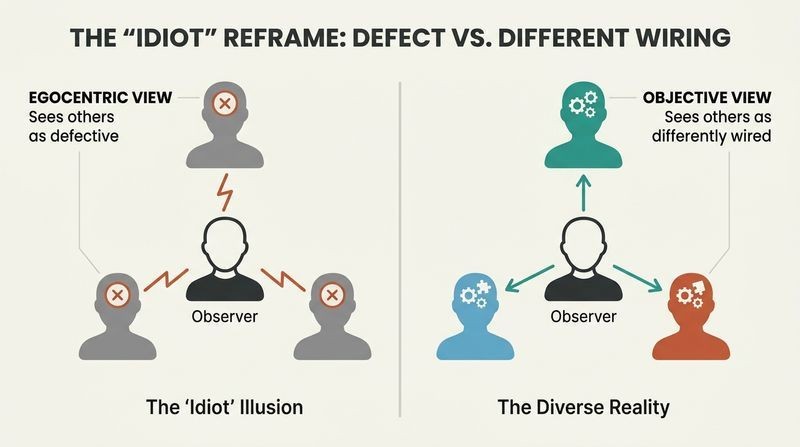
What's striking is how this echoes the fundamental attribution error from social psychology: we explain our own behavior by circumstance but others' behavior by character flaw. Sture is a caricature of that bias. The reframe also resembles Stephen Covey's "seek first to understand." One caution worth noting: relabeling difference as legitimate can slide into excusing genuinely toxic behavior. Not every clash is a style mismatch; sometimes an idiot really is behaving badly. The book's charity is a useful default, not an absolute rule. Still, as an opening provocation it disarms the reader's own smugness effectively.
Communication lands on the listener's terms, not yours
You control the sending, never the receiving. Everything you say passes through the other person's biases, moods, and past experiences before it becomes the message they actually absorb. You cannot install your intended meaning into someone's head no matter how sensible you feel you are being. This is humbling but liberating: since you cannot rewire the listener, your only lever is adapting your own delivery.
Erikson argues you can truly be yourself in only two situations: when alone, or when surrounded by people identical to you. Everywhere else, flexibility is the mark of a competent communicator. The person who insists "this is just how I talk" and refuses to adjust is opting out of actually being understood.
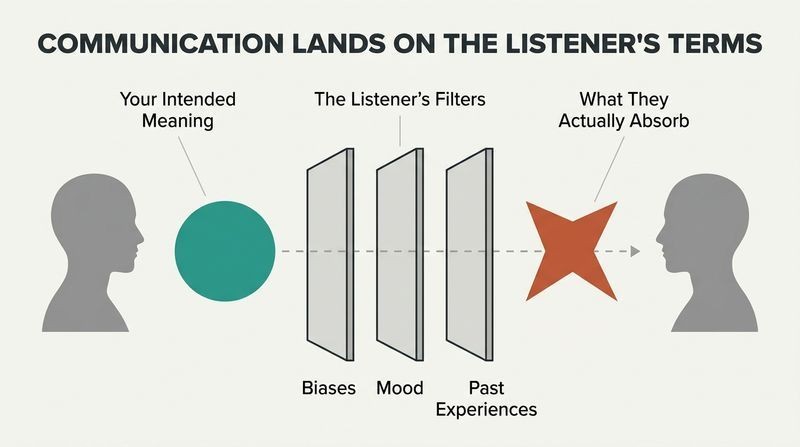
This principle predates DISC by centuries; rhetoricians from Aristotle onward stressed audience adaptation, and modern linguistics calls it audience design. The insight aligns with the transmission-versus-reception gap studied in information theory: noise distorts every signal. Where Erikson could go deeper is acknowledging the risk of over-accommodation. Chameleon communicators who mirror everyone can lose authenticity and trust, a tension the book's own interviewee Adam raises when he calls adaptation manipulative. The healthiest read: adaptation is translation, not deception. You keep your message and change the packaging, much as a teacher explains the same concept differently to a child and a colleague.
Sort people into four colors: Red, Yellow, Green, Blue
The DISC system, dressed in color. Erikson borrows the DISC model (Dominance, Inspiration, Stability, Compliance) and paints each type a color for easy recall:
1. Red: dominant, fast, results-driven, competitive
2. Yellow: optimistic, talkative, creative, relationship-seeking
3. Green: calm, loyal, stable, conflict-averse
4. Blue: analytical, precise, quality-obsessed, reserved
Crucially, almost nobody is one pure color. Roughly 80% of people blend two dominant colors, only about 5% show a single color, and the rest mix three. Green is the most common; pure Red the rarest. Erikson studies each color in isolation the way a chef learns individual ingredients before baking, but real humans are always a recipe of several.
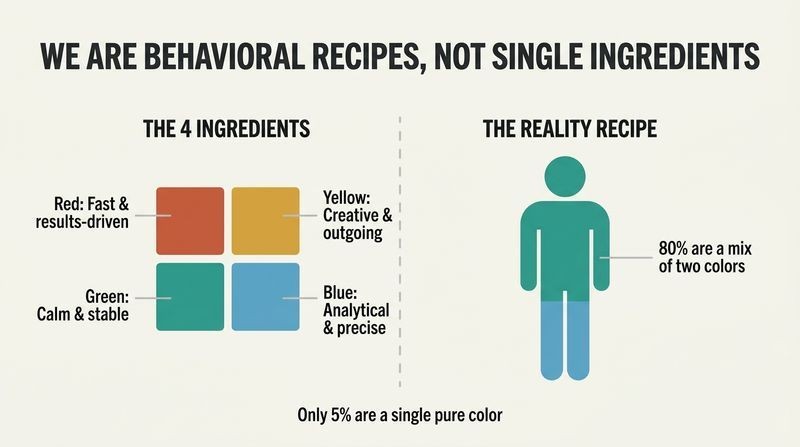
DISC traces to William Moulton Marston's 1928 work and has been administered tens of millions of times, yet academic psychologists generally prefer the Big Five (OCEAN) for validity and test-retest reliability. DISC's four-box simplicity is its strength for everyday use and its weakness for scientific precision. The color overlay is pure pedagogy, not theory, and it works: colors are sticky, memorable, and non-judgmental. Readers should treat the model as a communication heuristic, not a diagnosis. The danger is reification, freezing a living person into a box. Erikson's repeated insistence that most people are blends is the essential guardrail against horoscope-style thinking.
With Reds, cut the small talk and lead with the bottom line
Reds treat speed as a synonym for good. Erikson's colleague Björn once phoned him, and the entire call lasted eight seconds: are you looking for me, no, okay, click. No wasted pleasantries. Reds are task-oriented, competitive, blunt, and allergic to meetings that drag. One CEO turned a friendly office soccer match into a bruising contest because the flyer used the word "tournament."
To reach a Red, state your conclusion first, then offer background only if asked. Skip questions about their weekend; they are there to do business, not befriend you. Have your facts ready, because vagueness invites a grilling. And never back down when they raise their voice. Reds respect people who hold their ground and eat pushovers alive.
The Red profile maps closely onto high-dominance, low-agreeableness personalities and the classic Type A pattern. Research on leadership does confirm decisiveness and risk tolerance cluster in executive ranks, supporting Erikson's claim that CEOs skew Red. But the advice to "never back down" deserves nuance: escalation research shows matching aggression can trigger dominance contests. The book's own guidance is subtler than the slogan, standing firm on facts while refusing to mirror the theatrics. A useful parallel is hostage negotiation training, which teaches calm, factual assertiveness against high-arousal counterparts. The Red's blunt honesty, worth remembering, is rarely malicious; it is simply efficiency without emotional cushioning.
With Yellows, protect their ego and pin down commitments in writing
Yellows are charming, creative, and terrible listeners. Erikson once timed a Yellow sales manager named Peter who owned one item on a nineteen-point agenda yet spoke 69% of the meeting. Yellows think out loud, chase novelty, and are dazzling optimists about time, believing a kitchen renovation takes two days. They live in the future and forget the follow-through.
To work with a Yellow: create a warm, fun atmosphere, then extract concrete promises. Make them repeat what they agreed to and, ideally, write it in their calendar, because otherwise it evaporates. Invite them thirty minutes earlier than everyone else since they arrive last with colorful excuses. Their short memory has a silver lining: they forget criticism fast and rarely hold grudges.
Yellows resemble high-extraversion, high-openness types, and their "selective memory" for criticism echoes the psychological phenomenon of motivated forgetting. The planning fallacy, documented by Kahneman and Tversky, explains their chronic time optimism: people systematically underestimate task duration, and Yellows do so heroically. Erikson's tactic of massaging egos before delivering feedback is consistent with research showing self-affirmation reduces defensive resistance to threatening information. One critique: framing Yellows as needing to be "managed like children" risks condescension, and their scattered energy is inseparable from the creativity organizations prize. The fix is structure imposed by others, not suppression of the trait itself.
Greens won't tell you they disagree; silence is their veto
Green loyalty hides a stubborn undertow. Greens are the most common color: kind, dependable, superb listeners who remember your birthday and put the team before themselves. Erikson describes Maja, who always said yes to every request. But Greens despise conflict so thoroughly that they say yes while meaning no, then vent behind your back at the coffee machine. Their agreeableness masks real opinions they will not voice.
They also resist change fiercely. Erikson's Green mother needed weeks of mental preparation just to babysit, and a rescheduled dinner threw her into distress even though nothing about her task changed. To lead Greens, break change into small steps, explain the how repeatedly, and never assume their silence means genuine consent.
The Green "silent resistance" is a textbook case of passive aggression, and Erikson's link between chronic conflict-avoidance and burnout has real support: suppressing emotions (surface acting) correlates with exhaustion in occupational health studies. His barrel metaphor, where resentment accumulates unseen until it floods, resembles the gunny-sacking pattern couples therapists warn about. The organizational implication is sharp: leaders who read Green silence as buy-in are building on sand. Google's Project Aristotle found psychological safety, the felt permission to dissent, was the top predictor of team performance. Greens flourish precisely where that safety exists, which reframes their reticence as an environmental signal, not just a personality flaw.
With Blues, bring flawless facts because they already know more than you
Blues pursue perfection and distrust everything unverified. Erikson tried selling a leadership program to a Blue CEO who kept asking, meeting after meeting, "Is there any more material?" even after receiving three hundred pages detailing every coffee break. Blues value the process over the decision itself. They double-check Excel formulas with a calculator, read manuals twice, and count screws before assembling furniture.
To win a Blue: prepare meticulously, give exact figures (say $9.73, not "about ten dollars"), and never bluff. When you don't know, admit it, because the white lie will surface and destroy your credibility. Skip the personal chitchat and inspirational visions; they want realism, quality, and documentation. Blues aren't cold, just introverts whose feelings run beneath an expressionless surface.
Blues align with high conscientiousness, the Big Five trait most predictive of job performance and academic success, which validates Erikson's respect for their rigor. Their risk aversion connects to loss aversion in behavioral economics: they weight potential downsides more heavily than equivalent upsides. Toyota's "five whys" root-cause method, which Erikson cites, is genuinely Blue in spirit and a pillar of lean manufacturing. The shadow side is analysis paralysis; the project manager who test-drove sixteen car brands over eight months before buying the most popular model illustrates how perfectionism can consume the very time it aims to protect. Their precision is priceless in finance, engineering, and safety-critical work.
Alcohol reveals that no color is the fixed person you assume
A company party exposed the fluidity underneath. At a bank gathering Erikson watched personalities invert. The reserved Blue credit manager danced on a table telling filthy jokes. Three of four normally bubbly Yellow salespeople turned brooding and philosophical, one moping on the steps questioning life's point. The stern Red boss softened, telling the Green administrators he wasn't really a monster, whereupon the emboldened Greens cornered him and unloaded twenty years of grievances.
By Monday, order was restored: Yellows joking, Blue silent, boss glowering, Greens staring at the wall. The point is that behavior is context-dependent. Stress, safety, alcohol, and situation all shift how a person acts, so no color is a permanent cage.
This vignette quietly undercuts the rigidity critics fear in typing systems, and it deserves emphasis. Personality psychology increasingly favors interactionism: behavior emerges from trait times situation, not trait alone, exactly Erikson's formula that behavior is a function of personality and surrounding factors. Alcohol's disinhibiting effect on the prefrontal cortex explains why the Green's dammed-up resentment burst free and the Blue's restraint dissolved. The deeper lesson for readers is epistemic humility: a single observation, especially under unusual conditions, is weak evidence for typing someone. Consistent patterns across many ordinary situations, not one drunken night or one stressful deadline, are what actually reveal a person's dominant colors.
Watch how someone gets angry to decode their color fast
Temperament is a diagnostic shortcut. Erikson likens each color's anger capacity to a different vessel:
1. Red: a shot glass, fills and empties instantly, erupts often but forgets fast
2. Yellow: a tumbler, visible rising level, guilt follows the outburst
3. Green: a fifty-gallon barrel, absorbs injustice for years, then floods catastrophically
4. Blue: a barrel with a leaky tap, constant low-grade grumbling that releases pressure
When a Green finally erupts, everything from a promise broken years ago pours out at once. Blues never explode because their perpetual muttering ("typical, no structure here") functions as a relief valve. Observing what triggers someone and how they vent gives you a rapid read on their profile.
The vessel metaphor is genuinely useful because anger, being involuntary and revealing, is harder to mask than polished conversation. It connects to emotion-regulation research: the Green's suppress-then-explode pattern matches what psychologists call expressive suppression, which raises physiological load and predicts poorer wellbeing, supporting Erikson's hunch that Greens are burnout-prone. The Blue's chronic complaining resembles low-intensity venting, which some studies suggest can actually maintain rumination rather than dissolve it, a slight tension with Erikson's "pressure valve" framing. Still, as a field-observation tool the model is elegant: stress and provocation strip away the social mask and expose core wiring more reliably than calm interaction ever could.
Deliver feedback in the recipient's dialect, not your own
One message, four translations. Erikson insists the sandwich method (praise, criticism, praise) confuses everyone because the message drowns. Instead, tailor delivery:
1. Red: skip the wrapping, give blunt concrete examples, expect a fight, hold firm
2. Yellow: build warmth, stress you still like them, make them repeat the point, follow up because they forget
3. Green: be gentle but clear, admit your own feelings, don't backpedal when they crumble into self-blame
4. Blue: arrive armed with airtight data in writing, expect molecular counter-questions, never bluff
He warns that Reds and Yellows inflate their strengths and deny weaknesses, while Greens and Blues exaggerate their flaws and deflect praise. Knowing this asymmetry prevents feedback from backfiring.
This is the book's most actionable chapter and its research footing is solid. Personalized feedback outperforms generic feedback in learning studies, and the observation that different temperaments need different framing anticipates work on regulatory focus, where promotion-oriented people (Reds, Yellows) respond to gains language and prevention-oriented people (Blues, Greens) to loss and security language. Erikson's takedown of the sandwich method aligns with critiques that it dilutes clarity and trains recipients to dread praise as a criticism prelude. The self-assessment asymmetry he flags is essentially a color-coded Dunning-Kruger effect. One caveat: real feedback often goes to blended profiles, so practitioners must mix dialects rather than apply one script.
Build teams from all four colors, not clones of yourself
Homogeneous teams fail spectacularly. Erikson ran an experiment giving four single-color groups the same problem. The Reds argued, solved the wrong problem, and declared victory. The Yellows had a hilarious time and produced nothing. The Greens comforted a colleague grieving his dog and never finished. The Blues corrected the grammar in his instructions, weighed endless technicalities, and demanded more time.
The ideal group needs each color's contribution: the Yellow generates ideas, the Red decides, the Green does the steady work, and the Blue verifies quality. Yet managers keep hiring people like themselves because they understand each other. Erikson likens a Red and Blue pairing to an accelerator and a brake: both essential, disastrous if pressed simultaneously.
The finding that cognitively diverse teams outperform homogeneous ones is well established; research on functional and personality diversity links it to better problem-solving, though also to more conflict, which is the tradeoff Erikson's brake-and-accelerator metaphor captures. His single-color experiment is a vivid demonstration of complementary skills, echoing Belbin's team-role theory, which similarly argues balanced role coverage beats a team of stars. The homophily bias he names, hiring in one's own image, is documented in organizational behavior as a driver of monoculture and blind spots. The practical caution: diversity yields its dividend only when psychological safety and shared goals let the friction become productive rather than paralyzing.
Analysis
Surrounded by Idiots is a popularization, not a scientific treatise, and it should be read as such. Thomas Erikson takes the DISC framework (rooted in William Moulton Marston's 1928 Emotions of Normal People and commercialized by Walter Clarke and later firms like TTI Success Insights) and repackages it in four memorable colors. His genius is pedagogical, not theoretical: colors stick where letters and jargon slide off. The book's structure, dissecting each color's strengths, how others perceive them, how to adapt, how to give feedback, and how they handle stress, gives readers a practical field manual.
The intellectual honesty is uneven. Erikson repeatedly concedes no system is perfect, that most people blend two or three colors, and that behavior shifts with context (his formula: behavior equals a function of personality times surrounding factors). These caveats rescue the model from horoscope territory. Yet the book leans on anecdote almost entirely, with essentially no controlled evidence, and academic psychology largely favors the Big Five over DISC for validity and reliability. Readers seeking rigor should treat the colors as a communication heuristic, not a personality science.
What endures is the humane core: the people who frustrate you are not defective, merely different, and the burden of being understood falls on the communicator, not the listener. This is ancient rhetorical wisdom (Aristotle's audience adaptation, Covey's seek-first-to-understand) in accessible modern dress. The book's real risk is misuse, the same risk with any typing tool: labeling and boxing people, weaponizing profiles to excuse one's own rigidity, or reducing a colleague to a color. Erikson's toolbox metaphor is his best defense; a tool harms or helps depending on the hand wielding it. Used charitably, the framework builds patience and flexibility. Used lazily, it becomes a fresh vocabulary for calling people idiots. The choice, as he says, is the reader's.
Review Summary
Surrounded by Idiots receives mixed reviews. Some praise its accessibility and insights into personality types, while others criticize its lack of scientific basis and oversimplification. Supporters find it helpful for understanding different communication styles, but critics argue it's pseudoscience based on outdated theories. The book's informal tone and anecdotal examples are polarizing. Many readers appreciate its practical advice for dealing with various personalities, while others dismiss it as repackaged pop psychology lacking credibility.
People Also Read





FAQ
What's Surrounded by Idiots about?
- Understanding Human Behavior: Surrounded by Idiots by Thomas Erikson explores the DISC method, categorizing human behavior into four types: Red, Yellow, Green, and Blue, each with distinct communication styles and personality traits.
- Improving Communication: The book aims to help readers effectively communicate with each type, reducing misunderstandings and conflicts in both personal and professional settings.
- Valuing Differences: Erikson emphasizes that the "idiots" we encounter are not truly ignorant but simply different, and understanding these differences can enhance our interactions.
Why should I read Surrounded by Idiots?
- Practical Insights: The book provides practical advice on identifying and interacting with different personality types, beneficial in various aspects of life, including work and relationships.
- Enhancing Relationships: By learning to appreciate and adapt to different communication styles, readers can improve their relationships and reduce conflicts with others.
- Personal Growth: It encourages self-reflection and understanding of one's own behavior, leading to personal development and better emotional intelligence.
What are the key takeaways of Surrounded by Idiots?
- Four Behavior Types: The book outlines the four behavior types—Red (Dominance), Yellow (Inspiration), Green (Stability), and Blue (Compliance)—and their characteristics.
- Communication on Listener’s Terms: Effective communication happens when you tailor your message to the listener's style, which is crucial for successful interactions.
- Flexibility in Communication: Adapting your communication style to fit the needs of others can lead to more productive conversations and relationships.
What are the best quotes from Surrounded by Idiots and what do they mean?
- "If you don’t understand and use the principles, you’ll continue to be surrounded by idiots.": This highlights the importance of understanding different communication styles to avoid conflicts and improve interactions.
- "The idiots who surround you are, in fact, not idiots at all.": This emphasizes that differences in behavior and communication do not equate to ignorance; rather, they reflect individual personality traits.
- "Communication happens on the listener’s terms.": This underscores the necessity of adapting your communication style to the preferences of the person you are speaking to for effective dialogue.
How does the DISC method work in Surrounded by Idiots?
- Behavioral Categories: The DISC method categorizes individuals into four primary types based on their dominant traits: Reds are assertive and goal-oriented, Yellows are social and enthusiastic, Greens are calm and supportive, and Blues are analytical and detail-oriented.
- Color Associations: Each type is associated with a color—Red, Yellow, Green, and Blue—making it easier to remember and identify behaviors.
- Understanding Interactions: By recognizing these types, individuals can better understand their own behavior and the behavior of others, leading to improved communication and collaboration.
What are the characteristics of Red behavior in Surrounded by Idiots?
- Dominant and Direct: Reds are assertive, competitive, and often take charge in situations. They prefer quick decisions and can be perceived as aggressive or controlling.
- Goal-Oriented: They are highly focused on achieving their objectives and may disregard details that they consider unimportant.
- Impatient with Slow Processes: Reds often become frustrated with lengthy discussions and prefer to get straight to the point.
How can I effectively communicate with a Yellow according to Surrounded by Idiots?
- Be Enthusiastic: Engage with Yellows by matching their energy and positivity. They thrive in lively environments and appreciate a cheerful demeanor.
- Encourage Storytelling: Allow them to share their stories and experiences, as they enjoy expressing themselves and connecting with others.
- Keep It Fun: Incorporate humor and light-heartedness into conversations to maintain their interest and keep the atmosphere enjoyable.
What challenges do Greens face in communication as described in Surrounded by Idiots?
- Avoidance of Conflict: Greens often struggle with expressing their opinions, especially in group settings, due to their desire to maintain harmony and avoid confrontation.
- Indecisiveness: They may take longer to make decisions, as they prefer to weigh all options and consider the feelings of others.
- Passive Behavior: Greens can be perceived as passive or disengaged, as they often wait for others to take the lead in discussions.
What are the strengths and weaknesses of Blue behavior in Surrounded by Idiots?
- Strengths: Blues are detail-oriented, analytical, and methodical. They excel in tasks that require precision and thoroughness, making them reliable in quality control.
- Weaknesses: Their critical nature can lead to being perceived as overly cautious or pessimistic. They may struggle with decision-making due to their need for extensive information and analysis.
- Communication Style: Blues tend to be reserved and may not express their emotions openly, which can make them seem distant or unapproachable.
How can I adapt my communication style to different color types in Surrounded by Idiots?
- For Reds: Be direct and assertive. Present your ideas confidently and be prepared for a fast-paced discussion. Avoid excessive details, as they prefer to focus on results.
- For Yellows: Engage them with enthusiasm and positivity. Use storytelling and humor to connect, but be mindful of keeping the conversation on track to avoid distractions.
- For Greens: Create a calm and supportive environment. Be patient and provide clear instructions, allowing them time to process information and express their thoughts.
- For Blues: Focus on facts and details. Provide structured information and be prepared for questions. Avoid emotional appeals, as they prefer logical reasoning.
What stress factors affect each color type in Surrounded by Idiots?
- Reds: They become stressed when they feel a lack of control or when results are not achieved quickly. Inefficiency and routine tasks can frustrate them, leading to aggressive behavior.
- Yellows: Stress arises from feeling ignored or unappreciated. They thrive on social interaction, so isolation or excessive criticism can lead to anxiety and a need for validation.
- Greens: They experience stress from unpredictability and conflict. A lack of security or being forced into rapid changes can overwhelm them, causing withdrawal or passive-aggressive behavior.
- Blues: Stress is triggered by disorganization and a lack of structure. They need clear guidelines and can become anxious when faced with unexpected changes or risks.
How can I help others manage their stress based on their color type in Surrounded by Idiots?
- For Reds: Encourage physical activity to release pent-up energy. Provide clear goals and allow them to take charge of projects to regain a sense of control.
- For Yellows: Create opportunities for social interaction and fun. Encourage them to express their feelings and provide positive reinforcement to boost their confidence.
- For Greens: Allow them time to relax and recharge. Provide a stable environment and clear communication to help them feel secure and supported.
- For Blues: Give them space to analyze and process information. Encourage them to take breaks and provide structured feedback to help them feel more in control.
About the Author
Other books by Thomas Erikson





Download PDF
Download EPUB
.epub digital book format is ideal for reading ebooks on phones, tablets, and e-readers.








































