
Key Takeaways
1. Spiritual Formation is a Journey of the Heart, Not Stages
Spiritual formation, I have come to believe, is not about steps or stages on the way to perfection. It’s about the movements from the mind to the heart through prayer in its many forms that reunite us with God, each other, and our truest selves.
Beyond linear progress. In a society obsessed with progress and achievement, we often approach spirituality as a ladder to climb, seeking enlightenment or union with God in measurable stages. Henri Nouwen challenges this view, asserting that the spiritual life is a dynamic, fluid process of "movements" rather than fixed, progressive stages. It's less about reaching a destination and more about the continuous journey of the heart.
The heart as our core. The "heart" in spiritual formation refers to the biblical understanding of our core self—the unifying center where our physical, emotional, intellectual, volitional, and moral energies converge. It's the place where God dwells and where true transformation occurs. When our heart is open and responsive to the Spirit, healthy spiritual formation naturally unfolds, guiding us from enslavement to liberation.
Dynamic, not static. These spiritual movements are never static or perfectly completed; they are cyclical and vary with each individual and season of life. Nouwen identifies seven major movements:
- From opaqueness to transparency
- From illusion to prayer
- From sorrow to joy
- From resentment to gratitude
- From fear to love
- From exclusion to inclusion
- From denying to befriending death
This framework helps us discern God's activity in our lives, fostering a deeper awareness and freedom.
2. From Opaqueness to Transparency: Seeing God in All Things
To contemplate is to see, to make visible that which is hidden from ordinary sight.
God's incomprehensibility. Spiritual formation begins with humbly accepting that God is greater than our finite minds and cannot be fully contained by our concepts or emotions. Like emptying an overfull teacup, we must detach from our preconceived notions and open our minds and hearts to receive God's revelation. This leads to a "docta ignorantia," an articulate not-knowing, where we acknowledge God's vastness.
Contemplative prayer reveals. Through contemplative prayer, the world sheds its "opaqueness" and becomes "transparent," pointing beyond itself to the luminous Source of wisdom and understanding. This practice, called theoria physike by the Desert Fathers, allows us to see the true nature of things, unmasking illusions of control and the pretense of the false self. It transforms our perception of:
- Nature: From objects to be used to a gift to be cherished, revealing God's goodness.
- Time: From chronos (random events) to kairos (opportunities for change), seeing God's hand at work.
- People: From "characters" to be used to "persons" who "sound through" to a greater reality, revealing God's love.
Sacramental vision. This movement allows us to see all of life as sacramental, where the visible constantly reveals the invisible. When we move from opaqueness to transparency, darkness is dispelled, and divine light shines through, transforming our relationships with creation, time, and each other into a clear vision of God's love.
3. From Illusion to Prayer: Wasting Time with God
Prayer is being unbusy with God instead of being busy with other things.
Discipleship requires discipline. In a world that constantly demands our attention and fills our lives with endless tasks, a life without a quiet center easily becomes delusional. Discipleship, rooted in "to learn from," necessitates discipline to anchor our hearts and minds in God, creating boundaries where God's voice can be heard. Without this, we become preoccupied, spiritually sick, and one-dimensional.
Prayer as "useless" time. The world values productivity and usefulness, but Jesus invites us to "waste" time with Him. Prayer is not about gaining spiritual benefits or insights, but about simply being in God's presence without agenda. This "useless" time gradually transforms us, detaching us from the illusion of control and the need for constant accomplishment, reminding us that our worth is not defined by our usefulness.
Descending from mind to heart. Solitary prayer, exemplified by Jesus's frequent withdrawals, is crucial for understanding our identity and mission. It's a descent from the busy mind into the heart—the unified center of our being—where we listen to God's loving voice. Practices like:
- Slowly repeating sacred texts (e.g., "Our Father," Psalm 23)
- Focusing on a chosen word or image (lectio divina)
- Practicing the "Jesus Prayer" ("Lord Jesus Christ, have mercy on me")
These help quiet distractions and anchor us in the present moment, making prayer a continuous, embodied experience.
4. From Sorrow to Joy: Embracing Loss and Finding Connection
To grieve is to experience the pain of your life and face the dark abyss where nothing is clear or settled, where everything is shifting and changing.
The universality of loss. Life is a series of losses—from the womb's safety to the death of loved ones, dreams, and even faith. These losses can lead to deep sorrow, disillusionment, and a sense of spiritual depletion. The crucial question is not if we experience loss, but how we live through it. Denying or hiding our pain only leads to bitterness and prevents true healing.
Mourning as a path to joy. The first step from sorrow to joy is to courageously mourn our losses. This means daring to feel the pain, naming it, and allowing ourselves to grieve deeply. It's in this raw vulnerability that new life is born, and a joy deeper than happiness can be found. Nouwen's own experience of his mother's death revealed that in the midst of tears, a profound joy began to emerge, connecting him to a larger story of suffering and grace.
Connecting to universal suffering. The second step is to connect our personal pain to the larger suffering of humanity. By realizing that our grief is not isolated but shared with countless others—prisoners, refugees, the sick, the forgotten—we cultivate compassion (com-passion = to suffer with). This solidarity, as seen in the Emmaus story, allows Christ to walk beside us, opening the scriptures and warming our hearts, transforming our sadness into a purposeful journey toward re-creation and hope.
5. From Resentment to Gratitude: Reclaiming All of Life as Grace
Resentment is one of the most vicious qualities of life because it makes human relationships and community life so difficult.
The paralysis of resentment. Resentment is a "cold, agonizing anger" that hardens the heart, making us suspicious, cynical, and depressed. It stems from feeling unjustly treated or let down by life, often deeply hidden even from ourselves. This passion paralyzes us, preventing forgiveness, robbing us of joy, and making us cling to negative feelings as a false identity. It's particularly insidious for the faithful and hardworking, who may feel taken advantage of.
Gratitude as liberation. The antidote to resentment is gratitude, an attitude that embraces all of life as a gift. It's more than occasional thanks; it's a profound conversion that allows us to let go of anger, receive hidden gifts from others, and celebrate life. Gratitude:
- Blocks action, while gratitude lets us move forward.
- Makes us cling to negative feelings, while gratitude allows us to let go.
- Exhausts us with jealousies, while gratitude gives new vitality.
- Entangles us in distractions, while gratitude anchors our deepest self.
"All is grace." Moving from resentment to gratitude involves reclaiming our entire past—both joyful and painful moments—as the concrete way God has led us. This discipline challenges us to see experiences of rejection, loss, and failure as God's "pruning hands," purifying our hearts for deeper love and stronger hope. When we confess our resentments within a supportive community, we create space for forgiveness and freedom, allowing God's grace to transform interruptions into invitations for contemplation.
6. From Fear to Love: Dwelling in God's Intimate Presence
There is no fear in love; but perfect love casts out fear.
The pervasive power of fear. Fear has deeply invaded our lives, motivating many of our choices and decisions. It leads to alienation, scarcity, and a constant need to hoard resources and build walls, trapping us in a "house of fear." This fear is often exploited by those in power, making us slaves to anxiety and paralysis, rather than free individuals. Fear begets more fear, never love.
The house that love built. St. John's teaching that "perfect love drives out fear" points to a divine love that transcends human affection or strategic plans. This perfect love is God's intimate presence, a "house of love" where we are invited to dwell. Jesus, the Word made flesh, is our true home, inviting us: "Make your home in me, as I make mine in you." This is a call to move from imprisonment to freedom, from anxiety to peace.
Rublev's icon as a guide. Rublev's icon of the Holy Trinity beautifully depicts this "house of love." The three angels, seated around a table of hospitality, form a mysterious circle of intimacy. By focusing on this icon in prayer, we are gently invited to participate in this divine conversation, releasing our fears and entering into a circle of safety and love. This practice helps us dwell daily in God's intimate presence, transforming our individual lives and inspiring a global spirituality of peace and justice.
7. From Exclusion to Inclusion: Drawing the Circle Wide in Community
The call to solidarity always moves us from exclusion to inclusion in order to embrace a greater mystery and a larger community.
Radical hospitality. We often struggle to love and include those who don't fit our expectations of righteousness or good behavior. The story of Abba Agathon and the crippled man illustrates radical hospitality: serving without judgment or expectation, making oneself available to the other. True ministry is a "suffering with" in a community of equals, where powerlessness becomes a source of solidarity and divine blessing.
Community of the weak. Nouwen's experience at L'Arche Daybreak shattered his previous notions of exclusive community. He learned that community is shaped around the fellowship of the weak, where those with disabilities become teachers of love, forgiveness, and acceptance. This revealed a deeper unity beneath superficial distinctions, echoing Thomas Merton's realization that "I am still a member of the human race—and what more glorious destiny is there."
The Body of Christ. Christian spirituality is communal, rooted in the Incarnation—God becoming human flesh in Jesus. Our bodies are temples of the Holy Spirit, and in community, we experience a new dimension of physical and spiritual intimacy as the Body of Christ. The Eucharist, for Nouwen, is the most tangible celebration of this inclusive love, where we literally become Christ's body, breaking down barriers of:
- Minister and layperson
- Caregiver and care receiver
- Male and female
- Race and culture
- Sexual orientation
This calls us to "draw the circle wide," embracing all humanity as God's beloved.
8. From Denying to Befriending Death: Embracing Mortality with Trust
Who dies not before he dies, is ruined when he dies.
Confronting mortality. Death is an inevitable, often sudden, reality. Preparing for it involves confronting our mortality before we are in immediate danger, reflecting on unfinished business, and seeking forgiveness. Nouwen's own near-death experience revealed the profound desire to forgive and be forgiven, to let go of judgments, and to be free from resentment. This confrontation with death, seen through the eyes of love, brought immense peace.
Befriending death. Inspired by Jungian thought, Nouwen advocates "befriending death"—relating to it as a familiar guest rather than a threatening enemy. This doesn't mean giving up the fight for life, but rather embracing mortality with love, which paradoxically makes us stronger warriors. His personal experience of facing internal bleeding and potential death led to a profound sense of God's unconditional love and a release from fear, transforming him into a "lover of life and death."
Reclaiming belovedness and childhood. Befriending death allows us to reclaim our core identity as God's beloved children. This truth, heard by Jesus at the Jordan and on Mount Tabor, precedes our birth and extends beyond death, liberating us from fear and manipulation. It also involves becoming a "child again," embracing a new dependence on God and others, recognizing that life is a journey from dependence to dependence. This childlike trust, coupled with belief in the Communion of Saints, provides the spiritual power to make the passage of death with faith and courage.
9. The Inward and Outward Journeys are Intertwined
The journey inward is the journey to find the Christ dwelling within us. The journey outward is the journey to find the Christ dwelling among us and in the world.
Two essential journeys. Spiritual formation is a continuous interplay between an inward journey to the heart and an outward journey into community and mission. These two movements are interdependent and mutually strengthening, never to be separated. The inward journey cultivates discernment and attentiveness to our inner life, while the outward journey calls for compassion, witness, and accountability in the world.
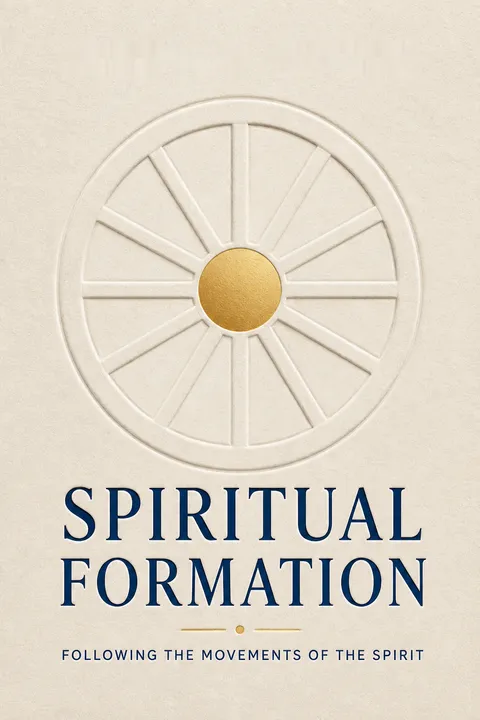
Inward precedes outward. Chronologically, the inward journey often precedes the outward. We must first know and love God and ourselves to truly know and love others. Communion with God forms the foundation for authentic community and effective ministry. As Nouwen describes with the "wagon wheel" metaphor:
- Hub: The heart of God, the place of prayer and communion.
- Spokes: Our connections to all aspects of life and people.
- Rim: The periphery of activity and engagement.
Living from the hub allows us to connect with all spokes without frantic effort, realizing that solitude naturally calls us to community.
Discernment and conversion. Both journeys are processes of ongoing discernment and conversion, challenging us to shed illusions and embrace deeper truths. They are difficult paths, best undertaken with spiritual guidance and community support. This holistic approach to spiritual life—encompassing formation, direction, and discernment—grounds us in God's love, enabling us to navigate life's complexities and serve a suffering world from a place of inner freedom and peace.
Review Summary
Spiritual Formation by Henri Nouwen receives overwhelmingly positive reviews (4.33/5). Readers praise its depth, vulnerability, and wisdom about spiritual transformation through "movements" like fear to love, resentment to gratitude, and exclusion to inclusion. Many note it should be read slowly with reflection exercises. Reviewers appreciate Nouwen's storytelling, inclusion of visio divina practices, and practical spiritual disciplines. Some Protestant readers note minor theological differences with Nouwen's Catholic perspective. The book challenges readers deeply while offering freedom and peace through its insights on prayer, community, and spiritual growth.
People Also Read





About the Author
Other books by Henri J.M. Nouwen


Download PDF
Download EPUB
.epub digital book format is ideal for reading ebooks on phones, tablets, and e-readers.








































