


Key Takeaways
The Holy Spirit is the person of God most Christians have never spoken to
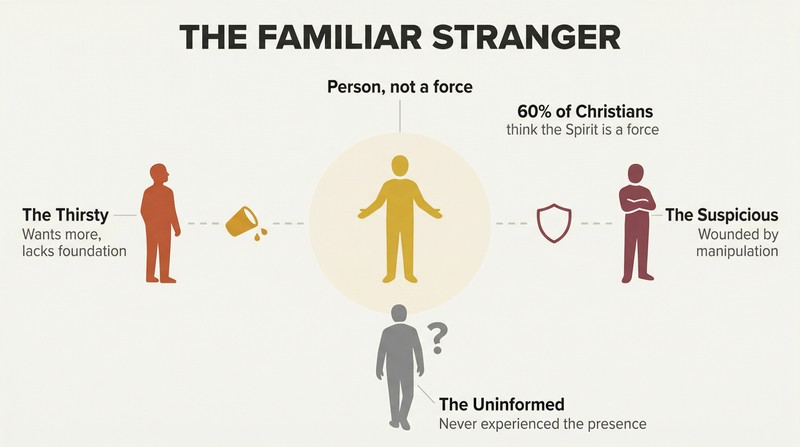
The Spirit is a familiar stranger. Staton describes the Holy Spirit as that person in your friend group you've sat in a room with for hours but never actually spoken to one-on-one. A 2022 "State of Theology" survey found that 60% of committed American Christians believe the Holy Spirit is a force, not a person — a familiar stranger rather than someone to know and be known by.
Three audiences need this reintroduction. The thirsty want more of God but lack biblical foundation. The suspicious have been wounded by manipulative charismatic environments. The uninformed have simply never experienced the Spirit's presence and power. Staton's aim is to reintroduce the Spirit as a person to relate to, not a power to wield or an experience to force.
Jesus said the Spirit upgrades his physical presence — we don't buy it
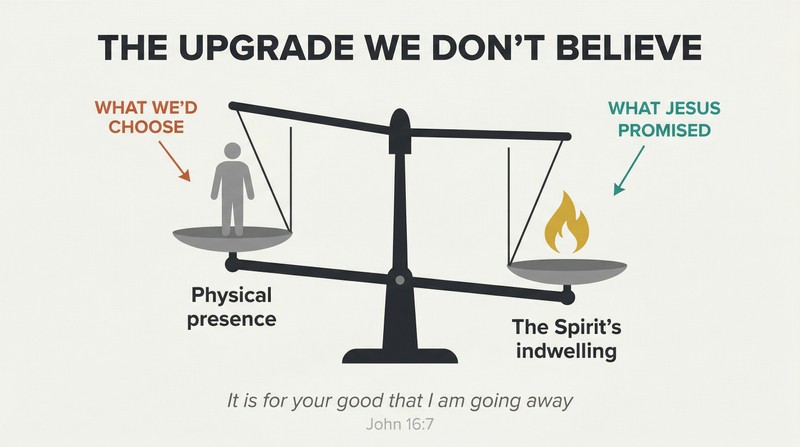
On his final night, Jesus told his disciples something baffling: "It is for your good that I am going away" (John 16:7). He claimed that the Holy Spirit's indwelling presence would surpass even face-to-face conversation with God in the flesh. Staton compares this to promising disappointed kids that croquet in the backyard will beat the mini golf course they'd set their hearts on.
Spiritual health means closing the gap between biblical promise and everyday experience — borrowing from Carl Jung's insight that psychological health means narrowing the distance between perceived and actual self. The Holy Spirit is the experiential agent narrowing that gap, turning the rumored life of Scripture into lived reality. Without the Spirit, pastors carry a weight they were never meant to bear alone.
The Spirit translates Jesus from head-knowledge into heart-healing
The Spirit's ministry is translation, not origination. The Spirit takes everything Jesus taught and pushes it from intellectual understanding into experiential, heart-level healing — rewriting neural pathways and enabling believers to embody their redemption. The Hebrew word yada, often translated "know," doesn't mean merely intellectual understanding but relational, experiential knowing — so intimate that Old Testament translations sometimes use it as a euphemism for sex.
This translation is targeted. In one story, a relative stranger named Gavin received a mental image during prayer — a man wrestling an octopus on a beach — that precisely accessed a buried traumatic memory tied to months of sleeplessness and anxiety. That prophetic image became a channel for God's love to reach the exact wound generic comfort could never touch.

Your deepest wounds, not your gifts, are your greatest ministry
Felix served three prison sentences and battled drug addiction before meeting Jesus. After his conversion, one wound remained untouchable — the shame of being an absent father for over a decade. His deepest pain became the source of his most powerful ministry: sober and serving as head chef of Portland's largest ministry to the houseless and addicted, cooking for hundreds weekly with skills he learned behind bars.
The early church's leaders weren't particularly intelligent, attractive, or qualified — they were "unschooled, ordinary men" filled with the same Spirit that filled Jesus. The addicted can become a safe harbor for others to find freedom. The depressed can be filled with joy and give it away. The powerfully healed become powerful healers — and the healing always starts from scars.

Don't wield the Spirit for ego or study it from a safe distance
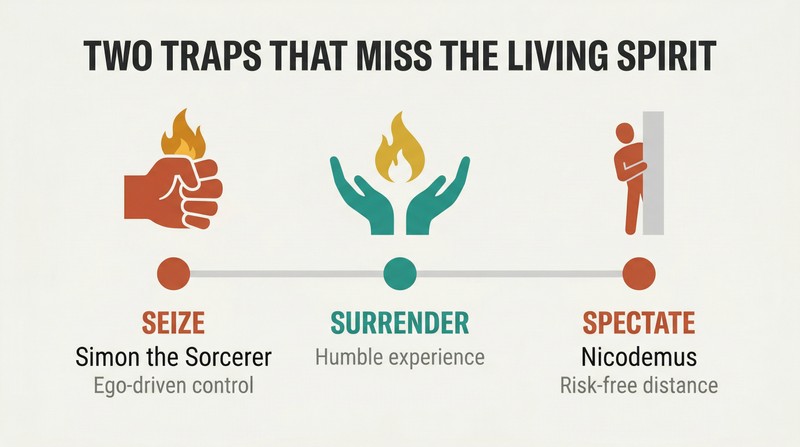
Staton diagnoses two ancient traps through two biblical characters. Simon the Sorcerer came to genuine faith but regressed into treating the Spirit as a depersonalized power source — offering money for the apostles' technique, driven by ego and the boast that he was "someone great." He mirrors B.F. Skinner's control-based psychology, seeking formulas that produce predictable spiritual results rather than humble surrender.
Nicodemus represents the opposite trap. A respected religious leader who kept approaching Jesus but couldn't shed his robes of status to risk genuine experience. He spectated from the riverbank, admiring Jesus' power without wading in. Staton names this posture functional cessationism — technically believing the Spirit's gifts are available while adopting a passive, risk-free stance toward them. Both extremes miss the living Spirit.
Claim the Spirit's power — not just the Father's forgiveness
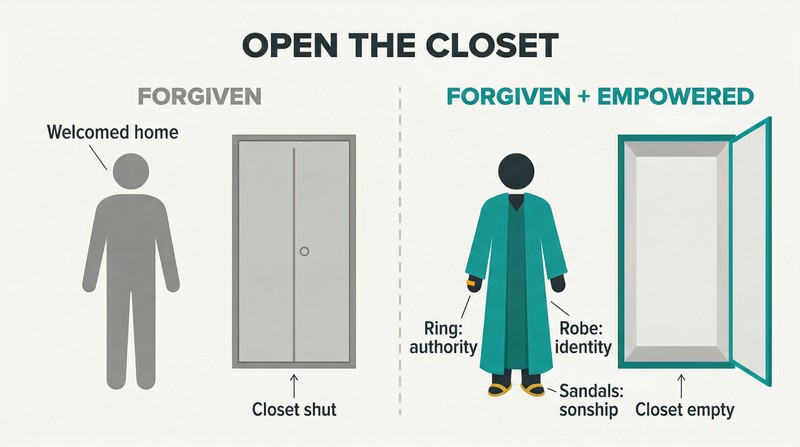
In the Prodigal Son parable, the father didn't just forgive his returning child — he gave him a ring, robe, and sandals symbolizing authority as an heir. Staton argues that many Christians are like the prodigal without the gifts: welcomed home, forgiven, clean — but the closet stays shut. Forgiveness without authority.
The empowerment is grounded in how Jesus operated. Staton argues that Jesus performed miracles not by his own divine power but by the anointing of the Holy Spirit — the historic view of the church, obscured by a post-Enlightenment reactionary theology only about 300 years old. Before his baptism, Jesus lived thirty unremarkable years. After the Spirit descended like a dove, everything changed. That same Spirit now anoints every follower of Jesus.
Learn God's whisper in the mundane before you need it in crisis
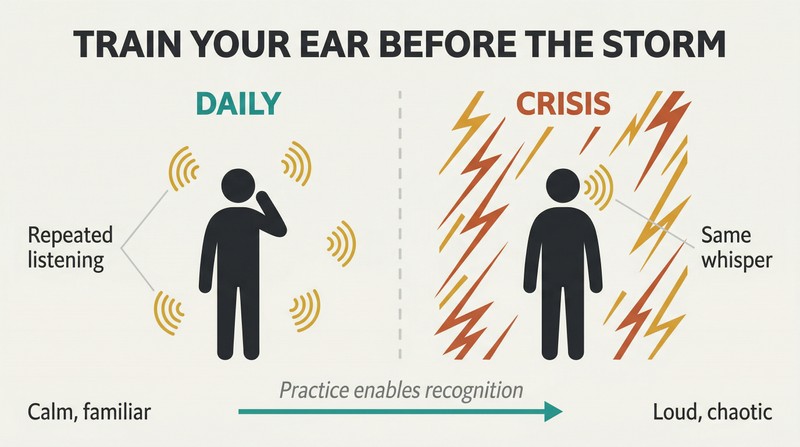
On Mount Horeb, Elijah expected God in the earthquake, wind, and fire — but God came as a still, small voice. On the Emmaus road, the risen Jesus walked alongside two disciples and nearly passed right by unrecognized. Staton identifies a biblical pattern: God's native language is a whisper — intimate rather than evasive, because loud displays polarize while whispers cultivate trust.
Treat discernment as a daily vitamin, not a crisis prescription. Fourth-century monk John Cassian taught disciples to become prudent money changers — so familiar with genuine coins they could identify counterfeits by weight and feel. Staton practices the Prayer of Examen daily: five steps of gratitude, asking, reviewing, repentance, and renewal — training to recognize God in hindsight until you recognize him in real time.
Risk looking foolish — prophecy grows through obedience, not formulas
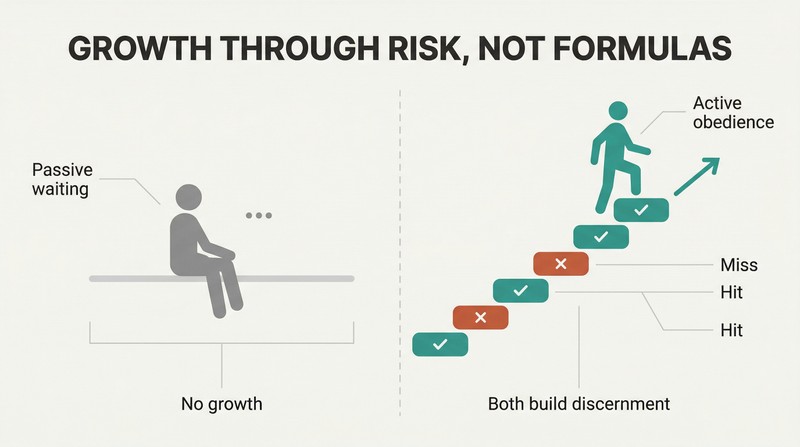
Prophecy means hearing God for others — not primarily future-telling but "speaking on behalf of another." Paul commands believers to "eagerly desire gifts of the Spirit, especially prophecy" — the Greek zeloo meaning to burn with zeal. Yet most Christians relate to God's voice passively: "If God wants to speak, I'm here." That passive posture contradicts Scripture's direct command.
The practice involves three movements: listening for thoughts or images that seem to arrive from outside your imagination, speaking after filtering through the ABCs (affirming, biblical, Christlike), and receiving with discernment. A friend of Staton's once shared a prophetic word on a train that completely missed the mark. In another instance, a prophetic word at a retreat identified someone with a suicide note at home — and saved his life that day.
Healing is a Kingdom preview — seek it eagerly without a recipe
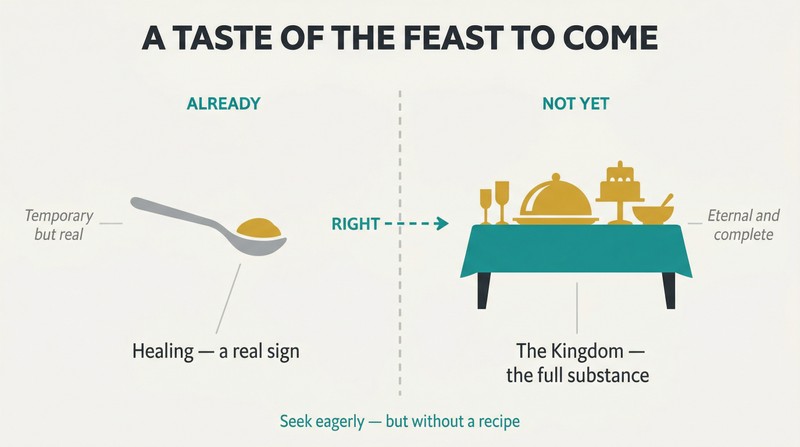
Staton frames healing through a sign-versus-substance distinction. Healing is a real, tangible, supernatural sign of the coming Kingdom — but not the substance itself. Like a kid desperate to lick cake batter off a spoon before the birthday feast, we should eagerly seek healing while knowing the full celebration is ahead. Every healing this side of heaven is temporary; Lazarus was resuscitated, not resurrected.
Six ingredients emerge from Scripture without forming a recipe:
1. Faith is a factor, but shame over "not enough faith" is the deceiver's lie
2. Preparation through prayer and fasting matters
3. Simple prayer — even one-sentence commands — is all it takes
4. Persistence may be required; even Jesus prayed twice for one blind man
5. Both healing and suffering are redemptive
6. Healing prayer never replaces medicine
The Spirit doesn't exit the valley — his power is alive in suffering
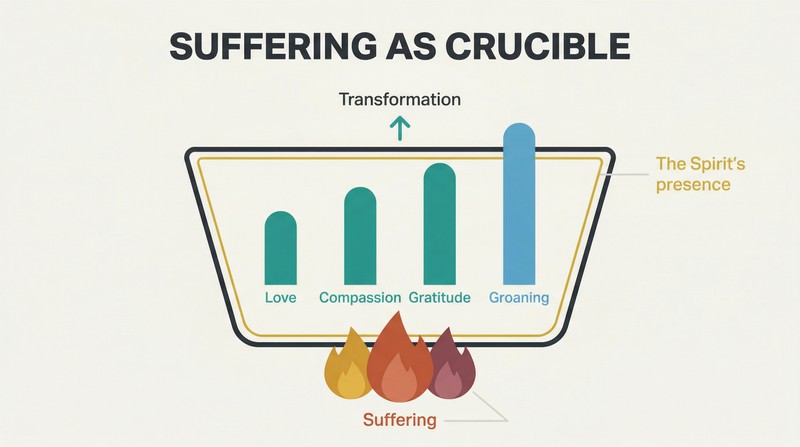
Writing from a chemotherapy chair while battling advanced-stage cancer, Staton insists the Spirit's power doesn't evacuate when suffering arrives. Weeks earlier he'd led a healing workshop for thousands; now tumors in his stomach required aggressive chemo. The same Spirit who fills believers with resurrection power also fills them with redemptive patience.
Suffering becomes a crucible for transformation through four movements: love (weakness invites others to care for us), compassion (our pain creates empathy for others' pain), gratitude (diagnosis reveals what's truly priceless), and groaning — the Spirit's intercession through "wordless groans" when we can't find our own prayers. Romans 8 promises the Spirit translates our inarticulate wails into communion with the Father. The practice of lament — brutally honest prayer — keeps the conversation open when suffering threatens silence.
Stay rooted in one messy church — spiritual fruit requires stability
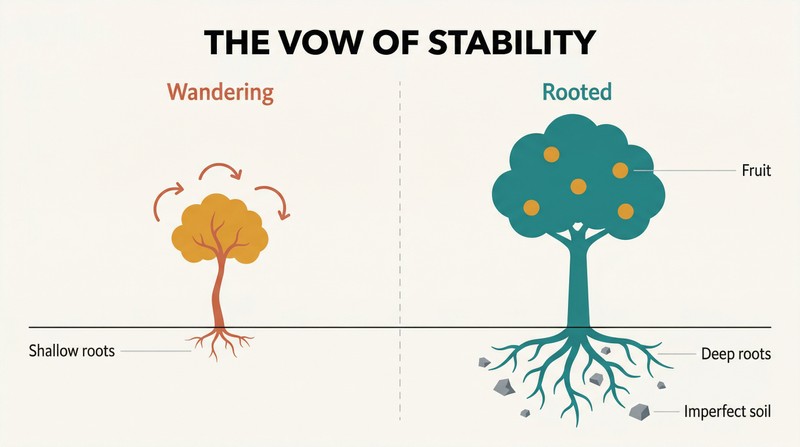
Pentecost was a spectacle, but the world-changing force wasn't the event — it was the community left behind. Journalist Sebastian Junger found that soldiers voluntarily return to war because thick community in the barracks exceeds comfortable isolation at home. The same pattern appeared with early American settlers abandoning colonial society to join Native tribes.
Saint Benedict created the vow of stability — a radical commitment to stay in one place among imperfect people — because rootless monks he called gyrovagues ("wandering in circles") were stunting their own growth. Staton's diagnosis of the modern church is similar: we short-circuit formation by bouncing between communities. Patience grows by bearing with difficult people. Kindness grows through conflict. Self-control grows where we're tempted toward gossip. People who stay also grow.
Analysis
Staton occupies an increasingly crowded but still underserved niche: the theologically rigorous pastor who takes charismatic experience seriously without descending into hype. What distinguishes this book from other Holy Spirit titles is its refusal to be positioned on either side of the cessationist-continuationist debate. Instead, Staton diagnoses both camps as malformed — the Simon camp reducing the Spirit to a power source and the Nicodemus camp reducing him to a theological concept. This dual diagnosis, drawn from lesser-known biblical characters, provides a more useful framework than the standard 'be open to the Spirit' exhortation.
The book's strongest contribution is its theology-model-practice framework, borrowed from Wimber but applied comprehensively. Most Spirit-focused books either stay in the theology lane (leaving readers with no idea how to start) or leap to practice without grounding (leaving readers vulnerable to manipulation). Staton's insistence on safe space to fail together addresses the primary reason most Christians never exercise spiritual gifts: no one showed them how in a low-stakes environment.
The narrative structure is perhaps the book's greatest risk and reward. Staton's personal stories — his son's miraculous shoulder healing, his own cancer diagnosis mid-book, the London pastor's prophetic word — give abstract theological claims embodied weight. But the sheer volume of anecdotes occasionally substitutes emotional resonance for rigorous engagement with counterarguments. The cessationist position is dispatched rather quickly, and the theodicy question receives the honest but incomplete answer of 'I don't know.'
Where Staton genuinely advances the conversation is in connecting the Spirit's power to community formation. His final chapter, drawing on Junger's research and Benedict's vow of stability, argues that supernatural ministry and rooted community are not separate tracks but the same track. This synthesis of charismatic power and communal rootedness is rare in contemporary Christian literature and represents the book's most original theological contribution — a both/and vision modeled through the author's own story of planting churches, battling cancer, and watching his infant son survive three open-heart surgeries.
Review Summary
The Familiar Stranger by Tyler Staton receives overwhelmingly positive reviews, with an average rating of 4.68 out of 5 stars. Readers praise Staton's balanced approach to discussing the Holy Spirit, combining theology with personal stories. Many found the book enlightening, convicting, and transformative, appreciating its practical guidance and emphasis on love. Reviewers highlight Staton's ability to make complex spiritual concepts accessible while maintaining depth. The book is frequently described as challenging yet encouraging, inspiring readers to deepen their relationship with the Holy Spirit.
People Also Read


Glossary
Familiar Stranger
The Holy Spirit, unknown personallyStaton's central metaphor for the Holy Spirit as a person most Christians know about but have never personally related to — like someone in your friend group you've shared a room with but never directly spoken to. The term captures the tragedy that the third person of the Trinity, whom Jesus was so eager to give, has become mysterious and divisive in today's church.
Ruakh
Hebrew for spirit or breathA Hebrew word appearing in Genesis 1:2 that can be translated as either 'spirit' or 'breath.' It describes both the Spirit of God hovering over creation and the breath of life God breathed into the first humans. Staton traces this word across the entire biblical narrative — from Genesis through Ezekiel's dry bones vision to Jesus breathing on his disciples — to show the Spirit's identity as God's creative and re-creative breath.
Parakletos
One called alongside to helpGreek title Jesus gives the Holy Spirit in John 14–17, used four times in one conversation. In first-century maritime usage, it referred to a rescue boat that would attach to a stranded vessel and tow it back to harbor. Jesus uses it to describe the Spirit in three roles: Comforter (present in our pain), Advocate (defending against the accuser's lies), and Counselor (guiding through pointed questions toward deeper healing).
Functional Cessationism
Passive openness without active pursuitStaton's term for Christians who technically believe the Spirit's supernatural gifts are still available today but adopt a passive posture toward them — 'If God wants to heal me, I'm right here' — without seeking, practicing, or developing openness to the Spirit's power. Distinguished from formal theological cessationism, which holds that miraculous gifts ceased after the apostolic age. Staton calls this a tactic never employed in other areas of spiritual growth.
Theology, Model, and Practice
Framework for living out ScriptureA three-part framework from Vineyard founder John Wimber for translating any biblical truth into lived experience in a local community. Theology is a shared understanding of what Scripture teaches. Model is a contextual expression suited to a particular community and place. Practice is protected space where stakes are lowered and mistakes are allowed — like a team rehearsal rather than a performance. Staton argues the Spirit's ministry feels inaccessible because most churches lack coherent models and safe spaces for practice.
Nephesh
Hebrew for whole-person soulA Hebrew word appearing over 700 times in the Old Testament, commonly translated 'soul' but literally meaning 'throat.' Ancient Israelites used it to refer to the whole person — a living, breathing, spiritual being — since what passes through the throat nourishes and expresses the whole life. Staton uses it to illustrate that God's healing addresses the entire person, not just the body, drawing on Tim Mackie's experience of throat healing as a sign of whole-person renewal.
Prayer of Examen
Daily five-step discernment prayerA prayer practice developed by Saint Ignatius involving five movements: gratitude for God's gifts, asking for the Spirit's insight, reviewing the day for moments of God's presence (noticed or missed), repentance for rejected invitations, and renewal through resolve for the next twenty-four hours. Staton practices it daily on his bike commute, describing it as learning to recognize God in hindsight so you eventually recognize him in real time.
Prudent Money Changer
Cassian's metaphor for discernmentA metaphor from fourth-century monk John Cassian describing the practice of discernment. Just as Roman-era money changers grew so familiar with genuine coins that they could instantly identify counterfeits by weight, engraving, and metal composition, Christians should grow so familiar with God's voice that they can quickly distinguish it from the deceiver's lies — recognizing what inflames the ego versus what nourishes the soul.
Gyrovagues
Rootless wanderers between communitiesSaint Benedict's term for monks who were 'wandering in circles' — from Latin gyro (circle) and vagues (wander). They were rootless followers who never committed to one community, enslaved to their own preferences. Benedict created the vow of stability as a direct counter to this pattern. Staton applies the concept to modern Christians who bounce from church to church, arguing that spiritual formation requires staying rooted among imperfect people over the long haul.
FAQ
What is The Familiar Stranger by Tyler Staton about?
- Experiential focus: The book reintroduces the Holy Spirit as a person to be known and experienced, not just a theological concept or force.
- Personal journey: Tyler Staton shares his own spiritual hunger and journey from reading about the Spirit to living in the Spirit’s power.
- Structure and aim: The book is structured around understanding the Spirit’s personhood, identifying unhealthy spiritual models, and offering practical guidance for Spirit-empowered living.
- Invitation to all: It invites Christians from all backgrounds—curious, skeptical, or uninformed—to deepen their relationship with the Holy Spirit.
Why should I read The Familiar Stranger by Tyler Staton?
- Bridges gap: The book addresses the gap many Christians feel between biblical promises about the Spirit and their lived experience.
- Balanced approach: Staton avoids extremes, offering a healthy, scriptural, and practical path to experiencing the Spirit.
- Practical and theological: It combines biblical theology, real-life stories, and actionable advice, making the supernatural accessible.
- Encourages transformation: Readers are challenged to move from passive belief or skepticism to active participation in the Spirit’s ministry.
What are the key takeaways from The Familiar Stranger by Tyler Staton?
- Spirit as person: The Holy Spirit is a relational person to be known, not just a power to wield.
- Unhealthy models: Staton identifies and critiques two common but unhealthy models of spiritual experience: the Simon the Sorcerer model (power/control) and the Nicodemus model (intellectual/passive).
- Practical spirituality: The book offers practical steps for discernment, prophecy, healing, witness, and redemptive suffering.
- Community emphasis: Spiritual gifts and growth flourish best in committed, loving church communities.
What are the best quotes from The Familiar Stranger by Tyler Staton and what do they mean?
- “The Holy Spirit is a staggering improvement to a direct, face-to-face conversation with God in the flesh.” — Highlights Jesus’ promise that the Spirit’s presence surpasses even his own physical presence.
- “Where the Spirit of the Lord is, there is freedom.” — Emphasizes that true Spirit-led life is marked by freedom, not control or manipulation.
- “God has never cared much for the qualified, but he’s shaped history through the available.” — Encourages openness and availability over expertise in Spirit-empowered ministry.
- “The scandal of the Holy Spirit isn’t power. The scandal is the power of God dwelling in and operating through wounded, ordinary people.” — Reframes the Spirit’s power as accessible and transformative for all believers.
How does Tyler Staton in The Familiar Stranger define the “familiar stranger” concept of the Holy Spirit?
- Common yet unknown: The Holy Spirit is often present in Christian life but remains misunderstood or underappreciated, like someone you know by association but have never truly met.
- Misconceptions: Many see the Spirit as a force to control rather than a person to love, with surveys showing this is a widespread view.
- Jesus’ promise: Jesus said the Spirit’s coming would be “for your good,” yet many Christians are skeptical or underwhelmed by their experience.
- Call to relationship: Staton urges moving from mere familiarity to genuine, relational encounter with the Spirit.
What are the key biblical metaphors for the Holy Spirit in The Familiar Stranger by Tyler Staton?
- Breath: The Spirit is the breath of God, giving life and re-creating the lifeless (Genesis 1:2; Ezekiel 37; John 20).
- Water: The Spirit is living water, symbolizing cleansing, renewal, and life amid chaos (Ezekiel 47; John 7).
- Dove: The Spirit descends like a dove at Jesus’ baptism, representing peace, purity, and empowerment for ministry (Matthew 3; Luke 3).
What unhealthy models of spiritual experience does Tyler Staton critique in The Familiar Stranger?
- Simon the Sorcerer model: Treats the Spirit’s power as a tool for control or spectacle, seeking formulas to manipulate outcomes.
- Nicodemus model: Values intellectual understanding but is passive or suspicious about experiential spirituality, avoiding risk and vulnerability.
- Consequences: Both models distort the Spirit’s ministry—one by misuse, the other by neglect—leading to dysfunction and division.
- Balanced path: Recognizing these models helps believers pursue a healthy, balanced spirituality.
How does The Familiar Stranger by Tyler Staton explain the role of the Holy Spirit in creation and re-creation?
- Spirit at creation: The Spirit is present at the beginning, hovering over chaos and breathing life into humanity (Genesis 1:2; 2:7).
- Re-creation after the fall: The Spirit brings restoration and hope, as seen in Ezekiel’s vision of dry bones (Ezekiel 37).
- Jesus’ ministry: Jesus is anointed by the Spirit to bring healing and restoration, fulfilling the Spirit’s creative mission (Luke 4:18-19).
- Spirit in believers: Pentecost marks the Spirit’s outpouring, enabling believers to participate in God’s ongoing work of renewal.
What practical advice does Tyler Staton give for living a Spirit-empowered life in The Familiar Stranger?
- Theology, model, practice: Staton emphasizes a solid biblical theology, a contextual model for expression, and safe spaces for practice within community.
- Practice over perfection: He encourages environments where mistakes are allowed and learning is collective, moving from theory to lived experience.
- Five expressions: The book offers practical instruction on discernment, prophecy, healing, witness, and redemptive suffering.
- Individual and communal growth: Readers are invited to start personal practices and engage in community to cultivate openness to the Spirit’s gifts.
How does Tyler Staton in The Familiar Stranger describe the gift and practice of discernment?
- Definition: Discernment is attuning to God’s voice amid competing inner voices, distinguishing the Spirit’s whisper from deception and ego.
- Community importance: Discernment matures best in community through spiritual friendship, direction, and group discernment.
- Daily practice: The Prayer of Examen is recommended as a daily exercise to review God’s presence and invitations.
- Lifelong journey: Discernment is a lifelong commitment to listening and obeying God’s voice, even when it requires risk.
What does Tyler Staton in The Familiar Stranger teach about prophecy and how to grow in it?
- Prophecy defined: Prophecy is hearing and speaking a message from God to others, not just predicting the future but revealing God’s heart.
- Accessible to all: Prophecy is not reserved for spiritual elites; all believers are encouraged to eagerly desire and practice it.
- Community and love: Prophecy should strengthen, encourage, and comfort, always exercised in love and discernment within community.
- Practical steps: Staton advises praying specifically for the gift, practicing encouragement, and sharing words with humility and biblical grounding.
How does The Familiar Stranger by Tyler Staton explain the Holy Spirit’s role in healing, witness, and redemptive suffering?
- Healing as Kingdom sign: Healing is a supernatural sign pointing to God’s coming Kingdom, offering a foretaste of restoration.
- Witness empowered: Witnessing is living and speaking the truth of Jesus’ Kingdom, empowered by the Spirit in everyday life and sacrificial love.
- Redemptive suffering: The Spirit dignifies and repurposes suffering, enabling believers to endure, grow in love, and participate in God’s redemptive work.
- Practical guidance: Staton outlines faith, preparation, simple prayer, persistence, redemptive suffering, and cooperation with medicine as key factors in healing prayer.
About the Author
Other books by Tyler Staton
Download PDF
Download EPUB
.epub digital book format is ideal for reading ebooks on phones, tablets, and e-readers.








































