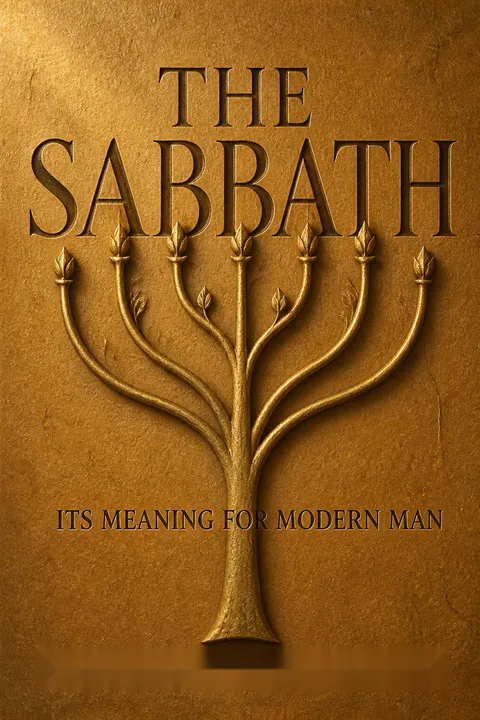

Key Takeaways
1. The Primacy of Time Over Space
To gain control of the world of space is certainly one of our tasks. The danger begins when in gaining power in the realm of space we forfeit all aspirations in the realm of time.
Modern obsession. Technical civilization, driven by the desire to subdue nature and acquire things, has become man's conquest of space. This triumph often comes at the cost of time, leading to a "thing-mindedness" that blinds us to the reality and significance of time itself. We expend time to gain space, mistakenly believing that "to have more does not mean to be more." This fixation on material possessions and spatial achievements fosters a deep-seated dread of time, which we perceive as a "slick treacherous monster" leading to inevitable death.
Time is existence's heart. Yet, time is the very "heart of existence," a realm where the goal is not to have but to be, not to own but to give, not to control but to share. The Bible, unlike other ancient traditions that associated deities with specific places or things, is profoundly concerned with time and history, seeing the world in the dimension of events rather than geography. It introduces the radical idea that holiness is primarily found in time, not space.
First holy object. The first holy object in the history of the world, as revealed in Genesis, is not a mountain or an altar, but the seventh day: "And God blessed the seventh day and made it holy." This foundational act establishes that holiness in time precedes the sanctity of man and space. Judaism, therefore, is an "architecture of time," teaching us to be attached to sacred events and to consecrate sanctuaries that emerge from the magnificent stream of a year, with the Sabbaths serving as our "great cathedrals."
2. The Sabbath: A Palace in Time
The Sabbath is not for the sake of the weekdays; the weekdays are for the sake of Sabbath. It is not an interlude but the climax of living.
A day for life. The Sabbath is not merely a day of abstaining from labor to recover strength for the coming week, as Philo suggested in the spirit of Aristotle. Instead, it is a day "for the sake of life" itself, the "climax of living," and "the end of the creation of heaven and earth." It is a divine exaltation of labor, affirming its dignity by setting it aside for a higher purpose. To enter its holiness, one must lay down the "profanity of clattering commerce" and the "fury of acquisitiveness," understanding that the world can survive without constant human toil.
Art of perfect rest. Perfect rest on the Sabbath is an art, requiring discipline and an accord of body, mind, and imagination. It is a "palace in time which we build," made of soul, joy, and reticence. Its splendor is often expressed through abstentions, a "via negationis" that conveys glory in the presence of eternity through the silence of noisy acts. This unique Jewish contribution to the idea of love—the "love of the Sabbath"—is an emotion that has filled songs and moods for millennia, a profound adoration for a day, for spirit in the form of time.
Eternity in disguise. The seventh day is a "mine where spirit's precious metal can be found," a dimension where the human is at home with the divine. It is where the "likeness of God can be found," as time is "eternity in disguise." Observing the Sabbath is a paraphrase of God's sanctification of the seventh day, offering a "window in eternity that opens into time." It is a day of delight for both soul and body, a "reminder of the two worlds—this world and the world to come," where its hours possess an inherent significance and "beauty of grandeur" independent of human achievement.
3. Beyond Civilization: A Day of Freedom and Harmony
The seventh day is the exodus from tension, the liberation of man from his own muddiness, the installation of man as a sovereign in the world of time.
Surpassing civilization. Technical civilization, while a product of human labor, often leads to man becoming a victim of his own creations, enslaved by the forces he sought to conquer. The Sabbath offers a way not to reject, but to "surpass civilization." It is a day set apart for freedom, a detachment from the "idols of technical civilization," where man's royal privilege to conquer nature is suspended. On this day, we abstain from activities that aim at remaking or reshaping the things of space, living, as it were, independent of our technological advancements.
Armistice in existence. The seventh day serves as an "armistice in man's cruel struggle for existence," a truce in all conflicts—personal, social, and with nature. It is a day of profound peace, where handling money is a desecration and anger is a double sin, even "righteous indignation." This "island of stillness" allows man to reclaim his dignity, abandoning plebeian pursuits to partake in a blessedness independent of social conditions, wealth, or career success.
No anxiety, only praise. The Sabbath is not a time for personal anxiety, care, or petitions; it is a day exclusively for praise, joy, and delight. Fasting, mourning, and expressions of grief are forbidden, and even visiting the sick requires a message of hope rather than complaint. This conscious harmony extends to all beings, as it is a day of rest for man and animal alike, fostering a "sympathy for all things and a participation in the spirit that unites what is below and what is above." It teaches us to "rest on the Sabbath as if all your work were done," even from the thought of labor.
4. The Sabbath as Israel's Beloved Mate
The Community of Israel will be your mate.
A lonely day finds its partner. An ancient allegory describes time as initially eternal and undivided, then split into seven days. The Sabbath, however, remained alone, like a king's youngest son endowed with nobility but without a mate. God's promise to the Sabbath was profound: "The Community of Israel will be your mate." This promise was fulfilled at Sinai, where the command "Remember the Sabbath day to sanctify it" (le-kadesh) also means "to betroth," impressing upon Israel their destiny to be the groom of the sacred day.
Reciprocity of spirit. This concept highlights a deep reciprocity between man and the spirit. The Sabbath, with all its grandeur, is not self-sufficient; its spiritual reality yearns for human companionship. While the six weekdays need space, the seventh day needs man. This idea resonated deeply during a time when the Temple lay in ruins, and Israel felt alone; it proclaimed that Israel was not alone, but "engaged to holiness, to eternity," a union that no one could disjoin.
Welcoming the Queen/Bride. This profound insight transformed the celebration of the Sabbath. Scholars like Rabbi Yannai and Rabbi Hanina the Great would don beautiful robes and exclaim, "Come O Bride, Come O Bride" or "Come, let us go out to welcome the Queen Sabbath." This metaphorical exemplification, while not a deification, expresses the Sabbath's preciousness as God's presence in the world, open to the soul of man. The Sabbath is both a queen and a bride, and its celebration is like a wedding, with prayers and customs reflecting this intimate union, culminating in the "escort of the queen" on Saturday night.
5. The Sabbath: A Foretaste of Eternity
The Sabbath is an example of the world to come.
Eternity in time. The idea that the Sabbath and eternity are one, or of the same essence, is an ancient and central concept. A legend recounts God offering Israel the "world to come" if they accept the Torah, and when asked for an example, He points to the Sabbath. Jewish tradition describes the Sabbath as me'en 'olam ha-ba—"somewhat like eternity" or "the world to come"—and even ma'yan—the "fountainhead of eternity." This means that a seventh part of our lives can be experienced as paradise, a revelation that scandalizes pagans but enlightens Jews.
Paradise within. To truly enjoy eternity in the world to come, one must first learn to "relish the taste of Sabbath while still in this world." The essence of the world to come is "Sabbath eternal," and the seventh day in time serves as a tangible example and "token of eternity." As the story of the rabbi in heaven illustrates, "Paradise is in the Tannaim"—eternity is not merely a posthumous destination, but a quality "planted within us," a spiritual state to be cultivated here and now.
Spirit in time. For Jewish piety, the ultimate human dichotomy is not mind and matter, but the sacred and the profane. The Sabbath law directs our bodies and minds to the dimension of the holy, teaching us that man relates not only to nature but also to its Creator. The Sabbath is "Spirit in the form of time," an ascent to the summit where we sanctify time, raise the good to the level of the holy, and behold the holy by abstaining from profanity. It reminds us that God is our father, time is life, and the spirit is our mate, a microcosm of the spiritual macrocosm.
6. Holiness Resides in Time, Not Just Space
How extremely significant is the fact that it is applied to time: "And God blessed the seventh day and made it holy."
A radical shift. Unlike other religions that projected God's consciousness into visible images or associated Him with phenomena in nature, Judaism introduced a radical shift: holiness was gradually moved from space to time, from the realm of nature to the realm of history, from things to events. The physical world was divested of inherent sanctity; to be sacred, a thing had to be consecrated by a conscious act of man, its preciousness bestowed in relation to God.
God of events. The prophets emphasized "the day of the Lord" over "the house of the Lord," envisioning a Messianic "end of days" that would restore unity to mankind. The Ten Commandments make no mention of a sacred place, instead proclaiming, "In every place where I cause My name to be mentioned I will come unto thee and bless thee." This awareness that sanctity is not bound to a particular location enabled the rise of the synagogue in every village, offering fixed times of prayer but no fixed place.
Sabbath's inherent sanctity. Even the site of the Temple in Jerusalem was chosen not for inherent supernatural qualities, but because man prayed for it and God desired it. While the Temple became sacred, its sanctity was established, not self-begotten, leading prophets to question, "Where is the house that ye may build unto Me?" The Sabbath, however, is inherently holy, sanctified by God Himself at creation, independent of human action or the lunar cycle. Its holiness precedes Israel, and even if men forsake it, its sanctity remains, requiring no ritual objects, for "the Sabbath is all holiness," a symbol in itself.
7. Coveting Time: The Path to Inner Liberty
Do not covet anything belonging to thy neighbor; I have given thee something that belongs to Me. What is that something? A day.
An additional soul. The Sabbath imparts something real to man, an almost perceptible light that glows from his face, a phenomenon observed by Rabbi Shimeon ben Yohai. On the eve of the Sabbath, man is given neshamah yeterah—an "additional spirit" or "supernal soul"—which departs at its conclusion. This additional soul, described as "all perfection" and a "holy spirit," allows for deeper insights into Torah wisdom and adorns man with a crown "like the crown of angels," reflecting a primordial light concealed since creation.
Pilgrimage to the seventh day. This profound experience requires the Sabbath not to be a lonely stranger but to be spiritually consistent with all other days. Our entire life should be a "pilgrimage to the seventh day," with the thought and appreciation of its blessings ever-present. The Sabbath serves as the "counterpoint of living," a melody sustained through life's agitations, fostering an awareness of God's presence. It is the spiritual law of gravitation, fighting against the "will to be a slave to one's own pettiness" and striving for inner liberty from the domination of things and people.
Covet the day. The Decalogue, beginning with God granting outer liberty from Egypt and ending with the tenth commandment, "Thou shalt not covet!", emphasizes the need for inner liberty. This command, uniquely reiterated twice, is practically futile unless understood in relation to the Sabbath. Judaism seeks to displace the coveting of things in space for "coveting the things in time," teaching man to long for the seventh day all week long. God Himself "coveted that day," calling it Hemdat Yamim—a day to be coveted—thereby correlating "Do not covet things of space" with the unspoken word: "Do covet things of time."
8. Time as God's Continuous Creation
Every instant is an act of creation. A moment is not a terminal but a flash, a signal of Beginning. Time is perpetual innovation, a synonym for continuous creation.
Beyond evanescence. While the common mind perceives time as evanescent and temporal, this perception arises from our focus on "things of space" that perish. In truth, time itself is everlasting, "that which never expires," and it is the world of space that "is rolling through the infinite expanse of time." From a spiritual perspective, "space is frozen time, and all things are petrified events." Time, independent of space, transcends the divisions of past, present, and future, remaining beyond our grasp and almost holy.
The eternal burning bush. Time is a mystery, "otherness," that hovers above all categories. Unlike space, which we occupy exclusively, time is shared by all living beings; "no one possesses time exclusively." Moses' vision of the burning bush, which "burned with fire, and the bush was not consumed," serves as a metaphor for time itself: "Though each instant must vanish to open the way to the next one, time itself is not consumed." It possesses "independent ultimate significance," speaking more profoundly than space in its "broken language of things."
Sanctifying the song. Time is the "process of creation," while things of space are merely its results. When we intuit time, we "hear the process of creation," becoming aware that "every instant is an act of creation, a Beginning." God's call that brought the world into being is a continuous process; "this present moment because God is present." To solve the problem of time, which transcends man, we must sanctify it. "Creation is the language of God, Time is His song, and things of space the consonants in the song. To sanctify time is to sing the vowels in unison with Him." This is man's task: to conquer space and sanctify time, sharing in the holiness at the heart of time, leading to endless peace and an awareness of eternity.
Review Summary
The Sabbath receives high praise for its poetic, philosophical exploration of sanctifying time over space. Readers appreciate Heschel's concept of Sabbath as a "palace in time" and the imagery of Sabbath as queen/bride. Many find it transformative, though some note the mystical, rabbinical approach can be challenging. Christians value the Jewish perspective on rest as sacred encounter rather than mere recuperation. The dense, lyrical writing rewards rereading. Some struggle with unfamiliar rabbinic references and repetition, but most consider it essential reading for understanding holiness, rest, and eternity's relationship to time.
People Also Read

About the Author
Other books by Abraham Joshua Heschel

Download PDF
Download EPUB
.epub digital book format is ideal for reading ebooks on phones, tablets, and e-readers.








































