

Key Takeaways
Persuade by asking sharp questions, not by delivering clever arguments
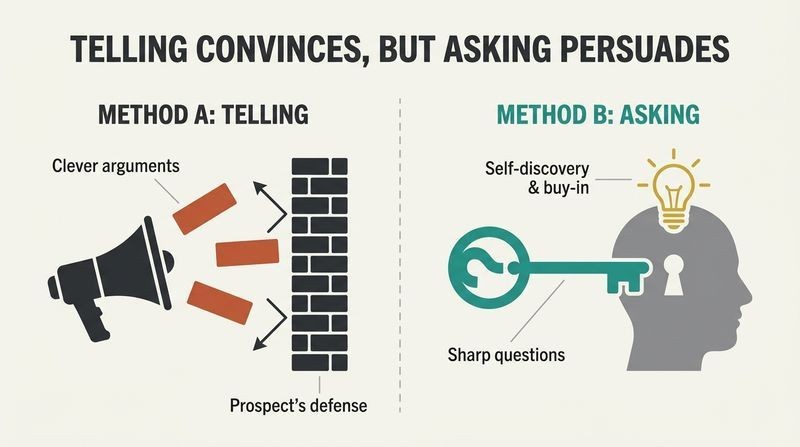
Telling convinces; asking persuades. Ziglar opens with Galileo, who climbed the Leaning Tower of Pisa and dropped two weights of different sizes to prove they land together. He won the argument, yet the University of Pisa kept teaching the old error. Galileo convinced the students but never persuaded them. That gap is the whole game in selling.
Questions do the heavy lifting. A well-crafted question makes prospects arrive at conclusions themselves, which they defend far more fiercely than anything you assert. Ziglar points to Christ answering questions with questions or parables, and to his own habit of listening for answers rather than talking over them. The salesperson's job is to interview like a caring counselor, not interrogate like a prosecutor. Curiosity, not eloquence, is the persuader's real instrument.
What's striking is how modern this feels. Research on the "self-generation effect" shows people remember and commit to ideas they produce themselves far more than ideas they are handed. Sales scholar Neil Rackham's SPIN Selling, built on 35,000 recorded calls, reached the same verdict: top performers ask more diagnostic questions and talk less. The Socratic method rests on identical logic. One caveat: questioning can curdle into manipulation when the answers are pre-scripted traps. Ziglar draws the line at intent, arguing genuine curiosity serves the prospect while leading questions serve only the quota. The distinction is real but slippery in practice.
Refunding an overcharge won a bigger sale than keeping it
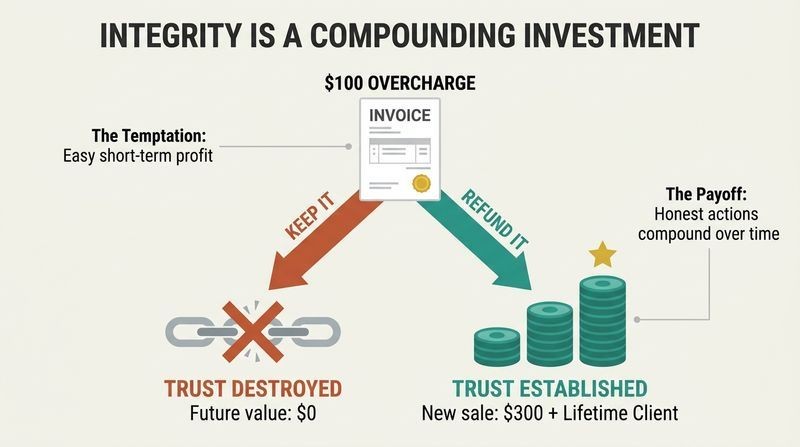
Honesty is the most practical policy. Ziglar tells of Robert Davis at Terminix pest control, whose eager new hire charged a homeowner $225 for a fifteen-minute bee job that should have cost $125 at most. When the customer politely questioned the price, Davis drove straight over, apologized, and handed back the check. The customer, disarmed, then hired them to handle roaches and ants too, producing a $300 sale and a lasting client.
Trust is what customers rate highest. The number one reason people refuse to buy is lack of trust. A casual promise is taken as gospel, and any small slip gets magnified into a deal-breaker. Ziglar frames ethics as an investment that compounds like money in the bank: the payoff may lag, but it is guaranteed. Integrity also removes the salesperson's own fear and guilt.
The Terminix story is a clean illustration of what behavioral economists call reciprocity and what game theorists call the long game. Robert Cialdini documented that unexpected concessions trigger a powerful urge to give back, which explains the roach upsell. Repeated-game theory shows cooperation dominates defection only when interactions continue, precisely Ziglar's point about selling the same product to the same people for years. The harder question he glosses over: what about businesses built on one-time transactions, where the customer never returns? There, the incentives for honesty weaken, which is exactly why reputation systems, reviews, and regulation exist to extend the shadow of the future.
Nobody buys the product; they buy what the product does for them
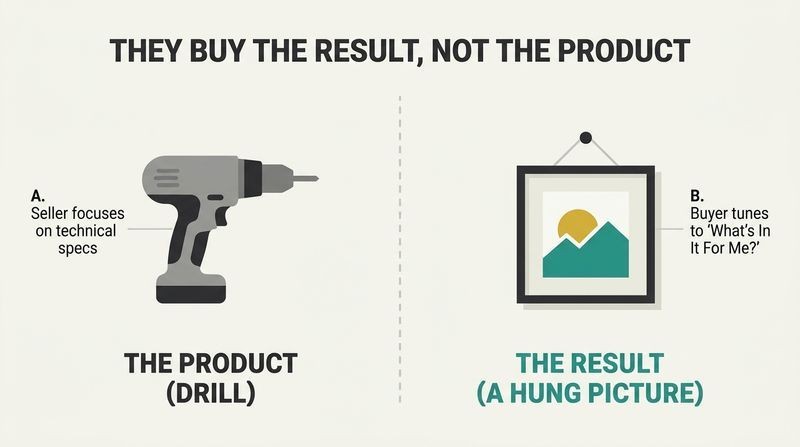
Lead with need, not features. Ziglar insists we never buy a bed, we buy a good night's sleep; we never buy a drill, we buy the hole. His consultant Nick Dalley showed up in braces, and when asked why he wanted braces he replied, "I don't want braces. I want straight teeth." Every prospect tunes to the same mental radio station, WII-FM: What's In It For Me?
Wanting beats needing. Selling cookware, Ziglar spent two hours failing to close a family who truly needed his pots but kept saying they had no money. As he packed up, the word "china" came up and the wife's eyes lit up. She bought a set of fine china worth more than the cookware. The lesson: people buy what they want when they want it more than the money it costs.
Theodore Levitt's famous marketing dictum, "people don't want a quarter-inch drill, they want a quarter-inch hole," is the same insight, and Ziglar's china story sharpens it further. Neuroscience backs the emotional premise: Antonio Damasio's patients with damaged emotional centers could reason flawlessly yet became paralyzed at simple decisions, suggesting wanting, not needing, actually drives choice. The cookware anecdote is almost uncomfortable, though. A family that cannot afford essential pots is talked into pricier china, which tests the integrity theme from the previous section. Ziglar would answer that the china genuinely delighted her, but the tension between serving desire and serving welfare is worth sitting with.
Run every sale through four steps: analyze, awaken, solve, satisfy
A repeatable architecture beats winging it. The plaid-coated, joke-telling, high-pressure peddler is extinct. Ziglar's planned-selling process gives structure that works across any product:
1. Need Analysis: x-ray the prospect with questions to uncover real needs, often hidden below the surface.
2. Need Awareness: make the lightbulb go on in your mind first, then in theirs, so both of you clearly see the specific need.
3. Need Solution: only now present your product, framed entirely as benefits.
4. Need Satisfaction: ask for the order.
Sell to needs, not symptoms. A salesperson who treats symptoms loses sales without knowing why. The point of the first two steps is to reach the true underlying need before offering anything, so the sale sticks rather than unraveling into buyer's remorse.
This four-stage funnel mirrors the consultative selling that dominated business education decades later, and it maps neatly onto medicine: diagnosis before prescription. The genius is sequencing. Most amateurs collapse steps three and one, pitching before understanding, which Ziglar likens to a doctor writing a prescription before examining the patient. The framework's weakness is rigidity in fast, transactional contexts, where a shopper who already knows what they want just needs a quick close. Ziglar concedes as much when he advises jumping straight to benefits for impatient buyers. The structure is best read as a checklist of what must happen, not a fixed script of when.
Pair an emotional trigger with logical justification using three questions
Emotion acts now, logic justifies later. Ziglar argues we make emotional decisions and then rationalize them, so using only emotion invites buyer's remorse while using only logic sends the prospect down the street to a warmer competitor. The fix is a three-question sequence. For a money-saving product:
1. "Can you see where this would save you money?" (emotional, taps fear of loss)
2. "Are you interested in saving money?" (logical, self-evident yes)
3. "When would be the best time to start saving?" (calls for action now)
Fear of loss outweighs desire for gain. The salesman Bill Callaway lost a $1,600-pricier computer deal until he divided the gap across a ten-year lifespan: forty-three cents a day for reliable service. Reframed that way, the customer said yes. Price always means more than money.
Ziglar intuited what Kahneman and Tversky later won a Nobel for: loss aversion, the finding that losses hurt roughly twice as much as equivalent gains please. His forty-three-cents-a-day reframing is textbook "pennies-a-day" pricing, a technique experiments confirm boosts compliance by shrinking a number until it feels trivial. The claim that emotion drives all decisions is slightly overstated; expertise and repetition can make choices genuinely analytical. Still, the practical wisdom holds. The three-question ladder is elegant because it lets the prospect supply the reasoning, echoing the asking-not-telling principle. The risk, again, is that the same scripts weaponized against a wary buyer feel like a trap rather than a service.
Book a daily appointment with yourself and keep it religiously
Action kills reluctance; logic cannot. Ziglar reports that 84 percent of salespeople feel call reluctance, and the first symptom is procrastination: inventing busywork to avoid facing the public. His breakthrough came from mentor P.C. Merrell, who told him to schedule his first prospect call at the exact same time every day and honor it no matter what. Results turned dramatic overnight.
Logic will not change an emotion, but action will. Reluctance is a feeling, so you cannot reason your way out; you act your way out, then let logic reinforce the action. Ziglar also reframes rejection: a prospect's no is a business refusal, not a personal verdict. They would have said no to anyone. Anxiety itself is useful, releasing adrenaline that sharpens performance. The trick is getting the butterflies to fly in formation.
This is one of the book's most durable ideas, and modern psychology validates it. Behavioral activation, a frontline treatment for depression, works on the identical premise: action precedes motivation, not the other way around. Amy Cuddy's work on "acting into" a mindset and the broader cognitive-behavioral tradition both hold that behavior reshapes emotion faster than insight does. The scheduled self-appointment is essentially an implementation intention, the "if-then" planning that Peter Gollwitzer's studies show roughly doubles goal follow-through. Reframing rejection as impersonal is also sound cognitive restructuring. The one blind spot: chronic reluctance sometimes signals a genuine mismatch between person and product, which no schedule can fix.
Sixty-three percent of pitches end without anyone asking for the order
Ask, or the answer is automatically no. Ziglar cites authority Chris Hegarty that 63 percent of sales interviews close without the salesperson ever requesting the sale. His emblem is Henry Ford, who bought a huge insurance policy from a stranger rather than a close friend in the business. When the friend asked why, Ford said simply, "You didn't ask me."
Always Ask For The Order. Ziglar abbreviates it A.A.F.T.O. and treats it as the moment many otherwise skilled salespeople freeze. A car trainee named Jim Borgman phoned a prospect who had walked away, asked whether he had bought elsewhere, learned prices there were steep, then asked where he would take his first trip in the new Suburban. The prospect pictured Kentucky, and drove back to buy. Persistent, pleasant asking, plus getting the buyer to visualize ownership, closed a deal others had abandoned.
The statistic lands because it exposes a paradox: people invest hours in a presentation, then skip the one sentence that monetizes it, usually from fear of hearing no. Psychologists call this anticipatory rejection avoidance, and it plagues far more than sales, from job negotiations to dating. Borgman's trick of asking about the first road trip is what marketers now call "future pacing," nudging the buyer to mentally rehearse ownership, which research links to higher purchase intent. The Ford anecdote is almost too tidy, but its point survives scrutiny. Worth noting: aggressive over-asking erodes trust, so the skill is calibration, asking clearly and often without tipping into pestering.
Treat every "no" as "I don't know enough yet"
No means not enough information. Ziglar reframes rejection: prospects rarely reverse a decision, but they readily make a new decision when handed new information. So a no signals a gap in what they know, not a closed door. Never argue; supply more reasons, benefits, and clarity.
Separate real objections from gorilla dust. He calls false objections gorilla dust, after male gorillas who fling dirt to create a smokescreen before a fight. To find the true objection, use two tests:
1. The Suppose Test: "Suppose that condition didn't exist, would you buy then?" This surfaces the real barrier.
2. The Isolate and Validate Test: "Is this the only thing standing between you and ownership, or is there something else?" Draw out every objection, confirm it is the last one, then resolve it and close.
Avoid becoming a gunfighter who savors defeating objections just to show off.
The distinction between stated and actual objections is the heart of skilled negotiation. Chris Voss, the FBI hostage negotiator turned author, teaches nearly the same move: surface the hidden "black swan" concern before bargaining. The Suppose Test is a form of hypothetical reframing that psychologists find lowers defensiveness because it costs the prospect nothing to answer honestly. Ziglar's gunfighter warning is underrated wisdom; the goal is the sale, not the intellectual victory, and status-driven salespeople routinely win arguments while losing customers. One nuance he underplays: sometimes no simply means no, and the professional skill includes recognizing a genuine dead end and redirecting energy to better prospects.
Open cold conversations with P.O.G.O.: person, organization, goals, obstacles
Give a track to run on. Firing questions at a stranger feels awkward, so Ziglar offers the P.O.G.O. formula, a conversational path that keeps both parties comfortable:
1. Person: show sincere interest in them, keeping your own sharing to about 25 percent.
2. Organization: learn their company, again three parts them to one part you.
3. Goals: probe what they truly want, pressing past surface answers.
4. Obstacles: uncover what stands between them and those goals.
Money is never the real goal. When a prospect names money, ask why it matters, and the true goal appears: a home, an orphanage wing, security for a family. Ziglar's colleague Jim Cathcart reframes the whole interaction as an "innerview," gathering information like a counselor rather than a fact collector. Preparation frees the creative brain to handle surprises.
P.O.G.O. is essentially rapport-building rebranded as a memorable acronym, and its ratio rule (talk one quarter, listen three quarters) aligns with communication research showing that likability rises when people feel heard. Arthur Aron's classic experiments demonstrated that escalating personal questions can generate closeness between strangers in under an hour, which is P.O.G.O.'s underlying engine. The insistence that money masks a deeper goal echoes Simon Sinek's "start with why" and the "five whys" technique from Toyota's problem-solving culture. A fair critique: some hurried buyers experience the personal phase as delay or false intimacy, so the sequence needs dialing up or down based on the prospect's own tempo, which Ziglar acknowledges.
Let an angry customer vent for two minutes without interrupting
Anger has a short shelf life. Ziglar claims almost no one can sustain full fury through speech for more than two minutes, provided you do not interrupt. Interrupting resets the clock and hands them fresh momentum. So relax physically, let your hands hang, and hear the person out completely before responding in a deliberately lowered, slowed voice that pulls them toward your calm.
Complaints are hidden opportunities. Roughly 90 percent of unhappy customers never complain to you; they simply leave and tell everyone else. So the one who yells is a gift. Thank them sincerely, acknowledge their right to feel as they do, and invite them to solve the problem together. Once resolved, follow up warmly, because a customer who was in the wrong may feel embarrassed and vanish unless you reassure them. This is the "and then some" principle: do what is expected, plus more.
The two-minute claim is folk wisdom that neuroscience roughly supports. The acute physiological surge of anger, driven by adrenaline and cortisol, does dissipate within minutes if not re-triggered, though rumination can restart it, which is exactly what interruption does. The 90 percent silent-defection figure has held up across decades of customer research and underpins the modern obsession with reviews and net promoter scores; a complaint is free market intelligence most rivals never receive. Ziglar's lower-your-voice tactic exploits emotional contagion, the well-documented tendency for people to mirror the affect of whoever they interact with. The follow-up insight about embarrassed customers fleeing is subtle and often missed even by good service teams.
You only sell two hours a day; defend them ruthlessly
Most of the day is not selling. Authorities estimate 80 percent of a salesperson's time goes to non-revenue activity: driving, waiting, parking, paperwork, service calls. Barely two hours are spent actually in front of prospects. Top performers, with no more hours than anyone else, spend twice as long face-to-face because they prioritize, not because they are more gifted.
Efficiency is doing things right; effectiveness is doing the right things. Ziglar cites Re/Max founder Dave Liniger, whose data showed 47 percent of the top 100 producers employed assistants to handle sign-planting, routine calls, and errands, freeing them to prospect and sell. These top earners worked longer weeks yet took more vacation, often four weeks a year. Keep a two-week activity log to expose where time leaks; do planning during non-selling hours so selling hours stay pure. One extra high-payoff hour daily outdistances most of the field.
The two-hour figure is sobering and remains directionally accurate; contemporary studies of field sales still find reps spend a minority of time actually selling. Ziglar's efficiency-versus-effectiveness distinction, borrowed from Peter Drucker, is the antidote to productivity theater, the busywork that feels virtuous but moves nothing. The Re/Max delegation data anticipates the leverage logic of Tim Ferriss and Michael Gerber's E-Myth: high earners systematize and outsource low-value tasks rather than grinding harder. The activity-log prescription is essentially time-tracking, which behavioral research shows changes behavior simply through measurement, the Hawthorne effect. The counterintuitive kicker, that top producers both work more and vacation more, dismantles the myth that success requires martyrdom to the calendar.
Analysis
Selling 101 is a condensed distillation of Zig Ziglar's larger works, aimed at new and struggling salespeople, and it is best understood as a moral philosophy of selling disguised as a tactical handbook. Its structure is framework-based, hanging everything on the four-step process (Need Analysis, Awareness, Solution, Satisfaction) and a cluster of memorable acronyms (P.O.G.O., A.A.F.T.O., WII-FM) engineered for recall in the field. What makes it hard to summarize is that its power lies less in novel information than in tone: a relentless reframing of selling as service, anchored by folksy anecdotes and a Southern-preacher cadence that resists paraphrase.
The book's spine is a single conviction, repeated as a credo: you can have everything in life you want if you help enough other people get what they want. Everything else, the questioning technique, the emotion-logic pairing, the integrity stories, descends from it. This is enlightened self-interest formalized, and it holds up remarkably well against later evidence-based sales research (Rackham's SPIN, Cialdini's influence work, Kahneman's loss aversion), much of which Ziglar intuited decades earlier without the data.
The weaknesses are of their era. The statistics are loosely sourced ("authorities estimate," "sales experts say"), the pseudo-scientific endorphin claims are thin, and the faith-infused framing may not travel for all readers. The cookware-to-china anecdote reveals an unresolved tension between serving desire and serving welfare that the integrity chapters never fully reconcile. And the persuasion-versus-manipulation line, drawn entirely at intent, is philosophically fragile since intent is invisible and self-serving.
Still, the core remains durable and modern: ask more than you tell, sell benefits not features, act your way past fear, always request the order, and guard your selling hours. Stripped of the dated packaging, Ziglar's message is that trustworthiness is the ultimate competitive advantage, a claim the subscription economy and online-review era have only made more true.
Review Summary
Selling 101 by Zig Ziglar receives positive reviews for its concise and practical approach to sales fundamentals. Readers appreciate its straightforward advice, particularly for beginners. The book covers topics like prospecting, client interactions, and closing techniques. While some find it basic or outdated, many value its timeless principles and motivational tone. Critics note its focus on product sales rather than services. Overall, readers recommend it as a quick, informative read for those new to sales or seeking a refresher on core concepts.
People Also Read







Glossary
Four-Step Formula
Ziglar's core selling sequenceZiglar Training Systems' planned-selling process consisting of Need Analysis (uncover the prospect's real needs through questions), Need Awareness (make both parties clearly see the specific need), Need Solution (present your product framed as benefits), and Need Satisfaction (ask for the order). Applies across any product or service; the time spent on each step varies but every successful sale involves all four.
WII-FM
What's In It For MeZiglar's mnemonic (borrowed from trainer Don Hutson) that every prospect mentally tunes to the radio station WII-FM: What's In It For Me? It captures the principle that people never buy what a product is, only what it does for them, so the salesperson must translate every feature into a personal benefit.
A.A.F.T.O.
Always Ask For The OrderZiglar's abbreviation for the final and most-skipped step of selling: explicitly requesting the sale. He cites that 63 percent of sales interviews end without the salesperson ever asking, and uses Henry Ford's line ("You didn't ask me") to drive it home. Persistent, pleasant asking often closes deals others abandon.
P.O.G.O. Formula
Person, Organization, Goals, ObstaclesA conversational interview structure for the information-gathering phase. The salesperson explores the prospect's Person (personal interests), Organization (their company), Goals (what they truly want), and Obstacles (what blocks those goals), keeping self-disclosure to about 25 percent so the prospect does most of the talking.
Gorilla Dust
False, smokescreen objectionsZiglar's term for fake objections prospects throw up to obscure their real hesitation, named after male gorillas who fling dirt to create a smokescreen before fighting. To distinguish gorilla dust from genuine objections, he recommends the Suppose Test and the Isolate and Validate Test.
Homeostatic Balance
Prospect's comfortable status quoA concept (introduced to Ziglar by Bryan Flanagan) that an organism stays in equilibrium until an outside force disrupts it, and people rarely act until they feel out of balance. In selling, the professional's job during Need Awareness is to reveal an imbalance that already exists, making the prospect uncomfortable enough to want a solution.
Feature, Function, Benefit
What a product is, does, providesA three-part distinction: a feature is a part of the product (a pen's clip), a function is what that part does (holds the pen to your pocket), and a benefit is the advantage to the customer (you don't lose the pen). Ziglar insists salespeople lead with benefits, since prospects pay for benefits, not features.
Prospect versus Suspect
Qualified buyer versus mere nameA suspect is just a name that offers hope but no verified potential. A prospect has a need for the product, a possible desire to own it, and the financial capacity to buy. Ziglar says you spend time with suspects but invest time with prospects, and urges Always Be Prospecting (ABP).
FAQ
What's "Selling 101: What Every Successful Sales Professional Needs to Know" about?
- Overview: "Selling 101" by Zig Ziglar is a comprehensive guide for sales professionals, focusing on the essential skills and principles needed to succeed in sales.
- Core Focus: The book emphasizes the importance of integrity, persuasion through questioning, and building long-term relationships with clients.
- Structure: It is structured around a four-step selling process: Need Analysis, Need Awareness, Need Solution, and Need Satisfaction.
- Purpose: The book aims to equip salespeople with the tools to not only close sales but also to create satisfied, repeat customers.
Why should I read "Selling 101" by Zig Ziglar?
- Proven Techniques: Zig Ziglar is a renowned sales expert, and his methods have been proven effective over decades.
- Comprehensive Approach: The book covers all aspects of the sales process, from prospecting to closing, making it a valuable resource for both new and experienced salespeople.
- Focus on Integrity: It emphasizes ethical selling practices, which are crucial for building trust and long-term success in sales.
- Practical Advice: The book provides actionable tips and strategies that can be immediately applied to improve sales performance.
What are the key takeaways of "Selling 101"?
- Integrity is Key: Selling with integrity is essential for building a sustainable sales career and maintaining customer trust.
- Ask, Don't Tell: Persuasion is more effective through asking questions and listening rather than telling.
- Four-Step Process: The book outlines a four-step selling process: Need Analysis, Need Awareness, Need Solution, and Need Satisfaction.
- Customer Satisfaction: Beyond making a sale, the focus should be on ensuring customer satisfaction to foster repeat business.
What are the best quotes from "Selling 101" and what do they mean?
- "You can have everything in life you want if you will just help enough other people get what they want." This quote emphasizes the importance of focusing on the customer's needs and desires to achieve personal success.
- "Selling with integrity is the only way you can build a long-term career." It highlights the necessity of ethical practices in sales for career longevity.
- "Questions are the answer." This underscores the book's focus on using questions to understand customer needs and build trust.
- "A.A.F.T.O.: Always Ask For The Order." This quote stresses the importance of confidently asking for the sale to close deals effectively.
How does Zig Ziglar define integrity in "Selling 101"?
- Foundation of Trust: Integrity is the foundation of trust in sales, allowing salespeople to build long-term relationships with clients.
- Ethical Selling: Selling with integrity means being honest about the product's benefits and not overstating them to make a sale.
- Fear and Guilt Elimination: With integrity, salespeople have nothing to fear or hide, which eliminates guilt and allows them to be authentic.
- Career Stability: Integrity leads to a stable career, as it encourages repeat business and customer loyalty.
What is the four-step selling process in "Selling 101"?
- Need Analysis: This step involves asking questions to uncover the customer's needs and wants.
- Need Awareness: Here, the salesperson helps the customer become aware of their needs and how the product can fulfill them.
- Need Solution: The salesperson presents the product as a solution to the customer's identified needs.
- Need Satisfaction: This final step involves closing the sale by ensuring the customer is satisfied with the solution provided.
How does "Selling 101" suggest overcoming call reluctance?
- Understand Anxiety: Recognize that anxiety is a natural part of the sales process and can be used to your advantage.
- Focus on the Prospect: Shift focus from personal fears to the prospect's needs and how you can help them.
- Set Clear Objectives: Before making a call, have a clear objective, whether it's setting an appointment or closing a sale.
- Regular Schedule: Establish a regular schedule for making calls to build discipline and reduce reluctance.
What role do questions play in the sales process according to "Selling 101"?
- Build Trust: Asking questions shows genuine interest in the customer, building trust and rapport.
- Uncover Needs: Questions help uncover the customer's needs, wants, and problems, which are crucial for tailoring the sales pitch.
- Combine Emotion and Logic: Effective questions combine emotional and logical elements to persuade the customer.
- Guide the Conversation: Questions guide the sales conversation, allowing the salesperson to control the flow and direction.
How does "Selling 101" address handling objections?
- Identify True Objections: Use tests like the "Suppose" and "Isolate and Validate" to identify real objections versus "gorilla dust."
- Empathize with Prospects: Understand and empathize with the prospect's concerns without necessarily agreeing with them.
- Provide New Information: Overcome objections by providing new information that addresses the prospect's concerns.
- Stay Professional: Maintain professionalism and avoid arguing with the prospect, focusing instead on finding solutions.
What is the importance of customer satisfaction in "Selling 101"?
- Beyond Service: The book emphasizes moving beyond mere customer service to ensuring complete customer satisfaction.
- Long-Term Relationships: Satisfied customers are more likely to become repeat buyers and refer others.
- Handling Complaints: Effectively handling complaints can turn dissatisfied customers into loyal ones.
- Value of Feedback: Customer feedback is valuable for improving products and services and enhancing customer satisfaction.
How does "Selling 101" suggest managing time effectively?
- Prioritize High-Payoff Activities: Focus on activities that directly generate sales and revenue.
- Delegate Non-Sales Tasks: Delegate administrative and non-sales tasks to free up time for selling.
- Use a Time Log: Keep a time log to identify and eliminate time-wasting activities.
- Plan and Prepare: Use tools like planners to organize tasks and ensure efficient use of time.
What is the significance of the P.O.G.O. formula in "Selling 101"?
- Structured Interview: The P.O.G.O. formula provides a structured approach to conducting sales interviews.
- Person, Organization, Goals, Obstacles: It stands for Person, Organization, Goals, and Obstacles, guiding the salesperson through key areas of inquiry.
- Builds Rapport: By focusing on these areas, salespeople can build rapport and gather valuable information.
- Tailored Solutions: The information gathered helps tailor solutions to the customer's specific needs and challenges.
About the Author
Other books by Zig Ziglar






Download PDF
Download EPUB
.epub digital book format is ideal for reading ebooks on phones, tablets, and e-readers.








































