


Key Takeaways
Office politics isn't dirty scheming; it's how you get anything done
Politics is neutral machinery, not villainy. McIntyre argues that politics is simply what happens whenever people with different goals, personalities, and interests try to work together. The process itself carries no morality; only motives and outcomes do. Both a saint and a tyrant can be politically skilled. When you take a job, you are automatically a player whether you like it or not.
Winning means acquiring the power to reach your goals, whatever they are: promotion, autonomy, security, interesting work, or just surviving change. Consider Kelly, a marketing grad stuck as an assistant. Trying to impress managers, she flaunted her superior knowledge and alienated every fellow assistant, who spread word she was arrogant. Her self-promotion backfired and killed her promotion chances. She mismanaged relationships while managing tasks, and that is the political failure at the heart of the book.
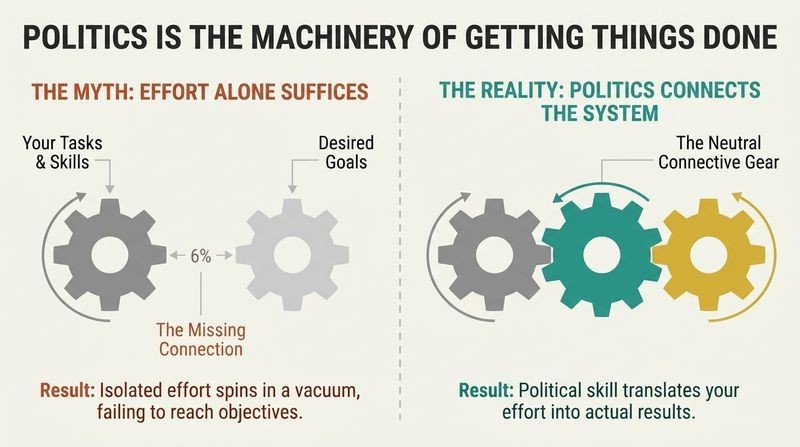
What's striking is how McIntyre reframes a word most people spit out with contempt. This mirrors Aristotle's view that humans are inherently political animals; conflict over shared resources is baked into collective life. The framing also disarms the moral squeamishness that keeps talented people passive. Research on organizational citizenship and networking behavior consistently finds that visibility and relationship quality predict advancement beyond raw performance. One caution: neutrality can be a convenient rationalization. Naming everything politics risks laundering genuinely manipulative behavior. McIntyre partly hedges this with her ethical rule, but the line between building relationships and cynical maneuvering is often blurrier in practice than her clean framing suggests.
Convert every whining wish into an action-owning goal
Wishes are passive; goals put you in the power seat. McIntyre's first practical move is linguistic. Wishes focus on what you want others to do ("I wish my boss weren't a moron"), implying you are at the mercy of the world. Goals describe what you yourself will do ("I will communicate more positively with my boss"), which returns control to you.
Jeff illustrates the trap. After a reorganization, this executive kept reporting to the old CEO, ignored his new boss, and made sarcastic remarks within earshot. He was burning energy obsessing about the past and wishing things would revert. Only when asked point-blank what he actually wanted did he choose to stay and rebuild management relationships, using one guideline: what would a committed team member do here? To convert a wish: define the specific result, name the obstacles, identify what you personally can do, then write an "I will" statement.
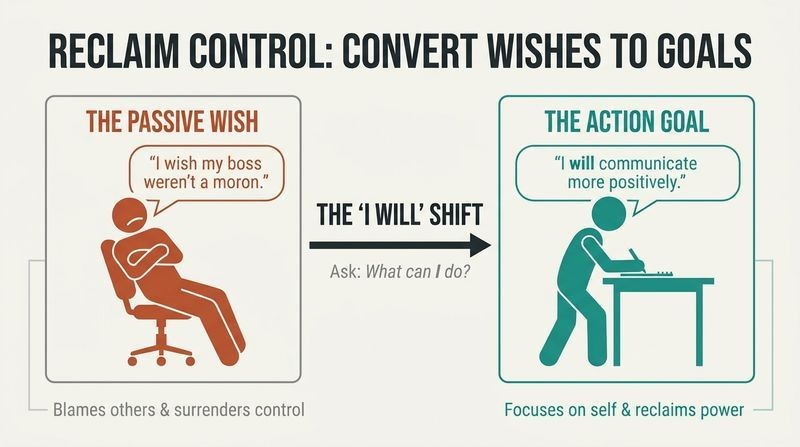
This echoes the psychology of locus of control: people who attribute outcomes to their own actions show greater persistence and lower learned helplessness than those who feel externally controlled. It also anticipates the implementation-intention research of Peter Gollwitzer, where phrasing goals as concrete if-then actions dramatically raises follow-through. The reframe from wish to goal is essentially a cognitive shift from rumination to agency. The limitation worth flagging: not every unfair situation is solvable through personal reframing. Sometimes the honest answer is that the obstacle is structural, and relentless self-ownership can tip into self-blame. McIntyre's own escape valve, leave for a better place, matters as much as the reframe.
Stop chasing fairness; hunt for leverage instead
Fairness is impossible; leverage is everything. McIntyre insists there is no absolute standard of fairness because it lives entirely in perception. Give everyone an identical 10% raise and the hard workers cry foul. She urges readers to accept five Organizational Facts of Life: organizations are not democracies, some people hold more power, nearly all decisions are subjective, your boss controls much of your life, and fairness is unattainable.
Leverage is your ability to get others to do what you want. Marcia, furious at incompetent movers, threatened to withhold payment while they still held her furniture hostage in the truck. Wrong moment. Her leverage would have peaked once everything was unloaded. Leverage is also dynamic: new bosses, promotions, and reorganizations trigger "leverage earthquakes." Because power shifts unpredictably, McIntyre's rule is to never intentionally offend anyone, since today's peer may be tomorrow's boss.
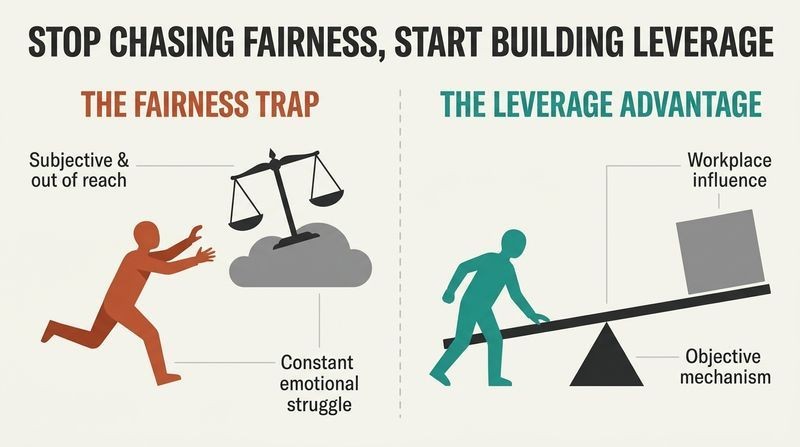
The fairness critique lands hard because Western institutions train people to expect procedural justice. Behavioral economics complicates McIntyre slightly: studies like the ultimatum game show humans will sacrifice real money to punish perceived unfairness, meaning fairness perceptions have genuine leverage of their own. Ignoring them entirely can breed the resentment and turnover that sink organizations. Still, her core point aligns with negotiation theory's BATNA concept: your power comes from alternatives and dependencies, not moral entitlement. The Marcia example is a crisp lesson in timing, the same insight behind why you never quit before securing the next offer. Leverage, like optionality, is a resource to bank quietly.
Sort yourself and colleagues into four political types
Behavior toward business and personal goals defines four types. McIntyre maps everyone onto a grid of whether their conduct helps the organization and helps themselves:
1. Martyrs: help the organization at ruinous personal cost, burning out or preaching until people flee them
2. Sociopaths: serve only themselves while damaging the business, winning short-term but usually crashing later
3. Dimwits: harm both themselves and the organization, driven by uncontrolled psychological needs
4. Winners: behave in ways that advance both business and personal success
The examples sting because they are recognizable. Emily, the self-sacrificing VP, worked herself into depression pleasing a demanding CEO, only to be seen as an unassertive doormat and nearly replaced. Glenn the Winner learned new areas, took visible projects, delivered under pressure, and built goodwill on his climb to VP. Most of us lapse into Martyr, Sociopath, or Dimwit behavior occasionally; the goal is to catch and correct it.
Typologies risk feeling like horoscopes, but this one earns its keep by tying category to consequence rather than personality. It resembles the managerial grid tradition of plotting concern-for-task against concern-for-people. The Martyr category is the most underappreciated insight: our culture valorizes self-sacrifice, yet McIntyre shows how it curdles into resentment and invisibility, a dynamic burnout researchers document in helping professions. The sharpest nuance is that these are behavioral states, not fixed identities, which keeps the framework from being deterministic. A skeptic might note the labels are unflattering enough to trigger defensiveness. The real utility is self-diagnostic: catching your own drift into martyrdom before others do.
Cultivate Friends, Partners, and Connections before you need them
Positive relationships are political capital. Since almost all decisions are subjective, McIntyre argues you must be well-regarded by the people making them. Allies come in three flavors:
1. Friends: colleagues who click through shared temperament or interests
2. Partners: people whose results depend on yours, so cooperation is structurally required
3. Connections: contacts you can tap occasionally for information or favors
Megan's story shows allies as insurance. Her boss Brad found her scattered and wanted to lay her off, but she had quietly built relationships across departments and impressed his boss and even the CEO. Her network protected her job. McIntyre warns against clustering (grouping with your demographic), layering (only mixing with your rank), and occupational tunnel vision. "Shy people get laid off," one HR manager told her. You do not need to be an extrovert, just willing to invest time attracting rather than repelling people.
This is social capital theory in plain clothes. Ronald Burt's research on structural holes shows that people who bridge otherwise disconnected groups gain outsized access to information and opportunity, exactly the payoff of fighting clustering and tunnel vision. Mark Granovetter's classic finding on the strength of weak ties reinforces why Connections, not just close Friends, drive job mobility. McIntyre's distinction between liking someone and rating their competence is subtle and important: warmth and competence are separate axes, as Susan Fiske's stereotype-content model confirms, and being adored without being respected still leaves you off the promotion list. The actionable core is to build the network in peacetime, because you cannot manufacture allies mid-crisis.
Diagnose adversaries as focused, emotional, or vengeful before reacting
Not every irritating person is an enemy. McIntyre warns that labeling someone an adversary too fast becomes a self-fulfilling prophecy. A true adversary actually stands between you and your goals. Once confirmed, ask what they want, because all behavior has a purpose, then sort them:
1. Focused: they simply want their own way and see you as an obstacle; convert them by showing shared goals, or contain them by boosting your leverage
2. Emotional: driven by anger or anxiety, they create problems for everyone; stay calm, since an emotional reaction is the reward they seek
3. Vengeful: personally out to get you, sometimes as "stealth opponents" who smile while spreading damage
Curt the stealth opponent befriended colleagues, then quietly destroyed the reputation of anyone he felt slighted him, getting one victim demoted. Against emotional adversaries like the boss who criticized anxious salesman Nabil, the fix is refusing to take the bait and outperforming instead.
The triage logic here is clinically sound. It maps neatly onto conflict-resolution frameworks that separate interest-based disputes (focused, negotiable) from identity or emotion-based ones (far harder to resolve rationally). The insight that emotional adversaries are rewarded by your reaction draws on basic operant conditioning: withhold the reinforcement and the behavior extinguishes. The stealth-opponent warning is the most valuable and most unsettling, since it names a real workplace phenomenon that HR rarely catches. A useful extension comes from game theory's tit-for-tat: converting a focused adversary works best when you can credibly demonstrate cooperation benefits them, essentially changing the payoff matrix rather than winning a zero-sum fight.
Spot the recurring game, then break its pattern deliberately
Political games have signatures. McIntyre identifies games by five signs: a repeating pattern, an emotional payoff, unstated true motives, a winner and often a loser, and resistance to anyone disrupting them. She groups them into Power Games (Suck-Up, Control, Shunning), Ego Games (Superiority, Put-Down, In-Group), and Escape Games (Scapegoat, Avoidance).
Ted and Russell played a two-year war of smiling sabotage. Never once arguing openly, they traded reorganizations, humiliating project assignments, and finally a rigged job offer that lured Ted to miserable exile in upstate New York, never knowing Russell engineered it. The countermove to most games is to calmly expose the pattern ("Albert, you always agree with the boss in meetings") or ask questions that surface hidden views, without becoming a game player yourself. And if malicious games are the daily norm, that is a toxic workplace, and the only winning move is to leave.
McIntyre's games clearly borrow from Eric Berne's transactional-analysis classic Games People Play, which cataloged repetitive social maneuvers with hidden payoffs. Her workplace translation is more actionable than Berne's therapeutic version because it pairs each game with countermoves. The deepest insight is that games persist because they deliver emotional rewards, which means logical appeals fail; you disrupt the payoff, not the logic. The toxic-workplace exit ramp is ethically important, because much self-help implies any situation is salvageable through better technique. McIntyre resists that. Her documentation-file anecdote, where keeping records was the only way to feel safe, is a vivid diagnostic for environments no individual skill can fix.
Becoming "The Problem" is career death; watch the tipping point
Once you consume disproportionate management attention, you are marked. McIntyre borrows the tipping-point idea: managers rarely decide to fire someone suddenly, but there is a moment when they stop thinking about how to coach you and start fantasizing about life without you. After that, confirmation bias kicks in and every misstep becomes evidence. Travis, a brand-new hire who announced he was "high-maintenance" and complained constantly, tipped within three months and was gone by probation's end.
Four behaviors drive people off the cliff:
1. Uncontrolled emotion, especially anger (complaining, rebellion, confrontation) or anxiety (timidity, neediness, hiding)
2. A victim mentality fed by negative self-talk, like Dorothy who assumed her boss blocked her promotion and litigated her way into being The Problem
3. Self-centered goals
4. Foolish reactions to change
The rescue is political plastic surgery via the AMISH steps: Awareness, Motivation, Identification, Substitution, Habit Replacement.
The confirmation-bias mechanism McIntyre describes is well-documented: once a manager forms a hypothesis, ambiguous behavior gets read as confirming it, a workplace echo of the halo and horns effects. Her point about self-talk anticipates cognitive behavioral therapy's central claim that interpretations, not events, drive emotion and behavior; Dorothy essentially authored her own downfall through rumination. The most practical warning is the attribution-error trap, our tendency to credit success to ourselves and blame failure on circumstance, which blinds people to fixable patterns. One tension: McIntyre's advice to avoid becoming The Problem could discourage legitimate whistleblowing. She acknowledges filing a discrimination complaint marks you as an adversary, an uncomfortable but honest description of institutional self-protection.
Titles lie; read real power through influence, not the org chart
Power has two sources and constant disguises. Position power comes with the role (hierarchy, status, expertise, platform), while personal power flows from your own traits and abilities. But appearances deceive. McIntyre's parable contrasts Steve, a lavishly-titled VP who turned out to be an "empty suit" shuffled into a meaningless job, with Rose, an unassuming employee-relations specialist everyone consulted and trusted. Final power ratings: Steve 2, Rose 8.
Map the terrain with a Power Grid plotting Level of Position against Degree of Influence, producing Weaklings, Empty Suits, Persuaders, and Power Players, with an inner Power Elite who set the culture. Read power by watching behavior, not listening to claims: who gets seen without an appointment, who talks about the future versus the past, whose emails carry weight. Crucially, the Power Elite's actual values (not their press releases) define the culture, so watch what they reward, promote, and change.
French and Raven's classic five bases of power sit underneath this chapter, but McIntyre's contribution is the diagnostic skill of reading influence in a suit-wearing world where rank obscures reality. The Persuaders category is genuinely useful: sociologists call these opinion leaders, and Everett Rogers's diffusion-of-innovations research shows they move organizations more than formal authority does. The advice to watch actions over stated values echoes revealed-preference reasoning in economics; culture is what gets rewarded, not what gets framed on the wall. Her organ-transplant metaphor, that an incompatible member gets rejected like a foreign organ, is a memorable argument for cultural fit as a survival factor, though it can also rationalize conformity pressure.
To change others' behavior, first change your own
The Paradox of Influence: you control only yourself. McIntyre distinguishes influence (broad) from control (nearly nonexistent). Since interaction is like a dance locked into patterns, shifting the pattern requires you to change your steps first. Talkative Brad and quiet Frank each left lunch thinking the other was boring, when either changing behavior would have unlocked a real conversation.
Self-management is the master skill, built from self-observation, self-control, and selective behavior. Choose an influence strategy suited to the specific person and your actual goal, and step into their "box" (their values, fears, and objectives) rather than arguing from your own. Darren wanting a Germany assignment stopped pitching how exciting it would be for him and reframed around project success and his boss's concerns. Balance a full toolbox: Observe and Wait, Ask and Listen, Persuade and Convince, Order and Act. Overusing your natural style, whether Carl's patient silence or Vickie's relentless directives, sabotages you.
This is emotional intelligence and perspective-taking rendered practical, and it aligns with decades of negotiation research from the Harvard Program on Negotiation emphasizing interests over positions. The dance metaphor captures systems-theory thinking: relational patterns are jointly maintained, so a unilateral change ripples through the whole loop, a principle family therapists exploit. McIntyre's "box" is textbook cognitive empathy, distinct from emotional empathy, and research shows it is the version most predictive of influence and deal-making success. The strongest practical nugget is matching tool to situation rather than defaulting to temperament; it reframes influence as a repertoire you build, not a gift you are born with. Robert Cialdini's persuasion research would add reciprocity and social proof as further tools.
Invisible excellence earns nothing; make results visibly sparkle
The Perception Principle: unseen contributions have no political value. McIntyre's parable: a teenager who rescues children out the front door in view of a crowd gets a scholarship and a medical career; the same rescue out the back door, unwitnessed, changes nothing. Outstanding work only counts politically if the right people know about it. This is not bragging; it is ensuring your accomplishments register with those who can support your goals.
Sort your work by importance and visibility:
1. Starmakers (high importance, high visibility): invest effort to make these memorable
2. Maintenance (low importance, high visibility): just avoid the "dirty bathroom" of noticeable failure
3. Transparent Tasks (high importance, low visibility): drag these into the spotlight, often by attaching numbers, since managers are information junkies
4. Time Wasters: eliminate or minimize
This sits inside the Four P's of political success: Power assessment, Performance, Perception, and Partnerships. Gayle, a furious technical-publications supervisor, applied all four, stopped complaining, partnered with product managers, and transformed from Martyr to promoted director.
The perception chapter risks sounding like a license for self-promotion, but McIntyre grounds it in a real asymmetry: performance and its recognition are separate variables, and the most competent people often assume good work speaks for itself. It does not. This connects to the sponsorship research of Sylvia Ann Hewlett, which found that women and minorities frequently overinvest in performance while underinvesting in the visibility and advocacy that actually drive promotion. The advice to quantify Transparent Tasks is quietly brilliant, since measurement converts invisible labor into legible value, the same reason metrics reshape what organizations prioritize. The ethical guardrail, her Political Golden Rule of never advancing yourself by harming the business or others, keeps visibility-seeking from sliding into pure spin.
Manage power in all directions: upward, lateral, and downward
Winners build positive relationships in every direction. Using the logic of 360-degree feedback, McIntyre notes many people ace one power relationship and fail another. The fix is to stay in the "Adult" role rather than lapsing into rebellious or submissive "Child" or domineering "Parent" modes.
1. Upward: accept your boss's authority, learn their style, make them look good, and never trash them to others; remember it is your boss's boss who truly protects your job
2. Lateral: be reliable and responsive, discuss problems face-to-face rather than backbiting, and treat internal customers (colleagues who depend on your output) as potential allies or deadly adversaries
3. Downward: a leader is someone people choose to follow, so aim for respect over being liked
Kate, the HR manager, is McIntyre's portrait of a Winner: her boss, peers, and staff all describe her as respectful, willing to challenge, collaborative, and genuinely helpful.
The Parent-Adult-Child lens comes from Thomas Harris's I'm OK, You're OK and transactional analysis, and it remains a useful shorthand for regression under stress: workplace hierarchies unconsciously reactivate family dynamics. The respect-over-likability point for managers is backed by research showing that leaders who avoid tough feedback to preserve friendliness produce lower-performing, paradoxically less satisfied teams. The internal-customer concept anticipates the service-chain thinking that reshaped quality management. Kate as an ideal is instructive precisely because her defining trait is directional fluency, not charisma; she calibrates her stance to each relationship. The subtle risk is that "manage in all directions" can become exhausting impression management; McIntyre's antidote is that authenticity and genuine respect, not performance, sustain it.
Analysis
Secrets to Winning at Office Politics is a framework-driven business self-help book built from an organizational psychologist's two decades of consulting cases. Its structure is clean: master the fundamentals (goals, leverage, allies), avoid the pitfalls (games, political suicide, power mistakes), then become a Winner (the Four P's, influence skills, managing power relationships). What makes it hard to summarize is its density of memorable but similar anecdotes; nearly every concept arrives wrapped in a named character, and the value lives as much in that recognizability as in the abstractions.
McIntyre's core intellectual move is to strip politics of its moral stench and treat it as neutral machinery, then hand readers a mechanic's manual. This is both her strength and her blind spot. The strength: she liberates competent, frustrated people from the passive fairness-obsession that sabotages them, replacing it with agency, leverage, and perception management. The framework has real predictive power, and it converges with respected research she never cites: social capital theory, transactional analysis, cognitive behavioral therapy, and perspective-taking studies all underwrite her advice.
The blind spot is that pure pragmatism can quietly normalize dysfunction. When McIntyre tells readers that filing a discrimination complaint marks them as an adversary, she is being admirably honest, but the book's overall posture, adapt to the Power Elite's culture or leave, offers little for those who want to change unjust systems rather than navigate them. Her escape valve (recognize toxicity and exit) partly rescues this, acknowledging some environments defeat any individual skill.
The book's enduring contribution is its diagnostic vocabulary. Terms like The Problem, the tipping point of managerial patience, Empty Suits, leverage miscalculations, and the four political types give readers language to see dynamics they previously only felt. In an era of remote work and flattened-but-still-political organizations, its central claim, that managing relationships is not separate from doing the job but constitutes half of it, has aged remarkably well. It is less a manipulation manual than a plea for self-awareness.
Review Summary
Secrets to winning at office politics receives mixed reviews, with an overall positive rating of 4.02/5. Readers appreciate its practical advice on navigating workplace dynamics and building leverage. Many wish they had read it earlier in their careers. Critics argue it's too conservative and doesn't address challenging power structures. The book is praised for its ethical approach, relatable examples, and helpful frameworks. Some find it particularly useful for new professionals, while others note its US-centric focus. Despite its controversial title, many readers recommend it as an essential guide for understanding office politics.
People Also Read






FAQ
What's Secrets to Winning at Office Politics about?
- Understanding Office Politics: The book explores the dynamics of office politics, presenting it as a natural and essential part of organizational life. It aims to help readers navigate these dynamics to achieve personal and professional goals.
- Political Intelligence: Marie G. McIntyre introduces the concept of Political Intelligence, which involves understanding power structures and relationships within an organization. This intelligence is crucial for managing workplace interactions and advancing one's career.
- Practical Strategies: The book provides strategies for recognizing political games, building alliances, and avoiding pitfalls. It encourages readers to develop a political game plan tailored to their specific work environment.
Why should I read Secrets to Winning at Office Politics?
- Enhance Career Success: The book equips readers with skills to navigate the complex political landscape of the workplace, leading to greater career success and goal achievement.
- Real-Life Examples: McIntyre uses real-life examples and case studies to illustrate her points, making the content relatable and applicable to readers' own work situations.
- Self-Improvement: It encourages self-reflection and personal growth, helping readers identify their political strengths and weaknesses to enhance their influence and relationships at work.
What are the key takeaways of Secrets to Winning at Office Politics?
- Politics is Inevitable: Office politics is a normal aspect of work life, and understanding it is essential for success. Political ability is a fundamental component of success in any job.
- Define Your Goals: Clearly defining your goals in the workplace is crucial. To win at office politics, you must first clearly define your goals.
- Build Alliances: Building a network of allies and understanding adversaries is significant. Positive relationships can enhance your political capital and help achieve objectives.
What are the best quotes from Secrets to Winning at Office Politics and what do they mean?
- "Politics is not a dirty word.": This quote encapsulates the book's central theme that politics is a natural part of organizational life, encouraging readers to embrace political skills.
- "If you’re not sure where you’re going, you’ll probably end up somewhere else.": Emphasizes the necessity of having clear goals to navigate office politics complexities.
- "Never advance your own interests by harming the business or hurting other people.": Reminds readers of the ethical considerations in office politics, underscoring the importance of maintaining integrity.
What are the four political types described in Secrets to Winning at Office Politics?
- Martyrs: Individuals who try to help their organizations at a high personal cost, often leading to burnout and resentment.
- Sociopaths: Self-centered individuals concerned only with their own needs, often causing harm to the organization.
- Dimwits: Exhibit self-destructive behavior that harms both themselves and the organization, driven by psychological needs.
- Winners: Contribute positively to both business and personal success, characterized by their ability to build relationships and navigate the political landscape effectively.
How can I develop my Political Intelligence according to Secrets to Winning at Office Politics?
- Recognize Power Dynamics: Understanding power relationships within your organization is crucial for navigating the political landscape effectively.
- Build Relationships: Developing positive relationships with colleagues and superiors is essential for increasing influence and building political capital.
- Stay Focused on Goals: Maintaining a clear focus on objectives while managing workplace dynamics is vital for success.
What is the Four P’s formula in Secrets to Winning at Office Politics?
- Power Assessment: Evaluate your current leverage position with decision-makers and understand what influences them.
- Performance: Focus on delivering results that contribute to the organization’s success, enhancing your reputation and political capital.
- Perception and Partnerships: Manage how others perceive you and build a network of allies to increase influence and support.
How can I avoid being seen as "The Problem" at work?
- Self-Reflection: Engage in honest self-scrutiny to identify behaviors that may be perceived negatively and make necessary changes.
- Change Your Approach: Focus on altering your behavior rather than blaming others to shift perceptions and improve relationships.
- Seek Feedback: Regularly ask for feedback from colleagues and supervisors to gauge perceptions and adjust actions accordingly.
What does McIntyre mean by "political plastic surgery"?
- Image Makeover: Refers to drastically changing one’s professional image to avoid political suicide by recognizing and correcting destructive behaviors.
- AMISH Method: A framework for personal behavior change involving Awareness, Motivation, Identification, Substitution, and Habit Replacement.
- Long-Term Commitment: Changing ingrained habits requires persistence and commitment to new behaviors for lasting change.
How can I increase my political power according to Secrets to Winning at Office Politics?
- Enhance Your Performance: Deliver high-quality work that aligns with organizational goals to boost reputation and leverage with decision-makers.
- Build Strong Partnerships: Cultivate relationships with colleagues and superiors to create a supportive network for assistance and opportunities.
- Assess and Adjust: Regularly evaluate your political standing and make necessary adjustments to navigate workplace challenges effectively.
What are some common power mistakes people make in the workplace?
- Giving Away Power: Shying away from using position power can inadvertently empower less competent colleagues, leading to a loss of respect.
- Overestimating Power: Trying to exert power not possessed can result in embarrassment or job loss; accurate self-assessment is essential.
- Ignoring Feedback: Failing to listen to constructive criticism can hinder growth and lead to political missteps; being open to feedback is crucial.
How does Secrets to Winning at Office Politics address gender differences in power dynamics?
- Different Approaches: Discusses how men and women often have different styles in power, with men focusing on dominance and women on relationships.
- Navigating Mixed-Gender Environments: Emphasizes adapting to different styles in a mixed-gender workplace for effective communication and collaboration.
- Balancing Styles: Effective individuals borrow from both male and female approaches to power, enhancing political intelligence and effectiveness.
Download PDF
Download EPUB
.epub digital book format is ideal for reading ebooks on phones, tablets, and e-readers.








































