


Key Takeaways
Your brain feels everything before it can think anything
Emotion gets the first word. Every sensory signal you receive enters your brain near the spinal cord and must travel to the frontal lobe, where rational thought happens. But it passes through the limbic system, your emotional center, first. This wiring guarantees you react emotionally before you can reason. The book illustrates this with surfer Butch Connor, paralyzed by fear when a 14-foot great white circled him at a California beach. Fear nearly killed him, then anger fueled a surfboard jab to the shark's gills, and finally deliberate self-calming let him paddle to safety.
You cannot stop the first feeling. What you control is the thought and reaction that follow, but only if you are aware of the emotion. Emotional intelligence lives in the quality of communication between your rational and emotional brains.
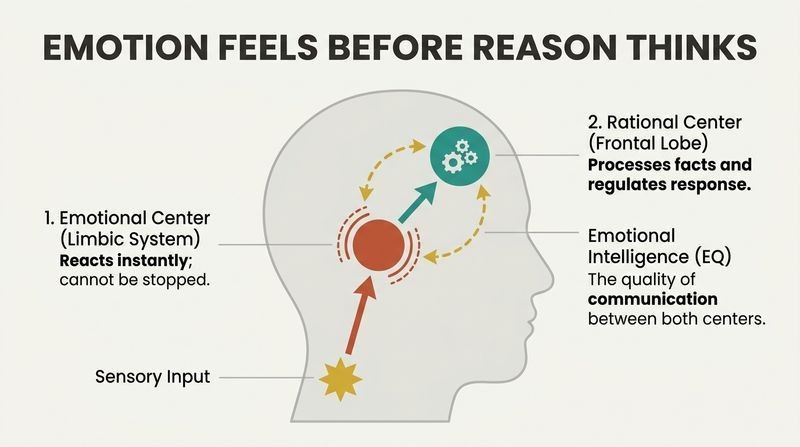
The neuroscience here is a simplified version of Joseph LeDoux's work on the amygdala's "low road," where threat signals reach the emotional brain milliseconds before the cortex. The shark story is vivid, but daily life rarely offers such clean stakes. What's useful is the reframe: emotional reactivity is not a character flaw but a structural feature of human anatomy. This dissolves shame and replaces it with strategy. The limitation is that the rational and emotional split is more of a useful metaphor than literal neurology. Modern affective science shows emotion and cognition are deeply intertwined, not housed in tidy separate buildings.
EQ predicts 58% of job performance, dwarfing raw IQ
Smart is not enough. The book reports a striking anomaly: people with the highest IQs outperform those with average IQs only about 20% of the time, while average-IQ people beat high-IQ people 70% of the time. That gap pointed researchers toward emotional intelligence as the missing variable. When tested against 33 other workplace skills, EQ accounted for the majority of them and explained 58% of performance across all job types.
The numbers compound in your paycheck. Ninety percent of top performers score high in EQ, while only 20% of low performers do. People with high EQ earn an average of $29,000 more per year, and each one-point EQ increase adds roughly $1,300 in annual salary. Unlike IQ and personality, which are fixed, EQ is a flexible skill anyone can build.
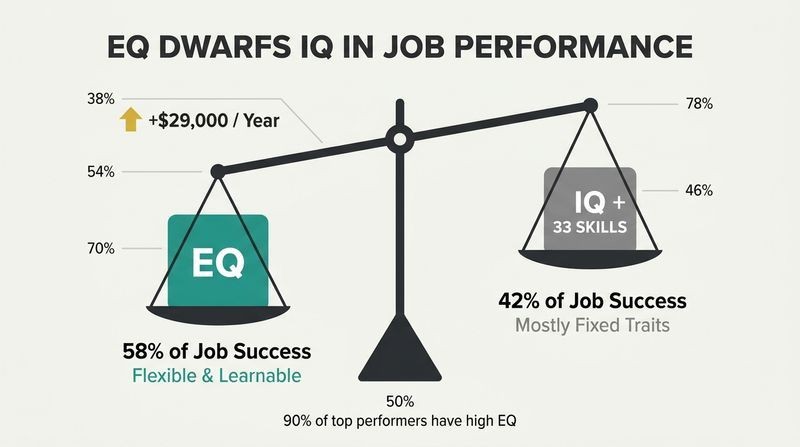
These figures, drawn from TalentSmart's proprietary data, should be read with care. The 58% claim has been criticized for overstating EQ's predictive power, and meta-analyses in industrial psychology typically find emotional intelligence adds modest incremental validity beyond cognitive ability and conscientiousness. The salary correlation also risks confusing cause with effect, since higher-status jobs may cultivate EQ rather than the reverse. Still, the core insight holds across decades of research: interpersonal skill matters enormously and is undertaught. The genuinely liberating claim is malleability. Where IQ is essentially fixed after childhood, the capacity to read and regulate emotion can be trained at any age.
Master four skills: know yourself, manage yourself, read others, manage relationships
EQ breaks into a tidy grid. The authors organize emotional intelligence into four skills under two competencies. Personal competence (about you) contains self-awareness and self-management. Social competence (about others) contains social awareness and relationship management.
1. Self-awareness: accurately perceiving your own emotions as they happen
2. Self-management: using that awareness to direct your behavior positively
3. Social awareness: accurately picking up emotions in other people
4. Relationship management: using all three to handle interactions well
The skills build on each other. Self-awareness is the foundation; you cannot manage what you do not notice. Among people high in self-awareness, 83% are top performers, versus just 2% of bottom performers. The skills are sequential, which is why the book advises against starting with relationship management if you score below 75 in all four.
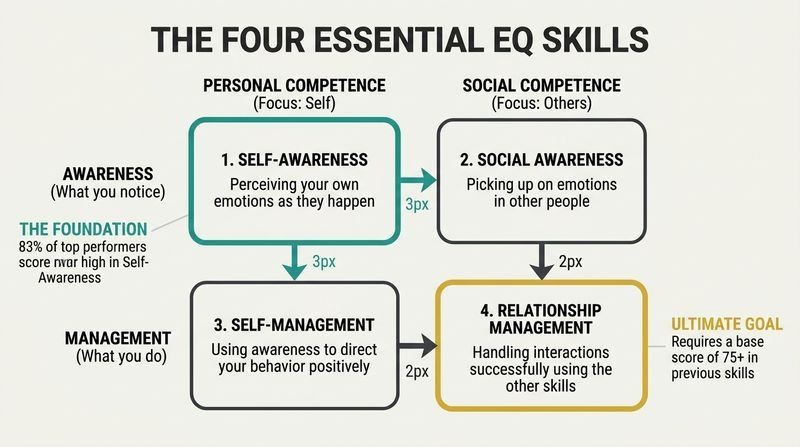
This four-quadrant model originates with Daniel Goleman, Richard Boyatzis, and Annie McKee, and the authors adapt it cleanly. Its strength is diagnostic clarity: rather than vaguely resolving to be more emotionally intelligent, a person can locate exactly which gear is grinding. The architecture mirrors a control-systems loop: sense (awareness), then act (management), applied inward and then outward. One nuance worth flagging is that the skills are not perfectly sequential in practice. Some people read others brilliantly while remaining oblivious to themselves, the classic profile of a manipulative charmer. Self-awareness as a strict prerequisite is more idealized scaffolding than empirical law.
Stop sorting feelings into good and bad piles
Judgment blocks understanding. The instinct is to label emotions: guilt is bad, banish it; excitement is good, feed it. But classifying a feeling prevents you from understanding what caused it. When you instead sit with an emotion without judgment, it runs its course and dissipates. Pass judgment, and you simply pile more emotions on top, trapping the original one.
Lean into discomfort instead of dodging it. The biggest obstacle to self-awareness is avoiding the sting of seeing yourself honestly. The book's advice is to move toward an emotion, into it, and through it, even mild ones like boredom or confusion. Ignoring feelings does not erase them; they resurface when least wanted. A practical tool: keep an emotions journal for a month to spot recurring patterns, triggers, and the physical sensations that accompany each feeling.
This maps almost exactly onto principles from Acceptance and Commitment Therapy, where "experiential avoidance" (the refusal to feel uncomfortable internal states) is identified as a root driver of psychological suffering. Suppression research by James Gross shows that bottling emotion increases physiological stress and impairs memory, while labeling emotion (what Matthew Lieberman calls "affect labeling") measurably calms amygdala activity. So the book's folk wisdom has solid laboratory backing: naming a feeling without rating it actually downshifts the nervous system. The journaling prescription is sound but underspecified. Evidence suggests reflective writing helps, while ruminative rehearsing of the same grievance can deepen the rut rather than resolve it.
Pinpoint exactly who and what trips your emotional wires
Triggers are specific, not general. Everyone has buttons that, when pushed, provoke irritation or rage. The book insists you cannot work with these abstractly. You must name the precise people, situations, and conditions that set you off: the meeting hijacker who loves the sound of her own voice, being caught off guard, a noisy office. Naming them strips away the element of surprise.
Then trace the root. Go further and ask why a given person irks you when other equally annoying people do not. Perhaps the spotlight-hogging colleague unconsciously echoes a sibling who claimed all the attention in childhood. A "trigger event" is anything that produces a prolonged emotional reaction, shaped by your personal history with similar situations. Understanding the source opens the door to choosing your response rather than reflexively reacting.
The move from cataloging triggers to excavating their origins is essentially a lay version of psychodynamic insight, the idea that present overreactions are often transference from unresolved past relationships. Cognitive behavioral therapy would add that the trigger itself is rarely the problem; the automatic interpretation layered onto it is. The colleague is not actually your sister, and recognizing that gap creates choice. A practical caveat: insight alone rarely changes behavior. Knowing why a button exists does not disarm it. The genuine leverage comes from pairing this awareness with rehearsed alternative responses, which is why this self-knowledge is treated as preparation for the management skills, not a destination.
Breathe deep and count to ten to reboot your rational brain
Oxygen is a self-management tool. Your brain consumes a full 20% of your body's oxygen, prioritizing survival functions over the complex thinking that keeps you calm and focused. Shallow breathing starves it, producing forgetfulness, mood swings, and anxious thoughts. Deep diaphragmatic breaths, where your stomach pushes outward, flood the rational brain and produce an almost immediate sense of clarity.
Slowing down interrupts the hijack. The kindergarten trick of counting to ten works because it cools the overheated limbic system and buys the rational brain time to catch up. Some people carry a beverage into meetings so that taking a sip gives them a socially invisible pause before responding. Other tools include sleeping on big decisions, since time brings clarity, and visualizing yourself handling tough situations well, since the brain barely distinguishes vivid imagination from reality.
The physiology is sound. Slow diaphragmatic breathing stimulates the vagus nerve and shifts the autonomic nervous system from sympathetic (fight or flight) toward parasympathetic (rest and digest), which is why it appears in everything from Navy SEAL box breathing to clinical anxiety treatment. The counting tactic is a behavioral wedge between stimulus and response, the gap Viktor Frankl famously located as the seat of human freedom. The visualization claim draws on mental rehearsal research with athletes, where imagined practice activates overlapping motor and emotional circuitry. The one oversell is the oxygen-deprivation framing. Normal shallow breathing does not meaningfully starve the brain, but slow breathing's calming effect is real regardless of the mechanism.
Make your goals public so accountability does the heavy lifting
Borrow other people's expectations. Much of self-management comes down to motivation, and the awareness that others are watching is a powerful engine. Private failures are the easiest to swallow, so the book recommends announcing your goals to friends, family, or colleagues and asking them to monitor your progress. The book cites a professor who pays his colleagues $100 every time he misses a deadline; unsurprisingly, he almost never misses one.
Manage the rumbling beneath the surface. Self-management is more than corking an eruption. Like a volcano, there is activity below the surface long before lava flows. Daily habits shape that pressure: protecting sleep hygiene (morning sunlight, no screens two hours before bed, caffeine only before noon), scheduling mental recharge through exercise, and focusing on your freedoms rather than your limitations. You always control your perspective, even when you cannot control the situation.
The public-commitment device is well-validated behavioral economics. Stickk.com, cofounded by Yale economist Dean Karlan, operationalizes exactly this by having users wager money forfeited to a charity (or anti-charity) they despise if they fail. Loss aversion makes the penalty version especially potent, which is why the professor's $100 forfeit works better than a mere promise. The sleep hygiene advice is consensus chronobiology: morning light anchors circadian rhythm, and caffeine's roughly six-hour half-life genuinely sabotages sleep architecture. One tension worth noting is that external accountability can crowd out intrinsic motivation over time, a finding from self-determination theory. The deeper aim should be internalizing the standard, not depending forever on an audience.
Watch people like an anthropologist, not a note-taker
Social awareness means total presence. The skill of reading others requires you to stop talking, silence your inner monologue, and quit rehearsing your next line. The book likens it to being an anthropologist observing subjects in their natural state, except you are in the middle of the interaction rather than watching from afar. A perceptive coworker who reads your mood before you speak, or a waitress who instantly sizes up each table's needs, demonstrates the skill in action.
Put down the pen. One counterintuitive strategy: stop taking notes in meetings. Multitasking degrades quality, and a head buried in a tablet misses the facial expressions, tone shifts, and body language that reveal what people actually feel. Watch the eyes (a genuine smile crinkles the skin at their corners), scan posture from head to toe, and greet people by name to anchor your attention outward.
The anthropologist framing is apt and echoes ethnographic method, where the observer's own assumptions are the chief source of distortion. The genuine-smile detail references Paul Ekman's work on the Duchenne smile, distinguished by involuntary contraction of the orbicularis oculi muscle around the eyes, which most people cannot fake on command. The note-taking prohibition is supported by attention research: the brain's executive resources are finite, and visible divided attention also signals disengagement to the speaker, eroding rapport. A reasonable critique is that hyper-monitoring others can tip into anxious mind-reading, where an observer over-interprets neutral cues. Calibration through asking, rather than assuming, is the necessary corrective the book itself recommends.
When evidence contradicts someone's words, gently test what you see
People say fine when they are not. Even skilled observers misread situations, and the remedy is disarmingly simple: ask. When someone's slumped posture and downcast eyes contradict their claim of being fine, the book recommends a reflective statement that names the evidence and poses a direct question, such as observing that they look down and asking whether something happened. This confirms your read and signals genuine interest.
Trust the body over the mouth. People telegraph feelings they do not state outright, dropping hints rather than declarations. Testing for accuracy catches your own jumped-to conclusions and sharpens your ability to detect cues that normally fly under the radar. Related tactics include stepping into someone's shoes by literally asking "if I were this person, how would I respond?" and catching the contagious mood of an entire room by scanning energy, posture, and your own gut instinct.
The reflective statement technique mirrors the "reflection of feeling" core to Carl Rogers' client-centered therapy and to motivational interviewing, where naming the unspoken emotion deepens trust and lowers defensiveness. Emotional contagion, the room-mood phenomenon, is documented in research by Elaine Hatfield and Sigal Barsade, who showed that group affect spreads through unconscious mimicry and shapes collective performance. The practice of checking rather than assuming is the antidote to a well-known cognitive trap: the illusion of transparency, where we overestimate how accurately we read others and they read us. The humility baked into "just ask" is the strategy's real sophistication. Confident misreadings damage relationships more than honest uncertainty ever does.
Explain decisions instead of dropping them like a verdict
People can handle change; they cannot handle darkness. The book compares arriving at an unfamiliar campsite at night, anxious and disoriented, to learning of a workplace decision after the fact. The site is identical by daylight; only information changed. When layoffs, schedule changes, or policy shifts are handed down without rationale, people feel like dependents rather than adults. Transparency, explaining the why, the alternatives considered, and the impact, makes people feel trusted and respected even when the decision hurts them.
Get angry only on purpose. Citing Aristotle's observation that anyone can be angry, but being angry with the right person, to the right degree, at the right time, and for the right purpose is hard, the book reframes anger as a precision tool. Used deliberately, like a coach's pointed halftime feedback, it focuses people. Overused, it desensitizes them until you cannot be taken seriously.
The transparency principle aligns with organizational-justice research, which distinguishes outcome fairness from procedural and informational fairness. Studies consistently show employees accept unfavorable outcomes (even layoffs) far more readily when the process is explained and seen as fair, a finding that predicts everything from lawsuit rates to retention. The Aristotle citation, from the Nicomachean Ethics, frames virtue as a mean between deficiency and excess, and anger as a skill of calibration rather than a vice to suppress. This challenges the popular wellness narrative that anger is always toxic. The harder truth the book surfaces is that strategically withheld and precisely deployed anger communicates gravity that perpetual calm cannot.
Open a hard conversation with agreement, not your rebuttal
Tough talks are inevitable, so navigate them well. The book offers a sequence for difficult conversations, illustrated by telling an employee named Judith why she was passed over for a promotion she learned about through the grapevine:
1. Start with common ground, even if it is just agreeing the talk will be hard but important
2. Ask the person to share their side first, because people who do not feel heard grow frustrated
3. Resist planning your comeback, since the brain cannot listen well and prepare to speak simultaneously
4. Then help them understand your perspective clearly and simply
5. Move the conversation forward by finding common ground again, and keep in touch afterward
Repair broken conversations with a fix-it statement. When a discussion derails into blame or circles, a neutral, common-ground phrase like "this is hard" acts like a breath of fresh air, refocusing both parties on resolution over being right.
This protocol closely tracks the methodology in Crucial Conversations and in Harvard Negotiation Project work like Difficult Conversations, which similarly stress establishing safety, separating impact from intent, and leading with inquiry before advocacy. The neurological claim that you cannot listen and rehearse a rebuttal at once is essentially correct: genuine listening and speech preparation compete for the same working-memory and language resources, which is why most arguments are two monologues. The fix-it statement is a small but elegant tool, functioning as what Gottman calls a "repair attempt," the single strongest predictor of whether couples (and by extension colleagues) survive conflict. The protocol's weakness is that it assumes good faith on both sides, which adversarial situations do not always provide.
EQ is a use-it-or-lose-it skill that even cultures can build
Emotional intelligence is contagious and reversible. Tracking the U.S. workforce, the authors found collective EQ rose steadily from 2003 to 2007, even among people who had never been trained, as if emotionally intelligent behavior spreads by exposure. Then in 2008, amid the worst economy in 70 years, collective EQ dropped for the first time. Stress consumes the mental resources EQ requires, so people's skills desert them precisely when they need them most.
Patterns emerge across groups. Self-management rises steadily with age, so younger generations score lower simply from having less practice, not from iPods or video games. CEOs, on average, post the lowest EQ scores in the workplace, while middle managers post the highest. Chinese executives outscored American ones by 15 points in self-management and relationship management, a disciplined edge the authors trace to cultural norms. The lesson: review and practice these skills at least yearly, or they fade like an abandoned instrument.
The contagion finding resonates with the social-network research of Nicholas Christakis and James Fowler, who showed emotional states like happiness propagate measurably through up to three degrees of social connection. The stress-degrades-EQ point is well grounded: cortisol and amygdala hyperactivity impair prefrontal regulation, which is why people regress under pressure. The CEO finding is provocative and politically inconvenient, suggesting promotion often rewards technical results over people skills, after which leaders interact less with staff and atrophy further. The cross-cultural comparison deserves skepticism, since EQ instruments validated in one culture may not measure the same construct in another, and 15 points could reflect different display norms rather than genuine capability differences. The yearly-refresher prescription is the practical heart.
Analysis
Emotional Intelligence 2.0 is a hybrid: part popular-science primer, part self-assessment vehicle, part strategy manual. Its commercial innovation was bundling a passcode to TalentSmart's online Emotional Intelligence Appraisal with the book, converting a passive read into a measured, trackable intervention. This structure shapes everything. The book is deliberately thin on theory and thick on prescription, offering 66 concrete strategies across the four skills, because its thesis is that EQ, unlike IQ, is learnable, and learning requires practice rather than understanding.
Intellectually, the book stands on the shoulders of Salovey, Mayer, and especially Goleman, whose four-domain model it adopts wholesale. Its contribution is not conceptual originality but operational translation, taking an established framework and making it actionable for a busy professional in an afternoon. That is also its vulnerability. The headline statistics (58% of performance, $1,300 per EQ point, 90% of top performers) come from proprietary, largely unpublished internal data and should be treated as directional marketing rather than peer-reviewed fact. Academic industrial-organizational psychology has long debated whether trait EQ adds meaningful predictive validity beyond personality and cognitive ability, and the consensus is more modest than the book's confident numbers suggest. Yet the core practical wisdom is durable and increasingly validated by adjacent fields: affect labeling calms the amygdala, slow breathing engages the vagus nerve, public commitment leverages loss aversion, and procedural transparency drives perceived fairness. The book's most defensible and important claim is malleability. Where so much self-help traffics in fixed essences, this work insists the brain's plasticity allows new neural pathways to form through repetition, with changes documented years out.
The ideal reader is a mid-career professional who senses that competence alone has plateaued their advancement. For them, the book functions less as a treatise than as a coach's playbook, valuable precisely because it refuses to let insight substitute for rehearsal.
Review Summary
Emotional Intelligence 2.0 receives mixed reviews. Many readers find it practical and insightful, praising its actionable strategies for improving emotional intelligence across four key areas. The included online assessment is appreciated by some. However, critics argue the book lacks scientific rigor, relies on questionable data, and oversimplifies complex concepts. Some view it as common sense repackaged or an extended advertisement. Despite divided opinions, many readers find value in its accessible approach to understanding and developing emotional intelligence skills.
People Also Read






FAQ
What's "Productivity for Minimalists" about?
- Focus on Minimalism: The book explores how minimalism can be applied to productivity, emphasizing reducing clutter and focusing on essential tasks.
- Historical Context: It delves into the history of productivity, examining how societal changes like the Industrial Revolution have shaped modern views.
- Practical Steps: Offers practical advice on achieving simplicity in daily life and work, aiming to streamline tasks and reduce stress.
- Philosophical Insights: Incorporates philosophical perspectives from both Eastern and Western cultures to provide a well-rounded understanding of productivity.
Why should I read "Productivity for Minimalists"?
- Simplify Your Life: The book provides strategies to simplify your work and personal life, making it easier to focus on what truly matters.
- Reduce Stress: By applying minimalist principles, you can reduce stress and avoid burnout, leading to a healthier work-life balance.
- Historical and Cultural Insights: Gain a deeper understanding of how productivity has evolved and how different cultures approach it.
- Actionable Advice: Offers practical steps and methods that can be easily implemented to improve efficiency and effectiveness.
What are the key takeaways of "Productivity for Minimalists"?
- Minimalism in Productivity: Emphasizes reducing unnecessary tasks and focusing on high-priority goals to increase efficiency.
- Avoiding Burnout: Provides strategies to recognize and prevent burnout, ensuring long-term productivity and well-being.
- Cultural Perspectives: Highlights the differences between Eastern and Western views on productivity, encouraging a balanced approach.
- Historical Impact: Explains how historical events like the Industrial Revolution have influenced current productivity standards and practices.
What are the best quotes from "Productivity for Minimalists" and what do they mean?
- Mark Twain's Insight: "The secret of getting ahead is getting started." This quote emphasizes the importance of taking the first step in any task.
- Franz Kafka's Definition: "Productivity is being able to do things that you were never able to do before." It highlights the transformative power of productivity.
- Socrates' Warning: "Beware the barrenness of a busy life." This quote warns against confusing busyness with true productivity.
- Marcus Aurelius' Advice: "If you seek tranquility, do less." It suggests that reducing non-essential tasks can lead to a more peaceful life.
How does "Productivity for Minimalists" define productivity?
- Measurement of Efficiency: Productivity is defined as a measurement of efficiency, often seen as the ratio of resources spent to the finished product.
- Personal Application: It emphasizes personal productivity as completing tasks and exerting energy toward personal goals.
- Process and Results: The book stresses that productivity involves both the process and the end results, valuing the journey as much as the destination.
- Versatile Concept: Productivity is versatile and can be applied differently depending on individual goals and circumstances.
What misconceptions about productivity does "Productivity for Minimalists" address?
- Early Rising Myth: Challenges the idea that waking up early is essential for productivity, emphasizing individual differences in productivity patterns.
- Sleep and Rest: Debunks the myth that productive people never rest, highlighting the importance of sleep for efficiency and focus.
- Multitasking Fallacy: Argues against the effectiveness of multitasking, suggesting it reduces efficiency and performance.
- Pressure and Stress: Refutes the belief that the best work is created under pressure, advocating for a balanced approach to productivity.
How does "Productivity for Minimalists" suggest dealing with burnout?
- Recognize Symptoms: Identifies common symptoms of burnout, such as self-doubt, loss of motivation, and physical symptoms like headaches.
- Avoidance Strategies: Offers strategies to avoid burnout, including setting boundaries, taking breaks, and maintaining a healthy work-life balance.
- Recovery Steps: Provides steps for recovering from burnout, such as seeking support, reevaluating priorities, and incorporating exercise and hobbies.
- Long-term Solutions: Encourages long-term lifestyle changes, like simplifying tasks and focusing on personal well-being, to prevent future burnout.
What practical steps does "Productivity for Minimalists" offer for achieving simplicity?
- Set Boundaries: Encourages setting clear boundaries to reduce stress and focus on high-priority tasks.
- Organize and Declutter: Suggests organizing physical and digital spaces to minimize distractions and streamline daily routines.
- Prioritize Tasks: Recommends prioritizing tasks using methods like the Eisenhower Matrix to focus on what truly matters.
- Mindful Living: Advocates for living intentionally, being mindful of daily decisions, and reducing unnecessary commitments.
How does "Productivity for Minimalists" compare Eastern and Western views on productivity?
- Individualism vs. Collectivism: Highlights the Western focus on individual success versus the Eastern emphasis on collective achievement.
- Cultural Influences: Explores how cultural backgrounds influence productivity approaches, with the West valuing personal freedom and the East valuing group harmony.
- Balance and Harmony: Encourages finding a balance between these perspectives to achieve a more holistic approach to productivity.
- Historical Context: Provides historical context for these cultural differences, linking them to broader societal changes and developments.
What historical insights does "Productivity for Minimalists" provide about productivity?
- Industrial Revolution Impact: Examines how the Industrial Revolution shaped modern productivity standards and work environments.
- Technological Advancements: Discusses how technological advancements intended to simplify life have sometimes increased stress and complexity.
- Cultural Shifts: Analyzes how cultural shifts over time have influenced societal views on work and productivity.
- Lessons from the Past: Encourages learning from historical events to understand current productivity challenges and opportunities.
What methods does "Productivity for Minimalists" recommend for organizing tasks?
- Eisenhower Matrix: Suggests using the Eisenhower Matrix to categorize tasks by urgency and importance, helping prioritize effectively.
- Q Methodology: Recommends the Q Methodology for creating concise to-do lists, focusing on essential and high-priority tasks.
- Eat the Frog: Advises tackling the most challenging task first to boost productivity and reduce procrastination.
- Weekly Review: Encourages regular self-reflection and review of progress to refine productivity strategies over time.
How does "Productivity for Minimalists" address the role of technology in productivity?
- Digital Noise Reduction: Advises reducing digital noise by limiting email subscriptions, notifications, and unnecessary apps.
- Intentional Technology Use: Encourages intentional use of technology, such as watching specific programs instead of mindlessly browsing.
- Screen Time Management: Highlights the importance of managing screen time to improve focus and reduce anxiety.
- Balancing Benefits and Drawbacks: Discusses the dual role of technology as both a tool for productivity and a source of distraction.
About the Author
Other books by Travis Bradberry
Download PDF
Download EPUB
.epub digital book format is ideal for reading ebooks on phones, tablets, and e-readers.








































