
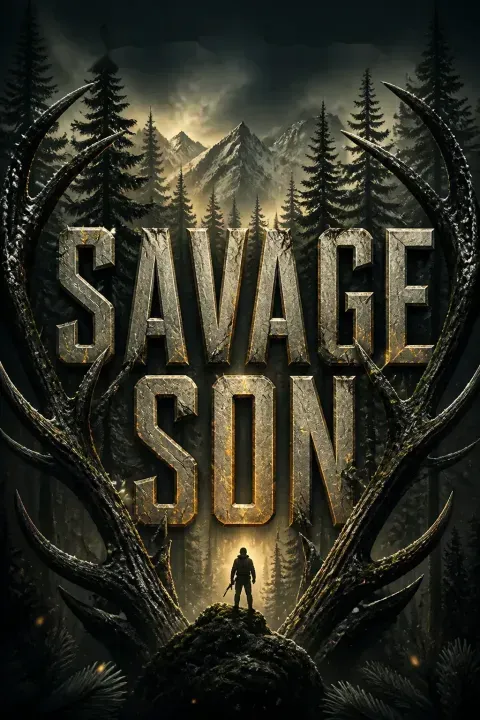


Plot Summary
Prologue
A woman runs through deep snow on Medny Island, pursued by a hunter on snowshoes and two massive Caucasian shepherd dogs. Cornered among jagged cliffs above the Bering Sea, she arms herself with a sharpened seal rib bone.
When the first dog lunges into her hiding spot, she stabs it repeatedly in the neck and chest until it tumbles into the sea. The second dog drags her toward the opening. Rather than be taken, she grabs its collar and hurls herself and the animal over the cliff. Both crash onto rocks four hundred feet below.
The hunter, Aleksandr Zharkov,4 lowers his crossbow in bitter disappointment. He wanted to wound her first, to savor the climax. But she was only bait, he tells himself. She will still serve her purpose in drawing the larger game he truly seeks.
The prologue establishes the book's thematic spine: the hunt reduced to its most primal form. A woman is stripped of every advantage except instinct and a bone, yet she dies on her own terms. Her suicide rather than capture is a refusal to give the hunter his satisfaction. Aleksandr's disappointment reveals his psychology: he does not merely want death, he wants the controlled experience of inflicting it. The phrase 'she was just bait' frames the entire novel's architecture of predation. Everything that follows (the Montana ambush, Hanna's abduction, the Medny traps) is a lure in a larger game. The unnamed woman is a ghost whose fate foreshadows what awaits those who fall into the hands of a hunter who has abandoned all humanity.
Raife Hastings gifts Reece a hidden cabin and a restored Land Cruiser
Raife Hastings2 drives James Reece1 through the Flathead Valley to a surprise destination: a furnished cabin on Kumba Ranch overlooking an alpine lake. Inside, above the stone fireplace, hangs the mounted elk that Reece's1 late father, Tom, killed during his last hunt on the property.
Raife2 then reveals a second gift in the detached garage: Reece's1 own 1988 Toyota Land Cruiser, salvaged and meticulously restored by Thorn Thornton's9 mechanics. Behind the seat hangs a Daniel Defense MK12 suppressed rifle with a Nightforce optic.
Reece,1 recovering from brain tumor surgery and still grieving his murdered wife and daughter, is overwhelmed by the generosity. Raife2 tells him to rest and regain his strength. For the first time in years, Reece1 has a place that feels like home.
This chapter establishes sanctuary as the novel's baseline, a peace that must be shattered for the story to begin. Kumba Ranch is not just property but a multisensory haven: the smell of pine, the taste of clean lake water, the weight of a father's elk above the hearth. The restored Land Cruiser is resurrection made mechanical, a vehicle from Reece's vigilante past reborn for a lawful future. Raife's gifts are acts of love that communicate belonging without sentimentality. The rifle behind the seat is a quiet acknowledgment that sanctuary is always conditional. Trouble finds men like Reece. The question is when.
Oliver Grey offers his CIA expertise to Russian mob boss Ivan Zharkov
In a luxurious Saint Petersburg hotel suite, Oliver Grey,3 a disheveled former CIA analyst, meets Ivan Zharkov,6 the powerful Pakhan of the Tambov Gang. Grey3 has endured a brutal overland journey from Argentina, fleeing after his mentor Vasili Andrenov was killed in Switzerland.
He wears Tom Reece's stolen Rolex Submariner as a trophy from the murder he arranged fifteen years earlier, when a Cajun enforcer named Jules Landry stabbed the retired case officer in a Buenos Aires street.
Now a wanted traitor terrified that James Reece1 will find him, Grey3 proposes a deal: his intimate knowledge of CIA operations, rival gang vulnerabilities, and U.S. intelligence weaknesses in exchange for protection and twenty million rubles a year. Ivan6 agrees after Grey3 delivers actionable intelligence on a mole in a competing syndicate. Grey3 has found a new master.
Grey embodies the psychology of the double agent: not a mastermind but a desperate, lonely man whose identity was built entirely on service to a father figure (Andrenov). Without that anchor, he seeks a new daddy in Ivan. The stolen watch on his wrist is a perverse connection to his original sin, the murder of Tom Reece. Grey's physical description (disheveled, trembling, reeking of metabolized vodka) contrasts with Ivan's imperial calm, emphasizing the power differential. Yet Grey's analytical brilliance is genuine. The scene establishes the Zharkov crime family as the central antagonist network and shows how Russian intelligence, organized crime, and political power interlock.
Katie Buranek extracts a confession from a sedated Reece
At Walter Reed hospital, Katie5 waits for Reece1 to emerge from brain surgery. Her father, a Czech doctor who passed medical intelligence to the CIA during the Cold War, taught her that post-operative patients on Versed fentanyl are vulnerable to questioning.
As Reece1 drifts through the narcotic haze, she asks the question that has tormented her: on Fishers Island, when an assassin wrapped her neck in explosive detonation cord, did Reece1 know the detonator was not connected? Through the drug, Reece1 answers that he knew. The blasting cap was too close; the physics did not add up.
When she presses why he let her believe otherwise for months, he murmurs that he expected to die that night and did not want her to mourn him as he had mourned his wife and daughter. Katie5 locks the door, finishes her questioning, and finally has her answer.
This ethically charged scene redefines the central relationship. Katie's decision to exploit Reece's medical vulnerability is a violation of trust that paradoxically deepens their bond. She is not just a love interest but an investigator who must verify before she can commit. Reece's confession (that his coldness was a dark form of protection, not indifference) reframes his earlier actions as a kind of mercy. The locked door, the nurse banging outside, and Katie's frantic need for answers create the tension of a heist scene: she is stealing truth from a man who might never have surrendered it voluntarily. Their relationship, the novel suggests, is built on uneasy truths rather than comfortable illusions.
A Russian operative plants a GPS device on Reece's vehicle
Working from his office at Petersburg Petroleum, Oliver Grey3 uses a network of Russian hackers to trace CIA contractor payments through the Automated Clearing House system. He narrows the search to Flathead Bank and Trust in Montana, where an account belonging to HDI, LLC receives deposits matching Reece's1 military pension and Agency salary.
HDI is Hastings Diversified Investments. Grey3 cross-references and finds an engagement announcement for Raife Hastings,2 a former SEAL and University of Montana classmate of Reece.1
In Whitefish, a young operative named Tanya works as a bartender, photographs Reece1 outside the bank, and slips a magnetic Iridium GPS tracker onto the frame rail of his Land Cruiser. From Saint Petersburg, Grey3 activates the device and watches a blinking dot settle at a remote lake cabin on satellite imagery. He has found his target.
Technology creates the illusion of safety that will soon be shattered. Reece has taken precautions: a corporate alias, a remote location, no social media presence. But financial transactions cannot be fully hidden, and Grey's methodology (following payment trails, not people) demonstrates how even the most careful operator leaves digital footprints. Tanya's infiltration is a study in soft espionage. She performs the role of a seasonal worker so naturally that Reece, despite his vigilance, finds her merely familiar rather than threatening. The blinking dot on Grey's screen transforms geographic distance into intimacy. He can watch his enemy live from halfway around the world, a godlike perspective that will soon prove dangerously incomplete.
Katie visits Montana and she and Reece become lovers
Katie5 flies to Kalispell for Labor Day weekend. Reece1 meets her at the small airport with flowers, and she kisses him firmly, erasing any doubt about where their relationship stands. At the cabin, Reece1 grills elk tenderloin and serves it with a vintage Mockingbird Blue cabernet.
Katie,5 who studied viticulture before journalism, appreciates the pairing. They talk of wine, war, and second chances. She recounts how the Benghazi betrayal drove her from enology into investigative reporting. They kiss by the crackling fire, and Katie5 leads Reece1 to the bedroom.
The next day they fly-fish a mountain stream, make love in a sunny meadow, and watch elk herds from the tailgate of his Cruiser. For the first time since his family's murder, Reece1 allows himself to imagine a future rather than an ending.
This chapter provides the emotional stakes the violence will threaten. The detailed descriptions of wine, food, and landscape are not decorative but functional: they represent Reece's tentative reentry into sensory life after years of numbness. Katie's expertise (the wine, the fly rod) establishes her as a partner, not a dependent. Their physical intimacy is presented as mutual and healing, a conscious choice to build something together. The ghost of Reece's dead wife is present in his silences, but Katie does not compete with memory; she offers a parallel path. This happiness, so hard-won, makes the coming attack an assault not just on bodies but on the very possibility of peace.
Vic Rodriguez's phone call saves Reece seconds before an ambush
Driving Katie5 toward Whitefish, Reece1 climbs a hill and regains cell service. A call from a blocked number rings through the truck's Bluetooth. It is Vic Rodriguez,12 head of CIA Ground Branch, warning of a Russian mafia hit team targeting Reece1 and Raife2 that very day.
Ahead, Reece1 sees two vehicles pulled over: an attractive woman with her hood up and a helpful cowboy who has stopped to assist. Recognizing the sharp curve as a perfect ambush choke point, Reece1 slams the brakes, pushes Katie's5 head below the dashboard, executes a screaming J-turn, and accelerates away.
Rounds from an AKM shatter the rear window. Tanya, the 'stranded' driver, flees. The cowboy who stopped to help is murdered on the asphalt. Katie5 and Reece1 survive, racing back toward Kumba Ranch as Reece1 desperately radios for Raife.2
The school is in the kill zone. Reece's operational instincts fire in sequence: threat recognition, immediate action, violence of maneuver. The J-turn is not movie bravado but a practiced combat skill that buys seconds. The unnamed cowboy's death is the novel's first innocent casualty, a man who stopped to help a woman in distress and paid with his life. Tanya's escape signals that the operation is already compromised. Vic's phone call, made possible because Aleksandr Zharkov betrayed his own father's plan, introduces the story's strangest dynamic: a Russian intelligence officer saving American commandos so he can hunt them personally. The ambush's failure transforms the hunters into the hunted, collapsing the distance between the two sides.
Raife fights off six gunmen with only a .45 pistol
While stalking a giant mule deer buck with his recurve bow on opening day, Raife Hastings2 comes under fully automatic fire from the ridge above. He dives behind a fallen ponderosa pine, the only cover in an open glacial valley, as 7.62mm rounds shred bark and earth around him.
Drawing his 1911 Colt, a family heirloom carried by his grandfather in the Long Range Desert Group, he engages the attackers at three hundred yards, hitting the team leader in the torso and another shooter in the lung.
Outnumbered six to one, armed with a century-old pistol design holding eight rounds, Raife2 maintains fire discipline, reloads tactically, and forces the assault element to slow their advance. He does not think of his pregnant wife10 or his own survival. He thinks about angles, fields of fire, and making them pay for every inch of ground.
Raife's stand is the novel's purest expression of the warrior ethos. The circumstances are absurdly unequal: a recurve bow hunter with a .45 pistol against six men with automatic rifles. But Raife's response is not desperation; it is cold calculation. His tracking background (African mentors, years of counterinsurgency) has taught him to read terrain as a weapon. The 1911 connects him to a lineage of warriors across three generations and two continents. The detail that he does not think of his pregnant wife during the fight is not callousness but focus. The mind that wanders to loved ones during combat is the mind that makes fatal errors. His stubborn resistance buys critical minutes.
Caroline Hastings turns the ranch house into a fortress
As a blue pickup carrying Vitya's hit team speeds toward the main house, Caroline Hastings8 positions herself in an upstairs dormer with her Czechoslovakian Brno .375 H&H rifle. She fires through the windshield, killing the driver with a shot to the throat.
Subsequent rounds gut-shoot another attacker and shatter the rearview mirror. The surviving gunmen bail out and spray the house with panic fire. Caroline8 moves room to room, firing single shots from different windows, creating the illusion of multiple defenders.
Annika10 guards the front door with a Benelli shotgun. Liz Riley11 covers the back hallway. When a young attacker named Oleg breaks through the rear patio, Katie,5 armed with an AR, freezes. Liz11 kills him with a burst. The house holds. The Hastings women have turned a home into a killing ground.
Caroline's transformation from gracious hostess to combat commander is not a transformation at all; it is a return. Her skills were forged in the Rhodesian Bush War, defending a farm against insurgents while her husband was at war. The Brno rifle, built in Soviet-occupied Czechoslovakia, carries historical irony: a Cold War weapon from behind the Iron Curtain now defending an American home against Russian gangsters. The scene deliberately echoes the frontier ethic that the Hastings family brought from Africa: when attacked, you do not call for help; you become your own first responder. Katie's freeze and Liz's kill shot acknowledge the spectrum of civilian responses to violence, honoring those who cannot act while celebrating those who can.
Reece tortures the surviving Russian with capsaicin to extract answers
At Thorn Thornton's9 remote Idaho cabin, Reece1 straps Dimitry Mashkov,13 the captured Russian enforcer, naked to a leather chair. He dries Jonathan's7 homegrown ghost peppers in the oven, grinds the pith, and mixes the capsaicin with whiskey into a solution measuring over three million Scoville Heat Units.
When Dimitry13 refuses to answer, Reece1 administers a drop into his eye, then injects the solution into his bladder via Foley catheter, and finally into his bloodstream. The pain is catastrophic: seizure, organ failure, blood flooding retinas. Broken, Dimitry13 reveals everything. Oliver Grey3 works for Ivan Zharkov6 and orchestrated the Montana hit.
Aleksandr Zharkov,4 Ivan's6 son in the SVR, betrayed the operation because he is a human hunter who wants Reece1 and Raife2 as his ultimate prey. He imports African prisoners to his leased island, Medny, where he hunts them for sport. Dimitry13 secures Reece's1 promise to kill Aleksandr4 before dying.
This scene forces the reader into an uncomfortable position as witness to torture, regardless of the victim's guilt or the information's value. The capsaicin technique, learned from CIA medical personnel during the Iraq war, is presented with clinical precision. Reece is neither sadistic nor reluctant; he is methodical, a man doing a necessary evil with full awareness of the moral cost. His suppressed urge to vomit after the interrogation confirms that crossing this line damages him, even if he believes the crossing justified. Dimitry's final request (kill Aleksandr) creates a strange intimacy between torturer and victim. The intelligence extracted reshapes the entire conflict: the Montana attack was not just a mob hit but a betrayal within a betrayal, a son undermining his father to secure his own dark pleasures.
Aleksandr's men abduct Hanna Hastings from her Romanian farmhouse
Hanna Hastings,16 the youngest of the Hastings children, works an agricultural aid project in Moldavia, Romania, teaching impoverished farmers modern irrigation techniques. One evening, a well-dressed woman knocks on her door, pretending to need directions. When Hanna16 steps outside, a man grabs her from behind.
She stabs him with a kitchen knife and runs for the back door, but a third attacker clubs her with a two-by-four, then beats her unconscious. Her abductors transport her overland through Moldova and Ukraine into Crimea. A military transport flies her to Kamchatka, then a helicopter to Medny Island, where Aleksandr Zharkov4 imprisons her in an underground cell.
Raife2 arrives at the farmhouse hours later, tracking the signs of struggle. He finds a blood trail, the dropped knife, and a note on the kitchen table bearing a Dark Web URL, username, and password. He books a human hunt, knowing it is a trap, because there is no other way to reach his sister.16
Hanna's abduction is the novel's cruelest blow because she is the family member least connected to the world of violence. She is not a warrior but a healer, someone who bottle-fed orphaned calves and taught subsistence farmers to irrigate crops. Her fierce resistance (stabbing an attacker with a kitchen blade) proves she carries the Hastings warrior gene, but it is not enough. The Dark Web note is Aleksandr's calling card, an invitation rather than a clue. Raife recognizes the trap and walks into it anyway because the alternative (waiting for diplomatic channels while his sister becomes prey) is morally unthinkable. His decision bypasses the institutions that should protect his family, a recurring theme when those institutions fail or are actively hostile.
The White House blocks the mission; Reece builds his own team
CIA Director Janice Motley and Vic Rodriguez12 brief White House Chief of Staff Reginald Pyne14 on two rescue options: an SDV submarine insertion by SEALs or a HAHO parachute assault by elite Army operators, both using non-attributable Russian weapons.
Pyne,14 a corrupt former tobacco lobbyist concerned only with his post-administration career, refuses to brief the president and kills both plans. He later tips off lobbyist Grant Larue, an SVR illegal, who relays the intelligence to Aleksandr.4 At Kumba Ranch, Reece1 assembles a private team: Farkus20 for parachuting, Devan17 and his attack dog Edo, Eli19 the medic, Chavez18 the knife fighter.
Jonathan7 and Thorn9 will pilot the Grumman Albatross for extraction. They plan a HAHO insertion from Thorn's9 Gulfstream, using borrowed Army gear and rehearsed tactics. The U.S. government will not rescue Hanna Hastings.16 Her family will.
This chapter draws a line between institutional failure and personal responsibility. Pyne is a monster of petty self-interest, a man who views dead servicemembers as acceptable casualties in his career advancement. His leaking of classified intelligence to a foreign asset for future lobbying fees is treason dressed in golf attire. The contrast with Reece's team building is stark: in a gun vault surrounded by generations of weapons, a family and its adopted warriors plan an invasion of a nuclear-armed nation because no one else will act. The briefing scene in the White House Situation Room, with Pyne occupying the president's chair, is a portrait of corrupted power. Reece's team represents the alternative: power that answers to conscience rather than ambition.
An EMP kills their electronics as they parachute onto Medny Island
From 35,000 feet over the Bering Sea, the team exits Thorn's9 Gulfstream into the arctic night. Their HAHO canopies open, and they glide toward Medny Island in loose formation. Then an experimental Russian EMP weapon pulses. Every electronic device goes black: night-vision goggles, GPS screens, radios, even the ATAK navigation tablets.
Landing scattered in darkness on snow-covered terrain, the team regroups using terrain association and compass bearings, skills Reece1 learned from Vietnam-era SEAL mentors.
Tracking toward the lodge through the snow, Edo the dog suddenly alerts on concealed MON-50 antipersonnel mines. Before they can react, a sniper round hits Reece1 square in the chest plate, dropping him into the snow. The team drags him behind rocks, pinned down by Wagner contractors who still possess night vision and infrared lasers.
The EMP attack strips away every technological advantage, forcing the team to rely on fundamentals: map, compass, terrain, instinct. This regression to a pre-electronic battlefield is metaphorically significant. In an age of satellite surveillance and drone warfare, Reece's team must fight with the tools their fathers used. His navigation by memory of satellite imagery, his ability to read terrain in darkness, are skills the younger generation of operators has let atrophy. The irony is sharp: the Russians, usually the technologically inferior force, have inverted the dynamic by denying electronics entirely. The flare gun tactic that will follow, borrowed from a Vietnam-era professor, is the past literally illuminating the present. Reece taking a round to the chest and continuing embodies the ethos: the fight ends only when you do.
The team finds prisoners and Hanna's severed head in the dungeon
Reece1 climbs to high ground with his father's Echols Legend rifle. Using flare guns to illuminate the battlefield, he begins systematically killing Wagner contractors from an elevated sniper position while his team engages from below. They eliminate the entire enemy force, including the sniper, though Farkus20 takes shrapnel to the leg from a grenade.
Following Edo into the lodge, they descend a narrow stone staircase to an underground prison. Six emaciated African prisoners cower in cells, survivors of Aleksandr's4 hunting operation. At the far end, a table holds a large glass specimen jar filled with formaldehyde.
Inside floats the severed head of Hanna Hastings,16 eyes upturned, hair suspended in the preserving fluid. Raife's2 cell is empty. Reece,1 sick with rage, tells his team to evacuate the prisoners and wounded to the extraction point. Aleksandr Zharkov4 is out there hunting Raife.2 Now Reece1 will hunt Aleksandr.4
Finding Hanna's head is the emotional nadir from which the novel's final act launches. The image is Gothic horror rendered with clinical precision: a young woman's head in a jar, preserved like a hunting trophy. For Reece, who has lost his own family to violence, this moment collapses his professional mission into a personal vendetta. His decision to go after Aleksandr alone is not tactical wisdom but a death pact; he cannot ask his team to follow where his rage is leading. The African prisoners, whom they do rescue, provide moral counterweight. Their survival demonstrates that some lives can still be saved, even if Hanna's cannot. They will be witnesses to what happened on Medny Island.
Reece kills Sergei in brutal combat and shoots Aleksandr with a native bow
Following Raife's2 tracks through the snow, Reece1 is ambushed by two dogs and their handler, the giant Koryak tracker Sergei.15 After killing both animals, Reece1 engages in savage hand-to-hand combat. Sergei,15 a former Spetsnaz operator and master of Sambo, throws Reece1 around the frozen ground, but Reece's1 blade skills prove decisive.
He uses his Half Face knife and Winkler tomahawk to disable Sergei's15 hands, then severs his spine with repeated ax blows. Grabbing Sergei's15 traditional bow, Reece1 reaches the coast just as Aleksandr4 aims a crossbow at a crippled Raife2 on the rocky beach. Two native arrows punch through Aleksandr's4 chest.
The Russian collapses into the surf. Reece1 drags Raife2 from the waves, splints his broken limbs with driftwood, and hauls him up the cliff on his back. At the extraction cove, Navy SEALs from an SDV team materialize in stealth boats, sent by a secret presidential order. Raife,2 Jonathan,7 and the team are saved. Reece1 refuses to board.
The double kill completes Reece's transformation into the thing he hunts. His fight with Sergei is the novel's most viscerally brutal sequence: a tomahawk duel on a Siberian island, two apex predators reduced to the language of edged steel. Reece's fury (cycling blows long after Sergei is dead) mirrors the savagery of his enemy. Aleksandr's death by native bow and arrow is poetically just: the weapon of the hunt, wielded by a man who respects its ancient purpose, used against a predator who perverted that purpose into murder for pleasure. Raife's survival despite multiple broken bones is a testament to human resilience. The Navy SEAL extraction, arriving too late for Hanna but in time for her brother, reveals that some levers of power functioned correctly, even if the process was hidden.
Reece crosses Siberia for six months to finally kill Oliver Grey
Rather than board the Navy extraction boat, Reece1 turns back into the Russian wilderness. He spends six months crossing Kamchatka and Siberia on foot. He hunts with a bow, trades game meat for supplies in remote villages, and sleeps in snow caves. Indigenous people whisper of a ghost haunting the taiga.
Finally he reaches Ivan Zharkov's6 dacha at the Tunguska blast epicenter, where the world's largest recorded impact event leveled two thousand square kilometers of forest. Reece1 detonates captured MON-50 mines, killing the security detail and the helicopter pilot.
When Oliver Grey3 attempts to bargain by offering to find Nizar Kattan, the Syrian sniper who killed Freddy Strain, Reece1 triggers a final Claymore mine, shredding the traitor. He recovers his father's Rolex from Grey's3 body. Then he offers Ivan6 a deal: safe passage home and a future back-channel to the CIA in exchange for Ivan's6 life.
The six-month trek elevates Reece into myth. He becomes a rumor moving through the wilderness, a violent nomad shedding every trapping of modern identity until only purpose remains. The Tunguska setting is deliberately cosmic: the site of inexplicable destruction contains the final confrontation. Grey's death is swift (a Claymore mine erases him in an instant) because his importance to the story has diminished. The real negotiation is with Ivan. Their deal (life for safe passage, plus an ongoing intelligence relationship) represents pragmatism over vengeance, a choice that sets up future possibilities. Reece recovers his father's watch, closes the loop on the original murder, and chooses to return to the world rather than die in the Siberian cold. The ghost goes home.
Epilogue
Six weeks after returning to the United States, Reece1 drives a rented Tahoe to a long-term storage facility in Baltimore, Maryland, that his father secretly maintained for fifteen years after his death. Inside unit 1855, he finds Tom Reece's 1985 Grand Wagoneer, an Ithaca 37 duckbill shotgun (his father's point-man weapon in Vietnam), and a safe-deposit box key.
A sealed letter in his father's handwriting waits beneath the foam. Sitting in the old Jeep as rain drums the metal roof, Reece1 reads the message from beyond the grave twice, hearing his father's voice in every line.
When he finishes, he pulls a burner phone from his pocket and dials Vic Rodriguez.12 He gives the CIA his answer. The vengeance that began with his family's murder has led him not to death but to a new understanding of purpose, one his father seemed to anticipate long before the journey started.
The epilogue is structured as an inheritance scene, but what Tom Reece leaves his son is not merely a Jeep and a shotgun. The safe-deposit box key and the letter are portals to an ongoing mystery, one that the father apparently prepared for the son decades before the son was ready. The storage unit is a time capsule preserving a version of Tom Reece that his son never fully knew: the case officer, the covert operator, the man with secrets worth locking away. When James Reece calls Vic to accept the CIA job, he is not just choosing a career. He is accepting a legacy that his father designed and a purpose that extends beyond personal vengeance. The rain falling outside the Wagoneer is a cleansing motif: the long storm of retribution is passing, and something new begins.
Analysis
Savage Son is a meditation on the spectrum between lawful violence and predation, and on what separates the warrior from the killer. The novel's architecture, adapted from Richard Connell's 1924 short story 'The Most Dangerous Game,' uses the hunt as both literal plot mechanism and organizing metaphor. Every major character is either hunter or prey, and several shift between categories as the narrative unfolds. James Reece1 begins as prey (recovering, hiding, targeted) and ends as the ultimate predator, crossing Siberia on foot for six months to kill a man who cannot fight back. The moral question is not whether Reece's1 violence is justified but whether it consumes him. His decision to accept the CIA job at the end suggests an answer: he has not lost himself, though he has come terrifyingly close. The Hastings family represents a model of prepared citizenship that the novel openly admires. They are wealthy but not soft, peaceful but never defenseless. Jonathan Hastings7 and Caroline Hastings8 bring their Rhodesian Bush War experience to Montana, transforming their ranch into a redoubt where every family member knows their tactical role. Their ethos, and the author's, is that civilization is a thin membrane stretched over primal realities, and those who forget this become victims. The Russian antagonist Aleksandr Zharkov4 is the dark double of the hunter archetype. He has all the skills (tracking, stalking, marksmanship) and none of the ethical constraints that give the hunt meaning. His progression from animal trophies to human prey is presented as a natural endpoint of unchecked appetite. The novel suggests that the capacity for such darkness exists in all hunters, and that only conscious moral choice prevents the slide. The political subplot involving White House Chief of Staff Reginald Pyne14 and lobbyist Grant Larue extends the critique to institutional corruption. Pyne14 blocks a rescue mission to protect his post-government earning potential, then leaks classified intelligence to a foreign asset. His venality is presented as a different kind of predation: the political class feeding on the sacrifices of those who fight. The contrast with the Hastings family's private response is stark. When institutions fail, individuals must act, and the novel is unambiguous about the righteousness of that action. The book's handling of torture (Reece's1 capsaicin interrogation) is deliberately uncomfortable. It does not pretend the technique is clean or that Reece1 enjoys it. But neither does it suggest the information could have been obtained otherwise, or that the result (saving lives, exposing the conspiracy) was not worth the moral cost. This ambiguity is the novel's most challenging position, and it trusts the reader to wrestle with it. Ultimately, Savage Son argues that the line between civilization and savagery is patrolled by warriors who must sometimes match the savagery they oppose. The cost of this work is borne in private, in moments like Reece1 stepping outside the cabin to suppress the urge to vomit after his interrogation, or sitting alone by a lake staring at an empty chair where his dead wife will never sit. The novel closes not with triumph but with inheritance: a father's letter, a storage unit full of secrets, and a choice to continue the fight on new terms.
Review Summary
Savage Son, the third installment in Jack Carr's James Reece series, is praised for its intense action, authentic military details, and character development. Many readers consider it the best in the series, appreciating the complex plot and Carr's knowledge of weaponry. Some criticize the excessive technical information and predictable storyline. The book explores themes of hunting, revenge, and the dark side of human nature. While most reviews are positive, a few readers found the violence excessive and the characters unrealistic. Overall, it's a gripping thriller that appeals to fans of military fiction.
People Also Read
Characters
James Reece
Former SEAL turned CIA contractorA Navy SEAL officer whose wife and daughter were murdered as part of a government cover-up. After avenging them, he underwent brain surgery and retreated to a Montana ranch to heal. He now works as a CIA contractor with two personal objectives: kill Oliver Grey3, the traitor who arranged his father's murder, and find Nizar Kattan, the Syrian sniper who killed his best friend Freddy. He is a lethal combination of operational skill and emotional damage. He can torture a man with capsaicin and then suppress the urge to vomit at what he has done. His relationship with journalist Katie Buranek5 represents his first tentative step toward a future not defined by loss. He moves through the world with the vigilance of prey that has learned to become predator.
Raife Hastings
Reece's blood brother, Montana rancherA Rhodesian-born former SEAL officer turned custom rifle maker and hunting outfitter on his family's vast Montana ranch. He is an extraordinary tracker and pistol shot, operating with a traditionalist's preference for leather, walnut, and brass over modern synthetics. He participated alongside Reece1 in the assassination of a Russian oligarch in Switzerland. Married to his childhood sweetheart Annika10 and expecting their first child, he embodies the warrior-hunter archetype without the darkness that consumes others. When his sister Hanna16 is abducted, he books a human hunt on the Dark Web and walks into a trap on a remote Russian island, knowing it is likely a one-way trip. His loyalty to Reece1 is absolute and reciprocated.
Oliver Grey
CIA defector and antagonistA former CIA analyst recruited as a mole by GRU Colonel Vasili Andrenov near the end of the Cold War. He spent decades feeding intelligence to the Russians from inside Langley. He arranged the murder of Tom Reece in 2003, using a Cajun enforcer to stage a Buenos Aires mugging and stealing the dead man's Rolex as a trophy. After Andrenov's death in Switzerland, he fled to Russia and now works for bratva boss Ivan Zharkov6. Physically unprepossessing and sexually dysfunctional, he compensates with analytical brilliance and careful manipulation. His defining terror is that James Reece1 will find him. When his Montana ambush fails, that terror becomes a self-fulfilling prophecy.
Aleksandr Zharkov
SVR deputy director, serial killerDeputy director of Directorate S in Russia's Foreign Intelligence Service and eldest son of mafia boss Ivan Zharkov6. He is a serial killer whose pathology began when he found his mother's body after her suicide; he felt curiosity, not grief. During overseas postings, he murdered prostitutes across the developing world before graduating to human safaris. He leases Medny Island, where he imports condemned African prisoners and sells the opportunity to hunt them for half a million dollars via the Dark Web. His relationship with his father6 is one of mutual instrumental use masking deep hatred. He betrays his father's6 operation against Reece1 because he craves the challenge of hunting a truly formidable adversary.
Katie Buranek
Investigative journalist, Reece's partnerAn award-winning Fox News journalist who rose to prominence exposing the Benghazi betrayal and later helped unravel the Capstone conspiracy that framed Reece1. She is the daughter of a Czech doctor who passed medical intelligence to the CIA during the Cold War, specifically to Tom Reece. Using medical knowledge from her father, she questioned Reece1 under anesthesia to verify his truthfulness about Fishers Island. Their relationship, now romantic, forces her to confront whether she can live with the violence that follows him. She is brave, principled, and refuses to be a passive observer. During the Montana ranch attack, she takes up an AR-15, though she freezes when the moment comes.
Ivan Zharkov
Russian mafia PakhanThe Vor v Zakone of the Tambov Gang, one of Russia's most powerful organized crime figures. He is a long-term strategist who placed his son Aleksandr4 in the SVR to serve as the family's eyes inside Russian intelligence. He employs Oliver Grey3 as a counterintelligence asset against rival gangs and Western law enforcement. Unlike his son, he is not a sadist; he is a pragmatist who treats violence as a business tool. He keeps a Siberian dacha at the epicenter of the 1908 Tunguska event, drawing superstitious strength from the location. His relationship with Aleksandr4 is cold and functional, haunted by his failure to understand or correct his son's darkness.
Jonathan Hastings
Former Selous Scout, family patriarchRaife's2 father, a veteran of the Rhodesian Bush War who served in the elite Selous Scouts. He emigrated from southern Africa in the 1980s and built a ranching and real estate empire in Montana. At sixty, he remains a lethal gunfighter who keeps his FAL battle rifle ready. When the ranch is attacked, he charges through the pines killing bratva shooters from the hip. His experience in counterinsurgency and his network of special operations veterans enable Reece's1 private war. He suffers the loss of his youngest daughter16 with the stoicism of a man who has buried too many friends, but the grief will change him.
Caroline Hastings
Ranch defender, family matriarchRaife's2 mother, raised on a Rhodesian ranch where she learned to defend the homestead during the Bush War. At Kumba Ranch, she becomes the tactical commander during the home invasion, assigning weapons and sectors with military precision. Her weapon of choice is a Brno .375 H&H rifle built in Soviet-occupied Czechoslovakia. She moves through the house like a sniper, firing single shots from different windows to create the illusion of multiple defenders. Her transformation from hostess to warrior is seamless because the warrior was never far beneath the surface. She represents a model of prepared womanhood forged in Africa's crucible.
Tim Thorn Thornton
Former senator, billionaire, aviatorAnnika's10 father, a Marine Vietnam veteran awarded the Silver Star who later served in the U.S. Senate before building an energy fortune. Now in his seventies, he provides the critical assets for the Medny operation: his Gulfstream G550 for the HAHO insertion and his Grumman Albatross flying boat for extraction. He lost his wife to cancer and never remarried, finding solace in the Montana backcountry. His advice to Reece1 (not to let the bastards who took his family take his future too) carries the weight of hard-earned wisdom. He is a self-made man who uses his immense resources to protect the family he has left.
Annika Hastings
Raife's pregnant wife, executiveThorn's9 daughter and Raife's2 childhood sweetheart. A former COO of a Dallas energy firm, she returned to Montana to marry Raife2 and run the family petroleum and real estate empire. Pregnant during the attack, she takes up a Benelli M1 Super 90 shotgun and guards the front door behind a stone hearth. She represents the civilian drawn into violence by circumstance, neither trained nor eager for combat but resolved to protect her unborn child. Her relationship with Raife2 is depicted as an enduring partnership tested by his years of deployments and now by threats that have followed him home.
Elizabeth Riley
Pilot, Reece's loyal friendA former Army OH-58 Kiowa pilot shot down over Najaf, Iraq, and rescued by Reece's1 sniper team in defiance of orders. Medically retired, she now works as one of Thorn's9 pilots, flying everything from the Gulfstream to the Albatross. Her loyalty to Reece1 is fierce and unconditional. She flies the HAHO insertion mission, helps dispose of Dimitry's13 body after the interrogation, and kills an attacker during the ranch defense. Her thick Southern accent and irreverent humor mask a combat veteran's steel. She is the connective tissue between the Hastings family and the operational world.
Vic Rodriguez
CIA Special Activities Division directorA Cuban-American former Green Beret officer who now runs the CIA's paramilitary operations. He recruited Reece1 into Ground Branch after recognizing the former SEAL's potential. He is the rare Washington operator respected by both political appointees and field personnel. He warns Reece1 of the Montana ambush, briefs the White House on rescue options, and, when those options are denied, provides quiet support for the private mission. His relationship with Reece1 is a negotiation between institutional constraints and personal loyalty. He wants Reece1 as a full-time asset but understands that the frogman's demons must be exorcised first.
Dimitry Mashkov
Russian enforcer, interrogation subjectA bratva soldier and former Russian paratrooper who spent seven years in Black Dolphin Prison before Ivan Zharkov6 freed him and promoted him to brigadier. Covered in prison tattoos that tell his life story, he leads the team that hunts Raife2 in the valley. After being captured with a shattered femur, he endures Reece's1 capsaicin interrogation. His resistance is genuine (he survived one of Russia's toughest prisons) but ultimately futile. In exchange for revealing the conspiracy, he asks only that Reece1 kill Aleksandr Zharkov4, the man who betrayed the operation. His death is agonizing but his final request is honored.
Reginald Pyne
White House Chief of StaffA venal Washington operator who parlayed a career defending tobacco companies into political power. As President Grimes's chief of staff, he controls access and treats national security decisions as currency for his post-government lobbying career. He blocks the CIA's rescue mission, then leaks classified intelligence to a Russian asset, Grant Larue, to curry favor. His internal monologue drips with contempt for the military personnel whose lives he controls. He embodies the book's critique of a permanent political class that treats warriors as expendable and secrets as commodities. His eventual resignation and Larue's disappearance suggest a reckoning, but justice remains incomplete.
Sergei
Aleksandr's Koryak trackerA massive Siberian native of mixed Koryak ancestry who served in Spetsnaz during the Second Chechen War, specializing in targeted assassinations. Now he serves Aleksandr4 as tracker, dog handler, and bodyguard on Medny Island. He prefers his ancestral bow to modern weapons and practices Sambo with religious devotion. His loyalty to Aleksandr4 is transactional; he serves the man who feeds him. His hand-to-hand combat skills nearly kill Reece1 in their brutal confrontation.
Hanna Hastings
Raife's sister, abducted aid workerThe youngest Hastings child, a horticulturist with a master's degree from Utah State University. She works for an NGO in rural Romania, teaching subsistence farmers modern irrigation and crop techniques. As a child she rescued an orphaned calf and defended the underdog; as an adult she chose service over wealth. Her abduction from her farmhouse is the catalyst that draws Raife2 and Reece1 to Medny Island. Her fierce resistance to her kidnappers proves the Hastings warrior spirit endures even in its gentlest vessel.
Devan Blanding
Dog handler on Reece's teamA former SEAL multipurpose canine handler sidelined by an IED in Yemen. He now runs a Montana facility training protection dogs and providing service animals to veterans with PTSD through his Rescue 22 foundation. His Belgian Malinois, Edo, a retired assault dog, accompanies the Medny mission. The bond between man and animal is depicted as deeper than most human relationships.
Chavez
Knife maker and former SEALLawrence Chiaverini, called Chavez after the Young Guns character. A former SEAL medically retired after being shot multiple times in a room-entry ambush. He now handcrafts custom blades under the Half Face Blades brand and does Hollywood stunt work. His knife making and combat skills make him essential to the Medny assault team.
Eli Malick
Team medic, corpsman veteranA Lebanese-Swedish former Navy corpsman who served with special operations units as a combat medic, earning respect despite never completing BUD/S. Fluent in multiple languages including Arabic and Russian, he provides medical and linguistic support on the mission. His bedside manner with wounded teammates is gruff but effective.
Farkus
Master parachutist, jumpmasterSean Fleming, nicknamed for his resemblance to the bully in A Christmas Story. A former SEAL reconnaissance specialist with thousands of free-fall jumps. He plans and leads the HAHO insertion onto Medny Island, navigating by ATAK until the EMP strike forces him to rely on dead reckoning. Takes shrapnel wounds during the night battle.
Plot Devices
The Dark Web Hunting Platform
Enables human hunts on Medny IslandAn anonymous marketplace on the Tor network through which Aleksandr Zharkov4 sells the opportunity to hunt human beings for $500,000 USD in bitcoin. Victims are described as condemned criminals. Wealthy clients from around the world travel to Medny Island to experience the ultimate hunt. The platform's URL, username, and password are left at Hanna's16 Romanian farmhouse as a deliberate invitation for Raife2 to book a hunt and walk into Aleksandr's4 trap. The platform also serves as the in-story equivalent of Richard Connell's 'The Most Dangerous Game,' the literary inspiration the author explicitly cites.
The Capsaicin Interrogation Solution
Extracts intelligence from a prisonerA homemade chemical agent derived from Jonathan Hastings's7 homegrown ghost peppers, measuring over three million Scoville Heat Units. Reece1 learned the technique from CIA medical personnel during the Iraq war. After drying and grinding the pepper pith, he mixes it with whiskey and injects the solution into Dimitry Mashkov's13 bladder and bloodstream via catheter and IV. The capsaicin causes catastrophic pain, seizure, and eventual organ failure. The information extracted (Oliver Grey's3 role, Aleksandr Zharkov's4 betrayal and human hunting operation) reshapes the entire conflict and motivates the Medny Island mission.
The GPS Tracking Device
Locates Reece for the ambushAn Iridium-based magnetic GPS transponder that Russian operative Tanya plants on the frame rail of Reece's1 Land Cruiser in Whitefish, Montana. Oliver Grey3 activates the device remotely from Saint Petersburg and receives real-time location data overlaid on Google Earth imagery. The tracker reveals Reece's1 precise movements between his lake cabin, the ranch road system, and town. This intelligence allows the bratva hit teams to determine the optimal ambush site (a tight hairpin turn) and confirm Reece's1 patterns of life. The tracker represents the vulnerability of even a careful operator in the digital age.
The Directional EMP Weapon
Disables electronic equipment on the islandA Russian experimental electromagnetic pulse generator installed on Medny Island as a proof-of-concept defense system. The weapon projects an invisible dome-like shield that fries all unshielded electronics up to 1,000 meters altitude. Aleksandr's4 Wagner contractors shelter in hardened bunkers during pulses, preserving their night vision and laser advantages. When Reece's1 team parachutes in, the EMP instantly kills their NODs, GPS, radios, and ATAK navigation. The device forces the team to fight with analog methods (compass, terrain association, flare guns) against a technologically superior enemy, inverting the usual dynamic of American special operations.
The Rolex Submariner Watch
Connects Reece to his murdered fatherTom Reece's stainless steel Rolex Submariner, purchased on R&R in Saigon during his first Vietnam tour with SEAL Team Two. He wore it through decades of combat and intelligence operations, planning to pass it to his son. After Oliver Grey3 arranged Tom's murder in 2003, his enforcer Jules Landry took the watch as a trophy. Grey3 has worn it ever since. The watch appears throughout the novel as a symbol of unfinished business. Reece1 recovers it from Grey's3 body during the Siberian confrontation, closing the loop on his father's death at the moment he chooses a new path forward.
FAQ
Synopsis & Basic Details
What is Savage Son about?
- Reece seeks Montana peace: James Reece, a former Navy SEAL recovering from brain surgery and the trauma of avenging his family, attempts to build a quiet life on a remote Montana ranch owned by his friend Raife Hastings's family.
- Past violence resurfaces: His fragile peace is shattered when a Russian mafia hit team, orchestrated by a former CIA analyst seeking revenge, targets him and Raife, forcing Reece back into the world of combat and survival.
- Deadly game of hunter/hunted: The conflict escalates into a high-stakes confrontation involving a powerful Russian crime boss and his SVR officer son, who views Reece and Raife as the ultimate prey in a twisted human hunting game, drawing their allies into the crosshairs.
Why should I read Savage Son?
- Deep dive into warrior psyche: The novel offers an unflinching look at the psychological complexities of elite operators transitioning from war, exploring themes of grief, purpose, and the primal instincts of hunting and survival, as highlighted in the preface's reference to "The Most Dangerous Game."
- High-stakes international thriller: It delivers intense action sequences, intricate plotting involving Russian organized crime and intelligence services, and a global scope that keeps the reader engaged from the Montana wilderness to the Russian Far East.
- Exploration of loyalty and legacy: The story showcases deep bonds of loyalty among former military teammates and the significance of family and legacy, particularly through the Hastings family's history and their willingness to defend Reece.
What is the background of Savage Son?
- Inspired by classic hunt narratives: Author Jack Carr explicitly states in the preface that the novel pays tribute to Richard Connell's "The Most Dangerous Game," exploring the dynamic between hunter and hunted in a modern context.
- Draws on author's SEAL experience: Carr, a former Navy SEAL, infuses the narrative with authentic details of special operations tactics, weapons, and the psychological impact of combat, lending realism to Reece's character and the action sequences.
- Explores post-Cold War Russian dynamics: The plot delves into the complex and often blurred lines between Russian organized crime (bratva) and state intelligence services (SVR, GRU), reflecting contemporary geopolitical realities and historical connections dating back to the Soviet era.
What are the most memorable quotes in Savage Son?
- "There is no hunting like the hunting of man...": Quoted from Ernest Hemingway in the book's epigraph, this sets the central, dark theme of the narrative, foreshadowing Aleksandr Zharkov's twisted pursuit of human prey.
- "It's not paranoia if they're really hunting you.": Attributed to Jonathan Hastings, this line encapsulates the constant state of vigilance required by characters like Reece and Raife, blurring the line between justified caution and psychological strain.
- "I am going hunting.": Reece's chilling declaration after discovering Hanna Hastings's fate signifies his complete transformation back into a relentless predator, abandoning any pretense of a peaceful life to seek vengeance.
What writing style, narrative choices, and literary techniques does Jack Carr use?
- First-person limited perspective: While primarily focusing on James Reece's internal thoughts and experiences, the narrative strategically shifts perspective to other key characters (Raife, Katie, Grey, Zharkovs, Dimitry, Hanna, Vasilievich) to build suspense, reveal hidden motivations, and provide a broader view of the unfolding plot.
- Integration of technical detail: Carr weaves in specific, authentic details about weapons, gear, tactics (e.g., HAHO jumps, CQB, tracking, interrogation techniques), and military/intelligence acronyms, grounding the thriller in realism derived from his background.
- Symbolism and thematic echoes: Recurring motifs like hunting (man vs. beast), water (cleansing, escape, death), and specific objects (Reece's father's watch, Raife's bow, Hanna's jar) are used to deepen thematic resonance and connect character arcs.
Hidden Details & Subtle Connections
What are some minor details that add significant meaning?
- Vehicle symbolism: The contrast between Reece's restored FJ62 Toyota Land Cruiser ("Japanese import") and Raife's older Land Rover Defender ("British SUV") subtly highlights their personalities – Reece, the adaptable Californian embracing modern performance, versus Raife, the traditionalist valuing soul and history, reflecting their different approaches to life post-SEALs.
- Katie's family history: The brief mention that Katie's father was a spy whose family was extracted from Czechoslovakia by Reece's father during the Cold War ("Tom Reece had defied orders to bring them out") adds a layer of inherited loyalty and trust, explaining Katie's deep connection to Reece and her willingness to risk her life for him, while also justifying her "trust but verify" approach.
- The Tunguska Event location: Ivan Zharkov's dacha being located at the epicenter of the 1908 Tunguska Event is more than just a remote setting; Zharkov's fascination with the unexplained power and destruction of the event ("Everything for eight hundred miles... was destroyed except for right here") symbolizes his own desire for absolute power and control, seeing himself as an enduring force like the land itself.
What are some subtle foreshadowing and callbacks?
- Prologue's hunt mirrors climax: The opening prologue detailing Aleksandr Zharkov hunting a woman on Medny Island ("She was a strong one... A feisty one.") directly foreshadows the climax where Raife is hunted on the same island, highlighting Zharkov's established pattern and setting the stage for the ultimate confrontation.
- Raife's hunting pseudonym: Raife's use of "S. Rainsford" as a pen name for his outdoor writing is a direct callback to the protagonist of "The Most Dangerous Game," subtly positioning him as the "quarry" in Aleksandr Zharkov's twisted hunt long before the plot fully unfolds.
- Jonathan Hastings's Bush War experience: Jonathan's casual references to his time in the Rhodesian Bush War ("It's just like the old days," "That was nothing compared to what the terrs and Mugabe's thugs did") and his immediate, expert response to the ranch attack foreshadow and explain the family's formidable defensive capabilities and mindset.
What are some unexpected character connections?
- Oliver Grey and Tom Reece's shared history: The revelation that Oliver Grey orchestrated the death of James Reece's father, Tom Reece, years prior, and that this was potentially motivated by Tom's involvement in a Vietnam-era MACV-SOG mission that killed Vasili Andrenov's father, creates a deep, personal, and multi-generational connection rooted in espionage and revenge.
- Aleksandr Zharkov and Grant Larue: The connection between SVR Deputy Director Aleksandr Zharkov and D.C. lobbyist Grant Larue, revealed to be an SVR illegal asset, highlights the deep reach of Russian intelligence into American political circles and provides the crucial intelligence link that allows Zharkov to anticipate the CIA's potential rescue mission.
- The Warrior/Guardian network: The informal network of former special operations veterans and successful civilians built by Raife (Warrior/Guardians) provides the unexpected, highly skilled, and loyal team that Reece assembles for the unsanctioned rescue mission, showcasing the enduring bonds and capabilities of this community outside of official channels.
Who are the most significant supporting characters?
- Raife Hastings: As Reece's closest friend and former teammate, Raife is not just an ally but a co-target and eventually the primary bait for Aleksandr Zharkov, driving a significant portion of the plot and demonstrating immense personal courage.
- The Hastings Family (Jonathan, Caroline, Annika): More than just providing a safe haven, the entire family, seasoned by their Rhodesian past, transforms into a formidable fighting unit, showcasing exceptional resilience, tactical skill, and unwavering loyalty in defending their home and supporting Reece's mission.
- Oliver Grey: As the initial antagonist who sets the plot in motion by targeting Reece, Grey's motivations, history with Tom Reece, and eventual fate at Reece's hands are central to the narrative's themes of revenge and consequence.
Psychological, Emotional, & Relational Analysis
What are some unspoken motivations of the characters?
- Reece's search for purpose: Beyond recovery and revenge, Reece is subtly seeking a new purpose after the loss of his family and the completion of his initial mission of vengeance, hinted at by his noncommittal stance with the CIA and his eventual decision to pursue Nizar Kattan.
- Aleksandr Zharkov's need for validation: Aleksandr's twisted hunting game seems driven by a deep-seated need to prove his dominance and superiority, perhaps stemming from his cold upbringing, his father's complex relationship with him, and a desire to exert control over life and death.
- Ivan Zharkov's complex paternal feelings: Despite his ruthless nature and awareness of Aleksandr's sadism, Ivan shows moments of paternal conflict ("What to do about his father? Not now. Later." and his reaction to Aleksandr's cruelty on the hunt), suggesting a hidden struggle between his role as a mob boss and his feelings for his eldest son.
What psychological complexities do the characters exhibit?
- Reece's duality of peace and violence: Reece constantly grapples with the transition from warrior to civilian, finding peace in nature and relationships (Katie, Hastings family) but easily reverting to his lethal instincts when threatened or when those he cares about are harmed, as seen in his immediate shift during the ambush and his brutal interrogation of Dimitry.
- Aleksandr Zharkov's sadism and detachment: Aleksandr exhibits profound psychological disturbance, deriving pleasure from inflicting pain and death on both animals and humans, a detachment potentially linked to his mother's suicide and a lack of emotional nurturing, making him a chilling and unpredictable antagonist.
- Katie's struggle with trust and trauma: Katie's experience on Fishers Island and her father's history with the CIA leave her with deep-seated trust issues regarding Reece and the intelligence community, leading her to seek verification ("Trust but verify") even in moments of intimacy, highlighting the psychological impact of her past.
What are the major emotional turning points?
- Reece's visit to Arlington: Visiting his parents' graves, particularly seeing his mother buried beside his father ("now she was gone forever, back at his father's side"), is a significant emotional turning point for Reece, forcing him to confront the finality of his losses and prompting him to whisper a prayer for his wife and daughter, signaling a step towards acceptance and finding a new path.
- Raife's discovery of Hanna's fate: Finding the jar containing Hanna's head is the most devastating emotional turning point for Raife, transforming his desperate search into a singular, hate-fueled mission of vengeance against Aleksandr Zharkov, overriding all caution and driving him to book the hunt on Medny Island.
- Katie's verification of Reece's actions: Katie's use of "truth serum" (Versed fentanyl) to confirm Reece's knowledge about the detonator on Fishers Island is a crucial emotional turning point for her, resolving her doubts and allowing her to fully trust Reece, deepening their relationship significantly.
How do relationship dynamics evolve?
- Reece and Katie's deepening bond: Their relationship evolves from a friendship forged in shared trauma to a romantic partnership, built on trust, mutual support, and a shared understanding of the dangerous world they inhabit, culminating in their intimacy in Montana.
- Reece and Raife's brotherhood reinforced: The attack on the ranch and the subsequent mission to rescue Hanna solidify Reece and Raife's bond as "blood brothers," demonstrating unwavering loyalty and willingness to sacrifice for one another, echoing their past experiences in the SEAL Teams.
- The Hastings family's unity: The threat to their home and family strengthens the Hastingses' already close-knit relationships, showcasing their collective resilience and shared history of survival, and integrating Reece and Katie further into their protective circle.
Interpretation & Debate
Which parts of the story remain ambiguous or open-ended?
- The full extent of Aleksandr Zharkov's human hunting operation: While the existence of the hunting game on Medny Island is confirmed, the scale, frequency, and identity of all the "clients" or "dentatae" remain largely ambiguous, leaving the reader to wonder about the true depth of Zharkov's depravity and network.
- The long-term consequences of the unsanctioned mission: The novel ends with Reece still in Russia and the fate of the other team members who escaped with the African prisoners uncertain, leaving open questions about potential international fallout, Russian retaliation, and whether the team will face legal repercussions in the U.S.
- The future of Reece's relationship with Katie: Despite their deepening bond and shared experiences, the ending leaves their future together uncertain, as Reece remains driven by his mission to hunt Nizar Kattan, suggesting his dangerous lifestyle may continue to pose a threat to their relationship.
What are some debatable, controversial scenes or moments in Savage Son?
- Reece's interrogation of Dimitry: Reece's use of extreme, torturous methods (capsaicin in the eye and bladder, cutting off fingers, slicing hands) to extract information from Dimitry is highly controversial, raising ethical questions about the justification of torture, even against a brutal criminal, and whether Reece has crossed a moral line.
- The depiction of Aleksandr Zharkov's human hunting: The central premise of hunting humans for sport is inherently disturbing and controversial, pushing the boundaries of thriller genre conventions and forcing readers to confront extreme sadism and the commodification of human life.
- The Hastings family's violent defense: While portrayed heroically, the Hastings family's immediate and lethal response to the ranch invasion, utilizing military-grade weapons and tactics, could be debated in the context of civilian self-defense and the normalization of extreme violence.
Savage Son Ending Explained: How It Ends & What It Means
- Reece hunts Oliver Grey: After the failed rescue on Medny Island and Raife's severe injury, Reece learns from Dimitry that Oliver Grey, the former CIA analyst who orchestrated the Montana attack and likely killed Reece's father, is in Siberia with Ivan Zharkov. Reece travels across Russia on foot, hunts down Grey, and kills him using a Claymore mine, achieving a key act of revenge.
- Alliance with Ivan Zharkov: Instead of killing Ivan Zharkov, Reece strikes a deal: Zharkov helps Reece escape Russia and provides intelligence on Nizar Kattan (the sniper who killed Freddy Strain) in exchange for Reece sparing his life and potentially serving as a back-channel contact to the CIA. This pragmatic alliance highlights the complex moral landscape and sets up future conflicts.
- Meaning: The hunt continues: The ending signifies that James Reece's journey as a warrior and hunter is far from over. He has avenged his father and friend's killer (Grey) but is now focused on hunting Nizar Kattan. His escape from Russia and alliance with Zharkov mean he remains deeply embedded in the world of international intrigue and violence, unable to fully return to a peaceful life, echoing the Hemingway quote from the preface.
Terminal List Series

About the Author
Other books by Jack Carr


Download PDF
Download EPUB
.epub digital book format is ideal for reading ebooks on phones, tablets, and e-readers.








































