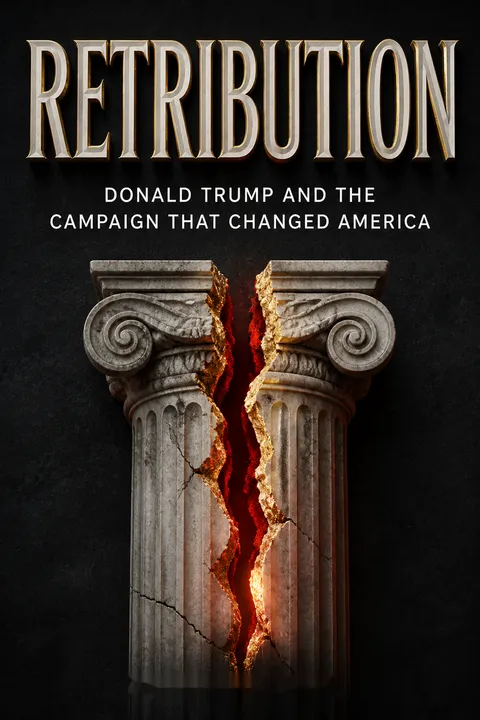

Key Takeaways
1. Trump's Legal Battles Fueled His Retribution Narrative
"For those who have been wronged and betrayed,” he declared at a March 2023 rally in Waco, Texas, “I am your retribution.”
Elite detachment. Donald Trump's 2024 campaign was driven by a narrative of retribution against the "elites" who had scorned him, investigated him, and prosecuted him since his 2021 departure from the White House. This resonated deeply with working-class Americans who felt similarly let down by powerful figures in politics, business, law, academia, and media. His legal travails, particularly the New York felony trial, were framed as political persecution, strengthening his connection with supporters.
Felon and front-runner. Despite facing 34 felony charges in New York—and more serious federal indictments for classified documents and January 6—Trump consistently led in polls. The New York "hush money" trial, focused on bookkeeping, allowed him to portray himself as a victim of a "witch hunt," turning courtroom appearances into campaign stages. This strategy proved effective, as his conviction did not diminish his standing with voters but rather garnered him additional sympathy and clarified the high personal stakes of the election.
Personal stakes. The guilty verdict in New York underscored Trump's personal imperative to win: victory meant vindication and the power to exact retribution, while a loss could mean a lifetime battling legal challenges and potential imprisonment. This stark choice intensified his campaign's focus on vengeance, promising to root out not just his enemies but also those of "ordinary, working-class Americans."
2. Biden's Age and Debate Debacle Led to His Withdrawal
“Folks, this is a big deal, this election,” Biden told donors at a fundraiser in Massachusetts just two days after Navalny wrote his letter outlining concerns about the president. “If Trump wasn’t running, I’m not sure I’d be running. But we cannot let him win, for the sake of the country.”
Reluctant candidacy. Joe Biden's decision to seek re-election was fraught with internal doubts and public concern, particularly regarding his age. Despite an earlier "bridge" promise to pass the torch to a new generation, the perceived threat of Donald Trump's return compelled Biden to run, believing he was the only one who could defeat him. This decision, however, stifled a potential Democratic primary and left many party leaders privately terrified about his viability.
Warning signs ignored. Biden's administration faced significant challenges, including a botched Afghanistan withdrawal, persistent inflation, and border mismanagement, which contributed to consistently low approval ratings. A special counsel's report, while declining to charge Biden, highlighted his "poor memory," further fueling public and private Democratic anxieties about his cognitive fitness. Despite these clear warning signs, Biden's inner circle, perhaps seeing only what they wanted to see, remained convinced he was "at the top of his game."
Debate disaster. The June 2024 debate against Trump proved catastrophic for Biden. His visibly frail appearance, weak voice, and fumbled responses shocked viewers and solidified doubts about his ability to serve another term. The performance triggered a rapid and widespread call from influential Democrats for him to withdraw, culminating in a private meeting where party leaders, including Senator Patty Murray, informed him of overwhelming opposition to his continued candidacy.
3. Kamala Harris's Swift Rise and Campaign Challenges
“This is the process,” Harris responded. “I am calling people and asking for their support. I hope to have your support.”
Coronation, not contest. Following Biden's withdrawal, Kamala Harris swiftly consolidated support, effectively clinching the Democratic nomination without a competitive primary. Her rapid outreach to party leaders, including potential challengers, ensured a unified front, preventing the "ugly fight" for the nomination that many feared. This "coronation" was aided by Biden's immediate endorsement, which was crucial for her legitimacy and momentum.
Initial surge and challenges. Harris's ascension brought a much-needed jolt of energy and fundraising to the Democratic Party, with her first rallies drawing enthusiastic crowds. However, she faced immediate challenges in defining her candidacy, particularly given her past progressive stances and the need to distance herself from the unpopular Biden administration. Her reluctance to engage in unscripted interviews or articulate clear policy shifts left her vulnerable to Trump's attacks, who quickly labeled her a "Radical Left Marxist."
Trump's counter-attacks. Trump struggled initially to adapt to Harris, but soon found effective lines of attack. He relentlessly questioned her authenticity, highlighting her shifting political positions and her claim of working at McDonald's. His campaign's "Kamala is for they/them, President Trump is for you" ad, targeting her stance on transgender surgeries for inmates, proved particularly devastating, effectively eroding her support among swing voters.
4. The Assassination Attempt Transformed Trump's Campaign
“A half an inch, a quarter of an inch,” he said, and it would have been all over.
Near-fatal attack. On July 13, 2024, Donald Trump narrowly survived an assassination attempt at a rally in Butler, Pennsylvania, when a gunman fired an AR-15 rifle from less than 200 yards away. The bullet grazed his ear, and the quick actions of Secret Service agents, combined with Trump's own defiant refusal to be immediately whisked away, created an iconic image of him raising his fist and shouting "Fight! Fight! Fight!"
Brief unity, then vengeance. The shooting initially prompted a rare moment of political unity, with President Biden expressing concern and Trump himself calling for national unity. However, this conciliatory tone was short-lived. Trump quickly reverted to his "retribution" persona, framing the event as a divine intervention and a testament to his resilience. His allies, like JD Vance, immediately blamed Democratic rhetoric for inciting the attack, further polarizing the political landscape.
Strategic impact. The assassination attempt profoundly impacted the campaign, generating a massive wave of sympathy and support for Trump.
- Elon Musk's immediate endorsement and significant financial backing followed.
- Robert F. Kennedy Jr.'s subsequent endorsement also stemmed from this event.
- The incident solidified Trump's image as a strong, divinely protected leader, boosting his poll numbers and creating a sense of inevitability around his return to power.
5. Trump's Transition Prioritized Loyalty and Retribution
“The difference between now and before is I know everybody now, and when I first came I knew nobody,” Trump told me during a phone conversation on October 21, 2024. “We had a lot of great people. But I didn’t know people. Had to rely on recommendations. Now I know people, so it’s good.”
Mar-a-Lago as command center. Trump's transition into his second term was largely orchestrated from Mar-a-Lago, emphasizing personal loyalty and proximity to the president-elect over traditional vetting processes. Key decisions, including cabinet selections, were made in his private club, often after in-person meetings where candidates were assessed for their "central casting" appeal and unwavering fealty. This approach contrasted sharply with his first transition, where he relied more on external recommendations.
Unconventional cabinet picks. Trump's selections for top positions, such as Pete Hegseth for Defense Secretary and Kristi Noem for Homeland Security, bypassed traditional vetting and raised eyebrows even among his allies.
- Hegseth, a Fox News personality with military service but no senior defense experience, faced sexual assault allegations and financial mismanagement claims.
- Noem, the South Dakota governor, had a controversial record, including ethics concerns and a book detailing the shooting of her dog.
These choices reflected Trump's desire for loyalists who would implement his agenda without question, rather than experienced technocrats.
"Weaponized Government" architects. Figures like Stephen Miller, architect of Trump's domestic policy, and Boris Epshteyn, his all-purpose legal advisor, were central to the transition. They planned for a radical reshaping of the federal government, including mass deportations and the dismantling of perceived "deep state" elements. Epshteyn, despite allegations of using his influence for personal gain, remained a key figure, demonstrating Trump's prioritization of loyalty above all else.
6. The Weaponization of Justice Under Trump's Second Term
“The hunted are about to become the hunters,” Bannon declared ominously a few days before Gaetz was selected.
Retribution in action. Trump's second term immediately saw the "weaponization" of the Justice Department, fulfilling his campaign promise of retribution against perceived enemies. Emil Bove, appointed Principal Associate Deputy Attorney General, spearheaded a rapid purge of top FBI and DOJ officials, targeting those involved in prosecuting Trump or January 6 defendants. This swift action, far exceeding previous political purges, signaled a new era of politically driven justice.
Adams case intervention. Bove's most controversial move was ordering federal prosecutors to drop a corruption case against New York Mayor Eric Adams, a Democrat who had become an ally of the Trump administration. Bove cited "weaponization" of justice and Adams's cooperation on immigration as reasons, effectively using the legal system as leverage. This unprecedented intervention led to multiple resignations within the DOJ, including a decorated combat veteran, who condemned it as a threat to the rule of law.
January 6 pardons. On his first day in office, Trump issued sweeping pardons or commutations for nearly all individuals charged in connection with the January 6 Capitol attack, including those convicted of assaulting police officers. This move, which effectively erased one of the largest FBI investigations in history, was a direct fulfillment of his "J6 hostages" promise. It drew condemnation from law enforcement unions but was celebrated by his base, further cementing his image as a protector of his supporters.
7. Biden's Final Pardons and the Symbolic Transfer of Power
“I believe in the rule of law, and I am optimistic that the strength of our legal institutions will ultimately prevail over politics,” Biden said in a statement announcing the moves. “But these are exceptional circumstances, and I cannot in good conscience do nothing."
Preemptive clemency. On his final day in office, Joe Biden issued last-minute, preemptive pardons to General Mark Milley, Dr. Anthony Fauci, Liz Cheney, and other members of the January 6 Committee and Capitol Police officers. These individuals, though not charged with crimes, had been relentlessly attacked by Trump and his allies, and Biden's pardons aimed to shield them from anticipated political retaliation by the incoming administration.
Family pardons. Biden also issued sweeping pardons for five members of his immediate family, including his siblings and their spouses, covering any nonviolent federal offenses committed since 2014. This move, while controversial and criticized by some Democrats, was justified by Biden as a response to "selective and unfairly prosecuted" attacks motivated by "raw politics." He personally signed Hunter's pardon, but used an autopen for the others, a detail later challenged by Trump.
Norms upheld, then challenged. Despite the deep animosity and Trump's previous refusal to participate, Biden welcomed Trump to the White House on Inauguration Day, upholding the tradition of a peaceful transfer of power. This symbolic gesture, however, was immediately followed by Trump's inaugural address, which condemned the "radical and corrupt establishment" and signaled his intent to dismantle institutions, demonstrating that while Biden honored tradition, Trump was ready to break it.
8. Trump's Second Term: A Radical Shift in American Governance
“My proudest legacy will be that of a peacemaker and unifier,” he added. “That’s what I want to be, a peacemaker and a unifier.”
"American Carnage 2.0". Trump's second inaugural address, despite initial promises of unity, largely echoed his "American Carnage" speech from 2017, condemning a "radical and corrupt establishment" and promising to reverse "horrible betrayals." This rhetoric, delivered with former presidents and tech titans in attendance, signaled a presidency focused on dismantling existing structures and fulfilling his "retribution" agenda, rather than fostering national reconciliation.
Dismantling institutions. Trump's second term immediately embarked on a radical transformation of American governance.
- His personal legal team took charge of the Justice Department, politicizing criminal justice.
- He attacked the courts and judges, drawing a rare rebuke from the Chief Justice.
- He mixed family business with government, accepting a $400 million jet from Qatar.
- He used presidential power to punish law firms and challenge university policies.
- He dismantled the US Agency for International Development, eroding American "soft power."
Politicizing the military. Trump sought firmer control over the armed services, removing portraits of General Mark Milley and firing top military leaders deemed disloyal. A speech at Fort Bragg, where Trump campaign merchandise was sold and active-duty soldiers booed political opponents, highlighted a concerning shift towards politicizing the military, an institution traditionally seen as apolitical and a trusted pillar of American society.
"Enemy within" and lasting damage. Trump's consistent message of Americans as victims, wronged by "elites" and "enemies within," fostered deep division. His rhetoric, exemplified by a hateful Memorial Day post calling judges "monsters," normalized extreme language and eroded trust in democratic institutions. While Trump may not become a dictator, his actions and rhetoric have provided a "road map" for future leaders with more sinister ambitions, leaving lasting damage to the nation's psyche and its commitment to shared values.
People Also Read




Download PDF
Download EPUB
.epub digital book format is ideal for reading ebooks on phones, tablets, and e-readers.








































