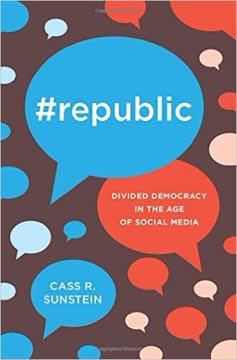
Key Takeaways
1. The "Daily Me" of personalized information threatens democratic exposure.
If you could look through thousands of stories every day and choose the 10 that were most important to you, which would they be? The answer should be your News Feed.
Personalization is here. Technology, especially social media and algorithms, allows individuals to curate their information universe, creating a "Daily Me" where they see only what they choose or what algorithms predict they want. This power to screen in and screen out content is unprecedented.
Algorithms curate. Beyond individual choice, algorithms actively filter content based on user data, often knowing preferences better than the user. This algorithmic curation creates personalized experiences, potentially leading to a fragmented information landscape where different people inhabit different realities.
Promise or threat? While personalization offers convenience and entertainment by filtering out unwanted "junk," it raises fundamental questions about freedom, democracy, and self-government. The ability to avoid topics and perspectives deemed uninteresting or irritating has a serious downside.
2. Unplanned encounters and shared experiences are vital for a healthy democracy.
It is hardly possible to overrate the value, in the present low state of human improvement, of placing human beings in contact with persons dissimilar to themselves, and with modes of thought and action unlike those with which they are familiar.
Beyond censorship. A well-functioning democracy requires more than just freedom from government censorship; it needs a culture of curiosity, openness, and humility. Citizens must be exposed to competing perspectives and appreciate the views of others, even if they disagree.
Public forums matter. Traditional public forums like streets and parks, and general-interest intermediaries like newspapers and television, historically ensured unplanned encounters with diverse people and ideas. These spaces provided shared experiences and exposed individuals to topics and viewpoints they wouldn't have sought out.
Social glue. Common experiences, whether national holidays, major sports events, or widely shared media moments, provide a form of social glue that helps a heterogeneous society address problems and understand one another. A communications system that diminishes these shared experiences risks increasing social fragmentation.
3. Personalization and filtering threaten unplanned encounters and common ground.
What both authors missed is another kind of dystopia, produced by the power to create one’s very own echo chamber: the power of personalization, or gated communities, which can diminish individual freedom and endanger self-government itself.
A new dystopia. Unlike Orwell's authoritarian control or Huxley's pleasure-driven conformity, the digital age presents a dystopia of self-created echo chambers. Personalization allows individuals to wall themselves off from differing viewpoints, potentially diminishing their own freedom by limiting exposure to new ideas and truths.
Eroding commonality. As people increasingly rely on personalized feeds and niche content, the number of shared experiences across society declines. This makes mutual understanding more difficult and hinders the ability of citizens to converge on solutions to common problems.
Self-insulation's cost. While self-insulation can offer comfort and reinforce existing beliefs, it spreads falsehoods and promotes polarization and fragmentation. An architecture of serendipity, which encourages unexpected encounters, is needed to counteract this tendency and promote both self-government and individual liberty.
4. Online echo chambers fuel group polarization and extremism.
When men have realized that time has upset many fighting faiths, they may come to believe even more than they believe the very foundations of their own conduct that the ultimate good desired is better reached by free trade in ideas—that the best test of truth is the power of the thought to get itself accepted in the competition of the market, and that truth is the only ground upon which their wishes safely can be carried out.
Polarization explained. Group polarization is the phenomenon where discussion among like-minded people leads them to adopt more extreme positions in the direction of their initial inclination. This occurs due to:
- Limited argument pools: Hearing mostly arguments supporting the initial view.
- Reputational pressure: Adjusting views to align with the group's dominant position.
- Confidence from corroboration: Becoming more certain and extreme when others agree.
Online amplification. The internet and social media facilitate the formation of like-minded groups and make it easier to avoid contrary views, serving as breeding grounds for polarization. Exposure to views on partisan sites or within homogeneous social media feeds can entrench and reinforce existing positions, often leading to extremism.
Real-world consequences. Increased polarization, fueled by online echo chambers, makes it harder for diverse groups to find common ground or make progress on societal problems. It contributes to "partyism"—visceral dislike of opposing political parties—and can lead people to believe in falsehoods, hindering effective governance.
5. Social cascades, especially online, spread information and falsehoods rapidly.
The apparent views of Albert, Barbara, and Cynthia carry information; that apparent view might be right.
Cascades defined. Social cascades occur when people base their decisions or beliefs on the apparent decisions or beliefs of others, rather than solely on their own private information. This can lead to rapid, widespread adoption of ideas or behaviors.
Two types. Informational cascades happen when people infer information from others' actions and follow suit, even if their private information suggests otherwise. Reputational cascades occur when people go along with the crowd to maintain social standing, even if they privately disagree.
Cybercascades. The internet and social media greatly amplify cascades, allowing information (true or false) to spread like wildfire. Online platforms make it easy to see what others are doing or saying, influencing individual behavior and potentially leading to rapid shifts in opinion or the spread of rumors and falsehoods.
6. Evaluating communication systems requires thinking as citizens, not just consumers.
The commitment to consumer sovereignty will also undermine political sovereignty if free consumer choices result in insufficient understanding of public problems, or if they make it difficult to have anything like a shared or deliberative culture.
Consumer vs. Citizen. A key challenge is distinguishing between our role as consumers, seeking personal satisfaction and convenience, and our role as citizens, concerned with the public good and democratic self-governance. Evaluating communication systems solely through the lens of consumer choice is insufficient.
Preferences are shaped. Individual preferences are not fixed; they are shaped by social circumstances, including the available options and the structure of communication markets. A system focused purely on consumer sovereignty risks reinforcing existing preferences, even if those preferences lead to outcomes detrimental to citizenship and democracy.
Aspirations vs. Choices. As citizens, people may have aspirations for a communication system that promotes democratic goals, such as informed deliberation and shared understanding, even if their individual consumer choices lean towards entertainment or partisan reinforcement. Democratic processes can reflect these higher aspirations.
7. "Regulation" is unavoidable; the debate is what kind best serves democracy.
There is no avoiding “regulation” of the communications market—of television, print media, and the Internet.
Regulation is omnipresent. The idea that the internet or communication markets can exist free of government regulation is incoherent. Property rights, contract law, and protection against cybercrime are all forms of regulation that are essential for these systems to function and from which participants benefit daily.
Not whether, but what. The relevant question is not whether to regulate, but what kind of regulation is desirable to promote a well-functioning system of free expression that serves democratic goals. Complaining about "regulation" in the abstract obscures the real debate about the design of the legal framework.
Democratic goals. Regulation can be evaluated based on whether it promotes democratic deliberation, protects against viewpoint discrimination, and ensures a robust public sphere. While government penalties on speech are highly suspect, subsidies or structural rules aimed at improving the information environment for citizens may be legitimate.
8. Terrorism and extremism exploit online dynamics for radicalization and recruitment.
Terrorists do not even consider that they may be wrong and that other views may have some merit.
Crippled epistemology. Terrorists and extremists often suffer from a "crippled epistemology," knowing very little and much of it false, derived primarily from like-minded individuals within isolated online enclaves. This limited information environment, combined with group polarization, fuels radicalization.
Online recruitment. Terrorist organizations like ISIL actively use the internet and social media for propaganda, recruitment, and inspiring "lone wolves." They exploit online platforms to connect with vulnerable individuals, isolate them from moderating influences, and accelerate the radicalization process through targeted communication and cascade effects.
Combating online terror. Counterterrorism efforts must address the online environment, not just physical threats. Strategies include:
- Counter-messaging to debunk propaganda and falsehoods.
- Working with tech companies to disrupt terrorist accounts and content.
- Understanding and counteracting the social dynamics of online radicalization.
9. Counteracting fragmentation requires promoting diverse encounters and shared knowledge.
My largest plea here, in fact, is for an architecture of serendipity—for the sake of individual lives, group behavior, innovation, and democracy itself.
Architecture of serendipity. To combat the risks of fragmentation and polarization, there is a need for communication systems designed to facilitate unplanned, unanticipated encounters with diverse topics and viewpoints. This "architecture of serendipity" benefits individuals and society by broadening horizons and fostering mutual understanding.
Promoting shared experiences. Encouraging common experiences, whether through media coverage of significant events or platforms that bring diverse people together, helps build social capital and a sense of shared identity necessary for a functioning democracy. This can be pursued through private initiatives or, cautiously, public ones.
Voluntary and creative solutions. While government mandates are often inappropriate, private institutions and individuals can adopt practices that promote diversity and shared knowledge. Examples include:
- Creating prominent online deliberative domains.
- Voluntary disclosure of public interest activities by media.
- Providing links or "serendipity buttons" to expose users to diverse content.
10. Maintaining a republic depends on an engaged citizenry and a robust public sphere.
The People, not the Government, possess the absolute sovereignty.
Franklin's challenge. The success of a republic depends not just on its founding documents but on the ongoing actions and commitments of its citizens. An "inert people" is a great menace to freedom, as it undermines the active engagement required for self-governance.
Free communication is guardian. As Madison argued, free communication among the people is essential for a free government, allowing citizens to evaluate public figures and measures. This view sees free speech as a cornerstone of self-government, not merely a market for ideas or a guarantee of consumer choice.
Beyond the Daily Me. The ideal communication system for a republic fosters a public sphere where citizens with varying experiences and views can meet, consult, and deliberate. While technology enables personalization, the health of the republic requires resisting the urge to retreat into purely private, filtered realities and instead embracing the challenge of engaging with diversity.
Review Summary
Reviews of "#republic" are mixed. Many readers find the premise interesting and relevant but criticize the book for being repetitive, overly long, and poorly organized. Some praise Sunstein's insights on echo chambers and polarization in social media, while others feel the arguments lack depth or practical solutions. Several reviewers note that the main points could have been conveyed more concisely. Despite these critiques, some readers still find value in the book's examination of how personalized media affects democracy and public discourse.
People Also Read





 Immersive





FAQ
What is #Republic: Divided Democracy in the Age of Social Media by Cass R. Sunstein about?
- Core focus on democracy and technology: The book examines how social media and the Internet are reshaping democracy, with particular attention to polarization, echo chambers, and the fragmentation of public discourse.
- Democratic self-government at risk: Sunstein argues that personalized, filtered information environments threaten the exposure to diverse viewpoints necessary for a healthy democracy.
- Broader implications: The book also explores how these dynamics affect freedom of speech, citizenship, and even the exploitation of social media by terrorist organizations.
Why should I read #Republic by Cass R. Sunstein?
- Insight into modern democracy: The book provides a deep analysis of how digital communication technologies influence political polarization, misinformation, and democratic participation.
- Clarifies free speech debates: Sunstein offers a nuanced perspective on the First Amendment, emphasizing the importance of democratic deliberation over mere consumer choice.
- Practical relevance: Readers gain tools to understand and evaluate current and future communication policies, as well as proposals for improving the democratic public sphere.
What are the key takeaways from #Republic by Cass R. Sunstein?
- Risks of personalization: Personalized news feeds and algorithmic curation can create echo chambers, reducing exposure to diverse ideas and increasing polarization.
- Importance of shared experiences: Democracy thrives when citizens encounter unchosen topics and share common experiences, which are threatened by fragmented media environments.
- Need for institutional reform: Sunstein advocates for communication systems and policies that promote serendipity, deliberation, and exposure to competing perspectives.
What is the "Daily Me" concept in #Republic and why does it matter?
- Definition and origin: The "Daily Me," coined by Nicholas Negroponte, refers to a personalized news feed tailored to individual preferences, representing a shift from mass media to individualized content.
- Promise and peril: While convenient and relevant, the Daily Me risks creating self-insulation and echo chambers, undermining democratic deliberation.
- Democratic implications: Sunstein warns that such personalization can fragment society and reduce the serendipitous encounters with diverse viewpoints essential for democracy.
How does #Republic by Cass R. Sunstein explain echo chambers and polarization on social media?
- Echo chambers defined: Social media algorithms and user choices often filter information, creating environments where individuals only encounter like-minded views.
- Group polarization: When like-minded groups interact, their views tend to become more extreme, a phenomenon amplified by online enclaves.
- Consequences for democracy: These dynamics increase hostility, spread misinformation, and threaten mutual understanding and social cohesion.
What are cybercascades in #Republic and how do they affect information and misinformation?
- Definition of cybercascades: Cybercascades are rapid, large-scale flows of information—true or false—through social networks, driven by social influence and reputational concerns.
- Types and effects: Informational and reputational cascades can amplify beliefs and behaviors, often without independent evaluation.
- Impact on democracy: Cybercascades can distort judgment, spread misinformation, and create unpredictable political turbulence, complicating efforts to maintain informed public discourse.
What is the distinction between consumer sovereignty and democratic deliberation in #Republic by Cass R. Sunstein?
- Consumer sovereignty critiqued: The book challenges the idea that freedom is simply about respecting individual consumer choices, noting that preferences are shaped by social context and limited exposure.
- Democratic deliberation emphasized: Sunstein argues that citizens, unlike consumers, aspire to collective goals and require exposure to diverse views for self-government.
- Policy implications: Communication technologies should be evaluated for their impact on citizenship and democratic participation, not just consumer satisfaction.
How do algorithms and hashtags shape information consumption according to #Republic by Cass R. Sunstein?
- Algorithms as curators: Social media platforms use algorithms to personalize content, often reinforcing existing beliefs and limiting exposure to opposing views.
- Hashtags as sorting tools: Hashtags help users find and join conversations, which can both promote discovery and deepen polarization by clustering like-minded individuals.
- Democratic consequences: Algorithmic filtering and hashtag use can foster echo chambers and cybercascades, intensifying political divisions and misinformation.
What role do general-interest intermediaries and shared experiences play in #Republic by Cass R. Sunstein?
- General-interest intermediaries defined: Traditional media outlets act as public forums, exposing citizens to diverse topics and viewpoints, often unchosen by the audience.
- Shared experiences as social glue: Common experiences foster social cohesion and mutual understanding, essential for democratic deliberation.
- Threats from new media: The decline of these intermediaries and rise of personalized media risk increasing fragmentation and weakening democratic self-government.
How does #Republic by Cass R. Sunstein address freedom of speech and regulation in the digital age?
- Free speech is not absolute: The book clarifies that the First Amendment allows for regulation of certain harmful speech, especially online.
- Types of regulation: Sunstein distinguishes between content-neutral, content-based but viewpoint-neutral, and viewpoint-discriminatory regulations, advocating for careful, democratic approaches.
- Balancing freedom and security: The book calls for transparency, voluntary self-regulation, and targeted legal measures to protect both free expression and public interests.
What solutions and proposals does #Republic by Cass R. Sunstein offer to counteract echo chambers and polarization?
- Architecture of serendipity: Sunstein advocates for systems that promote unplanned encounters with diverse ideas, countering the isolating effects of personalization.
- Deliberative domains: He suggests creating online spaces for discussion among people with diverse views, fostering mutual understanding and reflective citizenship.
- Innovative tools and regulation: Proposals include “opposing viewpoint” and “serendipity” buttons, transparency in content practices, and voluntary codes of conduct to promote diversity without heavy-handed regulation.
What is the significance of the phrase “A republic, if you can keep it” in #Republic by Cass R. Sunstein?
- Franklin’s challenge: The phrase underscores the ongoing responsibility of citizens to maintain democratic self-government.
- Preconditions for a republic: Sunstein argues that exposure to diverse and unchosen ideas is essential for sustaining a republic.
- Hope and obligation: The book stresses that while technology poses risks, it also offers promise if used wisely, and the future of democracy depends on collective commitment to its ideals.
About the Author
Other books by Cass R. Sunstein








Download PDF
Download EPUB
.epub digital book format is ideal for reading ebooks on phones, tablets, and e-readers.








































