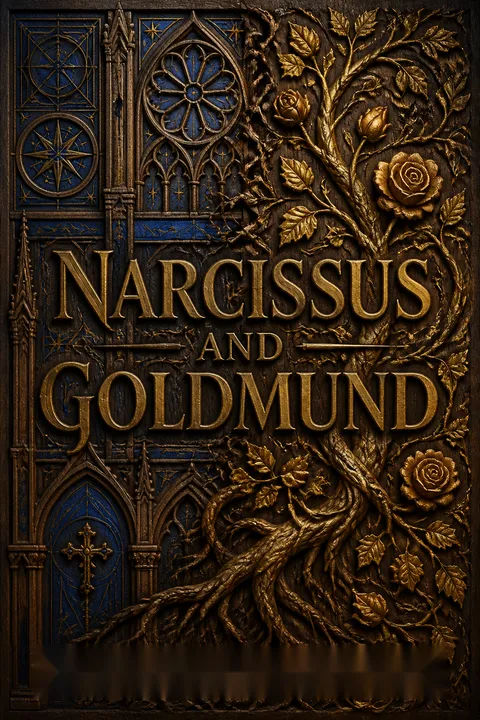

Plot Summary
Cloister Shadows and Seeds
In the medieval cloister of Mariabronn, life pulses with tradition, learning, and the quiet tension of spiritual striving. Among the monks and students, two figures stand apart: Narcissus, a brilliant, ascetic young teacher, and Goldmund, a dreamy, sensitive new pupil. Narcissus is admired for his intellect and self-mastery, while Goldmund, recently left by his father, is drawn to the beauty and mystery of the world around him. Their first encounters are marked by mutual fascination and a sense of destiny, as if each recognizes in the other a missing half. The cloister, with its rituals and rules, becomes the crucible in which their contrasting natures—mind and heart, discipline and instinct—begin to interact, setting the stage for a lifelong bond and a journey of self-discovery.
The Meeting of Opposites
Narcissus, the embodiment of intellect and order, becomes both mentor and challenger to Goldmund, whose soul is restless and attuned to beauty and feeling. Their friendship is intense, sometimes uneasy, as Narcissus seeks to awaken Goldmund to his true nature, sensing that the cloister's path is not his friend's destiny. Goldmund, torn between admiration for Narcissus and longing for the world's sensuality, struggles with guilt and confusion. The two debate the nature of destiny, the difference between mind and heart, and the meaning of fulfillment. Their conversations are both a comfort and a source of pain, as each tries to guide the other toward self-realization, even as their paths seem destined to diverge.
Awakening and Inner Turmoil
Goldmund's inner conflict intensifies as he is drawn to forbidden pleasures outside the cloister. A secret night in the village, a girl's kiss, and the awakening of desire leave him wracked with guilt and confusion. Narcissus, recognizing his friend's suffering, gently but firmly confronts him, guiding Goldmund to face the truth of his own nature. A crisis ensues: Goldmund collapses under the weight of his divided soul, haunted by memories of a lost mother and a father's stern expectations. In a moment of revelation, Narcissus helps Goldmund recover a forgotten childhood and the image of his mother, breaking the spell of self-denial and setting him on a new path. Their friendship, tested by pain and honesty, emerges deeper but changed.
The Mother's Forgotten Face
Haunted by dreams and memories, Goldmund recalls the mother he had been taught to forget—a wild, beautiful woman whose spirit lives on in his own longing for freedom and sensuality. The revelation brings both joy and sorrow, as Goldmund realizes that his true nature is not that of a monk, but of an artist and lover. The cloister, once a place of refuge, now feels confining. Narcissus, having fulfilled his role as awakener, withdraws into his own spiritual exercises, while Goldmund prepares to leave. The rediscovery of his mother's image becomes the wellspring of his future art and the compass for his wandering life, as he sets out to seek experience, beauty, and meaning beyond the cloister walls.
The Breaking of Spells
Given a final errand outside the cloister, Goldmund encounters Lise, a free-spirited woman who initiates him into the mysteries of love and the body. The experience is both ecstatic and fleeting, as Lise soon returns to her own life, leaving Goldmund to face the world alone. He bids a heartfelt farewell to Narcissus, who blesses his journey with both sorrow and hope. The cloister, once the center of Goldmund's world, recedes into memory as he steps into the unknown, guided by the call of his mother and the promise of a life lived through the senses. The spell of duty and guilt is broken; the adventure of self-discovery begins.
The Call Beyond Walls
Goldmund's journey through forests and villages is marked by wonder, hunger, and the thrill of freedom. He learns to survive on the land, to find beauty in nature, and to connect with people of all kinds. Each encounter—whether with a peasant family, a farmer's wife, or a passing animal—teaches him something about the world and himself. Love and desire become his teachers, as he moves from one brief affair to another, always searching for the elusive fulfillment that lies just beyond reach. The world is both beautiful and cruel, and Goldmund's heart is open to both joy and suffering.
Into the World's Embrace
As Goldmund wanders, he becomes a student of women, learning the art of love in all its forms. Each relationship is unique, each woman a new world to explore. Yet happiness is always fleeting, and loss is never far behind. Goldmund's openness to experience brings both delight and pain, as he is repeatedly abandoned or forced to move on. The world's embrace is sweet but impermanent, and Goldmund begins to sense the underlying sadness of all things. The lessons of desire and impermanence shape his soul, preparing him for the deeper calling that awaits.
The Lessons of Desire
A chance encounter with a master sculptor, Niklaus, reveals to Goldmund his true vocation: to become an artist and give form to the images that fill his soul. Under Niklaus's guidance, Goldmund learns the craft of carving, discovering the joy and agony of creation. His first works are inspired by memories of Narcissus and the women he has loved, as he seeks to capture the mystery of beauty and suffering in wood and clay. The discipline of art brings a new kind of fulfillment, but also new challenges, as Goldmund struggles with the demands of mastery, the temptations of pride, and the longing for freedom.
Love, Loss, and Exile
Goldmund's time in the master's house is marked by passion and peril. He falls in love with Lydia, the master's daughter, and is drawn into a web of desire, jealousy, and forbidden longing. The affair, both tender and tragic, ends in betrayal and exile, as Goldmund is discovered and cast out. The pain of loss is deep, but it is also a turning point, as Goldmund is forced once again into the world, stripped of illusions and ready to face the darkness as well as the light. The exile is both punishment and liberation, a necessary step on the path to selfhood.
The Wanderer's Ordeal
The world Goldmund re-enters is ravaged by plague, violence, and madness. He witnesses the horrors of death and the collapse of order, experiencing hunger, fear, and the constant threat of annihilation. Companions come and go, some dying by his hand, others lost to fate. Goldmund's journey becomes a dance with death, as he is both fascinated and repelled by the spectacle of suffering. The experience leaves him scarred and changed, but also deepens his understanding of life's fragility and the necessity of art as a response to mortality.
The Artist's Calling
Surviving the ordeal, Goldmund finds his way to a city where he is taken in by a master artist. Here, he rediscovers his vocation and pours his experiences into a new body of work. His sculptures, inspired by memories of Narcissus, Lydia, and the universal mother, are celebrated for their depth and beauty. Yet even in success, Goldmund feels the pull of impermanence and the limitations of art. The act of creation is both a consolation and a reminder of what cannot be preserved. The artist's calling is to give form to the fleeting, to salvage meaning from the dance of life and death.
Master and Apprentice
As Goldmund's reputation grows, he is offered a place as master and the hand of his mentor's daughter. Yet the prospect of settling down, of trading freedom for security, fills him with dread. The tension between the demands of art and the call of the world becomes unbearable. Goldmund chooses once again to leave, sacrificing comfort and recognition for the uncertain path of the wanderer. The decision is both a defeat and a victory, as he remains true to his nature, even at the cost of loneliness and loss.
The Plague and the Dance
The world Goldmund returns to is in the grip of the Black Death. He witnesses the collapse of society, the madness of crowds, and the cruelty born of fear. Amid the horror, he finds moments of tenderness and beauty—a girl rescued from a plague city, a brief idyll in a forest hut, the fleeting joys of love and companionship. Yet death is always present, and Goldmund is forced to confront the limits of his own strength and the inevitability of loss. The dance of death becomes both a nightmare and a source of insight, as Goldmund learns to accept the transience of all things.
Death's Seduction
As the plague recedes, Goldmund is left exhausted and broken. The women he has loved are gone, his body is weakened, and the world feels empty. Yet in the face of death, he finds a strange peace, a sense of having lived fully and without regret. The image of the universal mother, at once nurturing and destructive, becomes his final comfort. Death is no longer an enemy, but a return to the source, a reunion with the mother who has called him all his life. Goldmund's surrender is both an end and a fulfillment, the last lesson of a life lived in pursuit of beauty and truth.
Return to the City
Goldmund returns to the city of his artistic triumphs, hoping to find solace and purpose. Instead, he discovers that his master is dead, his beloved Lisbeth is a shadow of her former self, and the world he once knew has changed beyond recognition. The emptiness of success and the impermanence of all things weigh heavily on him. Even the act of creation feels hollow, as the images that once inspired him now seem distant and unattainable. Goldmund is forced to confront the limits of art and the inevitability of loss, as he searches for meaning in a world that no longer feels like home.
The Count's Mistress
A last, passionate affair with Agnes, the mistress of a powerful count, brings Goldmund to the brink of destruction. The love is intense, but fraught with danger, as Goldmund is discovered and condemned to death. Imprisoned and awaiting execution, he is forced to confront his own mortality and the choices that have led him to this point. The affair is both a culmination and a reckoning, as Goldmund faces the consequences of a life lived on the edge of desire and risk.
The Dungeon and the Abbot
In the darkness of the dungeon, as death approaches, Goldmund is visited by a priest—Narcissus, now Abbot of Mariabronn. Their reunion is charged with emotion, as Narcissus secures Goldmund's pardon and leads him back to the cloister. The two friends, changed by years of separation and suffering, find a new understanding and acceptance of each other. The meeting is both a rescue and a reconciliation, as the opposites are brought together once more, each recognizing the value and necessity of the other's path.
Homecoming and Confession
Back in the cloister, Goldmund is given the chance to create once more, to pour his life's experiences into a final work of art. He confesses his sins and doubts to Narcissus, finding peace in the acceptance of his own nature and the recognition of the limits of both art and intellect. The friendship between the two men deepens, as each acknowledges the other's gifts and the necessity of their differences. The cloister, once a place of conflict, becomes a sanctuary for reflection and creation.
The Final Creation
Goldmund's final years are devoted to the creation of a great work—a series of sculptures that capture the beauty and suffering of the world he has known. Assisted by a devoted apprentice, he pours his remaining strength into the task, seeking to leave behind a testament to his journey. As his health fails, Goldmund reflects on his life, his loves, and the meaning of his art. The act of creation becomes both a farewell and a reconciliation, as he prepares to let go of the world and return to the mother who has called him all his life.
Farewell, Friend and Self
In his final days, Goldmund is cared for by Narcissus, who confesses his love and gratitude for the friend who has enriched and challenged him. Goldmund, at peace with himself and the world, surrenders to death with the image of his mother before him. Narcissus, left behind, contemplates the mystery of their bond and the meaning of a life lived in pursuit of beauty, love, and truth. The story ends with a sense of completion and acceptance, as the opposites—mind and heart, order and chaos—are reconciled in the memory of friendship and the legacy of art.
Analysis
Hermann Hesse's Narcissus and Goldmund is a profound meditation on the duality of human nature and the search for wholeness. Through the intertwined lives of its two protagonists, the novel explores the tension between intellect and instinct, order and chaos, spirit and flesh. Hesse suggests that fulfillment lies not in the triumph of one pole over the other, but in the recognition and integration of both. The friendship between Narcissus and Goldmund becomes a model for the reconciliation of opposites, as each learns from the other and comes to accept the limits of his own path. The novel's modern relevance lies in its refusal to offer easy answers: art and intellect, love and discipline, freedom and belonging are all necessary, yet none is sufficient alone. The journey toward selfhood is marked by suffering, loss, and impermanence, but also by moments of beauty, connection, and grace. In the end, Hesse's message is one of acceptance: to live fully is to embrace both the light and the darkness, to create meaning in the face of death, and to honor the mystery at the heart of existence.
Review Summary
Narcissus and Goldmund is a philosophical novel exploring the duality of human nature through two contrasting characters. Readers appreciate Hesse's beautiful prose and thought-provoking themes, including the struggle between intellect and sensuality, art and spirituality. Many find the book deeply moving and enlightening, praising its exploration of life's meaning. Some criticize the portrayal of women and repetitive elements. Overall, the novel is considered a masterpiece by many, particularly resonating with young readers seeking self-discovery and understanding of life's complexities.
People Also Read






Characters
Narcissus
Narcissus is the ascetic, brilliant monk whose life is devoted to the pursuit of knowledge, discipline, and spiritual clarity. As a teacher and later Abbot of Mariabronn, he is respected for his intellect, self-mastery, and ability to read the souls of others. His relationship with Goldmund is both paternal and fraternal, marked by deep affection, rivalry, and a sense of destiny. Narcissus's psychoanalytic insight allows him to guide Goldmund toward self-discovery, even as he recognizes that their paths must diverge. Over time, Narcissus comes to understand the limitations of pure intellect and the necessity of embracing the fullness of life, as embodied by Goldmund. His journey is one of self-overcoming, as he learns to love, to doubt, and to accept the mystery of existence.
Goldmund
Goldmund is the sensitive, passionate wanderer whose life is a quest for meaning through the senses, love, and art. Orphaned and burdened by a father's expectations, he is awakened by Narcissus to the call of his forgotten mother and the world beyond the cloister. Goldmund's journey is marked by intense experiences—love affairs, suffering, artistic creation, and encounters with death. He is both innocent and wise, open to joy and pain, and driven by a longing for unity with the mother of all things. Goldmund's development is a movement from confusion and guilt to self-acceptance and creative fulfillment, culminating in a final reconciliation with his own mortality and the legacy of his art.
Master Niklaus
Niklaus is the renowned sculptor who becomes Goldmund's teacher and guide in the world of art. Stern, disciplined, and deeply skilled, he represents the ideal of craftsmanship and the sacrifices required for mastery. Niklaus's relationship with Goldmund is complex—marked by admiration, rivalry, and a shared devotion to beauty. His life is a cautionary tale of the costs of perfection and the dangers of settling for security over freedom. Niklaus's death marks the end of an era for Goldmund and the loss of a father figure, but his influence endures in Goldmund's work and self-understanding.
Lydia
Lydia, the knight's daughter, is Goldmund's first great love—a figure of innocence, longing, and unattainable beauty. Their relationship is marked by tenderness, secrecy, and the pain of separation. Lydia's refusal to abandon her world for Goldmund, and her eventual betrayal, become formative experiences in his journey. She represents the ideal of love that is both transformative and tragic, a memory that haunts Goldmund's art and shapes his understanding of desire and impermanence.
Lene
Lene is the peasant girl Goldmund rescues from a plague-stricken city, sharing with her a brief idyll of love and domesticity. Their time together is marked by joy, vulnerability, and the ever-present threat of death. Lene's illness and death become a turning point for Goldmund, forcing him to confront the limits of love and the inevitability of loss. Her memory lingers as a symbol of the beauty and fragility of life.
Agnes
Agnes, the mistress of Count Heinrich, is Goldmund's final great love—a woman of power, sensuality, and risk. Their affair is intense, secret, and ultimately destructive, leading to Goldmund's imprisonment and near execution. Agnes embodies the allure and peril of desire, the intersection of love and death, and the impossibility of lasting fulfillment. Her rejection of Goldmund in his later years marks the end of his journey as a lover and the beginning of his acceptance of mortality.
Erich
Erich is the blacksmith's son who becomes Goldmund's assistant and confidant in his later years. Eager, loyal, and full of admiration, Erich represents the next generation of artists and the hope of continuity. His relationship with Goldmund is one of learning and devotion, as he helps bring the master's final works to completion and bears witness to his decline and death.
Rebekka
Rebekka is the Jewish girl Goldmund encounters during the plague, mourning the loss of her family and facing persecution. Her beauty, pride, and suffering leave a deep impression on Goldmund, inspiring both compassion and artistic vision. Rebekka's fate highlights the brutality of the world and the necessity of art as a response to suffering.
Goldmund's Mother
Though absent in life, Goldmund's mother is a central presence in his psyche—a symbol of nature, sensuality, and the source of all life. Her memory, suppressed and then rediscovered, becomes the guiding force in Goldmund's journey, inspiring his art and shaping his understanding of love and death. She represents the mystery of existence, the unity of creation and destruction, and the ultimate destination of the soul.
Abbot Daniel
Abbot Daniel is the gentle, humble leader of Mariabronn during Goldmund's youth. He embodies the virtues of compassion, simplicity, and quiet strength, serving as a model of spiritual leadership. His relationship with both Narcissus and Goldmund is one of guidance and care, and his memory endures as a symbol of the best in religious life.
Plot Devices
Duality and Complementarity
The central device of the novel is the interplay between opposites: mind and body, order and chaos, intellect and instinct, masculine and feminine. Narcissus and Goldmund are not merely individuals, but archetypes—each representing a pole of human experience. Their friendship, marked by attraction and tension, becomes a microcosm of the struggle for wholeness. The narrative structure alternates between their perspectives, using dialogue, confession, and inner monologue to explore the limits and possibilities of each path. The device of duality is reinforced by recurring symbols—the mother, the cloister, the journey, the work of art—that serve as touchstones for the characters' development.
Foreshadowing and Recurrence
The novel employs foreshadowing through dreams, childhood memories, and symbolic encounters. Goldmund's forgotten mother, the image of the universal mother, and the recurring motif of the journey all point toward the ultimate reconciliation of opposites. The structure is cyclical: Goldmund's departure from and return to the cloister, his repeated experiences of love and loss, and the echoing of past events in new forms. The use of art as both a literal and metaphorical device allows the narrative to reflect on its own meaning, as Goldmund's sculptures become embodiments of his inner journey.
Psychoanalytic Depth
The novel's psychological realism is achieved through the use of confession, introspection, and dialogue. Characters are driven by unconscious forces—repressed memories, desires, and fears—that are gradually brought to light through crisis and revelation. The relationship between Narcissus and Goldmund is both therapeutic and transformative, as each helps the other to confront and integrate the shadow aspects of the self. The narrative structure mirrors the process of analysis, moving from repression and denial to insight and acceptance.
Symbolism and Allegory
The novel is rich in symbolism: the cloister represents order and tradition; the journey stands for the search for meaning; the mother is the archetype of nature and the unconscious. Art is both a literal vocation and an allegory for the human attempt to create meaning in the face of mortality. The plague, the dance of death, and the recurring image of the universal mother serve as reminders of the transience of life and the necessity of embracing both creation and destruction.
About the Author
Other books by Hermann Hesse


Download PDF
Download EPUB
.epub digital book format is ideal for reading ebooks on phones, tablets, and e-readers.








































