


Key Takeaways
Sell before you polish: your first job is a paying customer
Selling is the supreme priority of any new venture. Masterson argues that before your first sale, a business is just a set of unproven ideas you are spending money on. He cites Jim Koch of Samuel Adams beer, whose Goldman Sachs uncle mocked him for shopping for a computer before he had a single customer. Koch put six cold bottles in a briefcase, walked into a bar terrified, and walked out with a 25-case order. The lesson: spend 80% of your time, energy, and money on selling, only 20% on everything else.
Most would-be entrepreneurs invert this. They lease offices, design logos, print business cards, and perfect the product while making zero sales. That is arrogance and delay disguised as diligence.
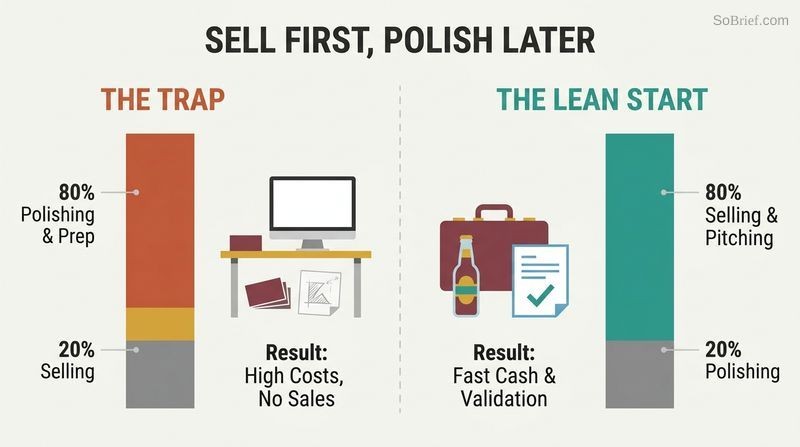
What's striking is how this contradicts the MBA curriculum. Koch noted Harvard Business School offered a dozen marketing courses and zero on selling, treating salespeople as failures. Masterson's claim aligns with lean startup thinking that emerged later: Eric Ries would call the untested product a set of hypotheses awaiting validated learning. The deeper psychology is loss aversion masquerading as productivity. Office setup feels safe and controllable; a sales rejection stings. Founders flee to comfortable busywork. One nuance: capital-intensive or regulated ventures (pharmaceuticals, aircraft) genuinely cannot sell first. Masterson concedes this, but insists even they can pretest demand cheaply before committing full resources.
Every business grows through four stages, each with one dominant problem
Masterson's core framework maps entrepreneurial growth to human development, delimited by revenue.
1. Infancy (zero to $1M): you don't know what you're doing; the challenge is the first profitable sale.
2. Childhood ($1M to $10M): you're barely breaking even; the challenge is creating many new products fast.
3. Adolescence ($10M to $50M): systems strain and customers notice; the challenge is turning chaos into order.
4. Adulthood ($50M+): sales stall; the challenge is becoming entrepreneurial again and getting the business to run itself.
He discovered that once companies cracked the first profitable sale, they hit $1M within a single year, then reached $10M in roughly five. Each stage demands different skills, and the leader must personally transform at each transition or the business stalls.
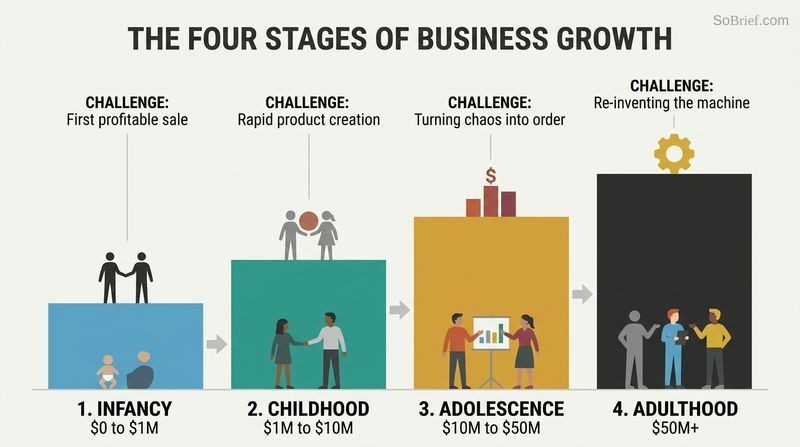
The stage model echoes Larry Greiner's classic 1972 Harvard Business Review piece on organizational growth through crises, and Ichak Adizes' corporate lifecycle, which Masterson credits. The value is diagnostic: knowing your stage tells you which problem deserves attention now versus which is a distraction. The revenue thresholds are admittedly arbitrary and industry-dependent (a footnote offers employee count as an alternative metric, pegged to communication breaking down past groups of seven). The sharper insight is that the founder is often the binding constraint. Businesses plateau not because markets are exhausted but because the leader refuses to shed the skills that worked one stage ago.
Find your optimum selling strategy by answering four questions
The Optimum Selling Strategy (OSS) is the single best way to acquire customers cost-effectively at your current stage. Masterson says it unlocks a padlock with four keyholes, each needing its own key:
1. Where are your customers?
2. What product do you sell them first?
3. How much do you charge?
4. How do you convince them to buy?
His counterintuitive advice for a beginner: imitate the industry norm. Tour the pro shops, browse the magazines, call competitors posing as a student, ask trade associations. Advertise where rivals repeatedly advertise, price near where proven products sell, and sell what is already hot with a small twist. Originality comes later, once you have data. A mediocre ad in the right medium beats a brilliant ad in the wrong one.
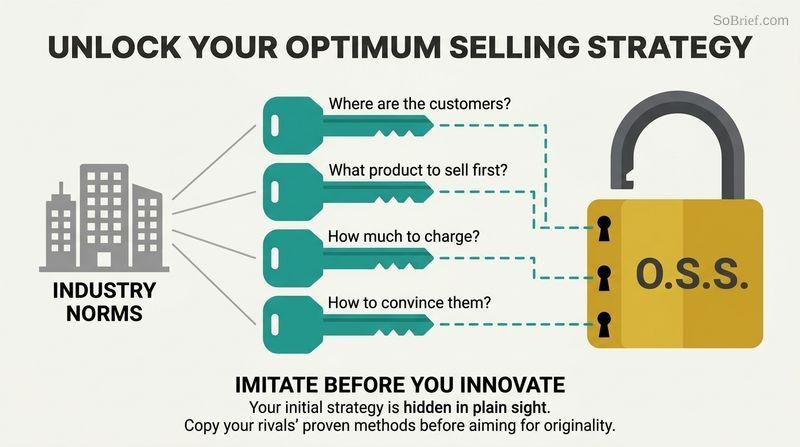
The advice to copy competitors first is refreshingly humble in a genre obsessed with disruption. It reflects a Bayesian logic: competitors have already run expensive experiments, and their repeated behavior encodes hard-won information. Why pay tuition they already paid? Behavioral economists call this observational learning, and it explains why clustering (all the car dealerships on one road) is rational, not lazy. The weakness is survivorship bias. Copying what visibly persists ignores the invisible graveyard of failed imitators, and dominant incumbents may sustain prices your smaller operation cannot. Masterson hedges by insisting on at least one distinct element, which is where genuine competitive advantage actually lives.
You sell wants, not needs, and wants never get satisfied
More than 90% of what people buy is driven by desire, not necessity. You don't need a Rolex, organic vegetables, or a fourth briefcase. Masterson illustrates with his own briefcase obsession versus his billionaire client who carries one ratty, torn nylon bag for fifteen years. The client buys only what he needs, so he is a loyal customer. Masterson buys whenever he wants, so he is a human ATM.
The stunning implication: the likelihood a customer buys is inversely related to their need for it. Commodities (rice, fuel) invite price wars and disloyalty because buyers want to pay as little as possible. Discretionary and luxury goods invite buying frenzies because value is perceived, psychological, and never fully sated by a single purchase.
This reframes marketing as applied psychology rather than logistics. It resonates with Maslow: once physiological and safety needs are met, spending migrates toward esteem and self-actualization, which are bottomless. Veblen's theory of conspicuous consumption explains why raising a watch's price can raise its desirability, inverting the standard demand curve. The buying-frenzy concept anticipates dopamine-driven consumption research: anticipation, not possession, delivers the neurochemical hit, so the frenzy is self-renewing. A caution worth naming: Masterson's ethical defense (selling wants follows the Golden Rule because you enjoy buying too) is comfortable but incomplete. It sidesteps predatory frenzies, addiction, and buyers whose desires outrun their means.
Build products with a unique selling proposition that only seems unique
A Unique Selling Proposition (USP) highlights one benefit above all others and owns that position in the customer's mind. Masterson's insight, borrowed from a legendary Schlitz beer campaign, is that the distinguishing feature need not actually be unique, it only has to seem unique. Every brewery sterilized bottles and tested batches, but Schlitz was first to tell customers how, vaulting from eighth to first in market share within six months.
A solid USP needs three traits:
1. The appearance of uniqueness.
2. Usefulness (the benefit must be desirable).
3. Conceptual simplicity (trendy ideas are simple).
FedEx made its overnight delivery genuinely better; 7-Up made a colorless soda merely seem better by branding itself the Uncola. Both dominated by hammering one clear promise relentlessly.
The Schlitz story, drawn from Claude Hopkins' Scientific Advertising, is a masterclass in preemptive positioning, later systematized by Ries and Trout: the goal is to be first into the prospect's mind, not first into the market. What Masterson adds is the moral permission to manufacture perceived uniqueness through disclosure rather than invention. There is genuine wisdom here, since most products truly are interchangeable. The risk is that a USP built on mere appearance is fragile once a competitor tells the same story better or louder. Durable USPs eventually require substance, which is why Masterson pairs the concept with continuous incremental improvement to keep the claim from going stale.
Ready, Fire, Aim: launch a good product, then perfect it with customer feedback
The title strategy inverts the cautious Ready, Aim, Fire. Once an idea is good (not perfect), fire it into the market immediately, then use real customer response to aim and refine. Masterson insists this is not recklessness, it is not Fire at Will. You still bring the gun to your shoulder. The point is that you cannot know what right looks like until customers use the product, and 90% of new-product ideas die in the development process, perfected to death before they ever ship.
He cites Microsoft shipping software with bugs to be patched later, and Apple's endless upgrades (you cannot upgrade something already perfect). The two killers of good ideas are perfectionism and procrastination, the God of Perfectionism and the God of Procrastination, a two-headed monster.
This is the book's signature idea and its most enduring, prefiguring agile development, minimum viable products, and continuous deployment across tech. The economic logic is subtle: firing first is cheaper because you avoid perfecting features customers never wanted. Masterson breaks innovations into separable uncertainties (would people drink a colorless cola? would they like the taste?) and tests each independently, a technique statisticians call factorial experimentation. The genuine tension, unaddressed at scale, is that Ready, Fire, Aim is catastrophic for elevators, bridges, and pharmaceuticals, which he concedes. The harder judgment call is the gray zone: how buggy is too buggy before shipping erodes trust faster than speed builds share?
Second-stage growth comes from a flood of new products, not a bigger market
To break the one-product-company syndrome and go from $1M to $10M, you must become a product-producing machine. Masterson's formula: 80% of second-stage growth equals innovation times velocity squared. Speed matters more than volume of ideas because good ideas rot; a brilliant concept captured in a phrase must be turned into actual ad copy within 24 hours or its magic evaporates.
Drawing on Gladwell's The Tipping Point, he argues winning products are not revolutionary but evolutionary, small variations on what is already trending, the extra droplet that makes the mound of water overflow. Aim for tipping-point products on the front end (to acquire customers) and ordinary products on the back end (to generate profit). Expect only one tipping-point hit per ten tries, so keep firing.
The evolution-not-revolution thesis is well supported by innovation research: Everett Rogers showed adoption depends on compatibility with existing behavior, and most breakthroughs are recombinations of familiar elements. Masterson's velocity-squared framing, while not literal math, captures a real truth that iteration speed compounds because each launch teaches you something the next one uses. His 24-hour rule to capture ideas before they decay reflects genuine cognitive science on memory reconstruction, where the tacit associations around an insight fade faster than the words. One critique: relentless product proliferation can breed brand confusion and operational strain, the very chaos that defines his third stage. Speed without pruning becomes clutter.
Front-end products acquire customers at breakeven; back-end products make the profit
Master the distinction between front-end sales (to first-time prospects) and back-end sales (to existing customers). The front-end sale's job is acquisition, not profit, so you should be willing to break even or take a loss, spending 30% to 100% of the product's price to land a customer. The back-end sale is where money is made, because selling to someone who already trusts you enjoys higher response rates, higher prices, and lower marketing costs.
The key metric is Allowable Acquisition Cost (AAC): calculate a customer's lifetime gross profit, subtract overhead and desired profit, and the remainder is what you can afford to lose landing them. Masterson grew one publisher from $10M to $80M, with half the growth coming purely from back-end offers the company had previously ignored.
This is the mathematical heart of direct-response marketing and the same engine behind modern subscription and freemium economics. Amazon, Costco, and countless SaaS firms deliberately lose money on acquisition because lifetime value dwarfs first-purchase margin. What Masterson makes concrete is the discipline of quantifying AAC before spending, which prevents the two opposite failures: underspending and starving growth, or overspending and running out of cash. The framework's blind spot is that lifetime value is an estimate, often wildly optimistic in year one, and cohorts churn unpredictably. Companies that scaled acquisition spend on rosy LTV assumptions (many venture-backed startups) discovered the back-end never materialized. The math is only as honest as its inputs.
Trigger buying frenzies by selling something else before the sale is finished
When a customer buys a discretionary product, the purchase itself stimulates the desire to buy again, so the moment to upsell is immediately, before you even ring up the first sale. Masterson dramatizes a man buying a $2,995 pen who is then sold a matching $1,995 pencil with a free case, because the buying experience is exactly what he came for. Three factors ignite a frenzy:
1. Feeling flush with more money than needed.
2. Exposure to effective selling signals.
3. The good feeling from buying itself.
The 80/20 Rule governs frenzies: 20% of customers deliver 80% of profits. Identify these big spenders, market to them aggressively right after their first purchase, appeal to psychological desires rather than physical wants, and keep selling until the frenzy exhausts itself.
The frenzy model finds strong support in consumer neuroscience and the concept of hedonic escalation, where each purchase resets rather than satisfies desire. Retailers exploit this with the post-purchase upsell (the fries with your burger, the extended warranty), and the timing insight is validated: commitment and consistency, documented by Cialdini whom Masterson cites elsewhere, means a fresh buyer is primed to buy again. Focusing 80% of effort on the top 20% is Pareto applied ruthlessly. The ethical and strategic caution is real: aggressive frenzy marketing can produce buyer's remorse, returns, and reputational damage, and it works best on the affluent. Applied to vulnerable buyers, the same tactics curdle into exploitation.
Beware incremental degradation: tiny quality cuts nobody notices eventually kill you
Product quality is the sum of many factors, some invisible individually. Masterson tells of a candy company whose new CEO removes ingredients one at a time; each taste test shows no detectable difference, so costs fall, the stock soars, and he pockets $26 million. Then sales collapse from first place to eleventh. His error: he tested each version against the previous one, not against the original. Nineteen imperceptible cuts summed to a product customers rejected.
The real-world parallel is Schlitz beer, which swapped barley malt for corn syrup and added a preservative in 1974, dropping from 24 million to 15 million barrels by 1980. The antidote is incremental improvement, regularly upgrading products by small degrees even when customers show no dissatisfaction, always benchmarking against the original.
Incremental degradation is a vivid statement of the boiling-frog problem and a warning about local versus global optimization. Each cost cut is locally rational (no measurable harm, real savings) yet globally catastrophic, because the baseline silently drifts. This is precisely the failure mode behind enshittification of digital platforms and the hollowing of legacy brands. The methodological lesson is sharp: always test against the origin, not the last increment, or you will optimize yourself off a cliff. The mirror-image principle, incremental improvement, aligns with kaizen and compounding. One nuance Masterson underplays: distinguishing degradation from legitimate cost innovation is genuinely hard, since some substitutions (digital delivery he mentions) improve products while cutting costs.
Fill your business with stars and superstars by recruiting like you market
A single great hire can be worth $10M to $50M; a bad one costs millions. Yet most owners spend only the normal amount of time hiring, which is the problem, because standard help-wanted ads and resume-scanning are designed to usher in mediocrity. Recruiting extraordinary people requires treating it like a direct-response campaign.
Masterson's better ad sells the dream job to the candidate rather than listing requirements, downplays experience in favor of character and intelligence, and asks for a two-page letter instead of a resume (which weeds out the lazy and reveals personality). You should build a pool of 50 to 100 candidates per opening, read every letter, make 20 to 30 phone calls, and conduct multi-hour interviews. Stars run operations; superstars, who can create growth, run profit centers.
The reframe of hiring as marketing is the actionable core, and it inverts the typical employer-centric job posting into a candidate-centric value proposition, exactly what modern employer-branding research recommends. Requesting a letter over a resume is a clever low-cost signal of conscientiousness and writing ability, traits that predict performance better than credentials. Masterson leans on Elliott Jaques' stratified-systems theory, the idea that people are hardwired to think in different time horizons (days versus years) and should be placed accordingly. That theory is elegant but empirically contested; the claim that time-span capacity is largely innate and unchangeable sits uneasily with growth-mindset research. Still, matching role complexity to cognitive horizon is practically sound.
As you scale, get out of your own way and become the bottleneck killer
In the third stage, the very structures that enabled growth start grinding, producing three viruses: bottlenecks (people or steps that slow things), bureaucracy (systems disconnected from the core purpose), and politics (people chasing power over profit). The most dangerous bottleneck is often the founder. At a retreat, Masterson advised two owners of $25M businesses, each personally clearing every product or every ad through their own office, with one blunt fix: get out of the way.
Adopt the Rule of Three (each manager reports just three key numbers monthly), split the company into an operations core under a COO and profit centers reporting to you, and combat politics with freedom rather than control. Free-market management, where profit centers compete and share information openly, lets strong ideas thrive and starves the power games that kill scaling companies.
The founder-as-bottleneck diagnosis is one of the most useful and least ego-flattering insights in entrepreneurship, echoing Gerber's E-Myth distinction between working in versus on the business. The Rule of Three is a disciplined antidote to dashboard overload, forcing managers to identify what actually matters, and it respects the psychological reality that attention is finite. The prescription to fight politics with freedom rather than adjudication is genuinely original and libertarian in flavor: rather than refereeing turf wars, dissolve the arena. The risk, understated here, is that pure internal competition can duplicate effort, hoard talent, and erode the cooperation that shared services require. Free markets need referees too, which Masterson half-concedes by retaining cash and legal controls.
Analysis
Ready, Fire, Aim is a framework-driven business book wrapped in memoir. Its structural spine, four developmental stages keyed to revenue, is neither novel (Greiner, Adizes, and Churchill preceded it) nor rigorously empirical; the revenue thresholds are admittedly arbitrary and the six-company sample is anecdotal. Yet the book earns its place through two things: an unusually candid voice and a coherent philosophy that selling and speed trump planning and polish at nearly every turn.
The deepest through-line is anti-perfectionism. From the supremacy-of-selling argument to the title strategy to incremental improvement, Masterson repeatedly attacks the founder's instinct to control, refine, and delay. This is psychologically astute. Most entrepreneurial failure is not a failure of ideas but a failure of action masked as diligence, and the book names the two culprits precisely: perfectionism and procrastination. In this, the work anticipated lean startup and agile orthodoxy by several years, arriving from the direct-marketing tradition rather than software.
The book's intellectual weakness is its cheerful certainty about human nature. The claim that 90% of purchases are wants, the buying-frenzy model, and the Golden Rule ethical defense together form a worldview optimized for selling discretionary and luxury goods to affluent buyers. It travels poorly to commodities, B2B, regulated industries, and vulnerable populations, all of which Masterson acknowledges only in footnotes. His reliance on Jaques' stratified-systems theory imports a deterministic view of human capacity that contemporary research would contest. What endures is the operator's toolkit: optimum selling strategy, allowable acquisition cost, front-end versus back-end economics, the Rule of Three, and founder-as-bottleneck. These are concrete, transferable, and still taught. The book is best read not as a unified theory but as a seasoned practitioner's field notes, strongest when specific, weakest when universal. Its enduring gift is permission to act before you feel ready, disciplined by the reminder that it is Ready, Fire, Aim, not Fire at Will.
Review Summary
Ready, Fire, Aim receives mostly positive reviews, with readers praising its practical advice for entrepreneurs at different business stages. Many appreciate Masterson's emphasis on sales, innovation, and adaptability. The book's structure, covering four phases of business growth, is seen as valuable. Some readers find the content overwhelming or repetitive, while others critique the author's ego. Overall, it's considered a useful guide for entrepreneurs, especially those aiming to scale their businesses rapidly.
People Also Read






Glossary
Ready, Fire, Aim
Launch good, then perfectMasterson's signature strategy of bringing a good (not perfect) product to market immediately, then refining it using real customer feedback. It prioritizes speed and action over exhaustive planning, on the logic that you cannot know what right looks like until customers use the product. Explicitly not reckless: it is Ready, Fire, Aim, not Fire at Will, and unsuited to high-stakes products like bridges or pharmaceuticals.
Optimum Selling Strategy (OSS)
Best current customer-acquisition methodThe single most cost-effective way to acquire customers at your business's current stage, defined by answering four questions: where your customers are, what to sell them first, how much to charge, and how to convince them to buy. Beginners should imitate the industry norm and innovate only after gathering data.
Allowable Acquisition Cost (AAC)
Max spend to land customerThe amount of money a business can afford to lose acquiring a first-time customer. Calculated by taking a customer's lifetime gross profit, subtracting overhead and desired profit; the remainder is the AAC. It lets a company aggressively discount or advertise while ensuring long-term profitability from back-end sales.
Front-end vs. Back-end marketing
Acquisition versus profit salesFront-end sales come from new prospects and exist to acquire customers, often at breakeven or a loss. Back-end sales come from existing customers and generate the real profit, enjoying higher response rates, higher prices, and lower costs because the customer already trusts you. The distinction is central to Masterson's growth math.
Tipping-point product
Small variation that catches fireBorrowing from Malcolm Gladwell, a front-end product that is not revolutionary but an evolutionary twist on an already-trending item, the extra droplet that makes a mound of water overflow. These acquire customers at double or triple the rate of ordinary products. Masterson estimates only one in ten attempts becomes a tipping-point hit.
Buying frenzy
Self-renewing discretionary spending spreeThe pattern where buying a discretionary product stimulates the desire to buy more rather than satisfying it. Triggered by feeling flush, effective selling signals, and the pleasure of purchasing itself. Marketers should identify big spenders (the 20% delivering 80% of profits) and sell aggressively right after the first purchase until the frenzy exhausts.
Incremental degradation
Unnoticed quality cuts compounding fatallyThe theory that tiny reductions in product quality, each imperceptible when tested against the previous version, accumulate over time into a product customers reject. Illustrated by a candy company that removed ingredients one by one and collapsed from first to eleventh place. The remedy is testing against the original and pursuing incremental improvement.
Rule of Three
Three key numbers per managerMasterson's reporting discipline for scaling businesses: each operational manager gives the CEO only three key numbers monthly, the most important indicators of that department's progress. With six or seven reports, this caps the CEO's attention at roughly 21 numbers, preventing information overload while ensuring managers identify what truly matters.
Intrapreneur
Growth-builder who stays employedAn employee who has the ability to grow a business but, unlike an entrepreneur, is comfortable taking direction and staying within a larger organization as long as fairly compensated. Masterson recommends developing intrapreneurs to run profit centers, since true entrepreneurs make poor employees and eventually leave, often taking the business with them.
Free-market management
Internal competition beats controlA laissez-faire approach to running profit centers where managers compete, share information openly, and face minimal restrictions except cash and legal controls. Masterson prescribes it as the antidote to office politics: rather than refereeing turf wars case by case, dissolve the environment of control that breeds power games, letting strong ideas thrive and weak ones fail.
FAQ
What's Ready, Fire, Aim about?
- Business Growth Focus: Ready, Fire, Aim by Michael Masterson is a guide for entrepreneurs aiming to grow their businesses from zero to $100 million. It emphasizes quick action and strategic adaptation at different growth stages.
- Four Stages of Growth: The book outlines four stages: Infancy, Childhood, Adolescence, and Adulthood, each with unique challenges and strategies.
- Action-Oriented Approach: Masterson advocates for a "Ready, Fire, Aim" method, encouraging entrepreneurs to act quickly, test ideas, and adjust based on market feedback.
Why should I read Ready, Fire, Aim?
- Practical Strategies: The book offers actionable strategies for entrepreneurs at various business stages, focusing on real-world applications.
- Learn from Experience: Masterson shares insights from his extensive experience in launching and growing businesses, making it valuable for both new and seasoned entrepreneurs.
- Focus on Selling: It emphasizes the importance of selling as the primary business function, helping readers prioritize sales for cash flow and growth.
What are the key takeaways of Ready, Fire, Aim?
- Selling is Paramount: Masterson stresses that selling should be the top priority, especially in the early stages, as it is crucial for sustaining a business.
- Adaptability is Crucial: Entrepreneurs must be flexible and willing to change strategies as their business evolves to ensure growth.
- Focus on Customer Feedback: Understanding customer needs and preferences is vital, and entrepreneurs should test products and marketing strategies to gather feedback.
What are the best quotes from Ready, Fire, Aim and what do they mean?
- "Without sales, it is very hard to sustain an ongoing business.": Highlights the critical importance of generating revenue for business survival.
- "The primary factor in Stage Two growth is the development and marketing of new products.": Emphasizes the necessity of innovation and product diversification.
- "Money loves speed.": Encourages quick action and decision-making to capitalize on market opportunities.
What are the four stages of entrepreneurial growth in Ready, Fire, Aim?
- Stage One: Infancy: Focuses on starting a business and making the first profitable sale, with the main challenge being to achieve a critical mass of customers.
- Stage Two: Childhood: Involves growing from $1 million to $10 million in revenue, with a focus on creating additional profitable products quickly.
- Stage Three: Adolescence: Scaling the business from $10 million to $50 million, requiring systems and processes to manage growth effectively.
- Stage Four: Adulthood: Sustaining growth beyond $50 million, with a focus on continuous innovation to avoid stagnation.
How does Masterson define the "Ready, Fire, Aim" method?
- Action-Oriented Strategy: Encourages quick action rather than over-planning, emphasizing testing ideas in the market to gather feedback.
- Iterative Process: Allows for rapid iterations based on real-world results, refining strategies and products as entrepreneurs learn from customer responses.
- Focus on Speed: Masterson argues that speed is essential for business growth, with quick execution leading to better financial outcomes.
What is the significance of selling in Ready, Fire, Aim?
- Top Priority: Selling is presented as the most critical function, especially in the early stages, to sustain an ongoing business.
- Customer Acquisition: Emphasizes acquiring customers quickly to generate cash flow, with a focus on effective selling strategies.
- Foundation for Growth: Successful selling lays the groundwork for future growth and product development, building a loyal customer base.
How can I identify my optimum selling strategy according to Ready, Fire, Aim?
- Answer Four Key Questions: Determine where to find customers, what product to sell first, pricing, and how to convince them to buy.
- Test and Adapt: Encourages testing different strategies and adapting based on market feedback to refine the selling approach.
- Focus on Customer Needs: Align your selling strategy with customer preferences to increase the likelihood of successful sales.
What role does innovation play in Ready, Fire, Aim?
- Key to Growth: Essential for moving from one stage of business growth to the next, with a focus on developing and marketing new products.
- Continuous Improvement: Entrepreneurs must consistently seek new ideas and improvements to stay competitive.
- Collaboration and Team Involvement: Involving the entire team in the innovation process fosters creativity and successful product launches.
How can I ensure my business remains adaptable as it grows?
- Embrace Change: Welcome change as a natural part of business growth, being flexible and open to new ideas.
- Monitor Market Trends: Regularly assess the market to stay relevant and make timely adjustments to strategies.
- Foster a Culture of Innovation: Encourage all employees to contribute ideas, promoting adaptability and thriving in changing environments.
What are the common mistakes entrepreneurs make in the early stages according to Ready, Fire, Aim?
- Neglecting Sales: Focusing too much on product perfection instead of prioritizing sales can hinder growth.
- Overcomplicating Operations: Complicating business structures too early can lead to inefficiencies; simplicity is key.
- Ignoring Customer Feedback: Failing to listen to customer feedback can prevent alignment with market needs and hinder growth.
How does Masterson suggest handling failures in Ready, Fire, Aim?
- Learn from Mistakes: View failures as learning opportunities, drawing valuable conclusions from actual business experiences.
- Iterate Quickly: Quickly iterate and improve products based on customer feedback to pivot and adapt to market needs.
- Maintain a Positive Attitude: Keeping a positive mindset is crucial for overcoming setbacks and focusing on quick execution over perfect planning.
About the Author
Other books by Michael Masterson


Download PDF
Download EPUB
.epub digital book format is ideal for reading ebooks on phones, tablets, and e-readers.








































