

Key Takeaways
Power defeats force every time — align with meaning, not coercion
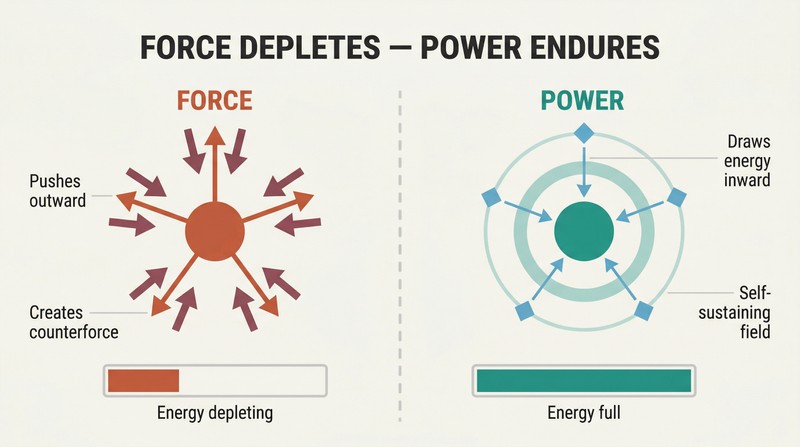
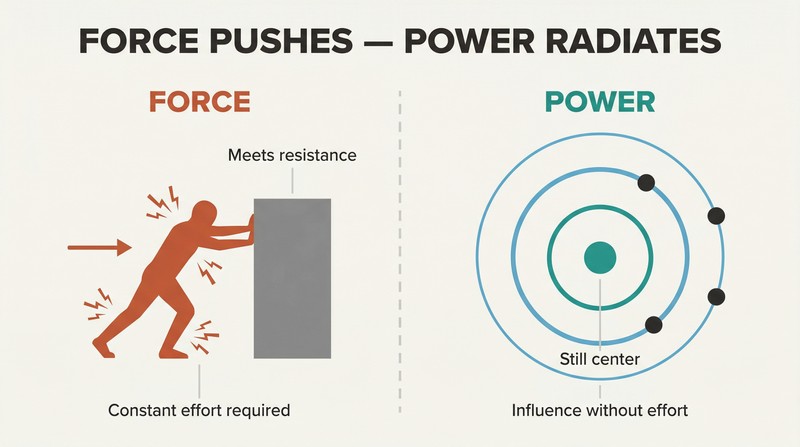
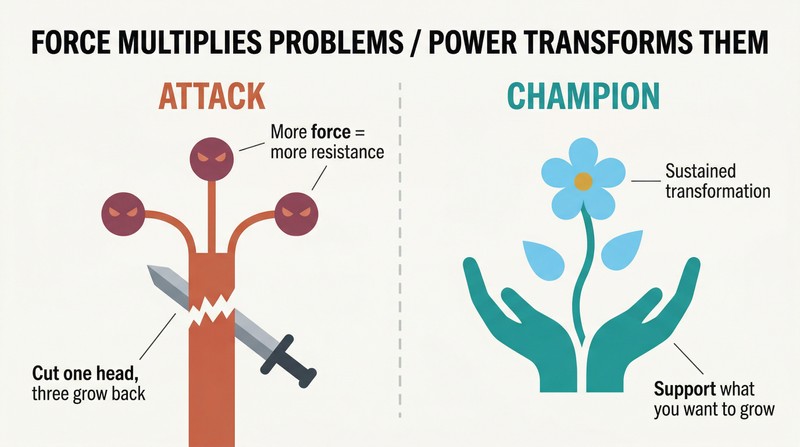
Hawkins's central thesis splits all human endeavor into two categories. Force — war, coercion, manipulation, intimidation — moves against something and requires constant energy. Power — principle, truth, compassion, meaning — is a standing field that doesn't move but influences everything within it. Force automatically creates counterforce: every attack provokes counterattack, every punishment breeds resentment, every war sows the next one.
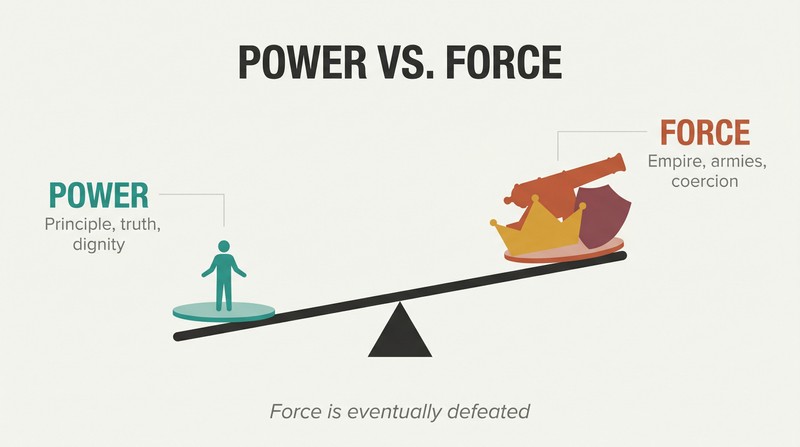
Power needs no defense because it's self-evident. The British Empire (force, calibrated at 175) collapsed before Gandhi (power, at 700). Churchill unified Britain through selfless principle while Hitler's machine crumbled. Force may dominate temporarily, but power prevails because it draws energy to itself rather than consuming it. Force must always be justified; power never does.
Every emotion occupies a measurable level on a 1-to-1000 scale
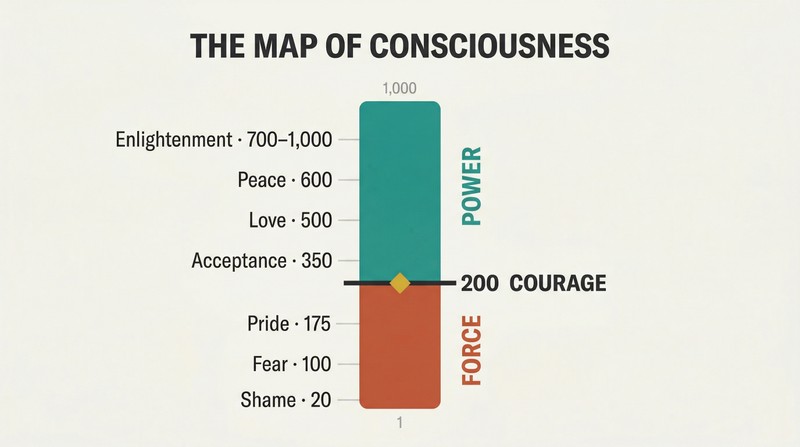
Hawkins developed the Map of Consciousness, a logarithmic scale calibrating levels of human awareness from 1 to 1,000 — where each number represents a base-10 power increase, so level 300 isn't three times 100 but 10^300 versus 10^100. The scale maps emotions to energy fields:
1. Shame (20), Guilt (30), Apathy (50), Grief (75)
2. Fear (100), Desire (125), Anger (150), Pride (175)
3. Courage (200), Neutrality (250), Willingness (310)
4. Acceptance (350), Reason (400), Love (500)
5. Joy (540), Peace (600), Enlightenment (700 – 1,000)
The calibrations were derived through kinesiologic muscle testing, a technique where a person's arm strength weakens for falsehood or negativity and strengthens for truth. Hawkins claims millions of tests on thousands of subjects confirmed consistency.
200 is the threshold: below it you weaken life; above it you strengthen it
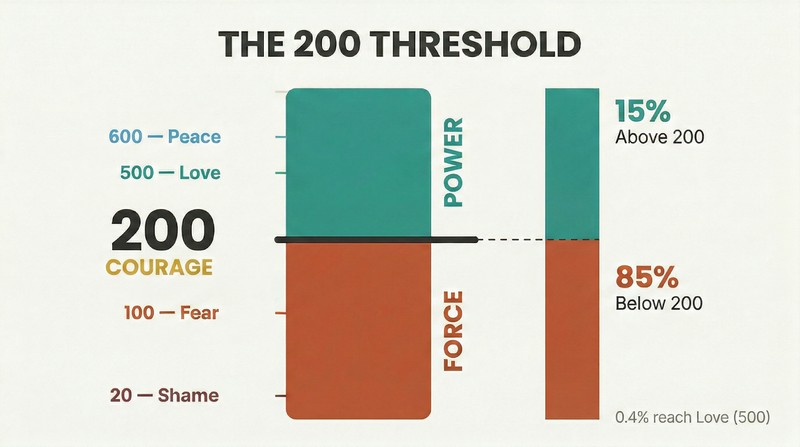
Level 200 — Courage — marks the critical fulcrum on the Map of Consciousness. Below 200, people see themselves as victims at the mercy of external forces. At 200, a fundamental shift occurs: the willingness to take responsibility for one's own actions, feelings, and beliefs. This is where productivity begins, where people put back as much energy as they take from society.
The global picture is sobering. Eighty-five percent of the world's population calibrates below 200. Only 0.4% of humanity reaches Love (500), and Peace (600) is attained by just one in ten million. The average person advances only about five points in an entire lifetime — meaning most people stay within the same band of consciousness from birth to death.
Force moves against things; power is a still field, like gravity
This physical metaphor captures the crucial mechanism. Gravity doesn't chase objects — it's a standing field that moves everything within it. Similarly, genuine power (truth, integrity, compassion) doesn't push, argue, or justify itself. It radiates influence. Force is incomplete and must be constantly fed energy; power is total and complete, requiring nothing from outside.
The practical implications run deep. Force polarizes, creating win/lose dynamics and requiring perpetual defense. Power unifies, producing win/win outcomes naturally. The U.S. Constitution (calibrating at 700) doesn't enforce itself through coercion — its principles hold sway through inherent truth. Force is associated with judgment and makes us feel poorly about ourselves; power is associated with compassion and makes us feel positively about ourselves.
Gandhi toppled the British Empire at 90 pounds — principle outranks might
A single unarmed man brought the world's greatest empire to its knees. Gandhi's power derived from one principle: the intrinsic dignity of human beings and their inalienable right to freedom — calibrated at 700. The British Empire's colonialism (175) was driven by self-interest. Gandhi forbade all violence yet was irresistible because he aligned with universal truth.
The same pattern recurs throughout history. Churchill defended Britain not through superior firepower but through unified will and selfless sacrifice. Soviet communism collapsed almost effortlessly despite half a century of nuclear confrontation. Lincoln prosecuted the Civil War without hatred. Statesmen represent power — they sacrifice themselves to serve others. Politicians represent force — they sacrifice others to serve themselves.
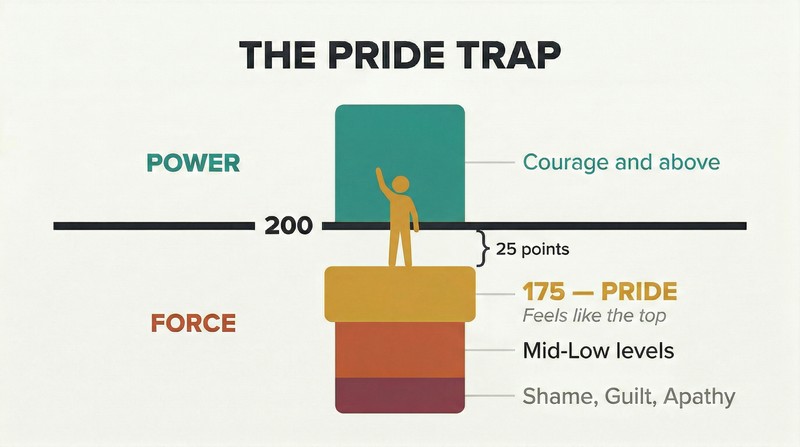
Pride at 175 feels positive but traps you below real power
Pride is the most seductive barrier to genuine empowerment. At 175, it feels dramatically better than the shame, fear, and despair below it — climbing from ghetto despair to Marine Corps self-respect is an enormous leap. Yet Pride sits 25 critical points below Courage (200), the threshold of actual power.
The problem is structural. Pride depends on external validation and crumbles when those conditions shift. It produces arrogance and denial — the inability to admit defects — which is why addiction recovery is impossible at this level. Nationally, Pride manifests as destructive nationalism: religious wars, political terrorism, and zealotry are all its price. In sports, athletes who shift from honoring their craft to seeking personal glory visibly lose strength at the decisive moment. Pride blocks the one thing needed for growth: willingness to be wrong.
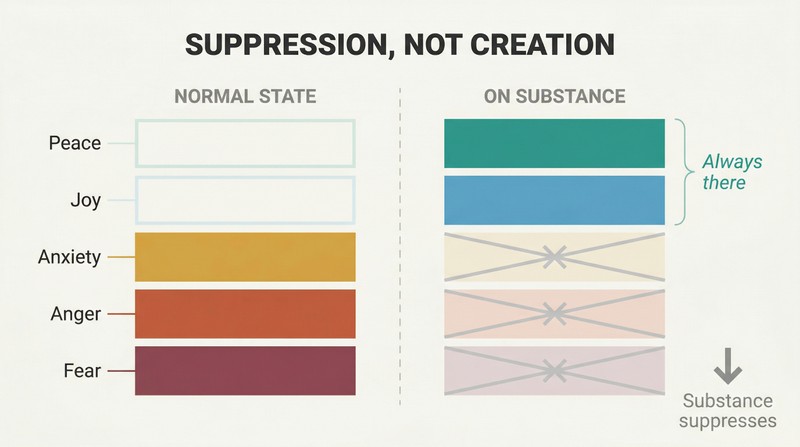
Addicts crave higher consciousness, not the substance itself
Hawkins's reframe of addiction is startling. Drugs and alcohol don't create euphoria — they calibrate at only 100. Instead, substances suppress lower energy fields (anxiety, fear, resentment), temporarily revealing the higher states (love, joy, peace) that already exist within. It's like muting an orchestra's low notes so only the highs are audible — the suppression doesn't create the high notes, it merely unmasks them.
Once someone experiences these states — through drugs, meditation, near-death events, or falling in love — they're permanently reprogrammed and forever dissatisfied with ordinary consciousness. The movie Lost Horizon illustrates this: its hero experiences Shangri-La (calibrating at 600) and spends years nearly dying to return. The cost of stealing this experience without earning it through inner work is the desperation of addiction.
Fix social problems by championing solutions, not attacking causes
Attack calibrates at only 150, guaranteeing failure through escalating counterforce. The U.S. war on drugs (calibrating at 150) moralized and punished rather than addressing underlying needs. Criminalizing soft drugs created a billion-dollar criminal enterprise and pushed users toward hard drugs. When drug lord Pablo Escobar died, three new kingpins instantly replaced him — the hydra grew more heads.
The principle applies universally. Recovery from alcoholism can't be achieved by fighting intoxication — only by choosing sobriety. Alcoholics Anonymous succeeds because it supports positive transformation rather than attacking destructive behavior. Amsterdam's serene red-light district shows how accepting human needs produces peaceful outcomes. The gun and the nightstick are evidence of weakness; the need to control others stems from lack of power.
One person at consciousness 700 counterbalances 70 million below 200
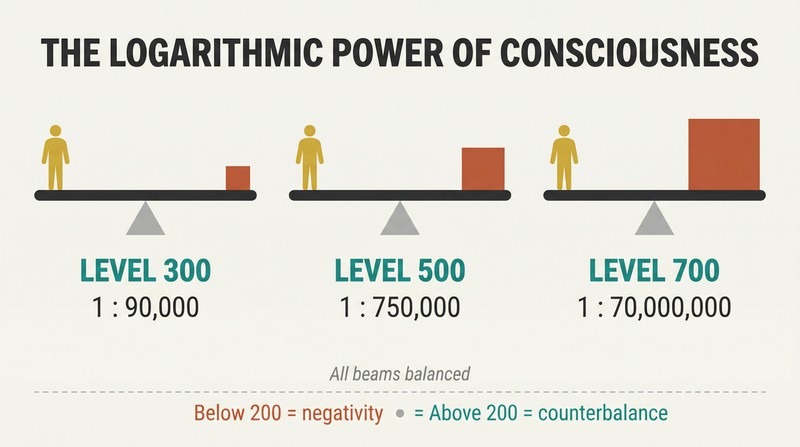
The logarithmic math produces staggering asymmetries. A loving thought at consciousness level 500 measures approximately 10^-35 million microwatts; a fearful thought measures 10^-750 million microwatts — a difference beyond imagination. Hawkins provides specific counterbalancing ratios:
1. One individual at 300 counterbalances 90,000 below 200
2. One at 500 counterbalances 750,000 below 200
3. One at 700 counterbalances 70 million below 200
This means the 15% of humanity above 200 mathematically counterbalances the negativity of the remaining 85%. Without these counterbalances, Hawkins argues, mankind would self-destruct. Even a few loving thoughts during the day more than offset all negative ones — individual consciousness-raising carries outsized collective impact.
Practice unconditional kindness — it's measurably the strongest act
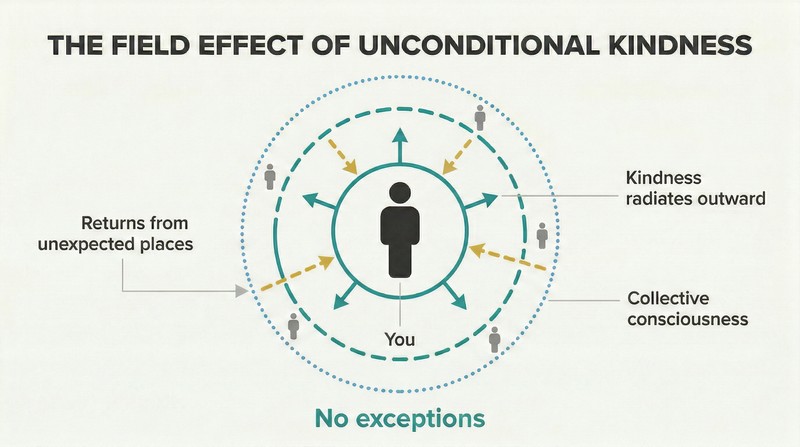
Hawkins distills his entire framework into one prescription: kindness to oneself and all living things, without exception. Not selective kindness or strategic kindness — unconditional. It produces no backlash (unlike force), has no downside, and increases personal power without exacting any toll. But it must permit no exceptions and cannot be practiced expecting selfish reward.
The mechanism is a field effect, not linear cause-and-effect. Kindness to an elevator man may manifest years later as a stranger's help on a deserted highway. We all float on the collective consciousness level, and every increment we add returns to us. Absorbing this book's material was shown to raise subjects' consciousness by an average of 35 points — seven times the typical lifetime advance of five points.
Analysis
Power vs. Force occupies a curious position in the intellectual landscape — straddling the boundary between philosophical framework and pseudoscientific claim. Hawkins's core distinction between power (life-supporting, meaning-aligned, self-sustaining) and force (coercive, energy-depleting, counterforce-generating) is genuinely illuminating as a philosophical model. The framework echoes insights from Taoism's wu wei, Stoic locus of control, and systems theory's feedback loops — but synthesizes them into a remarkably memorable schema that people actually use.
The Map of Consciousness, however, rests on kinesiologic muscle testing as an objective truth-detection method — a claim mainstream science has not validated. Systematic reviews of applied kinesiology find no evidence that muscle testing can diagnose conditions or detect truth beyond chance. The method's unfalsifiability is particularly problematic: any failure to replicate is attributed to the tester operating below level 200, creating circular logic. The precise numerical calibrations — Gandhi at 700, Einstein at 499, the Constitution at 700 — lend an air of scientific precision to what are essentially subjective judgments dressed in logarithmic clothing.
Yet dismissing the book entirely would miss its considerable influence and philosophical utility. The hierarchy of emotions — from shame through courage to love — maps surprisingly well onto developmental psychology (Maslow, Kohlberg, Spiral Dynamics). The insight that force generates counterforce is backed by game theory and conflict resolution research. The observation that attack-based social programs fail while support-based programs succeed is independently well-documented.
Perhaps the book is best understood as mythology in scientific garb — its maps and numbers function as powerful teaching metaphors rather than empirical measurements. The framework gives people an actionable vocabulary for distinguishing reactive, fear-based living from principle-centered living. Whether consciousness literally calibrates at precise logarithmic values matters less than whether the power/force distinction changes how people make decisions. By that pragmatic standard, Hawkins has delivered a framework that millions have found transformative — even as the measurement tool behind it remains, charitably, unproven.
Review Summary
Power vs. Force receives mixed reviews. Many readers find it transformative, praising its insights on consciousness levels and human behavior. They appreciate Hawkins' scale of consciousness and its applications. However, critics label it pseudoscience, questioning the validity of applied kinesiology and the author's claims. Some find the writing style difficult or the concepts far-fetched. Despite polarized opinions, many readers acknowledge the book's thought-provoking nature and its potential to inspire personal growth, even if they don't fully accept all its ideas.
People Also Read





Glossary
Map of Consciousness
Logarithmic scale of awareness levelsA calibrated scale from 1 to 1,000 developed by Hawkins, mapping the full spectrum of human consciousness. Each level corresponds to specific emotions, worldviews, and energy fields, progressing from Shame (20) through Courage (200), Love (500), and Peace (600) to Enlightenment (700–1,000). The scale is logarithmic, meaning each point represents a base-10 power increase rather than an arithmetic one.
Attractor patterns
Hidden energy fields organizing behaviorBorrowed from chaos theory (nonlinear dynamics), attractor patterns in Hawkins's framework are invisible energy fields within consciousness that organize human behavior into recognizable patterns. They range from weak (below 200, associated with force and negativity) to powerful (above 200, associated with power and life-support). Hawkins argues these fields dominate behavior across cultures and time, independent of individual identity.
Critical level of 200
Dividing line between force and powerThe calibration point on the Map of Consciousness that separates destructive from constructive energy fields. Below 200, all attitudes, thoughts, and entities make test subjects physically weaker; above 200, they strengthen. Associated with Courage and the shift from victimhood to personal responsibility. Hawkins reports 85% of humanity calibrates below this threshold.
Database of consciousness
Universal storehouse of all knowledgeHawkins's term (drawing on Jung's collective unconscious) for a field of shared human awareness accessible through kinesiologic testing. It functions like an electrostatic condenser with a field of potentiality rather than a stored charge. The database transcends time, space, and individual limitations, providing the mechanism by which test subjects can respond accurately to questions about topics they have no conscious knowledge of.
M-fields
Invisible patterns enabling paradigm breakthroughsShort for morphogenetic fields, a concept from biologist Rupert Sheldrake that Hawkins applies to consciousness. M-fields are invisible energy templates that, once created, exist as universally available patterns. When Roger Bannister broke the four-minute mile, he created a new M-field; afterward, many runners suddenly achieved sub-four-minute times. Each person who repeats an accomplishment reinforces the field's power for everyone.
Behavioral kinesiology
Muscle testing for psychological stimuliA discipline developed by psychiatrist John Diamond, extending George Goodheart's applied kinesiology from physical to psychological stimuli. It demonstrates that indicator muscles strengthen in response to positive emotional and intellectual stimuli (truth, love, beneficial images) and weaken in response to negative ones (falsehood, hostility, harmful substances). Hawkins extended this technique to calibrate levels of consciousness on a numerical scale.
Entrainment
Weaker fields synchronize with strongerA phenomenon where less powerful energy patterns synchronize with more powerful ones, analogous to how pendulums in proximity eventually synchronize or how a tuning fork vibrates at the rate of an adjacent one. In Hawkins's framework, exposure to higher consciousness fields elevates one's own consciousness—explaining why people feel transformed in the presence of spiritual teachers, or why self-help groups recommend simply attending meetings.
Critical point analysis
Finding leverage points in complex systemsA technique derived from nonlinear dynamics identifying the specific point in any complex system where the smallest input produces the greatest change. Like a tiny escape mechanism that can halt a giant windmill's gears, critical point analysis finds where minimal effort creates maximum impact. Hawkins applies this to consciousness, arguing that shifts in underlying attitudes (the critical point) produce far greater effects than addressing surface behaviors.
FAQ
What's Power vs. Force about?
- Exploration of Consciousness: Power vs. Force by David R. Hawkins explores human consciousness levels, categorizing them on a scale from 1 to 1,000. Each level corresponds to different emotional states and their impact on behavior.
- Power vs. Force Concept: The book distinguishes between power, which is constructive and life-affirming, and force, which is often destructive and self-serving. This distinction is key to understanding human and societal dynamics.
- Kinesiology as a Tool: Hawkins introduces kinesiology as a method to measure truth and consciousness levels, allowing individuals to discern the energy of thoughts, statements, and historical events.
Why should I read Power vs. Force?
- Transformative Insights: The book offers profound insights into consciousness and its effects on personal and societal outcomes, helping readers understand their motivations and behaviors.
- Practical Applications: It provides tools for evaluating truth and making informed decisions in health, relationships, and business, with kinesiological testing applicable in daily life.
- Spiritual Growth: For those on a spiritual journey, it serves as a guide to elevate consciousness and align with higher principles, promoting power through love and compassion.
What are the key takeaways of Power vs. Force?
- Levels of Consciousness: The book outlines a consciousness scale, with levels below 200 representing destructive emotions and those above 200 representing constructive states, aiding in emotional and spiritual development.
- Power vs. Force: True power aligns with universal principles, while force is rooted in self-interest and conflict. Understanding this can transform one's approach to life's challenges.
- Kinesiology for Truth: Kinesiology is introduced as a practical tool to discern truth and evaluate the energy of statements, aiding in complex decisions and relationships.
How does Dr. Hawkins define power and force in Power vs. Force?
- Power as Life-Affirming: Power supports life and aligns with universal principles, promoting growth, healing, and unity.
- Force as Destructive: Force is characterized by coercion and self-interest, leading to conflict and division, and is a temporary solution.
- Interplay of Power and Force: While force may achieve short-term goals, it cannot sustain itself against the enduring nature of power, crucial for understanding conflicts.
What is the significance of kinesiology in Power vs. Force?
- Measuring Truth: Kinesiology measures the truth of statements and the energy of thoughts, helping discern life-supporting versus life-diminishing elements.
- Practical Application: The book provides a guide on performing kinesiology tests, empowering readers to make informed decisions based on bodily responses.
- Universal Validity: Kinesiological responses are consistent across cultures, indicating a universal aspect of human consciousness, transcending individual beliefs.
How does Power vs. Force relate to personal growth and development?
- Framework for Self-Reflection: The levels of consciousness offer a framework for assessing emotional and spiritual states, leading to greater awareness and growth.
- Encouragement of Higher Values: The book encourages striving for higher consciousness levels, such as love and peace, fostering a compassionate and connected existence.
- Overcoming Limiting Patterns: Understanding power and force dynamics helps identify and overcome limiting beliefs and behaviors, essential for true empowerment.
What are the implications of the Map of Consciousness presented in Power vs. Force?
- Understanding Human Behavior: The Map of Consciousness explains motivations behind actions and societal trends, illustrating emotional states' influence on behavior.
- Guiding Personal Choices: Recognizing one's position on the map allows for conscious choices to elevate consciousness, leading to healthier relationships and fulfilling lives.
- Cultural and Historical Insights: The map provides insights into collective consciousness, explaining historical events and cultural phenomena, informing social movements.
How can I apply the concepts from Power vs. Force in my daily life?
- Kinesiological Testing: Practice kinesiology to evaluate truth in statements, products, or relationships, enhancing decision-making and personal integrity.
- Aligning with Higher Values: Choose to align with higher consciousness levels, like love and compassion, transforming interactions and experiences.
- Self-Reflection and Growth: Regular self-reflection using the Map of Consciousness identifies areas for growth, encouraging personal evolution and societal contribution.
What is the relationship between consciousness and societal change in Power vs. Force?
- Collective Consciousness: Societal change is influenced by collective consciousness; as individuals elevate their consciousness, they contribute to transformative societal shifts.
- Power of Principles: Movements aligned with universal principles, like freedom and equality, are more likely to succeed, with true power overcoming oppressive forces.
- Role of Individuals: Each person's journey toward higher consciousness contributes to society's evolution, inspiring others and creating positive change.
How does Power vs. Force address societal issues?
- Collective Consciousness: The book explores how society's collective consciousness influences behavior and outcomes, with higher consciousness leading to positive dynamics.
- Solutions through Positive Action: Hawkins advocates for solutions focusing on fostering positive change, leading to effective resolutions to societal issues.
- Moral Responsibility: Emphasizes individuals' moral responsibility to elevate collective consciousness, with personal growth impacting society as a whole.
How does Power vs. Force relate to addiction recovery?
- Spiritual Principles: Recovery is tied to spiritual principles and higher consciousness, exemplified by programs like Alcoholics Anonymous fostering community and support.
- Personal Responsibility: Highlights the importance of acknowledging powerlessness over addiction and committing to a higher path for healing.
- Transformative Experiences: Aligning with higher consciousness can lead to profound transformations, resulting in lasting recovery and renewed purpose.
How does Hawkins suggest we can elevate our consciousness?
- Practice Acceptance: Acceptance is key to elevating consciousness, moving beyond negative emotions to foster a positive mindset.
- Engage with Higher Energy Fields: Surrounding oneself with positive influences and environments facilitates growth and higher consciousness.
- Commit to Personal Growth: Emphasizes ongoing self-reflection, learning, and pursuit of higher truths for personal and spiritual development.
Power vs. Force Series Series
About the Author
Other books by David R. Hawkins



Download PDF
Download EPUB
.epub digital book format is ideal for reading ebooks on phones, tablets, and e-readers.








































