

Key Takeaways
Stop resisting a feeling and it dissolves on its own
The book's central move is deceptively simple. A feeling persists only because you resist it. So instead of fighting an emotion, venting it, or judging yourself for having it, you let it be fully present and focus on releasing the energy behind it. When you stop trying to modify it, the feeling shifts upward into a lighter state and eventually runs out.
Hawkins compares it to a moment in a heated argument when the whole thing suddenly strikes you as absurd, you laugh, and the pressure vanishes. That spontaneous release is the mechanism. The claim is that you can do it deliberately, anytime, with any emotion, freeing yourself from being at the mercy of your reactions.
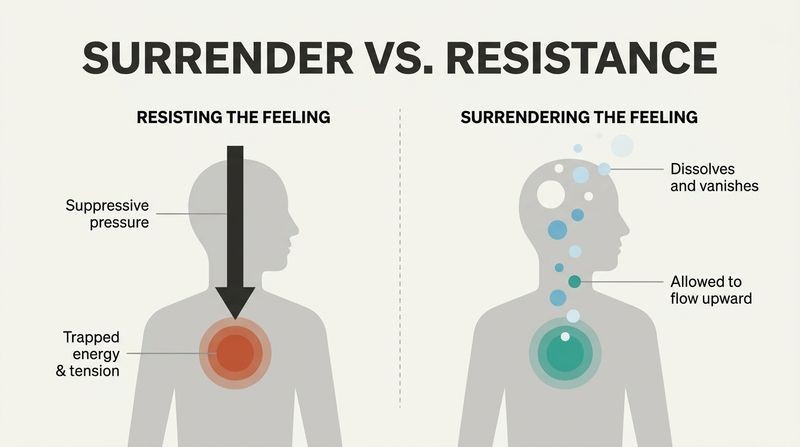
The insight aligns with acceptance-based therapies that arrived in mainstream psychology decades later. Acceptance and Commitment Therapy and mindfulness research both find that fighting an emotion amplifies it, while allowing it to be present reduces its grip, a pattern sometimes called experiential avoidance. What Hawkins frames spiritually, clinical work frames neurologically: labeling and allowing an emotion dampens amygdala activity. The weakness is measurability. Hawkins offers no controlled trials, only clinical anecdote. Still, the core mechanic, that resistance is the glue holding suffering in place, has held up remarkably well across traditions from Buddhism to modern behavioral science.
Suppression, venting, and distraction all fail; surrender is the fourth option
Most people handle emotions three ways, and Hawkins argues all three backfire. Suppression and repression push feelings down until they leak out as headaches, ulcers, insomnia, and hypertension. Expression, contrary to popular belief, does not purge anger; it rehearses and strengthens it while dumping the rest onto others, wrecking relationships. Escape (television, alcohol, overwork, endless scrolling) simply keeps you unconscious and drains energy.
He blames a misreading of Freud for the modern cult of venting. Freud said repression causes neurosis, so people concluded expression was the cure. But Freud actually prescribed channeling impulses into love, work, and creativity, not indulging them. Letting go is the missing alternative: neutralize the emotion internally so only positive feeling remains to express.
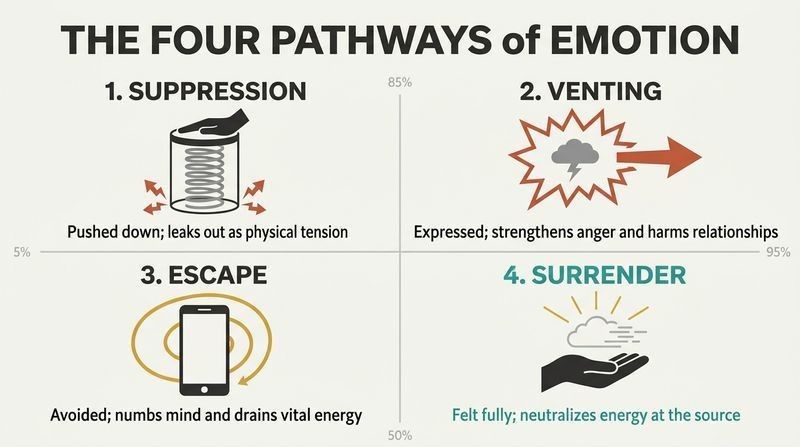
This directly contradicts the catharsis hypothesis that dominated pop psychology. Modern research vindicates Hawkins here. Studies by Bushman and others found that hitting punching bags or venting anger increases subsequent aggression rather than discharging it, because rehearsal reinforces the neural pattern. The projection point is sharp too: he argues we blame others for feelings we refuse to own, a mechanism that scales from family fights to wars. One nuance worth adding: suppression and surrender can look identical from outside, yet Hawkins insists the difference is conscious acknowledgment before release. Skipping the acknowledgment step turns surrender back into repression, which is the trap most people fall into.
One buried feeling generates thousands of thoughts; release the feeling, not the thoughts
Hawkins argues the mind runs backwards from how we assume. We think thoughts cause feelings, but he claims feelings generate and organize thoughts. A single suppressed emotion can spawn thousands of related thoughts over years, all filed together by emotional tone rather than logic. He cites the Gray-LaViolette research suggesting memories are stored by feeling, not fact.
The practical payoff is huge. Chasing and analyzing thoughts is endless, like biting at goldfish in a bowl. But surrender the underlying feeling and the whole cloud of associated thoughts vanishes at once. His example: a man frantic about a lost passport discovered the real feeling was grief over a separation. Once he released it, he instantly remembered where the passport was.
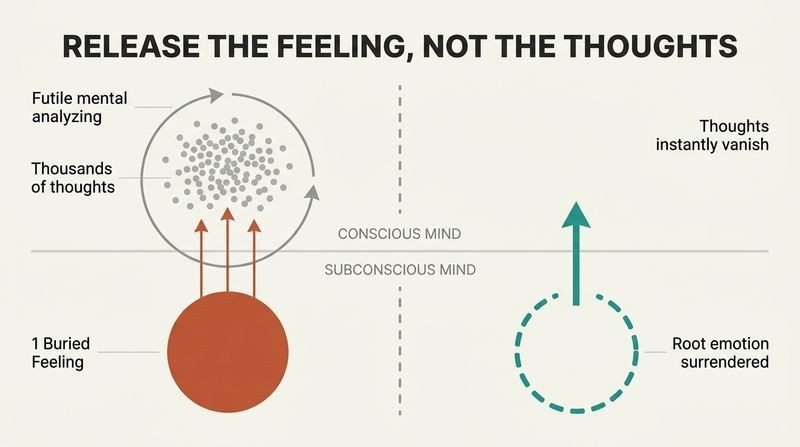
This reframes rumination as a symptom rather than a cause, a stance that anticipates cognitive science on affect-driven cognition. Antonio Damasio's somatic marker hypothesis argues emotions precede and shape reasoning, not the reverse, lending physiological support to Hawkins's ordering. The efficiency argument is genuinely useful: therapy and self-help often drown in the why, generating insight without relief. Targeting the emotional charge instead sidesteps the analytical treadmill. The passport anecdote also gestures at something real, that anxiety narrows attention and blocks recall, while a calm state restores it. The overreach is quantitative precision; there is no way to verify a feeling produces literally thousands of thoughts.
Emotions rank on a ladder, and Courage at 200 flips you from draining to empowering
Hawkins maps emotions on a calibrated scale from 1 to 1000. The bottom rungs, in ascending order, are Shame, Guilt, Apathy, Grief, Fear, Desire, Anger, and Pride. Above them sit Courage, Neutrality, Willingness, Acceptance, Reason, Love, Joy, and Peace.
The pivotal threshold is Courage at 200. Below it, emotions are life-draining and rooted in force, the stance of someone who takes energy from others. At and above it, states become life-supporting and rooted in power; people seek you out because you give energy. The fastest way to climb is telling the truth to yourself. Even jumping from apathy (I can't) to anger (I'll show you) is progress, because anger at least carries energy for action.
The scale's value is practical rather than literal. Treating emotions as a hierarchy with directionality gives people a compass: from paralysis, anger is an upgrade, not a sin. This matches trauma therapy, where moving a frozen, dissociated client toward anger is often a clinical win. The distinction between power (which attracts) and force (which repels) echoes leadership research on intrinsic authority versus coercion. The controversial part is the numeric calibration, obtained via muscle testing, which has no reproducible scientific basis and fails blind trials. Readers get the most by using the ladder as a directional model of emotional states, not as literal measurement.
Your stress comes from suppressed emotion inside, not the event outside
Hawkins inverts the usual view of stress. The traffic jam, the rude boss, the deadline are merely triggers. The real stressor is the reservoir of repressed feeling you already carry, waiting for an excuse to discharge. Two people face the same event; one erupts, one shrugs, because reactivity depends on what is stored inside. A guilt-ridden person sees temptation everywhere; a fearful person sees a threatening world. What you have repressed colors everything you perceive.
This explains why most stress-reduction programs disappoint. Teaching muscle relaxation or breathing treats the aftereffects, like lowering a fever without curing the infection. Remove the underlying suppressed anger, fear, or guilt, and the external world loses its power to rattle you.
This is a strong reframe supported by appraisal theory in psychology, notably Richard Lazarus, who showed stress is not the stimulus but the individual's cognitive and emotional appraisal of it. Hawkins pushes further, locating the appraisal in stored, often unconscious emotion. His critique of surface stress management is fair and increasingly echoed by clinicians who note that relaxation techniques offer temporary relief without addressing root cause. The car-accident illustration, where he scripts how each emotional level would react to a fender bender, is a memorable teaching device. The limit: some stressors are genuinely external and structural, and reframing them as purely internal risks blaming victims for their circumstances.
Most I can't statements are really I won't in disguise
Apathy is the belief I can't do anything and no one can help. Hawkins argues that since we are actually capable beings, nearly every I can't is a cover for I won't, and behind the I won't sits fear, pride, or unwillingness to pay a cost. Naming this honestly is itself an upgrade, because admitting I won't puts you back in the seat of choice rather than helpless victimhood.
He attacks blame as the great trap. Blame offers cheap payoffs: innocence, sympathy, the martyr role, even financial reward. But the price is your freedom, since a victim is by definition powerless. He cites Viktor Frankl, who chose to find meaning in a concentration camp rather than blame, proving the option to not blame is always available.
The I can't versus I won't distinction is a potent tool used in coaching and cognitive therapy alike, because it restores agency without denying difficulty. Frankl's Logotherapy, invoked here, rests on the same foundation: the last human freedom is choosing one's response. Hawkins's dissection of blame's hidden payoffs is psychologically astute and anticipates work on secondary gain, the unconscious benefits people derive from staying stuck. The nuance he underplays is structural constraint. Some limitations are real, not attitudinal. A useful synthesis: treat I won't as a diagnostic question rather than an accusation, revealing what fear or cost you are actually unwilling to face.
Wanting something intensely pushes it away; surrender the craving to receive it
Hawkins makes a counterintuitive claim about desire. To desire something is to affirm you do not have it, which places a psychic distance between you and the goal and consumes energy in the wanting. Strong craving, then, becomes the obstacle. When you surrender the desire and simply choose the goal, picturing it as already yours, it tends to arrive effortlessly.
His vivid example: he wrote down an oddly specific wish for a rent-controlled apartment on Fifth Avenue, rear-facing, high floor, two and a half rooms, then let go of wanting it. Within 24 hours he drove into the city on impulse, found parking outside a realtor, and was handed the only such apartment listed, matching his description exactly. The lesson is that decision and release outperform anxious striving.
Stripped of its metaphysics, this contains real psychological wisdom. Anxious grasping narrows cognition, breeds desperation others can sense, and triggers self-sabotage, well documented in performance research where trying too hard degrades results, the phenomenon of choking under pressure. Buddhist non-attachment makes the same case: craving is the root of suffering. The overclaim is causal magic, that releasing a desire summons matching events from the universe. Confirmation bias and selective memory easily explain the apartment story, since we forget the wishes that never materialized. The durable takeaway is behavioral: hold clear intention while releasing the frantic emotional charge, and you act with more clarity and less friction.
Fear yields to love, not to reason or reassurance
Hawkins treats fear as the dominant emotion of modern life and argues it cannot be talked away, only dissolved by a higher vibration. His case study is Betty, a patient whose germ phobia metastasized into fear of food, air, sunlight, muggers, medication, and finally losing her mind. Every therapeutic technique failed. In desperation he gave up trying to fix her and simply decided to love her, sending her loving thoughts and warmth during phone calls. Over months of this loving therapy, her fears receded and she recovered, though she never gained intellectual insight.
The principle he draws: a higher energy state heals a lower one, the same mechanism behind healers whose calming presence, not their words, quiets others. Fear held in mind also tends to manifest the very thing feared.
The Betty case dramatizes something legitimate even for skeptics. Co-regulation, the process by which a calm nervous system soothes a dysregulated one, is now foundational in attachment theory and polyvagal-informed therapy. A therapist's felt safety, not their technique, often predicts outcomes, which research on the therapeutic alliance confirms is a stronger predictor of success than the specific method used. Hawkins's framing as vibration is unscientific language for a real interpersonal phenomenon. The caution is scope: love as sole treatment for severe phobia or psychosis is risky as a general prescription, and modern care would pair warmth with evidence-based exposure. As an insight about presence over persuasion, it is sound.
Let grief run fully and it burns out in 10 to 20 minutes
Grief feels bottomless, so people suppress it, especially men taught that crying is unmanly. Hawkins insists grief is actually time-limited. If you stop resisting it and surrender to it completely, a wave runs out in roughly 10 to 20 minutes, then pauses. Keep releasing each wave as it returns and the reservoir eventually empties. Resisted grief, by contrast, can last years and drive psychosomatic illness.
He recounts men who had to first release the shame of crying, then the fear it would never stop, then anger at a culture forbidding male feeling, before the actual sobs could flow, followed by deep peace and even relief from a headache. The root of all grief, he adds, is attachment, treating external people or things as extensions of ourselves whose loss diminishes us.
The claim that a grief wave crests and subsides in minutes rather than being endless is validated by affect researchers who note discrete emotions have short physiological half-lives; what extends them is cognitive rehearsal and resistance. This reframes the fear of being overwhelmed as itself the obstacle. The attachment analysis draws straight from Buddhist psychology and, interestingly, aligns with attachment theory's account of grief as a broken bond. Hawkins's point about male emotional suppression is culturally acute and increasingly urgent given data linking suppressed affect to men's health outcomes. Worth noting: complicated or traumatic grief can genuinely persist and sometimes needs clinical support beyond self-directed surrender.
Pride is armor that invites attack; humility cannot be humiliated
Though society praises pride, Hawkins classifies it as a negative, love-devoid state whose signature is defensiveness. Because pride is inflated and fragile, it must constantly guard its image, opinions, possessions, and status, which drains energy and creates vulnerability. Hence defensiveness invites attack. The truly humble person, having nothing to defend, becomes immune to insult; a jab reveals the attacker's problem, not a wound in the target.
He suggests swapping pride for gratitude and joy. Take pleasure in an achievement for its own sake rather than for recognition, and you no longer depend on others' reactions. Reframe your opinions as preferences you enjoy rather than truths you must win, and arguments dissolve. He notes pride kills, citing addicts and patients who die rather than admit a problem and accept help.
The observation that defensiveness signals a hidden doubt is psychologically precise. Secure self-worth does not argue; it is only the fragile ego that must prove itself, a pattern confirmed in research on defensive versus secure high self-esteem, where the defensive kind correlates with aggression and the secure kind does not. His reframing of opinions as preferences is a practical de-escalation tool, echoing Stoic and Zen beginner's mind. The pride-kills point about addiction is clinically real, since denial is the hallmark obstacle in recovery. One tension: healthy self-respect and confidence do drive achievement, so the useful line is between grounded self-worth and brittle, comparison-driven ego inflation.
The body obeys the mind, so buried beliefs can become disease
Hawkins's boldest claim is that the body manifests what the mind holds, consciously or unconsciously, and that most illness carries an emotional-psychological component that can be reversed by removing the internal stressor. He offers himself as evidence: at 50 he suffered a staggering list including migraines, ulcers, gout, colitis, Raynaud's, and failing eyesight. As he surrendered decades of suppressed feeling and released guilt, ailment after ailment cleared, and even his need for glasses eventually disappeared.
He points to supporting phenomena: placebo injections triggering real premenstrual symptoms, and multiple personality disorder cases where allergies, eyesight, and even brain waves shift between personalities in one body. His practical tip is to stop labeling sensations with disease names, since a label like asthma is itself a whole fearful program the body then obeys.
Parts of this land, parts overreach. The placebo and nocebo effects are robustly documented, and psychoneuroimmunology confirms chronic stress suppresses immune function, so the mind-body link is real and mainstream. The multiple personality observations, if accurate, are genuinely striking evidence for belief-driven physiology. However, claiming that surrender cured gout, healed broken foot bones, and restored vision crosses from stress-reduction into unfalsifiable territory that could lead readers to delay necessary medical care. Hawkins hedges by invoking karma for cases that do not resolve, which makes the theory unfalsifiable. The safe extraction: emotional states measurably influence health and healing, so managing them is legitimate medicine, alongside, not instead of, treatment.
Analysis
Letting Go belongs to a distinctive genre hybrid: clinical psychiatry memoir fused with nondual spirituality. Hawkins, a genuinely accomplished psychiatrist who co-authored work with Linus Pauling, spent decades treating severe patients before an experience he describes as ego-dissolution reoriented his life toward teaching surrender. The book is his attempt to reverse-engineer that transformation into a repeatable technique accessible to anyone, cynic or believer.
The difficulty in summarizing it is that two books coexist between the covers. One is a shrewd, testable psychology of emotion: feelings drive thoughts, resistance sustains suffering, suppressed affect is the true source of stress, blame trades freedom for sympathy, and venting rehearses rather than releases anger. Much of this anticipates or parallels acceptance-based therapy, appraisal theory, and psychoneuroimmunology. The second book is a metaphysical system: the calibrated Map of Consciousness, muscle testing as a truth detector, thoughts that magnetize matching events, and diseases dissolved by consciousness. The first book is largely defensible and often ahead of its time. The second rests on kinesiology, which fails blind, controlled testing, and on unfalsifiable escape hatches like karma for cases that do not improve.
The honest reader benefits by mining the psychological gold while holding the metaphysics lightly. The surrender mechanic itself, allowing an emotion fully rather than fighting, expressing, or escaping it, is the durable core and converges with contemplative traditions and modern therapeutics alike. Its enduring appeal, and the reason it found a second life through Sedona Method practitioners and the self-help mainstream, is that it demands no belief, no guru, no equipment, only willingness. Where Hawkins is strongest is in reframing agency: you are not at the mercy of your reactions, your circumstances, or even your body's fear. Where he is weakest is in overpromising effortless mastery and cosmic causation. Read as emotional craft rather than cosmology, the book delivers a genuinely useful tool for defusing the reactivity that runs most lives.
Review Summary
Letting Go receives mixed reviews, with many praising its insights on managing negative emotions and achieving inner peace. Readers appreciate the practical "letting go" technique and its potential for personal growth. However, some criticize the book for repetitiveness, unsubstantiated claims, and new age concepts. Critics argue that certain ideas lack scientific backing and oversimplify complex issues. Despite divided opinions, many readers find value in the book's approach to emotional healing and self-improvement, while others dismiss it as pseudoscience.
People Also Read
Glossary
Letting Go / Surrender
Releasing a feeling by non-resistanceThe book's central technique: becoming aware of a feeling, allowing it to be fully present without resisting, venting, judging, or trying to change it, and focusing on releasing the energy behind it. Resistance is what keeps a feeling alive, so dropping resistance lets the emotion run its course and dissolve, shifting you into a lighter, freer state.
Map of Consciousness
Emotions ranked 1 to 1000Hawkins's logarithmic scale calibrating emotional and consciousness states from Shame (20) at the bottom through Courage (200), Love (500), and Peace (600) up to Enlightenment (1000). Lower levels are described as life-draining force; higher levels as life-supporting power. Surrendering negativity is said to move a person progressively up the scale.
Courage (200)
The critical positive-negative thresholdThe pivotal calibration point on the Map of Consciousness marking the shift from destructive to constructive states. Below 200, emotions weaken a person and take energy from others (force). At and above 200, states like willingness, acceptance, and love strengthen and give energy (power). The stance of I can, integrity, and effective action begins here.
Muscle testing (Kinesiology)
Body strength reveals truthA technique where a person extends an arm and a tester presses down while the subject holds a thought or substance in mind. Negative or false stimuli allegedly weaken the muscle instantly; positive or true stimuli keep it strong. Hawkins uses it to demonstrate the mind-body link and to calibrate consciousness, though it fails rigorous blind testing.
Small self versus Self
Ego versus true inner natureThe small self (ego) is the accumulated bundle of negative programs, fears, and survival-based beliefs that generates suffering and clings to the familiar. The greater Self is one's true inner nature, characterized by love, peace, and completeness. Surrendering negativity de-energizes the small self so the Self can shine through.
Glamour
Projected magical quality onto thingsBorrowed from Alice Bailey, the illusory aura, excitement, or magical importance we project onto goals, possessions, or people, making them seem larger than life. Glamour causes disillusionment because the thing never matches the projection. Recognizing and releasing glamour makes it easy to surrender the underlying desire, which was attached to fantasy rather than reality.
Having-Doing-Being
Ascending levels of self-worthHawkins's progression of consciousness. At low levels, worth comes from what you have (possessions). Higher up, from what you do (accomplishments and service). At the highest, from what you are (quality of presence). As consciousness rises, people seek your company for your being rather than your status or achievements.
FAQ
What's Letting Go: The Pathway of Surrender about?
- Inner Freedom Focus: The book explores surrender as a pathway to emotional and spiritual freedom, emphasizing that happiness, success, and love are innate qualities accessible by releasing negative emotions.
- Mechanism of Letting Go: Dr. Hawkins presents a practical technique for releasing negative feelings and attachments, which he argues are the primary causes of suffering.
- Emotional Healing: It discusses how unresolved emotions can lead to physical and psychological issues, and how letting go can facilitate healing and personal growth.
Why should I read Letting Go: The Pathway of Surrender?
- Transformative Insights: Gain valuable insights into emotional patterns and learn how to break free from limiting beliefs, achieving emotional well-being and spiritual enlightenment.
- Practical Techniques: Offers accessible advice and techniques for letting go of negative emotions, applicable in everyday life to foster resilience and inner peace.
- Universal Appeal: The concepts are relevant to anyone, regardless of their spiritual or psychological background, making it a versatile read for personal growth.
What are the key takeaways of Letting Go: The Pathway of Surrender?
- Surrender is Key: Surrendering to feelings and experiences is essential for emotional healing and spiritual growth, leading to profound transformation.
- Understanding Emotions: Provides a detailed analysis of emotions like fear, anger, and grief, and their impact on our lives, crucial for learning how to let them go.
- Levels of Consciousness: Introduces a scale of consciousness categorizing emotions and their energy levels, illustrating how higher states lead to greater peace and fulfillment.
What is the mechanism of letting go described in Letting Go: The Pathway of Surrender?
- Awareness of Feelings: Involves becoming aware of a feeling, allowing it to surface, and letting it run its course without resistance to dissipate its energy.
- Surrendering Resistance: Essential to let go of resistance to the feeling itself, as resistance prolongs the emotional experience.
- Continuous Practice: Encourages regular practice of this technique for cumulative emotional healing and increased inner peace.
How does Letting Go: The Pathway of Surrender address fear?
- Fear as a Common Emotion: Discusses fear as a pervasive emotion that can paralyze individuals and hinder personal growth, often rooted in unresolved feelings.
- Transforming Fear into Courage: By acknowledging and surrendering fear, individuals can move up the emotional scale to courage and acceptance.
- Healing Through Love: Posits that love is a powerful antidote to fear, diminishing its hold on our lives.
What role do emotions play in our lives according to Dr. Hawkins?
- Emotions as Energy: Emotions are energy that can either empower or disempower us, with negative emotions draining energy and leading to issues.
- Emotional Awareness: Becoming aware of emotions is the first step toward healing, allowing us to let them go and reclaim energy.
- Emotional Scale: Introduces a scale categorizing feelings from low-energy states like shame to high-energy states like love, impacting overall well-being.
How does the Map of Consciousness work in Letting Go: The Pathway of Surrender?
- Categorization of Emotions: Categorizes emotions and states of being on a scale from 1 to 1,000, with higher numbers representing more positive states.
- Guidance for Growth: Helps individuals recognize their current emotional state and work towards higher states for personal growth.
- Connection to Behavior: Illustrates how different emotional states influence behavior and decision-making, providing a framework for understanding challenges.
What is the relationship between love and healing in Letting Go: The Pathway of Surrender?
- Love as Healing Energy: Love has a profound healing effect on emotional and physical ailments, improving health and lightening emotional burdens.
- Transformative Power of Love: Shares stories of individuals transformed by love, demonstrating its ability to lead to miraculous changes.
- Unconditional Love: Emphasizes unconditional love as a state transcending personal desires, allowing for deeper connections and healing.
What are some practical techniques for letting go mentioned in Letting Go: The Pathway of Surrender?
- Mindfulness Practice: Suggests practicing mindfulness to become aware of feelings as they arise, crucial for the letting go process.
- Surrendering Thoughts: Focus on the feeling itself rather than associated thoughts, as thoughts can perpetuate the feeling.
- Regular Reflection: Keeping a journal or reflecting on emotional experiences helps identify patterns and facilitate the letting go process.
How can the letting go technique help with physical illnesses according to Letting Go: The Pathway of Surrender?
- Mind-Body Connection: Emphasizes that many physical ailments are rooted in suppressed emotions and negative beliefs.
- Case Studies: Shares numerous case studies of individuals who healed from chronic illnesses through the practice of surrender.
- Holistic Approach: Encourages a holistic view of health, integrating emotional, mental, and spiritual well-being as essential components of physical health.
What role does forgiveness play in the letting go process in Letting Go: The Pathway of Surrender?
- Forgiveness as Release: Crucial for releasing resentment and anger towards oneself and others, facilitating emotional healing.
- Transformative Effect: Shifts perspective on past grievances, leading to a greater capacity for love.
- Letting Go of Judgment: Helps transcend judgment, allowing for a more compassionate view of oneself and others, essential for personal growth.
What are the best quotes from Letting Go: The Pathway of Surrender and what do they mean?
- “What you are seeking is not different from your very own Self.”: Emphasizes that happiness and fulfillment are already within us, encouraging inward exploration.
- “The kingdom of heaven is within you.”: Reflects the idea that true peace and joy come from within, inviting exploration of the inner world.
- “Letting go is like the sudden cessation of an inner pressure.”: Illustrates the relief and freedom from surrendering negative emotions, highlighting the transformative power of the process.
Power vs. Force Series Series
About the Author
Other books by David R. Hawkins



Download PDF
Download EPUB
.epub digital book format is ideal for reading ebooks on phones, tablets, and e-readers.








































