

Key Takeaways
Take the company private to escape Wall Street's quarterly tyranny
The shot clock had to go. By 2012 Dell's stock had cratered near $9, its market cap below $20 billion, and pundits declared the PC dead. Dell saw opportunity where markets saw decline: he was transforming Dell from a PC maker into an enterprise IT solutions company, but public investors hated the near-term earnings hit that transformation required. Going private meant freedom to invest in R&D, sales, and acquisitions without explaining a softer quarter every ninety days.
Where others saw doom, he saw mispricing. Partnering with Silver Lake's Egon Durban (whom he met backstage at a Fortune conference), Dell engineered a $24.4 billion leveraged buyout at $13.65 a share. He thanked the market for undervaluing the company, because that gap was precisely what let him buy it back.
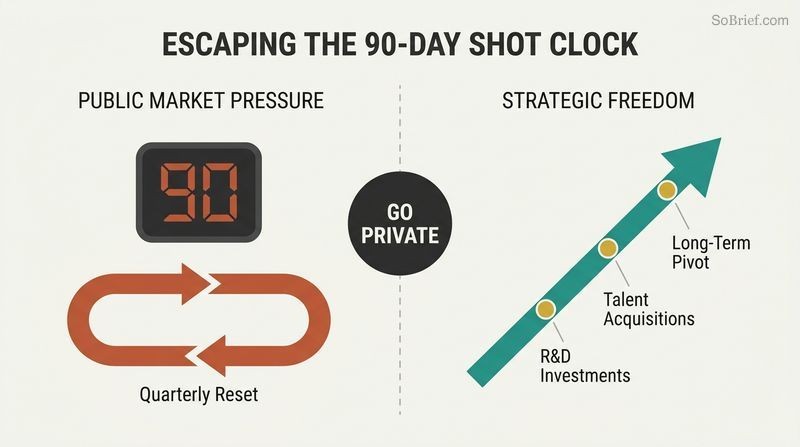
The tension Dell describes is structural, not personal. Research by John Graham and others found most executives admit they would sacrifice long-term value to hit quarterly earnings targets. Going private is one escape valve, but it carries survivorship bias: Dell's bet paid off spectacularly, so the strategy looks prescient. Countless leveraged buyouts saddle companies with crushing debt and end badly. What made Dell's case unusual was a founder with deep conviction, a patient private-equity partner, and a business throwing off consistent cash flow. The lesson is less "go private" than "align your capital structure with your time horizon."
"Play nice but win" became the operating creed of a lifetime
A childhood phrase turned philosophy. When young Michael and his brothers played street ball, their ambitious parents told them "play nice but win." The instruction captured a dual mandate: compete fiercely and ethically at the same time. Dell carried it into business, treating competition as energizing rather than dirty, and identified rivals (CompuAdd, Compaq, IBM) as targets to outwork and outsmart.
Fair competition, but competition nonetheless. Dell relishes a fight once he is in one, yet insists he never wins by exploiting loopholes, only by mastering the rules better than anyone. The phrase also drew a line: against Carl Icahn, whom Dell viewed as someone willing to lie publicly to win, the "play nice" half evaporated and it became personal. Winning with integrity is the harder, more durable path.
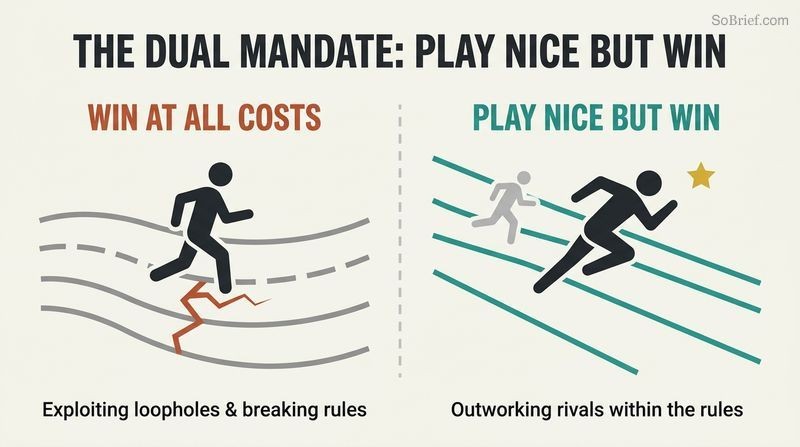
The maxim resolves a false binary that trips up many ambitious people: the belief that you must choose between being good and being successful. Adam Grant's research on "givers" and "takers" reaches a similar conclusion, that the most successful people are often generous, provided their generosity is paired with assertiveness rather than self-sacrifice. Dell's framing adds a competitive edge that pure niceness lacks. The risk is that "play nice but win" can rationalize aggression after the fact. The honest test is whether the niceness constrains the winning, or merely decorates it. In Dell's telling, the constraint was real.
Cut the middleman: build to order and sell direct
A handicap became the model. Starting with $1,000 in capital, Dell could not afford to mass-produce inventory like Compaq or IBM. So he built each computer only after a customer ordered it, sourcing the lowest-cost components and passing savings along. This "direct" model meant no retail markup, no aging stockpiles, and a one-on-one customer relationship that revealed exactly what buyers wanted.
The financial magic was the cash conversion cycle. Customers paid by credit card on shipment while suppliers were paid 30 days later, so Dell collected money before owing it. Lean parts inventory meant always buying components at the latest (usually falling) prices. As a teenager he had already practiced the principle, eliminating the auctioneer at stamp shows and going straight to Asian factories to cut out distributors. The direct connection was both a cost advantage and an intelligence network.
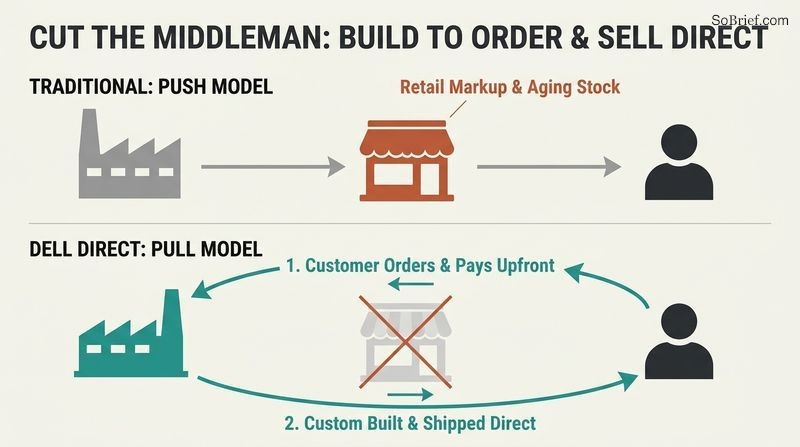
Dell's model is a textbook case of negative working capital, the same engine that later powered Amazon. By getting paid before paying suppliers, the company funded its own growth without external capital, a structural advantage competitors with retail channels could not replicate. The deeper insight is informational: selling direct gave Dell real-time demand signals that retailers blocked. This is why Dell killed his own profitable Walmart and Sam's Club deals in the mid-1990s. The model has limits, though. It thrived when buyers knew what they wanted (business customers), and struggled in consumer markets where people wanted to touch products first.
Hire people who know what you don't, then divide and conquer
The biggest mistake was a hire not yet made. At 21, running a company doubling yearly with no business training, Dell realized his management structure lacked a crucial piece at the top: someone with experience he didn't have. He recruited Lee Walker, a 45-year-old entrepreneur, as president. Walker secured credit lines Dell couldn't, professionalized finance, and let Dell focus on products and customers.
A pattern of elder partners. Dell repeated this throughout his career: Mort Topfer from Motorola to help scale from $3 billion to $10 billion, Kevin Rollins from Bain for strategy. He deliberately chose people senior enough not to threaten ambitious younger executives, positioning them as wise hands rather than rivals. His rule: never be the smartest person in the room, and surround yourself with people who challenge and teach you.
The counterintuitive move here is hiring "above" yourself, which threatens the ego of most founders who equate control with competence. Dell's willingness to recruit people who outranked him in experience reflects what psychologists call a learning orientation over a performance orientation. There is also shrewd organizational design: by bringing in elder statesmen rather than ambitious peers, Dell avoided succession anxiety among rising managers. One caution worth naming: this works only when the founder retains clear strategic authority, as Dell did. When founders abdicate too much (as some do to "professional" CEOs), the company can lose the very vision that made it special.
Growth covers up sins until the tide goes out
Speed hid the rot. When Dell crossed $2 billion in revenue around 1993, things fell apart. No single part of the company could support the scale; they were outgrowing their people, systems, and capital. A CFO drank himself out of the job; an HR chief put his stripper girlfriend on a no-show payroll. Rapid expansion masked these failures because revenue kept climbing.
The Alarmist was right. New CFO Tom Meredith, whom Dell nicknamed The Alarmist, warned that the mantra should shift from "Growth, Growth, Growth" to "Liquidity, Profitability, and Growth" in that order. Dell deliberately slowed expansion to build capability. He learned that the people who take you from point A to point B are often not the ones who can take you to point C, and that hyper-growth must eventually yield to operational discipline.
Warren Buffett's line, quoted in the book, captures it: only when the tide goes out do you see who was swimming naked. The scaling crisis Dell describes is so common it has a name in venture circles: the transition from founder-led chaos to professional management. What is instructive is Dell's specific reordering of priorities, putting liquidity first. Many high-growth startups die not from lack of demand but from running out of cash while chasing it. The personnel scandals also illustrate a subtler point: culture and controls must scale with headcount, because rapid hiring inevitably imports bad actors that slower growth would have filtered out.
Buy the rare number-one, not the cheaper number-six
Leaders are nearly impossible to dethrone. Dell learned through acquisitions like EqualLogic ($1.4 billion) that you could buy a number-six company with a great product and grow it to $1 billion in revenue using your customer relationships, but it would plateau there. Vaulting a sixth-place player to first place almost never happens, because entrenched leaders who keep investing and serving customers are extraordinarily hard to unseat.
So he chased the crown jewels. This logic drove the audacious $67 billion acquisition of EMC and its 81% stake in VMware in 2015, the largest tech deal in history. EMC led data storage; VMware pioneered virtualization. Both were undisputed number ones, which is exactly why they almost never come up for sale, command exorbitant prices, or sit inside larger companies. Dell judged their valuation a bargain relative to projected cash flow.
This inverts the bargain-hunter's instinct. Most acquirers chase discounts, buying troubled or second-tier assets cheaply. Dell argues the opposite: pay up for category leadership because market position is the moat that compounds. The reasoning echoes Buffett's evolution from buying "cigar butt" cheap stocks to paying fair prices for wonderful businesses. The risk is overpaying so much that even a great asset destroys value, the trap HP fell into with its $11 billion Autonomy fiasco. Dell mitigated this by financing creatively (a VMware tracking stock) and timing the deal when EMC was effectively in play. Conviction about leadership only pays if the price math survives a downturn.
Confront your loudest adversary face to face
Dinner with the raider. When corporate raider Carl Icahn amassed a huge Dell stake and waged a public campaign to block the buyout and oust Dell, Dell did something uncharacteristic: he phoned Icahn and invited himself to dinner. Over Mrs. Icahn's mediocre meat loaf, Dell asked the simple question Icahn couldn't answer: "What's your plan? Who's going to run the company?" Icahn's tell flashed across his face. He had no plan.
Calling the bluff. Dell told Icahn that if he wanted to buy Dell at $14 a share, he should go ahead, because Dell would take six months off, lose twenty pounds, and buy it back from a clueless Icahn at $8. Icahn's confidence evaporated. The lesson: a noisy opponent often relies on you never testing the substance behind the theatrics. Direct confrontation exposed that Icahn was running a greenmail play, not a genuine takeover.
Icahn's strategy was classic greenmail: make enough noise to force a target to raise its price or buy out his shares at a premium, regardless of whether he could actually run the business. Dell's response illustrates a negotiation principle from game theory, that credible threats matter more than loud ones. By probing for Icahn's operational plan, Dell forced his counterpart to reveal he held a weak hand. The broader lesson generalizes beyond boardrooms: bullies and bluffers thrive on others' avoidance. The catch is that this only works when you genuinely hold the stronger position, as Dell did with committed financing and 96% prior shareholder support.
Decide complex questions in 30 days with Facts and Alternatives
A process to beat paralysis. Companies stall on big decisions for months or never decide at all. Dell uses a two-step method to resolve any decision in 30 to 40 days. First, Facts and Alternatives: gather real facts (not opinions) and list every legitimate alternative, not fantasy options, then spend roughly two weeks examining each. Second, Choices and Commitments: make a choice and commit to it.
Data over personalities. When deciding what to name the merged company, Dell applied the process. Alternatives ranged from just "Dell" to "DellEMC" to inventing a wholly new brand (rejected as a hundred-million-dollar, multi-year expense). The objective, fact-driven analysis produced DellEMC for the infrastructure business under the Dell Technologies parent brand. Dell's culture treats facts and data as friends, deliberately stripping ego and emotion from the call.
The method resembles structured decision frameworks used at firms like Amazon (disagree and commit) and in military doctrine. Its real value is the forcing function of a deadline, which combats analysis paralysis, a documented failure mode where excess information degrades decision quality. Distinguishing facts from opinions and pruning illegitimate alternatives also fights the human tendency to either anchor on a favored option or drown in possibilities. One nuance the framework underplays: many strategic choices involve genuine uncertainty where facts are unknowable. There, speed of reversible experimentation often beats analysis. Dell acknowledges this elsewhere, favoring small tests as change accelerates.
Inspire teams up Maslow's pyramid, not just with paychecks
The Dellionaire hangover. During the boom, Dell's soaring stock minted thousands of millionaire employees. When the dot-com bubble burst and Dell did its first-ever layoffs in 2001, an anonymous internal survey called Tell Dell delivered a gut punch: about half of team members said they would leave for the same pay elsewhere. The company had built a culture of stock price and "what's in it for me."
Purpose sits at the apex. Dell invokes psychologist Abraham Maslow's hierarchy of needs. At the base, employees need income to provide for family, which every company offers. Higher up, they want to be engaged by their work. At the top, they need to feel their work serves a greater purpose. Dell and Kevin Rollins responded by codifying the "Soul of Dell," five values centered on loyal customers, team, directness, global citizenship, and winning.
Applying Maslow to organizations is intuitive but worth scrutinizing. Maslow's hierarchy itself has weak empirical support as a strict ladder; people pursue meaning and esteem even when lower needs are unmet. Still, the practical thrust aligns with Daniel Pink's well-evidenced trio of autonomy, mastery, and purpose as superior motivators to money once basic compensation is fair. The Dellionaire episode is a vivid natural experiment: extrinsic rewards (stock wealth) failed to create loyalty, and may have crowded out intrinsic commitment. The harder question Dell honestly raises is that purpose talk rings hollow if revenue, profit, and stock price are falling. Meaning and performance reinforce each other; neither substitutes for the other.
Compartmentalize ruthlessly when life and business collide
Survival skill under fire. Throughout the 16-month buyout battle, Dell's mother was dying of non-Hodgkin's lymphoma. His financial banker Jimmy Lee died suddenly mid-merger. A family medical emergency pulled him to New York between negotiations. Dell credits an intense ability to compartmentalize, focusing fully on one thing at a time, as the only way to lead 110,000 people while grieving and parenting.
The lonely cost of secrecy. Confidentiality rules meant Dell could discuss the deal with almost no one. His wife Susan, herself a former real estate executive, was his sole sounding board. They walked and talked through every angle, just as they had since their first date in 1988. Dell admits compartmentalization helped him in business but sometimes held him back in life, keeping him from opening up emotionally for decades.
Compartmentalization is a double-edged psychological tool. Clinically, it can be adaptive, letting surgeons operate and pilots fly under stress, but chronic reliance on it correlates with emotional suppression and relational distance, which Dell himself concedes. Research on "emotional granularity" suggests the healthiest high performers don't wall off feelings so much as label and integrate them. What rescues Dell's version is the pressure valve of his marriage: a single trusted confidant with whom nothing was compartmentalized. That pairing, ruthless focus at work plus total openness at home, may be the actual mechanism, not compartmentalization alone. The walking-and-talking ritual doubles as both strategy session and emotional processing.
Treat technology as fire: mostly warmth, not the villain's weapon
Relentless techno-optimism. Dell argues that for virtually every problem there is a technological solution, and that fear of technology is as old as fear of fire. He points to data: extreme poverty fell from 1.7 billion people in 1999 to about 700 million two decades later, while literacy rose and maternal and malaria deaths plummeted, all aided by technology.
The fourth industrial revolution. The world's data is exploding, from about 5 exabytes in 2002 to 59 zettabytes in 2020, heading toward 149 by 2024. Humans cannot analyze data at that scale, so AI and machine learning will. Dell sees this as a revolution merging the physical, digital, and biological. He acknowledges one stubborn downside: as economies specialize, income inequality deepens, and he offers no neat solution beyond believing technology will help and channeling his fortune into education and health for poor children.
Dell's optimism is well-grounded in the data economists like Max Roser have popularized, yet it deserves friction. The same technologies that lifted billions also concentrated wealth and power in ways Dell candidly flags but does not resolve. Erik Brynjolfsson's work on the "digital divide" and skill-biased technical change shows the inequality problem is not incidental but a structural feature of the revolution Dell champions. His fire analogy is honest precisely because fire genuinely burns. The intellectually consistent move, which Dell partly makes, is to pair optimism with active redistribution of opportunity. Believing technology "will help" is faith; funding 350,000 low-income degrees a year is evidence.
Stay forever curious; transformation is a race with no finish line
Curiosity as the engine. Dell was the curious kid who took apart every telephone, radio, and his first Apple II the moment it arrived, horrifying his parents. He credits his mother with teaching him to be forever curious, and says he was never bored a single minute as a child because there was always something new to learn. He puzzles over why curiosity isn't ranked as a top leadership trait.
Change or die. A corporation, Dell quotes Andy Grove, must continually shed its skin: methods, focus, and values must change, and the sum of those changes is transformation. Dell's own company reinvented itself repeatedly, from dorm-room PC reseller to public company to private buyout to history's biggest tech merger to public again. Real transformations of major tech companies are rare because capability and customers calcify. Dell insists the rate of change only accelerates, so learning never stops.
Curiosity as a leadership predictor has growing empirical backing; Harvard's Francesca Gino documents that curious teams make fewer decision errors and innovate more, yet most organizations suppress curiosity in favor of efficiency. Dell's puzzlement is justified. The "change or die" thesis from Grove (Intel's legendary CEO and Dell's mentor) is corporate Darwinism, and the graveyard of firms that failed to shed their skin (Kodak, Blockbuster, and arguably the HP Dell repeatedly outmaneuvered) validates it. The subtle tension is that constant transformation can also destroy hard-won identity and trust. Dell's counterbalance is his unchanging 1988 values statement: transform the methods relentlessly, but anchor to a fixed core of purpose and ethics.
Analysis
Play Nice But Win is a founder's memoir braided around a single dramatic spine: the 16-month, $24.4 billion fight to take Dell private in 2013, intercut with the origin story from a University of Texas dorm room. This dual structure is both its strength and its summarizing challenge. The financial machinations (leveraged buyouts, tracking stocks, majority-of-the-minority voting standards, mezzanine debt) are genuinely complex, and Dell's gift is making them legible without dumbing them down.
The book belongs to a distinct subgenre: the vindication memoir. Dell writes from a position of total triumph, having proven every doubter wrong. This produces clarity and confidence but also survivorship bias. The strategies he champions (going private, mega-mergers, paying premium prices for market leaders, taking on $50 billion in debt) worked, so they read as wisdom rather than as the enormous gambles they were. A reader should mentally adjust for the fact that the same playbook has destroyed other companies. Dell occasionally acknowledges this ("in hindsight it's easy to point out that it worked, but it could've failed"), and those moments are the most credible.
What distinguishes the book from generic CEO literature is its candor about emotion and vulnerability, which Dell explicitly contrasts with his guarded 1998 memoir. The death of his mother, his panic attack in Utah, the loneliness of enforced secrecy, and his self-diagnosed compartmentalization give the business narrative human stakes.
Intellectually, the through-line is that capital structure and time horizon must match strategy. Dell's core argument is that public markets systematically punish long-term transformation, and that the freedom to invest patiently is worth extraordinary effort and risk to obtain. The recurring villain, Carl Icahn, embodies the opposite ethos: extraction over building. Whether readers accept Dell's framing or see it as a billionaire rationalizing a maneuver that enriched him, the book is an unusually transparent window into how the largest deals in technology actually get made, and into the founder psychology, curiosity, persistence, and competitive fire, that drives them.
Review Summary
Play Nice But Win receives mixed reviews. Many praise Dell's entrepreneurial journey and business insights, particularly regarding Dell's privatization and EMC merger. Readers appreciate the blend of personal anecdotes and corporate strategy. However, some criticize the lack of introspection and self-reflection, feeling the book comes across as self-congratulatory. The writing style, alternating between past and present, divides opinions. Overall, the book is seen as valuable for those interested in business and technology, though some find it less engaging than other CEO memoirs.
People Also Read








FAQ
What’s Play Nice But Win: A CEO’s Journey from Founder to Leader by Michael Dell about?
- Personal and professional journey: The book is Michael Dell’s memoir, chronicling his evolution from a college student selling PCs in his dorm room to the CEO of Dell Technologies, a global tech leader.
- Business transformation: It details Dell’s transformation from a PC manufacturer to an end-to-end IT solutions provider, including major milestones like going public, going private, and the EMC merger.
- Leadership and values: Dell shares candid reflections on leadership, company culture, and the importance of innovation, resilience, and strong values.
- Philanthropy and technology’s impact: The narrative also explores Dell’s philanthropic efforts and his views on technology’s role in society.
Why should I read Play Nice But Win by Michael Dell?
- Insider perspective: Readers gain rare, firsthand insights into building and leading a tech giant, including the personal and professional challenges behind Dell’s success.
- Leadership lessons: The book distills principles like curiosity, perseverance, ethical conduct, and continuous improvement, applicable to entrepreneurs and leaders in any field.
- Business drama and strategy: It covers high-stakes negotiations, boardroom battles, and strategic decisions, providing a vivid look at corporate governance and transformation.
- Personal inspiration: Dell’s story is about resilience, family, and staying true to one’s principles, making it inspiring beyond just business contexts.
What are the key takeaways from Play Nice But Win by Michael Dell?
- Continuous learning and curiosity: Dell emphasizes always being curious and open to new ideas as a foundation for growth and innovation.
- Execution matters most: He stresses that while ideas are common, disciplined execution is what sets successful companies apart.
- Culture and values: Trustworthiness, ethics, and integrity are paramount for long-term success, and company culture must be intentionally built and maintained.
- Adaptability and resilience: Embracing failure, taking risks, and maintaining a long-term vision are essential in the fast-changing tech industry.
How did Michael Dell start Dell Technologies according to Play Nice But Win?
- Dorm room beginnings: Michael Dell started PC’s Limited in his college dorm with $1,000, selling customized IBM-compatible PCs directly to customers.
- Direct sales innovation: He cut out middlemen, offering better prices and service, which became a key differentiator for the company.
- Early challenges: Dell faced patent disputes, inventory crises, and skepticism from family, but overcame them through agility and innovation.
- Formal incorporation and growth: The company was officially formed in 1984, leading to rapid growth and an IPO in 1988.
What major business transformations does Michael Dell describe in Play Nice But Win?
- Going public and private: Dell details the company’s IPO in 1988 and the complex process of going private in 2013 to escape Wall Street pressures and enable long-term strategy.
- EMC merger: The $67 billion acquisition of EMC in 2015 created Dell Technologies, a leader in IT infrastructure, and required navigating financing and cultural integration.
- Return to public markets: In 2018, Dell Technologies returned to public markets with a new, more flexible structure after buying out VMware tracking stock shareholders.
How did going private impact Dell Technologies, according to Michael Dell?
- Strategic freedom: Going private freed Dell from the short-term pressures of public markets, allowing for bold investments and innovation.
- Facilitated acquisitions: The move enabled Dell to pursue major acquisitions in storage, software, and services, diversifying beyond PCs.
- Complex negotiations: The process involved intense negotiations with private equity firms and navigating opposition from activist investors like Carl Icahn.
- Leadership control: Michael Dell regained control, aligning company ownership with his vision for transformation.
How did Michael Dell handle shareholder opposition and activist investors in Play Nice But Win?
- Direct engagement: Dell personally met with activist investor Carl Icahn to understand and counter his opposition to the buyout plan.
- Legal and strategic maneuvers: The team navigated lawsuits, proxy battles, and public relations campaigns to defend the buyout.
- Maintaining focus: Dell prioritized reassuring employees, customers, and shareholders about the company’s future during the contentious process.
- Resilience under pressure: The experience highlighted the importance of persistence and optimism in overcoming external challenges.
What leadership philosophy and style does Michael Dell advocate in Play Nice But Win?
- Balance of humility and confidence: Dell promotes confidence without arrogance and humility without ego, emphasizing authenticity and fairness.
- Team-oriented approach: He believes in building strong teams, stating “Teams win championships, not players,” and values collaboration and diverse perspectives.
- Continuous improvement: Dell stresses curiosity, learning, and adapting as ongoing leadership imperatives.
- Purpose-driven leadership: He encourages finding meaning beyond profit and fostering a sense of purpose among employees.
What role do company culture and values play in Dell Technologies’ success, according to Michael Dell?
- Foundational values: Respect, integrity, customer focus, and teamwork are core to Dell’s culture and are codified in a values statement from 1988.
- People-centric approach: Dell emphasizes treating people with respect and credits the company’s success to its people and collaborative culture.
- Ethics and trust: Trustworthiness and ethical conduct are non-negotiable for sustainable success.
- Culture as a differentiator: Dell believes a strong, intentional culture is essential for navigating change and driving innovation.
How does Michael Dell describe the role of technology and innovation in Play Nice But Win?
- Democratizing force: Dell highlights how technology has empowered people globally, making computing accessible and affordable.
- Embracing digital transformation: The book discusses the impact of data, cloud computing, AI, and IoT, positioning Dell Technologies as essential infrastructure for the digital age.
- Sustainability focus: Dell addresses environmental responsibility, advocating for a circular economy and ambitious recycling goals.
- Continuous innovation: The company’s success is tied to its ability to adapt and innovate in response to industry shifts.
What personal stories and challenges does Michael Dell share in Play Nice But Win?
- Family influence: Dell credits his parents for instilling curiosity and strong values, and his wife Susan as a key confidante during critical moments.
- Work-life balance: He discusses the challenges of balancing intense work demands with family life and personal well-being.
- Security and privacy: Dell recounts a home break-in that led to increased security, illustrating the personal risks of public success.
- Resilience through loss: The book candidly addresses his mother’s battle with cancer and the emotional toll of leadership during personal hardship.
What are the best quotes from Play Nice But Win by Michael Dell and what do they mean?
- On transformation: “A corporation is a living organism; it has to continue to shed its skin... The sum total of those changes is transformation.” (Andy Grove, quoted in the book) – underscores the necessity of continual evolution.
- On resilience: “Life is about taking a punch, falling down, getting back up, and fighting again.” – highlights the importance of perseverance.
- On company values: “Treat people with respect... People are the greatest asset of the company.” – emphasizes the foundational role of respect and people-centric culture.
- On adaptability: “You must change or die. There are only the quick and the dead.” – stresses the need for adaptability in business.
- On optimism: “Optimism ... obviously! Finding ways to grow optimism in yourself will make you much happier.” – advocates for a positive mindset in leadership and life.
Download PDF
Download EPUB
.epub digital book format is ideal for reading ebooks on phones, tablets, and e-readers.








































