

Key Takeaways
Nvidia survived by nearly dying three times, not by being brilliant
Greatness was manufactured, not born. Jensen Huang insists Nvidia was terrible at the start. Its first chip, the NV1, was an overengineered flop that combined graphics and audio using proprietary standards nobody adopted; the world's most popular game, DOOM, ran horribly on it. Diamond Multimedia returned nearly all 250,000 chips ordered. The follow-up NV2 for Sega collapsed too, forcing layoffs from over 100 employees to 40.
Each near-death taught a survival lesson. The RIVA 128 pulled the company back from bankruptcy with months of cash left. The NV30 "leaf blower" fiasco (a chip so hot it needed a deafening fan) exposed internal silos. Jensen's verdict: "We survived ourselves. We were our own worst enemy." The company healed itself into existence over 31 years.
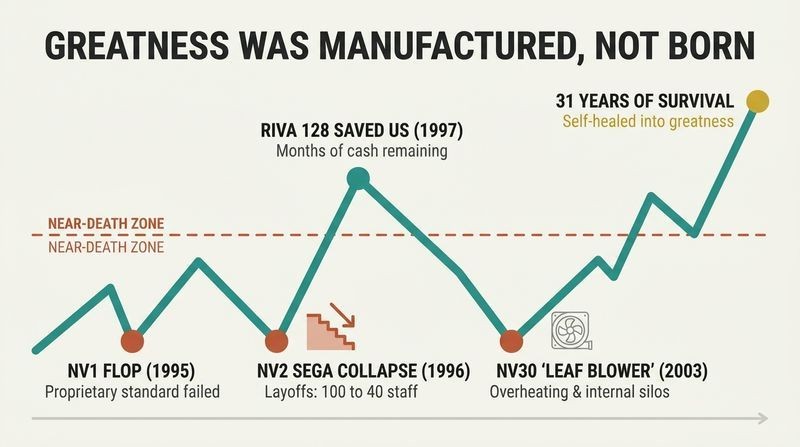
What's striking is how this inverts Silicon Valley's origin-myth genre, where founders are portrayed as prophets. Huang's framing echoes research by scholars like Sim Sitkin on "intelligent failures": organizations that treat early stumbles as cheap information outperform those that avoid risk. The danger is survivorship bias. For every Nvidia that "healed into existence," dozens of graphics firms (Rendition, Tseng Labs, 3dfx) simply died. Resilience is necessary but not sufficient; timing, capital access, and a forgiving market matter enormously. Still, the core insight holds: durable companies are refined by crises they barely survive, not spared them.
Sell what customers can see, not what engineers find clever
Technology alone loses. The NV1 was, by Malachowsky's admission, great technology but a bad product. It used quadrilateral rendering and proprietary wavetable audio when the market wanted triangle-based graphics and SoundBlaster compatibility. Jensen absorbed Al Ries and Jack Trout's book Positioning, learning that customers reject anything that clashes with their existing worldview and want to be seduced by a simple message, not persuaded by facts.
Rival 3dfx nailed the message. Its Voodoo Graphics pitch was pure emotion: get 250,000-dollar SGI-workstation performance on a 299-dollar consumer card. Nvidia learned to stop "polishing the turd," abandon proprietary standards, and out-execute using the same tools as everyone else. As Jensen put it, nobody buys a Swiss Army knife; a do-everything product screams that it excels at nothing.
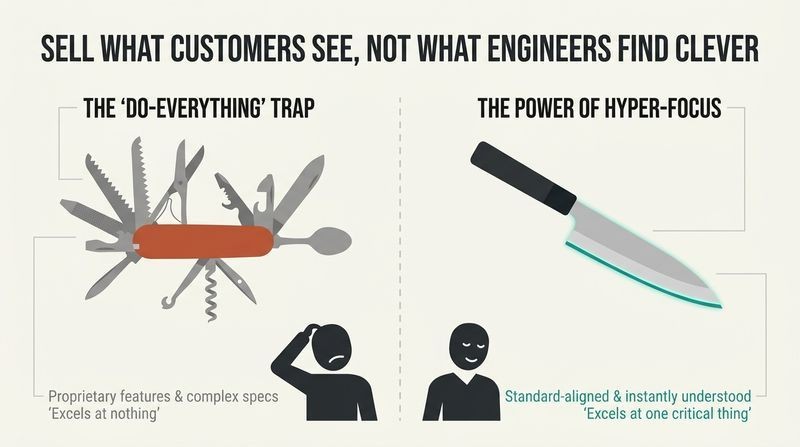
This maps onto Clayton Christensen's "jobs to be done" and Theodore Levitt's classic line that people buy quarter-inch holes, not quarter-inch drills. The NV1 failed because it optimized for engineering elegance rather than the job gamers hired it for: playing DOOM smoothly. There is a deeper cognitive-science point here. Buyers evaluate against salient alternatives, and a single visible deficiency (broken sound, choppy frame rate) overwhelms a dozen invisible virtues. The counterpoint: sometimes markets aren't ready for genuinely better standards, and premature abandonment of superior technology can be its own mistake. Nvidia's own CUDA bet, made years later, contradicts pure market-following.
Measure work against physics, not against competitors or your own past
Speed of Light sets an impossible bar. Jensen demands projects be planned assuming zero delays, queues, or downtime, revealing the theoretical maximum pace dictated only by the laws of physics. Goals referencing what Nvidia did before or what rivals do now are forbidden, because they invite sandbagging and incremental thinking that slowly kills companies.
RIVA 128 embodied it. Chips normally took two years; Nvidia had nine months. Jensen reversed the process, writing driver software before the chip existed, then spent 1 million dollars (cutting his cash runway from nine months to six) on an Ikos emulator to test a digital chip prototype. Testing was agonizing: loading Windows took fifteen minutes. But the gamble worked. Nvidia later built "Three Teams, Two Seasons," shipping a chip every six months to always stay ahead.
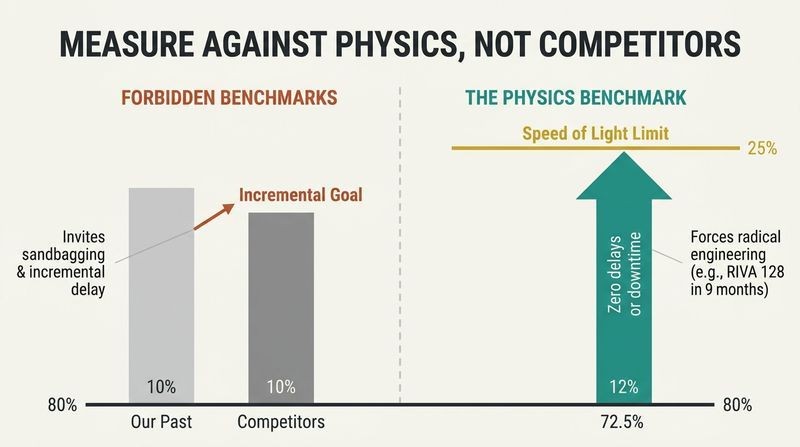
Speed of Light resembles "theoretical throughput" thinking in operations research and Eliyahu Goldratt's Theory of Constraints, which identifies the single bottleneck limiting a system's maximum output. By benchmarking against physics rather than peers, Nvidia sidesteps the anchoring bias that makes most firms define "good" as "slightly better than last year." The risk is burnout and false precision; a bar that is literally unreachable can demoralize as easily as it motivates. Amazon's "Day 1" mentality and Intel's Andy Grove's "only the paranoid survive" rhyme with this. The distinctive move is operationalizing paranoia into a schedule, making urgency structural rather than merely rhetorical.
Turn manufacturing waste into a weapon that traps low-cost rivals
Ship the whole cow. Inspired by The Innovator's Dilemma, Jensen feared a low-cost competitor locking Nvidia out at the bottom and climbing upward. His solution: stop discarding chips that failed quality tests at high speeds. Since packaging and testing a part cost only 1.32 dollars, Nvidia repurposed rejects into cheaper, slower products, like a butcher using every cut from nose to tail.
This created a defensive moat. The strategy let Nvidia build four or five products from a single design, pushed average selling prices up, and let the company price low-end chips so aggressively that competitors relying on those chips as their main product were forced to sell at a loss. It nearly bankrupted rival S3. Jensen borrowed the logic from Intel's practice of "speed binning" identical CPU cores.
This is a masterclass in converting a cost center into strategic leverage, echoing lean manufacturing's war on waste but weaponizing it competitively rather than merely for efficiency. Economists would recognize price discrimination: the same silicon segmented across willingness-to-pay tiers. The elegance is that a market leader's "garbage" becomes a disruptor's death sentence, inverting Christensen's usual bottom-up attack. One nuance worth flagging: this works only when yields produce enough usable rejects and when the high-end margins subsidize predatory low-end pricing. It is closer to a portfolio strategy than a manufacturing trick, and it foreshadows how platform companies later used loss-leader hardware to defend ecosystems.
Invest through a decade of pain when you believe in the destination
CUDA was a bet against Wall Street. In 2006, Nvidia launched CUDA (Compute Unified Device Architecture), software letting scientists and engineers, not just graphics programmers, harness the GPU's thousands of parallel cores for general computation. Jensen insisted CUDA ship on every GPU, even affordable gaming cards, saturating the market. The cost was brutal: the enabling chip took four years and 475 million dollars, roughly a third of R&D. Gross margins fell from 45.6% to 35.4%, and the stock dropped over 80%.
Belief carried it. "We had very few customers for CUDA but we made every chip CUDA compatible," Jensen admitted. He evangelized through universities, funding a course at Illinois, co-writing a textbook. When AI exploded in the 2020s, CUDA's 5 million developers and thousands of applications became an unassailable moat.
CUDA is a textbook example of what economists call increasing returns and network lock-in, the same dynamic that made Windows and x86 dominant. What separates Nvidia from doomed "visionary" bets is that Jensen paired conviction with distribution: by bundling CUDA onto cheap consumer cards, he manufactured the installed base that solved the chicken-and-egg adoption problem plaguing all platforms. The uncomfortable truth for imitators is that this required tolerating a decade of margin destruction that most public-company CEOs, facing activist pressure, could never survive. Conviction is cheap; the willingness to absorb sustained financial humiliation for an unproven thesis is the actual rare resource.
Give brutal feedback in public so everyone learns from one mistake
"I'd rather torture them into greatness." As Nvidia grew past 5,700 employees, Jensen couldn't coach everyone individually, so he began delivering criticism in large meetings. In one infamous 2011 all-hands, he had a cameraman zoom in on a project manager's face while berating him about a late chip. His logic: feedback is learning, and there's no reason only one person should learn from a mistake everyone could avoid.
He holds himself to the same standard. After a flawless quarter, Jensen told his team his morning ritual is looking in the mirror and saying "you suck." When an executive gushed about a successful product launch, Jensen's only response was "What could you have done better?" No praise. Praise, in his view, is a distraction that breeds the deadliest sin: complacency.
This is the most contestable pillar of the Nvidia Way. Organizational psychology, notably Amy Edmondson's research on psychological safety, links public humiliation to concealment: people hide problems to avoid the spotlight, which is precisely what Jensen's Top 5 emails try to surface. The apparent contradiction may resolve through selection: Nvidia's sub-3% turnover suggests those who stay have self-selected into tolerating it, and the feedback carries "no malice," only high standards. Still, extreme methods rarely transplant. What works for a founder with three decades of earned authority and a soaring stock can curdle into fear-driven toxicity under a lesser leader. The mechanism, not the harshness, is the lesson.
Flatten the org so information travels fast and politics starves
Sixty direct reports, no one-on-ones. Most CEOs keep a handful of direct reports; Jensen has more than sixty. He reasons his senior people are experts who need the least management, so he skips career coaching and one-on-ones, instead broadcasting strategy to everyone simultaneously. The flat structure (he calls rivals' hierarchies "upside-down V's" that executives build and defend) prevents turf-guarding and forces information to flow quickly.
The mission is the boss. Rather than permanent divisions fighting for resources, Nvidia pools talent and assigns a "Pilot in Command" to each project, reporting directly to Jensen. Employees are told to serve the mission, not their manager's career. "Top 5" emails, five action-first bullets on what each person is working on and seeing in the market, let Jensen detect "weak signals" before they become obvious threats.
Nvidia's structure resembles what management theorists call a "team of teams" (General Stanley McChrystal) or a Napoleonic corps system: decentralized execution unified by shared intent. The flat design attacks the principal-agent problem head-on by removing the intermediary layers where information gets sanitized and empires get built. There is real cognitive-load tension here, though: sixty direct reports exceeds any classic "span of control" guidance, and it works only because Jensen offloads coaching and eliminates status meetings. The design is inseparable from the man. This is both its genius and its fragility, a theme the book returns to when asking what happens after Jensen.
A technical CEO can see around corners that MBAs cannot
Engineering fluency beats business polish. The book contrasts Jensen with non-technical CEOs who stumbled: Intel's Bob Swan (a finance man) chased stock buybacks while missing smartphones and AI; Microsoft's Steve Ballmer oversaw a 30% stock decline and blew the mobile transition; Apple's John Sculley nearly bankrupted the company. Carl Icahn calls this "anti-Darwinian" succession, where affable, non-threatening executives rise while the technically brilliant get sidelined.
Jensen stays in the weeds. He attends academic AI conferences like NeurIPS simply "to learn," reads roughly 100 employee emails daily, and knows products better than their managers. Yet he avoids paralysis through "CEO math," rounding numbers (0.68 becomes 0.7) to think big-picture fast, a lesson from a college professor who taught him false precision is pointless.
The technical-founder thesis has strong empirical backing: research on founder-CEOs shows they invest more in R&D and take longer horizons than professional managers. But the book's roster of villains is selectively curated. Plenty of technical CEOs have failed (think of engineering-led firms that over-built products nobody wanted), and Satya Nadella, an engineer-turned-manager, succeeded partly through business and cultural reinvention, not raw technical calls. The sharper insight is not "engineers good, MBAs bad" but that in deeply technical industries, the ability to personally evaluate which bets are physically possible and how long they will take is a durable edge finance-trained leaders cannot fake or delegate.
The best acquisitions arrive by accident, but conviction closes them
Mellanox fell into Nvidia's lap. Activist hedge fund Starboard Value forced networking-chip maker Mellanox into a 2019 auction. Jensen wasn't initially hunting for it but quickly grasped that AI would require tens of thousands of servers working in concert, making Mellanox's high-speed InfiniBand technology essential. He outbid Intel and Xilinx at 125 dollars per share, paying 6.9 billion dollars.
The payoff was staggering. By 2024 the former Mellanox business generated over 12 billion dollars in annualized revenue, up sevenfold, an outcome one executive called possibly one of the best acquisitions ever. The thesis Jensen articulated on the announcement call, that the entire data center would become the computer, came true within years. Ironically, Starboard, which had briefly invested in Nvidia itself in 2013 before selling, admitted: "We never should have exited the position."
Most large acquisitions destroy value (studies consistently put the failure rate above 50%), so Mellanox is worth dissecting. Its success rests on strategic coherence: Jensen bought a complement, not a trophy, because his systems-level view told him networking was the emerging bottleneck in AI compute. This is the opposite of Intel's scattershot AI acquisitions (Nervana, then Habana, canceling one for the other), described in the book as "throwing darts." The accidental-origin detail matters: opportunity often arrives unbidden, but only leaders with a clear thesis about where value is migrating can recognize and act on it fast enough. Serendipity favors the strategically prepared mind.
Fund moonshots with no ROI deadline to escape the innovator's trap
Nvidia Research chases ten-year problems. Founded in 2006, this division works on inventions the core business is structurally unable to pursue. Ray tracing (simulating how light actually bounces, scatters, and reflects) took a decade from concept to consumer GPUs. Deep learning super sampling (DLSS), using AI to upscale lower-resolution images, took six years across iterations. Jensen himself invented DLSS on the spot two weeks before a 2018 keynote, seeing a business case the researchers had missed.
Patience is the point. Jensen's mature philosophy: "We don't have an ROI timeline. The only thing we're optimizing for is: Is it incredibly cool, and are people going to like it?" This institutionalized protection against short-term thinking is why Nvidia holds roughly 80% of the discrete GPU market despite AMD offering better raw price-to-performance.
This directly answers Clayton Christensen's innovator's dilemma, where incumbents rationally starve exploratory bets to protect profitable cores and get disrupted. Nvidia's fix resembles the "ambidextrous organization" (O'Reilly and Tushman): separate the explore function structurally so it isn't crushed by exploit metrics. The book's contrast with Google is pointed: Google authored the Transformer paper that birthed modern AI, yet all eight authors left, citing bureaucracy, while Nvidia monetized its research relentlessly. The lesson isn't just funding research; it's building an incubator with permission to fail and a leader technical enough to spot commercial value researchers overlook. Invention without a productization bridge is philanthropy.
Prepare for the wave years early so demand feels like destiny
The 2023 "Big Bang." When Nvidia guided to 11 billion dollars in quarterly revenue against Wall Street's 7.18 billion dollar estimate, analysts were stunned; one titled his note "The Big Bang," another called it the largest revenue upside in industry history. Shares jumped 24% in a day, adding 184 billion dollars, more than Intel's entire value.
It only looked like a miracle. Insiders saw natural evolution. A decade earlier, in 2013, Jensen overruled skeptical lieutenants and declared Nvidia would go "all in" on deep learning after a Toronto team's AlexNet used two consumer GPUs to shatter an image-recognition contest. Nvidia then built Tensor Cores and, spotting the 2017 Transformer paper's importance, added a "Transformer Engine" to its Hopper chips, released one month before ChatGPT launched. The company had pre-positioned hardware for a wave nobody else saw cresting.
This is the capstone that ties every prior principle together: paranoia (weak-signal detection), conviction (the 2013 all-in call), Speed of Light execution, and moonshot patience all compounding into a moment that appeared instantaneous but took ten years to load. It illustrates Nassim Taleb's point that black swans are often only unpredictable to the unprepared. The strategic literature calls this dynamic capability, the firm-level skill of sensing and seizing shifts. The sobering caveat the book itself raises: AI scaling laws may hit diminishing returns, and roughly 60% of data-center GPU sales tie to model training, leaving Nvidia exposed to any demand air pocket. Destiny still has a schedule.
Nvidia's greatest strength, total dependence on Jensen, is its deepest risk
The company is Jensen, scaled up. After 31 years, the longest tenure of any current tech CEO, Nvidia functions as an extension of one mind. He refuses a private office, works from conference rooms, teaches on whiteboards (using chisel-tip markers sold only in Taiwan), and personally awards stock grants he calls his "blood." His mantras ("the mission is the boss," "no one loses alone," "how hard can it be?") keep the culture aligned.
But that fusion is fragile. Apple survived losing Jobs, Microsoft outlived Gates, yet no one knows whether Nvidia's culture survives without Jensen, its "single point of failure." The book's honest conclusion: much of Nvidia's success was serendipity (Malachowsky nearly became a doctor; the NV1 had to fail to birth the RIVA 128), but most flowed from one man's refusal to quit, distilled into two words: "sheer will."
Founder-dependence is the unpriced liability in every cult-of-personality company. The book's own metaphor, a whiteboard that reflects genius but cannot create it, is quietly devastating. Succession research (Rakesh Khurana's work on "charismatic CEO" worship) warns that boards over-index on irreplaceable saviors and under-build institutional resilience. Nvidia's flat structure, so effective under Jensen, may prove the hardest thing to hand off, since it depends on his personal bandwidth and earned authority. The steelman: Jensen has spent decades embedding principles into thousands of employees, arguably distributing his "operating system" more widely than Jobs ever did. Whether encoded culture outlasts its author is the trillion-dollar open question.
Analysis
Tae Kim's book is a business biography structured chronologically across four eras, but its deeper project is reverse-engineering a management philosophy from three decades of near-death experiences. What distinguishes it from typical founder hagiography is its insistence, voiced by Jensen Huang himself, that Nvidia was not born great but was "tortured into greatness." The narrative arc, from a Denny's booth in 1993 to the world's most valuable company in 2024, works because Kim refuses to sand down the failures: the NV1, the NV2, the leaf-blower NV30. The book's central paradox is that a company obsessed with the future was forged entirely by learning from its past. The most intellectually valuable contribution is the articulation of the "Nvidia Way" as an integrated system rather than a grab-bag of tips. Speed of Light (benchmark against physics), ship the whole cow (weaponize waste), the flat mission-driven org, Top 5 emails, and moonshot research without ROI timelines are not independent tactics; they interlock to solve a single problem Huang diagnosed early, that success breeds the complacency and politics that kill technology companies. Read this way, the book is really a treatise on organizational entropy and how one leader engineered structural countermeasures.
The book's blind spots are worth naming. It is a survivor's story told largely through loyalists, so the human cost of 60-to-80-hour weeks and public humiliation is acknowledged but never seriously interrogated. The technical-CEO thesis is compelling but built on cherry-picked foils. And the founder-dependence problem, which Kim admirably foregrounds in his conclusion, undercuts the implicit promise that the "Nvidia Way" is transferable. Ultimately the book's most durable insight may be its least comfortable one: that in deeply technical industries, sustained competitive advantage flows less from strategy documents than from a leader who combines engineering fluency, ruthless standards, and a decade-long tolerance for financial pain that public markets almost never permit.
Review Summary
The Nvidia Way receives overwhelmingly positive reviews, with readers praising its comprehensive history of Nvidia and insights into Jensen Huang's leadership style. Many appreciate the technical details and business strategies presented. The book is noted for its engaging narrative, though some find it lacking in analysis. Readers highlight the company's intense work culture, innovative approaches, and Huang's relentless drive. The book is recommended for those interested in technology, business, and Nvidia's rise to prominence in AI and computing.
FAQ
What's The Nvidia Way about?
- Focus on Jensen Huang: The book chronicles the life and career of Jensen Huang, co-founder and CEO of Nvidia, highlighting his journey from humble beginnings to leading a tech giant.
- Nvidia's Evolution: It explores Nvidia's transformation from a small graphics chip company to a dominant player in the AI and GPU markets, emphasizing innovation and strategic decisions.
- The Nvidia Way: Author Tae Kim introduces "the Nvidia Way," a concept encapsulating the unique organizational design and work culture that drives Nvidia's success.
Why should I read The Nvidia Way?
- Insight into Innovation: Gain insights into how Nvidia fosters innovation through a culture of collaboration, accountability, and excellence.
- Lessons from Failure: Learn valuable lessons on overcoming adversity, as the book details Nvidia's near-death experiences and how it emerged stronger.
- Inspiration for Entrepreneurs: Entrepreneurs can find inspiration in Huang's leadership style and Nvidia's strategies to navigate challenges and seize opportunities.
What are the key takeaways of The Nvidia Way?
- Embrace Challenges: Jensen Huang emphasizes resilience and character building through overcoming challenges, encapsulated in his wish for "ample doses of pain and suffering."
- Speed of Light Philosophy: Encourages employees to work efficiently and avoid internal politics, ensuring rapid progress.
- Continuous Innovation: Highlights the importance of continuous innovation and adaptation, as seen in Nvidia's strategic shifts to meet market demands.
What are the best quotes from The Nvidia Way and what do they mean?
- "We were just bad at our jobs": Reflects Huang's candid acknowledgment of early struggles and the importance of learning from mistakes.
- "Second place is the first loser": Underscores Huang's competitive nature and the drive for excellence within Nvidia's culture.
- "We’re thirty days from going out of business": Serves as a motivational tool, instilling urgency and focus on performance among employees.
How did Jensen Huang's leadership style impact Nvidia?
- Direct Communication: Known for straightforward feedback, fostering transparency and accountability, encouraging continuous improvement.
- Focus on Talent: Prioritizes hiring top talent and creating an environment where they can thrive, essential for driving innovation.
- Visionary Thinking: Huang's foresight in industry trends, like AI, has guided Nvidia's strategic direction and long-term success.
What is the "Nvidia Way"?
- Organizational Design: Refers to Nvidia's unique structure promoting independence, high standards, and rapid innovation.
- Collaborative Culture: Emphasizes a work environment where employees share ideas and challenge each other, fostering continuous improvement.
- Accountability and Speed: Demands accountability and a fast-paced work ethic, ensuring high-quality results efficiently.
How did Nvidia overcome its early challenges?
- Learning from Mistakes: Emphasized learning from past failures, such as the NV1 and NV2 chips, to inform future strategies.
- Cultural Resilience: Retained a core group of dedicated employees committed to overcoming challenges and rebuilding after setbacks.
- Innovative Strategies: Adopted new strategies, like the "Three Teams, Two Seasons" approach, to accelerate product development.
What role did competition play in Nvidia's success?
- Driving Innovation: Competition from companies like 3dfx and ATI pushed Nvidia to innovate rapidly and improve products.
- Market Positioning: Effective positioning against competitors allowed Nvidia to capture significant market share with products like the RIVA and GeForce series.
- Strategic Partnerships: Leveraged relationships with major players like Microsoft and Apple to enhance market presence and secure contracts.
What is CUDA, and why is it significant?
- Definition of CUDA: A parallel computing platform and API model by Nvidia, enabling developers to use GPUs for general-purpose processing.
- Impact on Computing: Revolutionized computing tasks in fields like scientific research and machine learning, leveraging GPU power beyond graphics.
- Widespread Adoption: Became an industry standard, with millions of developers using it to accelerate applications, accessible across various programming languages.
How did Nvidia's culture contribute to its growth?
- High Expectations: Sets high expectations for performance and accountability, encouraging employees to push limits and strive for excellence.
- Collaborative Environment: Fosters teamwork and innovation, allowing employees to share ideas and learn from one another.
- Focus on Results: Emphasizes results and speed, ensuring agility and responsiveness to market changes, enabling quick capitalization on opportunities.
How did Nvidia's acquisition of Mellanox impact its growth?
- Strategic Acquisition: Enhanced Nvidia's data center capabilities, offering high-performance networking solutions alongside GPU products.
- Revenue Growth: Mellanox's technology contributed to a substantial increase in Nvidia's data center revenue, driving growth in AI and high-performance computing.
- Market Positioning: Positioned Nvidia as a leader in AI infrastructure, capitalizing on growing demand for AI solutions and expanding its ecosystem.
What are the future prospects for Nvidia?
- Continued AI Leadership: Positioned to maintain leadership in AI, with early investments and innovations in GPU technology.
- Expansion into New Markets: Exploring new applications in fields like digital biology, diversifying revenue streams.
- Focus on Innovation: Commitment to research and staying ahead of trends will drive growth, aiming to remain a dominant tech industry player.
Download PDF
Download EPUB
.epub digital book format is ideal for reading ebooks on phones, tablets, and e-readers.








































