
Plot Summary
Heatwave Beginnings, Supermarket Dreams
Piglet, newly engaged and freshly moved into a pristine Oxford home with her fiancé Kit, is introduced in the sweltering heat of a British summer. She shops for an elaborate housewarming dinner, determined to impress friends and herself with her culinary prowess. The supermarket is a stage for her anxieties and aspirations, as she contrasts her humble Derby upbringing with the sophisticated world she's entering. Food is more than sustenance—it's a marker of class, love, and self-worth. The dinner she plans is not just a meal but a performance, a way to claim her place in a new life. The chapter sets the tone: Piglet's hunger for approval, her discomfort with her roots, and her belief that happiness can be cooked, plated, and served.
Housewarming Feasts and Family Ghosts
Piglet's housewarming dinner is a carefully orchestrated event, blending her desire for perfection with the ghosts of her family's simpler traditions. The meal is a success on the surface—friends praise her food, Kit toasts her as his "astonishing" future wife, and the new house feels momentarily like home. Yet, beneath the laughter and clinking glasses, Piglet is haunted by memories of her parents' unrefined meals and the subtle judgments of Kit's upper-middle-class family. The chapter explores the tension between aspiration and authenticity, as Piglet tries to distance herself from her origins while feeling the ache of disconnection. Food becomes both a bridge and a barrier, a way to belong and a reminder of what she's left behind.
Friendship Shifts, Baby News
Piglet's closest friend, Margot, announces her pregnancy, shifting the dynamic of their friendship. Piglet, who once shared everything with Margot, now feels left behind as Margot moves confidently into motherhood with her wife Sasha. Their conversations become strained, filled with talk of baby showers and antenatal classes that Piglet can't relate to. She tries to contribute by cooking freezer meals for Margot, but the gesture feels inadequate. The chapter captures the bittersweet evolution of adult friendships—how shared histories can't always bridge new life stages, and how envy, love, and loss intermingle. Piglet's sense of self is further destabilized as she wonders if she'll ever feel as certain about her own future.
Kitchen Tensions, Private Longings
As the wedding approaches, Piglet and Kit's domestic life grows tense. Small disagreements in the kitchen—over coffee, over space—become stand-ins for deeper issues. Piglet feels both cared for and suffocated, unable to reconcile her need for independence with her longing for intimacy. The kitchen, once her sanctuary, becomes a battleground. She is haunted by the routines of her childhood and the expectations of her future in-laws. The chapter delves into the psychological push-pull of partnership, the difficulty of asking for help, and the fear that love might not be enough to sustain happiness. Piglet's private longings—her doubts, her hunger for more—remain unspoken, simmering beneath the surface.
Wedding Countdown, Family Visits
Piglet's family visits the new house for the first time, and she orchestrates another elaborate meal, hoping to impress and bridge the gap between her old and new worlds. The visit is fraught with class tension—her parents are out of place among the mismatched Wedgwood and Denby, her sister Franny's boyfriend Darren is unimpressed by craft beer, and Piglet's efforts to curate the perfect experience only highlight the distance between them. Stories from childhood resurface, revealing old wounds and the ways food has always been both comfort and curse. The chapter explores the impossibility of pleasing everyone, the pain of feeling like an outsider in one's own family, and the exhaustion of constant performance.
In-Law Rituals, Body Comparisons
Piglet is drawn into Cecelia's world of personal trainers, saunas, and naked confidence. The ritual of pre-wedding fitness classes with her future mother-in-law is both bonding and alienating. Piglet compares her own body—large, awkward, self-conscious—to Cecelia's effortless elegance. The experience is a microcosm of her larger struggle: wanting to fit in, to be worthy, to be seen as "good wife" material. The chapter examines the intersection of class, body image, and maternal expectations, as Piglet tries to mold herself into someone she's not. The pressure to shrink, to fast, to be perfect for the wedding dress becomes a metaphor for the ways women are asked to contain themselves.
Sisterly Confessions, Old Wounds
Franny confides in Piglet about Darren's business failure and their financial struggles, asking for a loan. The conversation reopens old wounds—memories of Franny's eating disorder, Piglet's role as protector, and the complicated love between sisters. Piglet is torn between resentment and responsibility, pride and empathy. The chapter explores the ways family history shapes adult relationships, the difficulty of setting boundaries, and the pain of not being able to save those we love. Piglet's own sense of inadequacy is heightened as she realizes she can't fix everything, and that her own life is more precarious than she lets on.
The Secret Shatters Everything
Thirteen days before the wedding, Kit confesses a devastating secret—an infidelity or betrayal that shatters Piglet's carefully constructed world. The revelation is delivered in bed, intimate and brutal, leaving Piglet physically and emotionally gutted. The chapter is a study in shock and denial: Piglet goes through the motions of daily life, unable to process what's happened. She is paralyzed by indecision—should she call off the wedding, tell her friends, confront her family? The secret becomes a splinter, infecting every interaction. The emotional arc is one of numbness, rage, and the slow, painful realization that nothing will ever be the same.
Aftermath, Silence, and Survival
In the days following Kit's confession, Piglet and Kit exist in a state of suspended animation. They communicate in clipped phrases, avoid each other in the house, and try to maintain appearances for the outside world. Piglet is haunted by the knowledge that her life is a lie, but she is also terrified of what will happen if the truth comes out. She turns to food for comfort, eating in secret, binging and purging her feelings. Attempts to reach out to Margot and Franny are stilted, as Piglet can't bring herself to share the full extent of her pain. The chapter is suffused with loneliness, shame, and the desperate need to survive.
Margot's Labour, Friendship Fractures
On the day of Piglet's final wedding dress fitting, Margot goes into early labour. In the chaos, Piglet confesses Kit's betrayal to Margot, seeking solace and absolution. Instead, Margot is furious—she can't believe Piglet would still marry Kit, and the two friends have a painful falling out. The birth of Margot's daughter, Layla, becomes a symbol of new beginnings and the irreparable changes in their friendship. Piglet is left feeling more alone than ever, her support system fractured. The chapter explores the limits of friendship, the cost of honesty, and the ways crisis can both reveal and destroy the bonds we rely on.
Eating Alone, Public Exposure
Piglet's relationship with food spirals as she seeks comfort in solitary feasts—ordering excessive amounts at restaurants, eating in secret, and using food to fill the void left by broken relationships. A humiliating encounter at a burger joint, where she is caught by colleagues gorging alone, exposes her private pain to the public. The incident is a turning point, forcing Piglet to confront the ways she uses food to cope with shame, loneliness, and the loss of control. The chapter is raw and visceral, capturing the intersection of appetite, self-destruction, and the longing to be seen.
The Wedding Approaches, Crumbling Facades
As the wedding day nears, Piglet's life becomes a series of performances—family dinners, office parties, last-minute fittings—all while her internal world is collapsing. She obsesses over the croquembouche wedding cake she's making herself, convinced that if she can just get this one thing right, everything else will fall into place. The pressure mounts as Margot and Sasha decline to attend, Franny becomes her reluctant maid of honour, and Kit's family hovers, oblivious to the turmoil. The chapter is a crescendo of anxiety, denial, and the desperate hope that perfection can save her.
The Croquembouche Catastrophe
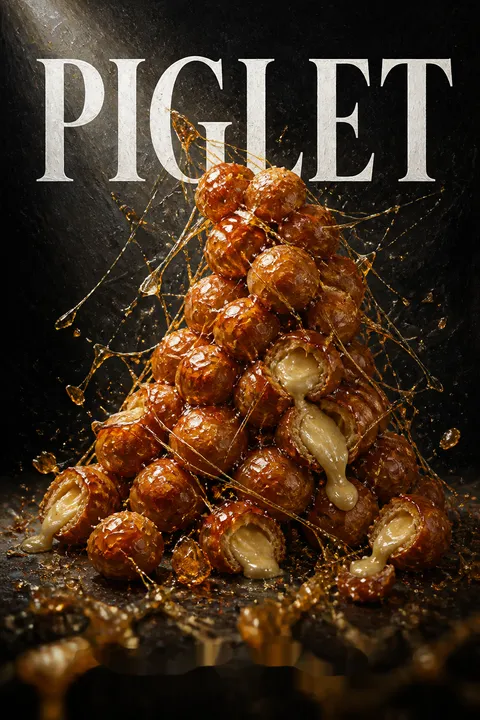
On the morning of the wedding, Piglet's meticulously planned croquembouche collapses in the kitchen, a sticky, custard-soaked mess. The disaster is both literal and symbolic—the final unraveling of her illusion of control. Her mother finds her in tears, covered in caramel and shame. The family scrambles to help, gluing the cake back together, but the damage is done. The scene is chaotic, farcical, and deeply sad, capturing the futility of trying to hold together a life that is already broken. Piglet is forced to confront the reality that some things cannot be fixed.
The Ceremony: Masks and Meltdowns
The wedding ceremony is a surreal, out-of-body experience for Piglet. She is trussed into a too-tight dress, walked down the aisle by her father, and recites her vows in a daze. The church is filled with people who don't know the truth, and Piglet feels like an imposter in her own life. The reception is a blur of speeches, forced smiles, and mounting dread. The emotional arc is one of numbness, grief, and the growing realization that she cannot go on like this. The chapter is a masterclass in the performance of happiness and the cost of self-betrayal.
Reception Ruin, Public Truth
During the wedding reception, Piglet reaches her breaking point. In a moment of raw honesty, she takes the microphone and reveals Kit's betrayal to the assembled guests. The confession is both cathartic and catastrophic—her dress rips, the croquembouche is destroyed, and the carefully curated facade of her life collapses in front of everyone. The scene is chaotic, messy, and liberating. Piglet's hunger for truth finally outweighs her fear of judgment. The chapter is a reckoning, a public unmasking, and the beginning of something new.
Escape, Destruction, and New Beginnings
Piglet flees the wedding, croquembouche in tow, and seeks refuge at Margot's house. The two women reconcile, sharing food, tears, and the comfort of old friendship. Piglet smashes the wedding cake in Margot's garden, a symbolic act of letting go. The chapter is a turning point—Piglet begins to accept that her life will not be what she planned, but that she can still choose her own path. The emotional arc is one of grief, forgiveness, and the tentative hope of starting over.
Homecoming, Letting Go
Piglet returns home, confronts her family, and has a final, honest conversation with Kit. They agree to separate, acknowledging that their marriage was built on lies and fear. Piglet's parents, especially her father, struggle to understand, but Piglet stands firm in her decision. The chapter is about closure, the pain of disappointing others, and the relief of no longer pretending. Piglet is alone, but for the first time, she feels free to be herself.
Alone in the Kitchen, Self-Feeding
In the final chapter, Piglet is alone in her kitchen, making a simple bowl of pasta for herself. The act of cooking and eating is no longer about performance, approval, or filling a void—it is an act of self-care, a quiet assertion of agency. Piglet reflects on her journey, her losses, and her newfound appetite for life on her own terms. The story ends not with a grand resolution, but with the small, profound satisfaction of feeding herself, at last.
Analysis
Piglet is a searing, darkly comic exploration of appetite, class, and the search for self-worth in a world obsessed with appearances. Lottie Hazell uses the rituals of food and the spectacle of the modern wedding to dissect the pressures faced by women to be perfect—physically, emotionally, and socially. The novel's countdown structure and sensory detail create a claustrophobic sense of inevitability, as Piglet's attempts to control her world through food and performance unravel spectacularly. At its core, Piglet is about the hunger for love, belonging, and authenticity—and the ways these desires are shaped and thwarted by class, family, and gender. The story refuses easy resolutions: Piglet's liberation is messy, painful, and incomplete, but it is real. The final image—Piglet alone in her kitchen, feeding herself—offers a radical vision of self-acceptance and agency. Hazell's novel is a powerful reminder that true satisfaction comes not from pleasing others, but from learning to nourish oneself.
Review Summary
Piglet received mixed reviews, with praise for its clever writing and exploration of food, class, and female identity. Many readers were captivated by the protagonist's unraveling and the tension-filled narrative. However, some found the characters unlikable and were frustrated by the undisclosed betrayal. The novel's themes of toxic femininity, eating disorders, and societal expectations resonated with some readers, while others felt the story lacked depth or resolution. Overall, it was recognized as an impressive debut with vivid food descriptions and compelling character study.
People Also Read










Characters
Piglet (Pippa)
Piglet is the novel's protagonist—a tall, self-conscious, food-obsessed woman navigating the treacherous terrain between her working-class Derby roots and the upper-middle-class world of her fiancé Kit. Her relationship with food is fraught: it is comfort, performance, and a battleground for self-worth. Piglet is deeply ambitious, desperate to be seen as "enough," and haunted by the fear that she never will be. Her psychological landscape is shaped by shame, longing, and the need to control what she cannot. Over the course of the novel, Piglet's journey is one of painful self-discovery: she must confront the lies she tells herself, the hunger she cannot satisfy, and the possibility of living authentically—even if it means being alone.
Kit
Kit is Piglet's fiancé and later husband—a product of privilege, charm, and entitlement. He is supportive on the surface, but emotionally evasive and ultimately unfaithful. Kit's relationship with Piglet is both loving and transactional; he admires her ambition and culinary skill but is blind to her deeper needs. His confession of betrayal is a catalyst for the novel's central crisis, exposing the fragility of their relationship and the dangers of building a life on secrets. Kit's development is limited—he is more a mirror for Piglet's desires and fears than a fully realized partner. His inability to confront his own flaws or truly support Piglet's growth is both his tragedy and hers.
Margot
Margot is Piglet's best friend—a confident, grounded woman who moves into marriage and motherhood with her wife Sasha. Margot represents both the comfort of shared history and the pain of growing apart. Her pregnancy and new baby, Layla, become symbols of change and the inevitability of life moving on. Margot is loving but not uncritical; her confrontation with Piglet over Kit's betrayal is a turning point, forcing Piglet to face uncomfortable truths. Margot's own anxieties about motherhood and identity mirror Piglet's struggles, highlighting the complexity of adult friendship and the difficulty of supporting each other through transformation.
Sasha
Sasha is Margot's wife—a poet, activist, and the more pragmatic half of their partnership. She is fiercely protective of Margot and Layla, and her relationship with Piglet is marked by both affection and skepticism. Sasha's directness and willingness to call out uncomfortable truths make her a necessary counterpoint to Piglet's evasions. She is the first to draw boundaries when Piglet's choices threaten Margot's well-being, embodying the limits of friendship and the importance of self-preservation.
Franny
Franny is Piglet's younger sister—a slight, anxious woman who has struggled with an eating disorder and financial instability. Her relationship with Piglet is a mix of dependence, rivalry, and deep love. Franny's request for a loan reopens old wounds, forcing both sisters to confront their shared history of caretaking and competition. Franny is both a mirror and a foil for Piglet: where Piglet seeks to escape her origins, Franny is more accepting, if also more vulnerable. Their bond is tested but ultimately endures, offering Piglet a model of forgiveness and resilience.
Cecelia
Cecelia is Kit's mother—a glamorous, confident woman who embodies the privileges and expectations of the upper-middle class. She is both mentor and adversary to Piglet, offering guidance while subtly reinforcing the boundaries of class and propriety. Cecelia's rituals—personal training, saunas, nakedness—are both alluring and alienating. She represents the world Piglet longs to enter but can never fully belong to. Cecelia's loyalty to Kit is unwavering, and her inability to truly accept Piglet is a source of ongoing pain.
Richard
Richard is Kit's father—a man of few words, more comfortable with rugby scores than emotional conversations. He is a background presence, embodying the unspoken rules of masculinity and class. Richard's approval is important to Kit and, by extension, to Piglet, but he is ultimately more invested in appearances than in genuine connection. His role is to reinforce the status quo, making it harder for Piglet to break free.
Piglet's Mother (Linda)
Linda is Piglet's mother—a loving, anxious woman who clings to family routines and traditions. She is proud of Piglet's achievements but struggles to understand her daughter's ambitions and anxieties. Linda's relationship with Piglet is marked by both closeness and misunderstanding; she wants to help but often says the wrong thing. Her presence is a reminder of the comforts and constraints of home, and her inability to fully support Piglet's choices is both a source of pain and a catalyst for growth.
Piglet's Father (John)
John is Piglet's father—a decent, working-class man who loves his daughter but is ill-equipped to navigate her world. He offers practical advice and unconditional love, but his emotional range is limited. John's inability to fully understand or support Piglet's decisions is both a comfort and a frustration. He represents the safety of the past and the impossibility of returning to it.
Darren
Darren is Franny's boyfriend—a self-employed, rough-around-the-edges man who is both a source of stress and comic relief. His business failure and financial dependence on Franny's family highlight the precariousness of working-class life. Darren's presence is a reminder of the world Piglet is trying to escape, but his straightforwardness and lack of pretense also offer a kind of honesty that is missing elsewhere.
Plot Devices
Food as Emotional and Social Currency
Throughout the novel, food is more than sustenance—it is a language, a weapon, and a measure of value. Piglet's elaborate meals are attempts to bridge class divides, win approval, and assert control over her life. The rituals of shopping, cooking, and eating are laden with meaning: they expose insecurities, mark transitions, and serve as battlegrounds for identity. The croquembouche wedding cake is the ultimate symbol—its collapse mirrors Piglet's unraveling, and its destruction marks her liberation. Food is also a site of shame and secrecy, as Piglet's solitary binges reveal her hunger for comfort and her fear of exposure.
Countdown Structure and Temporal Compression
The novel is structured as a countdown to the wedding, with chapters marked by the number of days remaining. This device creates a sense of mounting pressure and inevitability, as each day brings Piglet closer to a reckoning she cannot avoid. The temporal compression intensifies the emotional stakes, making every decision feel urgent and irreversible. The structure also mirrors the way anxiety distorts time, stretching and compressing moments of crisis.
Class and Social Performance
Class is a pervasive force in the novel, shaping Piglet's relationships, ambitions, and sense of self. The contrast between her Derby upbringing and Kit's privileged world is a source of constant tension. Social performance—through food, dress, conversation—is both a means of survival and a source of exhaustion. The novel uses parties, dinners, and weddings as stages on which characters perform their identities, often at great personal cost.
Foreshadowing and Symbolism
The novel is rich in foreshadowing and symbolism: the croquembouche, the wedding dress, the kitchen, and the act of eating alone all serve as metaphors for Piglet's internal state. The repeated motif of things falling apart—cakes collapsing, dresses ripping, meals burning—signals the impending breakdown of Piglet's carefully curated life. Conversely, the final act of cooking and eating for herself symbolizes the possibility of renewal and self-acceptance.
Narrative Voice and Interior Monologue
The narrative is tightly focused on Piglet's interiority, using close third-person and stream-of-consciousness to immerse the reader in her anxieties, desires, and rationalizations. This device allows for deep psychological exploration, making Piglet's struggles with food, love, and identity visceral and immediate. The voice is both witty and raw, capturing the contradictions of modern womanhood.
Download PDF
Download EPUB
.epub digital book format is ideal for reading ebooks on phones, tablets, and e-readers.








































