


Plot Summary
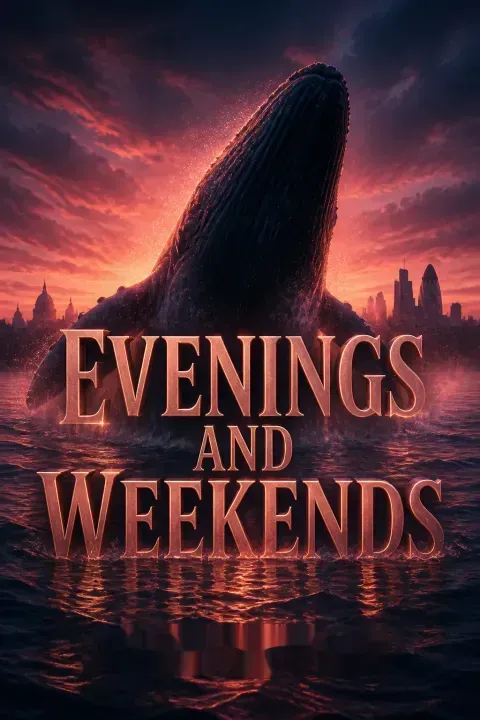
Phantom Whale, Real Panic
Ed Seymour,1 a courier, cycles past the Thames on a Friday in June and sees a whale beached on the opposite bank. He is certain he is hallucinating: nine weeks ago, his friend Callum7 gave him a tab of acid after learning his girlfriend Maggie2 was pregnant, and since then he has glimpsed imaginary creatures.
He calls 999, ready to say goodbye to Maggie2 and his unborn child, but the operator laughs and tells him the whale is real. It has become a media sensation. Later, Ed's1 panic subsides but his terror does not.
His father died of lung cancer at fifty, their Hackney flat is so damp it triggers Ed's1 childhood asthma, and they cannot afford nappies. They will move to Basildon. Maggie,2 finishing her last shift at a Greenwich cafe, texts her best friend Phil3 to meet, still unable to say aloud: I am pregnant.
The whale functions as an externalization of Ed's internal crisis: a creature displaced, gasping, lost in an environment that cannot sustain it. Ed's hallucinatory panic, the product of drugs, grief, and economic precarity, reveals a man dissociated from his own desires. The opening establishes the novel's central tension between what people present and what they actually feel, a silence maintained even with those they love most.
Liverpool Street Station Reunion
After work, Ed1 stops at Liverpool Street station toilets. A suited man lingers, raises an eyebrow, and slips into a cubicle. Ed1 hesitates, then turns back. Just as he approaches the door, Phil3 walks in. They freeze. Phil,3 fresh from his own office job, had followed the same man from the Tube.
The man flees. Ed1 babbles about it being great to see Phil,3 pretending he merely came to use the toilet. Phil3 sees through it. He reminds Ed1 he is meeting Maggie2 tomorrow. Ed's1 chest tightens.
Phil3 leaves, shaken, already wondering if he must tell Maggie2 about Ed's1 cruising. But underneath that ethical question lies a more wounding one: if Ed1 has always wanted men, why did he never want Phil?3 Why did he use Phil3 as a stepping stone to Maggie2 and then smash an egg into his skull?
The toilet encounter literalizes the closet: two men who share a secret history meeting in a space of anonymous desire. Phil's reaction is multilayered, not just shock at Ed's potential infidelity but wounding at the implicit rejection of his younger self. The scene raises questions about homophobia, internalized shame, and the ethics of disclosure. Phil's silence, like Ed's, is a survival strategy learned in childhood.
The Loaf of Bread Unshared
Rosaleen4 travels from Basildon to Phil's3 warehouse carrying a homemade loaf of bread. She cannot find the words to give it to him. The kitchen is chaotic, the housemates indifferent; she sits on a cat-hair-covered couch clutching the bread in her handbag.
They go to Westfield Stratford, where she pesters him about cabbages, settling down, saving for a mortgage. She compares him unfavorably to Ed1 and Callum.7 Phil3 snaps that Callum7 is a drug dealer. Rosaleen4 flinches but says nothing. She nearly tells him about her cancer, but instead they bicker over whether he ever liked cabbage.
They part on the station concourse, Phil3 ascending the escalator, Rosaleen4 wandering aimlessly. He runs back to find her, but she is gone. In the station toilets, she scrubs her hands without soap, regretting everything she did not say.
This scene captures the tragedy of familial love choked by unspoken things. Rosaleen's desperate search for cabbage, a vegetable Phil no longer eats, symbolizes her need to nurture in a language he has outgrown. Both mother and son are paralyzed by a fear of disappointing each other. The bread she never gives becomes a metaphor for love unexpressed, a gift that rots in her bag.
I'm Sorry, Not Congratulations
Maggie2 and Phil3 meet at Hampstead Heath. They strip to their underwear and plunge into the mixed pond, screaming at the cold. Afterwards, she tells him: she is twelve weeks pregnant. They are keeping the baby and moving to Basildon. Phil,3 horrified, says 'I'm so sorry' as if she had announced a terminal illness. Maggie2 is stung.
In a Finchley Road Waitrose, they argue: Phil3 implies Ed1 is not right for her, Maggie2 accuses him of looking down on her choices. Phil3 leaves, feeling that his life of casual sex with a taken man and a pointless job has been rendered trivial by her announcement. He drafts a text telling her the truth about Ed1 but cannot press send. Maggie,2 alone, wonders if Phil3 was right about Ed1 after all.
The friends' rift exposes a divergence in values and life trajectories. Phil's initial 'sorry' reveals his association of queerness with freedom and heterosexual domesticity with loss. But his shock also masks a deeper fear: that he will be left behind, his non-normative life judged as unserious. Maggie's defensiveness suggests her own ambivalence about the path she has chosen.
Karaoke for Pauline
On Saturday evening, Rosaleen4 and Joan8 speed down the dual carriageway to the Dartford Crossing, chasing the barge carrying the whale. Standing on the bridge, Rosaleen4 involuntarily shouts 'Pauline!11' into the wind. Joan8 asks who Pauline11 was.
Rosaleen4 explains, haltingly: a girl from Dublin she wrestled with as a child, a poet who died young, someone she loved. Later, at the local pub, Joan8 bullies her onto the karaoke stage. Rosaleen4 sings Cher's 'Believe,' her voice quivering. It is the first time she has sung since the nuns told her she had bad insides.
Afterwards, Steve9 announces they are going to Ireland once her treatment allows. He has already checked the passports. Rosaleen,4 for the first time in decades, feels she might still become the woman who once dreamed of growing wings.
Rosaleen's arc from self-erasure to voice is the novel's emotional core. Her confession about Pauline, a love that dared not speak its name in 1970s Catholic Ireland, links queer history with personal liberation. The Cher anthem in a sticky-floored pub becomes genuinely transcendent. The trip to Ireland, insisted upon by her quiet husband, promises to reconnect her with the country she fled and the self she buried.
Kyle Connolly's Party Bomb
At the solstice party in the warehouse, Ed1 gets drunk. He finds Phil3 in the courtyard and apologizes for the egg incident a decade ago, then blurts out that he heard about Phil's mum's4 cancer from Callum.7 Phil3 did not know.
Maggie2 rushes over and invents a cover story about a Facebook scam to protect Phil,3 but then Kyle Connolly,12 a childhood friend turned influencer, appears. Kyle12 casually reveals that Ed1 used to play the same secret bedroom games with him that he played with Phil.3 Maggie2 confronts Ed,1 who denies knowing Kyle.12
They leave early. Walking through Hackney, Ed1 admits he almost hooked up with a stranger in a toilet the previous day. Phil,3 meanwhile, follows Keith5 to a darkroom and, for the first time, allows himself to be fully present during sex.
The party becomes a pressure cooker where decades of silence detonate. Kyle's revelation, dropped as casual gossip, collapses the boundary between Ed's singular betrayal and a larger pattern of behavior. Maggie's instinct to protect Phil with a lie about the cancer shows her loyalty but also her entanglement in the culture of silence. Ed's confession to Maggie marks the beginning of honesty, however painful.
Payment Declined, Relationship Over
Sunday morning, Ed1 wakes determined to repair things. He drags Maggie2 to Lidl, piles a crate with bacon, eggs, a child's karate outfit, and a bright red highchair. At the till, his card is declined. Maggie2 watches him fumble for another card, his breathing growing shallow. She says she cannot do this.
In the car park, Ed1 confesses everything: the handjob he asked Phil3 for as a teenager, the egg he smashed into his head to prove he was not gay, the men he has cruised in station toilets, the lie he has lived. Maggie2 tells him their relationship is over. She will have an abortion. They sob together on the banks of the River Lea. Later, Phil3 leaves a box of art supplies at her door with a note: 'Hope to see some work of yours soon.'
The failed supermarket trip crystallizes the material impossibility of their life together. Ed's manic attempt to purchase a future, the highchair, the karate costume, collides with the blunt reality of an overdraft. Maggie's decision to terminate is framed not as regret but as survival: she cannot breathe in a life built on suppression. The art supplies from Phil represent a counter-narrative, an invitation to reclaim her creative self.
I Love You Too
The morning after the party, Phil3 and Keith5 lie in bed listening to rain on the warehouse roof. The previous night, in a makeshift darkroom, Phil3 had sex without dissociation for the first time since his assault in Burgess Park at nineteen. Later, walking through South Bermondsey, they buy chips and a Diet Coke from McDonald's.
Phil's3 mouth forms the words 'I love you' like a malfunctioning robot. Keith5 beams and says he loves him too. They kiss with globs of mashed potato between their teeth. Over the following weeks, Keith5 moves to Folkestone with Louis,6 but the three men begin navigating a polyamorous arrangement. Phil3 discovers a new addiction: making Louis6 laugh. For the first time, Phil3 feels his body is his own.
Phil's capacity to love is restored through physical vulnerability and verbal honesty. The McDonald's setting rejects cinematic romance in favor of real, messy connection. The emerging triad with Louis suggests that relationships can expand rather than break under the pressure of desire. Phil's healing is not instantaneous but ongoing, a slow reclamation of a body he had abandoned.
The Chinese Restaurant Confession
Phil3 takes a train to Basildon without calling ahead. He gives his mother4 a floral mug from TK Maxx. They go to a Chinese restaurant where they once celebrated his university acceptance. Midway through the meal, Rosaleen4 puts down her water glass and says, 'I need to tell you.
I've got cancer.' She insists she will get better, contradicting the doctor's prognosis of six months to three years. Phil,3 who prides himself on emotional eloquence, freezes. He excuses himself to the toilet, where he cries quietly.
He returns and asks nothing about the diagnosis, the treatment, the odds. The conversation swerves to the quality of fake meats and tofu curry. He realizes that neither he nor his mother4 knows how to speak to each other, and that this silence has been mutual, inherited, and durable.
The cancer revelation, dropped amid harp music and spring rolls, is followed by a retreat into trivialities. Phil's paralysis demonstrates how family patterns of non-communication persist even in extremis. His silence is not indifference but incompetence: he lacks the vocabulary for the enormity of what she has told him. The setting, a site of past celebrations, underscores how the rituals of working-class family life provide structure but also constraint.
The Magenta Fascinator Speech
Six weeks after her diagnosis, Rosaleen4 stands in a bridal shop surrounded by family. Everyone hates the magenta fascinator she adores. She buys it anyway. At the Catholic ceremony, Ed1 and Phil3 stand as groomsmen, their shared history unspoken but acknowledged. At the reception, Rosaleen4 backs out of her speech, but Joan8 bullies her onto the stage.
Under disco lights, Rosaleen4 grips the microphone and speaks: 'Callum,7 before I had you, I never knew just how many creatures could live beneath the earth of one tiny back garden.' She describes how her son7 taught her to see the world as wondrous again. Keith5 squeezes Phil's3 hand. Joan8 applauds. Rosaleen's4 voice cracks but does not break.
The wedding speech is the culmination of Rosaleen's journey from silence to voice. The magenta feather, tacky, defiant, hers, symbolizes her refusal to disappear. By speaking publicly about love and wonder, she challenges the Irish Catholic legacy of shame that silenced her and Pauline. The moment validates a key idea: that love is not a feeling but an action, something you deliberately make.
Pauline's Grave, Bray Head
Rosaleen,4 Steve,9 Phil,3 and Callum7 fly to Dublin. She shows them O'Connell Street, the DART coast, the startling blue of Dublin Bay. At a cemetery, she lays flowers on Pauline's11 black marble headstone. She tells Phil:3 Pauline11 was a poet who died young; she said poems in the pub once. On Bray Head, looking at the city, Phil3 squints toward the Poolbeg Chimneys as if he might see Pauline11 there.
Rosaleen4 tries to explain the texture of her past: the nun who praised her essay, the terror of hellfire, the smell of dust on her mother's carpet after wrestling with Pauline.11 Phil3 says he wishes he could have heard Pauline's11 poems. Rosaleen4 realizes that is enough. She does not have to say everything at once.
The novel ends not with death but with continuity: Rosaleen passes her story to Phil, who receives it as a gift. The trip to Ireland mends the rupture caused by emigration, shame, and time. Pauline's presence, a queer foremother, is finally named and mourned. The open-endedness suggests that healing is a long, incomplete process, built from small acts of telling and listening. Rosaleen's story, like her bread, has finally been shared.
Analysis
Evenings and Weekends is a novel about the violence of silence and the labor of speaking. Across one sweltering weekend in June 2019, its characters navigate the gap between the lives they perform and the selves they suppress. Ed1 cannot tell Maggie2 he desires men; Rosaleen4 cannot tell Phil3 she has cancer, much less that she once loved a girl called Pauline;11 Phil3 cannot tell anyone about the assault that severed him from his own body. These silences are not personal failings but inheritances: from Catholic Ireland's culture of shame, from English class codes that punish deviation, from a social order that treats queer lives as unserious. The whale, beached and dying under the glare of media attention, becomes the novel's central metaphor for what happens when a creature is forced into an environment that cannot hold it. The city itself, London in an apocalyptic heatwave, poised between austerity and climate collapse, between Theresa May's tearful resignation and the fragile hope of a Corbyn government, feels like a place at the end of something. Yet the book is not hopeless. Small acts of courage accumulate: Rosaleen4 singing Cher in a Basildon pub, Phil3 giving Maggie2 art supplies, Keith5 saying I love you over McDonald's chips. The novel's structure, which jumps between perspectives and timelines, enacts the interconnectedness it celebrates. No one is an island; every crisis is interwoven. What emerges is a portrait of community as a survival mechanism. The characters do not achieve happiness in any simple sense, but they inch toward honesty, toward telling the people they love who they actually are. Rosaleen4's final trip to Dublin, where she stands at Pauline11's grave and tells Phil3 about the poet she loved, is not a resolution but a continuation. The silence has been broken; the story can now be told. In its tender, funny, unflinching rendering of ordinary lives under extraordinary pressure, the novel argues that the courage to speak, however haltingly, is the only thing that can save us.
Review Summary
Evenings and Weekends receives mixed reviews, with praise for its queer representation, London setting, and complex characters. Many compare it to Sally Rooney's work, though opinions differ on its success. Some readers found the multiple perspectives engaging, while others felt disconnected. The novel's exploration of relationships, miscommunication, and millennial life resonates with some but falls flat for others. Critics applaud McKenna's writing style and debut effort, though some found the pacing slow and characters underdeveloped. Overall, it's a polarizing contemporary fiction that captures London's essence.
Characters
Ed Seymour
Courier, closeted boyfriend, father-to-beSoft-spoken courier trapped between duty and desire. Ed carries the weight of a dead father, a moldy flat, and a decade-long relationship with Maggie2 founded on a lie: as a teenager, he asked her best friend Phil3 for a handjob, then used Phil3 to win Maggie's2 heart. He conceals his attraction to men, cruising station toilets and then despising himself. His chronic breathlessness, triggered by the damp flat but psychosomatic in origin, manifests his inability to speak his own truth. Underneath his goofy humor and Frank Sinatra impressions, Ed longs to be seen, held, and forgiven, but cannot imagine a world in which he deserves such tenderness.
Maggie
Waitress, estranged artist, pregnant girlfriendA former art student turned café waitress, Maggie has spent a decade deferring her creative ambitions. She is sharp, funny, and fiercely loyal, but profoundly ambivalent about the life she has constructed: a straight relationship in a queer social world, a pregnancy she feels she should want, a move to the suburbs she once escaped. Her wit and warmth mask a fear that she has already missed her chance to become the artist she dreamed of being. The pregnancy forces her to confront what she actually wants, beyond what her friends, family, and her boyfriend1 expect.
Phil
Office worker, trauma survivor, yearning loverMaggie's2 best friend and a gay man navigating London's queer scene. Phil works an office job that drains him and pines for Keith5. He carries trauma from a sexual assault in Burgess Park at nineteen, which severed him from his body and left him unable to experience sex without dissociation. His childhood in Basildon was marked by homophobic bullying, including a humiliating egg incident orchestrated by Ed1. Phil's arc involves reclaiming his body, learning to ask for what he wants, and repairing his relationship with his mother4. He is a compulsive narrator, describing his life as if from outside, until love finally pulls him back in.
Rosaleen
Irish mother, call center worker, cancer patientPhil3 and Callum7's mother, a Dubliner who emigrated to London at eighteen and never returned. Rosaleen works in a call center, loves cream leather couches, and enters Facebook competitions. She carries a double secret: a recent cancer diagnosis and a lifelong love for a girl named Pauline11, who died young in Ireland. Terribly guilty and pathologically self-effacing, Rosaleen speaks of her 'bad insides' as a diagnosable condition inherited from Catholic childhood. Her journey is toward voice: singing karaoke, delivering a wedding speech, and finally telling her son3 about the woman she loved.
Keith
Phil's lover, in open relationshipA warm, bearded, working-class gay man who works in a warehouse and tends an allotment. Keith is in an open relationship with Louis6 but falls for Phil3 in ways that complicate the arrangement. His own Catholic upbringing left him with a sense of being unlovable, which makes him sensitive to Phil's3 emotional distance. Physically intuitive and emotionally generous, Keith is the catalyst for Phil's3 sexual and romantic healing. He recites Virginia Woolf and does excellent karaoke.
Louis
Academic, Keith's primary partnerAn academic with a property-developer mother and a sculptor father, Louis is Keith's5 primary partner. He is well-meaning, often tactless, and deeply in love with Keith5. His unexpected confession to Phil3 at the party, that he likes him, opens a door to a polyamorous triad. Despite his privilege, Louis is insecure: he worries he is boring, unsexy, and losing Keith5. His arc involves learning to embrace complexity in love.
Callum
Phil's brother, drug dealer, groomPhil's3 older brother and Ed's1 best friend. Callum is a small-time drug dealer engaged to Holly10. He drinks too much, deflects emotion with humor, and has a history of suicidal impulses. He is fiercely protective of Phil3, once beating up Ed1 for the egg incident. His mother's4 cancer terrifies him, but he channels his fear into manic wedding planning and a toad he rescues from the road. Beneath his laddish exterior, Callum possesses a tender, almost childlike capacity for wonder.
Joan Seymour
Ed's widowed mother, eccentric neighborEd's1 widowed mother, who drags her living room furniture onto the pavement every evening and counts the colors on magpies' wings (thirty-six, she believes). Joan's eccentricity masks profound grief and resilience. She befriends Rosaleen4, takes her to see the whale, and bullies her into singing and giving her wedding speech. Joan speaks bluntly about death and refuses to treat her husband's chair as sacred. She becomes the unexpected midwife of Rosaleen's4 liberation.
Steve
Rosaleen's quiet, devoted husbandRosaleen's4 husband, a quiet, balding man who wanted once to live alone in the wilderness. Steve expresses love through acts of service: making breakfast, checking passports, planning the Ireland trip. He rarely speaks, but when he does, he undoes Rosaleen4. His silence is not absence but a different grammar of care.
Holly
Callum's anxious bride-to-beCallum's7 anxious bride-to-be, who wants desperately to be liked. Holly narrates her own life as if she were a guest at someone else's wedding. She is anxious, prone to saying the wrong thing, but deeply committed to Callum7. Her witnessing of Rosaleen4 on stage and her own quiet struggle to feel real during her wedding day parallel the book's larger themes of authenticity and performance.
Pauline
Dead poet, Rosaleen's first loveRosaleen's4 girlhood friend and first love, who died in Dublin in 1981, likely from a pregnancy-related cause. Pauline was a poet, a cartwheeler, a girl with loose morals who taught Rosaleen4 to wrestle, their only excuse for physical intimacy. Her death severed Rosaleen's4 connection to Ireland and to her own desire. She exists in the novel as a ghost, a name shouted into the wind, a headstone, a story finally told.
Kyle Connolly
Childhood friend turned influencerA figure from Maggie2 and Phil's3 Basildon childhood who has since become a minor Instagram celebrity. Kyle's unexpected appearance at the warehouse party, where he reveals that Ed1 used to play secret bedroom games with him, detonates the central relationship. He represents the past that refuses to stay buried.
Ali
Maggie's cynical, loyal friendMaggie's2 best female friend since art school, Ali is blunt, political, and emotionally perceptive beneath a protective layer of irony. She accompanies Maggie2 to the hen party and the warehouse party, providing sardonic commentary and steadfast support. Her own past relationship with Debs adds a layer of queer history to the friend group.
Plot Devices
The Thames Whale
Symbol of displacement and mortalityA northern bottlenose whale stranded in the Thames during the June 2019 heatwave becomes a media sensation and a symbolic anchor for the novel. The whale's suffering, its public spectacle, and its eventual death mirror the characters' feelings of being out of place: Ed1 in his sexuality, Rosaleen4 in England, Maggie2 in the role of mother. The whale also drives plot events: Ed's1 panic attack, Phil3 and Keith's5 outing, Rosaleen4 and Joan's8 bonding trip to the Dartford Crossing, and marine biologist Valerie's subplot about visibility and queer love.
The Ungiven Loaf
Symbol of unexpressed loveA homemade loaf Rosaleen4 bakes for Phil3 but never gives him. It sits in her handbag throughout their tense shopping trip and eventually goes stale. The ungiven bread symbolizes love that cannot find expression, Rosaleen's4 inability to communicate with her son3, and her lifelong habit of withholding herself. It becomes a shared object when she later offers it to Joan8, suggesting that intimacy can find alternative routes when the intended recipient is unreachable.
The Magenta Fascinator
Symbol of defiant self-assertionAt Callum's7 wedding, Rosaleen4 chooses a bright magenta feather fascinator that everyone else finds tacky. Her insistence on wearing it represents her first deliberate act of self-assertion against others' expectations. The fascinator, flamboyant and camp, visually aligns her with the queer aesthetics of her son's3 world, bridging their estrangement. It becomes the emblem of her refusal to disappear, to be only the dying mother, the apologetic immigrant.
The Art Supplies Gift
Catalyst for Maggie's creative rebirthAfter Maggie's2 abortion, Phil3 leaves a box of paint, fabric, latex, scissors, and glue on her doorstep with a note: 'Hope to see some work of yours soon.' This gift reopens the creative path she abandoned years ago. It signals Phil's3 support for her independent future and his belief in her artistic identity beyond the roles of girlfriend and mother. The materials echo the novel's broader theme of making meaning from salvage.
The Red Watering Can
Symbol of care that persists despite failureMarine biologist Valerie uses a small red watering can to keep the whale hydrated on the barge. After the whale dies, she gives it to a boy named Jackson who wants to be a marine biologist. The watering can embodies tenderness that exists even when rescue is impossible, a small, absurd gesture of devotion. It also echoes the novel's interest in legacy and the passing of stories between generations, as Valerie, like Rosaleen4, makes herself visible.
Download PDF
Download EPUB
.epub digital book format is ideal for reading ebooks on phones, tablets, and e-readers.








































