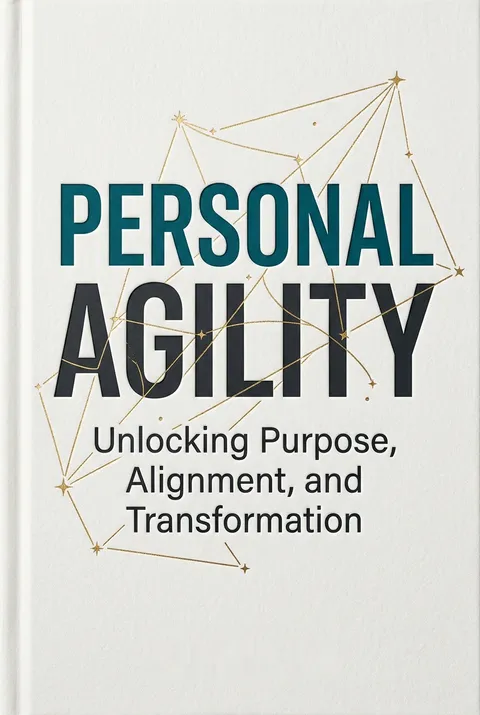

Key Takeaways
1. Life is an ocean, and you must navigate it by defining "What Really Matters."
What Really Matters represents your navigation stars that keep you on course to your destination.
Navigating life's currents. The authors use the metaphor of a ship on a vast ocean to represent human life. Without a clear destination and a captain at the helm, the ship is at the mercy of unpredictable winds, waves, and currents. Personal Agility acts as a GPS, helping you identify your personal "Jamaica"—your ultimate goals—and keeping you on course despite daily storms.
The core compass. At the center of this navigation system is the concept of "What Really Matters" (WRM). This is not a static to-do list, but a set of core priorities that define your values and long-term aspirations. By aligning your daily actions with these guiding stars, you transition from merely surviving to actively thriving.
Real-world transformation. The power of defining WRM is illustrated by Sharon Guerin, a single mother working five jobs just to survive. By identifying her core priorities and visualizing them daily, she broke the cycle of survival mode. Within two years, she became a successful entrepreneur with a six-figure income and lost 55 pounds.
- Life is the ocean; you are the captain of your own ship.
- "Jamaica" represents your ultimate destination or deeper "why."
- Daily distractions and emergencies are the storms and crosswinds.
- Aligning actions with WRM creates deep personal and professional fulfillment.
2. The Six Powerful Questions of Personal Agility provide a continuous GPS for your life.
At the heart of Personal Agility are Six Powerful Questions to help you visualize and reflect on what you are doing so you can choose the actions that will help you achieve the results you want.
A reflective framework. Personal Agility replaces rigid, top-down planning with a simple, reflective framework of six questions. These questions are designed to be asked regularly, ideally on a weekly cadence, to help you assess your current position and make conscious choices about your next steps. They encourage a mindset of self-kindness and curiosity rather than self-judgment.
The six questions. The questions guide you from high-level purpose to immediate, actionable tasks. They force you to look back at what you actually accomplished, brainstorm future possibilities, filter them by urgency and happiness, commit to a realistic weekly plan, and identify sources of support.
- Questions 1 & 2: What Really Matters, and what did you actually accomplish last week?
- Questions 3 & 4: What could you do this week, and what is important, urgent, or makes you happy?
- Questions 5 & 6: Which of these do you want to get done this week, and who can help if you get stuck?
Intentional decision-making. By systematically answering these questions, you bridge the gap between your ideal self and your actual behavior. It allows you to perform triage on your endless to-do list, ensuring that important long-term goals are not constantly pushed aside by short-term emergencies. Over time, this practice becomes an intuitive, unconscious habit that guides your daily choices.
3. The Priorities Map and Breadcrumb Trail turn abstract goals into visual, actionable progress.
By making your priorities and your actions visible, you can figure out what you really want to do and become more intentional in your choices.
Visualizing your workload. Human beings are highly visual creatures, and abstract tasks are difficult to manage when they only exist in our heads. The Personal Agility System uses "information radiators" like the Priorities Map to make your workload tangible. This map consists of columns that track your journey from high-level possibilities to daily focus and completed tasks.
The Priorities Map structure. The map organizes your life into clear, color-coded columns that correspond directly to your "What Really Matters" categories. By color-coding your tasks, you can instantly see if you are neglecting crucial areas of your life, such as health or family, in favor of work.
- What Really Matters: Your permanent, color-coded navigation stars.
- Possibilities & Urgent: A backlog of brainstormed ideas and critical items with immediate deadlines.
- This Week & Today: Your committed focus areas for the current cycle.
- Done: Completed tasks awaiting celebration.
Tracking your path. Complementing the Priorities Map is the Breadcrumb Trail, which archives your completed tasks week by week. This tool provides a historical record of where you have spent your time, allowing you to use the Alignment Compass to calculate the exact percentage of energy dedicated to each priority. It serves as a powerful motivator, showing you visual proof of your progress and helping you recognize when you are drifting off course.
4. Multitasking is a productivity killer; focus is achieved through a structured weekly cadence.
Every time you reduce the number of tasks you are multitasking by one, you double the rate at which you get things done.
The multitasking illusion. Many professionals pride themselves on their ability to juggle multiple projects simultaneously, believing it increases efficiency. However, research and practical experience prove that multitasking is a dangerous illusion that dramatically reduces cognitive capacity. When you switch between tasks, you pay a heavy "switching cost" in time and energy, often losing up to 75% of your productive capacity when managing five projects at once.
The cost of switching. This loss of capacity is not just due to mental fatigue, but also to "analysis paralysis"—the constant, exhausting need to decide what to work on next. Walter Stulzer of Futureworks experienced this firsthand when his company attempted 30 parallel initiatives with 30 people, resulting in zero progress over two years. By shifting to a focused, three-week cadence and limiting active initiatives, they achieved all their goals with half the work in a quarter of the time.
Establishing a cadence. To combat the weeds of multitasking, PAS introduces a regular cadence of "Celebrate and Choose." This rhythm sets natural boundaries on your work-in-progress, forcing you to prioritize and finish existing tasks before starting new ones.
- Multitasking can drop overall productivity by up to 40%.
- Switching between two tasks wastes 20% of your cognitive capacity.
- Cadence provides a structured opportunity to inspect, adapt, and refocus.
- Finishing one task completely is always faster than progressing three partially.
5. Procrastination is a diagnostic signal, not a personal failure.
Procrastination is trying to tell you something.
Decoding the delay. In traditional productivity systems, procrastination is viewed as a moral failing or a lack of discipline. In Personal Agility, however, a stuck card on your Priorities Map is treated as a valuable diagnostic signal. When a task repeatedly fails to move from "Possibilities" or "This Week" to "Done," it is an invitation to pause and investigate the underlying cause.
Uncovering the root cause. Procrastination is rarely about laziness; it is almost always driven by deeper emotional or physical factors. By asking yourself powerful coaching questions, you can uncover whether you are simply exhausted and need rest, or if you are facing a hidden fear.
- Low Energy: Your body and mind are demanding necessary rejuvenation.
- Fear of Failure: Anxiety about not performing perfectly.
- Fear of Success: Worry about how your life or relationships will change if you succeed.
- Lack of Clarity: The task is too large or poorly defined to start.
Moving past the block. Once the root cause is identified, you can take practical steps to get unstuck. This might involve breaking a daunting task into tiny, easily achievable micro-steps, or invoking the sixth question: "Who can help?" Recognizing that "rest is part of the work" allows you to recharge guilt-free, while visualization on your Priorities Map helps build the momentum needed to push past fear.
6. Modern leadership is about asking powerful coaching questions rather than dictating solutions.
The skill of a modern leader is not to have the answers but to formulate the questions, facilitate discussion, enable collaboration, and activate the intelligence in the room.
The shift to coaching. In the complex, fast-moving business environment of the 21st century, traditional "command and control" management is no longer effective. Centralized decision-makers become bottlenecks, slowing down responsiveness and stifling employee initiative. Modern leadership requires a shift from managing and directing to business coaching, where the leader's primary role is to unlock the potential of their team.
The power of questions. A coach does not hand down solutions or act as the sole expert; instead, they use powerful, open-ended questions to guide others to find their own insights. This approach fosters deep ownership and accountability, as people are far more committed to executing solutions they co-created.
- Closed-ended questions guide a conversation to a predetermined outcome.
- Open-ended questions invite broad exploration and discussion.
- Powerful questions force the listener to stop, think, and generate new insights.
- Coaching builds long-term organizational capability rather than solving short-term symptoms.
Embodying the change. This leadership transformation is illustrated by Lyssa Adkins, co-founder of the Agile Coaching Institute. By applying PAS to her own life, she realized she needed to coach herself with the same kindness she offered others. She learned to celebrate her achievements and treat rejuvenation as an essential part of her professional foundation, ultimately leading to a more relaxed and effective way of working.
7. True alignment is built on empathy, active listening, and mutual trust.
The secret to creating alignment is truly listening to each other.
The foundation of trust. Alignment is the holy grail of both personal relationships and corporate strategy, yet it is rarely achieved through decree. True alignment requires a foundation of mutual trust, which can only be built through empathy and active listening. When people do not feel heard, they become defensive, disengaged, or actively resistant to decisions.
Establishing alignment trust. Personal Agility introduces the concept of "Alignment Trust," which is defined by the simple rule: "I listen to you, you listen to me, and we care about each other's answers." This requires a conscious effort to "listen before you talk, and ask before you tell." By letting others finish their thoughts completely and asking clarifying questions, you create a safe space for genuine collaboration.
- Blind Trust: Taking things on faith without verification.
- Commitment Trust: Doing what you say you will do.
- Psychological Safety: The freedom to admit weakness without fear of blame.
- Alignment Trust: Mutual respect and care for each other's perspectives.
Resolving conflict. This approach is highly effective for resolving conflicts, whether between spouses planning holiday visits or corporate board members deciding on company strategy. When parties stop debating their preferred solutions and instead explore their underlying needs and constraints, they often find they are 90% in agreement. Aligning on "What Really Matters" first makes finding a mutually satisfying compromise on the remaining 10% remarkably easy.
8. The Stakeholder Canvas aligns diverse interests and turns organizational conflict into consensus.
The process of creating alignment is the process of creating trust.
Managing stakeholder complexity. In any project or business endeavor, stakeholders have the power to disrupt plans, shift priorities, or withdraw support. Traditional stakeholder management often relies on superficial updates or political maneuvering. Personal Agility provides a structured, empathetic alternative: the PAS Stakeholder Canvas, which is designed to build deep alignment and trust through structured interviews.
The Stakeholder Canvas structure. The canvas guides you through a series of powerful questions to uncover a stakeholder's true motivations, fears, and frustrations. Rather than focusing immediately on project deliverables, it seeks to understand what keeps the stakeholder awake at night and what their "definition of awesome" looks like.
- Main Goals: What the stakeholder wants to achieve.
- Challenges & Frustrations: The technical and emotional obstacles they face.
- Risks & Fears: What they are worried could go wrong.
- Definition of Awesome: Their ideal, miracle outcome.
- What Really Matters: The synthesized, agreed-upon core priorities.
Creating consensus. This tool was used by Vivior AG to align its Board of Directors during a critical pandemic-induced cash crisis. By interviewing each board member individually using the Stakeholder Canvas, an outside coach mapped out a holistic, honest view of the company's options. The subsequent workshop, governed by simple rules of active listening, allowed the board to quickly reach a unanimous, friction-free decision on which market segment to pursue.
9. Aligned autonomy scales agility from the individual to the entire enterprise.
Control leads to compliance; autonomy leads to engagement.
The power of aligned autonomy. To survive in a volatile, uncertain world, organizations must be highly responsive. However, granting employees complete autonomy without alignment leads to chaos, while maintaining strict control stifles innovation and speed. The solution is "aligned autonomy," where leadership provides absolute clarity on "What Really Matters" (the purpose), and empowers teams to decide how to achieve it.
Limiting organizational WIP. Just as individuals must limit multitasking, organizations must limit the number of active strategic initiatives. By establishing a clear, ranked list of company-wide "bets" or priorities, leadership can apply a simple rule: high-priority initiatives never share or wait on resources from lower-priority ones. This prevents the common corporate disease of spreading talent too thin across dozens of half-finished projects.
- Autonomy: The freedom to direct your own work and solve problems.
- Alignment: A shared understanding of the organization's mission and priorities.
- Aligned Autonomy: Teams self-organizing to achieve clearly defined strategic goals.
- Initiative WIP Limits: Restricting active corporate projects to maximize delivery speed.
The Chief Empowerment Officer. This shift in organizational culture is exemplified by Ben Sever, CEO of eRemede. By training his executive team in Personal Agility, he learned to let go of micromanagement and delegate large deliverables. This culture of mutual empowerment and trust allowed the startup to co-create self-organizing teams, ultimately reaching their target $35 million valuation in 18 months—half the time of their original three-year roadmap.
Review Summary
The book Personal Agility receives mixed reviews, with an overall rating of 4.30 out of 5 based on 10 reviews. However, one critical review gives it 2 out of 5 stars, stating that the book is too broad and attempts to address everything for everyone. The reviewer expresses disappointment, feeling that the book introduces too many new terms and focuses heavily on workplace examples, deviating from its intended focus on personal agility. They suggest that the author seems to be pitching a new framework under the Agile Manifesto rather than providing practical guidance for personal use.
People Also Read






Download PDF
Download EPUB
.epub digital book format is ideal for reading ebooks on phones, tablets, and e-readers.








































