
Key Takeaways
1. Asset Managers Increasingly Own Our World
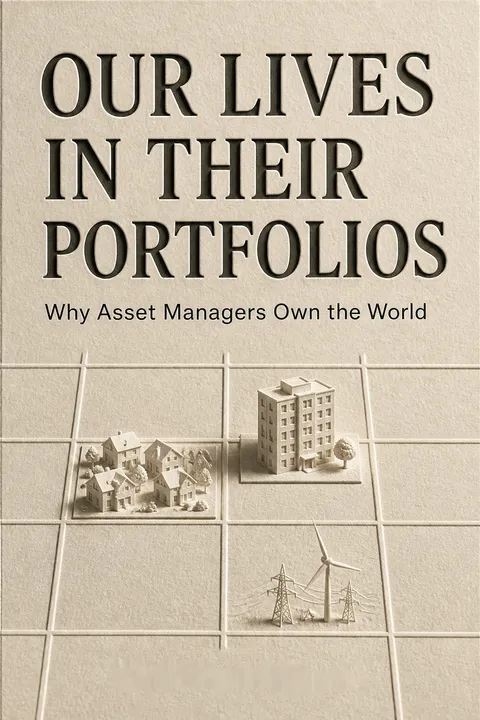
In a very physical, if also strangely intangible respect, all of our lives are now part of their investment portfolios.
Pervasive reach. Asset-manager society describes a world where private financial firms, known as asset managers, increasingly own and control the essential physical systems and frameworks that underpin our daily lives. These "real assets" include everything from the apartment buildings we rent and the roads we drive on to the wind farms that generate our electricity and the hospitals where we seek care. This ownership is often invisible, yet profoundly impacts our social existence.
Foundational assets. Forty years ago, it was unthinkable to buy gas, pay for parking, or rent a home from a company like Blackstone. Today, for millions globally, this is the reality. Asset managers extract income from these foundational assets, making them direct, intimate, and often unacknowledged participants in our everyday lives. For example:
- Macquarie owns infrastructure relied upon by over 100 million people daily.
- Asset managers collectively control at least $4 trillion in global housing and infrastructure assets.
A new metonym. The Summer House apartment complex in Alameda, California, serves as a microcosm of this trend. Its history of ownership by asset managers like Fifteen Group, Kennedy Wilson, and Blackstone illustrates consistent rent increases, tenant displacement, and recurring concerns about living conditions—a stark reflection of the modern world under asset-manager control.
2. Investment Funds Drive the System
The investment fund is as central to asset-manager society as the commodity is to the capitalist mode of production.
Pooling capital. At the core of asset-manager society is the investment fund, a legal vehicle that aggregates capital from multiple third-party investors, typically institutional clients like pension schemes and insurance companies. These funds, rather than the asset managers themselves, are the actual owners of the acquired real assets, making them the financial kernel around which the entire system revolves.
Limited partnerships. Most real-asset funds are structured as "limited partnerships," where external investors are Limited Partners (LPs) with limited liability and control, while the asset manager's entity acts as the General Partner (GP), controlling the fund's investments. These funds are predominantly unlisted, meaning they operate with minimal public disclosure, contributing to the sector's opacity.
Closed-end vs. open-end. Funds come in two main types:
- Closed-end funds: Have a predetermined lifespan (7-12 years) and require assets to be sold before termination, prioritizing capital gains. KKR's investment in Bayonne's waterworks is a prime example.
- Open-end funds: Are perpetual, with no set term, and aim to maximize recurring income, allowing investors to commit and redeem capital periodically.
Despite the long-term nature of real assets, closed-end funds remain dominant, embedding a short-term, trading mentality into the ownership of essential infrastructure and housing.
3. A Recent Historical Phenomenon
By the end of the 1980s, the conditions for the realisation of asset-manager society were largely in place.
Post-war context. Historically, major institutional investors primarily invested directly in financial assets like equities and bonds, with minimal exposure to real assets. Housing was often state-owned or fragmented among small landlords, and core infrastructure was largely public, deemed unsuitable for private capital due to market failure.
Three crucial shifts. The 1970s and 1980s laid the groundwork for asset-manager society:
- Institutional investment in real assets: Some countries (e.g., UK, Netherlands, Sweden) saw early institutional interest in farmland and multi-family housing, often spurred by legislative changes.
- Privatization wave: The neoliberal era, led by figures like Margaret Thatcher, initiated widespread privatization of state-owned infrastructure (telecoms, energy, water) and social housing, making these assets available for private acquisition.
- Asset management's rise: Global Assets Under Management (AUM) by asset managers surged from $100 billion in 1979 to over $1 trillion by 1989, establishing asset managers as significant financial intermediaries.
Australia's pioneering role. Asset-manager society truly began in Australia in the early 1990s, where a wave of infrastructure privatizations (electricity, gas, communications, toll roads) coincided with the emergence of dedicated infrastructure funds from firms like Hastings and Macquarie. This dynamic interplay between asset availability and investor demand "invented infrastructure as an asset class," driven by factors like long-term liability matching, stable cash flows, monopoly status, inflation protection, and diversification.
4. Global North Dominates, Global South Emerges
The bulk of the institutional money invested in infrastructure by asset managers comes from US, European and Asia-Pacific investors, but with investors in some countries – notably Australia – playing a much more significant role than they do within the asset-management world more generally.
Capital's origins. The vast majority of capital managed by asset managers, including that for real assets, originates from institutional investors in the Global North—primarily North America (especially the US) and Europe, with a smaller but significant contribution from the developed Asia-Pacific (Japan, Australia). This means the ultimate beneficiaries of asset-manager society are overwhelmingly Western citizens.
Manager locations. Asset managers themselves are predominantly headquartered in these same regions. While North American firms dominate housing investment globally, Europe and Australia host a stronger presence in infrastructure management. For instance, Macquarie, an Australian firm, is a global leader in infrastructure.
Investment destinations. While capital and managers are concentrated in the Global North, real-asset investments are increasingly global. Historically, Europe and Australia were epicenters for infrastructure investment due to extensive privatization. However, the US has recently closed the gap, and investment in "emerging markets" in Africa, Latin America, and developing Asia is growing, often driven by the need for new infrastructure. India, for example, has become a leading Asian market for private infrastructure investment.
5. The Big Three: Blackstone, Brookfield, Macquarie
If one company more than any other represents the corporate embodiment of asset-manager society, then Canada’s Brookfield Asset Management is undoubtedly that company.
Blackstone: Housing giant. Stephen Schwarzman's Blackstone Group, the world's largest "alternative" asset manager, is a linchpin of asset-manager society, primarily through its vast housing portfolio. After divesting from housing before the 2007 crisis, Blackstone aggressively re-entered the market post-2011, acquiring distressed single-family, multi-family, student, senior, and manufactured housing across at least eleven countries. Its strategy focuses on market distress and rent maximization, leading to a global housing portfolio valued at over $100 billion.
Brookfield: The embodiment. Canada's Brookfield Asset Management, with assets approaching $700 billion, is arguably the quintessential real-asset manager, active in both housing and diverse infrastructure. Its complex structure involves affiliates like Brookfield Property Partners and Brookfield Infrastructure Partners. While its housing portfolio is smaller and more North America-centric than Blackstone's, Brookfield is a massive international player in infrastructure, owning:
- Transportation: Rail networks, toll roads.
- Telecoms: Data centers, fiber, cell towers.
- Farmland: Hundreds of thousands of hectares.
- Energy: One of the world's largest owners of renewable power assets.
Macquarie: Infrastructure pioneer. Australia's Macquarie Group, through its Macquarie Asset Management division (MIRA), is consistently ranked as the largest infrastructure owner globally among financial investment institutions, with over A$200 billion in infrastructure AUM. A pioneer in "inventing" infrastructure as an asset class, Macquarie's portfolio is geographically dispersed (Europe, Asia-Pacific, Americas) and sectorally diversified, including:
- Energy: Green power generation.
- Transportation: Rail, toll roads, airports.
- Water: Water and wastewater infrastructure.
- Farmland: Millions of hectares.
Macquarie's model often involves listed funds and a significant portion of external investor capital, making it a dominant force in shaping global infrastructure.
6. Short-Termism is Built-In
The reality is that the flows of income generated by a portfolio asset create wealth for investors in such a fund primarily indirectly – specifically, by persuading third parties that the asset is worth buying, and at a premium price.
The paradox of long-dated assets. Asset managers often invest in long-dated assets like infrastructure and housing using fixed-term, closed-end funds, which typically have a 7-12 year lifespan. This creates a fundamental paradox: investors seeking long-term returns are forced to liquidate assets in the short to medium term, embedding short-termism into the very structure of asset ownership.
Asset churn. This structural imperative leads to intense asset churn, where managers buy assets only to sell them a few years later, often to other asset managers who restart the cycle. Examples include:
- KKR selling Bayonne's water concession after five years.
- The UK's Four Seasons care-home chain changing hands between five different asset managers in less than two decades.
- The active secondary market for UK PFI contracts, with some projects changing equity owners nine times in a decade.
Trading, not stewarding. For closed-end fund managers, the primary goal is to maximize the disposal consideration, not to steward the asset for its full lifespan. Income flows generated during ownership are less about direct earnings and more about signaling market value to prospective buyers. This makes managers essentially "glorified traders," focused on buying low and selling high as quickly as possible, with quicker exits often correlating with higher returns.
7. Maximizing Revenue, Minimizing Costs
If an asset manager has acquired a piece of farmland or an apartment block or a wind farm, it will always endeavour to capture as much revenue as possible, and as soon as possible: all other things being equal, the more cash an asset generates, the greater its market value will be.
The golden rules. To prepare an acquired asset for profitable disposal, asset managers adhere to three golden rules:
- Maximize revenues: Swiftly increase rates, tolls, or rents. Chicago's parking meter deal, for instance, saw annual revenues jump from $20 million to over $80 million, leading to increased fines and suspensions disproportionately impacting low-income drivers.
- Minimize operating costs: Cut expenses related to maintenance and operations. This often impacts asset users (e.g., poor maintenance) and workers (e.g., squeezed wages).
- Avoid capital expenditure: Generally, avoid long-term investments that won't yield returns within the fund's short holding period.
Blackstone's housing playbook. Blackstone's Invitation Homes exemplifies this. After acquiring 40,000 US single-family homes, it rapidly:
- Increased average monthly rents from $1,424 to $1,600.
- Reduced annual spending on repairs and maintenance per home from $1,362 to $1,146.
This strategy boosted operating profit margins from 51.8% to 61.4% in two years, making the company ripe for a profitable IPO, but led to widespread tenant complaints of "slumlord-like" behavior.
Deterioration and neglect. The inherent bias against capital expenditure means that housing and infrastructure assets under asset-manager ownership often do not receive the necessary long-term investment, leading to physical deterioration. Macquarie's tenure at Thames Water, for example, was marked by chronic underinvestment in infrastructure, resulting in missed leakage targets, pollution fines, and service interruptions, while the company paid out substantial dividends.
8. Risk is Socialized, Not Shared
The reality is that asset managers actively resist the assumption of risk.
De-risking by the state. Asset managers are not "risk capitalists" in the traditional sense; they actively seek to offload risk. Governments, eager to attract private capital for infrastructure and housing, systematically de-risk investment opportunities, often by guaranteeing revenue streams or absorbing unforeseen costs. This process reconfigures real assets to generate dependable financial returns for investors.
Fiscal timebombs. This de-risking socializes risk, meaning taxpayers and the state bear the costs when things go wrong. Examples include:
- Bayonne's water concession, where KKR was guaranteed minimum revenue, leading to rate hikes for residents when water usage dropped.
- Seoul's Metro Line 9, where the city paid over $150 million to Macquarie's fund due to lower-than-projected ridership, prompting the city to end revenue guarantees for future concessions.
- Chicago's parking meter deal, where "adverse action" clauses forced the city to pay $61 million in penalties for street closures and non-paying motorists, transforming the system from a revenue source to an expenditure.
Constrained planning. Beyond financial costs, de-risking also constrains governments' ability to plan and shape the built environment for social benefit. Contractual obligations, like non-compete clauses in Chicago's parking deals, limit urban planning flexibility, forcing decisions that prioritize investor exchange values over public use values, such as hindering the development of bus rapid transit or bicycle lanes.
9. Fiscal Extractivism: Profits Privatized, Taxes Avoided
The public’s capital is once again being mobilised to fund public-use infrastructures. Yet the linchpin of this investment cycle is today a private-sector actor actively extracting tribute from the fiscal domain.
From mutualism to extractivism. Historically, public pension schemes often funded public infrastructure through municipal bonds, a "fiscal mutualism" benefiting the state and taxpayers. Today, asset managers act as intermediaries, mobilizing public capital for public-use infrastructure but actively extracting "tribute" from the fiscal domain.
Shareholder loans. A key mechanism for this "fiscal extractivism" is shareholder loans, where asset managers lend money to their own portfolio companies at high interest rates. These interest payments reduce the portfolio company's taxable profits, effectively diverting potential tax revenue to the asset manager. Examples include:
- Innisfree lending to its Swedish hospital PPP at 9% interest, reducing Swedish taxable profits.
- Macquarie's Arqiva and Wales and West gas network deals, where shareholder loans at 13-21% interest significantly offset operating profits, leading to minimal UK corporation tax payments.
Other extractivist mechanisms. Asset managers also utilize other methods:
- REITs: Real Estate Investment Trusts allow companies to shield most profits from income taxes, distributing them as dividends. Blackstone uses REITs for its US and Spanish housing portfolios.
- Private debt funds: Asset managers' debt funds provide loans to other asset managers' equity funds, generating interest income that further suppresses taxable profits and privatizes fiscal duty.
Carried interest loophole. The taxation of "carried interest"—asset managers' performance fees—as capital gains rather than income is another major form of fiscal extractivism. This loophole, fiercely defended by industry leaders like Stephen Schwarzman, allows asset managers to pay significantly lower tax rates, further concentrating wealth in their hands at the expense of public coffers.
10. Disproportionate Gains for the Elite
Asset managers’ fund prospectuses really should be clearly adorned with the motto: ‘Heads I win, tails you lose’.
Unequal distribution of returns. When asset managers' real-asset funds perform well, everyone in the investment chain gains, but disproportionately. Asset manager executives, like Stephen Schwarzman ($40 billion net worth) and Bruce Flatt ($3 billion), are the biggest winners, earning millions in fees and carried interest. Pension scheme managers also earn fees regardless of performance.
Savers bear the risk. In contrast, individual retirement savers, whose capital forms the bulk of fund investments, receive diluted returns after multiple layers of fees (asset manager, pension scheme). If a fund fails, savers bear almost all the losses, while asset managers are insulated by management fees and minimal "skin in the game." For example, PSERS's catastrophic losses in real estate funds directly impacted Pennsylvania teachers' pensions.
Beyond "teachers and firefighters." The narrative that asset managers primarily benefit "teachers, nurses, and firefighters" is misleading. While pension schemes are major clients, the gains accrue disproportionately to:
- Global North citizens: Due to the geographical concentration of retirement savings.
- High earners: Within those countries, retirement wealth is highly unequal, benefiting bankers, lawyers, and consultants more than average workers.
- Other institutional investors: Sovereign wealth funds (like Saudi Arabia's PIF), insurance companies, and banks are significant contributors of capital, often securing preferential fee terms due to their scale, further concentrating gains among powerful entities.
11. Crises Accelerate Asset Manager Dominance
The central point is that, given that they turn fundamentally on society’s most important real assets, the ways in which the twin housing and climate crises are approached in the coming years and decades will inevitably play a disproportionately significant role in shaping the future of asset-manager society around the world.
Post-pandemic "return of the state" is neoliberal. The massive government spending during Covid-19 in rich countries did not challenge private ownership. Instead, it reinforced the neoliberal state's role as a handmaiden to private capital. Biden's Infrastructure Investment and Jobs Act, for instance, offered limited public funding while expanding opportunities for private investment via PPPs, ensuring a "public asset bonanza" for asset managers.
Housing crisis fuels investment. The post-2007 housing crisis, coupled with declining homeownership rates and a shift in narrative, normalized institutional investment in residential property. Asset managers, seeing reliable rental income and opportunities for capital gains through rent increases (especially amid supply shortages), doubled down on housing. Despite public outcry and some policy interventions (e.g., Denmark's "Blackstone intervention"), governments in many countries remain largely accommodating, viewing asset managers as "part of the solution."
Climate crisis: A "historic investment opportunity." The climate crisis, framed as a market failure, is being addressed through neoliberal solutions that prioritize private finance. Governments de-risk "climate infrastructure" (renewable energy, sustainable transport, farmland) to attract asset managers. Figures like BlackRock's Larry Fink and Brookfield's Mark Carney actively advocate for this, positioning the climate transition as an "enormous commercial opportunity" for private capital. The G7's PGII initiative aims to "mobilize" $600 billion in private capital for Global South infrastructure, explicitly using de-risking mechanisms.
Inflation reinforces the trend. The return of high inflation and rising interest rates, far from deterring asset managers, is likely to intensify their dominance. Real assets are seen as a strong hedge against inflation, with rents and regulated fees often index-linked. Furthermore, rising capital costs for developers will exacerbate housing shortages, benefiting investor-landlords. If bank debt becomes too expensive, asset managers' private debt funds are poised to fill the financing gap, ensuring continued growth of asset-manager society.
People Also Read









Download PDF
Download EPUB
.epub digital book format is ideal for reading ebooks on phones, tablets, and e-readers.








































